What Is Agentic AI?
If you run a business in Fort Wayne or anywhere in northeast Indiana, you have probably heard the term "agentic AI" in the last year. It shows up in tech headlines, vendor pitches, and conference panels. Most of the explanations either drown you in jargon or oversimplify it into meaninglessness.
Let's fix that with a straightforward definition.
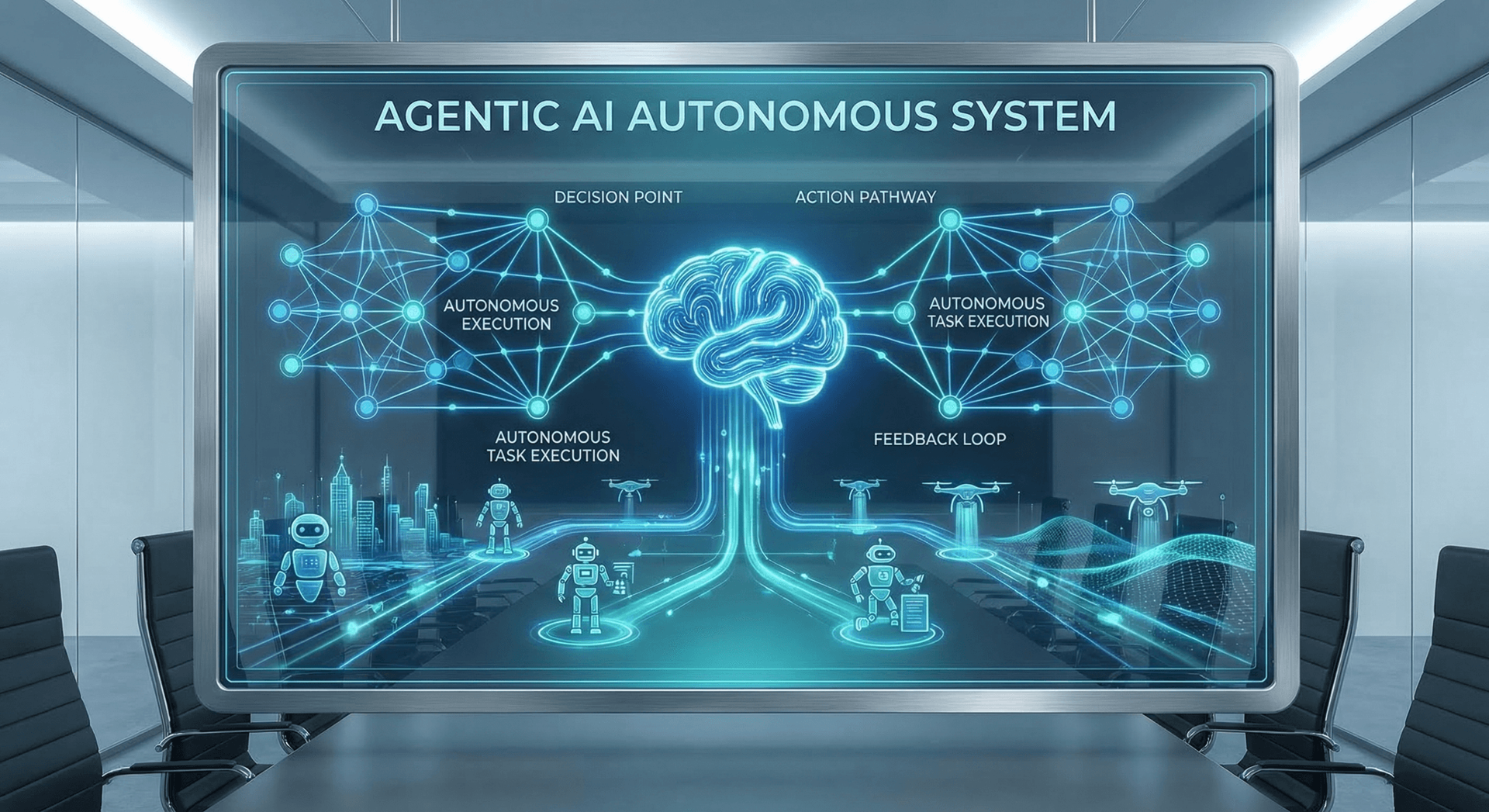
Agentic AI is artificial intelligence that can independently perceive a situation, reason about what to do, take action across your business systems, and learn from the results — all without a human prompting every step.
That one sentence is worth unpacking, because every word matters.
Independently means the AI does not sit idle waiting for you to type a request. It monitors inputs — incoming calls, form submissions, calendar changes, CRM updates — and responds on its own.
Perceive means it takes in information from multiple sources: a caller's voice, the words in an email, the data in your scheduling system, the time of day, the history of past interactions with that contact.
Reason means it does not just pattern-match a keyword to a canned response. It evaluates the situation, considers multiple possible actions, and selects the best path forward based on your business rules and the context of the interaction.
Take action means it does not just generate a text response and wait for you to copy-paste it somewhere. It books the appointment, sends the confirmation text, updates the CRM record, triggers the follow-up sequence — it operates across your tools the way a capable employee would.
Learn means it gets better over time. Which responses lead to booked appointments? Which follow-up timing gets the best callback rate? Which phrasing converts callers into customers? The system refines its approach based on real outcomes.
The Core Distinction
Think about the difference between a search engine and an employee. A search engine waits for your query, returns a list of results, and then sits there until you ask again. An employee notices a problem, evaluates the options, takes action, reports back, and moves on to the next task. Agentic AI is that transition applied to software.
For Fort Wayne businesses, this is not abstract futurism. It is happening right now. AI Employees built by Cloud Radix are designed to answer phones, qualify leads, book appointments, and follow up with prospects — all without human intervention on each individual task. This is the capability we build and deploy for Fort Wayne businesses. The AI perceives an incoming call, reasons about the caller's intent, takes the appropriate action (schedule an appointment, transfer to a specialist, answer a question, send information), and learns from each interaction to improve over time. Our 98 things an AI Employee can do guide covers the full range of tasks these systems handle.

The major AI research labs are investing heavily in agentic capabilities. OpenAI has discussed agent-based architectures in their research and product roadmaps. Anthropic — the company behind Claude — has published extensively on building safe, steerable AI agents, and their documentation on tool use and agentic patterns is some of the most thorough in the industry. Google DeepMind has explored agentic approaches through projects like Gemini's function-calling capabilities and multi-step reasoning.
These platforms are still maturing, and general-purpose AI agents that can handle any task are not yet a reality. But purpose-built agentic systems designed for specific business workflows — answering phones, qualifying leads, managing appointments, handling follow-ups — are delivering real results today. The key is building agents that are narrowly focused but deeply capable within their defined scope.
That distinction matters. The agentic AI that works for a Fort Wayne HVAC company is not trying to be a general-purpose assistant that can also write poetry and debug code. It is purpose-built to handle customer communication for home services businesses, and it does that one job exceptionally well because every layer of the system — from its training data to its integration points to its escalation rules — is optimized for that specific workflow.
Traditional AI vs Agentic AI
The best way to understand agentic AI is to compare it side-by-side with the AI tools most Fort Wayne business owners are already familiar with. Traditional AI — the kind you interact with through ChatGPT, Google Gemini, or similar tools — follows a simple pattern: prompt, response, done.
You give it an instruction. It produces an output. You evaluate that output and decide what to do next. The human remains the orchestrator at every step.
Agentic AI changes this dynamic fundamentally. Instead of responding to a single prompt, it pursues a goal through multiple steps, making decisions along the way and executing across your business systems.
Let's walk through several detailed scenarios so the difference becomes concrete.
Scenario 1: Content Marketing
Traditional AI approach: You open ChatGPT and type, "Write me a blog post about HVAC maintenance tips for Fort Wayne homeowners." The AI produces a draft. You read it, edit it, add your own voice, format it for your website, upload it, create a social media post to promote it, and schedule that post. Total human time: two to three hours.
Agentic AI approach: You tell the system, "Manage our content marketing for the HVAC service area." The agent monitors trending topics in your local market, identifies content gaps on your website, researches what competitors are publishing, drafts a content calendar, writes posts aligned with your brand voice, optimizes each piece for local SEO (including Fort Wayne and Allen County keywords), schedules publication, creates social media summaries, monitors performance metrics, and uses those metrics to inform the next round of content. Total human time: periodic review and approval.
The difference is not just speed — it is the shift from "I use a tool to help me do my job" to "I have a system that does this part of the job, and I oversee it."
Scenario 2: Lead Follow-Up
Traditional AI approach: You use AI to draft follow-up email templates. A team member reviews your CRM each morning, identifies leads that need follow-up, selects the right template, personalizes it, and sends it. If the lead responds, the team member continues the conversation manually.
Agentic AI approach: The system monitors your pipeline continuously. When a lead has not been contacted within your defined timeframe, the agent automatically crafts a personalized follow-up based on the lead's original inquiry, their browsing behavior, and your current service availability. It sends the message through the appropriate channel (email, SMS, or phone call depending on the lead's preference), handles the response if it comes back, qualifies the lead further, and either books an appointment or continues nurturing. If the lead needs something the AI cannot handle, it escalates to your team with full context.
Scenario 3: Phone Call Handling
Traditional AI approach: You might use an IVR (interactive voice response) system that routes callers through a phone tree. "Press 1 for scheduling, press 2 for billing." Callers get frustrated. Many hang up. Those who get through leave voicemails that your team returns hours — or days — later.
Agentic AI approach: An AI Employee answers every call with a natural, conversational voice. It understands what the caller wants without requiring them to navigate a menu. It checks your calendar in real time, books appointments, answers questions about your services and pricing, sends confirmation texts, and handles the entire interaction from greeting to goodbye — including nuanced situations like callers who are comparing quotes or have complex scheduling needs. After the call, it logs everything in your CRM and triggers any relevant follow-up workflows.
| Dimension | Traditional AI | Agentic AI |
|---|---|---|
| Interaction model | Single prompt → single response | Goal → multi-step autonomous execution |
| Human role | Orchestrator at every step | Sets goals, reviews outcomes |
| System integration | Standalone tool | Connected across CRM, calendar, phone, email, SMS |
| Continuity | Each session starts fresh | Persistent memory and ongoing awareness |
| Proactivity | Waits for input | Monitors and initiates action |
| Error handling | Human catches errors manually | Detects issues, escalates or self-corrects |
| Learning | Static until retrained | Improves from every interaction |
Scenario 4: Appointment Scheduling for a Medical Practice
Traditional AI approach: A patient calls. The phone rings four times and goes to voicemail. The patient leaves a message. An office staff member listens to the message, pulls up the schedule, calls the patient back, negotiates a time, books the appointment, and sends a reminder. Elapsed time: hours to days. Many patients, frustrated by voicemail, simply call another practice.
Agentic AI approach: The patient calls. An AI Employee answers on the first ring. It identifies the patient (or creates a new record), understands their need (routine checkup, follow-up, urgent concern), checks provider availability in real time, books the appointment, sends a confirmation text with office directions and any pre-visit instructions, and adds a reminder to the patient's file. If the patient's concern sounds urgent, the AI escalates immediately to clinical staff. Elapsed time: under three minutes, with zero human staff involvement for routine bookings.
Scenario 5: Multi-Location Service Business
Traditional AI approach: A Fort Wayne home services company with multiple crews uses a dispatcher who manually checks which crews are available, what jobs are in the queue, and which neighborhoods each crew is working in. AI might help draft customer communications but does not touch the scheduling logic.
Agentic AI approach: The agent monitors your job queue, crew locations, estimated completion times, and incoming service requests. When a new call comes in from a homeowner on the south side of Fort Wayne, the agent checks which crew will be nearest when they finish their current job, proposes a time window to the homeowner, books the job, notifies the crew, and optimizes the rest of the day's routing. If a job runs long, it proactively contacts affected customers to adjust expectations.
The Productivity Multiplier
One important nuance: traditional AI and agentic AI are not mutually exclusive. Many Fort Wayne businesses will use both. You might use ChatGPT to brainstorm marketing ideas (traditional AI) while an agentic AI Employee handles your phone lines and lead follow-up (agentic AI). The question is not "which one?" but "which tasks should operate autonomously, and which should remain human-directed?"
The Agentic AI Stack
Every agentic AI system — whether it is answering phones for a Fort Wayne roofing company or managing content operations for a marketing agency — operates on four fundamental layers. Understanding these layers is valuable for two reasons: it helps you evaluate whether a vendor's solution is truly agentic (or just a chatbot with better marketing), and it gives you a framework for thinking about what an AI system needs to do its job well in your business.
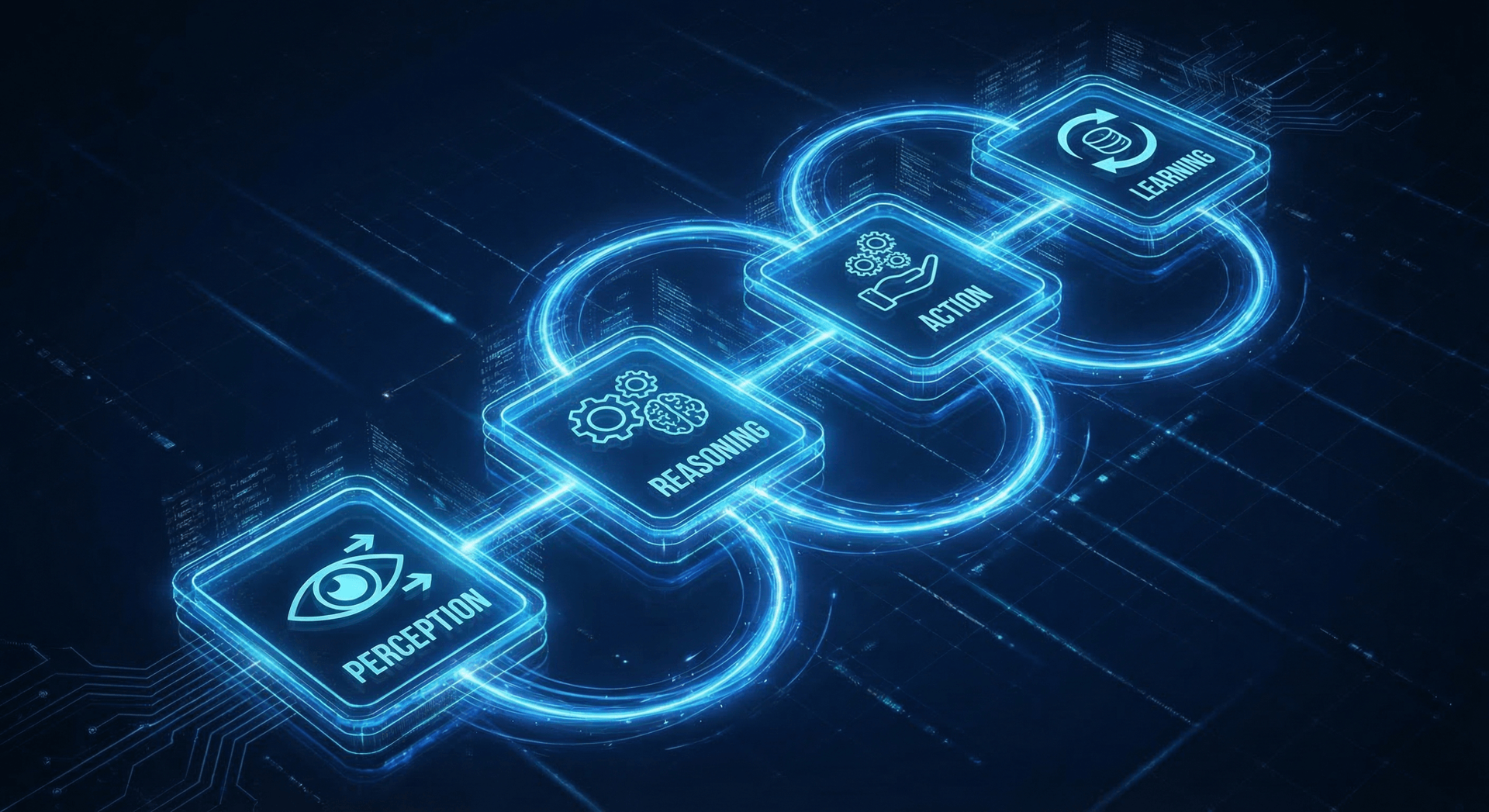
Layer 1: Perception — Understanding Inputs From Multiple Sources
The perception layer is how the AI takes in information about the world. For a business AI Employee, perception spans multiple channels and data types simultaneously.
Voice perception means the AI listens to phone calls in real time, understanding not just the words but the tone, pace, and emotional context of the caller. Modern speech recognition systems — like those from Deepgram, AssemblyAI, and the major cloud providers — have reached accuracy levels that make natural phone conversations viable for business use.
Text perception covers inbound SMS messages, emails, web chat messages, and form submissions. The AI reads and understands free-form text, extracting the caller's intent, urgency, and key details (name, service needed, preferred timing, address).
Structured data perception means the AI can read your business systems: CRM records, calendar availability, pricing tables, service area maps, and inventory levels. When a caller asks "Can you come out tomorrow afternoon?" the AI does not guess — it checks your actual schedule.
Contextual perception ties it all together. The AI knows it is 7 PM on a Tuesday, that the caller has contacted your business twice before, that their last interaction was about a furnace repair estimate, and that your next available technician in their ZIP code is free Thursday morning. All of this context shapes how the AI handles the conversation.
For Fort Wayne businesses, perception quality is especially important because of the diversity of communication styles in our market. Some customers call and get straight to the point. Others want to chat. Some are comparing three quotes and want detailed pricing. Others have an emergency and need someone today. The perception layer has to handle all of these interactions gracefully.
Layer 2: Reasoning — Analyzing, Deciding, and Planning
This is the layer that separates agentic AI from everything that came before. The reasoning layer does not follow a script. It evaluates the situation, considers the available information, weighs multiple possible actions, and selects the best path forward.
Here is a concrete example. A caller reaches your Fort Wayne law firm's AI Employee and says, "I was in a car accident last week and I'm not sure what to do." The reasoning layer processes multiple factors simultaneously:
- This is a potential new client, not an existing one (checked CRM).
- Car accident cases are a priority practice area for the firm.
- The one-week timeline means there may be time-sensitive evidence preservation needs.
- The caller's tone suggests they are stressed and uncertain.
- Attorney Smith has a consultation opening tomorrow at 10 AM.
- The firm's intake process requires collecting basic accident details before booking.
Based on this reasoning, the AI decides to: express appropriate empathy, gently collect the key details (date, location, injuries, insurance status), explain the firm's free consultation process, and book the appointment with Attorney Smith for tomorrow morning. It does all of this in a natural, conversational way — not by reading from a decision tree, but by reasoning about what this specific caller needs in this specific moment.
The reasoning layer is powered by large language models (LLMs) from companies like Anthropic, OpenAI, and Google. These models have been trained on enormous datasets and have developed sophisticated capabilities for understanding context, following instructions, and generating appropriate responses. The key innovation in agentic AI is giving these models the ability to reason about actions — not just words — and to chain multiple reasoning steps together to accomplish a goal.
Reasoning vs Scripting
Layer 3: Action — Executing Across Your Systems
The action layer is what makes agentic AI operationally useful instead of just conversationally impressive. This layer connects the AI to your actual business tools and gives it the ability to do things, not just say things.
Actions an agentic AI Employee can take include:
- Booking appointments in your calendar (Google Calendar, Calendly, ServiceTitan, or any system with an API).
- Creating and updating contact records in your CRM (HubSpot, Salesforce, GoHighLevel, and others).
- Sending SMS confirmations and follow-up messages.
- Triggering email sequences in your marketing automation platform.
- Transferring live calls to specific team members based on the situation.
- Looking up pricing, availability, or service details in your internal databases.
- Creating support tickets or work orders.
- Logging complete interaction transcripts for your review.
Each of these actions is executed through secure API integrations. The AI does not have access to anything beyond what you explicitly authorize. It cannot send money, access private employee records, or take any action outside its defined permissions. The action layer is powerful precisely because it is bounded — the AI can do a lot within its scope, and nothing outside it.
For Fort Wayne businesses, the action layer often connects to the tools you already use. If your plumbing company runs on ServiceTitan, the AI integrates with ServiceTitan. If your law firm uses Clio, the AI integrates with Clio. You do not have to switch platforms to benefit from agentic AI — the AI meets you where your systems already are.
Layer 4: Learning — Improving From Every Interaction
The learning layer is what makes agentic AI compound in value over time, and it is the layer that most distinguishes it from traditional automation. A traditional phone script stays exactly the same whether it works well or poorly. An agentic system adapts.
Learning happens at multiple levels:
Interaction-level learning: Within a single conversation, the AI adjusts its approach based on how the caller responds. If a caller seems confused by technical language, the AI simplifies. If a caller is in a hurry, the AI gets to the point faster.
Pattern-level learning: Across many conversations, the system identifies what works. Which opening lines lead to the longest, most productive calls? Which follow-up timing generates the highest callback rate? Which qualification questions best predict which leads will convert?
Business-level learning: Over weeks and months, the AI develops an increasingly detailed understanding of your specific business. It learns your peak call times, your most common service requests, your seasonal patterns, and the characteristics of your highest-value customers. This knowledge informs every interaction.
An important note on transparency: the learning layer should be auditable. You should be able to see what the AI is learning and verify that its adaptations align with your business goals. Cloud Radix provides visibility into how AI Employees are performing and what patterns they are identifying, so you are never in the dark about how the system is evolving.
| Capability | Basic Chatbot | AI Assistant | Agentic AI Employee |
|---|---|---|---|
| Answers questions | ✓ Yes | ✓ Yes | ✓ Yes |
| Understands conversation context | ✗ No | ✓ Yes | ✓ Yes |
| Reads from your business systems | ✗ No | ✗ No | ✓ Yes |
| Takes action across tools (CRM, calendar, SMS) | ✗ No | ✗ No | ✓ Yes |
| Decides next steps autonomously | ✗ No | ✗ No | ✓ Yes |
| Learns and improves from outcomes | ✗ No | ✗ No | ✓ Yes |
| Operates 24/7 without prompting | ✗ No | ✗ No | ✓ Yes |
| Escalates intelligently to humans | ✗ No | ✗ No | ✓ Yes |
What Agentic AI Could Look Like for Fort Wayne Businesses
The theory matters, but practical applications are where Fort Wayne business owners need to focus. Below are five illustrative scenarios showing how agentic AI could operate for local businesses. These are example workflows based on the technology's current capabilities — not descriptions of specific live deployments. We include them to help you envision what is possible for your business.
1. Autonomous Customer Acquisition Pipeline
Customer acquisition is where most Fort Wayne businesses start with agentic AI, because the ROI is immediate and measurable. Here is how the full pipeline works when an agentic system is running it.
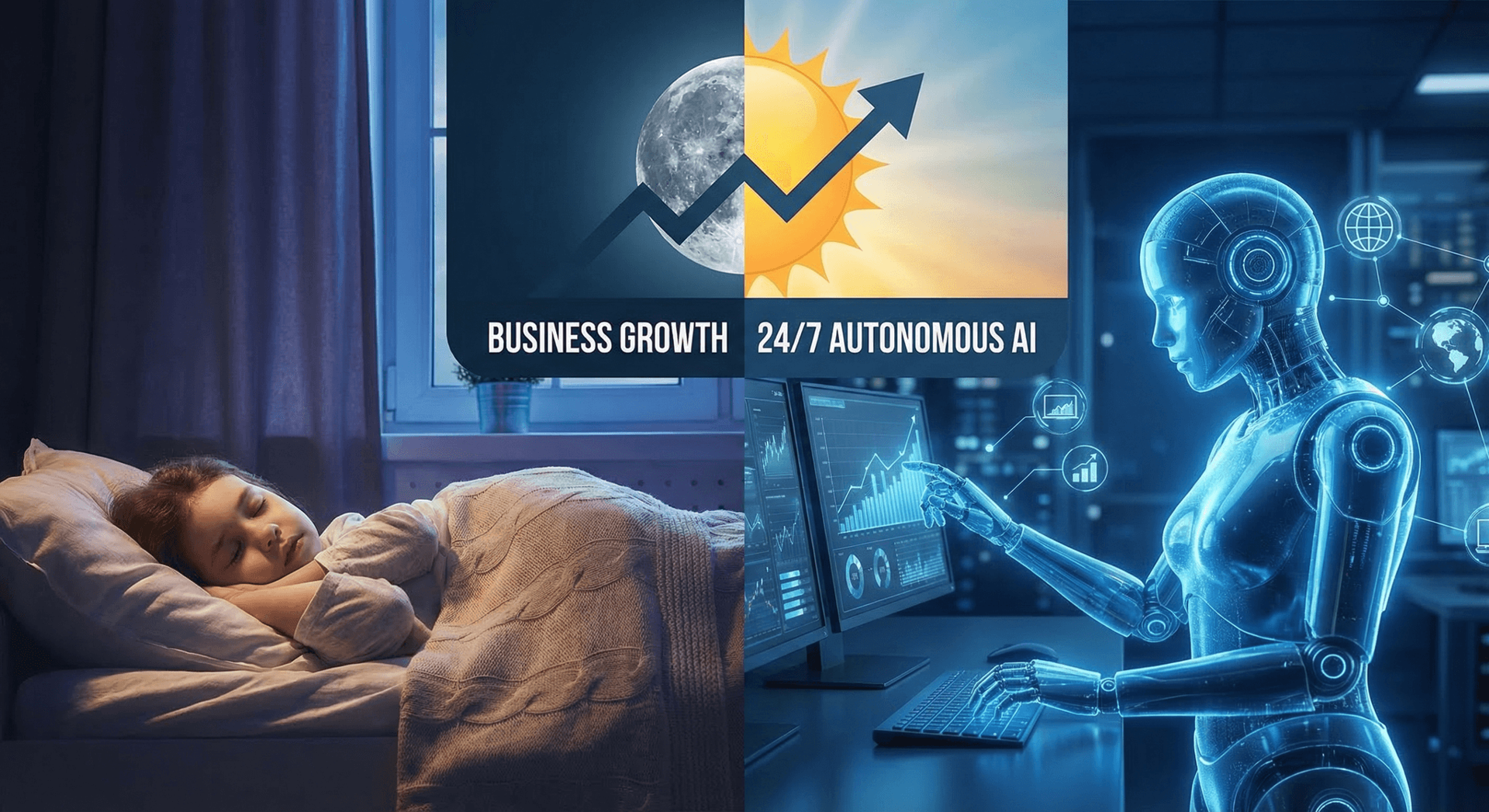
Lead capture: Every inbound channel is covered — phone calls, web form submissions, SMS inquiries, email, and web chat. The AI answers every interaction within seconds, day and night, weekdays and weekends. No voicemail. No "We'll get back to you on Monday."
Qualification: The AI does not just take a message. It engages the prospect in a natural conversation to understand their needs, timeline, budget range, and service area. For a Fort Wayne roofing company, the AI might ask about the type of roof, the age of the home, whether it is an insurance claim, and what the homeowner's primary concern is (leak, appearance, energy efficiency). By the end of the conversation, the lead is scored and prioritized.
Scheduling: Qualified leads get booked immediately. The AI checks your real-time availability, offers options that work for both the customer and your crew, and locks in the appointment. A confirmation text goes out within seconds.
Follow-up: If the prospect is not ready to book, the AI enters a nurture sequence. It follows up at appropriate intervals — not too aggressive, not too passive — with personalized messages that reference the original conversation. If the prospect re-engages, the AI picks up right where they left off.
Reporting: Every interaction is logged. You can see exactly how many calls came in, how many leads were qualified, how many appointments were booked, and what your conversion rate is at each stage. The data is there for every decision you need to make.
For a Fort Wayne home services company, this means the difference between capturing a fraction of inbound leads (common when calls go to voicemail or are missed during busy periods) and capturing substantially more (because every call gets answered, day and night).
2. Autonomous Market Intelligence
Most Fort Wayne businesses know they should be monitoring their competitive landscape, but few have the time or staff to do it consistently. Agentic AI changes this by making market intelligence a continuous, automated function.
Competitor monitoring: The agent tracks competitor websites, Google Business profiles, review platforms, social media, and job postings. It identifies meaningful changes — a competitor launched a new service, raised their prices, got a wave of negative reviews, or started hiring aggressively.
Review sentiment analysis: The agent monitors your own reviews and your competitors' reviews across Google, Yelp, and industry-specific platforms. It identifies trends: Are customers praising your response time? Are they complaining about a specific service? Is a competitor's reputation improving or declining?
Opportunity identification: Based on all of this data, the agent generates actionable briefings. "Competitor X raised prices on duct cleaning by 15%. Your current pricing is now the lowest in the Fort Wayne market for that service. Consider highlighting this in your next marketing push." Or: "Three new negative reviews for Competitor Y mention long wait times. Your average response time is under 30 seconds. This is a differentiator worth emphasizing."
This kind of intelligence was previously available only to businesses that could afford a dedicated marketing analyst. Agentic AI makes it accessible to a Fort Wayne business with five employees.
3. Autonomous Content Operations
Content marketing is one of the most effective long-term growth strategies for local businesses, and it is also one of the hardest to sustain. Writing, optimizing, publishing, and promoting content consistently requires time that most Fort Wayne business owners do not have.
Cloud Radix's own content system, Skywalker, is a working example of agentic content operations. Skywalker monitors industry trends, identifies content opportunities, researches topics, writes long-form articles optimized for search, and manages publication scheduling. (Full disclosure: Skywalker authored this article, with human editorial review.)
An agentic content system for a Fort Wayne business might operate like this:
- Monitor local search trends and identify what Fort Wayne customers are searching for in your industry.
- Analyze your existing content and identify gaps — topics you should cover but have not.
- Draft content that matches your brand voice and is optimized for local search terms (Fort Wayne, Allen County, NE Indiana).
- Include internal links to your service pages and relevant resources.
- Schedule publication at optimal times based on your audience's engagement patterns.
- Monitor performance — which pieces drive traffic, generate leads, and rank well — and use that data to plan future content.
The result is a consistent content engine that would otherwise require a part-time or full-time marketing hire. The human role shifts from "writing and publishing everything" to "reviewing and approving what the system produces."
4. Autonomous Customer Service
Customer service is a natural fit for agentic AI because most customer interactions follow predictable patterns, but the timing and volume are unpredictable. A Fort Wayne dental office might get three calls in an hour during lunch rush and zero for the next two hours. A property management company might get a burst of maintenance requests after a storm.
An agentic customer service system handles this variability effortlessly:
- Phone: Every call answered within one ring. No hold music. No phone tree. Natural conversation that resolves the issue or routes to the right person.
- SMS: Immediate responses to text inquiries, appointment reminders, and follow-up messages.
- Email: Inbound emails are read, categorized, and responded to — or flagged for human attention if they require a personal touch.
- Web chat: Website visitors get real-time assistance that goes beyond FAQ matching — the AI can check availability, provide quotes, and book appointments directly from the chat.
The key advantage for Fort Wayne businesses is consistency. Whether a customer calls at 2 PM on a Tuesday or 11 PM on a Saturday, they get the same quality of interaction. That consistency builds trust, and in a relationship-driven market like Fort Wayne, trust is the foundation of every long-term customer relationship. See how this works in practice in our guide on what your AI Employee does while you sleep.
5. Autonomous Scheduling and Dispatch
For Fort Wayne businesses that dispatch teams to job sites — HVAC companies, plumbers, electricians, cleaning services, landscapers, home inspectors — scheduling and dispatch is a daily coordination challenge. Agentic AI can manage this end-to-end.
The agent monitors your crew schedules, job durations, customer locations, and incoming service requests. When a new request comes in, it identifies the best crew to handle it based on proximity, skill set, current workload, and estimated travel time. It proposes a time window to the customer, books the job, notifies the crew, and adjusts the rest of the day's schedule if needed.
If a job runs longer than expected, the agent proactively contacts the next customer on the schedule to adjust their window, preventing the frustration of a no-show or late arrival. If a crew finishes early, the agent checks whether there are any unscheduled jobs in the area that could fill the gap.
This is the kind of optimization that a good dispatcher does manually — but the agentic system does it continuously, across all crews simultaneously, with real-time data that no human could process at the same speed.
Where to Start
How Cloud Radix Deploys Agentic AI
Cloud Radix is a Fort Wayne-based AI company that builds and deploys agentic AI Employees for local businesses. Our AI automation for Fort Wayne approach is informed by two principles: start with a specific, high-value workflow and expand from proven results, and always maintain human oversight for decisions that matter.
Skywalker: A Proof of Concept You Can See
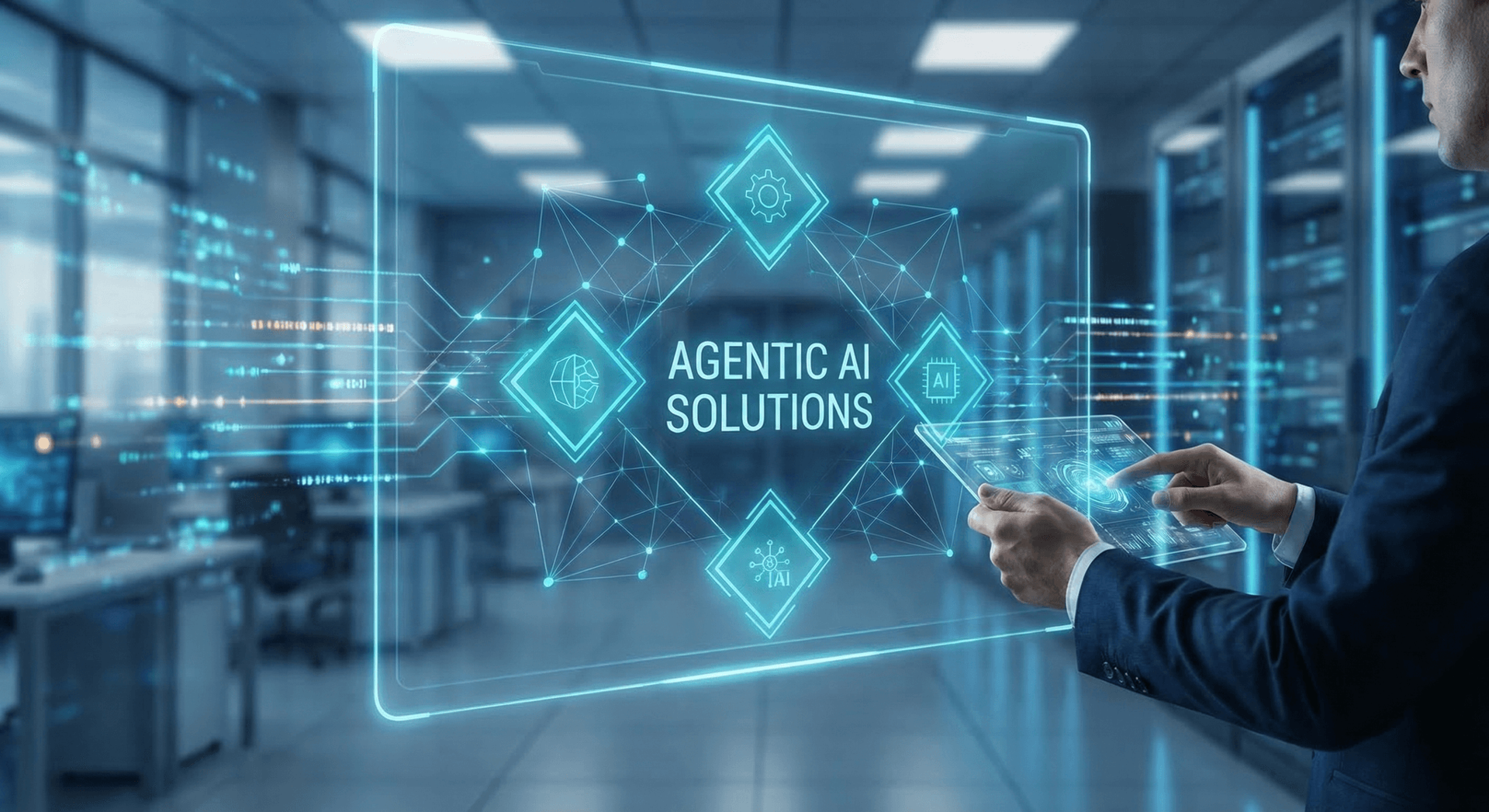
One of the best ways to understand what agentic AI looks like in practice is to look at Skywalker, Cloud Radix's autonomous content agent. Skywalker is a working demonstration of the agentic AI stack described above.
Perception: Skywalker monitors industry news, search trends, competitor content, and Cloud Radix's own analytics to identify content opportunities.
Reasoning: It evaluates which topics will be most valuable for our audience (Fort Wayne business owners exploring AI), assesses keyword difficulty and search volume, and decides what to write and when to publish.
Action: It researches, outlines, writes, optimizes, and formats complete articles — like this one. It generates metadata, structures content for SEO, and manages the publication pipeline.
Learning: It tracks which articles perform well (traffic, engagement, lead generation) and uses those insights to inform future content decisions.
Skywalker is not a theoretical demo. It is a production system that has been creating content for Cloud Radix's blog for months. Every article on this blog authored by Skywalker was produced by an agentic AI system with human editorial oversight. We eat our own cooking.
Guardrails and Human Oversight
Every Cloud Radix deployment includes clearly defined boundaries. We believe responsible agentic AI requires four types of guardrails:
Scope guardrails: The AI knows exactly what it can and cannot do. An AI Employee for a Fort Wayne dental office can book cleanings and checkups, but it cannot provide medical advice. An AI Employee for a law firm can schedule consultations, but it cannot provide legal opinions. The scope is defined before deployment and enforced by the system.
Escalation guardrails: Certain situations always route to a human. Angry customers, complex complaints, requests outside the AI's scope, and any interaction where the AI's confidence is below a defined threshold — all of these trigger an escalation with full context passed to the human team member.
Approval guardrails: For high-stakes actions — sending a quote over a certain amount, modifying a customer's account, or making a commitment on behalf of the business — the AI can be configured to request human approval before proceeding. The human approves or modifies, and the AI executes.
Transparency guardrails: Every action the AI takes is logged and auditable. You can review every call transcript, every message sent, every appointment booked, and every decision the AI made. Nothing happens in a black box.
Our Deployment Methodology
Cloud Radix follows a structured deployment process that minimizes risk and maximizes the chance of a successful rollout.
Discovery (Week 1): We map your current workflows — how calls come in, how leads are handled, how appointments are scheduled, where the bottlenecks are. We identify the highest-value workflow to automate first.
Configuration (Week 1-2): We configure the AI Employee for your specific business: your services, pricing, scheduling rules, FAQ answers, escalation paths, brand voice, and integration points with your existing tools.
Testing (Week 2): The AI Employee is tested with simulated interactions that cover normal scenarios, edge cases, and stress tests. We refine until the system handles your real-world situations correctly and naturally.
Pilot launch (Week 2-3): The AI Employee goes live on a subset of your traffic — after-hours calls only, or overflow calls during busy periods. This lets you see real performance data without fully committing.
Full deployment (Week 3-4): Based on pilot results, we expand to full coverage and begin measuring against your KPIs. For a step-by-step breakdown of the full process, read our guide to building an AI workforce.
Ongoing optimization: We continue monitoring, refining, and expanding capabilities based on your business needs and the AI's performance data.
The Fort Wayne Advantage
There is a genuine strategic advantage to being a Fort Wayne or northeast Indiana business when it comes to adopting agentic AI. This is not cheerleading — it is a structural argument about why smaller markets can adopt new technology faster and more effectively than larger ones.
Less Legacy Complexity
Large enterprises in major metro areas often have decades of accumulated technology: legacy CRMs, custom-built systems, complex integrations that nobody fully understands, and IT governance processes that add months to any technology change. Fort Wayne businesses, by contrast, tend to run leaner tech stacks. Many are on modern cloud-based platforms (Google Workspace, HubSpot, ServiceTitan, QuickBooks Online) that have well-documented APIs and straightforward integration paths.
This means an AI Employee can be connected to your existing systems in days, not months. There is no six-month enterprise IT project. There is no committee approval process. A Fort Wayne business owner can make the decision on Monday and be testing the system by Friday.
Practical Business Culture
Fort Wayne business owners are practical people. They do not adopt technology because it is trendy — they adopt it because it solves a problem and the numbers make sense. This pragmatism is actually an advantage when it comes to agentic AI, because the businesses that deploy it with clear, measurable goals (more calls answered, faster response times, higher booking rates) see better results than those who deploy it because "everyone is doing AI."
The Fort Wayne approach — "Show me the numbers" — is exactly the right framework for evaluating agentic AI. And the numbers are straightforward to show because every action the AI takes is tracked and attributable.
First-Mover Opportunity in the Local Market
As of early 2026, agentic AI adoption among Fort Wayne businesses is still in its early stages. Most local businesses have not deployed AI beyond basic chatbots (if that). This creates a genuine first-mover opportunity for businesses that adopt now.
Consider the competitive advantage: while your competitors send calls to voicemail after 5 PM, your AI Employee answers every call with a knowledgeable, friendly voice. While competitors take 24 to 48 hours to follow up on web leads, your system follows up in under a minute. While competitors let leads go cold over the weekend, your AI is booking Monday appointments on Saturday afternoon.
These advantages compound. A business that captures 30% more leads per month does not just grow 30% faster — it builds a larger customer base that generates more referrals, more reviews, and more repeat business. Over 12 months, the gap between early adopters and late adopters widens significantly.
Tight Labor Market
Fort Wayne's unemployment rate has been consistently low, and finding qualified front-office staff is a genuine challenge for local businesses. Posting a job for a receptionist or customer service rep, interviewing, hiring, training, and then hoping they stay — it is expensive and time-consuming, and turnover means starting the cycle again.
Agentic AI does not solve the labor shortage by replacing workers. It solves it by ensuring your existing team is never bogged down by tasks that do not require human skill. Your experienced team members can focus on high-value work — closing deals, building relationships, solving complex problems — while the AI handles the volume of routine interactions that would otherwise require additional hires.
Relationship-Driven Economy
Fort Wayne runs on relationships. People do business with people they know and trust. Referrals drive growth. Reputation matters.
Agentic AI strengthens those relationships by ensuring consistency. No customer ever gets voicemail when they need help. No follow-up falls through the cracks. Every interaction is handled promptly and professionally, which means your human team can invest their time and energy in the relationship-building that actually requires a human touch. The AI handles the logistics; your people handle the relationships.
Getting Started: A Phased Deployment Roadmap
If you are a Fort Wayne business owner reading this and thinking, "This sounds valuable, but I want a clear plan, not a sales pitch," — this section is for you. Below is a realistic, four-phase roadmap for deploying agentic AI in your business.
Phase 1: Foundation (Weeks 1-2)
The foundation phase is about understanding your current operations and identifying where agentic AI will deliver the highest impact.
Audit your communication channels. How do customers reach you? Phone, email, web form, text, walk-in? Which channels get the most volume? Which have the slowest response times? Where are you losing leads?
Map your workflows. When a customer calls, what happens? Who answers? What questions do they ask? How is the lead tracked? What follow-up happens? Document the full journey from first contact to closed deal. This is the blueprint the AI will follow.
Define your guardrails. What should the AI handle autonomously? What requires human approval? What should always be escalated? These decisions are business decisions, not technical ones — they should be made by the people who understand your customers and your standards.
Choose your starting point. For most Fort Wayne businesses, the highest-ROI starting point is inbound phone handling. It is high-volume, high-value, and the results are immediately measurable.
Phase 2: Pilot (Weeks 2-4)
The pilot phase is about proving value with real data before committing to a full rollout.
Deploy on a subset of traffic. Start with after-hours calls, or overflow calls during your busiest periods. This gives you real performance data without changing your daytime operations.
Measure everything. Track calls answered, average handling time, lead qualification accuracy, appointments booked, customer satisfaction signals, and escalation rates. Compare these numbers to your baseline.
Iterate based on data. Review call transcripts. Identify where the AI handles things perfectly and where it needs adjustment. Refine the AI's knowledge base, conversation flows, and escalation triggers.
Calculate ROI. After two to four weeks of pilot data, you should have clear numbers: the cost of the AI versus the revenue it captured from previously missed opportunities. This is the decision point — does the math work? For most businesses, it does, and it does quickly.
Pilot Best Practice
Phase 3: Scale (Months 2-3)
Once the pilot proves value, the scale phase expands the AI's role.
Expand to full coverage. Move from after-hours only to all-hours operation. The AI becomes your first point of contact for all inbound calls, with seamless handoff to your human team when needed.
Add channels. Extend the AI to SMS, web chat, and email. Each channel adds incremental value because you are meeting customers wherever they prefer to communicate.
Enable proactive outreach. Once the AI is handling inbound well, activate outbound capabilities: automated follow-ups, appointment reminders, re-engagement sequences for past customers, and review requests.
Integrate deeper. Connect the AI to additional business systems — your CRM, marketing automation, invoicing, or job management platform — so it can take more comprehensive action on behalf of your business.
Phase 4: Transform (Months 3-6 and Beyond)
The transform phase is where agentic AI moves from a productivity tool to a strategic advantage.
Multiple AI Employees. Different roles may warrant different AI configurations. One AI Employee handles customer-facing calls. Another manages internal scheduling and dispatch. A third handles content and marketing operations. Each is specialized for its domain.
Predictive capabilities. As the system accumulates data about your business, it can start identifying patterns and making predictions. Which leads are most likely to convert? When are your busiest periods? Which services are trending up? These insights inform your business strategy.
Competitive moat. By this stage, your AI systems have months of learning and optimization built in. A competitor who starts deploying agentic AI six months after you will need time to catch up — not just in the technology setup, but in the accumulated knowledge and optimization that your system has developed from thousands of real interactions with your customers.
| Phase | Timeline | Focus | Key Metric |
|---|---|---|---|
| Foundation | Weeks 1-2 | Audit, map workflows, define guardrails | Readiness score |
| Pilot | Weeks 2-4 | Deploy on subset, measure, iterate | ROI on pilot traffic |
| Scale | Months 2-3 | Full coverage, add channels, go proactive | Revenue captured |
| Transform | Months 3-6+ | Multiple agents, predictive, strategic | Competitive advantage |
What Agentic AI Can't Do Yet
Honesty about limitations is not a weakness — it is what separates responsible technology companies from hype machines. Here is a straightforward assessment of where agentic AI falls short as of early 2026. These are genuine limitations, not caveats that will be resolved next quarter.
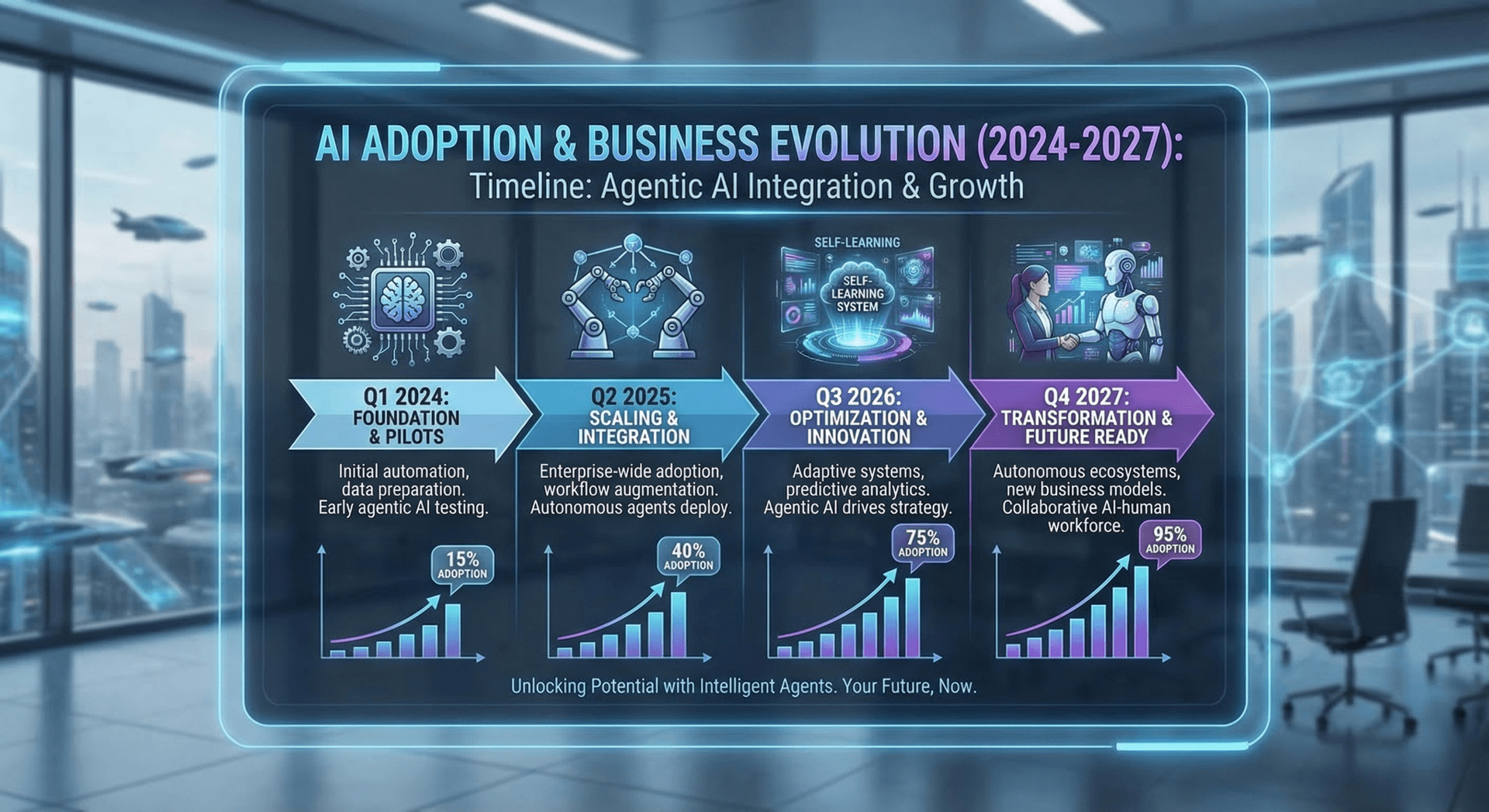
Physical Tasks
Agentic AI lives in the digital world. It can schedule a plumbing appointment, but it cannot fix the pipe. It can coordinate a delivery, but it cannot carry the package. It can optimize a crew's route, but it cannot swing a hammer.
For Fort Wayne businesses in trades, manufacturing, healthcare, or any hands-on industry, this means AI handles the communication, coordination, and administrative layer — your skilled workers still do the actual work. This is not going to change in the near term. Robotics is advancing, but practical, affordable robots for trades work are not on the immediate horizon.
Truly Novel Creative Work
AI can write competent blog posts (like this one), generate marketing copy, and produce content at scale. What it cannot do — yet — is produce genuinely original creative work that comes from lived experience, unique perspective, or creative vision that has never existed before.
AI content is at its best when it is informational, educational, and well-structured. It is at its weakest when you need a piece that requires a deeply personal voice, provocative original thinking, or the kind of creativity that comes from being human in the world. For Fort Wayne businesses, this means AI content handles the bulk of your content needs (service pages, FAQ content, educational blog posts, social media), while genuinely creative or deeply personal content — your founder's story, a thought leadership piece with a bold opinion — still benefits from a human writer.
High-Stakes Decisions Without Human Oversight
Any decision that carries significant financial, legal, or reputational risk should involve human oversight. Agentic AI should not be:
- Approving large contracts or financial commitments.
- Making hiring or firing decisions.
- Providing legal, medical, or financial advice.
- Handling sensitive customer complaints that could escalate to litigation.
- Making public statements on behalf of the business on controversial topics.
The right approach is to build clear thresholds into your AI deployment. Below a certain dollar amount or complexity level, the AI handles it autonomously. Above that threshold, it gathers the information and presents it to a human decision-maker with a recommendation. This is how Cloud Radix configures every deployment.
Genuine Emotional Intelligence
Modern AI has gotten remarkably good at detecting sentiment, adjusting tone, and responding with appropriate empathy. But there is a meaningful difference between simulating empathy and genuinely understanding another person's emotional state.
When a customer calls an HVAC company in Fort Wayne because their furnace died on the coldest night of the year and they have young children at home, they need more than a correct answer — they need to feel heard and reassured. An AI can express concern and prioritize the call, but the depth of human empathy in that moment is something AI does not replicate.
The practical implication: AI handles the initial routing and data collection for emotionally sensitive situations, then connects the caller to a human who can provide genuine empathy. The AI makes sure the human has full context so the caller does not have to repeat themselves.
Building Relationships
Fort Wayne is a relationship town. Business happens at coffee meetings, chamber events, and kids' sports games. AI cannot attend a BNI meeting, shake hands at a Greater Fort Wayne Business Weekly event, or grab lunch with a referral partner.
What AI can do is free up your time so you have more hours for those relationship-building activities. If your AI Employee is handling 50 routine calls a day that used to consume your front desk staff's time, your team has bandwidth for the relationship work that actually requires showing up as a human being.
Operating Without Clear Boundaries
Agentic AI works best when it has well-defined scope, clear rules, and specific goals. It struggles when given vague, open-ended mandates like "grow my business" or "make customers happy." The technology is powerful within boundaries and unreliable without them.
This is why the foundation phase (auditing your workflows, defining guardrails, choosing a specific starting point) is so important. The more clearly you define what the AI should do, the better it does it. Businesses that skip this step and expect AI to figure everything out on its own are consistently disappointed.
A Realistic Perspective
Sources and Further Reading
The following resources provide deeper technical and strategic context for the topics covered in this article. We recommend them for Fort Wayne business owners who want to go beyond the fundamentals.
- Anthropic — "Building effective agents" — Anthropic's guide to designing agentic AI systems, including patterns for tool use, multi-step reasoning, and safety guardrails. Available at docs.anthropic.com.
- OpenAI — "A Practical Guide to Building Agents" — OpenAI's framework for understanding agent architectures, orchestration patterns, and guardrail design. Available at openai.com.
- Google Cloud — "Agent Development Kit" — Google's open-source framework for building multi-agent systems with orchestration and tool-calling capabilities. Documentation at google.github.io/adk-docs.
- LangChain — "What is an AI Agent?" — A practical overview of agent architectures, including the difference between simple chains and autonomous agents. Available at langchain.com/agents.
- Anthropic — "Claude's Character" — Anthropic's documentation on how they approach AI safety, helpfulness, and honest behavior in Claude models — relevant to understanding the guardrails that make agentic AI trustworthy. Available at docs.anthropic.com.
Frequently Asked Questions
Q1.What is agentic AI in simple terms?
Agentic AI refers to AI systems that can independently perceive situations, reason about what to do, take action across your business tools, and learn from the results — all without needing a human to prompt every step. Think of it as the difference between a calculator (you push every button) and an employee (they figure out what needs to happen and do it within the boundaries you set).
Q2.Is agentic AI ready for small businesses or just enterprise?
It is ready now for specific, well-defined workflows. Cloud Radix deploys agentic AI capabilities in the Fort Wayne area. Our AI Employees can handle inbound calls, qualify leads, schedule appointments, and manage follow-ups autonomously. The technology is most mature for customer-facing communication and structured data processing tasks. More complex, open-ended workflows are still developing.
Q3.How is this different from ChatGPT or other AI chatbots?
ChatGPT is a conversational AI — you ask it questions and it responds, one prompt at a time. An agentic AI Employee operates autonomously within your business systems. It answers calls, books appointments, follows up with leads, updates your CRM, and manages workflows without you needing to prompt it for each task. The core difference is autonomy: ChatGPT waits for you; agentic AI acts on your behalf.
Q4.What happens when the AI encounters something it cannot handle?
Every Cloud Radix AI Employee includes escalation protocols. When the AI encounters a situation outside its defined capabilities — a complex complaint, an unusual request, a high-stakes decision — it transfers to a human team member with full context of the conversation so far. The handoff is designed to be seamless for the customer.
Q5.How long does it take to deploy agentic AI for my Fort Wayne business?
A Cloud Radix AI Employee can typically be deployed within two to four weeks, depending on the complexity of your workflows and integration needs. Simple phone handling deployments can be live in under two weeks. Multi-channel deployments with deep CRM integration may take three to four weeks.
Q6.Is my business data safe with agentic AI?
Cloud Radix takes data security seriously. All interactions are encrypted in transit and at rest, access is role-controlled, and data stays within your defined boundaries. Every action the AI takes is logged and auditable. We are transparent about our architecture and happy to walk through our security practices with any business owner.
Q7.Will agentic AI replace my employees?
No. Agentic AI handles the repetitive, high-volume tasks that consume your team's time — answering routine calls, following up on leads, scheduling appointments, entering data. Your human team members get freed up to focus on relationship building, complex problem-solving, and the work that genuinely requires human judgment and empathy. Most businesses find their team is more productive and more satisfied when routine tasks are automated.
Q8.What is the difference between agentic AI and robotic process automation (RPA)?
RPA follows rigid, pre-programmed scripts — if step 3 encounters an unexpected input, the whole process breaks. Agentic AI reasons about what to do next, adapts to unexpected situations, and makes judgment calls within its defined scope. RPA automates a fixed sequence of steps. Agentic AI automates a goal, figuring out the steps dynamically.
Q9.Can agentic AI integrate with the business software I already use?
Yes. Cloud Radix AI Employees integrate with common business platforms — Google Workspace, HubSpot, Salesforce, GoHighLevel, ServiceTitan, Clio, Calendly, and many others — through secure API connections. The AI works with your existing tools rather than requiring you to switch to new ones.
Q10.What industries benefit most from agentic AI in Fort Wayne?
Any business with high-volume customer interactions sees immediate value: home services (HVAC, plumbing, electrical, roofing), legal practices, healthcare clinics, dental offices, real estate agencies, insurance offices, property management companies, and professional services firms. The common thread is inbound communication that needs fast, consistent handling.
Q11.How do I measure the ROI of agentic AI?
Every interaction an AI Employee handles generates trackable data: calls answered, leads qualified, appointments booked, follow-ups completed, response times, and conversion rates. Cloud Radix provides a dashboard where you can see exactly what the AI is doing and tie those actions back to revenue. Compare the monthly cost of the AI to the value of leads it captures that you were previously missing.
Q12.What does agentic AI cost for a Fort Wayne small business?
Cloud Radix AI Employees are priced as a fraction of a full-time hire, with API and model costs disclosed separately so you always know what you are paying for. The exact cost depends on which capabilities you need and your interaction volume. Most Fort Wayne businesses see positive ROI within the first 60 days.
Ready to See Agentic AI in Action?
Let us show you exactly how an AI Employee would handle your business calls, qualify your leads, and book your appointments — with a live demo tailored to your Fort Wayne business.
Schedule a Free ConsultationNo contracts. No pressure. Just an honest conversation about what agentic AI could do for your business.