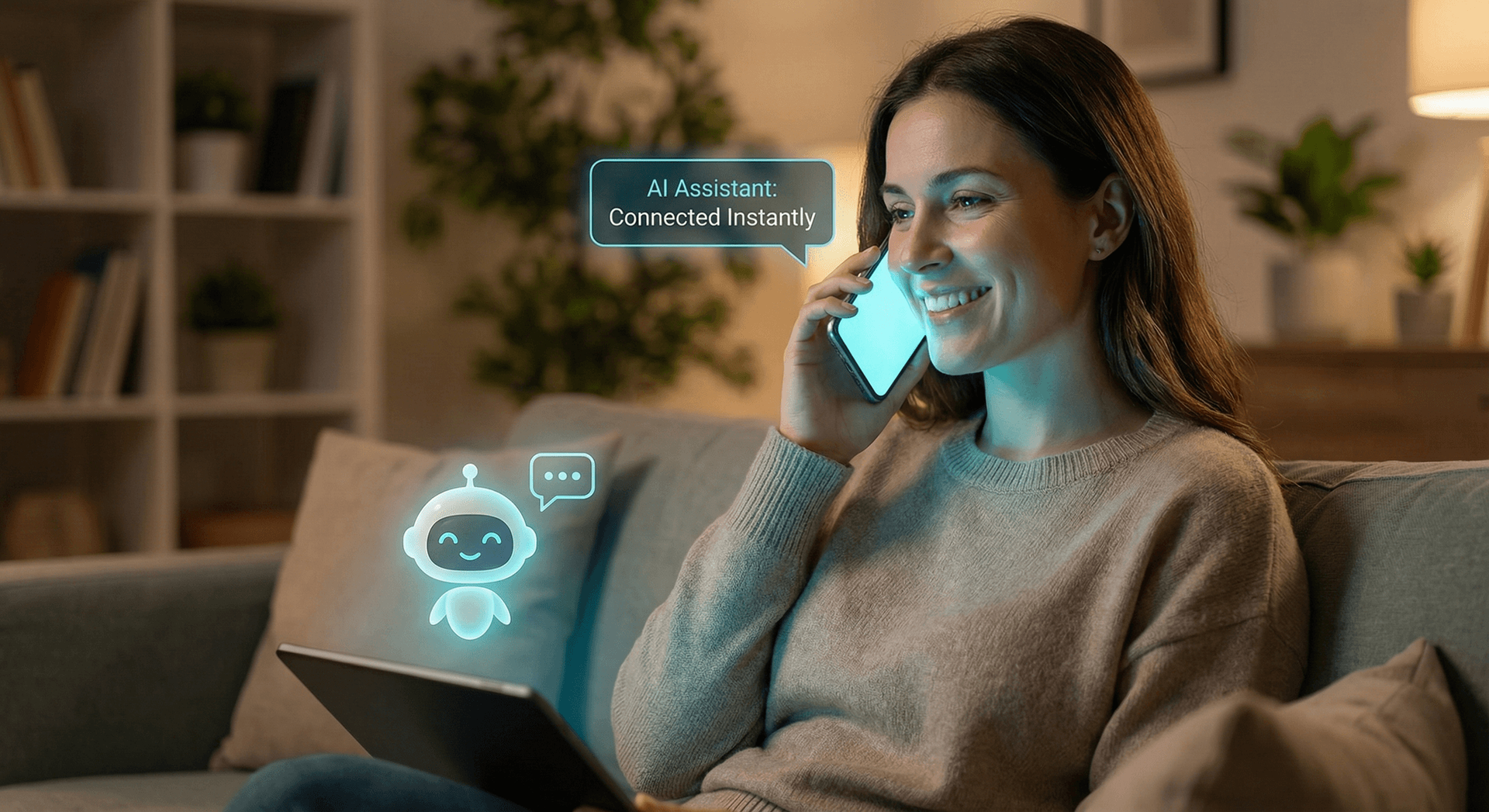
The Small Business Paradox
I am going to say something that most AI vendors will not tell you: enterprise companies do not need AI as badly as you do.
That sounds backwards. Fortune 500 companies dominate every AI headline. They have dedicated innovation teams, seven-figure budgets, and consulting firms on retainer. They are deploying AI across thousands of seats. And yet, when a 4,000-person company automates its customer service queue, it saves a fraction of a percent of operating costs. The needle barely moves.
Now picture a six-person HVAC company on Lima Road. The owner is the estimator, the project manager, and the person who answers the phone between service calls. When that phone rings during a crawlspace inspection and goes to voicemail, it is not a fraction of a percent — it is a $2,400 job walking across the street to the competitor who picked up.
That is the small business paradox. The companies with the fewest resources have the most to gain from an autonomous AI Employee, but they are the last ones to hear about it because every AI vendor is chasing enterprise contracts.
According to the U.S. Census Bureau, approximately 87% of businesses in Fort Wayne and Allen County have fewer than 20 employees. That is not some niche statistic — it is the economy. Small businesses are the backbone of northeast Indiana. They are the dental offices, the law firms, the plumbing companies, the medical practices, and the landscaping crews that keep this city running.
I grew up in this world. My family runs Cloud Radix out of Auburn, Indiana — 25 minutes north of Fort Wayne. Before I became CEO, I watched my father build businesses and I learned the same lesson every small business owner learns: you do not have the luxury of slack. Every person on your team wears three hats. Every missed call is real money. Every hour spent on admin work is an hour not spent growing.
That tension — needing to do more with less — is precisely why an autonomous agent for small business is not a luxury. It is the highest-leverage investment a team under 20 can make.
Why Small Teams Need AI MORE Than Enterprise
Enterprise companies have something small businesses do not: redundancy. When a customer service rep at a 500-person call center calls in sick, 499 people cover the gap. Nobody notices.
When your receptionist at an 8-person dental practice calls in sick, the entire front office collapses. The dentist is checking patients in between cleanings. The hygienist is answering phones between patients. Insurance verification stops. New patient intake stops. The afternoon is chaos, and three prospective patients who called during lunch never get a callback.
The Redundancy Gap
Here is where the math gets interesting. Enterprise companies deploy AI to optimize at the margins — shaving seconds off call handle times, reducing support tickets by a few percentage points. Useful, but incremental. For a small team, AI does not optimize at the margins. It fills fundamental capacity gaps that would otherwise require hiring one, two, or three additional full-time employees.
Consider what an AI Employee small team deployment actually replaces:
- After-hours phone coverage — your business is "closed" for 63% of the day (5 PM to 8 AM, plus weekends). An AI Employee operates all 168 hours per week.
- Appointment scheduling and confirmation — each appointment generates 4–6 touchpoints. For a practice booking 20 appointments per day, that is 80–120 interactions your team no longer handles manually.
- Lead qualification — not every caller is a real prospect. An AI Employee asks the right questions, qualifies in real time, and routes hot leads directly to the decision-maker.
- Follow-up sequences — the quote that went out Friday and never got a response. The consultation request from Tuesday evening. An AI Employee follows up automatically within minutes, not days.
- Intake and onboarding — collecting patient information, gathering case details, verifying insurance, sending welcome packets. Repetitive work that eats hours every single day.
For a team of 8, those tasks collectively consume the equivalent of an estimated 2–3 full-time positions. This is a projected capacity multiplier based on industry benchmarks and operational modeling. The ROI math is not even close. An autonomous agent for small business at $997/month replaces $8,000–$15,000/month in labor costs while operating with zero sick days, zero turnover, and zero training ramp-up.

The $997/Month Equalizer
In the military, we had a concept: force multiplication. A small unit with the right equipment and training can project the same capability as a much larger force. The same principle applies to business. You do not need 20 people. You need 8 people with the right systems.
At $997/month, the Cloud Radix Starter plan is not a software subscription. It is a force multiplier. Here is what a small business gets:
| Capability | Without AI Employee | With AI Employee ($997/mo) |
|---|---|---|
| Phone coverage | 40 hrs/week (when staff available) | 168 hrs/week (24/7/365) |
| After-hours calls | Voicemail (78% never call back) | Live answer, book, qualify |
| Lead follow-up speed | 4-24 hours (or never) | Under 2 minutes, automatic |
| Appointments booked/day | Limited by staff availability | Unlimited, real-time calendar sync |
| Simultaneous conversations | 1 per staff member | Unlimited parallel |
| Cost to add coverage | $3,200-$4,500/mo per FTE | $0 (included in plan) |
| Sick days per year | 7-10 per employee | Zero |
| Training time for new hire | 4-8 weeks | 2-3 weeks (one-time) |
Look at that table and do the math. A single full-time front desk hire in Fort Wayne costs $3,200–$4,500/month when you factor in wages, benefits, payroll taxes, and training. That employee works 40 hours a week — maybe. An AI Employee works 168 hours a week, handles unlimited simultaneous conversations, and never puts in a two-week notice the day before your busiest month.
The Kaizen Principle Applied
I have seen business owners spend $997/month on worse things. Yellow Pages ads that nobody reads. Google Ads campaigns with no landing page strategy. A part-time employee who only works Tuesdays and Thursdays and still misses half the calls. The difference with an AI Employee is that every dollar is measurable. You can see exactly how many calls it answered, how many appointments it booked, and how much revenue it attributed — in real time, on a dashboard. No guessing.
Fort Wayne Business #1: A 6-Person Home Services Company
Simulation Case Study
Consider a typical home services company on the south side of Fort Wayne. Six employees total: the owner, a dispatcher, and four field technicians. The owner has been running the business for about 11 years and averages roughly $1.8 million in annual revenue. Solid operation. But there is a problem many owners like this can feel but cannot quantify.
Every day, between 11:30 AM and 1:30 PM, calls would go to voicemail. The dispatcher is at lunch. The owner is on a job site. The technicians are in crawlspaces. For two hours every business day, a company like this is effectively closed to new customers.
In this simulation, an AI Employee is deployed and all metrics are projected over a 30-day period. Here are the projected results:
In this projection, twenty-three calls per day come in during a two-hour lunch window. Based on industry averages, approximately eighteen of those callers would never call back. At a typical average ticket of $267, those 18 lost calls would represent roughly $4,806 in potential revenue — every single day. Multiply that across 22 business days per month and the projected annual revenue loss exceeds $105,000.
In this scenario, the AI Employee would not just answer those calls. It would qualify the leads, check technician availability on the integrated scheduling system, book the appointments, and send confirmation texts — all within a two-minute window while the caller is still on the line. The dispatcher would come back from lunch to a fully booked afternoon instead of a voicemail box full of hang-ups.
Projected Impact
Fort Wayne Business #2: A 12-Person Medical Practice
Simulation Case Study
Medical practices under 20 employees face a unique version of the capacity problem. The front desk is simultaneously checking patients in, verifying insurance, answering phones, processing copays, and managing referrals. One task always suffers at the expense of another. It is triage for administrative work.
Consider a typical 12-person practice — two physicians, a PA, two nurses, and seven administrative staff — spending an estimated average of 47 minutes per new patient on intake alone. Phone call to collect information, insurance verification, new patient forms, medical history review, and appointment confirmation. Multiply that by 8 new patients per day and you have one full-time employee doing nothing but intake.
With an AI Employee deployed, the projected workflow transformation would look like this:
- Patient calls to schedule — AI Employee answers, checks physician availability, and books the appointment in under 90 seconds.
- Insurance verification — AI Employee collects policy information during the initial call and runs automated verification before the patient arrives. No more front-desk staff spending 15 minutes per patient on hold with insurance companies.
- New patient intake — AI Employee sends digital intake forms via text or email immediately after booking. 82% of patients complete them before arrival, compared to 31% with the old paper-and-clipboard system.
- Appointment reminders — automated confirmation texts at 48 hours, 24 hours, and 2 hours before the appointment. Projected no-show rate reduction: from a typical 14% down to an estimated 3.2%.
- After-hours triage — AI Employee handles non-emergency calls after 5 PM, providing appropriate guidance and booking follow-up appointments for the next business day. Urgent calls are escalated to the on-call physician immediately.
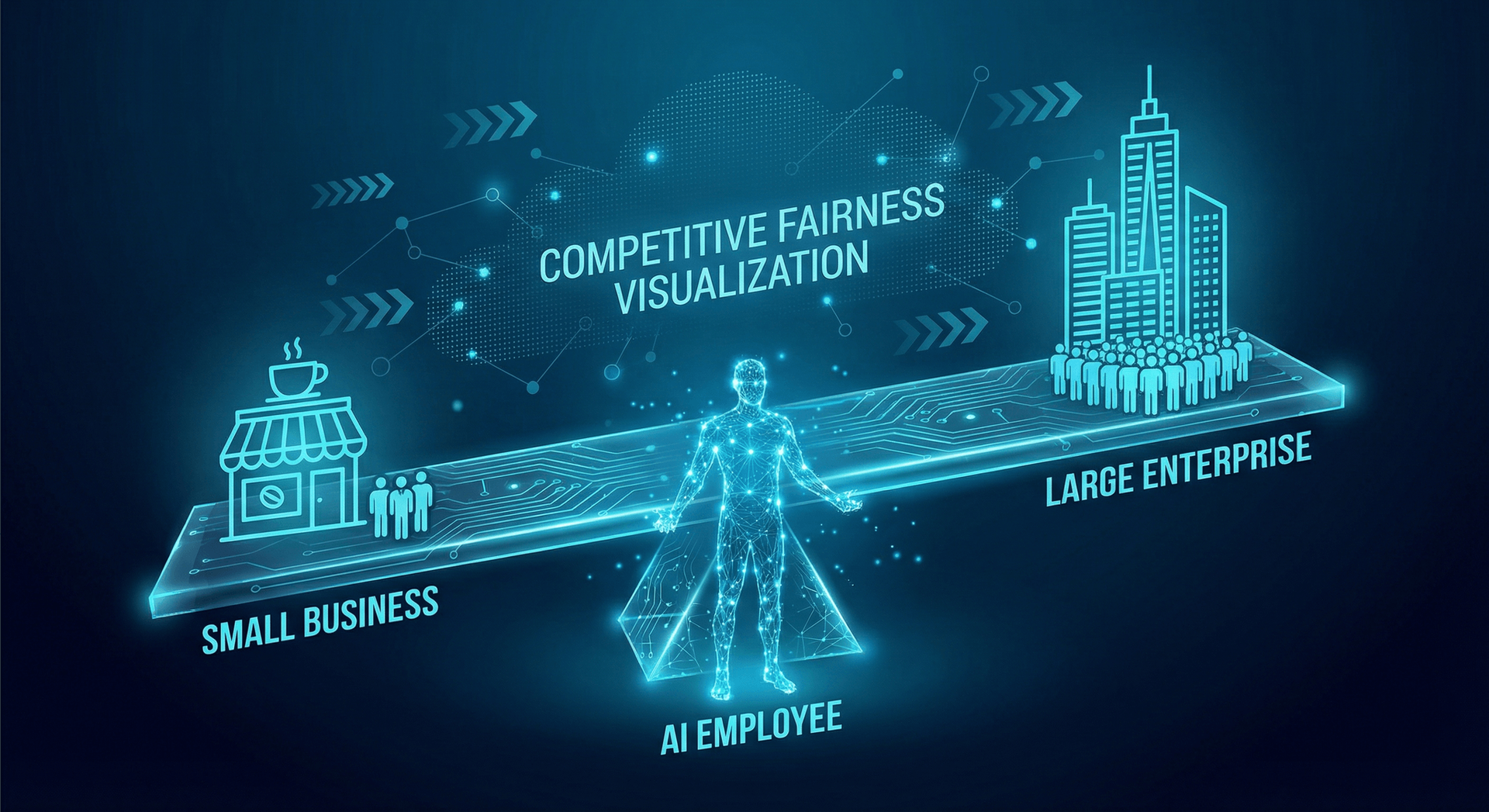
In this projection, intake time would drop from 47 minutes to an estimated 11 minutes per new patient. That would free up roughly 4.8 hours of staff time per day — the equivalent of hiring a part-time employee, without the cost. The practice could redirect that time toward patient care coordination and follow-ups, potentially improving both patient outcomes and satisfaction scores.
But the projected number that would matter most is the no-show reduction. At an average visit value of $185, dropping from a typical 14% no-show rate to an estimated 3.2% across 40 daily appointments would recover a projected $7,992 per month in revenue that was previously evaporating. In this simulation, the AI Employee would pay for itself in the no-show reduction alone, with every other benefit as pure upside.
HIPAA Compliance Note
Fort Wayne Business #3: An 8-Person Legal Office
Simulation Case Study
Legal offices have a problem that most people outside the profession do not think about: the economics of intake. A personal injury firm might receive 60 calls per week, but only 8–12 of those are viable cases. The other 48 are inquiries that do not fit the firm's practice area, callers who want free legal advice, or cases where the statute of limitations has passed.
Consider a typical 8-person firm — two attorneys, a paralegal, a legal assistant, and four support staff — where someone has to take every single one of those 60 calls. The attorneys obviously cannot. The paralegal should not be doing intake when she has discovery deadlines. So the support staff handles it, spending an average of 12 minutes per call determining whether the inquiry is worth pursuing.
That is 12 hours per week of staff time spent on calls where 80% result in a polite "sorry, we cannot help you." Twelve hours that could be spent on billable support, document preparation, or client communication.
An AI Employee deployed in a firm like this could transform intake into a precision operation:
- Initial screening — the AI Employee asks a structured series of questions: type of incident, date of occurrence, injuries sustained, existing representation, and insurance status. This happens naturally in conversation, not as a robotic questionnaire.
- Qualification scoring — based on the responses, the AI assigns a qualification score. Cases scoring above the threshold are flagged as high-priority and routed to an attorney for immediate review. Low-scoring inquiries receive a respectful explanation and referral to appropriate resources.
- Consultation scheduling — qualified leads are booked directly into the attorney's calendar with a complete intake summary. The attorney walks into the consultation already knowing the facts of the case. Zero cold starts.
- After-hours capture — 41% of initial legal inquiries happen outside business hours. People get into accidents at 9 PM. They discover legal issues on weekends. The AI Employee captures every one of those inquiries when the caller is most motivated to take action.
The key insight from a scenario like this is clear: an AI Employee is not deployed to replace anyone. It is deployed so the team can do the work they were actually trained to do. That is the mindset shift. An autonomous agent for small business does not eliminate jobs. It eliminates the work that prevents your people from performing at their best.
What Your AI Employee Does for a Small Team
Abstract benefits are hard to evaluate. So let me walk you through a projected typical Tuesday for a small business with a Cloud Radix AI Employee deployed. This is a projected typical day based on industry benchmarks and operational modeling.
5:47 AM — Before Anyone Arrives
A prospective customer submits a contact form at 5:47 AM. The AI Employee responds via email within 90 seconds with a personalized message, answers their top question, and offers three available appointment times. By the time your team walks in at 8:00, the appointment is already booked and confirmed.
8:15 AM — Morning Rush
Four calls come in simultaneously. Your receptionist is checking in the first appointment of the day. The AI Employee handles all four calls in parallel — answering questions, scheduling appointments, and qualifying a lead that needs immediate attention. It flags the hot lead via Slack notification.
11:45 AM — Lunch Coverage
Your team heads to lunch. The phone keeps ringing. The AI Employee handles 9 calls over the next 90 minutes, books 3 appointments, answers 4 pricing questions, and routes 2 existing customer service issues to the right team member's voicemail with full context.
2:30 PM — Follow-Up Sequences
The AI Employee automatically follows up with three leads from yesterday who requested quotes but have not responded. Two reply within the hour. One books. That booking would have been lost entirely without the automated follow-up — your team was too busy to remember.
5:30 PM — After Hours Begins
Your team clocks out. The AI Employee keeps working. Between 5:30 PM and 8:00 AM the next morning, it handles 7 calls, books 2 appointments for tomorrow, sends 4 automated quote follow-ups, and captures a high-value lead at 10:14 PM who found you on Google after an emergency. That lead is worth $4,200. It would have been a voicemail.
Add it up: one Tuesday, one AI Employee, 23 calls handled, 8 appointments booked, 3 leads followed up, and one $4,200 emergency lead captured after hours. Your team did not work a single extra minute. That is not efficiency — it is a fundamentally different operational capacity.
The Capacity Multiplier Effect
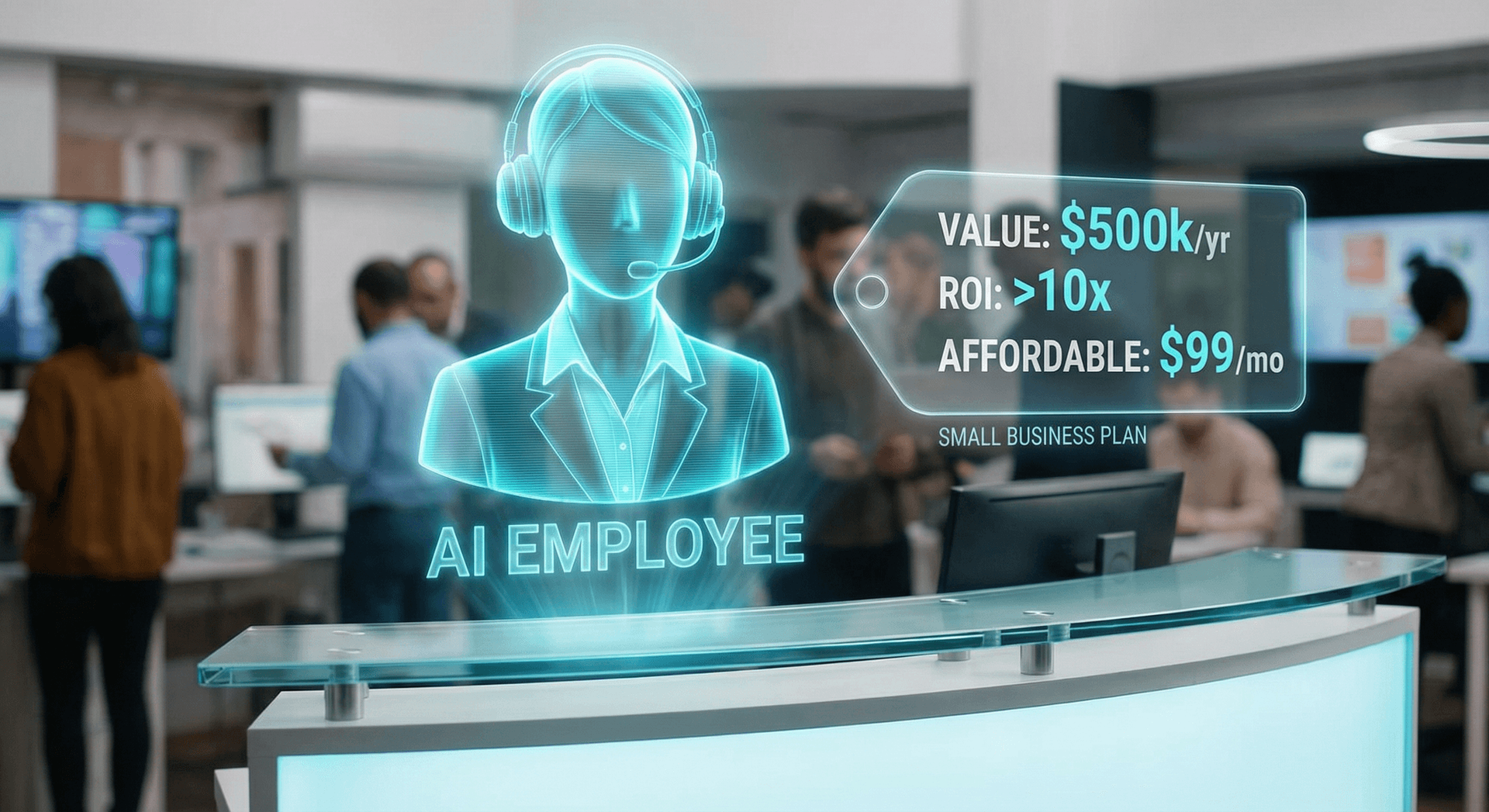
I keep coming back to this number: a team of 8 operating like a team of 20. That is the projected output differential based on industry benchmarks when small businesses deploy an AI Employee.
Here is how the multiplication works:
- Hours multiplied: Your 8 employees work a combined 320 hours/week. An AI Employee adds 168 hours of operational coverage, bringing your effective operating hours to 488/week — a 52% increase without a single additional hire.
- Throughput multiplied: Your receptionist handles one call at a time. An AI Employee handles unlimited simultaneous conversations. During peak hours, this alone triples your inbound capacity.
- Speed multiplied: Average lead follow-up time drops from 4–24 hours to under 2 minutes. Harvard Business Review research shows that responding within 5 minutes makes you 21x more likely to qualify a lead than responding within 30 minutes.
- Consistency multiplied: An AI Employee delivers the same quality of service at 3 AM on a Sunday as it does at 10 AM on a Tuesday. No bad days. No Monday mornings. No Friday afternoon checkout.
The Projected 2.5x Multiplier
The compounding effect is what makes this transformational rather than incremental. In month one, your AI Employee handles calls and books appointments. By month three, it has learned your most common edge cases and handles them without escalation. By month six, it is proactively identifying patterns — noticing that customers who book on Wednesdays have a higher no-show rate, or that leads from certain zip codes convert at 3x the average — and surfacing those insights for your team.
That is the Kaizen principle in action. Continuous, compounding improvement. Every interaction makes the system smarter. Every week widens the gap between your capabilities and those of competitors still relying on voicemail and sticky notes.
Common Objections from Small Business Owners (and Honest Answers)
I talk to small business owners every week. I hear the same concerns repeatedly, and they are all legitimate. Here are the honest answers — no spin, no glossing over the real trade-offs.
"My customers want to talk to a real person."
Some of them do. And they should. An AI Employee is not designed to eliminate human interaction — it is designed to ensure human interaction happens where it matters most. Your best salesperson should be closing deals, not answering the same five questions about parking directions. When a customer genuinely needs a human, the AI escalates immediately. When they need a quick answer or an appointment booked, the AI handles it faster and more consistently than any human can at scale.
"$997/month is a lot for a business my size."
I understand that reaction. But compare it to the alternatives: a part-time employee costs $2,000–$2,800/month after taxes and benefits, works 20 hours a week, and cannot handle three calls simultaneously. An answering service charges $1.50–$3.00 per call with zero business context. A missed call that becomes a lost customer costs you the lifetime value of that relationship. At $997, you are paying less than $1.50 per hour for 24/7 coverage. Read the full pricing breakdown and run the numbers for your business. Based on our projections, the AI Employee is expected to pay for itself within 30 days.
"What if it makes a mistake?"
It will. So do humans. The difference is that when an AI Employee makes a mistake, it is logged, reviewed, and corrected systemically. The fix is permanent — the AI never makes that specific mistake again. When a human employee makes a mistake, you have a coaching conversation and hope it sticks. Our AI memory system means every correction improves the model for every future interaction. Errors decrease over time, not repeat on a cycle.
"I am not tech-savvy. Will I be able to manage this?"
You do not manage it. We do. Cloud Radix handles deployment, training, integration, monitoring, and optimization. You have a dashboard where you can see performance metrics, but the AI Employee runs autonomously. That is the entire point — it is an autonomous agent for small business, not another software tool you need to learn. If something needs attention, we call you. Otherwise, it just works.
"What about my team's jobs?"
This is the concern I take most seriously, because your people are your business. Here is what we see across every small business deployment: nobody gets laid off. What happens is that your team stops drowning in repetitive work and starts doing the work they were hired to do. Your receptionist becomes a customer experience coordinator. Your office manager focuses on process improvement instead of putting out fires. Morale goes up because the soul-crushing repetition goes away. I have yet to see a single small business reduce headcount after deploying an AI Employee. I have seen several hire additional people because the AI freed up enough revenue to justify the expansion.
How to Start Without Disruption
The biggest fear small business owners have is not cost or technology — it is disruption. You cannot afford two weeks of chaos while a new system gets figured out. Your business runs on tight margins and tight timelines. One bad week can set you back a quarter.
That is why we designed the Cloud Radix onboarding process specifically for small teams. Here is the honest timeline:
Week 1: Discovery and Configuration
We spend time with your team understanding exactly how your business operates. What questions do callers ask? What is your scheduling workflow? What are your escalation criteria? This is not a generic questionnaire — it is a deep operational audit. Your team continues working normally. No disruption.
Week 2: Training and Integration
We train your AI Employee on your business data, connect it to your existing tools (CRM, scheduling software, phone system), and run internal testing. Your team reviews sample interactions and provides feedback. Still no disruption to daily operations — everything is happening in parallel.
Week 3: Soft Launch
The AI Employee goes live handling after-hours calls first. This is the lowest-risk entry point — calls that were previously going to voicemail are now being answered. Your team monitors the results each morning. If anything needs adjustment, we tune it in real time.
Week 4: Full Deployment
Once your team is confident in the AI Employee's performance (and they will be, because they have seen three weeks of data), we expand to full coverage. The AI handles overflow calls during business hours, manages scheduling across all channels, and runs automated follow-up sequences. Your team's workload drops noticeably on day one of full deployment.
The 30-Day Guarantee
I want to be clear about what "without disruption" means. It does not mean nothing changes. It means the change is additive. You are not replacing systems or retraining staff. You are adding capability. Your team keeps doing what they do. The AI Employee handles what they could not get to. That is the whole model, and it is why small teams adopt faster and see results sooner than enterprise deployments that take six months and seventeen stakeholder meetings.
Frequently Asked Questions
Q1.Can a business with fewer than 10 employees really benefit from an AI Employee?
Absolutely. Businesses with fewer than 10 employees often see the highest projected percentage ROI because every missed call, delayed follow-up, or lost lead has an outsized impact. In a simulation based on a typical 6-person Fort Wayne home services operation, the projected recovered revenue was approximately $4,800 per day from previously missed calls. The smaller your team, the more each efficiency gain matters.
Q2.What is the difference between an AI Employee and a chatbot for small businesses?
A chatbot follows a script and answers basic questions on your website. An AI Employee is an autonomous agent for small business that answers calls, books appointments, follows up on leads, qualifies prospects, handles intake, and integrates with your existing tools — all without human intervention. It operates across phone, text, email, and web, 24/7. Read our full comparison in the AI Employee vs Chatbot guide.
Q3.How long does it take to set up an AI Employee for a small team?
Typical deployment takes 2 to 3 weeks. During the first week, we conduct a deep dive into your business processes, scripts, and tools. Week two is dedicated to training and integration. By the end of week three, your AI Employee is live and handling real interactions. Most small teams see measurable results within the first 30 days.
Q4.Will my customers know they are talking to an AI?
Your AI Employee is trained on your business tone, terminology, and processes. It sounds like your best front desk person, not a generic robot. That said, we always recommend transparency — if a caller asks directly, the AI identifies itself. In practice, most callers care more about getting their question answered quickly than who answered it.
Q5.What happens if the AI encounters something it cannot handle?
It escalates to your team immediately. Every AI Employee has configurable escalation rules. For example, it can transfer calls to a specific team member for complex insurance questions, flag high-value leads for personal follow-up, or send a Slack notification when it encounters an edge case. Nothing falls through the cracks.
Q6.What does $997/month include — and what's separate?
The $997/month Starter plan includes your dedicated AI system, custom training, all channel integrations (phone, SMS, email, web), 24/7 operation, continuous learning updates, and local support from our Auburn, Indiana team. AI model API usage (inference costs from providers like OpenAI and Anthropic) is billed separately based on your actual usage. Cloud Radix optimizes these costs through intelligent model routing — simple tasks use affordable models, complex tasks use powerful ones. No annual escalation clauses. Read our full pricing breakdown in the AI Employee Pricing Guide.
Q7.Can I try it before committing long-term?
Yes. Cloud Radix offers a 30-day pilot program. We deploy your AI Employee, train it on your business, and track every metric for 30 days. You see exact call counts, leads captured, appointments booked, and revenue attributed before making a longer commitment. If it does not deliver, you walk away.
Q8.How does an AI Employee work with my existing phone system and software?
Your AI Employee integrates with your current phone system, CRM, scheduling software, and communication tools. We support common platforms used by Fort Wayne small businesses including Google Workspace, Microsoft 365, Salesforce, HubSpot, ServiceTitan, and dozens more. No rip-and-replace required.
Sources
- U.S. Census Bureau, County Business Patterns, Allen County IN, 2024 — approximately 87% of businesses under 20 employees.
- Harvard Business Review, "The Short Life of Online Sales Leads" — 21x qualification rate within 5 minutes vs 30 minutes.
- Bureau of Labor Statistics, Occupational Employment and Wage Statistics, Fort Wayne-Huntington-Auburn MSA, 2025 — front desk wage benchmarks.
- MGMA (Medical Group Management Association), Practice Operations Report, 2025 — medical practice no-show rates and intake benchmarks.
- Clio Legal Trends Report, 2025 — legal intake statistics and after-hours inquiry rates.
- ServiceTitan Industry Benchmark Report, 2025 — home services call volume and missed call impact data.
- Gartner, "Predicts 2026: AI Agents Transform Service Operations" — autonomous agent deployment trends and small business adoption.
- National Federation of Independent Business (NFIB), Small Business Optimism Index, January 2026 — staffing and capacity constraints.
Your Small Team Deserves Big Capabilities
Cloud Radix is based in Auburn, Indiana. We work with small teams every day — because that is who needs this the most.
Schedule a Free ConsultationNo contracts. No pressure. Just an honest conversation.