Same Model, Completely Different Risk
Here is something most AI vendors do not want you thinking about too clearly: the AI models powering premium enterprise AI solutions and the AI models powering free consumer ChatGPT are, in many cases, identical. GPT-4 is GPT-4 whether you access it through a free browser tab or through an enterprise API with a Business Associate Agreement.
So if the model is the same, what are you actually paying for when you choose enterprise AI over consumer AI? And more importantly — if the model is the same, why does one represent a business liability and the other represent a business asset?
The answer is not the AI's capabilities. It is the plumbing around the AI — the path your data takes, the controls that govern that path, the records kept, and the accountability structures in place if something goes wrong. Our security architecture page details exactly how this plumbing works. That difference is enormous, and for most businesses in regulated industries, it is the difference between compliance and violation.
The Core Distinction
The Data Flow: Side-by-Side Comparison
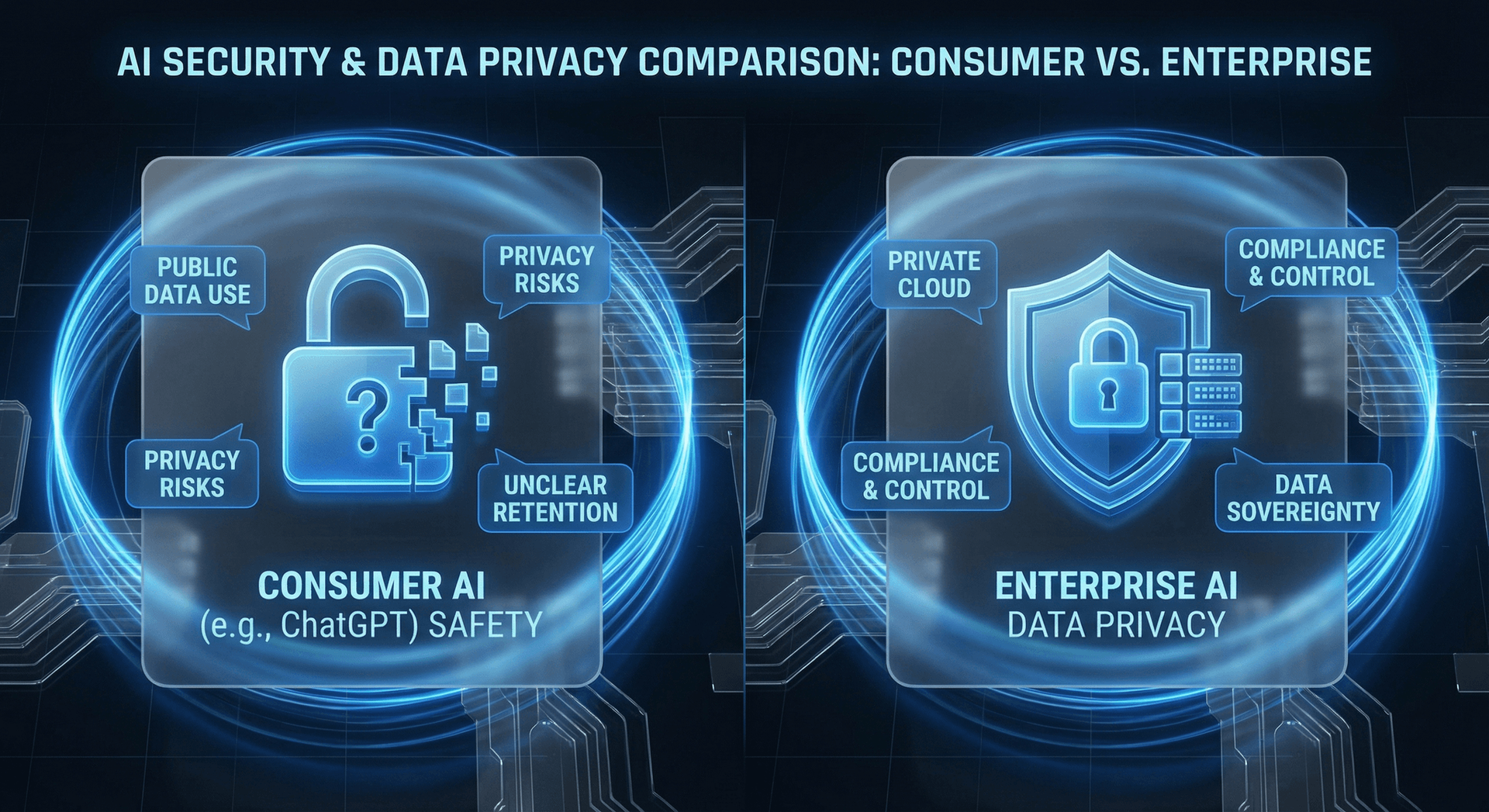
The most important thing to understand about consumer vs. enterprise AI is the path your data takes from your keyboard to a model response and back. These paths are structurally different in ways that have profound security and compliance implications.
Consumer ChatGPT Session: The Data Journey
Employee opens ChatGPT.com in a personal or work browser
Employee pastes business data — customer records, financial data, code, strategy documents
Data transmitted to OpenAI's servers over public internet (encrypted in transit, but no business controls applied)
OpenAI's servers process the request — data may be retained according to current policy (varies by account type)
Depending on account settings, data may be used for model training or fine-tuning
No log is generated in your business systems — this interaction is invisible to your IT team, security monitors, or compliance officers
No access controls were applied — the employee could have submitted any data they had access to
Response returned. No record that this exchange ever happened, from your business's perspective.
Enterprise AI Employee: The Data Journey
Employee opens the business AI interface — accessed through SSO with their corporate identity
Employee submits a request — DLP scanning runs automatically, detecting and redacting any sensitive data patterns before the request leaves the business environment
Sanitized request transmitted via API to the model provider under a zero-retention agreement
The model provider contractually guarantees no data retention and no use for training — evidenced by a signed DPA or BAA
Response returned — optionally filtered through output safety layer before reaching the employee
Complete audit log created: timestamp, user identity, request category, DLP scan results, model used, response generated
Role-based access controls confirm the employee was authorized to make this type of request
Interaction available for compliance review, security audit, or incident investigation — retained per your configured policy
The AI capabilities at the end of both paths are comparable. The business risk profile is radically different. One path has no controls, no records, and no accountability. The other has end-to-end governance that satisfies regulatory requirements and enables meaningful security monitoring.
API Access vs. Consumer Sessions: The Training Data Difference
The training data question is where the consumer vs. enterprise distinction becomes most consequential for businesses handling valuable intellectual property.
OpenAI's current policies (as of early 2026) are layered and frequently updated:
ChatGPT Free / Plus (Consumer)
Data from conversations may be used to improve OpenAI's models unless the user has explicitly opted out in account settings. Most users have not changed default settings. Training data opt-out is not guaranteed to be permanent or retroactive for already-submitted data.
ChatGPT Team
Policy states data is not used for training by default. However, this is a policy statement, not a contractual guarantee with defined remedies for violation. "Not by default" also means settings can change.
ChatGPT Enterprise
Contractual no-training guarantee with defined terms. Significantly better, but still transmits data to OpenAI's infrastructure. Does not include DLP scanning, RBAC, audit logging, or integration with your existing security stack.
API Access with Zero-Retention Agreement
The only option with both contractual no-training guarantees AND no data retention. Data is processed in memory and not stored. This is how Cloud Radix AI Employees access models — your data is never persisted on the model provider's infrastructure.
The Uncertainty Principle
The training data concern extends beyond the AI provider to the data itself. If proprietary information enters a training corpus, the intellectual property contamination is potentially permanent. Future users of the same model could receive responses influenced by patterns derived from your trade secrets. This is not a hypothetical concern — it is why Samsung's semiconductor data breach (via ChatGPT) was treated as a serious IP incident, not just a privacy matter. The risk multiplies when employees use unauthorized shadow AI tools without any organizational visibility.
The Audit Trail Gap
Imagine a regulator asks you: "On March 15th, did any employee access or share patient data through an AI system?" With consumer AI, you cannot answer that question. With an enterprise AI Employee, you can pull a timestamped, user-attributed log within minutes.
The audit trail gap is not just a compliance issue — it is a security investigation issue. When a breach occurs, the ability to reconstruct exactly what happened, in what sequence, by whom, and what data was involved, is the difference between a contained incident and an unquantifiable exposure.
Consumer AI Audit Capability
- • No record in business systems that the session occurred
- • No record of what data was submitted
- • No record of what response was generated
- • No record of which employee was involved
- • Conversation history visible only inside the AI tool — not in your security stack
- • Cannot satisfy regulator requests for AI interaction logs
Enterprise AI Employee Audit Capability
- • Complete log of every AI interaction with timestamp
- • User identity from SSO (not just a username — verified corporate identity)
- • Request classification (what type of task was requested)
- • DLP scan results (what sensitive data patterns were detected)
- • Model version used and response ID for reproducibility
- • Retention policy configurable to match your compliance requirements
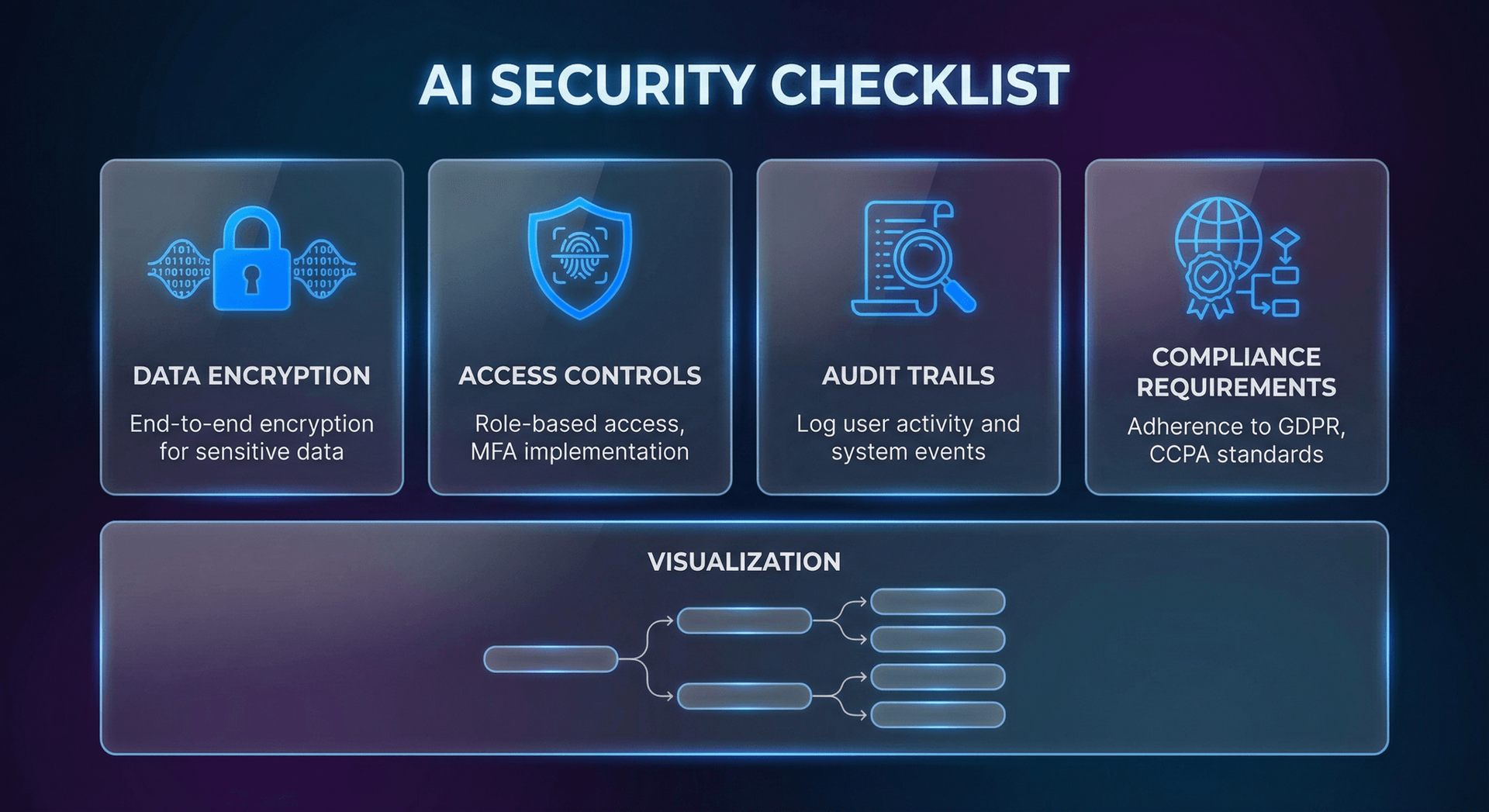
For HIPAA-covered entities, audit logs of AI interactions are increasingly expected by auditors. For SOX-compliant businesses, AI interactions involving financial data should be part of your documented control framework. For any business subject to data breach notification laws, the ability to determine the scope of a breach requires knowing what data was submitted to what systems. For a comprehensive evaluation framework, use our AI Employee security checklist.
The Access Control Gap
In any well-governed business, employees have access to the data they need to do their job — and not more. A customer service rep can see customer support tickets but not salary data. A bookkeeper can see accounts receivable but not strategic planning documents. This principle of least privilege is fundamental to data security.
Consumer AI tools have no awareness of your access control policies. They accept whatever data is submitted to them. If an employee with elevated database access submits a full customer export to ChatGPT to "help with analysis," there is nothing in the consumer AI architecture that prevents this — regardless of whether that employee was supposed to have that data exported.
Role-Based AI Access
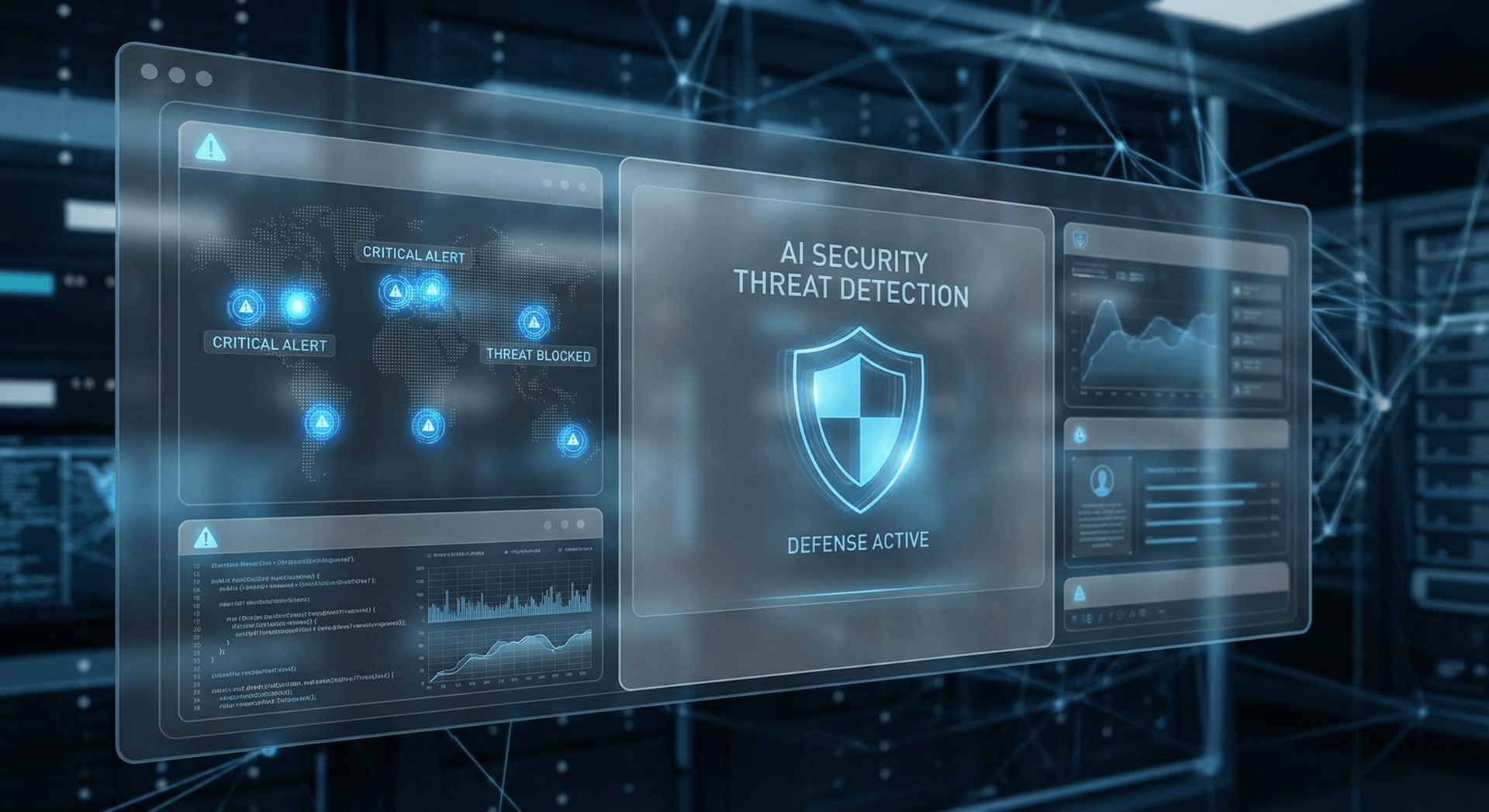
Enterprise AI Employees enforce role-based access at the AI layer — not just at the data layer. A customer service agent's AI interface only provides access to customer interaction data. The CFO's AI interface has access to financial systems. Cross-role queries — a CSR trying to access financial data through the AI — are blocked and logged. This is access control where it matters: at the point where the data is actually being processed.
Data Loss Prevention at the AI Layer
Even with access controls in place, employees may inadvertently paste data from their clipboard or attach files containing sensitive information. DLP scanning at the AI layer catches these inadvertent submissions — redacting PII, PHI, PCI data, and custom-defined sensitive patterns before they leave the business environment. This catches the "CFO copies financials to ChatGPT" scenario even if the CFO technically has legitimate access to those financials.
Identity Verification and SSO Integration
Consumer AI tools accept access from anyone with an email address and a password. Enterprise AI Employees integrate with your existing identity provider (Microsoft Entra ID, Google Workspace, Okta) and enforce MFA at the corporate level. If an employee's account is compromised, your corporate identity controls protect the AI system — the attacker cannot access the AI without the employee's full corporate credentials.
The Integration Gap
One of the most compelling productivity arguments for consumer AI is its simplicity: open a browser, ask a question, get an answer. No integration, no configuration, no technical overhead.
But that simplicity is exactly the problem. Because consumer AI has no access to your business systems, employees compensate by manually extracting data and pasting it in. That manual extraction is where data control breaks down. The moment data leaves your controlled business systems and enters a clipboard or a downloaded file, your governance policies no longer apply.
Enterprise AI Employees integrate directly with your business systems:
- CRM integration: The AI accesses customer records directly through an authorized API connection — without the employee needing to export, copy, or paste anything. The data never leaves the controlled environment.
- ERP and accounting integration: Financial analysis performed within the integrated environment, not on exported spreadsheets submitted to a consumer tool.
- Document management integration: Documents analyzed from SharePoint, Google Drive, or your document management system — not downloaded to a local drive and pasted into a chat window.
- Ticketing and support integration: Customer support AI accesses ticket history, customer profiles, and knowledge bases directly — reducing the need to manually pull context into external tools.
The integration layer eliminates the primary vector for shadow AI data exposure: the manual copy-paste workflow that extracts data from controlled systems into uncontrolled consumer tools. For more on how shadow AI creates data exposure risk, see our companion post on shadow AI as your biggest data risk.
Compliance Implications
The consumer vs. enterprise AI distinction has direct regulatory implications that vary by industry:
Healthcare (HIPAA)
Consumer AI tools will not sign Business Associate Agreements. Any submission of Protected Health Information to a consumer AI tool is an unauthorized PHI disclosure. Period. There is no compliance exception for "it was just a summary" or "we deleted the conversation." Enterprise AI with a signed BAA and zero-retention API access is the only compliant path.
Finance (SOX / PCI-DSS)
Material financial information and cardholder data each have specific transmission and storage requirements. Consumer AI tools are not within any business's defined Cardholder Data Environment. Submitting cardholder data to them is a PCI-DSS violation. SOX requires documented controls over financial data flows — consumer AI sessions are undocumented by definition.
Legal and Professional Services
Attorney-client privilege generally does not survive voluntary disclosure to a third party, including an AI tool. Law firms using consumer AI tools for client matter analysis are potentially waiving privilege. The same concern applies to accountant-client and other professional privilege relationships.
State Privacy Laws (Including Indiana IC 24-4.9)
State data breach notification laws are triggered by unauthorized disclosure of personal information. If a consumer AI tool experiences a breach and your customer data was in it — because an employee pasted it in — you may have notification obligations under Indiana and any other states where your customers reside.
"Same Power, Total Control": The Enterprise AI Argument
Here is the argument in the simplest possible terms: you do not have to choose between AI capability and AI security. The same models that power consumer AI tools — GPT-4, Claude 3.5, Gemini Pro — are accessible through enterprise API agreements with the governance controls your business needs. Our AI Employees deliver exactly this: full model capability wrapped in enterprise-grade controls.
This is the "Same Power, Total Control" thesis: enterprise AI does not require you to use weaker or less capable AI. It requires you to access capable AI through a channel with appropriate business controls. The user experience can be just as fast, just as easy, and just as capable as the consumer experience — while the security and compliance posture is completely different.
| Capability | Consumer ChatGPT | Enterprise AI Employee |
|---|---|---|
| GPT-4 / Claude 3.5 access | ✓ Yes | ✓ Yes |
| Natural language interface | ✓ Yes | ✓ Yes |
| Code generation | ✓ Yes | ✓ Yes |
| Document analysis | ✓ Yes | ✓ Yes |
| Data loss prevention | ✗ No | ✓ Yes |
| Audit trail | ✗ No | ✓ Yes |
| Role-based access control | ✗ No | ✓ Yes |
| Business system integration | ✗ No | ✓ Yes |
| Zero-retention guarantee | Account dependent | ✓ Yes |
| BAA available (HIPAA) | ✗ No | ✓ Yes |
| SSO / corporate identity | ✗ No | ✓ Yes |
| Custom AI personality | ✗ No | ✓ Yes |
| Persistent business memory | ✗ No | ✓ Yes |
The productivity gap between consumer and enterprise AI is narrowing to zero. The security and governance gap remains enormous. For businesses in regulated industries or with any meaningful data sensitivity, the enterprise AI choice is not a luxury — it is a business requirement.
To see how Cloud Radix delivers enterprise AI controls without sacrificing the productivity that makes AI worth deploying, visit our Secure AI Gateway.
When Consumer AI Is Fine (And When It Is Not)
To be fair: consumer AI is genuinely appropriate for many use cases. The goal here is not to create blanket fear of publicly available tools — it is to help businesses understand where the line is.
Consumer AI is appropriate for:
- • General knowledge questions with no business-specific data
- • Personal productivity with no sensitive information submitted
- • Learning and exploration of AI capabilities
- • Public information research that is not proprietary
- • Creative brainstorming with anonymized or fictional scenarios
- • Code generation with no proprietary business logic or credentials
Consumer AI is NOT appropriate for:
- • Customer data of any kind (names, emails, purchase history)
- • Patient information or anything touching HIPAA
- • Financial data, earnings information, or pricing strategies
- • Employee records, compensation, or HR matters
- • Proprietary source code, formulas, or trade secrets
- • Legal matters, contract terms, or litigation details
- • Strategic plans, M&A targets, or competitive intelligence
The Practical Reality
Frequently Asked Questions
Q1.Is ChatGPT Enterprise safe for business use?
It is significantly safer than consumer ChatGPT, with contractual no-training guarantees. However, it still lacks DLP scanning, role-based access control, audit logging in your security stack, business system integration, and persistent business memory. It is a better consumer product, not an enterprise security solution.
Q2.We already pay for Microsoft Copilot or Google Gemini for Workspace. Isn't that enough?
These products improve on consumer AI for data handling because they operate within your Microsoft or Google tenant. They still lack the full audit trail, DLP at the AI layer, custom access controls, and persistent business memory that a purpose-built AI Employee provides. They are a meaningful step up from consumer AI — but not a complete enterprise AI solution.
Q3.Can we just tell employees not to paste sensitive data into ChatGPT?
Policy without technical enforcement has a consistent outcome: non-compliance, especially under deadline pressure. 78% of employees use unauthorized AI despite most companies having policies against it. Technical controls — DLP scanning, access controls, approved-only AI tools — are required to make the policy effective.
Q4.What does 'zero-retention API agreement' actually mean?
A zero-retention agreement with the AI model provider means they contractually commit to not storing your query data after the API response is generated. The data is processed in memory and discarded. Combined with no-training-use provisions, this is the only way to guarantee your data does not persist on the provider's infrastructure.
Q5.Does enterprise AI actually use the same models as ChatGPT?
Yes. Cloud Radix AI Employees can be built on GPT-4, Claude 3.5, Gemini Pro, or other leading models, accessed via API with enterprise agreements. The model capability is the same. The access path, data handling, and governance controls are completely different.
Q6.How do I convince my team to use our sanctioned AI tools instead of ChatGPT?
Make the sanctioned tool as good as or better than consumer AI for the tasks your team actually does. If your enterprise AI is slower, harder to use, or less capable in ways that matter to employees, they will use ChatGPT anyway. Cloud Radix AI Employees are designed to be the best tool available — not just the safest.
Sources
- WalkMe — 2025 Shadow AI Report: Employee AI Tool Usage
- IBM Security — Cost of a Data Breach Report 2025
- OpenAI — Privacy Policy and Data Usage Terms (2025)
- HHS — HIPAA Business Associate Agreement Requirements
- PCI Security Standards Council — PCI-DSS v4.0: Cardholder Data Environment Definition
- ISACA — State of Enterprise AI Governance 2025
- Indiana Code — IC 24-4.9 Data Breach Notification Requirements
Get the Power of ChatGPT, With Total Business Control
You do not have to choose between AI capability and AI security. Cloud Radix AI Employees deliver the same underlying model power with enterprise-grade data governance, audit trails, and compliance controls built in.