Why This Is a First
To our knowledge, James is the first AI Employee ever deployed full-time for a personal injury law firm. Not a chatbot on a landing page. Not a virtual assistant reading from a script. Not an answering service forwarding messages to voicemail. A dedicated, purpose-built AI system that handles 16+ distinct roles across every operational function of the firm.
I want to be clear about the claim. There are AI tools for law firms. There are chatbots on law firm websites. There are answering services that use some degree of automation. There are legal research platforms with AI features bolted on. None of them do what James does. None of them come close.
What makes James different is not any single capability. It is the integration. A single AI Employee that analyzes medical records, evaluates case viability, drafts demand letters, builds custom case management software from scratch, manages a CRM, has built an entirely new website ready to launch, creates content, runs social media, executes digital marketing strategy, and is deploying a complete AI-powered phone intake system — as one unified intelligence that remembers everything and compounds in effectiveness every single day.
Nobody has done this before. We checked. We looked at every legal AI company, every law firm tech provider, every virtual assistant platform marketing to attorneys. Plenty of point solutions. Zero integrated AI Employees operating at this scope for a personal injury practice.
James is deployed at Delventhal Law Office, a personal injury firm that decided to stop hiring for roles AI could handle better, faster, and at a fraction of the cost. In the first week alone, the output has been staggering.

What James Actually Does (Not Hypothetically)
Before we go deep on each capability, here is the full picture. James operates across four major categories. Some capabilities are fully operational today, others are in the final stages of deployment. James has been live at Delventhal Law Office for approximately one week — and what has been accomplished in that time is extraordinary.
After-Hours & Intake
- 24/7 AI phone answering — in final deployment
- Empathetic intake conversations
- Accident and injury detail collection
- Lead scoring and qualification
- Consultation scheduling
- Full briefings delivered before business hours
Case Analysis & Legal Ops
- Medical records review and analysis
- Injury severity evaluation
- Liability and coverage assessment
- Case viability scoring
- Demand letter drafting
- Damages documentation review
Digital Strategy & Growth
- Complete website design and development
- SEO optimization from the ground up
- Blog content creation
- Social media management
- Nightly competitor and trend research
- Digital marketing asset creation
Case Management & CRM
- Custom case management software (built from scratch)
- Integrated CRM for every lead and client
- Automated case status tracking
- Document organization and retrieval
- Client communication logs
- Pattern recognition across all cases
This Is Real. This Is Happening Now.
After-Hours Intake: The AI Phone System
Personal injury is an urgency-driven practice area. When someone is in a car accident at 11 PM on a Saturday, they do not wait until Monday to call a lawyer. They call right then. And if they get voicemail, they call the next firm on Google.
This is not speculation — it is documented across every study on legal lead response. The firms that answer the phone win the case. The firms that send callers to voicemail lose them permanently. And the data on after-hours lead loss in personal injury is brutal.
The After-Hours Lead Crisis
James is not being built as a glorified answering service that takes a message and sends an email. James is being deployed to conduct full intake conversations — empathetic, detailed, and legally informed. Here is what happens when a potential client calls Delventhal Law Office after hours once the system is live:
- Immediate answer. No hold music. No "press 1 for..." menu. A direct, conversational response within seconds.
- Empathetic engagement. James is trained to handle people in crisis. A car accident victim calling at midnight needs to feel heard, not processed. James acknowledges their situation, asks how they are doing, and transitions naturally into intake.
- Detailed information collection. Accident details — when, where, how. Injury information — type, severity, treatment received. Insurance coverage — all parties. Liable parties identified. Witnesses noted.
- Lead qualification and scoring. Based on the information collected, James scores the lead on case viability, estimated damages, and likelihood of successful resolution. High-value cases are flagged for immediate attention.
- Consultation scheduling. James has access to the attorney's calendar. If the caller wants to schedule a consultation, it happens on the call. No callback required. No missed opportunity.
- Full briefing delivery. Before the attorney arrives Monday morning, a complete brief sits in the queue — caller details, accident facts, injury assessment, lead score, recommended next steps. The highest-value cases are at the top.
Think about what this means for a solo practitioner or a small firm. Without an AI phone system, that Saturday night call goes to voicemail. The potential client calls two more firms. One answers. Case gone. Revenue gone. With James, the call will be answered, the intake completed, the consultation scheduled, and the case scored — all before the attorney wakes up Sunday morning.
And once fully deployed, James will do this every night. Every weekend. Every holiday. Thanksgiving at 3 AM. Christmas morning. New Year's Eve. The phone answered. The intake completed. The brief delivered. The AI phone system is in the final stages of deployment now — and when it goes live, Delventhal Law Office will never lose another after-hours lead.

Medical Records Analysis and Case Evaluation
This is where James starts to separate from anything else on the market. AI chatbots answer phones. Some AI tools can even handle basic intake. But medical records analysis for personal injury case evaluation? That requires a fundamentally different level of capability.
When James receives medical records for a case, the analysis is not a keyword search. It is not pattern matching against a template. James reviews the records with trained understanding of what matters in a personal injury context:
- Injury severity evaluation — nature and extent of injuries, treatment trajectory, long-term prognosis indicators
- Liability indicators — evidence within the medical record that supports or complicates the liability argument
- Insurance coverage analysis — relevant policy limits, coverage gaps, subrogation triggers
- Damages assessment — medical costs incurred, projected future treatment costs, lost wage documentation, pain and suffering indicators
- Case viability scoring — composite score factoring injury severity, liability clarity, coverage adequacy, and estimated settlement range
The output is a structured case evaluation that the attorney reviews. James does the work that would otherwise take a paralegal hours — reviewing records, cross-referencing details, building the case analysis. The attorney makes the final decision on every case, but they make it with comprehensive analysis already completed.
Here is the part that matters most: James does this analysis consistently. The same framework applied to every case. No off days. No rushing through a file at 4:55 PM on a Friday. No missing a detail in a 200-page medical record because it was buried on page 147. Every record gets the same thorough review, every time.
Human in the Loop — Always

Demand Letter Drafting
Demand letters in personal injury are high-stakes documents. They set the tone for negotiation, establish the damages framework, and often determine whether a case settles favorably or drags into litigation. Getting them right matters. Getting them out quickly matters too — delays in demand letter submission directly correlate with reduced settlement efficiency.
James drafts demand letters by analyzing the full case file: medical records, damages documentation, liability evidence, insurance coverage details, and the case evaluation already completed during intake and analysis. The resulting draft is comprehensive, organized, and formatted to the standards the attorney requires.
Here is what the process looks like in practice:
- Case file aggregation. James pulls together all relevant documentation — medical records, bills, wage loss evidence, accident reports, photographs, witness statements.
- Damages calculation. Economic damages quantified with supporting documentation. Non-economic damages articulated with reference to injury severity, treatment duration, and impact on daily life.
- Liability narrative. Clear, persuasive articulation of liability with evidentiary support from the case file.
- Demand package assembly. The letter itself, plus organized exhibits, supporting documentation, and a clear demand amount with justification.
- Attorney review and approval. The attorney reviews the complete package, makes edits, approves, and sends. James handles the preparation; the attorney owns the final product.
The time savings are significant. A demand letter that might take a paralegal or associate an entire day to prepare — gathering documents, organizing exhibits, drafting the narrative, calculating damages — James completes in a fraction of that time. And because James already analyzed the medical records and scored the case during earlier stages, the data is already structured and ready.
More importantly, nothing gets missed. Every exhibit referenced. Every medical bill accounted for. Every element of damages addressed. The demand package is thorough because James does not forget details, skip steps, or rush through documentation at the end of a long week.
The Integration Advantage
Custom Case Management Software and CRM — Built from Scratch
This is the capability that stops attorneys mid-sentence. James did not integrate with existing case management software. James built the case management software. From scratch. Custom-designed around how Delventhal Law Office actually operates — not how some software company in Silicon Valley thinks a law firm should operate.
It is nearing completion — built in under a week, from scratch, by an AI Employee.
The problem with off-the-shelf legal case management software is well documented. Firms buy a platform, spend months configuring it, and still end up forcing their workflows into someone else's structure. Features they do not need clutter the interface. Features they desperately need do not exist. And the monthly subscription costs keep climbing.
James is eliminating that entire problem by building the system around the firm's actual workflows — not the other way around. Here is what the system includes:
- Intake-to-case pipeline. Every lead James handles during intake flows directly into the case management system. No manual data entry. No duplicate records. No leads falling through cracks between systems.
- Integrated CRM. Every lead, prospect, and active client lives in one system. Contact history, communication logs, case status, follow-up schedules — all unified.
- Full team communications. Built-in chat and email between the attorney, staff, and James — all within the platform. No separate Slack. No switching between apps. Case discussions, status updates, and team coordination happen inside the system where the case data lives.
- Automated status tracking. Cases move through stages automatically as milestones are completed. The attorney sees a real-time dashboard of every active case and where it stands.
- Document management. Medical records, demand letters, correspondence, court filings — organized, tagged, and instantly retrievable.
- Deadline and calendar management. Statutes of limitations, filing deadlines, hearing dates, follow-up schedules — tracked and surfaced proactively.
The integration advantage cannot be overstated. Because James handles case analysis, demand letters, AND is building the case management system, the data flowing through the system will be structured, categorized, and enriched from day one. There is no gap between the AI that analyzes cases and the system that tracks them. They are the same intelligence. The software is not a tool the firm uses — it is an extension of the AI Employee that runs the firm's operations.
And as James builds intimate knowledge of every case the firm takes and every case it declines, pattern recognition will compound over time. James will identify which types of cases tend to settle favorably, which lead sources produce the highest-value clients, and which case characteristics predict complications. That kind of institutional intelligence usually takes a firm decades to develop — if they develop it at all. James will build it in months.
Software Built by the Intelligence That Runs the Firm
WordPress to Next.js — A Complete Website Transformation
James did not update the old website. James is replacing it. The firm's WordPress site is being rebuilt from the ground up as a modern Next.js application — the same enterprise framework powering Netflix, Nike, and Hulu. The new site is built and launching soon — an SEO and AEO juggernaut designed to dominate search results for every practice area Delventhal covers.
This is not a template swap. It is a complete architectural transformation — server-side rendering, edge caching, structured data baked into every page, Answer Engine Optimization from day one. The kind of website that a digital agency would charge $15,000-$30,000 to build and take 3-6 months to deliver. James built it as one of sixteen functions — and it is ready to launch.
Here is what the new website includes:
- Enterprise Next.js architecture. Server-side rendered, edge-cached, performance-optimized. Sub-second page loads on any device, any connection. Core Web Vitals scores that outperform 95% of law firm websites.
- Practice area pages engineered for local search dominance. Each page targets specific keywords and search intent patterns for the firm's geographic market — not generic legal content, but hyper-specific pages built to rank.
- Full structured data and schema markup — FAQPage, Service, Attorney, BreadcrumbList, LocalBusiness — giving Google and AI answer engines exactly what they need to feature Delventhal in search results and AI Overviews.
- Conversion-first design. Every page engineered to move visitors toward consultation requests. Clear calls to action. Click-to-call on mobile. Trust signals throughout — settlement results, client testimonials, credentials.
- AEO-optimized content hub. Blog content, FAQ pages, and practice area resources structured so AI answer engines — Google AI Overviews, ChatGPT, Perplexity — cite Delventhal as the authority.
Here is what makes this different from hiring a web agency: the AI Employee that built the website is the same AI Employee that answers the phone, analyzes cases, and knows every detail about the firm's practice. James knows which practice areas generate the most revenue, which case types the firm prefers, which geographic areas produce the best clients. That intelligence informed every design decision, every page structure, every content choice.
A web agency builds what you tell them to build. James builds what the data says you need. And James keeps building — the website evolves as the firm's data reveals new opportunities.

The Compounding Advantage: Institutional Memory
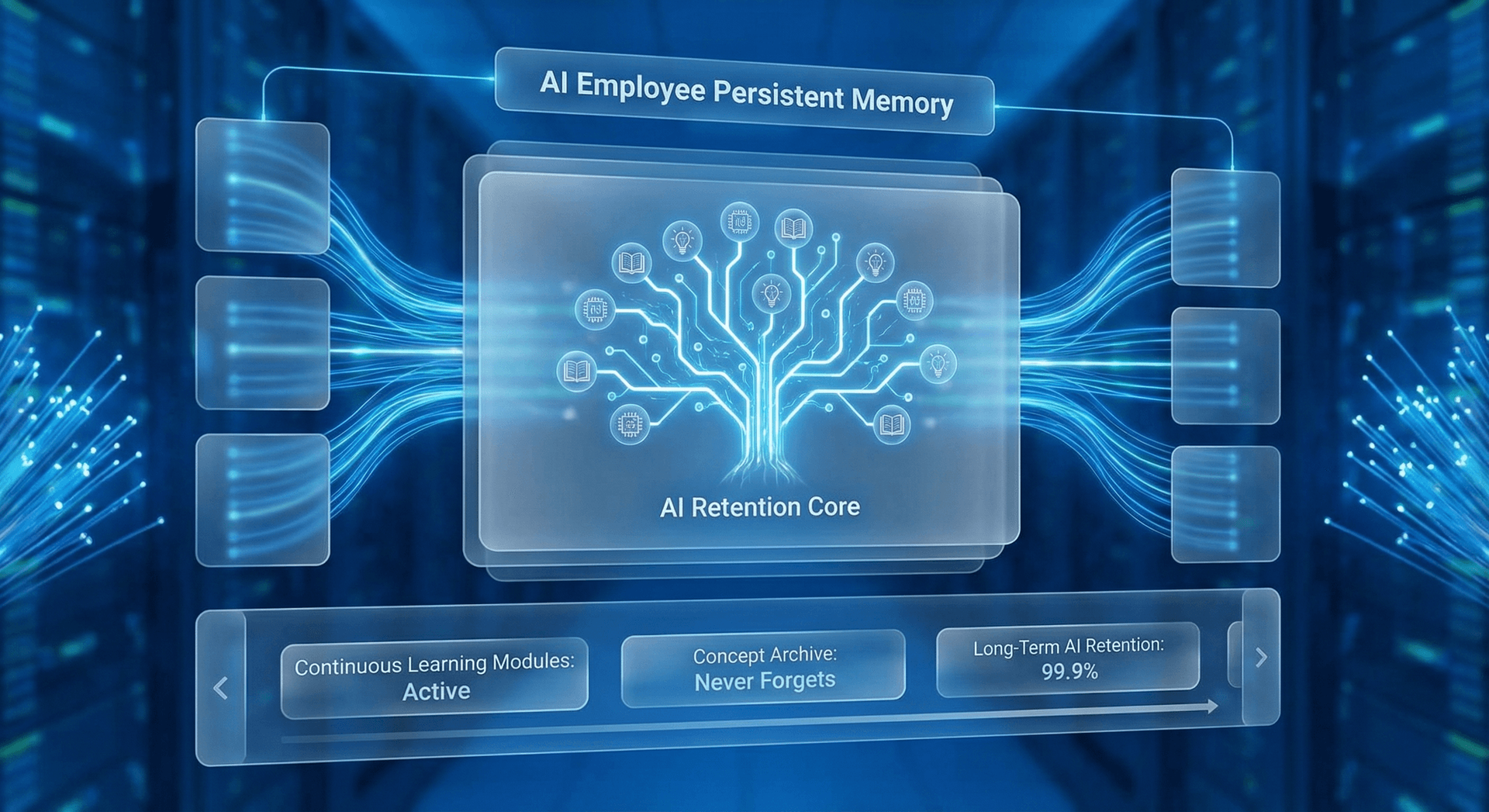
This is the section that separates James from every chatbot, every answering service, every AI tool, and every SaaS platform on the market. Most AI products suffer from what we call the Dory Problem — they forget everything between sessions. James does not. And this is the capability that will matter most twelve months from now.
James remembers everything. Every case taken. Every case declined. Every intake conversation. Every medical record reviewed. Every demand letter drafted. Every lead score assigned. Every website page built. Every content piece created. Every competitor analyzed. Every search trend identified. James is one week in — and the memory is already building.
This is not a feature — it is an architecture. James is built on persistent memory systems that retain and organize institutional knowledge across every interaction. Three months from now, when a new lead calls in with a case similar to one James evaluated before, James will recognize the pattern. When a medical record shows an injury profile James has seen in previous cases, James will apply what it learned to the current analysis.
A new paralegal starts from zero. They spend weeks learning the firm's preferences, the attorney's style, which cases the firm likes, which ones to decline. Then they leave, and the next one starts from zero again. James started from zero once, in week one, and has been building institutional knowledge every day since.
Month 1 James is capable. Month 6 James is dramatically better. Month 12 James has a depth of institutional knowledge — powered by memory embeddings that make every interaction retrievable — about the firm's operations, case patterns, and market dynamics that no individual human employee could match. No human remembers every detail of every case, every lead, every conversation, every outcome.
This compounding effect is the most important thing about an AI Employee, and it is the thing most people miss when they evaluate the technology. The question is not "what can James do today?" The question is "what will James know in a year that nobody else in the firm could possibly know?"
The Compounding Effect
For a deeper look at how persistent memory works and why it is the single most important differentiator between an AI Employee and every other AI product, read our full analysis: Your AI Employee Never Forgets.
Reinventing How Personal Injury Firms Operate
James is not just being built to automate existing workflows. James is being built to propose entirely new ones. This is the part that will change everything about how personal injury law is practiced going forward.
Because James will operate across every function of the firm simultaneously — intake, case analysis, demand letters, case management, CRM, website, content, marketing — James will see patterns that no individual staff member could. Patterns that span departments. Connections between lead sources and case outcomes. Correlations between intake conversation quality and settlement values. Relationships between content strategy and the types of cases that walk through the door.
As James accumulates data across every function, the AI Employee will begin actively proposing new workflows — approaches to running a PI practice that a traditional staff would never conceive because no single person has visibility across every function at once. Here is what that looks like as James matures:
- Predictive case scoring that gets sharper every month — identifying which cases will settle favorably before the first demand letter is drafted, based on patterns across every case the firm evaluates.
- Proactive lead nurturing — when a lead calls but is not ready to retain, James will not just log it. James will initiate a personalized follow-up sequence based on the specific injury type, urgency signals from the intake conversation, and timing patterns from cases that converted.
- Content-to-case pipeline optimization — as data accumulates, James will know which blog posts and search rankings generate the highest-value leads. The content strategy will be based not on keyword volume — but on which content produces cases that settle for the most money.
- Workflow automation between functions — when a case reaches a certain stage in the management system, James will automatically begin demand letter preparation, surface relevant comparable cases from memory, and alert the attorney with a recommended timeline. No manual triggers. No waiting for someone to remember the next step.
This is what will change the game. An AI Employee does not just do what you tell it to do. It observes. It learns. It proposes. And the proposals will be grounded in data that spans every operation the firm touches — data that no human employee has ever had access to in aggregate.
James Is Not a Tool. James Is a Strategist.
Want to see what an AI Employee could propose for your firm? Our ROI Calculator shows the operational impact — book a strategy call to explore what James-level AI could do for your practice.

What This Means for Every Personal Injury Firm
The question is not whether AI will change personal injury law. That question was settled the moment James analyzed his first medical record, drafted his first demand letter, built an entire case management platform from scratch, and began deploying a complete AI-powered phone intake system. The only question that matters now is whether your firm will be the one with an AI Employee — or the one losing cases to the firm that has one.
James is not a concept. Not a demo. Not a waitlist. James is a deployed, operational AI Employee that has already built custom case management software with integrated team communications. Already built a complete Next.js website ready to launch — an SEO and AEO juggernaut replacing the old WordPress site. Already proposed workflow innovations that are reinventing how this firm practices law. Already analyzing every case, drafting every demand letter, creating every piece of content — with a complete AI-powered phone intake system in the final stages of deployment that will ensure no after-hours call ever goes unanswered.
Consider the competitive dynamics — and consider them carefully, because this is not theoretical. When one firm in your market has an AI Employee answering every after-hours call while your firm sends leads to voicemail, they will capture those cases. When one firm has a custom-built case management platform powered by the same intelligence that scores leads and drafts demands, they operate with a precision your firm cannot match with spreadsheets and off-the-shelf software. When one firm's AI Employee has been compounding institutional knowledge for six months — learning which cases settle favorably, which lead sources produce the highest value, which content drives the best clients — that firm is not just ahead. That firm is unreachable.
The gap compounds. A 3-month head start becomes a 6-month advantage. A 6-month advantage becomes a 12-month moat. And the firm that moves second will not be starting where the first firm started — they will be starting behind an AI Employee that has been learning, adapting, proposing new strategies, and improving every single day since deployment. You do not catch up to that. You either start now, or you fall further behind every day you wait.
James is changing how personal injury attorneys conduct business. Not incrementally. Fundamentally. The firms that deploy AI Employees now will define the next era of personal injury practice. The firms that wait will spend the next five years wondering what happened to their market share.
We built James for Delventhal Law Office. We deploy AI Employees for personal injury firms across the Midwest — in Indianapolis, Detroit, Chicago, and across Indiana, Ohio, Michigan, Illinois, Wisconsin, and Kentucky. Each AI Employee is custom-trained on the specific firm's operations, practice areas, and market. No templates. No one-size-fits-all.
Read the full deployment story in our Delventhal Law Office case study. If you practice personal injury law in Indianapolis, read our deep dive on why Indianapolis PI attorneys need an AI Employee.
The Competitive Window Is Closing
Frequently Asked Questions
Q1.Is James really the first personal injury AI Employee?
To our knowledge, yes. There are AI chatbots on law firm websites and AI-powered legal research tools, but a dedicated AI Employee handling 16+ roles across intake, case analysis, demand letters, case management, CRM, website, content, and social media as one integrated system is unprecedented.
Q2.Can James handle confidential case information securely?
Yes. James runs on dedicated hardware installed at the firm. Case data never leaves the premises. All communications are encrypted with full audit trails maintained for every action taken. See our full AI Employee Security Checklist for details.
Q3.Does the attorney still make all legal decisions?
Absolutely. James handles research, analysis, drafting, and operations. Every legal decision — which cases to take, what to include in demand letters, what to publish — requires attorney approval.
Q4.How long did it take to deploy James?
James was deployed in the first week. Capabilities continue to expand as we train on more of the firm's processes and data — the website is built, case management software is nearing completion, and the AI phone system is in final deployment. The system compounds in usefulness every day. Read about what the first week looks like in our onboarding guide.
Q5.Can other PI firms get the same thing?
Yes. Cloud Radix deploys AI Employees for personal injury firms across the Midwest. Each AI Employee is custom-trained on the specific firm's operations, not a one-size-fits-all template.
Q6.How do I get an AI Employee for my firm?
Contact Cloud Radix for a free strategy call. We assess your firm's operations, identify where an AI Employee creates the most impact, and deploy a custom-trained system on your premises. Most firms are operational within 1-2 weeks.
Q7.Does James replace the attorney's staff?
James handles the work that would otherwise require 5-6 additional hires. For a solo practitioner or small firm, James IS the staff. For larger firms, James amplifies existing staff by handling the repetitive, time-consuming tasks that eat billable hours.
Q8.Can James handle multiple practice areas?
Yes. James is trained on all of Delventhal Law Office's practice areas, not just personal injury. The same AI Employee handles intake and case evaluation across every area the firm covers.
Sources
- American Bar Association — Technology and Innovation in Law Practice 2025
- Clio — Legal Trends Report: Law Firm Productivity and Revenue Benchmarks
- Thomson Reuters — State of Legal Technology: AI Adoption in Law Firms
- National Law Review — After-Hours Lead Response and Client Acquisition Rates
- Bureau of Labor Statistics — Occupational Employment and Wages: Legal Occupations 2025
- McKinsey — AI in Professional Services: Automation Potential by Task Category
Your Firm's James Is Waiting
Every after-hours call your firm misses is a case your competitor takes. Every hour spent on manual intake, records review, and demand letter assembly is an hour not spent practicing law. James changed that equation for Delventhal Law Office. Your AI Employee can change it for yours.