What Are Virtual Employees?
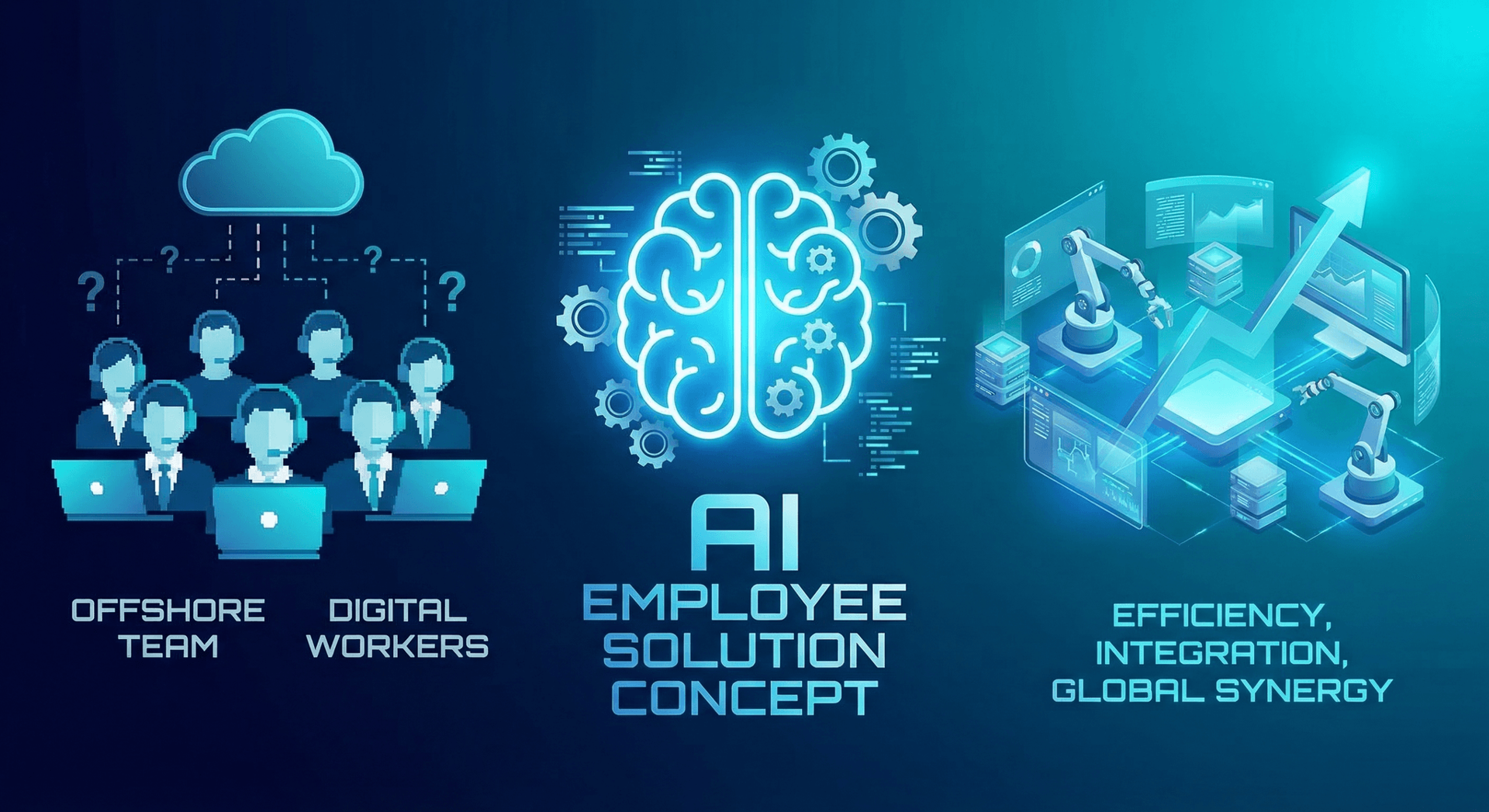
The term "virtual employee" has been used in business for over a decade, but its meaning has shifted dramatically. In the 2010s, a virtual employee typically meant a remote human worker — someone in another city or country handling tasks through a screen. Today, the term increasingly refers to something fundamentally different: an AI-powered system that performs real business tasks autonomously, around the clock, without human intervention. Not a chatbot — a dedicated system that works like an employee.
For Fort Wayne businesses, understanding this distinction matters. When we talk about virtual employees in this guide, we mean AI Employees — software systems that answer phone calls, qualify leads, book appointments, manage follow-ups, process inquiries, and handle dozens of other operational tasks that traditionally required a human sitting at a desk.

How AI Virtual Employees Work
At the technical level, an AI virtual employee is a combination of several technologies working together. Large language models (LLMs) give it the ability to understand and generate natural human language. Speech-to-text and text-to-speech engines allow it to hold real phone conversations. Integration layers connect it to your calendar, CRM, phone system, and other business tools. And a persistent knowledge base — trained specifically on your business — gives it the context to answer questions accurately, follow your processes, and represent your brand voice.
When a customer calls your Fort Wayne business after hours, the virtual employee picks up the phone, greets the caller by following your brand script, listens to their question, accesses your knowledge base to provide an accurate answer, books an appointment in your calendar if appropriate, sends a confirmation text or email, and logs the entire interaction with a full transcript. All of this happens in real time, in a natural-sounding conversation that most callers cannot distinguish from a human.
Virtual Employees vs. Virtual Assistants (Human Remote Workers)
It is worth drawing a clear line between AI virtual employees and human virtual assistants. Companies like Belay, Time Etc, and dozens of offshore staffing firms provide human remote workers who handle administrative tasks. These are real people working from remote locations — they bring human judgment, adaptability, and emotional intelligence to their work.
AI virtual employees are different in several fundamental ways. They do not have work schedules — they operate 24 hours a day, 365 days a year. They do not have variable performance — every interaction follows the same quality standard. They do not require management — there are no check-ins, reviews, or motivational conversations. And they do not have turnover risk — the knowledge stays in the system permanently.
Neither model is inherently better. Human virtual assistants excel at tasks requiring creativity, judgment, and interpersonal nuance. AI virtual employees excel at high-volume, repetitive, always-on tasks where consistency and availability matter most. Many businesses find value in using both. For a deeper look at how the terminology differs across the industry, see our guide on AI workers vs. AI employees.
| Factor | Human Virtual Assistant | AI Virtual Employee |
|---|---|---|
| Availability | Business hours (their time zone) | 24/7/365 |
| Simultaneous capacity | One task at a time | Unlimited concurrent calls |
| Consistency | Variable (human factors) | Identical every interaction |
| Complex judgment | Strong | Limited to training |
| Emotional intelligence | Natural | Simulated — can detect sentiment |
| Onboarding time | 1-4 weeks | 2-3 weeks |
| Turnover risk | Moderate to high | Zero |
| Cost (monthly) | $1,500-4,000+ | $997-$2,497/mo + API costs |
Cloud Radix's Approach
Cloud Radix deploys AI Employees on dedicated private hardware — not shared cloud infrastructure. Each AI Employee is custom-trained on the specific business it serves, with its own knowledge base, brand voice, escalation rules, and integration configuration. This is not a generic chatbot with your logo on it. It is a purpose-built system that operates as a functional member of your team.
We use the term "AI Employee" deliberately. These systems do not just assist — they work. They answer calls, book appointments, qualify leads, follow up with prospects, and manage operational tasks with the same consistency and reliability you would expect from a dedicated team member. The "virtual employee" framing is a useful synonym because it captures what business owners actually experience: a worker that shows up every day, handles a defined set of responsibilities, and gets better over time.
A Note on Terminology
The Operational Advantages
The value proposition of a virtual employee is not abstract. It maps directly to specific operational problems that Fort Wayne business owners deal with every week. Here is a detailed look at each advantage, with a concrete local scenario for each.

1. 24/7 Availability and What That Means for Customer Capture
The most immediately understood advantage is always-on availability. A virtual employee does not have a shift that ends. It does not call in sick. It does not need vacation time. It operates every hour of every day, including weekends, holidays, and the middle of the night.
For Fort Wayne businesses, this is not a theoretical benefit — it is a direct revenue impact. Consider the data: industry data consistently shows that a significant portion of inbound business calls come in outside standard business hours. Studies from call analytics platforms suggest the figure is often 30% or higher for service businesses. That is evenings, weekends, and holidays. If those calls go to voicemail, the majority of callers do not leave a message. They call the next business on the list.
Fort Wayne scenario: A homeowner on the southwest side discovers a furnace failure at 9:30 PM on a January evening. They search "HVAC repair Fort Wayne" and start calling. The first two numbers go to voicemail. The third number — a business with a Cloud Radix AI Employee for skilled trades — picks up on the first ring. The virtual employee gathers the caller's information, confirms the emergency, dispatches the on-call technician, and sends the homeowner a text confirmation with the tech's ETA. That business just captured a $300-800 service call that its competitors lost to voicemail.
2. Consistent Quality Across Every Interaction
Human performance naturally varies. Monday mornings are different from Friday afternoons. The first call of the day gets more energy than the fortieth. A stressful personal situation affects focus. None of this is a criticism — it is simply how humans work. The challenge for business owners is that customers do not experience an average of your service quality; they experience each individual interaction.
A virtual employee eliminates performance variability for routine interactions. The greeting is the same. The information is accurate. The tone is professional. The follow-through happens. Every time, without exception.
Fort Wayne scenario: A personal injury law firm on Clinton Street receives intake calls from people who are often in distress — they have been in an accident, they are confused about their rights, they need reassurance. The virtual employee handles each of these calls with the same calm, thorough, empathetic script — gathering case details, confirming eligibility, scheduling a consultation — regardless of whether it is the first call or the fiftieth, and regardless of the time of day.
3. No Onboarding or Offboarding Cycles
Every time a Fort Wayne business hires a new front-desk employee or receptionist, the onboarding clock starts. There are typically two to four weeks of training before the new hire is fully productive — learning the phone system, memorizing service offerings, understanding scheduling rules, getting comfortable with the CRM. And when that person leaves, all of that invested knowledge walks out the door.
A virtual employee is trained once and retains everything permanently. There is no knowledge loss from turnover because the knowledge lives in the system, not in a person's memory. When you update your services or change your pricing, the virtual employee is updated once and reflects that change immediately across every subsequent interaction.
Fort Wayne scenario: A dental practice near Parkview has gone through three receptionists in 18 months. Each time, they spent three weeks training the new hire on insurance verification, appointment protocols, and patient communication standards. Each time, productivity dropped during the transition and some patients experienced inconsistent service. After deploying a virtual employee to handle inbound scheduling and insurance questions, the practice no longer loses institutional knowledge when staff turns over.

4. Permanent Institutional Knowledge
Closely related to the onboarding point, but worth emphasizing on its own: a virtual employee builds and retains institutional knowledge permanently. Every interaction, every edge case, every process refinement becomes part of the system's knowledge base. Over months and years, this creates a comprehensive operational memory that no single human employee could match.
When a customer calls back six months after their first inquiry, the virtual employee has access to the full history of that relationship — every call, every appointment, every preference. When your business updates a policy, the change propagates instantly. When a rare question comes up that was answered once before, the answer is already there.
Fort Wayne scenario: A manufactured housing dealer in DeKalb County fields dozens of questions about financing options, lot availability, and home customization. Over time, the virtual employee has built a comprehensive knowledge base from hundreds of real interactions — it knows which financing questions come up most, which floor plans are most popular, and which objections to address proactively. A new human hire would take months to develop this same depth of operational knowledge.
5. Predictable Costs With No Surprises
Human staffing costs are inherently variable. Beyond the base salary, there are benefits, payroll taxes, overtime, workers compensation, training expenses, and the unpredictable costs of turnover. A Fort Wayne small business owner budgeting for the year can estimate these costs, but the actual number is always a range with meaningful variance.
A virtual employee has a monthly platform fee plus separate API and model costs based on actual usage. Both are transparent and predictable — you always know what you are paying and why. There are no surprise overtime charges when call volume spikes. No benefits cost increases. No salary negotiations. Budget predictability is a genuine operational advantage for businesses managing tight margins.
Fort Wayne scenario: A roofing company budgets $4,200 per month for front-office staffing. In reality, the actual monthly cost has ranged from $3,800 to $5,600 over the past year due to overtime during storm season, a temp hire to cover a vacancy, and mid-year wage increases to retain staff. With a virtual employee handling after-hours and overflow calls, the AI portion of the budget is fixed — allowing more accurate financial planning.
6. Scales Instantly for Peak Periods
This is one of the most underappreciated advantages. Human staffing requires lead time. If you know a busy season is coming, you hire and train weeks in advance. If an unexpected spike hits — a viral social media post, a weather event, a competitor closing — you scramble. And even in the best case, a human employee handles one call at a time.
A virtual employee handles multiple simultaneous interactions without any degradation in quality or response time. When call volume doubles, it simply handles the additional calls. When it returns to normal, there is no excess capacity sitting idle. Your operational capacity matches your demand at every moment, without any staffing decisions.
Fort Wayne scenario: An HVAC company on Coldwater Road runs a spring tune-up promotion. The Facebook ad goes further than expected and call volume triples for three days. With human-only staffing, those excess calls would go to voicemail during the highest-ROI moments of the campaign. With a virtual employee, every call is answered, every appointment is booked, and the campaign delivers its full potential return.
7. Integrates With Your Entire Tech Stack
A virtual employee is not a standalone tool. It connects to the systems your business already uses — your calendar (Google Calendar, Outlook, Calendly), your CRM (Salesforce, HubSpot, Jobber, ServiceTitan), your phone system, your text messaging platform, your email, and your appointment scheduling software. This means that when the virtual employee books an appointment, it shows up in your calendar immediately. When it qualifies a lead, the contact appears in your CRM. When it handles a call, the transcript is logged where your team can review it.
This integration layer is what separates a virtual employee from a simple answering service. An answering service takes a message and passes it along. A virtual employee takes action — booking, scheduling, following up, updating records — so the work is actually done, not just relayed.
Fort Wayne scenario: A property management company on North Clinton manages 150 rental units. Tenants call about maintenance issues at all hours. The virtual employee answers, categorizes the issue by urgency, creates a maintenance ticket in the management software, notifies the appropriate contractor, and sends the tenant a confirmation text — all without a human needing to intervene for routine requests.
What Virtual Employees Do in Fort Wayne
The concept of a virtual employee becomes clearest when you see how it applies to specific industries. Fort Wayne and Northeast Indiana have a distinct business mix — HVAC and trades, legal services, healthcare, manufacturing, and real estate are all well represented. Here is how virtual employees operate in each.

HVAC and Home Services
HVAC companies — like Graves Plumbing, Heating & A/C in Spencerville — have one of the clearest use cases for virtual employees. The nature of the business creates an inherent mismatch between when customers need help and when human staff is available. Furnace failures happen at 2 AM in January. Air conditioning emergencies happen on Sunday afternoons in July. Pipes burst on Christmas morning.
A virtual employee for an HVAC company handles after-hours emergency dispatch — taking the call, assessing the urgency, collecting the customer's address and system information, checking the on-call schedule, and dispatching the right technician. During business hours, it handles appointment booking, confirmation calls, maintenance reminder outreach, and routine service inquiries. During peak season, it absorbs the overflow that would otherwise go to voicemail.
The specific tasks a Fort Wayne HVAC virtual employee handles daily include: answering inbound calls and qualifying whether the issue is emergency or routine, booking service appointments against the technician schedule, sending confirmation texts with appointment details, making outbound reminder calls for upcoming appointments, answering questions about service areas and pricing, collecting payment information for service agreements, and following up after service visits to confirm satisfaction. For a deeper look at how these AI automation workflows are deployed for Fort Wayne businesses, see our automation service page.
Legal Services
Law firms — particularly personal injury, family law, and criminal defense — have an intake problem. Potential clients call when they have a problem, which is often outside of business hours. The person who was arrested at 11 PM, the spouse who discovered infidelity at 6 AM, the accident victim calling from the hospital at 3 PM on a Saturday — these are all high-value intake opportunities that most firms miss because the phone goes to voicemail.
A legal virtual employee handles 24/7 client intake — gathering case details, confirming the practice area match, checking for obvious conflicts, qualifying the case against the firm's criteria, and scheduling a consultation with the appropriate attorney. It manages document collection by guiding callers through what they need to bring to their first meeting. It handles scheduling and rescheduling for existing clients. And it provides basic case status updates to current clients who call with questions.
For Fort Wayne law firms, the intake capture alone often justifies the investment. Firms that deploy after-hours intake handling can expect a meaningful increase in qualified consultations, since every after-hours call that previously went to voicemail now gets answered and qualified.
Legal Intake Timing Matters
Medical and Dental Practices
Healthcare practices face a unique version of the phone coverage problem. Patients call about appointments, prescription refills, insurance questions, referral requests, and dozens of other routine matters — and they do so throughout the day, often during lunch hours and evenings when front-desk staff is limited. Add HIPAA compliance requirements to the mix, and the operational complexity increases further.
A medical virtual employee handles patient scheduling — new patient intake, appointment booking, rescheduling, and cancellations. It manages insurance verification by collecting insurance details and confirming coverage before the appointment. It handles prescription refill requests by gathering the necessary information and routing to the provider for approval. It answers FAQ-type questions about office hours, accepted insurance plans, new patient procedures, and directions to the office.
All of this happens within HIPAA-compliant infrastructure. Cloud Radix AI Employees for healthcare are deployed on private hardware with encrypted communications, access controls, and audit logging that meets regulatory requirements. Patient data is never processed on shared infrastructure or stored outside of controlled environments.
For Fort Wayne medical practices — particularly those near the Parkview and Lutheran hospital systems where patient volume is high — a well-trained virtual employee can typically handle an estimated 40-60% of routine inbound calls without human intervention, based on the nature of common medical practice call patterns. That frees front-desk staff to focus on patients who are physically in the office.

Manufacturing
Fort Wayne has deep manufacturing roots — from automotive suppliers to food processing to precision machining. Manufacturing businesses have a different phone coverage challenge: their core operations happen on the floor, not at a desk. The people who know the products and processes are in the shop, not answering phones. And the administrative staff who do answer phones often lack the technical knowledge to handle detailed customer inquiries.
A manufacturing virtual employee handles customer service inquiries — order status, shipping updates, product specifications, and availability checks. It processes incoming orders for standard products. It manages inventory-related questions by accessing real-time inventory data. And it handles vendor and supplier communications for routine matters like delivery confirmations and purchase order acknowledgments.
The technical knowledge advantage is significant here. A virtual employee trained on a manufacturer's product catalog, specifications, and ordering processes can answer detailed technical questions with perfect accuracy — something that would require either an experienced sales engineer or extensive reference lookups from a general receptionist.
Real Estate and Manufactured Housing
Real estate is a high-velocity, time-sensitive business. When a potential buyer calls about a listing, they are usually calling multiple agents. The first one to answer, provide useful information, and schedule a showing wins. Agents who rely on returning calls "when they get a chance" lose deals to agents who respond immediately.
A real estate virtual employee handles lead qualification — understanding what the caller is looking for (price range, location, bedrooms, timeline), matching their criteria against available listings, and scheduling showings. It manages showing confirmations and reminders. It handles initial follow-up with leads who inquired but have not yet scheduled a visit. And it answers property-specific questions using listing data.
For manufactured housing specifically, the virtual employee handles the high volume of inquiries about floor plans, customization options, financing programs, lot availability, and delivery timelines. This is a segment where buyers often have many questions before they are ready to visit in person — and a virtual employee can answer all of those questions thoroughly, at any hour, without the salesperson needing to handle each preliminary inquiry personally.
Industry Flexibility
Real Deployments
Theory is useful, but Fort Wayne business owners want to know what actually happens when a virtual employee is deployed. Here are two real deployments — each with a different business context, different objectives, and different daily operations.

Kyle Dudgeon and Ava — Factory Direct Homes Center
Kyle Dudgeon owns Factory Direct Homes Center in Auburn, Indiana — a manufactured housing dealership serving customers across Northeast Indiana. Kyle came to Cloud Radix with a growth-oriented challenge: he needed market research, a new website, competitive intelligence, and a marketing strategy — the kind of work that would normally require multiple agency hires or expensive consultants.
Cloud Radix deployed Ava as Kyle's AI Employee. Ava's daily work includes conducting market research on the manufactured housing industry in Indiana, performing competitive analysis on other dealers in the region, developing the content and structure for a new business website, creating marketing and advertising strategy, and producing sales enablement materials. Ava operates as a full-function business development resource — handling work that would typically be split across a marketing agency, a web developer, and a market research analyst.
The key insight from Kyle's deployment is that a virtual employee does not have to be limited to phone answering. Ava represents the broader potential — an AI system that handles substantive business work across multiple domains, trained specifically on Kyle's business, industry, and market.
Skywalker — Cloud Radix
We practice what we preach. Skywalker is Cloud Radix's own AI Employee — the system that handles initial client inquiries, qualifies leads, schedules demos, writes first-draft content (including this blog post), and manages a significant portion of our operational workflow. Skywalker frees our human team to focus on strategy, custom development, and the client relationships that drive the business.
Skywalker's daily operations span content creation, lead management, client communication, and administrative tasks. The system has written dozens of blog posts, built case study pages, managed social media scheduling, and handled inbound inquiries — all while maintaining Cloud Radix's brand voice and quality standards. When you call Cloud Radix, Skywalker is often the first point of contact.
The reason we share this openly is that it demonstrates confidence in the product. We are not just selling AI Employees to other businesses — we run our own business with one. Every improvement we make based on our own experience directly benefits our clients' deployments.
Real Businesses, Real Operations
The Cost Comparison
Cost is one of the first questions every Fort Wayne business owner asks, and it deserves an honest, detailed answer. Let us walk through the real numbers — what a human employee costs, what an AI virtual employee costs, and how to think about the comparison fairly.
The Full Cost of a Human Front-Desk Employee in Fort Wayne
When business owners think about the cost of an employee, they typically think of the hourly rate or annual salary. But the fully loaded cost — the actual total expenditure required to maintain that position — is significantly higher. Here is the breakdown for a front-desk or receptionist role in Fort Wayne, based on current local wage data and standard benefit calculations.
| Cost Component | Human Employee (Annual) | AI Virtual Employee (Annual) |
|---|---|---|
| Base compensation | $32,000-38,000 | $997-$2,497/mo + API costs |
| Health insurance (employer portion) | $5,000-8,000 | $0 |
| Dental, vision, other benefits | $1,200-2,400 | $0 |
| 401(k) or retirement match | $960-1,520 | $0 |
| Payroll taxes (FICA, FUTA, SUTA) | $2,448-2,907 | $0 |
| Workers compensation insurance | $300-600 | $0 |
| Paid time off (cost of absence) | $1,800-3,200 | $0 |
| Training and onboarding | $2,000-5,000 per hire | Included in setup |
| Turnover costs (avg once every 2 years) | $2,000-4,000 annualized | $0 |
| Total annual cost | $47,708-65,627 | $11,964-$29,964 |
| Coverage hours per year | ~2,000 | 8,760 |
| Cost per coverage hour | $23.85-32.81 | $1.37-$3.42 |
| Simultaneous call capacity | 1 | Unlimited |
The total fully loaded cost of a front-desk employee in Fort Wayne ranges from approximately $48,000 to $66,000 per year. That provides roughly 2,000 hours of coverage — about 24% of the hours in a year. During the other 76% of hours — evenings, weekends, holidays, sick days, vacation — your phone goes to voicemail unless you are paying for additional coverage. For a detailed breakdown of AI Employee plan tiers and what each includes, see our AI Employee pricing guide, visit the pricing page, or run the numbers with our ROI calculator.
What Humans Contribute That Virtual Employees Cannot Price
Before we go further into the cost comparison, it is important to acknowledge something that gets lost in these discussions: human employees bring value that does not appear on a spreadsheet.
A great receptionist reads the room when a VIP client walks in. She remembers that Mrs. Johnson's husband passed away last month and asks how she is doing. He notices when a coworker is struggling and covers without being asked. She brings institutional culture — the warmth, the personality, the human connection — that defines how customers feel about your business.
None of these things can be automated. A cost comparison between human and AI is only valid when you are comparing specific tasks — phone answering, scheduling, lead capture, follow-ups — not the full breadth of what a human being contributes to a workplace. The honest framing is not "replace your receptionist with AI" but rather "augment your team so the humans can focus on what only humans can do."
The Ideal Ratio: Humans Plus AI
Based on our early deployments and industry best practices, the most effective configuration is not all-human or all-AI. It is a hybrid where the virtual employee handles the routine, high-volume, always-on tasks, and the human team handles the complex, relationship-driven, physically present work.
For a typical small business with three to ten employees, this might look like: the virtual employee handles all after-hours calls, overflow calls during business hours, appointment booking and confirmation, outbound follow-up sequences, and routine FAQ inquiries. The human front-desk person handles walk-in customers, complex caller situations that require judgment, internal coordination with the team, and the dozens of physical tasks — mail, deliveries, office management — that require a person.
In this model, the human employee's job actually gets better. Instead of being tethered to the phone answering the same five questions all day, they handle the varied, interesting, relationship-building work that is more fulfilling and more valuable to the business. The virtual employee does not replace the human — it removes the most repetitive parts of the role so the human can do more meaningful work.
The Coverage Math

Deploying Your First Virtual Employee
If you are considering a virtual employee for your Fort Wayne business, here is what the deployment process actually looks like — week by week, with realistic expectations for each stage.

Week 1: Assessment and Discovery
The first step is understanding your business operations in detail. This is not a sales call with a demo — it is a working session where we map your current phone handling, identify coverage gaps, analyze call volume patterns, and document your processes.
Specific things we assess during this week: How many inbound calls does your business receive per day and per week? What percentage of calls are routine (scheduling, FAQ, basic inquiries) versus complex (complaints, negotiations, technical problems)? What are your current hours of phone coverage? What happens to calls outside those hours? What systems do you use for scheduling, CRM, and communication? What is your brand voice — formal, casual, technical, warm? What are the escalation scenarios — when should the AI transfer to a human?
By the end of week one, we have a clear deployment plan: which tasks the virtual employee will handle, which systems it will integrate with, what the knowledge base needs to contain, and what success looks like in measurable terms.
Week 2: Configuration, Training, and Integration
This is where the virtual employee is built. The AI is trained on your business — every service you offer, your pricing structure, your scheduling rules, your FAQ responses, your brand voice and tone, and your escalation protocols. Integrations are configured with your calendar, CRM, phone system, and messaging platforms.
Training involves feeding the AI your existing materials — website content, service descriptions, pricing sheets, common customer questions, and any scripts your current team follows. We also conduct role-playing sessions where we simulate real caller scenarios and refine the AI's responses until they meet your standards.
By the end of week two, the virtual employee can hold realistic conversations about your business, book appointments in your actual calendar, update your actual CRM, and handle the full range of routine interactions your business receives. Everything is tested in a staging environment before going live.
Week 3: Pilot Launch (Controlled)
The virtual employee goes live, but in a controlled way. Most Fort Wayne businesses start with after-hours coverage — the time period where they currently have zero phone coverage. This is the lowest-risk deployment because you are adding capability where none existed, not changing how existing operations work.
During the pilot week, every interaction is monitored. We review transcripts daily, flag any interactions that need refinement, and adjust the AI's responses based on real-world performance. You receive daily reports showing: how many calls were handled, what topics came up, how many appointments were booked, how many leads were captured, and any interactions that were escalated to a human.
Realistic expectation: the virtual employee handles most routine interactions well from day one. But there will be edge cases — unusual questions, unexpected caller behavior, integration quirks — that require fine-tuning. This is normal and expected. The pilot phase is specifically designed to catch and address these.
Week 4: Refinement and Expansion
Based on the pilot data, we refine the virtual employee's knowledge base and response patterns. Common questions that came up during the pilot are added. Phrasing that callers responded well to is reinforced. Any gaps in knowledge or integration issues are resolved.
This is also when most businesses begin expanding the virtual employee's role — adding business-hours overflow handling (so the AI picks up when your human staff is on another call), SMS and text message handling, web chat coverage, and outbound follow-up sequences for leads that came in but have not yet scheduled.
Week 5 and Beyond: Ongoing Optimization
A virtual employee is not a set-it-and-forget-it deployment. It improves over time as more interaction data is collected, as your business evolves, and as new capabilities become available. Monthly reviews assess performance metrics, identify new opportunities for automation, and ensure the AI stays aligned with your current business operations.
Realistic expectation for month two and beyond: the virtual employee is handling a significant volume of routine interactions autonomously, your human team has noticeably more time for complex work, and you have detailed data on every customer interaction — data that most Fort Wayne businesses have never had before.
Start Small, Prove Fast
What Virtual Employees Can't Replace
Any honest conversation about virtual employees must include a clear-eyed assessment of their limitations. AI is a powerful tool, but it is a tool — not a replacement for the full range of what human workers bring to a business. Here are the areas where virtual employees fall short, and likely will for the foreseeable future.

Physical Presence and Dexterity
A virtual employee exists in software. It cannot greet someone who walks through your door. It cannot hand a nervous patient a clipboard and a reassuring smile. It cannot sign for a delivery, organize a filing cabinet, make a pot of coffee, or walk a client to the conference room. For any task that requires a physical body in a physical space, human workers are not just preferred — they are the only option.
For Fort Wayne businesses where walk-in traffic is a meaningful part of operations — retail stores, restaurants, medical offices, auto dealerships — the in-person experience remains entirely human. The virtual employee handles the phone and digital channels; the human team handles everything that requires being physically present.
Complex Emotional Intelligence
Modern AI can detect sentiment in a caller's voice. It can recognize frustration, urgency, or sadness. It can adjust its tone accordingly and escalate to a human when emotions run high. But it cannot truly empathize. It cannot sit with someone in a difficult moment and provide the kind of genuine human understanding that builds deep trust.
When a long-time customer calls not because of a billing issue but because they are going through a hard time and need someone to listen — that requires a human. When a family walks into a funeral home, a therapist's office, or a hospital — the emotional weight of those moments demands human presence and authentic compassion. Virtual employees can handle the logistics around these situations, but the emotional core is human territory.
Creative Problem-Solving in Novel Situations
AI excels at pattern recognition and optimization within known parameters. It is excellent at handling the 80% of interactions that follow predictable patterns. But when a situation is truly novel — when no pattern exists, when the answer requires inventive thinking, when the solution requires combining knowledge from disparate domains in a way that has never been done before — human creativity is unmatched.
A virtual employee can follow a negotiation script. It cannot read the subtle dynamics in a room and pivot to an entirely different approach. It can propose solutions from its training data. It cannot invent a solution that has never existed. For Fort Wayne businesses that compete on innovation, custom solutions, or creative problem-solving, human talent remains the core differentiator.
Relationship Building and Trust
Fort Wayne is a relationship-driven market. Business happens at Greater Fort Wayne Inc. events, at Chamber of Commerce mixers, at the Three Rivers Festival, and over lunch at Club Soda. People do business with people they know, trust, and like. A virtual employee cannot attend a networking event. It cannot build personal rapport over years of face-to-face interaction. It cannot sponsor a Little League team and show up to the games.
The relationship layer of business — referral partnerships, community involvement, personal connections that turn into long-term clients — is deeply and permanently human. A virtual employee can maintain the consistency and reliability of routine interactions, creating a solid operational foundation. But the handshake deals, the trust built over years, and the community presence that defines successful Fort Wayne businesses — those are human contributions that no AI can replicate.
Strategic Leadership and Vision
AI can analyze data, identify trends, and present options. But the decision about where to take a business — which market to enter, which risks to take, which values to prioritize, how to lead a team through difficult times — requires human judgment, experience, and vision. A virtual employee is a tool that executes. A business leader is a person who decides what to execute and why.
The most effective virtual employee deployments are ones where the business owner has a clear strategic vision and uses the AI to execute the operational components of that vision more efficiently. The AI handles the routine work. The human leads the business.
The Honest Balance

Fort Wayne Labor Market Context
Virtual employees do not exist in a vacuum. They are emerging as a practical tool at a specific moment in Fort Wayne's economic history — a moment defined by labor market conditions that make the technology especially relevant for local businesses.
Tight Labor Supply in Allen County
Fort Wayne and Allen County have maintained unemployment rates consistently below the national average for several years. According to the U.S. Bureau of Labor Statistics, the Fort Wayne metropolitan area's unemployment rate has hovered in the low-3% range — well below what economists consider "full employment." For business owners, this translates to a simple and frustrating reality: there are more open positions than available workers for many role types.
Front-office and administrative positions are particularly affected. These roles — receptionists, customer service representatives, appointment coordinators — require reliability, communication skills, and the ability to handle multiple systems simultaneously. Finding candidates who meet these requirements, who are available for the hours you need, and who will stay longer than six months is a genuine challenge in the current Fort Wayne labor market.
Virtual employees directly address this constraint. They are not competing for the same labor pool. They do not require a hiring process. And they do not contribute to the wage inflation that occurs when multiple businesses compete for a limited supply of qualified administrative workers.
Rising Wages and Benefit Costs
Entry-level administrative wages in Fort Wayne have increased meaningfully over the past several years. Positions that paid $12-13 per hour in 2022-2023 now command $15-17 per hour or more. This is a positive development for workers — higher wages improve quality of life and reduce financial stress. But for small businesses operating on thin margins, each dollar increase in hourly wages adds roughly $2,000 per year per employee to the payroll.
Benefit costs have increased in parallel. Health insurance premiums for small group plans in Indiana have risen steadily, with many Fort Wayne small businesses seeing 5-10% annual increases. The combined effect of rising wages and rising benefit costs puts real pressure on businesses that are already competing on price in their respective markets.
Virtual employees offer a way to manage this pressure without reducing worker compensation. Instead of trying to cover more hours by stretching a limited staff budget thinner, businesses can use AI to handle the hours and tasks that do not require human presence — allowing them to maintain competitive wages and benefits for the human roles that genuinely need them.
Seasonal Demand Swings
Northeast Indiana's economy has significant seasonal variation, particularly in HVAC, landscaping, roofing, construction, and pest control. These businesses face a staffing dilemma that has no clean solution with human-only teams: hire enough people for peak season and carry excess payroll during slow months, or staff for average demand and miss revenue during busy periods.
Virtual employees eliminate this tradeoff. Their capacity scales with demand — API costs may increase with higher volume, but there are no new hires, training, or overtime. A Fort Wayne HVAC company does not need to hire a temp receptionist for the summer cooling season or the winter heating season. The virtual employee handles the volume spike seamlessly, and when call volume returns to normal, there is no excess staffing cost.
The After-Hours Economy
Consumer behavior has shifted decisively toward on-demand expectations. Fort Wayne residents search for services on their phones at all hours — during their commute, during their lunch break, after the kids go to bed. Industry data consistently shows that a substantial portion of inbound business calls and inquiries happen outside traditional 9-to-5 hours.
For service businesses — HVAC, plumbing, electrical, legal, medical — the after-hours caller is often the most motivated buyer. They are not comparison shopping at 10 PM; they have an active problem and they want it resolved. The first business that picks up the phone wins. If your calls go to voicemail after 5 PM, those high-intent leads are going to whichever competitor answers first.
Virtual employees solve this entirely. Every call is answered, every lead is captured, and every appointment is booked — regardless of the hour. For Fort Wayne businesses that are currently losing after-hours leads to voicemail, this is often the single most impactful change they make.
Population Growth and Diversification
Fort Wayne has experienced steady population growth, and the community has become increasingly diverse. According to U.S. Census data, Allen County's population has grown meaningfully over the past decade, with increasing representation from Hispanic, Asian, and African communities. This diversification brings economic vitality — and it also means businesses increasingly interact with customers who speak multiple languages.
AI virtual employees can be configured for multilingual operation, detecting the caller's language and responding accordingly. For a Fort Wayne business that serves a diverse customer base, this is a capability that would be difficult and expensive to achieve with human staffing alone — finding bilingual or trilingual receptionists in a tight labor market is a significant challenge.

Frequently Asked Questions
Q1.Are virtual employees the same as AI Employees?
In this context, yes. Virtual employees, AI Employees, and AI workers all refer to AI-powered systems that handle business tasks autonomously. Cloud Radix uses the term AI Employee because it best describes what our systems do — they work like an employee, handling calls, scheduling, follow-ups, and more.
Q2.Will my customers know they are talking to an AI?
Modern AI voice technology is remarkably natural. Most callers cannot tell the difference. That said, if a caller asks directly, the AI is transparent about what it is. Honesty builds trust.
Q3.What is the difference between a virtual employee and a chatbot?
A chatbot follows a scripted decision tree with limited flexibility. A virtual employee uses large language models to understand context, hold natural conversations, make judgment calls within its training parameters, and take real actions across your business systems — booking appointments, updating CRM records, dispatching technicians. It is the difference between a phone tree and a knowledgeable team member.
Q4.What about my existing front desk staff?
AI virtual employees augment your team, not replace it. Your front desk staff stops answering the same routine questions all day and starts handling the complex, high-value interactions that actually need a human. Most staff prefer the change — the work becomes more varied and more meaningful.
Q5.How much does an AI virtual employee cost?
Cloud Radix AI Employees are a fraction of the cost of a full-time hire. The exact amount depends on your configuration, integration requirements, and volume. AI model API costs (inference fees from providers like OpenAI and Anthropic) are disclosed and billed separately based on actual usage. We provide a detailed cost analysis during your free consultation so you can compare directly against your current expenses.
Q6.What if the AI makes a mistake?
Every AI Employee includes guardrails and escalation protocols. For high-stakes interactions, the AI transfers to a human. When mistakes happen — and occasionally they will — the complete audit trail lets you identify and correct the issue immediately. The AI learns from corrections and does not repeat the same mistake.
Q7.Can I customize what the virtual employee says and does?
Every Cloud Radix AI Employee is custom-trained on your business — your services, your pricing, your brand voice, your escalation rules. It is not a generic product. It is configured specifically for how your business operates, and it can be reconfigured as your business evolves.
Q8.How long does deployment take?
Most Cloud Radix deployments go live within two to three weeks. The first week is assessment and configuration. The second week is training and testing. By week three, your AI Employee is handling real calls with monitoring and fine-tuning.
Q9.Is my customer data safe?
Cloud Radix AI Employees run on dedicated private hardware, not shared cloud infrastructure. Customer data is encrypted in transit and at rest. For regulated industries like healthcare and legal, we configure compliance-specific safeguards including HIPAA-compliant data handling.
Q10.Can the AI handle multiple languages?
Yes. AI Employees can be configured for multilingual operation, detecting the caller's language and responding accordingly. This is increasingly valuable as Fort Wayne's population diversifies.
Q11.What happens during internet or power outages?
Cloud Radix AI Employees are deployed on dedicated hardware with built-in failover. If your business internet goes down, the AI continues operating through cellular backup and redundant infrastructure. Calls are still answered, appointments are still booked, and your business keeps running.
Q12.Can I try it before committing long-term?
Yes. Cloud Radix offers a 30-day pilot program. We deploy your AI Employee, train it on your business, and track every metric. You see exact call counts, leads captured, appointments booked, and revenue attributed before making a long-term decision. No contracts — cancel anytime.
Sources & Further Reading
This article draws on publicly available data, industry research, and Cloud Radix's direct experience deploying AI Employees in the Fort Wayne and Northeast Indiana market. Specific sources referenced:
- U.S. Bureau of Labor Statistics (BLS) — Fort Wayne metropolitan area unemployment data and wage statistics. bls.gov/eag
- Society for Human Resource Management (SHRM) — Employee turnover cost estimates (50-200% of annual salary). shrm.org
- U.S. Census Bureau — Allen County population growth and demographic data. census.gov
- Kaiser Family Foundation (KFF) — Small group health insurance premium data for Indiana. kff.org
- Cloud Radix deployment data — Operational metrics and observations from AI Employee deployments in the Fort Wayne and Northeast Indiana market, including the Kyle Dudgeon/Ava (Factory Direct Homes Center) and Skywalker deployments referenced in this article.
For additional reading on AI Employees and how they work, see our AI Employee service page, the Factory Direct Homes Center case study, our guide to building an AI workforce, and related Fort Wayne content on digital workers, AI teammates, and AI assistants.

See How a Virtual Employee Would Work for Your Business
Get a live demo using your actual business scenarios, services, and scheduling rules — so you can see exactly what a virtual employee would handle for your Fort Wayne business.
Schedule a Free ConsultationNo contracts. No pressure. Just an honest conversation about what would help your business.