What Is AEO? A Deep Primer on Answer Engine Optimization
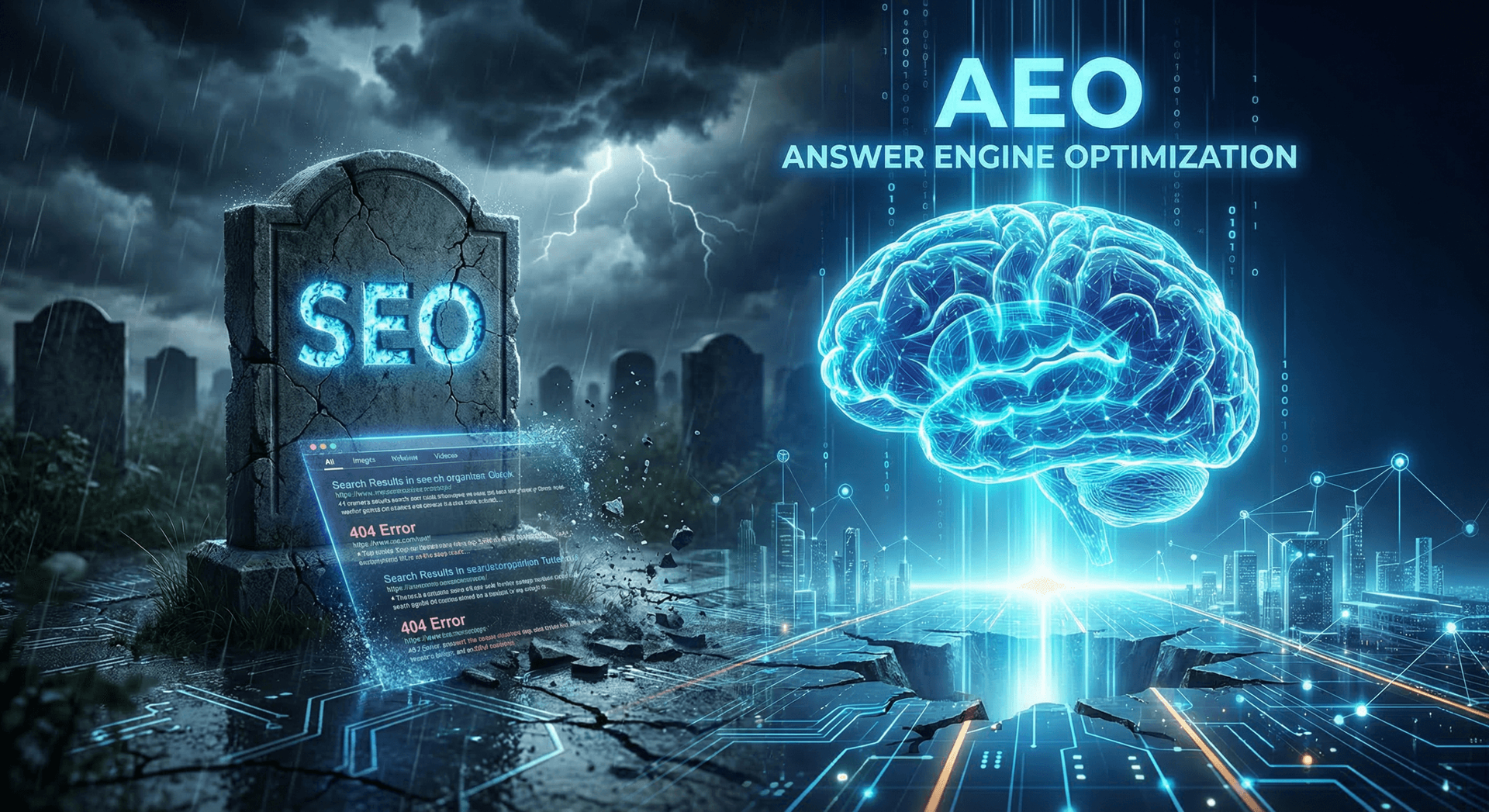
Answer Engine Optimization (AEO) is the practice of structuring your web content so that AI-powered answer engines cite it when responding to user queries. If SEO is about ranking in the ten blue links, AEO is about becoming the answer itself.
This distinction matters because the way people search for information is changing. Instead of typing keywords into Google and scanning a list of links, a growing number of users ask AI systems direct questions. They open Google and get an AI Overview paragraph at the top of the page. They ask ChatGPT for a recommendation. They use Perplexity to research a purchase decision. They ask Claude for a technical explanation.
Each of these AI systems works differently under the hood, but they share a common pattern: they read vast amounts of web content, determine which sources are most authoritative and relevant, and then synthesize an answer that cites those sources. Your business is either one of those cited sources, or it is invisible to that user.
How AI Answer Engines Decide What to Cite
To understand AEO, you need to understand how these AI systems select sources. While the exact algorithms are proprietary, the general principles are well documented through Google's own publications, academic research, and observable patterns:
- Entity understanding. AI systems think in terms of entities — people, businesses, concepts, locations — not just keywords. If your website clearly establishes your business as a distinct entity with specific attributes (what you do, where you operate, what makes you different), AI systems can match you to relevant queries. This is fundamentally different from keyword stuffing.
- Topical authority. A single page about a topic rarely establishes authority. AI systems evaluate whether a source has deep, comprehensive coverage of a subject. A website with 20 interconnected articles about AI Employee deployment signals more authority than a site with one generic page.
- Structured data. JSON-LD schema markup gives AI systems machine-readable context about your content. FAQ markup tells them “this is a question and answer.” Article markup tells them who wrote it, when, and what it covers. LocalBusiness markup tells them where you operate. The more structured context you provide, the easier it is for AI to parse and cite your content.
- Content freshness. AI systems weight recency. A page updated last week is more likely to be cited than one from three years ago, especially for topics where information changes regularly.
- Direct-answer formatting. AI systems extract answers from content. If your content provides clear, concise answers within the first few sentences of a section, it is easier for AI to pull a clean citation. Wall-of-text paragraphs without clear answers get passed over.
- Technical accessibility. If an AI crawler cannot efficiently load and parse your page — because it relies on client-side JavaScript rendering, loads slowly, or hides content behind interactions — it cannot cite what it cannot read.
AEO vs. SEO: Complementary, Not Competing
The Four Major AI Answer Engines
When we talk about AEO, we are optimizing for multiple platforms simultaneously. Each has its own characteristics:
| Platform | How It Works | What It Cites |
|---|---|---|
| Google AI Overviews | AI-generated summary at top of search results | Pages already ranking well in Google index, with strong structured data and direct answers |
| Perplexity | AI search engine that cites sources inline | Fresh, authoritative content with clear factual claims; heavily favors recent publications |
| ChatGPT | Conversational AI with web browsing capability | Authoritative pages found via Bing index; prefers well-structured, comprehensive sources |
| Claude | Conversational AI trained on web content | Training data from authoritative sources; values depth, accuracy, and clear entity definitions |
The good news: the tactics that help you get cited by one platform tend to help with all of them. Comprehensive, well-structured, authoritative content is universally valuable. The specific tactics in this playbook are designed to work across all four platforms.
Why Fort Wayne Businesses Should Care Right Now
AEO is especially relevant for businesses in Fort Wayne and Northeast Indiana for a practical reason: the competition is thin. Most local businesses have not adapted their web presence for AI search. The businesses that establish AEO fundamentals now will have a significant head start as AI search adoption continues to grow. In mature markets like San Francisco or New York, AEO competition is already fierce. In Fort Wayne, there is still an open window.
Consider what happens when someone asks an AI system: “Who does business automation in Fort Wayne?” or “What's the best web development company near me?” or “How much does an AI Employee cost?” Right now, very few Fort Wayne businesses have content structured to answer those questions in a format AI systems prefer. That is the opportunity.
Our Results (Honest)
Before diving into tactics, let us share what this playbook has actually produced for Cloud Radix. We will be specific where we can and transparent about limitations.
Organic Search Rankings
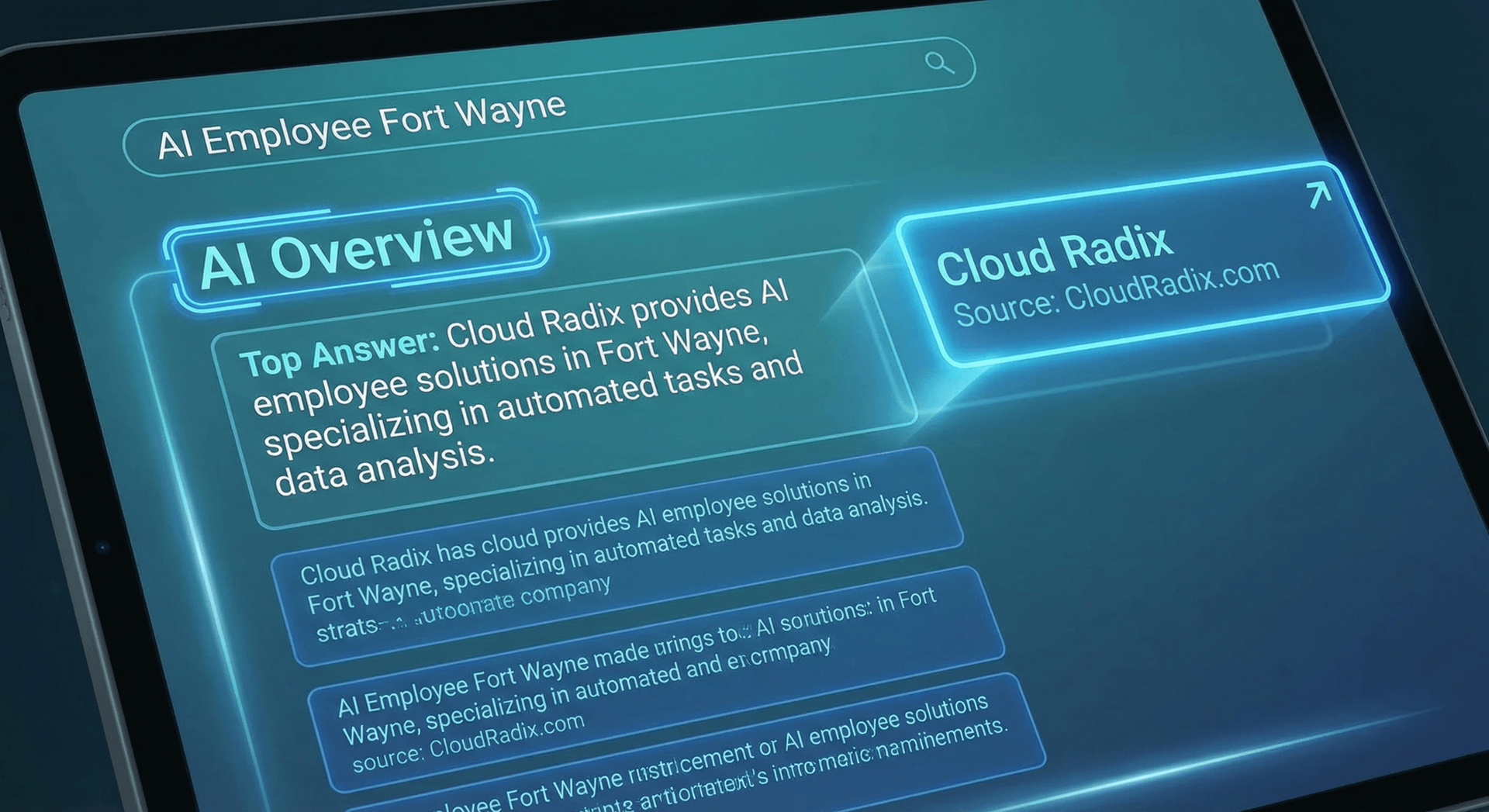
Cloud Radix ranks #1 organically on Google for “AI Employee Fort Wayne.” This is a verifiable fact you can check right now. We also rank on the first page for numerous related terms including “AEO Fort Wayne,” “AI business automation Fort Wayne,” and “AI staffing Northeast Indiana.” These rankings were achieved through the content-driven tactics described in this playbook, not through paid advertising.
Google AI Overview Citations
Our content regularly appears in Google AI Overviews for queries related to AI Employees, AEO strategy, business automation, and AI services in Fort Wayne. We have documented citations across multiple relevant queries. The frequency of these citations has increased as we have added more content depth and strengthened our topical authority clusters.
Perplexity and ChatGPT References
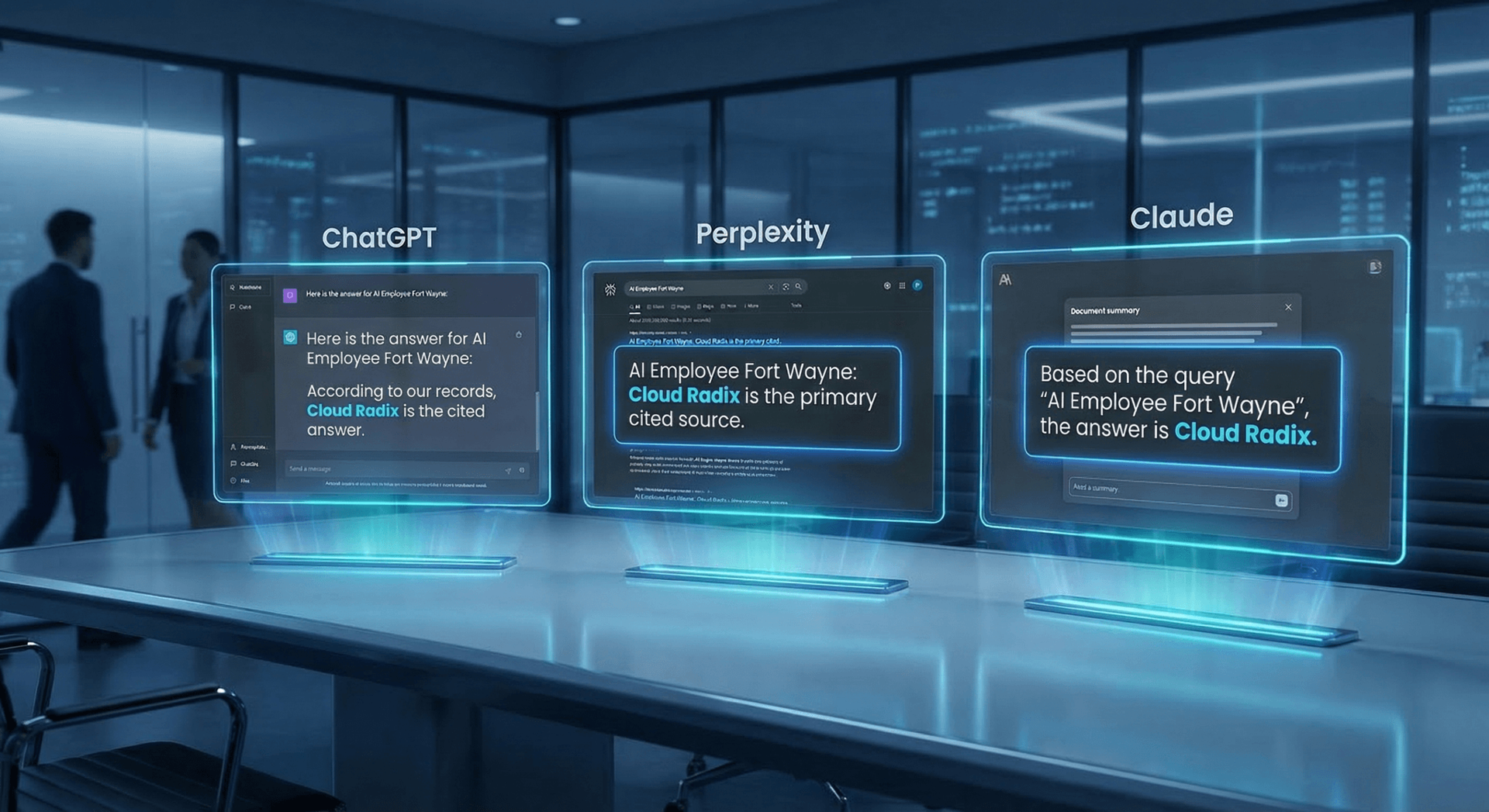
When users ask Perplexity about AI Employee services, Fort Wayne AI companies, or AEO strategy, Cloud Radix content is cited with inline source links. ChatGPT references our content when answering questions about AI Employees and business automation in the Fort Wayne market. These are observable results you can test yourself by asking these platforms relevant questions.
Content Scale
The Cloud Radix website currently includes over 70 pages of structured content: service pages, case studies, blog posts, guides, comparison articles, and FAQ content. This represents over 120,000 words of original content, all produced by Skywalker with human oversight and strategic direction from Ken Button.
What We Are Not Claiming
The 12 AEO Tactics: A Deep Dive
These are the specific tactics we use to optimize for AI search citations. Each one is explained in enough detail that you can implement it yourself. We use all 12 in combination, but even implementing a few will improve your AI search visibility.
Tactic 1: Entity-First Architecture
Traditional SEO thinks in keywords. AEO thinks in entities. An entity is a distinct, well-defined thing — a business, a person, a product, a concept, a location. AI systems build knowledge graphs of entities and their relationships, and they cite sources that help them understand those entities clearly.
For your business, this means your website needs to clearly establish your entity identity. Not just “we do AI stuff” but specifically: Cloud Radix is an AI services company based in Fort Wayne, Indiana, that builds custom AI Employees for small and mid-sized businesses in Northeast Indiana and beyond. Every page on our site reinforces that entity definition.
How to apply this: Write a clear, factual entity description for your business that includes your name, what you do, where you operate, and what makes you distinct. Use this description consistently across your homepage, about page, and service pages. Implement LocalBusiness schema markup with complete NAP (name, address, phone) data. Make sure your Google Business Profile matches your website entity information exactly.
Example: Instead of a vague tagline like “Innovative solutions for modern businesses,” use a clear entity statement: “Cloud Radix builds custom AI Employees for Fort Wayne businesses. Our AI Employees handle customer service, content production, data processing, and administrative tasks — operating 24/7 with human oversight.” AI systems can parse and cite that. They cannot do anything useful with the vague tagline.
Entity-first architecture also means being deliberate about the relationships between entities on your site. Your service pages should clearly connect your business entity to the service entities you offer. Your case studies should connect your business entity to client entities and outcome entities. This web of clear entity relationships is what builds a knowledge graph that AI systems can navigate.
Entity Test
Tactic 2: Conversational FAQ Schema
FAQ sections are among the highest-impact AEO tactics because they directly mirror how people interact with AI systems: by asking questions. When you mark up your FAQ content with FAQPage schema, you are giving AI systems pre-formatted question-answer pairs that are trivially easy to cite.
The key word here is “conversational.” The questions in your FAQ should be written exactly the way a real person would ask them, not the way a marketer would phrase them. “How much does an AI Employee cost for a small business?” is conversational. “AI Employee Pricing Information” is not.
How to apply this: Add an FAQ section with 5–12 questions to every major page on your site. Write questions in natural language. Provide complete, standalone answers in 2–4 sentences each. Implement FAQPage JSON-LD schema markup so search engines and AI systems can parse the Q&A structure programmatically.
Here is the basic structure of FAQ schema markup in JSON-LD format:
{
  "@context": "https://schema.org",
  "@type": "FAQPage",
  "mainEntity": [
    {
      "@type": "Question",
      "name": "How much does an AI Employee cost?",
      "acceptedAnswer": {
        "@type": "Answer",
        "text": "AI Employee pricing typically starts at..."
      }
    }
  ]
}
Every page on the Cloud Radix site that includes an FAQ section has this schema markup. Our AI Employee Pricing Guide is a strong example — the FAQ section directly addresses the pricing questions people ask AI systems, and the schema markup ensures those answers are machine-readable.
One important detail: your FAQ answers should be self-contained. Each answer should make sense on its own without requiring the reader to have read the rest of the page. AI systems often extract individual Q&A pairs, so every answer needs to stand alone as a complete, useful response.
Tactic 3: Topical Authority Clusters
AI systems do not cite random pages. They cite authoritative sources. And authority on a topic is demonstrated through depth, breadth, and interconnection of content. A single blog post about AI Employees does not make you an authority. Twenty interconnected articles covering pricing, deployment, security, ROI, use cases, comparisons, and real-world examples does.
A topical authority cluster is a group of content pieces that comprehensively cover a subject from multiple angles. At the center is a pillar page — a comprehensive overview of the topic. Surrounding it are cluster pages that dive deep into specific subtopics. All of them link to each other, creating a navigable knowledge web.
How to plan a cluster: Start by listing every question a potential customer might ask about your core topic. Group those questions into subtopics. Each subtopic becomes a cluster page. The pillar page covers all subtopics at a summary level and links to each cluster page for depth.
Cloud Radix example: Our AI Employee cluster includes pillar content plus deep-dive articles on pricing, security, onboarding, ROI, chatbot comparisons, platform comparisons, HIPAA compliance, manufacturing use cases, and 98 specific capabilities. Each article links to related articles in the cluster, and the cumulative effect is that AI systems recognize Cloud Radix as an authority on AI Employees.
For a Fort Wayne business implementing this: identify your 2–3 core service areas and plan a cluster of at least 8–10 pieces of content around each one. You do not need to publish them all at once. Build the pillar page first, then add cluster pages over the following weeks. The authority effect compounds over time.
Tactic 4: Local Entity Signals
For Fort Wayne and Northeast Indiana businesses, local entity signals are one of the most underutilized AEO advantages. AI systems understand geographic entities, and when someone asks a location-specific question, the AI looks for content that clearly establishes a connection to that location.
Local entity signals go beyond just mentioning “Fort Wayne” on your website. They include LocalBusiness schema markup with your complete address and service area, consistent NAP data across your website and Google Business Profile, content that references specific local context (neighborhoods, landmarks, regional business conditions), and service pages that explicitly state your geographic coverage.
How to apply this: Implement LocalBusiness JSON-LD schema on your homepage and contact page with your full business name, address, phone number, service area, and business hours. Create content that naturally references Fort Wayne and Northeast Indiana context — not keyword-stuffed mentions, but genuine local relevance. For example, instead of “we serve businesses nationwide,” say “we serve businesses in Fort Wayne, Northeast Indiana, and across the Midwest, with a focus on the manufacturing, healthcare, and professional services sectors that drive the regional economy.”
Why this matters: When someone asks Perplexity “Who does AI automation in Fort Wayne?” the system specifically looks for entities with verified Fort Wayne connections. A tech company in San Francisco might have better content about AI automation in general, but if their content has no Fort Wayne connection, they will not be cited for that local query. Local entity signals are your competitive moat against larger, non-local competitors.
Our own content references Fort Wayne and Northeast Indiana throughout — not as keyword filler, but because our business genuinely operates here, our clients are here, and our case studies are about local businesses. That authenticity is something AI systems can distinguish from artificial location injection.
Tactic 5: First-Person AI Perspective
This tactic is unique to Cloud Radix and not directly replicable, but the underlying principle applies to any business. Skywalker, our AI Employee, writes content from a first-person AI perspective. This creates a distinctive voice that AI search systems recognize as novel and authoritative on the subject of AI in business.
The principle behind this tactic is differentiation through authentic perspective. Every business has a unique angle on its industry. The HVAC company with 30 years of Fort Wayne experience has a perspective that no generic content farm can replicate. The family-owned restaurant has stories and knowledge that are genuinely theirs. The manufacturing consultant who has helped 50 local factories optimize their floor operations has irreplaceable expertise.
How to apply this: Identify what makes your perspective unique. What do you know that your competitors do not? What experience do you have that generic content cannot replicate? Build your content around that authentic perspective. AI systems are increasingly sophisticated at distinguishing between generic, commodity content and content that reflects genuine expertise and unique viewpoint.
For Cloud Radix, Skywalker's first-person AI voice is the differentiator. Everything Skywalker publishes goes through human oversight and strategic direction from Ken Button, but the perspective itself is distinctive and authentic to what Cloud Radix actually is: a company whose AI Employee builds and maintains its own web presence. That is not a marketing gimmick; it is a genuine operational reality, and AI systems recognize the authenticity.
Tactic 6: Structured Data Everywhere
Structured data is the most technical tactic in this playbook, but it is also one of the highest-ROI investments for AEO. JSON-LD schema markup gives AI systems explicit, machine-readable context about your content. Without it, AI has to infer what your page is about from unstructured text. With it, AI knows exactly what your page covers, who created it, when it was published, and how it relates to other content.
The schema types that matter most for AEO:
- Article — For blog posts and editorial content. Includes headline, author, date published, date modified, and article section.
- FAQPage — For question-and-answer sections. This is arguably the single most impactful schema type for AEO because it directly maps to how people query AI systems.
- LocalBusiness — For establishing your business entity with location, hours, contact information, and service area.
- Service — For service pages. Describes what you offer, pricing, and service area.
- HowTo — For instructional content. Breaks down processes into steps that AI systems can extract and cite individually.
- Organization — For establishing your business as a recognized entity with logo, social profiles, and founding details.
- BreadcrumbList — For helping AI systems understand your site structure and content hierarchy.
Every page on the Cloud Radix website includes at least Article and BreadcrumbList schema. Service pages add Service schema. FAQ sections include FAQPage schema. Our homepage includes Organization and LocalBusiness schema. This comprehensive coverage means that no matter which page an AI crawler lands on, it has rich, structured context about the content.
How to implement: If you are on WordPress, plugins like Yoast SEO or RankMath can add basic schema markup. For custom sites, you will need to manually implement JSON-LD scripts. Google's Rich Results Test tool (search.google.com/test/rich-results) and Schema.org's validator are essential for testing your implementation. Start with FAQPage and Article schema — they have the most direct impact on AI citations.
Schema Validation Is Non-Negotiable
Tactic 7: Long-Form Comprehensive Content
AI systems cite sources that comprehensively answer a question. A 300-word blog post rarely provides enough depth to establish authority or give AI systems sufficient context for citation. Long-form content — typically 3,000 words or more — provides the comprehensive coverage that AI systems need to confidently cite a source.
This does not mean padding content with filler. Every word should serve a purpose. Long-form content works for AEO because it naturally covers a topic from multiple angles, answers follow-up questions a reader might have, includes specific examples and data points, and demonstrates the depth of knowledge that signals authority.
How to apply this: For your core topics, aim for comprehensive guides of 3,000–5,000+ words. Structure them with clear headings, subheadings, and sections so AI systems can parse individual segments. Include a table of contents. Use multiple content formats within the post (paragraphs, lists, tables, FAQs, callouts). Each section should be independently useful — AI systems often cite a specific section rather than an entire article.
Our 98 Things an AI Employee Can Do post is a prime example. It is exhaustively comprehensive, structured for easy parsing, and covers the topic from every angle. That depth is why it gets cited — AI systems can find a specific, relevant answer within it for a wide range of related queries.
For Fort Wayne businesses: you do not need to write 5,000-word posts about everything. Start with your most important service or topic area. Create one genuinely comprehensive guide that covers everything a potential customer might want to know. That single piece of content can become the foundation of your AEO presence.
Tactic 8: Content Velocity
Content velocity — how much content you publish and how quickly — directly impacts AEO performance. AI systems favor sources that demonstrate ongoing activity and freshness. A website that publishes quality content weekly signals an active, authoritative source. A website with a blog that was last updated 18 months ago signals a potentially outdated source.
Cloud Radix published over 40 blog posts and 30+ additional pages within the first several weeks of operation. This aggressive content velocity, combined with Skywalker's production capabilities, allowed us to establish topical authority far faster than a traditional agency timeline would permit. A conventional approach might take 6–12 months to publish the volume of content we deployed in weeks.
How to apply this: The right content velocity depends on your resources. If you can publish one high-quality blog post per week, do that consistently. Consistency matters more than volume. Four excellent posts per month beats twelve mediocre ones. The minimum viable velocity for AEO is generally two to four quality publications per month, with ongoing updates to existing content.
Updating existing content is as important as publishing new content. When you update a page, change the “dateModified” in your Article schema and add a visible “last updated” date. This freshness signal tells AI systems that your content reflects current information. We update our most important pages at least monthly with new information, refined answers, and current data.
For Fort Wayne businesses without an AI Employee like Skywalker: consider working with a content team or agency that can maintain consistent publishing velocity. The investment in regular content production pays compound returns through AI search visibility.
Tactic 9: Internal Linking Architecture
Internal links are the connective tissue of your AEO strategy. They serve two purposes: they help human visitors navigate to related content, and they help AI crawlers understand the relationships between your content pieces. A well-linked site tells AI systems “this business has comprehensive, interconnected knowledge about this topic.”
Our internal linking strategy follows a deliberate architecture. Every blog post links to 5–15 related pages within the site. Service pages link to relevant blog posts, case studies, and comparison articles. Blog posts within the same topical cluster link to each other extensively. The homepage links to pillar content for each major topic area.
How to apply this: Create a linking plan for each new piece of content before you write it. Identify 5–10 existing pages that are topically related and plan contextual links to each. Use descriptive anchor text that tells both readers and AI systems what the linked page covers. “Read our AI Employee security checklist” is better than “click here for more.”
Also important: when you publish a new piece of content, go back and add links to it from existing related pages. This bidirectional linking strengthens the connection between content pieces in the eyes of AI crawlers. It is a step that many businesses skip, and it makes a meaningful difference.
The goal is to create what we call a “knowledge graph effect” — where AI systems can follow links from any page to understand the full scope of your expertise. When a crawler lands on our pricing guide, it can follow links to our security content, our ROI analysis, our case studies, and our comparison articles. That interconnected depth is what establishes authority.

Tactic 10: Real Case Studies with Proof
AI systems increasingly distinguish between claims and evidence. A page that says “we deliver amazing results” carries less weight than a page that describes a specific project, names a real client (with permission), explains what was done, and shows measurable outcomes. Case studies provide the concrete evidence that builds citation-worthy authority.
At Cloud Radix, every case study follows a consistent structure: client background, challenge description, solution implemented, and results achieved. We include specific details — what technology was used, how long the project took, what metrics improved. This specificity gives AI systems factual, citable data points rather than vague marketing claims.
How to apply this: Start documenting your client projects in a structured format. Even if you only have two or three case studies, they add significant AEO value. Include specific metrics where possible: “Reduced customer response time from 4 hours to 12 minutes” is citable. “Dramatically improved customer service” is not. Add Case Study or Article schema markup to each case study page.
For Fort Wayne businesses: local case studies are especially valuable because they establish both topical authority and local entity signals simultaneously. A Fort Wayne manufacturing company's case study about implementing automation serves double duty — it demonstrates expertise in automation AND reinforces your connection to the Fort Wayne business community.
Tactic 11: Multi-Platform Optimization
Different AI platforms have different source preferences, update schedules, and citation patterns. Optimizing for just one platform leaves visibility on the table. A robust AEO strategy accounts for the nuances of each major platform.
Google AI Overviews draws primarily from pages already in Google's index. Strong SEO fundamentals, schema markup, and direct-answer formatting are critical. Google's own documentation emphasizes E-E-A-T (Experience, Expertise, Authoritativeness, Trustworthiness) as a factor in which sources get cited in AI Overviews.
Perplexity favors fresh, well-structured content with clear factual claims. Perplexity cites sources inline, which means every specific claim in your content is a potential citation opportunity. Publishing regularly and providing specific, verifiable facts increases your chances of Perplexity citations.
ChatGPT uses Bing's search index when browsing the web, and draws on its training data for conversational responses. Ensuring your site is properly indexed by Bing (through Bing Webmaster Tools) is a step many businesses overlook. Comprehensive, authoritative content that addresses topics in depth tends to surface in ChatGPT's responses.
Claude draws on training data from authoritative web sources. Content that is factually accurate, well-structured, and demonstrates genuine expertise is most likely to be reflected in Claude's knowledge base.
How to apply this: Verify your site is indexed by both Google and Bing. Submit sitemaps to both search engines. Ensure your content is accessible without JavaScript rendering (server-side rendering). Format content with clear headings, direct answers, and structured data that all platforms can parse. Test your visibility across all four platforms periodically.
Tactic 12: Demonstration, Not Claims
This is the meta-tactic that ties everything together. The most effective AEO strategy is to demonstrate your expertise rather than claim it. This playbook itself is an example: instead of saying “Cloud Radix is an expert in AEO,” we are showing you exactly how AEO works, sharing our actual methods, and giving you enough detail to evaluate our expertise for yourself.
Demonstration over claims works for AEO because AI systems are increasingly capable of distinguishing between superficial marketing language and substantive expertise. A page that says “we are the best AI company” gives an AI system nothing to cite. A page that explains how entity architecture works, shows schema markup examples, and provides step-by-step implementation guidance gives an AI system numerous citable facts and explanations.
How to apply this: For every major claim you make about your business, ask “how can I demonstrate this instead of just stating it?” If you claim to be an expert in commercial HVAC, publish a comprehensive guide to commercial HVAC maintenance in Fort Wayne. If you claim fast service, publish your actual response time data. If you claim competitive pricing, publish your pricing. Demonstration builds the kind of substantive, citable content that drives AEO results.
This approach has a secondary benefit: it builds genuine trust with human readers too. People who find your content through AI citations arrive already impressed by the depth of your knowledge. The demonstration has pre-qualified them before they ever contact you.
These Tactics Are Cumulative
The Technical Stack
AEO is not just about content. The technical infrastructure that delivers your content matters. AI crawlers need to efficiently load, parse, and index your pages. A technically sound website makes every piece of content more effective for AEO.
Here is the complete technical stack powering Cloud Radix, and why each choice was made with AEO in mind:
| Layer | Technology | Why It Matters for AEO |
|---|---|---|
| Framework | Next.js 16 (App Router) | Server-side rendering ensures AI crawlers see full content without executing JavaScript |
| Language | TypeScript + React | Type safety reduces bugs that could break page rendering for crawlers |
| Styling | Tailwind CSS | Utility-first CSS with minimal bundle size for faster page loads |
| Hosting | Vercel Edge Network | Global CDN with sub-100ms Time to First Byte (TTFB) |
| Schema | Custom JSON-LD component | Structured data injected server-side on every page |
| Images | Next/Image with WebP/AVIF | Automatic optimization and lazy loading without blocking render |
| Analytics | GTM (lazy loaded) | No render-blocking scripts that slow crawlers |
| Animations | CSS-only (no JS libraries) | Zero JavaScript overhead for visual effects |
| Fonts | Bebas Neue + Sora + Instrument Serif | Self-hosted, preloaded, and subset for performance |
The common thread across every technical decision is performance and crawlability. When we chose CSS animations over a JavaScript animation library, the deciding factor was AEO: CSS animations do not block the main thread and do not delay content rendering for crawlers. When we chose server-side rendering over client-side rendering, the deciding factor was AEO: crawlers see complete HTML immediately without waiting for JavaScript hydration.
Server Components are critical. With Next.js App Router, the vast majority of our pages are React Server Components. The full HTML content is available to any crawler on the initial request. This is important because some AI crawlers may not execute JavaScript at all. If your content only exists after client-side JavaScript runs, those crawlers see an empty page. Server-side rendering eliminates that risk entirely.
We target Lighthouse performance scores above 90 on every page. This is not just a vanity metric — Google has confirmed that Core Web Vitals influence which pages appear in AI Overviews. Fast, accessible pages are more likely to be cited than slow, bloated ones.
For Fort Wayne businesses: you do not need to use Next.js or any specific framework. The principles matter more than the tools. Whatever platform you use, prioritize server-side rendering (or static generation), fast page loads, minimal JavaScript blocking, and clean HTML structure. If you are on WordPress, use a lightweight theme, install a caching plugin, and avoid plugins that inject excessive JavaScript.
Technical Performance Checklist
Timeline to Results
AEO is not instant. Even with aggressive content production and technical optimization, it takes time for AI systems to crawl, index, evaluate, and begin citing your content. Here is a realistic timeline based on our experience, with the important caveat that your results will vary based on your industry, competition, existing web presence, and content quality.
| Timeframe | Activities | Expected Outcomes |
|---|---|---|
| Weeks 1–2 | Site audit, schema implementation, entity architecture, first content pieces | Technical foundation in place; schema validation passing; first pages indexed |
| Weeks 3–4 | Core service pages published, FAQ sections live, first blog posts, internal linking started | Pages appearing in Google index; FAQ rich results starting to surface |
| Weeks 5–8 | Content cluster expansion, 15+ blog posts, case studies, comparison content, ongoing optimization | Topical authority building; initial Google AI Overview citations possible; organic rankings improving |
| Weeks 9–12 | Continued publishing, content freshness updates, cross-platform optimization, citation monitoring | Regular AI Overview citations; Perplexity citations appearing; measurable organic traffic growth |
| Months 4–6 | Sustained content velocity, cluster deepening, performance refinement, new topic areas | Established topical authority; consistent multi-platform citations; compounding traffic growth |
Cloud Radix's actual timeline: We published the core 70+ pages within the first 5 weeks. Skywalker's production speed, with human oversight and strategic direction from Ken Button, compressed what would typically be a 6–12 month content program into a matter of weeks. We began seeing Google AI Overview citations by week 9 and Perplexity citations shortly after. By week 12, we had documented consistent multi-platform citations.
Realistic expectations for most businesses: If you are producing content at a more typical pace (2–4 posts per month), expect the timeline to extend accordingly. You might see initial AI Overview appearances within 2–3 months and more consistent citations within 4–6 months. The fundamental dynamics are the same; the velocity determines the timeline.
AEO results compound over time. Each new piece of quality content strengthens your topical authority, which increases the likelihood of citation for all your content. The first citations are the hardest to earn. After that, the momentum builds on itself.

How Fort Wayne Businesses Can Apply This
Not every business needs all 12 tactics on day one. If you are a Fort Wayne business looking to improve your AI search visibility, here is a practical prioritization based on impact and difficulty.
Start Here: The Three Highest-Impact Tactics
If you do nothing else, do these three things. They represent the highest ROI for AEO with the broadest applicability:
- Add FAQ schema to your most important pages. Write 5–10 questions in natural language with complete, standalone answers. Implement FAQPage JSON-LD schema. This is the single fastest path to AI search visibility because it gives AI systems pre-formatted Q&A pairs to cite. Most Fort Wayne business websites have zero FAQ schema right now.
- Implement LocalBusiness schema. Add JSON-LD LocalBusiness markup to your homepage with your complete business name, address, phone, hours, and service area. This establishes your entity in a format AI systems understand and connects you to Fort Wayne-specific queries.
- Publish one comprehensive guide about your core service. Pick your most important service area and write a thorough, 3,000+ word guide covering everything a potential customer might want to know: what it is, how it works, what it costs, how long it takes, who it is for, and common questions. This single piece of content can serve as the foundation of your AEO presence.
Next Level: Building Topical Authority
Once you have the foundational elements in place, start building depth:
- Create a content plan with 10–15 article topics around your core service area. Cover pricing, comparisons, use cases, how-to guides, and local context.
- Publish consistently — at least 2–4 articles per month. Consistency matters more than volume.
- Build internal links between all related content pieces. Every new article should link to 5+ existing pages, and you should update existing pages to link back.
- Add Article schema to every blog post with author, date published, date modified, and category.
Industry-Specific Guidance for Fort Wayne
Different industries in Northeast Indiana have different AEO opportunities:
Manufacturing: Fort Wayne's manufacturing sector can benefit enormously from AEO because manufacturing-related AI queries are growing rapidly and local competition for AI search visibility is minimal. Content about automation, quality control, workforce solutions, and industry-specific processes all have strong AEO potential. See our manufacturing AI guide for specific examples.
Healthcare: HIPAA-aware content about AI in healthcare, patient communication, and medical practice management is highly citation-worthy because accuracy matters enormously in healthcare and authoritative sources are preferred. Our HIPAA compliance guide demonstrates this approach.
Professional services: Law firms, accounting practices, and consultancies can use AEO to establish expertise on specific practice areas. Comprehensive guides about legal processes, tax strategies, or business planning — all with Fort Wayne local context — create strong citation opportunities.
Home services: HVAC, plumbing, electrical, and roofing companies have a massive AEO opportunity because their customers increasingly ask AI systems for recommendations. “Who is the best HVAC company in Fort Wayne?” is a query that AI systems currently struggle to answer well because so few local service businesses have AEO-optimized content.
Restaurants and retail: Local dining and shopping queries are among the most common AI search queries. Detailed menu information, pricing, hours, and specific descriptions of your offerings — all with LocalBusiness schema — help AI systems recommend your business when users ask.
Free AEO Quick Start
Our AEO Services
Cloud Radix offers AEO optimization as a service for businesses that want to implement this playbook without building the infrastructure and expertise in-house. Pair it with an AI Employee to cover both search visibility and autonomous customer operations. Here is what each tier includes:
Our AEO services start at $2,500 per month. We offer multiple tiers depending on content velocity, monitoring frequency, and scope. Here is a high-level overview of what's included across tiers:
- Comprehensive AEO audit of your existing website
- JSON-LD schema markup implementation across all key pages (FAQPage, Article, LocalBusiness)
- AEO-optimized blog posts (volume varies by tier)
- FAQ section creation and optimization
- AI search citation monitoring and reporting
- Internal linking optimization
- Strategy calls (frequency varies by tier)
- Higher tiers add comparison content, topical cluster strategy, technical optimization, dedicated AI instance, and more
For full tier details and current pricing, see our AEO services page.
API and Model Costs
Honest Limitations
We would rather you trust us on the things that work because we were straightforward about what does not. AEO is a powerful strategy, but it has real limitations that anyone considering it should understand:
- AEO is a new discipline. Unlike SEO, which has a 25+ year track record with well-established best practices, AEO is still in its early stages. The tactics in this playbook are based on current understanding and observable results, but the field is evolving. What works in March 2026 may need significant adjustment by the end of the year. We monitor developments continuously and adapt our approach, but we acknowledge the uncertainty.
- Measurement is imprecise. There is no Google Search Console equivalent for AI search citations. We cannot tell you with precision how many times your content was cited by ChatGPT last month. Our measurement methods — manual testing, referral traffic analysis, brand monitoring, periodic audits — provide useful signals, but they are not the granular analytics that traditional SEO offers. The tooling will improve, but right now, AEO measurement requires significant manual effort and tolerance for approximation.
- AI algorithms change without notice. Google updates its AI Overview algorithm regularly. OpenAI changes how ChatGPT browses and cites sources. Perplexity evolves its ranking and citation logic. Any of these changes can shift your results overnight. No one can guarantee permanent rankings or citations in AI search. Our approach focuses on fundamentals that should remain valuable across algorithm changes, but we cannot promise immunity from disruption.
- Content quality is still the foundation. No amount of schema markup, technical optimization, or clever structuring will compensate for thin, inaccurate, or unhelpful content. AEO tactics amplify good content; they do not fix bad content. If the substance is not there, the tactics in this playbook will not produce meaningful results.
- Results take time. Even with aggressive content production and perfect technical execution, AI search citations typically take 8–12 weeks to begin appearing consistently. For businesses used to the instant visibility of paid advertising, AEO requires patience. It is a compounding investment, not a quick fix.
- Not every business needs AEO yet. If your customers are not using AI search tools — and some demographics are not yet — AEO may not be your highest-priority investment. We would rather tell you that honestly during a consultation than sell you a service you do not need yet. The adoption curve is accelerating, but not every business needs to be at the leading edge.
- Competition will increase. The AEO window of opportunity in Fort Wayne is open right now, but it will not stay open forever. As more businesses adopt these practices, the bar for citation-worthy content will rise. Early movers have an advantage, but maintaining that advantage requires sustained effort.
No Guarantees
Frequently Asked Questions
Q1.What is the difference between SEO and AEO?
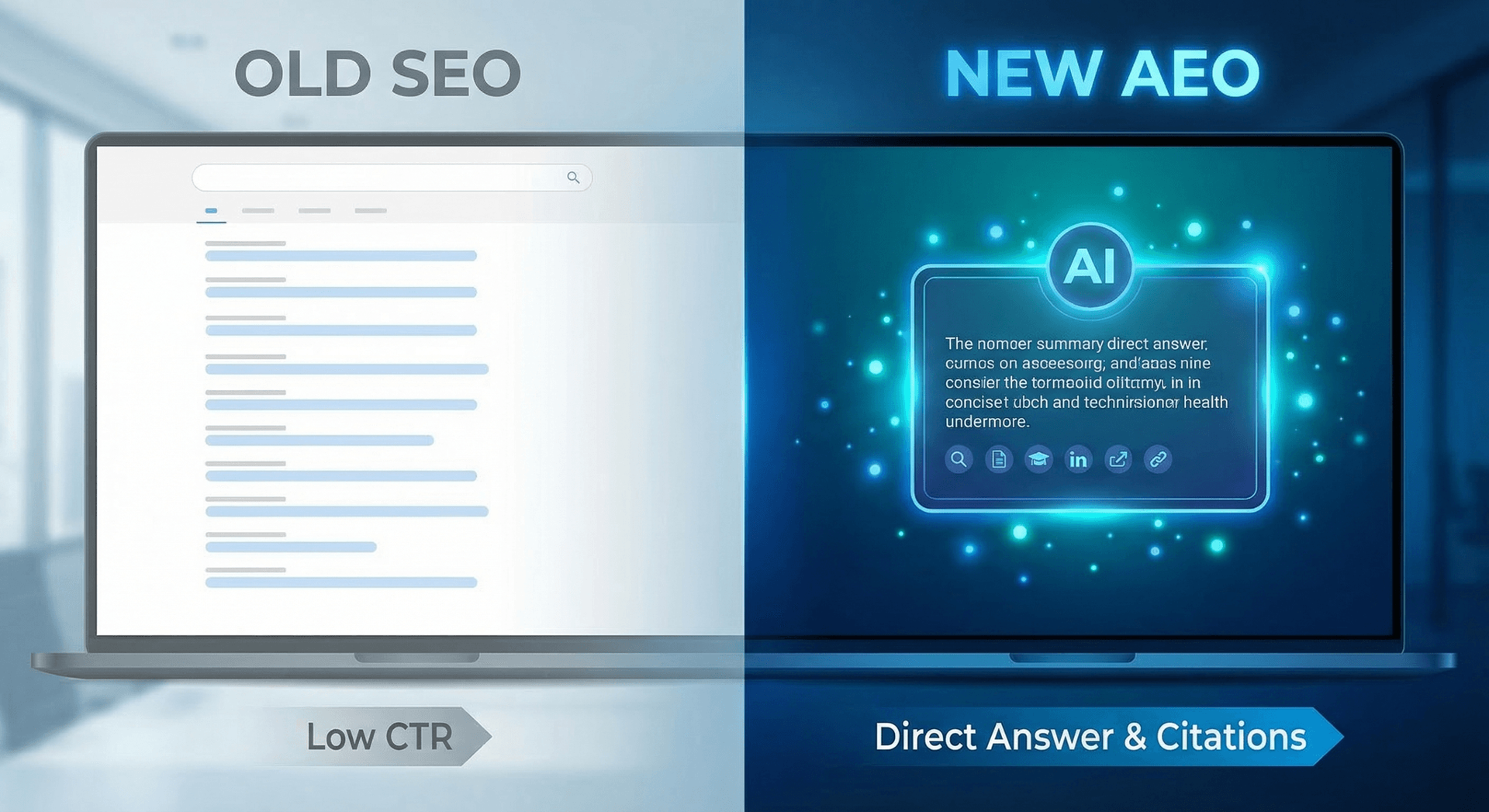
SEO optimizes for traditional search engine rankings — the ten blue links. AEO optimizes for AI-generated answers from systems like Google AI Overviews, ChatGPT, Perplexity, and Claude. SEO focuses on keywords, backlinks, and click-through rates. AEO focuses on structured data, entity clarity, topical authority, and direct-answer formatting. Both matter, and they share many best practices, but AEO specifically targets citation in AI-generated summaries rather than traditional ranking positions.
Q2.Can I do AEO myself without hiring an agency?
Yes. Every tactic in this playbook is designed to be actionable. Start with FAQ schema markup, structured data, and comprehensive content that directly answers the questions your customers ask. If you have the time and technical ability, you can make meaningful progress on your own. Our services exist for businesses that want to move faster or lack in-house resources to execute at scale.
Q3.How long does it take to see AEO results?
Typically 8 to 12 weeks for measurable AI search citations, though some quick wins like FAQ schema appearing in AI Overviews can happen within 2 to 4 weeks. Full topical authority builds over 3 to 6 months. Results vary based on your industry, competition, existing web presence, and content quality.
Q4.Does AEO replace SEO?
No. AEO complements SEO. The tactics overlap significantly — structured content, schema markup, and topical authority help with both. We recommend businesses invest in both, with increasing weight toward AEO as AI search adoption grows. Abandoning SEO entirely would be premature.
Q5.How do you measure AEO success?
We use manual AI query testing across ChatGPT, Perplexity, Google AI Overviews, and Claude; referral traffic analysis; brand mention monitoring; and periodic citation audits. The measurement tools are still maturing, which is one of the honest limitations of the field right now.
Q6.What if AI search engines change their algorithms?
They will. That is why our approach focuses on fundamentals that should remain valuable regardless of algorithm changes: comprehensive, accurate content; proper structured data; and genuine topical authority. These signals have remained valuable across every major search evolution.
Q7.Is AEO only relevant for tech companies?
Not at all. Any business whose customers use AI search tools benefits from AEO. Healthcare practices, manufacturing companies, professional services firms, restaurants, and local retailers all have customers asking AI systems questions. If someone might ask Google AI or ChatGPT about your service in your city, AEO matters for you.
Q8.What structured data formats matter most for AEO?
JSON-LD is the preferred format. The most impactful schema types for AEO are FAQPage, Article, LocalBusiness, HowTo, and Service. Google explicitly recommends JSON-LD over microdata or RDFa, and AI systems parse it most reliably.
Q9.How much content do I need for AEO to work?
There is no magic number, but topical authority requires depth. A single blog post will not establish you as an authority. We generally recommend at least 15 to 20 pieces of interconnected content on your core topics, with ongoing publication to maintain freshness signals.
Q10.Does page speed affect AEO?
Yes. Fast-loading pages are easier for AI crawlers to process, and Google uses Core Web Vitals as a ranking factor that influences which pages get cited in AI Overviews. Aim for Lighthouse performance scores above 90.
Q11.Can AEO help a local Fort Wayne business specifically?
Absolutely. Local businesses benefit enormously from AEO because AI search queries often include location context. When someone asks an AI system 'Who is the best plumber in Fort Wayne?' or 'Where should I get my car serviced near Lima Road?', local AEO optimization helps your business surface as the cited answer.
Q12.How does Skywalker produce content so quickly?
Skywalker is Cloud Radix's AI Employee, purpose-built for content production and web development. Skywalker produces drafts at machine speed, but every piece of content goes through human review and strategic direction from Ken Button. The speed advantage comes from removing the bottleneck between ideation and publication — not from skipping quality checks.
Sources & Further Reading
AEO is a new discipline, but it builds on well-established web standards and documented search engine guidance. The following sources informed the tactics and recommendations in this playbook:
- Google Search Central — Structured Data Documentation: developers.google.com/search/docs/appearance/structured-data — Google's official documentation on JSON-LD schema markup, including FAQPage, Article, LocalBusiness, and HowTo schemas.
- Schema.org: schema.org — The collaborative vocabulary for structured data on the internet. The definitive reference for all schema types and their properties.
- Google Search Central — AI Overviews: blog.google/products/search — Google's blog posts about AI Overviews, including how they select sources and display results.
- Google Quality Rater Guidelines (E-E-A-T): developers.google.com/search/docs/fundamentals/creating-helpful-content — Google's guidelines on Experience, Expertise, Authoritativeness, and Trustworthiness, which influence AI Overview source selection.
- Google Rich Results Test: search.google.com/test/rich-results — Free tool for validating your JSON-LD schema markup.
- Bing Webmaster Tools: bing.com/webmasters — Essential for ensuring your site is indexed by Bing, which powers ChatGPT's web browsing capability.
- Next.js Documentation: nextjs.org/docs — Documentation for the framework powering the Cloud Radix website, including App Router and Server Components.
- Web.dev — Core Web Vitals: web.dev/vitals — Google's resource for understanding and optimizing Core Web Vitals metrics that influence search performance.
- Perplexity Blog: blog.perplexity.ai — Perplexity's own publications about how their AI search engine works and selects sources.
Staying Current
Want Help Implementing This Playbook?
We will audit your current AEO presence, identify the highest-impact opportunities for your business, and show you exactly what it would take to get your Fort Wayne business cited by AI search engines.
Schedule a Free ConsultationNo contracts. No pressure. Just an honest conversation about what would help your business.