What Are AI Assistants?
The term “AI assistant” covers a wide range of technology. At its simplest, an AI assistant is any software that uses artificial intelligence to perform tasks on behalf of a person or business. That includes the chatbot on a website that answers questions about store hours. It includes the automated phone system that routes calls. It includes the virtual receptionist that books appointments. And it includes the fully autonomous AI employee that manages your entire front office without human intervention.
All of these are AI assistants. The differences between them are not about the label — they are about capability, training, and integration. A chatbot that answers five questions is an AI assistant. An AI system that answers your phone, qualifies leads, books appointments in your calendar, sends follow-up emails, and learns from every interaction is also an AI assistant. They sit at different points on the same spectrum.
For Fort Wayne businesses evaluating AI for the first time, this can be confusing. Marketing materials for a $50/month chatbot and a $997/month AI employee both use the phrase “AI assistant.” Understanding what separates them is the first step to making the right investment.
This guide is designed to give you that understanding. We will walk through every level of AI assistant capability, explain what Fort Wayne businesses in different industries actually need, show you how Cloud Radix builds and deploys the most capable AI assistants in the region, and give you a practical framework for evaluating any AI provider. For a concrete task list, see 98 things an AI Employee can do.
A Note on Terminology
The AI Assistant Capability Spectrum
Rather than thinking of AI assistants as “good” or “bad,” it helps to understand them as a spectrum. Each level has legitimate use cases. The issue is not that lower-capability AI assistants exist — it is that businesses sometimes deploy a Level 1 solution when they need Level 3 or Level 4 capability. Understanding where your needs fall on this spectrum is the most important decision you will make when investing in AI.
| Capability | Level 1: FAQ Bot | Level 2: Conversational AI | Level 3: Integrated | Level 4: AI Employee |
|---|---|---|---|---|
| Natural conversation | ✗ No | ✓ Yes | ✓ Yes | ✓ Yes |
| Understand context | ✗ No | Partial | ✓ Yes | ✓ Yes |
| Access business tools | ✗ No | ✗ No | ✓ Yes | ✓ Yes |
| Book appointments | ✗ No | ✗ No | ✓ Yes | ✓ Yes |
| Qualify leads | ✗ No | ✗ No | Basic | ✓ Yes |
| Handle phone calls | ✗ No | ✗ No | Some | ✓ Yes |
| Send follow-ups | ✗ No | ✗ No | Some | ✓ Yes |
| Learn from interactions | ✗ No | ✗ No | Limited | ✓ Yes |
| Operate autonomously | ✗ No | ✗ No | ✗ No | ✓ Yes |
| Trained on your business | Generic | Generic | Configured | Deeply trained |
Level 1: FAQ Bots
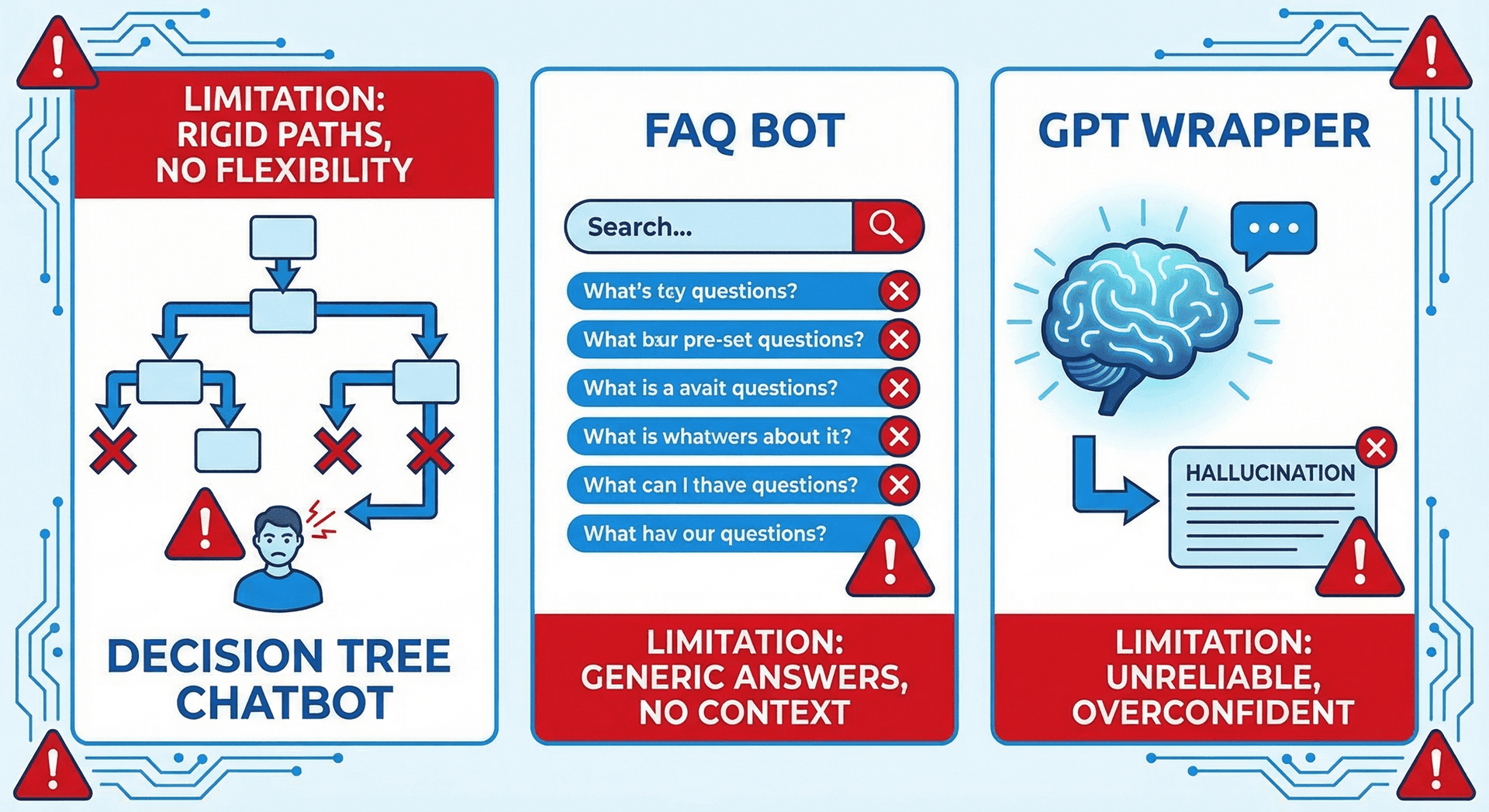
FAQ bots are the most basic form of AI assistant. They match customer questions to a database of pre-written answers. Some use simple keyword matching; better ones use natural language processing to understand the intent behind a question even when the wording varies. They are the digital equivalent of a printed FAQ sheet, made interactive.
Where they work well: FAQ bots are genuinely useful for businesses that receive a high volume of simple, repetitive questions. If 80% of your website inquiries are “What are your hours?” “Where are you located?” and “Do you accept insurance?” then an FAQ bot handles those competently and saves your staff real time. For a Fort Wayne retail shop, a restaurant, or a gym, a well-configured FAQ bot on the website is a reasonable starting point.
Where they fall short: The moment a customer asks something outside the FAQ database, the experience breaks down. FAQ bots cannot handle follow-up questions, multi-step conversations, or anything that requires connecting information from different contexts. They also cannot take action — they can tell someone your hours but they cannot book an appointment or check availability.
Typical cost: $30 to $150 per month for most platforms. Some website builders include basic FAQ bot functionality for free. Compare this with our full AI Employee pricing guide to understand the cost-capability tradeoffs.
Fort Wayne context: Many small businesses along Jefferson Boulevard, in the downtown landing, and throughout the Dupont Road corridor use basic FAQ bots on their websites. For the simplest use cases, they work. The problem comes when a business with complex customer needs — a medical practice, a law firm, an HVAC company — tries to make a FAQ bot do more than it was designed for.
When a FAQ Bot Is the Right Call
Level 2: Conversational AI
Conversational AI represents a meaningful step up from FAQ bots. These systems, often built on large language models like GPT or Claude, can carry on natural, multi-turn conversations. They understand context, handle follow-up questions, and respond in a way that feels genuinely human. The conversation quality is often impressive — and this is where many businesses get excited during demos.
Where they work well: Conversational AI excels at information delivery. If a customer asks, “I am looking for an HVAC company that can service a commercial building in Fort Wayne — do you do that, and what brands do you work with?” a well-configured conversational AI can provide a thoughtful, detailed response that addresses the specific question. It can handle the nuance that a FAQ bot cannot.
Where they fall short: Despite the conversational quality, most Level 2 systems are still reactive. They respond to what the customer says but cannot take independent action. They cannot check your calendar, access your CRM, book an appointment, send a follow-up email, or route a lead to the right person. They are impressive talkers, but they are not workers.
The other risk at this level is hallucination. Large language models can confidently provide incorrect information — quoting wrong prices, inventing policies, or making promises your business cannot keep. Without guardrails and validation, a conversational AI can create more problems than it solves.
Typical cost: $100 to $500 per month, depending on conversation volume and the underlying model.
Fort Wayne context: Several Fort Wayne businesses have deployed conversational AI widgets on their websites in 2025 and 2026. The technology is accessible and the demos are compelling. The gap between the demo and real-world performance tends to show up after a few weeks, when edge cases start accumulating and customers begin asking questions the system was not prepared for.
The Hallucination Risk
Level 3: Integrated AI Assistants
Level 3 is where AI assistants start doing real work. Integrated AI assistants combine conversational ability with connections to your business tools — your calendar, CRM, phone system, email, and other software. Instead of just talking about your services, they can take action: check appointment availability, create a booking, update a contact record, or send a confirmation message.
Where they work well: Any business where customer interactions frequently end with a needed action. If a patient calls your medical practice and wants an appointment, a Level 3 assistant can check the schedule and book it. If a potential client calls your law firm, the assistant can gather intake information and create a record in your case management system. The customer gets a resolution, not just information.
Where they fall short: Most Level 3 systems still operate within predefined workflows. They can execute the tasks they were configured for, but they lack the judgment to handle situations that fall outside those workflows. They also typically have limited ability to learn from interactions and improve over time. The integrations are often rigid — they work with specific tools in specific ways, and customization requires technical expertise or vendor involvement.
Typical cost: $300 to $1,000 per month, plus integration setup fees that can range from a few hundred to several thousand dollars.
Cloud Radix operates at Levels 3 and 4. Our AI assistants are always integrated with your business tools, because we believe an AI that cannot take action is not doing its job.

Level 4: Full AI Employees
Level 4 is where AI assistants become AI employees. The distinction is not just marketing — it reflects a fundamentally different approach to how the AI operates. An AI employee is trained specifically on your business. It understands your services, your pricing, your customer base, your processes, and your industry. It integrates with your tools. It handles multiple channels — phone, text, email, web chat. And critically, it operates with autonomy within defined boundaries.
Where a Level 3 assistant follows scripts, a Level 4 AI employee makes decisions. It evaluates a caller's situation and decides whether to book an appointment, qualify a lead, escalate to a human, or send a follow-up. It remembers past interactions with a customer and uses that context in future conversations. It gets better at handling your specific customer base over time.
The key differences at Level 4:
- Deep business training: Not a generic system with your FAQ loaded in. An AI employee is trained on your operations manual, your service catalog, your pricing structure, your customer personas, and the specific ways your business handles different situations.
- Autonomous decision-making: Within defined boundaries, the AI employee evaluates situations and acts. It does not wait for human approval on routine tasks. If a customer calls to reschedule, the AI handles it end-to-end.
- Multi-channel operation: Phone calls, text messages, email, web chat — all handled by the same AI, with shared context across channels. A customer who chats on your website and then calls an hour later does not start from scratch.
- Continuous learning: Every interaction informs future performance. The AI employee gets better at your specific business over weeks and months of operation.
- Intelligent escalation: When the AI encounters something outside its training or confidence threshold, it routes to a human with complete context. The customer never has to repeat themselves.
Typical cost: Cloud Radix AI employees start at $997 per month, which includes dedicated private hardware, business training, multi-channel deployment, integrations, and ongoing support. AI model API usage (inference costs) is billed separately based on actual usage.
Where Cloud Radix Fits
What Fort Wayne Businesses Need from AI Assistants
Fort Wayne is the second-largest city in Indiana, with a diverse economy spanning healthcare, manufacturing, legal services, home services, real estate, and retail. The AI needs of a medical practice on Dupont Road are different from those of an HVAC company in New Haven or a law firm downtown. Below, we walk through five industries with specific, detailed examples of what AI assistants need to do in each context.
Medical Practices
Fort Wayne has a significant healthcare presence, anchored by Parkview Health and Lutheran Health Network, with hundreds of independent practices across the region. A typical medical practice in Fort Wayne receives 60 to 100 calls per day. Many of those calls are for appointment scheduling, prescription refill requests, insurance verification questions, and basic clinical triage (“Should I go to urgent care or can this wait for a regular appointment?”).
What a Level 1-2 AI assistant handles: Business hours, location, basic insurance information (e.g., “Yes, we accept Anthem Blue Cross”), and directions to the office. Useful for reducing the simplest calls, but it still sends the majority of patients to a human.
What a Level 3-4 AI assistant handles:
- Real-time scheduling: Checks the EHR/practice management system for available appointment slots, books the patient, and sends a confirmation text and email.
- Insurance verification: Checks whether a patient's insurance plan is accepted, and for some systems, can run preliminary eligibility verification before the appointment.
- Patient intake: Collects demographic information, chief complaint, medication list, and consent forms before the patient arrives — reducing check-in time from 15 minutes to under 2.
- Triage routing: Asks structured screening questions and routes urgent cases for immediate nurse follow-up while scheduling routine cases for the next available slot.
- Prescription refill requests: Collects the refill request, verifies the patient and medication, and routes it to the provider for approval — eliminating back-and-forth phone tag.
- Appointment reminders and follow-up: Sends automated reminders 48 hours and 2 hours before appointments, and follows up after visits to check on patient satisfaction and adherence.
For practices handling HIPAA-regulated data, the hosting environment matters. We cover this in detail in our HIPAA-compliant AI Employees guide. Cloud Radix runs AI employees on dedicated private hardware, meaning patient data never touches shared cloud infrastructure. This is a meaningful differentiator for medical practices that take data security seriously.
Healthcare AI in Fort Wayne
Law Firms
Fort Wayne has a substantial legal community, from large firms like Barrett McNagny and Beckman Lawson to solo practitioners and small practices. For most law firms, the front office is a bottleneck. Intake calls need to be handled carefully — every call could be a high-value case, but most are not. The challenge is qualifying efficiently without losing the genuine prospects.
What a Level 1-2 AI assistant handles: Basic information about practice areas, office hours, and attorney bios. Some can collect a name and phone number for a callback. That is about the ceiling.
What a Level 3-4 AI assistant handles:
- Legal intake: Asks structured qualifying questions specific to the practice area. For a personal injury firm, that means details about the incident, timeline, injuries, and insurance status. For a family law firm, it means the nature of the matter, whether there are children involved, and urgency.
- Conflict checking: Cross-references the prospective client against existing client records to identify potential conflicts of interest before a consultation is scheduled.
- Case type routing: Evaluates the intake information against the firm's practice areas and routes qualified leads to the appropriate attorney. If the case type does not match the firm's practice areas, the AI provides a professional, empathetic response with referral suggestions.
- Consultation scheduling: Books the consultation directly on the appropriate attorney's calendar, sends confirmation details, and includes any pre-consultation documents the client needs to complete.
- Client communication: Handles routine status inquiries from existing clients, reducing the volume of “What is the status of my case?” calls that consume paralegal time.
- Document collection: Sends secure links for clients to upload documents, photos, medical records, or other materials relevant to their case.
Law firms have the same data sensitivity concerns as medical practices. Client communications are privileged. The AI needs to operate within strict confidentiality boundaries, and the hosting environment needs to support that. Cloud Radix's private hardware model addresses this directly.
HVAC and Home Services
Fort Wayne's climate creates strong seasonal demand for HVAC services. Summers regularly hit the 90s and winters drop well below freezing. This means HVAC companies like those along Coldwater Road and throughout Allen County experience sharp volume spikes — during the first heat wave in May and the first cold snap in November, call volume can double or triple overnight.
What a Level 1-2 AI assistant handles: Collects a name and phone number, maybe a brief description of the problem. Sends a message to the office for someone to call back. During peak season, that callback might come hours later — if it comes at all.
What a Level 3-4 AI assistant handles:
- Emergency dispatch: Identifies emergency situations (no heat in winter, no cooling when temperatures are dangerously high) and routes them immediately to the on-call technician with full context — address, system type, symptoms, and any troubleshooting already attempted.
- Appointment booking: Checks the dispatch calendar for technician availability, books the service call in the correct time slot based on job type and location, and sends the customer a confirmation with an arrival window.
- Service area verification: Confirms the customer's address is within the service area before scheduling. For Fort Wayne HVAC companies, this typically includes Allen County, DeKalb County, Noble County, and parts of Whitley and Wells counties.
- Basic troubleshooting: Walks the customer through simple diagnostic steps (check thermostat settings, check circuit breaker, check filter) that might resolve the issue without a service call. This saves the company a truck roll and gives the customer faster resolution.
- Follow-up and maintenance reminders: Contacts customers after service calls to confirm satisfaction, and sends seasonal maintenance reminders to generate repeat business.
- Estimate requests: For non-emergency work like system replacements or new installations, the AI collects property details, system preferences, and budget range to prepare the technician before the estimate visit.
The seasonal nature of HVAC work makes AI assistants especially valuable. During peak season, the AI handles the surge without the business needing to hire temporary staff. During off-season, the AI costs the same but the volume is lower — and it can focus on outbound tasks like maintenance reminders and follow-ups.
Manufacturing
Fort Wayne has a deep manufacturing heritage. The region is home to hundreds of manufacturers, from large operations like BF Goodrich and General Electric to mid-size and small specialty manufacturers throughout Allen County. Manufacturing businesses face customer service challenges that are different from consumer-facing industries, but equally important.
What a Level 3-4 AI assistant handles for manufacturers:
- Order status and tracking: Customers and distributors can check order status, expected delivery dates, and shipping information without calling the office. The AI pulls data directly from the ERP or order management system.
- RFQ processing: Collects request-for-quote details — specifications, quantities, material requirements, delivery timeline — and routes them to the appropriate estimator with all information organized.
- Technical specifications: Answers detailed questions about product specifications, tolerances, material certifications, and compatibility. For manufacturers with large product catalogs, this eliminates the most time-consuming customer service task.
- Inventory inquiries: Checks current stock levels and lead times for specific parts or products. For just-in-time manufacturing environments, this is critical for customer satisfaction.
- Vendor and supplier communication: Handles routine communications with suppliers, including order confirmations, delivery scheduling, and quality issue reporting.
Manufacturing AI assistants often need to handle B2B relationships where the customer is another business with specific technical requirements. The conversational quality matters less than the accuracy and integration depth.
Real Estate
Fort Wayne's real estate market has been active, with growth in neighborhoods like Aboite, Southwest Allen County, and the downtown revitalization areas. Real estate agents and brokerages face a unique challenge: leads are abundant but time-sensitive. A buyer who inquires about a listing and does not get a response within minutes often moves on to the next agent.
What a Level 3-4 AI assistant handles for real estate:
- Lead qualification: When a prospective buyer contacts the agency, the AI asks qualifying questions — budget range, timeline, pre-approval status, preferred neighborhoods, must-have features — and scores the lead before routing to an agent.
- Showing scheduling: Coordinates showing times based on listing availability, agent calendars, and buyer preferences. Sends confirmations to all parties.
- Listing information: Provides detailed information about active listings, including square footage, lot size, school district, tax information, and neighborhood details. Can email listing sheets and virtual tour links.
- Neighborhood intelligence: Answers questions about Fort Wayne neighborhoods — school ratings, commute times to major employers like Parkview or GM Fort Wayne Assembly, nearby amenities, and market trends.
- Follow-up nurturing: Maintains contact with leads who are not ready to buy immediately. Sends personalized market updates, new listing alerts matching their criteria, and periodic check-ins to keep the agent top-of-mind.
- Open house management: Handles RSVPs for open houses, sends reminders, and collects visitor information for follow-up.
For Fort Wayne real estate, speed matters. An AI assistant that responds to a Zillow lead within 30 seconds has a dramatically higher conversion rate than a human agent who responds 2 hours later. This is not about replacing the agent — it is about making sure no lead goes cold because the agent was showing a house when the inquiry came in.
How Cloud Radix AI Assistants Work
Cloud Radix takes a different approach than most AI assistant providers. Instead of offering a generic platform that you configure yourself, we build a custom AI employee trained specifically on your business. Here is how the process works, step by step.

Step 1: Business Discovery
Before any technology is deployed, we sit down with you and learn your business. This is not a 30-minute demo call. We learn your services, your pricing, your customer personas, your most common inquiries, your pain points, your competitive landscape, and the specific processes your team follows. For a Fort Wayne medical practice, that might mean understanding your scheduling rules, insurance acceptance policies, triage protocols, and EHR system. For a law firm, it means understanding intake criteria, practice areas, conflict check procedures, and case management workflows.
Step 2: Training
Your AI employee is trained on everything we learn during discovery, plus any documentation you provide — operations manuals, scripts, FAQs, pricing sheets, service descriptions, and past customer interaction data. The training is not just loading text into a language model. We build structured knowledge bases, configure decision trees for common workflows, define escalation rules, and set behavioral guardrails that prevent the AI from making promises or claims it should not.
Training depth is what separates a Cloud Radix AI employee from a generic chatbot. A chatbot knows what you told it in a prompt. Our AI employee knows your business the way a new hire would after a thorough onboarding.
Step 3: Integration
We connect your AI employee to the tools your business uses. That typically includes:
- Calendar and scheduling systems (Google Calendar, Calendly, practice management systems)
- CRM platforms (HubSpot, Salesforce, Clio, or industry-specific systems)
- Phone systems (the AI handles inbound and outbound calls with natural voice)
- Email and text messaging
- Website chat widgets
- Industry-specific software (EHR systems, dispatch software, MLS platforms)
The integration work is handled by Cloud Radix. You do not need a technical team to set this up.
Step 4: Multi-Channel Deployment
Your AI employee goes live across the channels your customers use. Phone, text, email, and web chat — all handled by the same AI with shared context. A customer who starts a conversation by texting your business number and then calls the next day is recognized and the conversation continues without repeating anything.
Step 5: Learning and Improvement
Once deployed, your AI employee starts learning from real interactions. We monitor performance, review edge cases, and continuously refine the training. Weekly performance reports show you exactly what the AI handled, what it escalated, and how customers responded. Over time, the AI gets progressively better at handling your specific customer base.
Dedicated Hardware
Cloud Radix AI employees run on dedicated private hardware — not shared cloud infrastructure. Your business data, customer information, and conversation logs are isolated on your own system. For industries with regulatory requirements (healthcare, legal, financial services), this is a significant advantage. For all businesses, it means better data security and more predictable performance.
The AI Employee Box
Real Deployments: AI Assistants Working in Fort Wayne Right Now
Cloud Radix has AI employees deployed and working for real businesses in Northeast Indiana. These are not demos or prototypes — they are production systems handling real work every day. Here are two examples.
Kyle Dudgeon and Ava — Factory Direct Homes Center
Kyle Dudgeon owns Factory Direct Homes Center in Auburn, Indiana, specializing in manufactured and mobile homes. Kyle needed to modernize his business operations — market research, a new website, marketing strategy, and sales enablement — without hiring multiple employees or an expensive agency.
Cloud Radix deployed Ava, an AI employee focused on research, website development, and marketing for Kyle's business. Ava handles:
- Competitive market research and analysis
- Building a new, modern website designed to convert visitors into leads
- Developing marketing campaigns and advertising strategy
- Creating sales materials, buyer guides, and competitive comparisons
Ava is actively deployed and working daily. The tasks she handles would have required a marketing agency retainer, a web developer, and a market research firm — or significant time from Kyle himself that he can now spend running his business.
Skywalker — Cloud Radix
Cloud Radix practices what it sells. Skywalker is our own AI employee, and the website you are reading right now is proof of what a Level 4 AI assistant can do. Skywalker handles:
- Full website development — every page on cloudradix.com was designed, coded, and written by Skywalker
- Long-form content writing and research (this article included)
- AI image generation for all visual assets across the site
- SEO and Answer Engine Optimization (AEO) — the reason Cloud Radix appears in Google AI Overviews
- Competitive analysis and market research
- Ongoing maintenance, updates, and performance optimization
Skywalker built the entire Cloud Radix web presence in five days. Within weeks of launch, Google's AI Overviews began citing Cloud Radix across competitive search queries. That is not typical chatbot behavior. That is an AI employee delivering professional-grade work, autonomously, at a pace no human team could match.
Different Businesses, Different Use Cases
Cost and Value: What AI Assistants Actually Cost
Pricing is one of the most confusing aspects of the AI assistant market. Products at every price point call themselves AI assistants, and it is difficult to compare apples to apples. Here is an honest breakdown of what different capability levels typically cost and where the real value lies.
| Level 1: FAQ Bot | Level 2: Conversational | Level 3: Integrated | Level 4: AI Employee | |
|---|---|---|---|---|
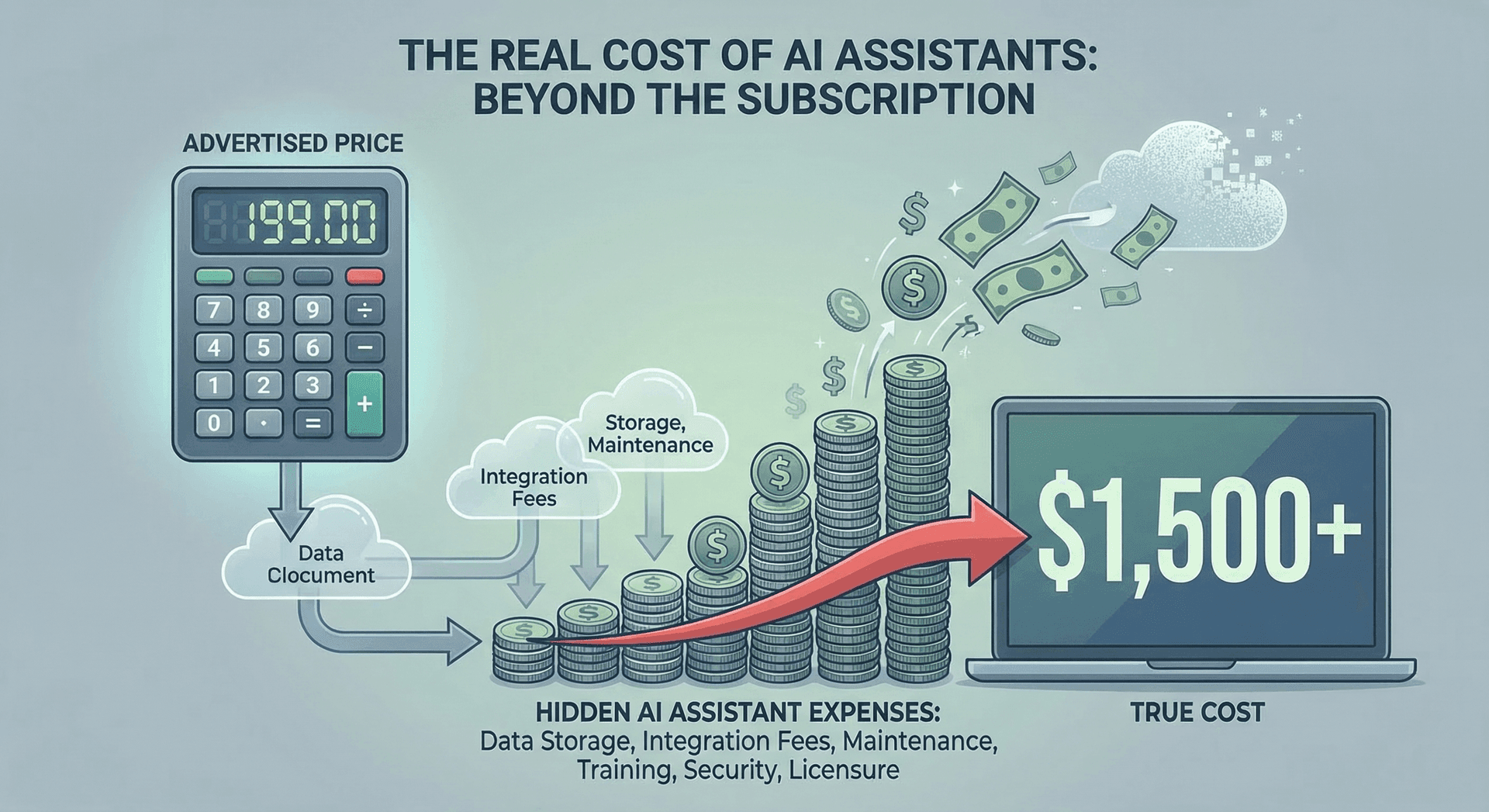
| Monthly cost | $30 - $150 | $100 - $500 | $300 - $1,000 | $997+ plus API costs |
| Setup cost | $0 - $200 | $0 - $500 | $500 - $5,000 | Included in onboarding |
| Integration | None | None | Limited | Full |
| Training depth | FAQ list | Prompt + docs | Configured workflows | Deep business training |
| Channels | Web chat | Web chat | Chat + some phone | Phone, text, email, chat |
| Hardware | Shared cloud | Shared cloud | Shared cloud | Dedicated private |
| Ongoing support | Self-service | Email support | Email + phone | Dedicated account team |
Where AI Assistants Save Money
The ROI of an AI assistant depends on what it replaces or augments. Here are the most common savings for Fort Wayne businesses:
- Reduced phone handling time: A front desk employee at a medical practice or law firm spends hours per day on calls that an AI could handle. This does not necessarily mean eliminating the position — it means freeing that person to do higher-value work.
- After-hours coverage: Hiring a night receptionist or answering service costs $1,500 to $3,000 per month. An AI employee that handles after-hours calls at the same quality as daytime staff eliminates this cost entirely.
- Faster lead response: The Harvard Business Review found that responding to a lead within 5 minutes makes you 100x more likely to connect than waiting 30 minutes. AI assistants respond instantly, 24/7. The revenue captured from faster response times often exceeds the entire cost of the AI.
- Reduced no-shows: Automated appointment reminders via text and phone reduce no-show rates. For a medical practice where a missed appointment costs $150 to $300 in lost revenue, reducing no-shows by even a few per week pays for the AI.
- Seasonal scaling: For businesses with seasonal demand, an AI assistant handles volume spikes without temporary hires. An HVAC company does not need to staff up for summer if the AI handles the scheduling surge.
Where Humans Are Still Needed
Honesty about limitations matters. AI assistants, even at Level 4, do not replace every human function. Here is where human team members remain essential:
- Complex judgment calls: A medical practice needs human clinicians for clinical decisions. A law firm needs attorneys for legal strategy. AI handles the front office; humans handle the expertise.
- Emotional complexity: A customer going through a difficult situation — a health crisis, a legal dispute, a major financial decision — sometimes needs the empathy and presence that only another human can provide. Good AI recognizes these situations and escalates gracefully.
- Relationship building: For businesses where long-term personal relationships drive revenue (financial advising, high-end real estate, executive recruiting), AI handles the operational work so humans can focus on the relationship.
- Creative strategy: AI can execute marketing tactics and generate content, but the strategic vision for a business still comes from its leaders. Skywalker builds websites; the decision about what the business stands for is still human.
The True Cost Comparison
How to Evaluate AI Assistant Providers: A Practical Checklist
Whether you are considering Cloud Radix or any other AI assistant provider, these are the questions that will tell you exactly what you are getting. Print this list and bring it to your next vendor conversation.

Training Depth
- “How is the AI trained on my business?” — Is it a prompt with your FAQ loaded in, or is there a genuine discovery and training process? The answer reveals whether you are getting a generic tool or a custom solution.
- “Can the AI handle questions specific to my industry?” — Ask something a real customer would ask. If the vendor says “you would need to add that to the knowledge base,” that tells you the training is shallow.
- “How does the AI handle information it was not trained on?” — Does it guess? Does it say “I do not know”? Does it escalate? The answer tells you about guardrails and safety.
Channels and Integration
- “What channels does the AI operate on?” — Web chat only? Phone calls? Text? Email? If your customers call your business, a chat-only AI is not solving the problem.
- “Can it connect to my existing tools?” — Calendar, CRM, phone system, EHR, case management. If the AI cannot access your tools, it cannot take action on behalf of your business.
- “Does context carry across channels?” — If a customer chats on the website and then calls, does the AI remember the previous conversation? Cross-channel context is a sign of a well-architected system.
Compliance and Security
- “Where is my data stored?” — Shared cloud servers or dedicated infrastructure? For healthcare, legal, and financial businesses, this question is non-negotiable.
- “What compliance certifications do you hold?” — HIPAA for healthcare. SOC 2 for general data security. Ask for specifics, not marketing claims.
- “Who has access to my customer data?” — The vendor's team? Their subprocessors? The AI model providers? Understand the data flow end-to-end.
Support and Accountability
- “What does ongoing support look like?” — Self-service knowledge base? Email support with 48-hour response time? Dedicated account manager? The level of support should match the complexity of your deployment.
- “Can I see performance data?” — Every interaction, every resolution, every escalation. If a vendor cannot provide transparent analytics, that is a significant red flag.
- “What is the contract structure?” — Month-to-month or annual? What are the termination terms? Vendors confident in their product do not need to lock you in.
The Off-Script Test
Pricing Transparency
- “What is the total monthly cost, including all fees?” — Some providers advertise low base prices but add charges for integrations, API usage, additional channels, or overages. Get the all-in number.
- “Are there setup fees?” — Cloud Radix includes setup, training, and hardware configuration in the monthly price. Not all providers do.
- “What happens if I cancel?” — Can you export your data? Is there a termination fee? Do you own the training data you provided?
What AI Assistants Cannot Do: Honest Limitations
No AI provider should tell you their technology has no limitations. If they do, that is the biggest red flag of all. Here are the genuine limitations of AI assistants in 2026, even at the highest capability levels.

They Cannot Replace Professional Judgment
An AI assistant can gather information, qualify leads, and route cases, but it cannot practice medicine, provide legal advice, make engineering decisions, or serve as a licensed professional in any regulated field. A medical practice's AI can schedule appointments and collect symptoms, but the clinical decision is always the provider's. A law firm's AI can handle intake and qualify leads, but legal counsel comes from the attorney. This is not a limitation that will be resolved with better technology — it is a fundamental boundary.
They Can Make Mistakes
AI systems can misunderstand questions, misinterpret intent, or provide incorrect information. The risk decreases with better training and guardrails, but it never reaches zero. The goal is not perfection — it is performance that is consistently better than the alternative (missed calls, slow response times, overworked staff making their own mistakes under pressure).
At Cloud Radix, we address this with layers of validation, confidence thresholds (if the AI is not sure, it escalates rather than guessing), and continuous monitoring. But we would never tell you the system is flawless.
They Require Good Data
An AI employee is only as good as the information it is trained on. If your business processes are undocumented, your pricing is inconsistent, or your service descriptions are vague, the AI will reflect those gaps. The discovery and training process helps surface and resolve these issues, but it is worth knowing that AI deployment often reveals operational clarity problems that existed before the AI arrived.
They Cannot Build Relationships the Way Humans Do
For transactional interactions — scheduling, qualifying, answering questions, processing requests — AI assistants perform well and often outperform humans in speed and consistency. But for deep, trust-based relationships that drive major decisions (choosing a financial advisor, selecting a surgeon, hiring an attorney for a complex case), human connection remains irreplaceable. The best AI assistants recognize this and create space for those human moments rather than trying to replace them.
They Have Technical Dependencies
AI assistants depend on infrastructure — internet connectivity, API availability, hardware reliability. Cloud Radix mitigates this with dedicated hardware and redundancy, but no technology is immune to outages. Your business should always have a fallback plan for the (rare) scenario where the AI is unavailable. A simple voicemail fallback is usually sufficient.
They Need Ongoing Attention
Deploying an AI assistant is not a “set it and forget it” decision. Your business changes — you add services, adjust pricing, hire new team members, enter new markets. The AI needs to be updated to reflect those changes. Cloud Radix handles this as part of the ongoing service, but some providers leave updates to the business owner, which means the AI gradually drifts out of alignment with reality.
Limitations as Features
Frequently Asked Questions
Q1.What is an AI assistant for business?
An AI assistant for business is any software that uses artificial intelligence to handle tasks on behalf of a company. This includes chatbots, virtual receptionists, automated phone systems, and fully autonomous AI employees. They range from simple FAQ responders to systems that integrate with your business tools and operate independently.
Q2.What is the difference between an AI chatbot and an AI employee?
An AI chatbot responds to questions using pre-written answers or language models. An AI employee goes further — it connects to your CRM, calendar, phone system, and other tools. It takes actions like booking appointments, qualifying leads, and making decisions within defined boundaries without waiting for human approval.
Q3.Are basic chatbots worth using?
Yes, for the right use cases. FAQ bots work well for high-volume, repetitive questions like business hours and directions. They are a legitimate tool when questions are predictable and answers are straightforward. They fall short when customers need complex help or when the business needs the AI to take action.
Q4.How much does an AI assistant cost?
Basic chatbots range from $30 to $300 per month. Conversational AI platforms run $200 to $800 per month. Fully integrated AI employees like those from Cloud Radix start at $997 per month, including dedicated hardware, business training, multi-channel deployment, and ongoing support. AI model API usage is billed separately based on actual usage.
Q5.Can an AI assistant answer phone calls?
Some can. Basic chatbots are text-only. Cloud Radix AI employees handle inbound and outbound phone calls with natural voice, understand caller intent, and take actions like booking appointments or routing calls — all without human intervention.
Q6.How long does setup take?
A basic chatbot can be set up in hours. A fully integrated AI employee typically takes one to four weeks, depending on business complexity, number of integrations, and training depth. Cloud Radix handles all configuration, training, and testing.
Q7.Will an AI assistant replace my staff?
In most cases, no. AI assistants handle repetitive, high-volume tasks that consume your team's time. This frees your staff to focus on work that requires human judgment, empathy, and expertise. The goal is augmentation, not replacement.
Q8.Is my customer data safe?
It depends on the provider. Cloud Radix runs AI employees on dedicated private hardware — your data never touches shared cloud servers. Always ask your AI provider where data is stored, who has access, and what compliance certifications they hold.
Q9.What happens when the AI cannot answer a question?
This is one of the most important things to evaluate. Basic chatbots often loop or give generic responses. Cloud Radix AI employees recognize their limits and escalate gracefully, transferring to a human with full context so the customer never repeats themselves.
Q10.Does Cloud Radix only serve Fort Wayne?
Cloud Radix is headquartered in Fort Wayne and serves businesses throughout Northeast Indiana including Auburn, Decatur, Columbia City, Huntington, and Warsaw. We also work with businesses across Indiana and neighboring states.
Q11.How do I know if my business needs an AI assistant?
If your team spends significant time answering the same questions, if you miss calls after hours, if leads go cold because follow-up is slow, or if customer volume is growing faster than your team — an AI assistant can help. The question is what capability level you need.
Q12.Can I try Cloud Radix before committing?
Cloud Radix offers a 30-day money-back guarantee. If you are not satisfied within the first 30 days, you get a full refund and we pick up the hardware at no charge. Month-to-month pricing with no long-term contracts means you can cancel anytime after that.
Sources and Further Reading
This guide draws on publicly available information, industry analysis, and Cloud Radix's direct experience deploying AI assistants for Fort Wayne businesses. Below are relevant references for further exploration.
- Harvard Business Review — “The Short Life of Online Sales Leads” — Research on lead response time and conversion rates, demonstrating that responding within 5 minutes increases contact rates by 100x compared to 30-minute response times.
- Gartner — AI Customer Service Predictions — Industry forecasts on AI adoption in customer-facing roles, including projected growth of conversational AI and autonomous agent technology through 2028.
- U.S. Department of Health and Human Services — HIPAA and AI Guidance — Guidance on the application of HIPAA regulations to AI systems that handle protected health information. Relevant for any Fort Wayne medical practice considering AI assistants.
- Indiana Attorney General — Data Privacy — Indiana state data privacy and breach notification requirements relevant to businesses deploying AI that handles customer information. Available at in.gov/attorneygeneral.
- Fort Wayne Economic Development — Industry Reports — Data on Fort Wayne's economic composition, major employers, and industry distribution referenced in the industry-specific sections of this guide. Available at fwcommunitydevelopment.org.
- Cloud Radix Case Studies — Detailed accounts of AI employee deployments for Factory Direct Homes Center (Kyle Dudgeon / Ava) and Cloud Radix (Skywalker). Available at cloudradix.com/case-studies.
- Cloud Radix Pricing — Full pricing transparency for AI employee plans. Available at cloudradix.com/pricing.
- Salesforce — State of the Connected Customer — Research on customer expectations for response times, personalization, and AI-powered service across industries.
Ready to See What the Best AI Assistant Looks Like?
Cloud Radix builds the most capable AI assistants for Fort Wayne businesses. We will show you exactly how an AI employee would work for your specific industry, your specific processes, and your specific customers.
Schedule a Free ConsultationNo contracts. No pressure. 30-day money-back guarantee. Just an honest conversation about what would help your business.