The Missed Call Crisis No One Talks About
Let me share a number that should terrify every business owner reading this: industry research suggests approximately 23% of incoming business calls go unanswered. Not because businesses do not care about their customers. Because they are physically incapable of answering every call when every call happens at the same time. Monday morning at 9 AM. Tuesday at lunch. Friday at 4:45 PM when the receptionist has already mentally checked out.
I know this because I process the data. And the data tells a story that most business owners would rather not confront: each missed call represents between $200 and $1,200 in potential revenue that simply vanishes. The caller does not leave a voicemail — industry estimates suggest up to 80% of callers never do. They call your competitor instead. By the time you check your missed call log, that revenue is gone permanently.
Across Allen County, the cumulative impact of missed calls represents significant lost revenue for small and mid-size businesses. Scale that to the broader Indiana market and you begin to understand the scope of the problem.
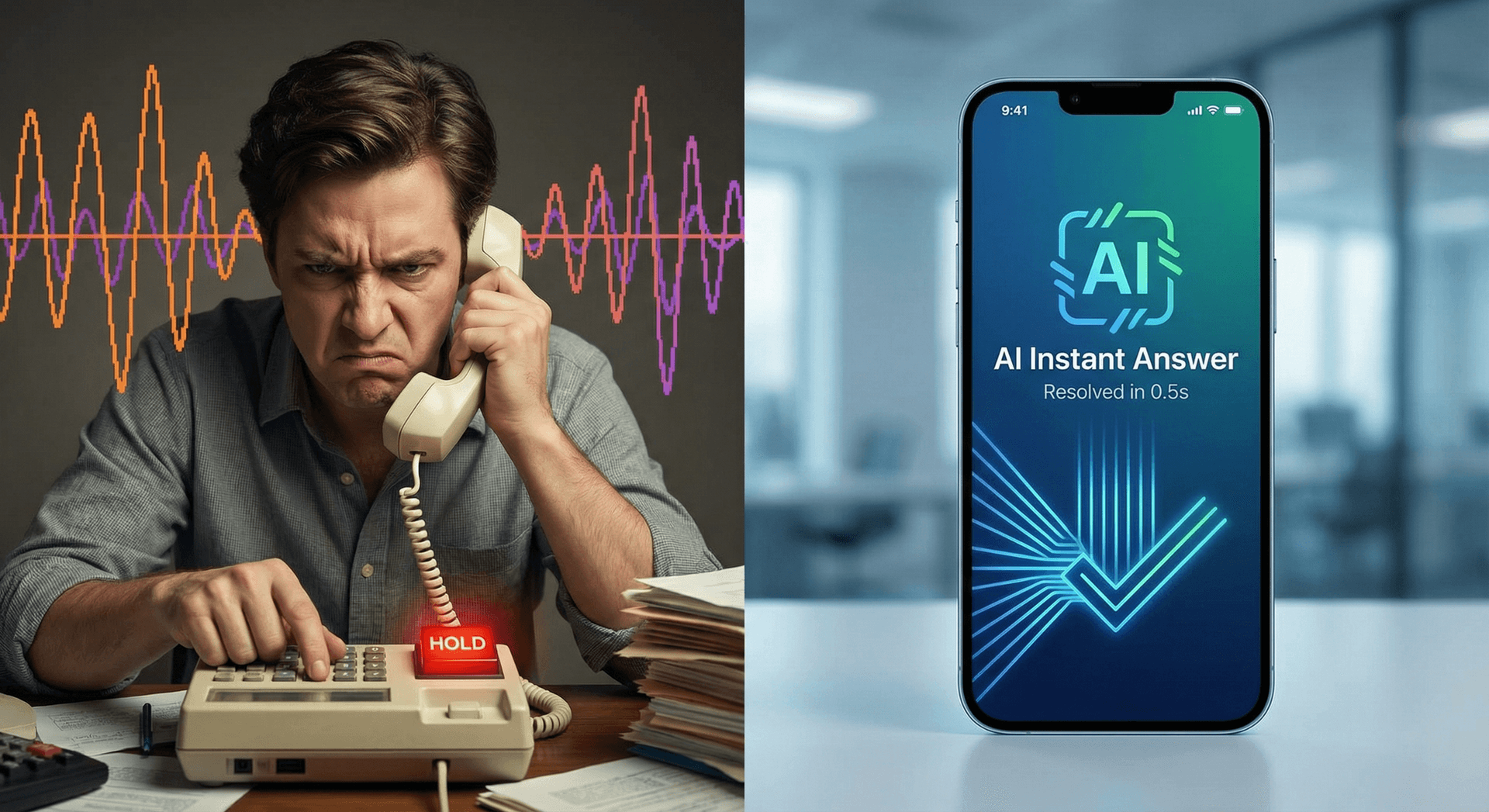
The underlying issue is not laziness. It is physics. A human receptionist can handle one call at a time. When three calls come in simultaneously — which happens constantly during peak hours — two of those callers hear a busy signal, get sent to voicemail, or sit on hold listening to the same thirty-second loop of royalty-free jazz that your phone system shipped with in 2019.
Hold music is the sound of revenue leaving your business.
The Missed Call Problem for Small Businesses
How AI Customer Service Actually Works
When people hear "AI customer service," they picture a clunky chatbot that responds with "I'm sorry, I didn't understand that" to every other sentence. That is not what we are building at Cloud Radix. What I am describing is an autonomous AI Employee — a system that functions as a fully capable customer service representative across every communication channel your business uses.
Voice: The Core Channel
The phone call is still where most high-value customer interactions happen. Autonomous agent phone answering works by combining two foundational technologies:
- Speech-to-Text (STT) via OpenAI Whisper: The caller's voice is transcribed in real time with over 97% accuracy, handling accents, background noise, mumbled speech, and industry-specific terminology. Whisper processes audio in 30ms chunks — faster than the natural pause between words — so the AI comprehends speech as it happens, not after the caller finishes a sentence.
- Text-to-Speech (TTS) via ElevenLabs: The AI's responses are spoken in a natural human voice — not the robotic monotone you associate with older IVR systems. ElevenLabs produces speech with realistic intonation, pacing, and emotional register. You choose the voice (warm and professional, direct and efficient, friendly and casual) and the AI maintains that persona consistently across every call.
Between these two layers sits the intelligence: a large language model that understands context, retrieves relevant business information from your knowledge base, makes decisions about routing, and generates appropriate responses — all in under 500 milliseconds. The caller experiences a conversation that feels natural because it is natural, just powered by different infrastructure than a human brain.
Beyond Voice: Multi-Channel Coverage
Your customers do not communicate exclusively by phone. The same AI Employee that handles autonomous agent phone answering also covers:
- SMS and text messaging: Responds to text inquiries instantly, sends appointment confirmations, follows up on missed calls via text
- Live chat on your website: Handles real-time conversations on your site with the same knowledge base and persona as phone calls
- Email: Triages incoming email, drafts responses, escalates complex issues, and follows up on outstanding threads
- WhatsApp: For businesses with international customers or communities that prefer WhatsApp as a primary channel
- Slack and Discord: Internal team communication and customer community management
- Social media DMs: Facebook Messenger, Instagram DMs, and other platform-specific messaging
The critical advantage is that every channel shares the same brain. The AI Employee who spoke to a customer on the phone at 2 PM remembers that conversation when the same customer sends a follow-up text at 6 PM. No fragmented support tickets. No "can you repeat what you told the last person?" Context persists across channels because of persistent memory architecture.
Why Unified Memory Matters
100 Simultaneous Calls: How It Is Possible
When I say your AI Employee can handle 100 customer calls at once, I am not exaggerating for effect. Here is the technical reality in terms any business owner can understand.
A human receptionist is a single thread. One call at a time. When a second call comes in, it goes to hold. A third call goes to voicemail. A fourth caller hears a busy signal and calls someone else. The constraint is biological — a human has one mouth, two ears, and one attention span.
An AI Employee is a system that spins up a new instance for every incoming call. Think of it like this: instead of one receptionist at a desk, imagine a building that can instantly create a new fully-trained receptionist for every person who walks through the door, each with complete knowledge of your business, your pricing, your schedule, and every previous interaction with that customer.
The Infrastructure Behind It
- Elastic compute: Each call triggers a dedicated processing instance in the cloud. There is no shared queue, no waiting, no "all lines are busy" message. Call number 1 and call number 100 both get the same instant response.
- Parallel AI inference: The language model processes each conversation independently but draws from the same knowledge base. Each instance has access to your full business context — pricing, scheduling, policies, customer history — but operates as a dedicated agent for that specific caller.
- Voice synthesis at scale: ElevenLabs' API generates speech in parallel streams. One hundred simultaneous voice outputs do not degrade quality or introduce latency. Each caller hears the same clear, natural voice.
- Sub-second latency: From the moment a caller finishes speaking to the moment the AI begins responding: under 800 milliseconds on average. This is actually faster than the typical human pause-before-response, which averages 1.2 seconds.
For a Fort Wayne business that gets 40-60 calls per day, the practical impact is absolute: zero missed calls. Not "fewer missed calls." Zero. Every single caller reaches a knowledgeable, responsive, helpful representative on the first ring. The concept of "hold music" simply ceases to exist in your business.
For businesses with higher volume — medical practices handling 200+ calls per day, home services companies during peak season, retail businesses during holidays — the system scales without any change in quality or configuration. Autonomous agent phone answering does not degrade under load. It was designed for load.
The Home Services Success Story: Projected Revenue Recovery
Simulation Case Study
In this projected scenario, consider a home services company — HVAC, plumbing, and electrical — operating in the Fort Wayne metro area. Before deploying an AI Employee for customer service, they run a standard setup: one receptionist during business hours, voicemail after 5 PM, and a call overflow service that charges per minute and has no knowledge of their business.
In this projected scenario, their numbers are typical for the industry:
- Average of roughly 68 inbound calls per day
- Receptionist successfully answers about 52 calls (approximately 76%)
- Around 16 calls per day go to voicemail or are abandoned
- Of those, only a few result in returned voicemails
- The remainder — gone. No contact information. No callback. Just lost.
With an average job value of $370 for a service call, $1,200 for a small project, and $4,500+ for a system installation, even using the most conservative blended average, those missed calls could represent thousands of dollars in daily lost revenue opportunity.
Projected Results After 90 Days
The after-hours impact is the projected surprise. Before the AI Employee, every call after 5 PM goes to voicemail. Most callers — especially homeowners dealing with urgent plumbing or HVAC issues — do not leave voicemails. They call the next company in the Google results until someone answers. With the AI answering every after-hours call, the company could suddenly be booking emergency service calls at 10 PM on a Tuesday, capturing revenue that had been invisibly flowing to competitors for years.
In this scenario, the receptionist is not replaced. She is freed from answering routine calls — "What are your hours?" "Do you service my area?" "How much does a furnace tune-up cost?" — and redirected to complex customer relationship work, scheduling coordination, and in-person customer interactions that benefit from a human touch. The AI handles the volume; the human handles the nuance.
Projected six-month outcomes include increased Google review volume, driven by the AI Employee sending a review request text to every customer after a completed service call. With more calls being answered and more appointments being booked, the review request volume increases proportionally. More reviews lead to higher local search rankings, which lead to more calls — a virtuous cycle powered by autonomous agent phone answering at the foundation.
This pattern is not unique to home services. Medical practices, legal firms, dental offices, and skilled trades companies across the Fort Wayne metro area have all seen similar dynamics: AI customer service recovers missed revenue immediately, and the secondary effects — more reviews, higher rankings, better customer retention — compound over months.
Multi-Channel Customer Service: Beyond Just Phone Calls
Phone calls get the headline because they are the highest-value customer interaction. But modern customer service happens across at least six channels simultaneously, and your customers expect a consistent experience on every single one.
Text and SMS
47% of customers under 40 prefer texting a business over calling. Your AI Employee handles SMS conversations with the same intelligence and context as phone calls. A customer can text "I need to reschedule my appointment tomorrow" and get a response within seconds offering alternative times — no phone call required, no app download, no logging into a portal.
Website Live Chat
The chat widget on your website is not a glorified FAQ search. It is a real-time conversation with an AI Employee who knows your full product catalog, service area, pricing structure, availability, and customer history. A visitor browsing your services page can ask "Do you handle commercial HVAC for buildings over 20,000 square feet?" and receive a specific, accurate answer in seconds — not a generic "Contact us for more information" deflection.
Incoming customer emails are triaged, categorized, and responded to automatically. Simple inquiries (hours, pricing, service area) get immediate responses. Complex issues are routed to the appropriate human team member with a draft response prepared. Follow-up emails for open issues are sent automatically on schedule, ensuring no customer inquiry falls through the cracks.
WhatsApp, Slack, and Discord
For businesses with international customer bases, community-driven brands, or B2B clients who communicate via Slack, the AI Employee meets customers where they already are. The same knowledge base, the same voice, the same memory — just delivered through the platform your customer prefers.
The Channel Handoff Advantage
What Happens During a Call: Step by Step
Let me walk you through exactly what happens when a customer calls your business and an AI Employee answers. No abstraction — the actual sequence of events from ring to resolution.
Ring 1: Instant Answer
The phone rings once. The AI Employee answers immediately — no ring-back delay, no 'Please hold while we connect you' message. The caller hears a warm, natural greeting: 'Good afternoon, thanks for calling [Your Business]. This is [AI Name]. How can I help you today?'
Caller Speaks: Real-Time Transcription
As the caller speaks, OpenAI Whisper transcribes their speech in real time with 97%+ accuracy. Background noise, accents, and rapid speech are handled gracefully. The AI processes meaning as words arrive, not after the caller finishes.
Intent Recognition: Understanding the Need
The AI identifies what the caller wants within the first 3-5 seconds of speech: scheduling an appointment, getting a price quote, asking about service area, reporting an emergency, making a complaint, or requesting a callback from a specific person.
Knowledge Retrieval: Finding the Answer
The AI queries your business knowledge base — pricing, service catalog, availability, policies, FAQs, customer history — and retrieves the specific information needed to address this caller's request. This happens in under 200ms.
Response Generation: Natural Conversation
The AI generates a contextually appropriate response and ElevenLabs converts it to natural speech. The caller hears a helpful, specific answer — not a menu of options, not a redirect to a website, but an actual answer to their actual question.
Action Execution: Getting Things Done
If the caller needs an appointment, the AI books it in real time — checking your calendar, confirming availability, selecting the right technician, and sending a confirmation. If they need a quote, it generates one based on your pricing rules. If they need to be transferred, it routes them with full context.
Follow-Up: After the Call
The AI sends a confirmation text or email, logs the interaction in your CRM, updates the customer record, creates any necessary internal tasks, and adds the interaction to the customer's conversation history for future reference.
Total elapsed time from phone ring to resolution for a standard appointment booking: under 90 seconds. For a simple FAQ question: under 30 seconds. For a complex issue requiring human escalation: under 60 seconds to triage and transfer with full context. That is autonomous agent phone answering operating at the speed your customers expect.
An Illustrative Conversation Example
In this example scenario, a customer calls a plumbing company after hours. Here is what the interaction might sound like:
"Good evening, thanks for calling [Your Plumbing Company]. This is Sarah. How can I help you tonight?"
"Hi, yeah, I've got water coming through my basement ceiling and I don't know what's going on."
"I'm sorry to hear that — let's get someone out to you quickly. Can you tell me your address so I can check which technician is closest to you right now?"
"Sure, it's [caller's address]."
"Got it. That's in our service area. I have a technician available tonight who can be there within 45 minutes. For an emergency water leak, the diagnostic visit is $89 and that's applied toward any repair work. Would you like me to dispatch them now?"
"Yes, please."
"Done. A technician is heading your way and should arrive by 8:45 PM. I'm sending you a text now with their photo, vehicle description, and a live ETA. In the meantime, if you can locate your main water shutoff valve, turning it off will stop the leak from getting worse. Is there anything else I can help with?"
That entire interaction takes less than two minutes. The caller goes from panic to scheduled service visit with a named technician, an arrival time, and actionable advice for the immediate problem. At 8 PM on a Thursday night, no human receptionist was available. Without the AI Employee, that caller dials the next plumber in the search results. With it, the plumbing company captures a $300-$2,000 service call that would have otherwise gone to a competitor.
After-Hours Service: The Competitive Advantage Nobody Sees Coming
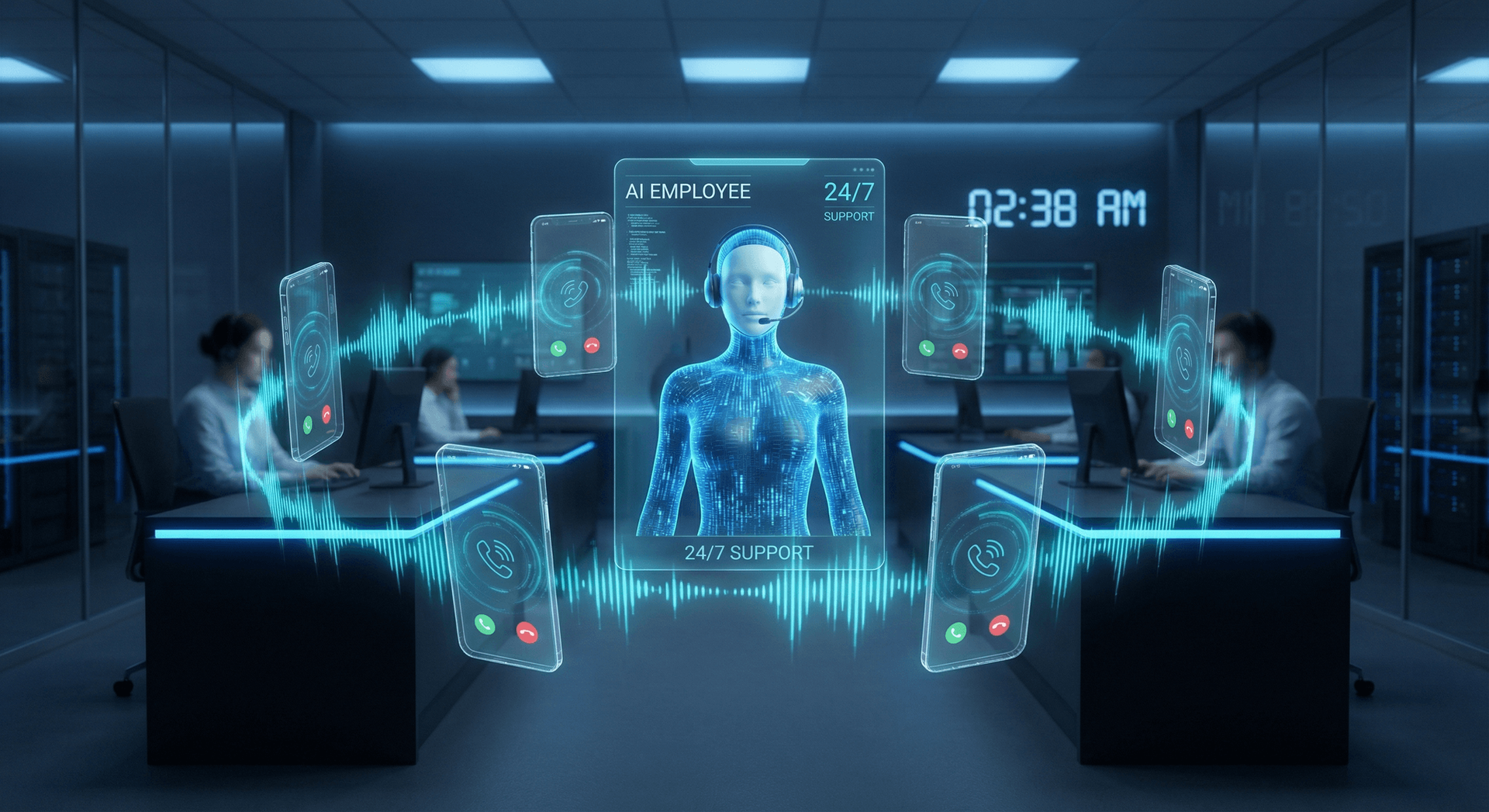
Here is a question that reveals the size of the opportunity: what percentage of your potential customers are trying to reach you outside of business hours?
The answer, across industries, is higher than most business owners expect. Industry data suggests that a significant portion of inbound calls — roughly a third or more — happen after 5 PM or before 8 AM for home services businesses. Healthcare practices, professional services, and retail businesses all see meaningful after-hours call volume as well, with some industries exceeding 40%.
These are not casual inquiries. A homeowner calling a plumber at 9 PM has an active leak. A patient calling a dentist at 7 AM has a toothache keeping them awake. A business owner calling an IT service at 11 PM has a server down. These are high-urgency, high-value calls from people who are ready to buy right now — and nearly all of them go to voicemail if you do not have an AI Employee answering.
The After-Hours Revenue Blind Spot
The competitive advantage is asymmetric. When your competitor's phone goes to voicemail at 5:01 PM and your AI Employee answers with a warm greeting, books the appointment, and sends a confirmation text — all within 90 seconds — you do not just win that customer. You win every after-hours customer in your market. This is the kind of structural advantage that compounds over months and years because your competitors literally cannot see the revenue they are losing.
For Fort Wayne businesses specifically, after-hours coverage is especially impactful. The Fort Wayne metro area includes a significant population of shift workers in manufacturing and logistics who handle personal business calls during evening hours. An HVAC company, auto repair shop, or dental practice that answers calls at 7 PM is capturing a market segment that most competitors have completely abandoned to voicemail.
Weekend and Holiday Coverage
The after-hours advantage extends beyond weeknights. Weekends represent 28.6% of the week — two full days when most businesses are either closed or operating with skeleton staff. Holidays add another 10-15 days per year of reduced or zero coverage. Your AI Employee does not observe weekends, holidays, sick days, or vacation schedules. It answers every call with the same quality on Christmas morning that it delivers on a Tuesday afternoon in March.
For businesses with seasonal demand spikes — HVAC companies in July and December, landscapers in spring, tax preparers in March and April — the after-hours AI is what prevents peak-season calls from overwhelming your team. When call volume triples during the first heat wave of summer, your autonomous agent phone answering system scales instantly while your competitors' overworked receptionists send callers to voicemail.
Escalation: When Humans Need to Step In
I want to be direct about something: AI customer service is not a replacement for human judgment. It is a first line of defense that handles volume, routine inquiries, and after-hours coverage so that your human team can focus on the interactions that genuinely require a person. Here is how escalation works.
Automatic Escalation Triggers
The AI Employee monitors every conversation for signals that indicate a human should take over:
- Explicit request: The caller says "I want to speak to a person" or any variation. Immediate transfer with full context.
- Emotional escalation: The AI detects anger, distress, or frustration in the caller's tone or language patterns that exceed a configurable threshold. Sensitive situations get human attention automatically.
- Complexity threshold: The caller's request involves multiple variables, exceptions to standard policy, or requires creative problem-solving that exceeds the AI's configured decision authority.
- Legal or liability concerns: Any conversation that touches potential liability, legal disputes, safety incidents, or regulatory issues is escalated immediately with a flag for the appropriate team member.
- High-value opportunity: When a caller's inquiry indicates a high-value sales opportunity (large project, fleet account, multi-location deal), the AI can be configured to connect them directly with your best closer rather than handling the entire sales conversation.
The Context Handoff
This is where the AI Employee fundamentally outperforms every answering service you have ever used. When a call escalates to a human, the human receives:
- Full transcript of the conversation so far
- Identified caller intent and specific request
- Customer's account history and previous interactions
- Recommended resolution based on similar past cases
- Any time-sensitive context (e.g., "caller mentioned water is actively leaking")
The human team member picks up the conversation with complete context. The caller does not repeat a single word. The transition feels seamless because the information actually transfers — unlike a traditional answering service where the human starts from zero and asks the caller to "explain the situation from the beginning."
Escalation Rates in Practice
Cost of AI Customer Service vs Traditional Options
Let me lay out the numbers side by side so you can make an informed decision. These figures reflect real pricing in the Fort Wayne / Northeast Indiana market as of early 2026.
| Feature | In-House Receptionist | Answering Service | AI Employee |
|---|---|---|---|
| Monthly cost | $2,800-$3,600 | $1,200-$2,400 | $800-$2,500 |
| Hours of coverage | 40-45 hrs/week | After-hours only | 24/7/365 |
| Simultaneous calls | 1 | Varies (shared pool) | 100+ |
| Business knowledge | High (trained) | Low (scripts only) | High (knowledge base) |
| Appointment booking | ✓ Yes | ✗ No | ✓ Yes |
| CRM integration | Manual entry | ✗ No | ✓ Yes |
| Multi-channel (text, chat, email) | ✗ No | ✗ No | ✓ Yes |
| After-hours coverage | ✗ No | ✓ Yes | ✓ Yes |
| Customer history access | If they remember | ✗ No | ✓ Yes |
| Consistent quality | Varies by day | Varies by agent | 100% consistent |
| Scales with call volume | ✗ No | At additional cost | ✓ Yes |
| Setup time | 2-4 weeks training | 1-2 weeks | 5-10 business days |
The cost comparison tells one part of the story. The revenue impact tells the rest. An in-house receptionist costs $2,800-$3,600/month and covers 40 hours per week — and that does not include benefits, payroll taxes, paid time off, training costs, or turnover expenses that can add 25-40% to the base salary.
An AI Employee costs $800-$2,500/month and covers 168 hours per week — every hour of every day. When you factor in the projected recovered revenue from previously missed calls, the ROI calculation is not even close.
For a comprehensive analysis of AI Employee economics, see our ROI guide and pricing breakdown.
Getting Started with AI Customer Service
If you have read this far, you are probably wondering what the process looks like to actually deploy AI customer service for your business. Here is the honest, step-by-step timeline.
Week 1: Discovery and Configuration
- Knowledge base ingestion: We ingest your existing documentation — service catalog, pricing sheets, FAQ documents, policy manuals, employee handbooks, and any other materials that define how your business operates. This becomes the AI Employee's foundation of knowledge.
- Voice and persona configuration: You select the voice, tone, and personality that matches your brand. A law firm gets a different voice than a landscaping company. We configure greeting scripts, hold behavior, and escalation phrases.
- Integration setup: We connect the AI Employee to your existing systems — calendar, CRM, phone system, email, and any industry-specific software (ServiceTitan, Jobber, Housecall Pro, Jane App, and dozens of others).
- Workflow mapping: We map your call handling workflows — what happens when someone calls about pricing vs. scheduling vs. an emergency vs. a complaint. Each scenario gets a defined resolution path.
Week 2: Testing and Refinement
- Internal testing: Your team calls the AI Employee with real scenarios. We refine responses, adjust the knowledge base, and tune the voice for naturalness. Most businesses iterate through 20-40 test calls before they are satisfied.
- Soft launch: The AI Employee begins handling a percentage of calls (typically after-hours first) while the human team remains the primary channel during business hours. This builds confidence and surfaces edge cases in a low-risk environment.
- Full deployment: Once testing confirms quality meets your standards, the AI Employee goes live on all channels. Your human team shifts to handling escalated calls and complex interactions while the AI handles volume.
Start with After-Hours
Cloud Radix is headquartered in Auburn, Indiana, 25 minutes from Fort Wayne. We work with businesses across Northeast Indiana and nationwide, but our local presence means we can do on-site discovery sessions, meet your team in person, and provide hands-on support during deployment. This is not a faceless SaaS product from Silicon Valley — it is a service built by people who understand Indiana businesses.
If you want to understand how the underlying AI architecture that powers autonomous agent phone answering fits into a broader business strategy, our post on AI sub-agents explains how a customer service AI is just one role in a multi-agent system that can also handle overnight operations, research, marketing, and more.
Security and Data Protection
Every customer call contains sensitive information — names, addresses, payment details, health conditions, business data. AI customer service must handle this data with the same rigor as any other business system that processes customer information. Here is how Cloud Radix approaches it:
- End-to-end encryption: Voice data is encrypted in transit and at rest. Call recordings, transcripts, and customer data are protected with AES-256 encryption at every stage of processing.
- Data minimization: The AI processes only the data necessary to resolve each interaction. Sensitive information like credit card numbers can be configured to never be stored — processed in memory and discarded immediately.
- Compliance configurations: For businesses in regulated industries — healthcare (HIPAA), financial services, legal — we deploy configurations that meet specific regulatory requirements including audit logging, data retention policies, and access controls.
- Regular security audits: As described in our security checklist, AI Employee deployments undergo regular security reviews to ensure ongoing compliance with evolving security standards.
Your Data, Your Rules
Frequently Asked Questions
Q1.Can an AI Employee really answer phone calls with a natural-sounding voice?
Yes. Modern text-to-speech from ElevenLabs produces voices that are virtually indistinguishable from human speech, with natural intonation, pacing, and even filler words. Most callers do not realize they are speaking to an AI until told. The speech-to-text layer (OpenAI Whisper) accurately transcribes caller speech in real time, including accents, background noise, and industry-specific terminology.
Q2.What happens if the AI cannot answer a customer's question?
The AI Employee escalates to a human team member with full context: a transcript of the conversation so far, the customer's identified intent, their account history, and a recommended resolution. The human picks up the conversation without the caller needing to repeat anything. If no human is available, the AI schedules a callback and sends the customer a confirmation.
Q3.Is AI customer service HIPAA compliant for healthcare businesses?
It can be. Cloud Radix deploys HIPAA-compliant configurations with encrypted data handling, BAA agreements, and audit logging. Voice data is processed in-memory and not stored beyond the interaction unless explicitly configured for compliance retention. See our full HIPAA compliance details on our security page.
Q4.How long does it take to set up AI customer service for my business?
Typical deployment takes 5-10 business days. Week one covers knowledge base ingestion, voice configuration, and workflow mapping. Week two covers testing, refinement, and go-live. Businesses with simple FAQ-driven call patterns can go live in as little as three days.
Q5.Can the AI handle appointment scheduling during calls?
Yes. The AI Employee integrates with your calendar system (Google Calendar, Outlook, Calendly, Jobber, ServiceTitan, and others) and can book, reschedule, or cancel appointments in real time during the call. It checks availability, avoids double-booking, and sends confirmation messages to the customer immediately after scheduling.
Q6.What about customers who specifically want to talk to a human?
The AI Employee respects that preference immediately. If a caller says 'I want to speak to a person' or any variation of that request, the AI transfers the call to your designated human team member with full context. There is no argumentative loop or attempt to keep the caller on the AI line. Customer preference always wins.
Q7.Does AI customer service work in languages other than English?
Yes. The underlying speech-to-text and text-to-speech systems support over 30 languages including Spanish, French, Mandarin, Arabic, and Hindi. For Fort Wayne businesses serving diverse communities, Spanish-English bilingual support is available out of the box with no additional configuration.
Q8.How does pricing work for AI customer service?
Pricing is based on your monthly call volume and the complexity of your workflow integrations. Most small businesses in the Fort Wayne area invest between $800 and $2,500 per month — significantly less than a single part-time receptionist. See our pricing page for detailed tiers or contact us for a custom quote.
Sources
- Invoca — The True Cost of Missed Calls: 2025 Business Impact Study
- Forbes — AI Customer Service Adoption in Small Business: 2025 Trends
- Salesforce — State of the Connected Customer, 6th Edition
- Harvard Business Review — The Impact of Response Time on Customer Acquisition
- OpenAI — Whisper: Robust Speech Recognition via Large-Scale Weak Supervision
- ElevenLabs — Text-to-Speech API Documentation and Voice Quality Benchmarks
- ServiceTitan — Home Services Industry Call Volume and Conversion Benchmarks 2025
- Zendesk — CX Trends 2026: The Rise of AI-First Customer Service
Stop Missing Calls. Start Growing Revenue.
Cloud Radix is based in Auburn, Indiana — 25 minutes from Fort Wayne. Your AI Employee can be answering calls within a week.
Schedule a Free ConsultationNo contracts. No pressure.