The RFQ Speed Problem in Northeast Indiana Manufacturing
A request for quote arrives at 2:14 PM on a Tuesday. It comes from a Tier 1 automotive OEM in Detroit. They need 8,000 precision-machined brackets, tolerance of plus or minus two-thousandths, 4140 steel, heat treated. They need a price by end of day. Your estimator is on the shop floor troubleshooting a tooling issue. Your office manager is on the phone with a freight company. Nobody sees the email until 4:45 PM, and by then it is too late to pull the material costs, check machine availability, and build a professional quote. The response goes out the next morning at 10 AM — twenty hours after the request arrived.
The OEM already has three other quotes. Yours is the fourth. The job goes to a shop in Michigan that responded in ninety minutes.
This scenario plays out hundreds of times a week across Northeast Indiana. The region is home to more than 1,200 manufacturing establishments — everything from five-person CNC shops in Huntington County to 500-employee stamping operations in Allen County. The vast majority of them share the same bottleneck: the front office cannot keep up with the pace that modern procurement demands. Buyers expect same-day responses. Many expect same-hour responses. And when an autonomous agent at a competing shop can return a quote in sixty seconds, the human-only workflow does not stand a chance.
The math is brutal. If two-thirds of the work goes to whoever responds fastest, and your average response time is measured in days rather than minutes, you are structurally positioned to lose the majority of competitive bids. This is not a quality issue. It is not a pricing issue. It is a speed issue — and it is precisely the kind of problem that autonomous agents in manufacturing were built to solve.
What Manufacturing Workflows an AI Employee Actually Handles
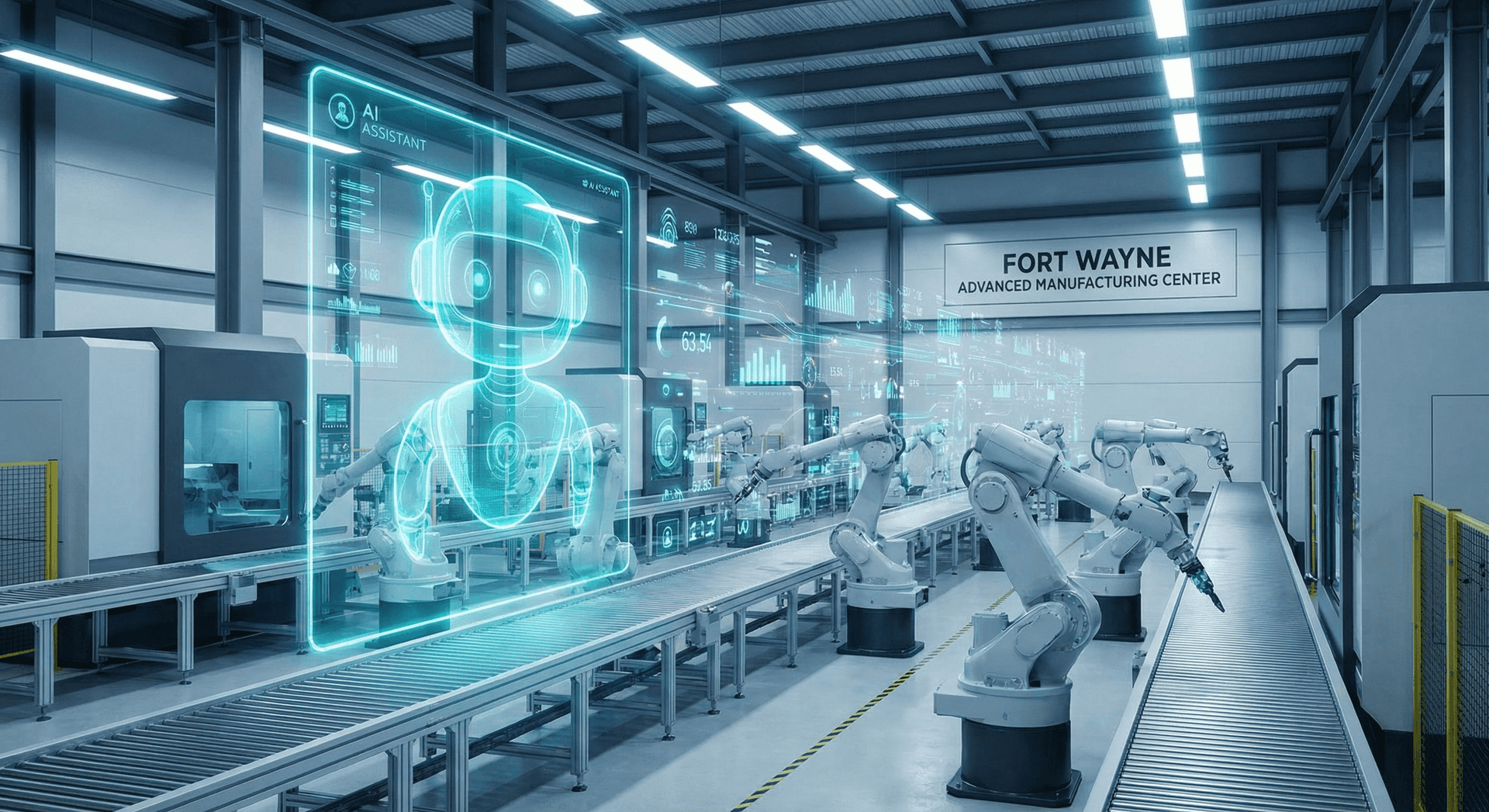
When manufacturers hear "AI," they tend to think of robotic arms on the shop floor or machine-vision inspection systems — capital equipment that costs six figures. That is one application, but it is not where the immediate ROI lives for most Northeast Indiana shops. The highest-impact use of AI automation in manufacturing is on the business side: the quoting, the documentation, the vendor management, and the compliance work that buries your front office while your machines sit underutilized because the quotes did not go out fast enough to fill the schedule.
RFQ intake and quoting
An autonomous AI Employee monitors your RFQ inbox — email, web forms, even phone calls. When a request arrives, it parses the specifications, identifies the material, processes, tolerances, and quantities, then pulls relevant data from your ERP system: current material costs, shop rates, machine availability, and historical pricing for similar parts. Within sixty seconds it generates a professional quote document, attaches it to a reply, and sends it back to the buyer. The estimator gets a notification and can review and adjust if needed, but the response is already out the door. Manufacturers in Toledo and Detroit use the same system for their OEM supplier networks.
Quality reports and inspection documentation
Every shop that supplies automotive, aerospace, or defense customers knows the documentation burden. First article inspection reports, PPAP packages, dimensional reports, material certifications — the paperwork can take as long as the machining. An AI Employee trained on your quality system pulls CMM data, populates report templates, cross-references material certs, and generates a complete quality package that your quality manager reviews rather than creates from scratch. What used to take four hours takes fifteen minutes of review time.
Vendor and supplier management
Your purchasing team spends hours every week chasing PO acknowledgments, checking delivery dates, following up on late shipments, and reconciling receiving records against invoices. An autonomous agent handles the entire communication loop: sends POs, follows up automatically when acknowledgments are late, tracks delivery status, flags discrepancies, and escalates only the exceptions that require human judgment. Your purchasing person stops being a full-time email writer and starts being a strategic buyer.
Compliance and certification documentation
ISO 9001, IATF 16949, AS9100, NADCAP — whatever your certification landscape looks like, documentation is the constant burden. Internal audit records, corrective action reports, management review minutes, training records — all of it needs to be current, organized, and audit-ready at all times. An AI Employee maintains your document control system, flags upcoming reviews, generates draft corrective actions from nonconformance data, and compiles audit packages on demand. The quality manager focuses on system improvement rather than filing.
What an Autonomous Agent Is NOT Doing
From 3 Quotes per Day to 25: A Northeast Indiana Simulation
Simulation Case Study
In this simulation, a precision CNC machining shop in Allen County runs a typical front office operation: one office manager, one estimator, and the owner splitting time between the shop floor and the front desk. On a good day, the estimator can turn out three complete quotes. On a day with interruptions — which is every day — it is closer to two. The shop has fourteen CNC machines and is running at roughly sixty percent capacity. Not because the work is not available, but because the quotes are not going out fast enough to win it.
In our model, the owner tracks inbound RFQs for one month. In thirty days, the shop receives a projected 147 RFQ inquiries across email, phone, and their website contact form. The estimator responds to 64 of them. The other 83 either receive a delayed response (more than 48 hours) or are never responded to at all. Of the 64 that receive timely quotes, the shop wins 19 — a 30% close rate that is actually above industry average.
The problem is not close rate. It is response rate. Only 44% of incoming RFQs are even getting quoted.
The deployment
Cloud Radix deployed an AI Employee configured specifically for the shop's operation. In this simulation, the system is integrated with their ERP (JobBOSS), their material pricing database, their rate sheets for each machine center, and their historical quoting data going back three years. The AI is trained on the shop's capabilities: machines, tolerances, materials, finishing processes, and typical lead times by part family.
When an RFQ arrives, the autonomous agent now performs the following workflow in under sixty seconds:
- Parses the drawing or specification document (PDF, STEP, or email body) and extracts dimensions, tolerances, material, finish, and quantity
- Matches the part characteristics against the shop's capability matrix to confirm feasibility
- Pulls current material pricing from their supplier database and applies the shop's standard markup
- Calculates cycle time estimates based on historical data for similar part geometries
- Applies the shop's machine-hour rate for the appropriate work center
- Generates a professional PDF quote with the shop's branding, terms, and conditions
- Sends the quote directly to the buyer with a personalized cover message
- Logs the quote in the ERP with full cost breakdown for the estimator to review
Projected results after 90 days
In our model, within the first ninety days after deployment, the shop's quoting volume goes from an average of 2.7 quotes per day to a projected 24.8. Every inbound RFQ receives a response — most within sixty seconds, all within five minutes. The estimator shifts from quote generation to quote review and strategic pricing adjustments on high-value jobs. Machine utilization is projected to climb from 61% to 83% within the first quarter.
In our model, the additional quarterly revenue is calculated conservatively. The shop wins an additional 31 jobs in the first quarter that it would not have quoted under the old system — either because the RFQ would have been missed entirely or because the response would have been too slow to compete. At an average job value of $4,100, those 31 jobs represent a projected $127,100 in new revenue against a Cloud Radix monthly investment of $1,497. The projected annualized ROI exceeds 21x. See our dedicated Fort Wayne manufacturing AI Employee page for full deployment details and capabilities.
The Estimator Did Not Lose a Job — He Got a Better One
How Autonomous Agents Integrate with Manufacturing ERP Systems
The power of an AI Employee in a manufacturing environment comes directly from its integration depth. A standalone chatbot that cannot see your inventory, your machine schedule, or your cost data is useless in a shop environment. The autonomous agent needs to live inside your operational data to deliver real value.
Supported ERP and MRP integrations
Cloud Radix AI Employees integrate with the ERP and MRP systems that Northeast Indiana manufacturers actually use. This is not a theoretical compatibility list — these are systems we have connected in production environments:
- JobBOSS / E2 Shop System — The most common ERP among small to mid-size job shops in the Fort Wayne area. Integration covers quoting, job tracking, material costs, and scheduling data.
- Epicor — Common in mid-size manufacturers. Integration supports work order creation, cost estimation, and inventory queries.
- ProShop ERP — Popular among precision shops and aerospace suppliers. Full integration with quoting, quality management, and document control modules.
- Global Shop Solutions — Integration with estimating, scheduling, and purchasing modules.
- IQMS (DELMIAworks) — Common in injection molding and plastics manufacturing. Integration with quoting and production planning.
- SAP Business One / SAP S/4HANA — For larger manufacturers. API integration with materials management, production planning, and financial modules.
- QuickBooks / Sage — For shops that run their financials separately from production tracking, the AI connects to accounting systems for cost data and invoicing.
How the data flows
The autonomous agent connects to your ERP through secure API endpoints or, where APIs are limited, through a local gateway appliance that reads your database directly. The appliance sits on your network, communicates with the AI over an encrypted tunnel, and never exposes your ERP to the public internet. Data flows are bidirectional: the AI reads material costs, shop rates, and machine schedules; it writes back quote records, PO status updates, and document references.
This architecture matters because manufacturing data is sensitive. Your rate sheets, your material costs, your customer pricing history — this is competitive intelligence. Cloud Radix AI Employees process this data within a private, encrypted environment that never shares your information with other customers or uses it to train general-purpose models. Your data stays yours.
Start Where the Data Already Lives
Quality Report Automation: From Hours to Minutes
If you supply to automotive or aerospace OEMs, you already know that the documentation requirements can rival the machining complexity. First article inspection reports (FAIR), production part approval process (PPAP) submissions, capability studies, dimensional reports with balloon callouts, material test reports — the list is long, and the cost of getting it wrong is a rejected shipment or a lost customer.
How the AI builds a quality package
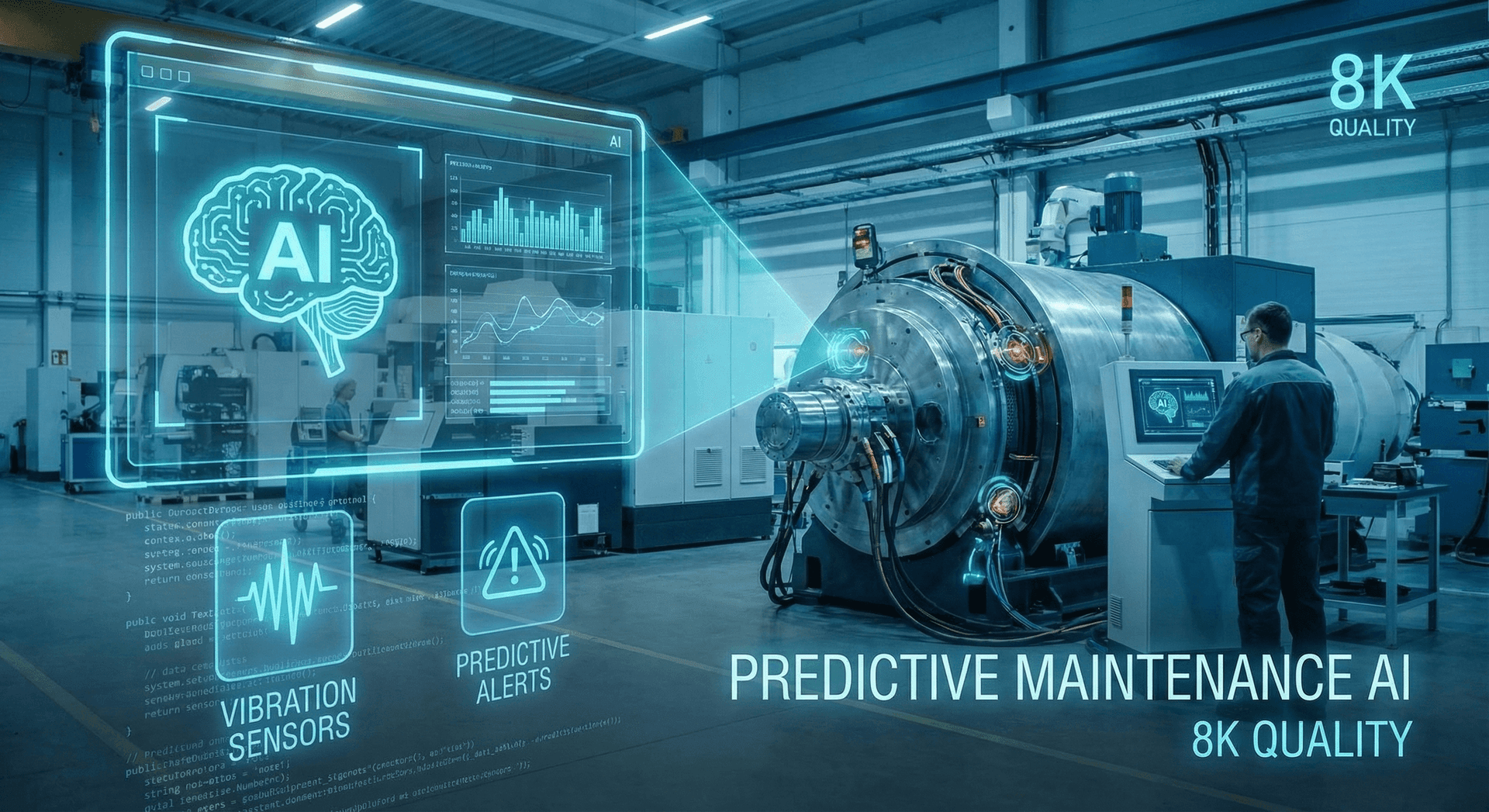
The autonomous agent connects to your CMM software (PC-DMIS, Calypso, QC-CALC, or similar) and ingests measurement data directly. It maps each measurement to the corresponding dimension on the drawing, populates the inspection report template in your customer's required format, attaches the material certification from your supplier, and compiles the complete package as a single PDF with bookmarked sections. The quality manager opens the package, reviews the data, and signs off. No manual data transfer. No copy-paste errors between the CMM printout and the inspection form.
PPAP automation for automotive suppliers
A Level 3 PPAP submission requires eighteen elements. Many Fort Wayne area shops that supply to GM Truck Assembly, Dana Incorporated, or other regional OEMs submit dozens of PPAPs per year. Each one traditionally requires the quality team to manually assemble design records, process flow diagrams, control plans, MSA results, capability studies, dimensional reports, and material certifications into a single, organized submission. An autonomous agent that already has access to your quality data, your ERP, and your document control system can assemble ninety percent of a PPAP package automatically. The quality engineer reviews, adds engineering judgment where required, and submits.
The projected time savings are significant. Shops that currently allocate two to three days of quality team time per PPAP submission could potentially complete them in an estimated two to four hours — with fewer errors and more consistent formatting.
Vendor Communication Management: Stop Chasing POs
Ask any purchasing manager at a Northeast Indiana job shop what they spend most of their day doing, and the answer is almost always the same: following up. Following up on PO acknowledgments. Following up on delivery dates. Following up on late shipments. Following up on material certifications that were supposed to ship with the order. Following up on pricing discrepancies between the quote and the invoice. The role has become ninety percent communication administration and ten percent strategic purchasing.
An autonomous agent reverses that ratio. Here is what it handles:
- PO transmission and acknowledgment tracking: The AI sends purchase orders to suppliers, monitors for acknowledgments, and follows up automatically after 24 and 48 hours if no acknowledgment is received.
- Delivery date monitoring: The AI tracks expected delivery dates against actual receiving records and flags shipments that are approaching or past due, escalating to the purchasing manager only when human intervention is needed.
- Material cert collection: When material arrives without the required certification documents, the AI sends an automated request to the supplier, follows up daily, and flags the lot as held in the ERP until certs are received.
- Invoice reconciliation: The AI matches supplier invoices against POs and receiving records, flags price discrepancies, and routes confirmed invoices for payment while holding discrepant ones for human review.
- Supplier scorecarding: Over time, the AI builds a comprehensive delivery and quality performance record for each supplier, giving your purchasing team data-driven leverage for negotiations and sourcing decisions.
The result is a purchasing operation that runs on exceptions rather than manual monitoring. The AI handles the ninety percent that is routine. The purchasing manager handles the ten percent that requires negotiation, judgment, or relationship management. In manufacturing, autonomous agents do not replace procurement professionals — they free procurement professionals to actually do procurement.
Compliance and Documentation: Audit-Ready Without the Panic
Every certified manufacturer knows the feeling: the registrar calls to schedule an audit, and the next two weeks are consumed with scrambling to update training records, close out open CARs, organize management review minutes, and make sure the document control system is current. The audit itself takes two days. The preparation takes two weeks. And the stress is disproportionate to the actual complexity of the work — most of it is administrative organization that should have been happening continuously.
An autonomous agent makes audit preparation a non-event because it maintains documentation continuously rather than in bursts:
- Document control: The AI tracks document revision status, flags items approaching review dates, and routes updated documents for approval automatically. The document control matrix is always current.
- Training records: When a procedure is updated, the AI identifies which personnel need to be retrained based on the responsibility matrix and generates training assignments automatically.
- Corrective action management: When a nonconformance is logged, the AI drafts a corrective action report with root cause analysis suggestions based on historical data, assigns it to the appropriate owner, and tracks it through verification and close-out.
- Management review preparation: The AI compiles quality metrics, customer complaint summaries, audit findings, supplier performance data, and trend analysis into a formatted management review package — ready for the meeting rather than assembled during it.
- Internal audit scheduling and checklists: The AI maintains the internal audit schedule, generates audit checklists based on the applicable standard, and tracks findings through close-out.
AI Supports Compliance — It Does Not Replace Your Quality System
Cost Comparison: AI Employee vs. Additional Staff for Manufacturing
The most common alternative to deploying an autonomous agent in a manufacturing front office is hiring another person. A second estimator, a dedicated quality administrator, an additional purchasing coordinator — the instinct is to solve a capacity problem with headcount. Here is how the economics compare in the Fort Wayne labor market as of 2026.
| Cost Category | Additional Employee | AI Employee |
|---|---|---|
| Monthly base cost | $4,200–$5,800 (salary + benefits) | $1,497/month (platform + support; API usage separate) |
| Onboarding time | 2–6 weeks before full productivity | 5–7 days to full deployment |
| Training cost | $3,000–$8,000 (ERP, quality systems, processes) | Included in setup — AI learns from your data |
| Coverage hours | 40 hrs/week (M–F, 8–5) | 168 hrs/week (24/7/365) |
| Sick days / PTO | 15–20 days/year average | Zero downtime |
| Quoting capacity | 3–5 quotes/day | 25–50+ quotes/day |
| Error rate | Manual data entry — 2–5% error rate | Automated data pull — < 0.1% error rate |
| Scales with demand | No — must hire again at next capacity ceiling | Yes — handles volume surges without additional cost |
| Annual total cost | $65,000–$85,000+ (fully loaded) | $17,964/year |
| Turnover risk | High — turnover rates typical in manufacturing admin | Zero — AI does not quit |
The comparison is not intended to suggest that AI replaces people in every scenario. Some situations genuinely require another human — particularly roles that involve physical presence, complex relationship management, or creative problem-solving that goes beyond pattern recognition. But for the specific tasks that consume manufacturing front office bandwidth — quoting, documentation, follow-up, and compliance administration — the economics of an AI Employee investment are dramatically favorable.
And unlike a new hire, the autonomous agent reaches full productivity in a week, works every shift including weekends, never calls in sick, and does not leave for a competitor offering a dollar more per hour. In a labor market as tight as Fort Wayne's manufacturing sector in 2026, that reliability has a value that goes beyond the monthly cost comparison.

The Fort Wayne Manufacturing Landscape: Why This Matters Now
Northeast Indiana is not a peripheral manufacturing region. It is one of the densest manufacturing corridors in the United States. Allen County alone accounts for an estimated $4.5 billion in annual manufacturing output. The region's manufacturers supply General Motors, Stellantis, Toyota, Boeing, Raytheon, and dozens of other OEMs. The Northeast Indiana Regional Partnership consistently ranks the region among the top manufacturing economies per capita in the country.
But the landscape is shifting. OEM procurement is moving faster. Digital-first procurement platforms like Xometry, Fictiv, and Protolabs have trained buyers to expect instant quoting. Even traditional OEM purchasing departments now use automated RFQ distribution tools that send requests to twenty suppliers simultaneously and evaluate responses within hours. The shops that respond first — and respond professionally — are the shops that fill their schedules.
The competitive window
As of early 2026, adoption of autonomous agents in manufacturing front offices across Northeast Indiana remains in its early stages. The vast majority of the region's job shops have not yet deployed AI-driven quoting, documentation, or vendor management systems. This means the shops that move now gain a structural advantage — faster response times, higher quoting volume, lower administrative costs — before their competitors adopt the same tools.
That window will not stay open indefinitely. The technology is proven, the cost is accessible, and the ROI is measurable within ninety days. The question for Northeast Indiana manufacturers is not whether autonomous agents will reshape the competitive landscape — it is whether you will be the shop that gains the advantage or the shop that scrambles to catch up.
Local support matters for manufacturing
Manufacturing AI deployment is not something you want to manage through a chat window with a software company in San Francisco. Your ERP has quirks. Your quoting process has edge cases. Your quality system has specific formatting requirements that a general-purpose tool will not understand. Cloud Radix is based in Auburn, Indiana — twenty-five minutes from downtown Fort Wayne. Our team walks your shop floor, meets your estimator, sits with your quality manager, and configures the system to match how your specific operation works. When something needs adjustment, we drive over. We do not open a ticket.
Northeast Indiana Manufacturing Resources
Frequently Asked Questions
Q1.Can an AI Employee really parse a manufacturing drawing and generate an accurate quote?
Yes, with context. The autonomous agent does not estimate from the drawing alone — it combines the drawing data with your shop's historical quoting database, current material pricing, machine-hour rates, and capability matrix. For standard part families that your shop has quoted before, accuracy typically exceeds 95% compared to your estimator's pricing. For novel geometries or unusual materials, the AI flags the quote for human review rather than guessing. The system improves continuously as it processes more of your specific quoting data.
Q2.What ERP systems do Cloud Radix AI Employees integrate with?
We have production integrations with JobBOSS, E2 Shop System, Epicor, ProShop ERP, Global Shop Solutions, IQMS (DELMIAworks), SAP Business One, and QuickBooks. For shops running custom or legacy ERP systems, we build a gateway integration using your database structure. If your system stores data in a SQL database — and most do — we can integrate with it. The integration is configured during the five-to-seven-day onboarding process and includes full testing before going live.
Q3.How does the AI handle RFQs that are outside our shop's capabilities?
The autonomous agent is configured with your complete capability matrix — machine envelopes, tolerance limits, material capabilities, finishing processes, and certifications. When an RFQ arrives that falls outside your capabilities, the AI responds to the buyer with a professional decline that specifies the capability gap, suggests the buyer contact a shop with the appropriate equipment, and logs the inquiry in your CRP for future capability planning. This is significantly better than the current alternative for most shops, which is simply not responding at all.
Q4.Is our manufacturing data secure with an AI Employee?
Your data is processed within an encrypted, isolated environment that is dedicated to your account. Rate sheets, material costs, customer pricing history, and proprietary process data are never shared with other customers, never used to train general-purpose models, and never accessible to anyone outside your authorized team. The system runs on a local hardware appliance connected to Cloud Radix through an encrypted tunnel. Your ERP is never exposed to the public internet. We provide a full security architecture document during the evaluation process.
Q5.How long does it take to deploy an AI Employee for a manufacturing shop?
Typical deployment for a CNC job shop takes five to seven business days. Days one and two cover discovery — we walk your shop, meet your team, and document your quoting process, quality system, and vendor management workflows. Days three through five involve system configuration, ERP integration, and AI training using your historical data. Days six and seven are live testing with your team reviewing output in real time. Most shops are fully operational by the end of week one, with a thirty-day optimization period where we fine-tune based on real-world performance.
Q6.Will our estimator lose their job if we deploy an AI Employee?
No. In every manufacturing deployment we have done, the estimator's role has evolved rather than been eliminated. Instead of spending five hours a day on data entry and quote formatting, the estimator shifts to reviewing AI-generated quotes for accuracy, adjusting pricing on strategic opportunities, developing relationships with key buyers, and analyzing margin trends across the quote portfolio. The estimator becomes more valuable, not less. The AI handles the volume work. The human handles the judgment work.
Q7.What happens if the AI generates an incorrect quote?
Every AI-generated quote is logged in your ERP with a full cost breakdown visible to your estimator. The system includes configurable confidence scoring — quotes below a specified confidence threshold are routed for human review before being sent. For the first thirty days, most shops choose to have the estimator review every quote before release. After the optimization period, shops typically release standard quotes automatically and route only unusual or high-value quotes for review. The AI learns from every correction, so accuracy improves continuously over time.
Q8.Can the AI Employee handle phone-based RFQ inquiries, not just email?
Yes. The AI Employee includes voice capabilities that can answer phone calls, conduct a structured RFQ intake conversation with the buyer, capture part specifications verbally, and generate a quote from the phone conversation data. For complex inquiries that require drawing review, the AI guides the caller to email the drawing and then processes the complete quote once the file arrives. The phone capability is particularly valuable for shops that receive a significant portion of their RFQ volume through direct phone calls from purchasing agents.
Sources
- U.S. Census Bureau — County Business Patterns: Allen County, IN (2024) — census.gov
- Indiana Economic Development Corporation — Northeast Indiana Advanced Manufacturing Sector Report 2025 — iedc.in.gov
- Northeast Indiana Regional Partnership — Regional Economic Dashboard: Manufacturing Output 2025 — neindiana.com
- Thomas / Xometry — State of North American Manufacturing Survey: Procurement Speed and RFQ Response Times (2025) — thomasnet.com
- National Association of Manufacturers — 2025 NAM Manufacturers' Outlook Survey: Workforce and Technology Adoption — nam.org
- McKinsey & Company — AI in Manufacturing: From Pilots to Scale (2025) — mckinsey.com
- U.S. Bureau of Labor Statistics — Occupational Employment and Wages: Manufacturing Sector, Indiana (2025) — bls.gov
- Deloitte — 2025 Manufacturing Industry Outlook: Digital Transformation and Workforce — deloitte.com
Ready to Automate Your Manufacturing Workflows?
Cloud Radix is 25 minutes from Fort Wayne. We understand Northeast Indiana manufacturing.
Schedule a Free ConsultationNo contracts. No pressure.