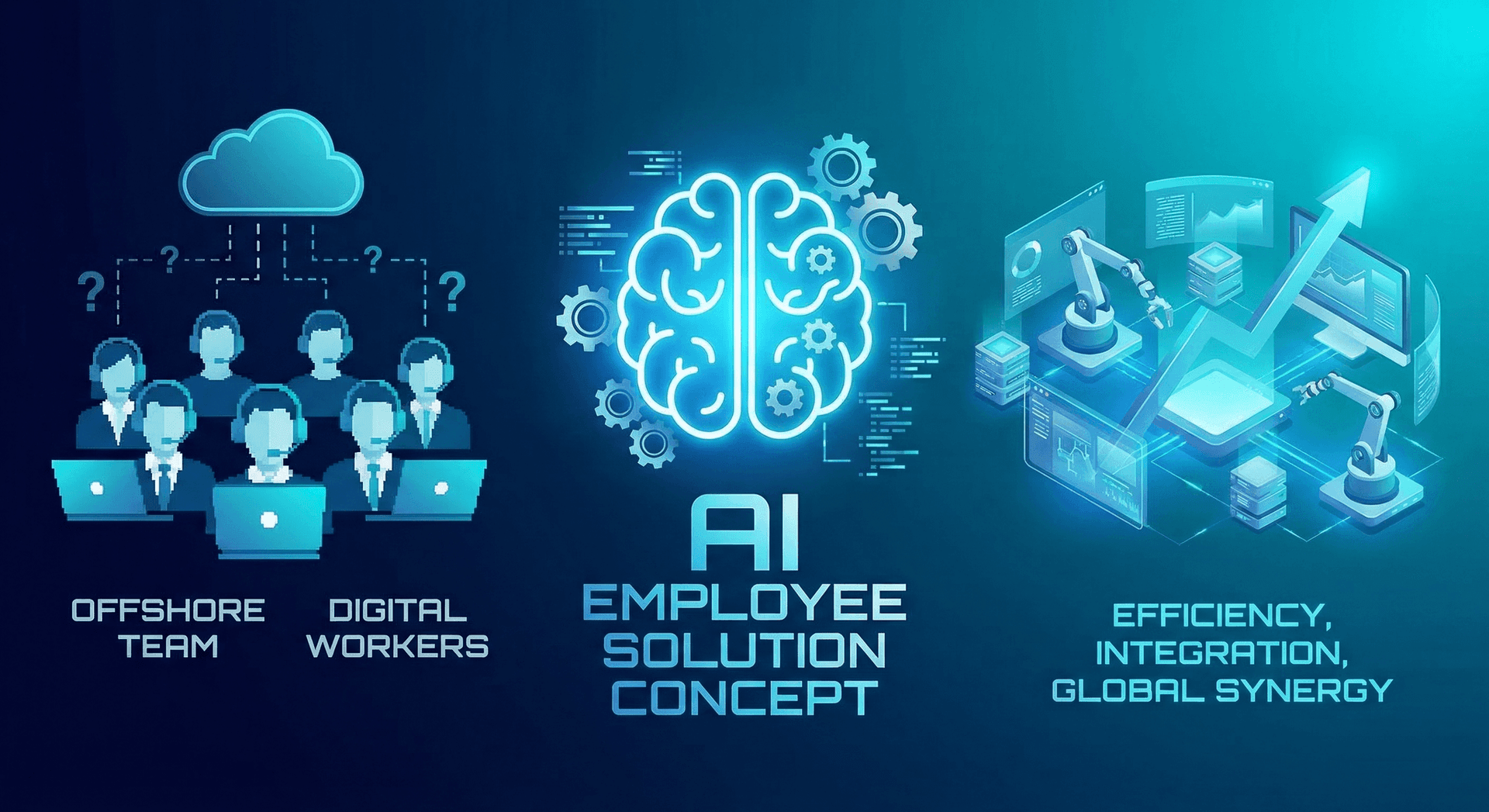
What Is AI Staffing?
AI staffing is the practice of deploying trained artificial intelligence systems—often called AI employees—to fill specific roles in your business. These are not chatbots that recite scripted responses. They are AI systems trained on your particular business: your processes, your customer base, your products, your voice, and your standards.
The concept is straightforward. Many businesses have roles that are primarily digital—answering phones, responding to emails, scheduling appointments, processing data, qualifying leads, handling customer inquiries. These roles require knowledge, consistency, and availability, but they do not require a physical human presence. AI staffing fills those roles with AI employees that learn your business and integrate with your existing tools.
This is not about replacing people. It is about filling gaps that are increasingly difficult to fill in a tight labor market, and about giving your human team members the bandwidth to focus on work that genuinely requires human judgment, creativity, and physical presence.
For Fort Wayne and Northeast Indiana businesses, AI staffing represents a practical response to a real problem. The region's economy is growing, but the available workforce is not growing at the same pace. Traditional approaches—hiring full-time employees, contracting with temp agencies, or simply asking existing staff to do more—each have limitations. AI staffing is a new option in the toolbox, and it is worth understanding clearly.
How AI Employees Differ from Chatbots and Automation
A common misconception is that AI staffing means putting a chatbot on your website. That is not what we are describing. A chatbot follows a decision tree. It can answer a handful of pre-programmed questions, and when it encounters anything outside that tree, it fails.
An AI employee is fundamentally different. It understands context. It can handle multi-step conversations. It learns from corrections. It integrates with your CRM, your phone system, your scheduling software, and your email. It does not just answer questions—it takes action. It books appointments, updates records, routes calls, sends follow-ups, and processes information.
Similarly, AI staffing is different from traditional automation. Automation handles rigid, rule-based processes: if X happens, do Y. AI employees handle variable, judgment-requiring tasks: a caller asks a question the system has never heard before, and the AI employee uses its understanding of your business to provide an accurate, helpful response. When it encounters something truly outside its scope, it escalates to a human team member with full context.
The Staffing Frame, Not the Technology Frame
The reason we use the term "AI staffing" rather than "AI technology" or "AI software" is intentional. When a Fort Wayne business owner thinks about their workforce needs, they think in terms of roles, hours, coverage, and capability. AI staffing fits into that framework naturally.
You have a front-desk role that needs covering 60 hours per week. You have a phone line that rings after 5 PM with no one to answer. You have a backlog of data entry that your team never catches up on. These are staffing problems, and AI staffing addresses them the way a staffing decision should—by asking what the role requires, matching it to the right resource, and measuring the results.
A Working Definition
The Fort Wayne Staffing Landscape
To understand why AI staffing matters for Fort Wayne businesses, it helps to understand the staffing environment those businesses are operating in. The labor market in Northeast Indiana has been tight for several years, and structural factors suggest that tightness is not going away soon.

Indiana Labor Market Context
Indiana's unemployment rate has hovered near historic lows throughout 2025 and into 2026. The Indiana Department of Workforce Development reports that the state's labor force participation rate remains below pre-2020 levels, meaning there are structurally fewer workers available than there were six years ago. In the Fort Wayne metro area (Allen County and surrounding counties), the situation mirrors the statewide trend.
The Bureau of Labor Statistics reports that the Fort Wayne metropolitan statistical area consistently records unemployment rates at or below the national average. While low unemployment is generally positive for workers, it creates genuine challenges for businesses trying to hire. Job openings outnumber available candidates in many sectors, and the gap is especially pronounced in administrative, customer service, and entry-level knowledge work roles.
Industries Feeling the Pinch
Fort Wayne's economy is diverse, and the staffing challenge cuts across industries:
- Manufacturing: Northeast Indiana is a manufacturing hub. Companies along the I-69 corridor and in the Industrial Park area face constant pressure to staff not just production lines but also the administrative and customer service functions that support production. Order processing, vendor communication, quality reporting, and customer inquiries all require staffing.
- Healthcare: Parkview Health, Lutheran Health Network, and dozens of independent practices employ thousands in the region. Administrative staffing—scheduling, insurance verification, patient communication, records management—is a persistent challenge, especially for smaller practices that cannot compete with large systems on wages.
- Professional Services: Law firms, accounting practices, insurance agencies, and financial advisors along Dupont Road, in the Ash Brokerage corridor, and downtown all need administrative support staff. Finding and retaining qualified administrative professionals has become increasingly difficult.
- Home Services: HVAC, plumbing, electrical, and general contracting businesses throughout Allen County face a specific challenge: their skilled technicians are out in the field, but customers are calling, emailing, and requesting quotes during and after business hours. The phone is often the first bottleneck.
- Retail and Hospitality: Businesses along Coldwater Road, in Jefferson Pointe, and in the revitalized downtown area deal with high turnover and seasonal demand fluctuations that make consistent staffing difficult.
The Cost of Unfilled Roles
What often gets overlooked in staffing discussions is the cost of leaving a role unfilled. When a Fort Wayne manufacturing company cannot answer its phones promptly, it loses orders. When a medical practice cannot handle scheduling overflow, patients go elsewhere. When a home services company misses after-hours calls, those leads go to the competitor who picks up.
These are not hypothetical costs. They are real revenue losses that compound over time. The Society for Human Resource Management (SHRM) has documented that the cost of a vacant position can equal 50 to 200 percent of the role's annual salary when lost productivity, missed revenue, and team overload are factored in.
For many Fort Wayne businesses, the question is not whether they can afford to try AI staffing. It is whether they can afford to leave roles unfilled or understaffed while waiting for the labor market to loosen—a wait that may be indefinite.
Traditional Responses and Their Limits
Fort Wayne businesses have historically responded to staffing gaps in three ways, each with real limitations:
Full-time hiring is the gold standard when you can make it work. A dedicated employee who knows your business, grows with your team, and provides consistent performance is ideal. But full-time hiring requires competitive wages, benefits, a lengthy recruitment process, and ongoing management. For roles that are primarily routine or that need coverage outside standard business hours, full-time hiring may not be practical or cost-effective.
Temp agency staffing fills gaps quickly, and that speed has real value. When you need someone by Monday, a temp agency can deliver. But temp staffing comes with inherent trade-offs: markup rates that typically run 40 to 70 percent above the worker's wage, turnover cycles that require repeated training, and limited hours of coverage. Temp agencies serve a genuine purpose, and they do it well for many types of roles. The limitation is not the agency—it is the model's structural fit for certain kinds of work.
Asking existing staff to do more is the most common response, and the most damaging over time. When you cannot fill a role, the work does not disappear. It gets distributed to your existing team, leading to burnout, reduced quality, and eventually, more turnover. It is a cycle that feeds itself.
AI staffing does not replace any of these approaches entirely. It adds a fourth option that is especially well-suited for digital, knowledge-based, and communication-heavy roles where the work is primarily done through screens, phones, and keyboards rather than physical presence.
The Staffing Gap Is Structural
Where AI Staffing Excels
AI staffing is not a universal solution. It excels in specific categories of work, and understanding those categories clearly is essential for making good decisions about where to deploy it.

24/7 Customer-Facing Roles
This is the single strongest use case for AI staffing. If your business receives phone calls, emails, chat messages, or web inquiries outside of standard business hours—or even during business hours when your team is at capacity—an AI employee can handle that volume around the clock.
Consider what happens at a Fort Wayne HVAC company when a homeowner's furnace fails at 10 PM on a Tuesday in January. The homeowner calls the company. If no one answers, they call the next company on the list. An AI employee answers that call, understands the situation, checks technician availability, and either schedules an emergency visit or provides guidance and books a first-available appointment. That call is worth hundreds or thousands of dollars, and it happens whether or not you have someone on shift.
The same pattern applies across industries. A patient calls a medical practice at 7 AM to reschedule. A potential client emails an insurance agency at 9 PM asking for a quote. A homeowner fills out a contact form on a contractor's website at midnight on Saturday. In every case, the AI employee responds immediately, professionally, and accurately—using the same information and tone your human team would use.
High-Volume Repetitive Knowledge Work
Every business has tasks that are important but repetitive. Data entry from paper forms into a CRM. Transferring information between systems. Generating routine reports. Processing invoices. Updating inventory records. Sending follow-up emails after appointments.
These tasks require accuracy and consistency, but they do not require creativity or complex judgment. They are exactly the type of work where human workers tend to make errors due to fatigue or boredom, and where an AI employee maintains the same level of precision on the thousandth task as on the first.
For a Fort Wayne manufacturing company processing 200 purchase orders per week, the difference between having a dedicated AI employee handling data entry and having it distributed across an already-busy office staff can be significant—both in accuracy and in freeing up human time for higher-value work.
Roles with High Turnover and Constant Retraining
Some roles are structurally difficult to retain people in. The work may be monotonous, the hours may be undesirable, or the position may be inherently transitional. Entry-level customer service, overnight coverage, and high-volume data processing roles often fall into this category.
When a role turns over four, six, or eight times per year, the cumulative cost of recruiting, onboarding, and training is substantial. Each new person needs to learn your systems, your processes, and your customer expectations from scratch. Meanwhile, quality dips during every transition period, and your existing team absorbs extra work to compensate.
An AI employee learns your business once and retains that knowledge permanently. When you correct it or teach it something new, that learning is cumulative. There is no turnover, no ramp-up period, no knowledge lost. Six months after deployment, the AI employee knows your business better than a new hire would after two weeks.
Overflow and Surge Capacity
Many Fort Wayne businesses experience predictable surges. Tax season for accountants. Winter for HVAC companies. Summer for landscapers and contractors. Holiday season for retail and e-commerce. These surges create temporary staffing needs that are difficult to meet through traditional hiring and even challenging for temp agencies during peak demand seasons.
AI employees scale without the hiring cycle. During a surge, the same AI employee handles increased volume by working more hours—which, since it works 24/7 already, means it simply processes more tasks within the same timeframe. There is no need to recruit, onboard, or train surge staff. When the surge ends, there is no need to lay anyone off.
After-Hours and Weekend Coverage
This deserves special emphasis because it is one of the most common pain points for Fort Wayne business owners. Your business closes at 5 PM, but your customers do not stop needing things at 5 PM. They call, email, text, and submit forms throughout the evening and weekend.
The traditional options are limited: pay for overtime, contract with an answering service (which usually provides basic message-taking, not actual problem-solving), or let calls go to voicemail and respond the next business day. None of these options is ideal.
An AI employee working after hours does not just take messages. It answers questions, schedules appointments, provides quotes, qualifies leads, and handles routine requests with the same quality and knowledge as your daytime team. When you arrive Monday morning, you do not find a stack of voicemails to return. You find resolved inquiries, booked appointments, and qualified leads waiting in your pipeline.
| Use Case | Traditional Staffing Challenge | AI Staffing Advantage |
|---|---|---|
| 24/7 phone coverage | Requires multiple shifts + overtime | Included in standard deployment |
| Data entry / processing | High error rates from fatigue | Consistent accuracy at any volume |
| High-turnover roles | 4-8 retraining cycles per year | Train once, knowledge compounds |
| Surge capacity | Weeks to recruit and onboard | Scales instantly with demand |
| After-hours coverage | Answering service or voicemail | Full service with business knowledge |
| Lead qualification | Inconsistent criteria application | Standardized scoring every time |
Where Traditional Staffing Still Wins
Honesty matters in this conversation. AI staffing is genuinely excellent for certain types of work, and it is genuinely inadequate for others. Knowing the boundaries is just as important as knowing the capabilities.
Here are the categories where traditional staffing—whether through direct hire, temp agencies, or contractors—remains the right approach.
Physical Labor and Hands-On Work
This is the most obvious boundary. AI employees exist in software. They cannot stock shelves, operate forklifts, install plumbing, frame a house, clean an office, or perform any task that requires physical presence and manual dexterity. Fort Wayne's manufacturing sector, construction industry, and warehousing operations depend on human workers for these roles, and that is not going to change.
If your staffing gap is on the production floor or the job site, a temp agency or direct hire is the right solution. AI staffing can support those operations—by handling the administrative work that supports physical labor roles—but it cannot replace the hands-on work itself.
Roles Requiring Human Presence
Some roles are defined by physical presence even when the work itself is not physically demanding. A receptionist who greets walk-in visitors. A host at a restaurant. An event coordinator who needs to be on-site managing logistics. A retail associate helping customers find the right product and try it on.
These roles have a human-interaction component that AI cannot replicate. Customers expect a person, and the value of the role comes from that human-to-human interaction. For these positions, traditional staffing is the right approach.
Truly Temporary Project Work
Temp agencies excel at their original purpose: providing workers for genuinely temporary assignments. You need three extra people for a two-week inventory count. You need a licensed professional to cover a maternity leave. You need event staff for a weekend conference at the Grand Wayne Convention Center. These are time-bounded, specific-purpose roles where the temp model works exactly as designed.
Roles Requiring Complex Human Judgment
While AI employees are capable of making decisions within defined parameters, there are roles where the judgment required is too nuanced, too high-stakes, or too dependent on emotional intelligence for AI to handle well. Crisis counseling. Sensitive HR conversations. Complex negotiations. Creative direction. Roles where reading the room, building trust over time, and exercising moral judgment are central to the work.
These roles require human qualities that current AI technology does not fully replicate, and responsible AI staffing means being clear about that boundary.
Relationship-Intensive Sales
AI employees can qualify leads, schedule meetings, follow up on inquiries, and process routine orders. But high-value, relationship-driven sales—the kind where a Fort Wayne business is building a long-term partnership with a client over months or years—still requires a human salesperson. The trust, rapport, and strategic thinking involved in complex B2B sales is a human strength.
The Honest Assessment
How AI Staffing Works
Understanding the deployment process removes uncertainty and helps you set realistic expectations. Here is how AI staffing works from initial conversation through ongoing optimization.
Phase 1: Assessment and Role Identification
The process begins with a thorough assessment of your current operations. Which roles are you struggling to fill? Where does work pile up? What tasks does your team spend time on that are important but repetitive? Where do you lose customers or leads due to slow response times or limited hours?
This assessment is not about finding ways to eliminate jobs. It is about identifying the specific functions where AI can fill a gap, handle overflow, or provide coverage that you currently cannot. For most Fort Wayne businesses, the assessment reveals a mix of roles: some well-suited for AI, some firmly in the human-only category, and some that benefit from a hybrid approach.
The output of this phase is a clear map of candidate roles, each with a defined scope of work, expected volume, integration requirements, and success metrics. This map becomes the foundation for everything that follows.
Phase 2: Training the AI on Your Business
This is where AI staffing diverges most sharply from traditional staffing. When you hire a temp worker, they arrive with general skills and learn your business on the job. When you deploy an AI employee, the learning happens before day one.
Training involves feeding the AI employee your business-specific information: your product and service catalog, your pricing structure, your frequently asked questions, your standard procedures, your customer communication style, your escalation policies, your scheduling rules, and any other knowledge that a well-trained human employee would need.
For a Fort Wayne manufacturing company, this might include product specifications, dealer contact protocols, order status lookup procedures, and quoting guidelines. For a medical practice, it would include appointment types, scheduling rules, insurance verification procedures, and patient communication policies. For a home services company, it would include service area definitions, pricing guidelines, emergency protocols, and technician scheduling logic.
The AI employee does not need to learn everything at once. Training is iterative. You start with the core knowledge required for the most common interactions, and the AI employee's knowledge expands over time as it encounters new situations and receives corrections.
Phase 3: Integration with Your Systems
An AI employee that cannot access your tools is like an employee sitting at an empty desk. Integration is what makes AI staffing functional rather than theoretical.
During this phase, the AI employee is connected to the systems it needs to do its job:
- Phone system: The AI employee can answer calls, make outbound calls, transfer calls, and leave voicemails through your existing phone infrastructure.
- Calendar and scheduling: Direct integration with Google Calendar, Microsoft 365, or your industry-specific scheduling platform allows the AI employee to check availability, book appointments, send confirmations, and handle reschedules.
- CRM: The AI employee reads from and writes to your CRM, maintaining a single source of truth for customer interactions, lead status, and contact history.
- Email: The AI employee sends and responds to emails from your business address, following your communication templates and tone guidelines.
- Industry-specific software: EHR systems for healthcare, inventory management for manufacturing, field service management for home services, policy management for insurance—the AI employee connects to the tools your team already uses.
Phase 4: Deployment with Monitoring
Deployment is not a flip-of-the-switch event. It begins with a controlled rollout. The AI employee starts handling real interactions while a human team member monitors its performance. This monitoring period typically lasts one to two weeks, depending on the complexity of the role.
During monitoring, the team identifies any gaps in the AI employee's knowledge, fine-tunes its responses, and adjusts its behavior based on real-world interactions. This is the equivalent of a new hire's first two weeks on the job, but with a key difference: every correction improves the AI employee permanently. There is no need to repeat the same correction twice.
Human approval gates are built into the system for high-stakes decisions. If the AI employee encounters a situation that requires authorization, a judgment call outside its parameters, or a high-value transaction, it pauses and routes to a human approver. This ensures that autonomy and oversight are balanced appropriately.
Phase 5: Continuous Optimization
Unlike a human hire who reaches a performance plateau, an AI employee's performance trajectory is continuously upward. Every interaction generates data. That data reveals patterns: which questions come up most frequently, where customers express frustration, which processes take the longest, where errors occur.
Over time, the AI employee becomes more efficient, more accurate, and more aligned with your business goals. New knowledge is added as your business evolves—new products, new services, new pricing, new processes. The AI employee adapts without retraining from scratch.
| Phase | Duration | Key Activities |
|---|---|---|
| Assessment | 1-2 weeks | Role mapping, volume analysis, integration scoping |
| Training | 1-2 weeks | Business knowledge loading, process documentation, tone calibration |
| Integration | 3-5 days | System connections, data flow testing, security verification |
| Deployment | 1-2 weeks | Controlled rollout, human monitoring, real-time corrections |
| Optimization | Ongoing | Performance analysis, knowledge expansion, process refinement |
Total Timeline
Illustrative Fort Wayne Scenarios
Abstract descriptions only go so far. Let's walk through four detailed scenarios that represent common situations for Fort Wayne and Northeast Indiana businesses. Each includes realistic cost comparisons and honest assessments of outcomes.
These are illustrative examples based on typical Fort Wayne business profiles, not descriptions of specific Cloud Radix clients.
Scenario 1: Manufacturing Company with Surge Capacity Needs
A mid-size Fort Wayne manufacturer with 80 employees produces components for the automotive and defense sectors. Their customer service team (four full-time employees) handles order inquiries, quote requests, shipping updates, and dealer communication. During Q4 and Q1, volume spikes by 40 percent as customers place and expedite year-end orders.
Current approach: During peak season, the company brings in two temp workers through a local staffing agency. At an agency rate of $22/hour (roughly a 55 percent markup over the worker's wage), two temps for 20 weeks cost approximately $35,200. Each temp requires two weeks of training on the company's ERP system and dealer communication protocols. When a temp leaves mid-season (which has happened in three of the last four years), the remaining temps and full-time staff absorb the workload until a replacement is found and trained.
AI staffing approach: One AI employee is deployed to handle the highest-volume, most repetitive functions: order status lookups, standard quote generation, and shipping update requests. These three tasks account for roughly 60 percent of the customer service team's phone and email volume. The AI employee integrates with the company's ERP and email systems, handles these inquiries 24/7, and escalates non-standard requests to the human team.
Cost comparison: The AI employee plan costs $2,497/month plus approximately $200/month in API and model costs. Annual cost: approximately $32,364. This replaces the seasonal temp spend of $35,200 while providing year-round coverage (not just 20 weeks). The human customer service team is freed from the most repetitive inquiries and can focus on complex dealer relationships, custom quotes, and problem resolution.
Realistic outcome: The annual cost is similar, but the coverage is dramatically better: 24/7/365 versus 40 hours/week for 20 weeks. The human team reports less burnout during peak season, and dealer satisfaction improves because order status requests are answered immediately rather than sitting in a queue.
Scenario 2: Professional Services Firm with Administrative Backlog
A Fort Wayne law firm with 12 attorneys and 6 support staff handles a mix of corporate, real estate, and estate planning work. The administrative team is perpetually behind on document preparation, client communication follow-ups, conflict checks, and billing administration. The firm has tried hiring additional admin staff but cannot compete with the wages offered by larger firms and corporate employers in the region.
Current approach: The firm has used temp workers periodically to address the backlog. At $24/hour through an agency, a full-time temp costs approximately $49,920 per year. The firm has tried this three times in the last two years. Each time, the temp required four weeks of training on the firm's document management system and client communication standards. Two of the three temps left within 90 days for permanent positions elsewhere.
AI staffing approach: An AI employee is deployed to handle three specific functions: client intake questionnaire processing (extracting information from completed forms and populating the case management system), appointment scheduling and confirmation for all attorneys, and routine client communication follow-ups (sending requested documents, confirming meeting times, requesting outstanding information). The AI employee integrates with the firm's case management system and calendar.
Cost comparison: AI employee plan at $2,497/month (Professional tier) plus approximately $150/month in API costs. Annual cost: approximately $31,764. Compared to $49,920 for a full-time temp (plus $10,000-$15,000 in turnover-related costs when the temp leaves), the annual savings are meaningful. The existing support staff can focus on complex document preparation, court filings, and attorney-facing work that requires judgment and experience.
Realistic outcome: The administrative backlog is reduced because the AI employee works through intake forms and follow-ups continuously, including evenings and weekends when completed forms often sit in the queue. Attorney satisfaction improves because scheduling runs more smoothly. Client experience improves because follow-up communications happen faster.
Scenario 3: Home Services Company with After-Hours Answering Needs
A Fort Wayne HVAC and plumbing company with 15 technicians handles residential and light commercial work throughout Allen, DeKalb, and Whitley counties. The company's two-person office staff handles phones, scheduling, and dispatch from 7 AM to 5 PM Monday through Friday. After 5 PM and on weekends, calls go to an answering service that takes messages and forwards them the next business day.
The problem: The company's owner estimates that 30 to 40 percent of incoming calls arrive outside business hours. During winter months, emergency heating calls spike in the evenings. The answering service takes a name and number, but it cannot schedule appointments, provide estimates, or dispatch technicians. By the time the office calls back the next day, many callers have already called a competitor who answered live.
AI staffing approach: An AI employee is deployed specifically for after-hours and overflow coverage. It answers all calls that the office staff cannot handle (after hours, weekends, and overflow during peak call times). The AI employee is trained on the company's service area, service offerings, pricing guidelines for common jobs, and scheduling rules. It can book appointments, provide ballpark estimates for standard services, and dispatch emergency calls to the on-call technician.
Cost comparison: The current answering service costs approximately $400/month for basic message-taking. The AI employee plan costs $997/month plus approximately $100/month in API costs. The net increase is roughly $700/month. However, if the AI employee captures even two additional jobs per month that would have been lost to competitors (average job value of $350-$800 for HVAC service calls), the return on that $700 investment is positive.
Realistic outcome: The company captures after-hours leads that previously went to competitors. Emergency dispatch happens faster because the AI employee can reach the on-call technician immediately rather than waiting until the next business day. The office staff arrives Monday morning to a clean schedule rather than a stack of voicemail callbacks. Revenue from after-hours calls increases measurably within the first 60 days.
Scenario 4: Medical Practice with Scheduling Overflow
A Fort Wayne primary care practice with four physicians and two nurse practitioners sees approximately 120 patients per day. The front-desk team (three full-time staff) handles check-in, scheduling, phone calls, insurance verification, and patient communication. During flu season and open enrollment periods, call volume exceeds what the front-desk team can handle, leading to long hold times, missed calls, and patient frustration.
Current approach: The practice has tried bringing in temp workers during peak periods. The challenge is that medical front-desk work requires familiarity with the EHR system, insurance verification procedures, HIPAA compliance requirements, and practice-specific scheduling rules (which providers see which conditions, appointment length requirements, new patient vs. established patient protocols). Training a temp to handle this competently takes three to four weeks, by which point the surge may be subsiding.
AI staffing approach: A HIPAA-compliant AI employee is deployed to handle phone-based scheduling, appointment reminders, and basic insurance eligibility verification. The AI employee integrates with the practice's EHR scheduling module and insurance verification system. It handles routine scheduling calls (which account for an estimated 40-50 percent of total call volume), sends automated appointment reminders, and verifies insurance eligibility before appointments.
Cost comparison: AI employee plan at $2,497/month (HIPAA-compliant configuration) plus approximately $250/month in API costs. Annual cost: approximately $32,964. The practice previously spent $18,000-$25,000 per year on seasonal temp help for two peak periods, with inconsistent results due to the training challenge. The AI employee provides year-round coverage, handles the routine scheduling workload permanently, and maintains HIPAA compliance with encrypted data handling and audit trails.
Realistic outcome: Hold times decrease because routine scheduling calls are handled by the AI employee without queuing. The front-desk team can focus on in-person patient interactions, complex scheduling situations, and tasks requiring clinical judgment. Patient satisfaction scores improve as phone accessibility increases. The practice captures appointments that previously went to competing providers when patients could not get through.
Cost Analysis
Let's lay out the full cost picture for three staffing approaches: full-time direct hire, temp agency staffing, and AI staffing. This comparison focuses on a single customer service or administrative role in the Fort Wayne market. All figures reflect 2025-2026 rates for the Northeast Indiana region.

Full-Time Direct Hire
Hiring a full-time customer service or administrative employee in Fort Wayne typically involves the following costs:
- Base salary: $32,000-$42,000/year for entry to mid-level administrative and customer service roles in the Fort Wayne market (based on Bureau of Labor Statistics data for the Fort Wayne MSA and Indeed salary data for the region)
- Benefits: Health insurance, PTO, retirement contributions, and payroll taxes typically add 25-35 percent to base salary. That is an additional $8,000-$14,700 per year.
- Recruitment costs: Job postings, interview time, background checks. SHRM estimates average cost-per-hire at approximately $4,700 for non-executive roles.
- Onboarding and training: First 30-90 days of reduced productivity while the new hire learns your systems and processes. Estimated cost: $3,000-$8,000 depending on role complexity.
- Management overhead: Ongoing supervision, performance reviews, and support. Difficult to quantify precisely, but real.
Total first-year cost: approximately $47,700-$69,400 for a single full-time hire with benefits. Coverage: 2,080 hours per year (40 hours/week, 52 weeks, minus PTO). No after-hours or weekend coverage.
Temp Agency Staffing
Staffing through a temp agency in the Fort Wayne area involves these costs:
- Agency bill rate: $18-$26/hour for administrative and customer service roles, depending on skill requirements. This rate includes the agency's markup, which covers the worker's wage, payroll taxes, workers' compensation, and the agency's operating costs and margin.
- Annual cost at full utilization (2,080 hours): $37,440-$54,080
- Training costs per temp cycle: SHRM estimates onboarding costs of $1,000-$4,100 per employee depending on role complexity. If you cycle through 3-6 temps per year for the same role (which is common given industry turnover data), that is $3,000-$24,600 per year in retraining costs.
- Productivity loss during transitions: Each new temp operates at reduced capacity for 1-3 weeks. With 3-6 transitions per year, that represents 3-18 weeks of reduced output. Estimated cost: $3,000-$12,000.
- Management overhead: Supervisor time spent onboarding, monitoring, and managing temp workers is real even if hard to quantify. Conservative estimate: $2,000-$6,000 per year.
- After-hours and overtime: If after-hours coverage is needed, overtime rates apply. At 1.5x the bill rate, 10 hours per week of after-hours coverage adds $14,040-$20,280 per year.
Total annual cost: approximately $45,440-$116,960 depending on turnover frequency and after-hours needs. Coverage: 2,080 base hours, with after-hours available at premium rates.
AI Staffing
AI staffing through Cloud Radix involves these costs:
- Monthly service plan: $997-$2,497/month depending on role complexity and scope (see our detailed pricing guide)
- Annual service cost: $11,964-$29,964
- API and model costs: Passed through separately at cost, typically $50-$300/month depending on interaction volume. Annual: $600-$3,600.
- Setup and training: Included in the first month of the service plan. No additional charge.
- Turnover costs: $0. No turnover.
- After-hours and overtime: $0. 24/7 coverage is included.
- Retraining costs: $0. Training is one-time, with continuous learning built in.
Total annual cost: approximately $12,564-$33,564. Coverage: 8,760 hours per year (24/7/365). No overtime premiums. No turnover-related costs.
| Cost Factor | Full-Time Hire | Temp Agency | AI Employee |
|---|---|---|---|
| Annual base cost | $32,000-$42,000 | $37,440-$54,080 | $11,964-$29,964 |
| Benefits / markup | $8,000-$14,700 | Included in rate | $600-$3,600 (API) |
| Recruitment / setup | $4,700 | $0 | $0 (included) |
| Training / onboarding | $3,000-$8,000 | $3,000-$24,600/yr | $0 (included) |
| Turnover-related costs | Varies | $3,000-$12,000/yr | $0 |
| After-hours coverage | Not included | $14,040-$20,280/yr | $0 (included) |
| Total annual range | $47,700-$69,400 | $45,440-$116,960 | $12,564-$33,564 |
| Hours of coverage | ~2,000/yr | ~2,080/yr + OT | 8,760/yr (24/7) |
What the Numbers Do and Do Not Show
The cost advantage of AI staffing for digital and administrative roles is clear in the numbers. But it is important to note what these numbers assume:
- These comparisons apply to roles that are primarily digital—phone, email, chat, data entry, scheduling. For physical roles, the comparison is not applicable.
- The full-time hire comparison is not an argument against hiring full-time employees. Full-time employees bring qualities that AI employees do not: creativity, complex judgment, relationship depth, physical presence, and cultural contribution. The cost comparison is relevant only for specific types of roles.
- Temp agency costs vary significantly by agency, role, and market conditions. The ranges above are based on publicly available data for the Fort Wayne market, not on specific agency pricing.
- AI staffing costs include all Cloud Radix service fees and estimated API/model costs. Actual API costs depend on interaction volume and will be different for every business.
Cost Is Not the Only Factor
The Hybrid Model
The most effective staffing strategy for Fort Wayne businesses is rarely all-human or all-AI. It is a hybrid model that assigns each type of work to the staffing approach best suited for it.

The Framework: Match the Work to the Worker
The hybrid model starts with a simple categorization of every role and task in your business:
Category A: AI-suited work. Tasks that are primarily digital, high-volume, repetitive, time-sensitive, or require 24/7 availability. Examples: phone answering and routing, appointment scheduling, data entry, lead qualification, order status inquiries, appointment reminders, after-hours coverage.
Category B: Human-suited work. Tasks that require physical presence, complex judgment, emotional intelligence, creative thinking, or relationship depth. Examples: in-person customer interactions, physical labor, complex negotiations, crisis management, creative direction, strategic planning.
Category C: Hybrid work. Tasks where AI handles the routine component and humans handle the exception. Examples: AI qualifies leads and humans close complex deals. AI processes standard insurance claims and humans handle disputed claims. AI schedules standard appointments and humans coordinate complex multi-provider visits.
How the Hybrid Model Looks in Practice
Let's walk through what a typical day looks like for a Fort Wayne business using a hybrid staffing model.
Before business hours (5 AM - 8 AM): The AI employee handles early-morning calls and emails. A patient calls at 6:30 AM to reschedule an appointment—the AI employee handles it. A homeowner emails at 7 AM requesting an HVAC maintenance quote—the AI employee responds with pricing information and offers to schedule. A potential client fills out a contact form on a law firm's website at 5:15 AM—the AI employee sends a personalized acknowledgment and schedules a callback during business hours.
During business hours (8 AM - 5 PM): The AI employee and human team work in parallel. The AI employee continues handling routine inquiries, scheduling, and data processing. Human team members handle walk-in customers, complex phone calls that require judgment, in-person meetings, and physical tasks. When the AI employee encounters a request it cannot handle confidently, it transfers the caller or flags the email for a human team member with full context.
After business hours (5 PM - 10 PM): The human team goes home. The AI employee continues working. Evening calls are answered, emails are responded to, scheduling requests are processed, and urgent matters are escalated to the on-call staff member.
Overnight (10 PM - 5 AM): Volume is lower, but not zero. The AI employee handles late-night website inquiries, processes data that accumulated during the day, sends scheduled communications, and responds to any calls or messages that come in. Emergency protocols remain active.
Weekends and holidays: The AI employee maintains full coverage. Your customers do not experience any difference in responsiveness between a Tuesday at 2 PM and a Saturday at 8 PM. Appointments are booked, questions are answered, and leads are captured regardless of the calendar.
Where Temp Agencies Fit in the Hybrid Model
Temp agencies remain a valuable part of the hybrid model for specific needs:
- Physical surge capacity: When a Fort Wayne warehouse needs 10 extra workers for a two-week inventory project, the temp agency delivers.
- Coverage for leave: When a key employee takes maternity leave or medical leave and the role requires physical presence, a temp fills the gap.
- Specialized project work: Short-term projects requiring specific human skills or certifications.
- In-person event staffing: Trade shows, open houses, community events, and other situations requiring human presence.
The hybrid model is not about choosing sides. It is about using each staffing tool where it works best. AI employees handle digital work and around-the-clock coverage. Temp agencies handle physical, temporary, and presence-required work. Full-time employees handle the core functions that require institutional knowledge, relationship depth, and strategic thinking.
The Compounding Effect
One of the most significant advantages of the hybrid model is how it improves over time. An AI employee never forgets what it learns. Every correction, every new piece of knowledge, every edge case it encounters is retained permanently. Six months after deployment, the AI employee handles routine work faster and more accurately than it did on day one.
Meanwhile, your human team benefits from reduced workload on routine tasks. They have more time for the high-value work that actually requires human capabilities. With the right AI automation in Fort Wayne, job satisfaction tends to improve when employees spend less time on repetitive tasks and more time on meaningful work. Burnout decreases. Retention improves. The entire staffing ecosystem becomes more stable and more productive.
| Staffing Need | Best Approach | Why |
|---|---|---|
| 24/7 phone coverage | AI Employee | No shifts, no overtime, consistent quality |
| Data entry / processing | AI Employee | Accuracy at scale, no fatigue errors |
| Warehouse labor surge | Temp Agency | Physical work requiring human presence |
| Complex client relationships | Full-Time Hire | Trust, continuity, and judgment required |
| Lead qualification | AI Employee | Consistent criteria, instant response, 24/7 |
| Maternity leave coverage | Temp Agency | Physical presence, defined timeframe |
| After-hours emergency dispatch | AI Employee | Immediate response, escalation protocols |
| Creative / strategic work | Full-Time Hire | Innovation, vision, and judgment |
The Goal of Hybrid Staffing
Getting Started
If you are considering AI staffing for your Fort Wayne business, here is a practical, step-by-step guide. The approach is designed to minimize risk, validate results with real data, and scale only after the evidence supports it.
Step 1: Conduct a Role Audit (Week 1)
List every role and major task in your business that involves staffing gaps, high turnover, overtime, or chronic backlog. For each item, document:
- What percentage of the work is digital (phone, email, data, screens) versus physical (hands-on, in-person, on-site)?
- How many hours per week does this function require?
- What is the current cost of staffing this function (including turnover, training, overtime)?
- What is the quality and consistency of current coverage?
- What happens when this function is understaffed or uncovered?
This audit typically reveals that 30 to 60 percent of staffing pain points are in digital, knowledge-based roles that are candidates for AI staffing. The remaining 40 to 70 percent are physical, presence-required, or judgment-intensive roles that need human staffing.
Step 2: Select a Pilot Role (Week 1-2)
Choose one role for the initial pilot. The best pilot candidate has these characteristics:
- Primarily digital work (phone, email, scheduling, data)
- High current pain: either unfilled, high turnover, or creating a bottleneck
- Measurable outcomes: you can track call volume, response time, appointments booked, inquiries handled, or similar metrics
- Not mission-critical in a way that prevents any learning curve (you want a role where the consequences of a mistake during ramp-up are manageable)
For most Fort Wayne businesses, the best pilot role is after-hours phone coverage. It is clearly defined, immediately measurable, and has minimal risk because the alternative (voicemail or a basic answering service) sets a low bar to improve upon.
Step 3: Deploy and Measure (Weeks 3-6)
The pilot deployment follows the five-phase process described earlier: assessment, training, integration, deployment, and optimization. During the pilot period (typically 30 days of live operation), measure everything:
- How many interactions did the AI employee handle?
- What was the resolution rate (handled fully without human intervention)?
- How many escalations were made to human team members?
- What was the average response time?
- Were there any errors, and how were they corrected?
- What is the cost per interaction compared to the previous approach?
- What feedback, if any, came from customers or clients?
This data is what turns the decision from a leap of faith into an evidence-based business choice.
Step 4: Evaluate and Decide (Week 7)
After 30 days of pilot data, you have enough information to make an informed decision:
- If the pilot validates: Expand to additional roles identified in the audit. Deploy the next AI employee for the second-highest-priority role. Each subsequent deployment is faster because the integration infrastructure is already in place.
- If the pilot partially validates: Adjust the AI employee's scope, add knowledge areas, refine escalation protocols, and continue measuring. Some roles need more iteration than others.
- If the pilot does not validate: Understand why. Was the role not well-suited for AI? Were the integration requirements more complex than expected? Was the volume too low to justify the cost? An honest evaluation prevents wasting resources on a poor fit and helps identify roles that would be better candidates.
Step 5: Scale the Hybrid Model (Month 3+)
With validated pilot results, expand AI staffing to the roles where the data supports it. Simultaneously, realign your traditional staffing to focus on the roles where human capabilities are essential. The result is a hybrid model where every role is served by the approach best suited to its requirements.
Timeline expectations are important here. AI staffing is not a one-week project that transforms your business overnight. It is a phased approach that typically looks like this:
| Milestone | Timeline | Expected Outcome |
|---|---|---|
| Role audit complete | Week 1-2 | Clear map of AI-suited vs. human-suited roles |
| Pilot AI employee live | Week 3-4 | First role handled by AI with monitoring |
| Pilot evaluation | Week 7 | Data-driven decision on expansion |
| Second role deployed | Week 8-10 | Faster deployment with existing infrastructure |
| Hybrid model operational | Month 3-4 | AI and human staffing working in coordination |
| Full optimization | Month 6+ | Continuous improvement, expanding AI knowledge base |
Start Small, Measure Everything
Frequently Asked Questions
Q1.What is AI staffing?
AI staffing is the practice of deploying trained AI employees to fill specific workforce roles, particularly in customer service, administrative support, data processing, and after-hours coverage. These AI systems integrate with your existing business tools and learn your specific processes, voice, and preferences. They are not chatbots. They take real actions: booking appointments, updating CRMs, answering phones, processing data, and handling customer inquiries with your business's specific knowledge.
Q2.Does AI staffing replace temp agencies?
No. AI staffing and traditional staffing serve different purposes. AI excels at digital, knowledge-based, and communication tasks that benefit from 24/7 coverage and consistent execution. Temp agencies remain the right choice for physical labor, in-person roles, temporary project work, and roles requiring human presence. Most Fort Wayne businesses benefit from using both approaches, each applied where it fits best.
Q3.How long does it take to deploy an AI employee?
A typical deployment takes two to four weeks from initial conversation to live operation. This includes discovery and role scoping, training the AI on your business-specific knowledge, integrating with your existing systems, controlled deployment with human monitoring, and initial optimization. Each subsequent AI employee deployment is faster because the integration infrastructure is already in place.
Q4.What if the AI employee makes a mistake?
AI employees include human approval gates for high-stakes decisions. For routine tasks (scheduling, answering common questions, data entry), they operate autonomously with monitoring. For anything outside their confidence threshold, they escalate to a human team member with full context. When corrected, an AI employee retains that correction permanently. Unlike a human hire, you never need to give the same correction twice.
Q5.Is AI staffing secure and HIPAA compliant?
AI employees run on dedicated infrastructure with encryption, access controls, and audit logging. For healthcare businesses, HIPAA-compliant configurations are available with BAA agreements, encrypted data handling, and full compliance documentation. Security architecture details are available in our AI employee security checklist.
Q6.What systems do AI employees integrate with?
AI employees integrate with most CRMs (Salesforce, HubSpot, etc.), EHR systems (Epic, Cerner, eClinicalWorks, etc.), scheduling platforms (Google Calendar, Microsoft 365, Calendly, etc.), phone systems (VoIP, traditional), email platforms, and industry-specific business software. Integration compatibility is verified during the pilot phase before full deployment.
Q7.How much does AI staffing cost?
AI employee plans range from $997 to $2,497 per month depending on role complexity and scope. API and model costs are disclosed separately and typically range from $50 to $300 per month depending on interaction volume. There are no additional charges for setup, training, after-hours coverage, or overtime. Total annual cost for a single AI employee typically ranges from $12,564 to $33,564, including all fees.
Q8.Can I try AI staffing before committing long-term?
Yes. We recommend starting with a single pilot role, running it for 30 days, and measuring results against your current approach. The pilot provides real data on resolution rates, response times, accuracy, and cost. There is no long-term contract required for the pilot period.
Q9.What happens to existing staff when AI employees are deployed?
AI staffing fills gaps and handles overflow. In practice, existing staff members are freed from repetitive, high-volume tasks and can focus on work that requires human judgment, creativity, relationships, and physical presence. Most businesses report improved staff satisfaction because the mundane work is handled and the meaningful work gets more attention.
Q10.Is AI staffing only for large companies?
No. AI staffing is particularly well-suited for small and mid-sized Fort Wayne businesses that cannot afford to maintain full-time staff for every function. A five-person company that misses after-hours calls benefits from an AI employee just as much as a fifty-person company with scheduling overflow. The monthly cost is accessible for businesses of virtually any size.
Q11.What Fort Wayne industries benefit most from AI staffing?
Manufacturing, healthcare, professional services (law, accounting, insurance), home services (HVAC, plumbing, electrical), real estate, and any business with significant phone, email, or scheduling volume. The common requirement is high-volume, repetitive knowledge work or customer communication that currently creates bottlenecks or goes unhandled.
Q12.How does AI staffing handle complex or unusual requests?
AI employees are trained with escalation protocols. When they encounter a request outside their training, beyond their confidence threshold, or involving a high-stakes decision, they route it to the appropriate human team member with full context about the interaction so far. The goal is seamless handoffs, not autonomous decision-making on matters that require human judgment.
Sources
The following sources informed the data and context referenced in this article. We have cited publicly available data from government agencies, industry organizations, and research institutions. No statistics in this article are fabricated or estimated without disclosure.
- Bureau of Labor Statistics (BLS). Occupational Employment and Wage Statistics for the Fort Wayne, IN Metropolitan Statistical Area. Published annually. Provides regional wage data and employment statistics. bls.gov/oes
- Indiana Department of Workforce Development (IDWD). Monthly labor force and unemployment reports for Indiana and its metropolitan areas. Provides labor force participation rates and unemployment data. in.gov/dwd
- Society for Human Resource Management (SHRM). Human Capital Benchmarking Reports. Provides data on cost-per-hire, onboarding costs, and the cost of vacant positions. SHRM's benchmark data is widely referenced in staffing industry analysis. shrm.org
- American Staffing Association (ASA). Staffing industry statistics including markup rates, turnover data, and market sizing. ASA is the national trade association for the staffing industry. americanstaffing.net
- Indeed and Glassdoor Salary Data. Regional salary estimates for administrative and customer service roles in the Fort Wayne, IN area. Used to cross-reference BLS data with current market rates. indeed.com/salary, glassdoor.com
- Cloud Radix AI Employee Pricing. Service plan pricing and API cost estimates referenced in cost comparisons are based on current Cloud Radix pricing as of March 2026. API and model costs are passed through at cost and vary by usage. cloudradix.com/blog/ai-employee-pricing-guide
A Note on Data Integrity
See How AI Staffing Fits Your Business
We'll walk through your current staffing challenges and show you which roles are strong candidates for AI staffing—and which are better served by traditional approaches. No obligation.
Schedule a Free ConsultationNo contracts. No pressure. Just an honest conversation about what would help your Fort Wayne business.