
Google did not announce four things on Monday. It announced one thing, four times, in the language of four different mid-market budget lines. The I/O 2026 keynote on May 19 shipped a faster, cheaper frontier model (Gemini 3.5 Flash), a standalone agent platform (Antigravity 2.0), an any-to-any multimodal capability (Gemini Omni), and a Gmail-resident agent that drafts your emails and — per Google's own framing — will “eventually spend your money.” Read in isolation, each is a product release. Read together, they are a coordinated push to let a mid-market buyer skip the six-month Anthropic-versus-OpenAI selection process that has consumed most operations leaders' 2026 calendars and adopt Google's full stack instead.
For a Northeast Indiana operations director with a 100-employee shop, four AWS-style or Workspace-style budget lines, and a board meeting next month, the question is not “what was announced?” — every tech blog has answered that by now. The question is what to do about it. The four buyer-side questions that will hit IT directors within the next thirty days are concrete: do we re-evaluate our model choice now that Gemini 3.5 Flash claims a meaningful cost edge on agentic workloads; do we add Antigravity 2.0 to our platform shortlist; does Gemini Omni collapse the multi-vendor voice or vision pipeline we are running today; and what is our standing-authorization policy for the Gmail-resident agent before our staff start using it. This post is the mid-market translation layer for those four decisions, anchored to the mid-market readers guide to enterprise agentic AI platform rankings published yesterday.
Key Takeaways
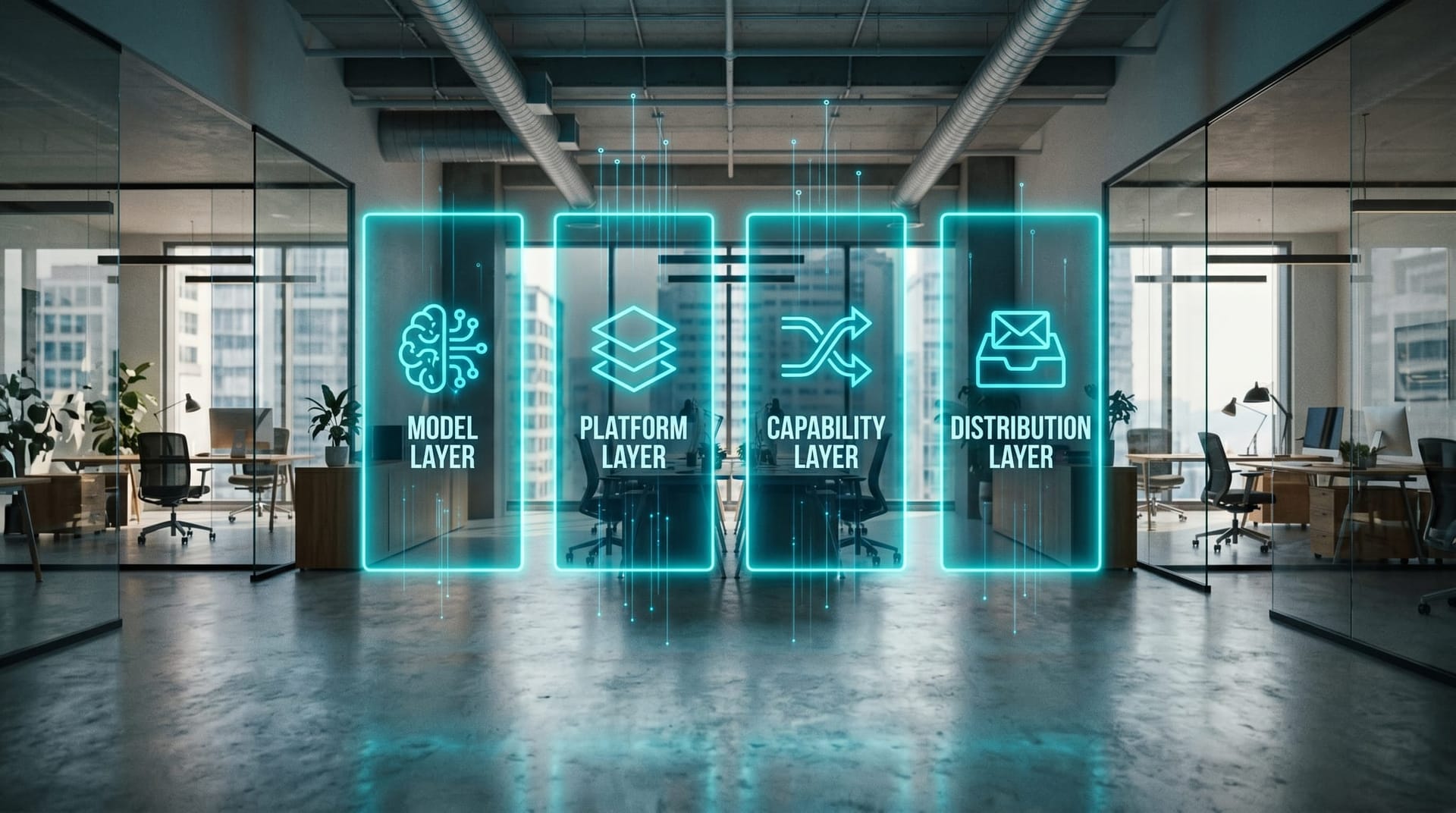
- Read the four Google I/O 2026 announcements as a single stack — model (Gemini 3.5 Flash), platform (Antigravity 2.0), capability (Gemini Omni), distribution (Gmail-resident agent) — not as four separate news items.
- Gemini 3.5 Flash is the load-bearing claim: Google's published cost framing puts the model in direct competition with Claude Sonnet and GPT-5.5 for agentic and coding workloads, and the savings story is computable from your existing token usage in under an hour.
- Antigravity 2.0 changes the 3-filter platform test (cost floor, deployment time, regulated-industry posture) but does not finish it — pricing tiers and BAA/HIPAA posture remain unpublished at launch.
- Gemini Omni's “any-to-any” framing is a real capability shift for voice, vision, and phone-agent stacks built today out of stitched-together models — but parallel-run telemetry is non-negotiable before any cutover.
- The Gmail-resident agent is the most operationally consequential of the four; it reaches mid-market staff inboxes via standard Google Workspace seats, and most firms have no standing-authorization control configured.
- Cloud Radix's architectural answer: evaluate Gemini through the Secure AI Gateway against your existing eval rubric — add it as a candidate, do not replace your incumbent until parallel-run data justifies the switch.
Why is Google I/O 2026 a single stack, not four announcements?
The conventional read of an I/O keynote is announcement-by-announcement. The mid-market read is layer-by-layer. Google shipped one product release across four layers of the AI Employee stack, and the four layers map cleanly to four budget lines a mid-market firm already owns.
The model layer is Gemini 3.5 Flash — the foundation-model SKU that an AI Employee program calls at inference time. According to MarkTechPost's coverage of the launch, Google positioned the model as faster and cheaper than its predecessor for the two workloads mid-market buyers care about most: agentic execution and coding. The model layer is a single line on the budget — a per-million-tokens API spend that sits inside whichever platform the firm has selected.
The platform layer is Antigravity 2.0. Per MarkTechPost's launch writeup, Antigravity 2.0 ships as a standalone agent-first platform with a CLI, an SDK, managed execution, and an enterprise-support tier. This is Google's direct answer to Anthropic Managed Agents, OpenAI Workspace Agents, Microsoft Agent 365, and Salesforce Agentforce. The platform layer is a separate line on the budget — the per-seat or per-execution cost of the harness that orchestrates the AI Employee's work.
The capability layer is Gemini Omni. VentureBeat's enterprise framing of the model describes it as “any-to-any” — text, audio, image, and video in and out in a single model — collapsing the orchestration overhead of the prior pattern of stitching together a speech-to-text model, an LLM, a text-to-speech model, and a vision model into one pipeline. The capability layer is not a budget line of its own — it is the technical fabric that determines how many other budget lines a firm needs.
The distribution layer is the Gmail-resident AI agent. VentureBeat's reporting on the agent describes a system that drafts emails, monitors the inbox, and — as Google framed it — will “eventually spend your money.” The distribution layer is not a new budget line either; it ships through existing Google Workspace seats. That is the most important sentence in this post: the riskiest of the four announcements arrives through the budget line you already pay.
Read together, the four layers compose a complete mid-market AI Employee stack — model plus platform plus capability plus distribution — under a single vendor. Read separately, they look like four product blogs. The first job of an operations leader this month is to read them together.
What does the Gemini 3.5 Flash cost claim mean for a mid-market firm?
Google's headline cost framing was an enterprise-scale number. VentureBeat reported that Google says Gemini 3.5 Flash can cut enterprise AI costs by more than $1 billion a year. That is not the right number for a 100-employee operations team in Auburn or DeKalb County. The right number is the one your IT director can compute from your existing usage in under an hour.
The computation has three inputs. First, your existing per-day AI Employee token volume — for a mid-market firm running an AI Employee across 50 to 150 staff, this is typically in the 5 million to 50 million token-per-day range, depending on how heavily the AI Employee participates in inbound communication, document processing, and research. Second, the per-million-token rate of your current model, whether that is Claude Sonnet 4.6, GPT-5.5, or another. Third, the published per-million-token rate for Gemini 3.5 Flash as documented in Google's pricing page on launch day.
Multiply daily token volume by the per-million-token rate delta and project across thirty days — that is the order of magnitude of the monthly savings claim. For most mid-market firms we have run this exercise with, the result is in the low-to-mid five figures per year of potential savings if every workload moved to Gemini 3.5 Flash. The savings number is large enough to warrant evaluation but small enough that operational risk — degraded output quality, a vendor lock-in step, a new audit surface — is the more important consideration than the dollar figure.
This is exactly the case for adding Gemini to your evaluation rubric rather than replacing your current model. The multi-model AI agent eval neutral layer writeup covered the buyer-owned eval rubric — a customer-controlled benchmark that scores any candidate model against the firm's actual workloads. Gemini 3.5 Flash becomes a new candidate in that rubric. If it wins on quality at the new price, the switch is justified by data. If it wins on price but loses on quality, you have a multi-model routing decision rather than a wholesale migration. The agent control plane buying decision writeup covered how a routing layer makes the multi-model case tractable.
Does Antigravity 2.0 belong on a mid-market platform shortlist?
Maybe — and the word “maybe” is load-bearing. Yesterday's mid-market platform-rankings guide introduced a three-filter test for the platform layer: a sub-$50,000 annual cost floor, a sub-90-day time-to-deployment, and a regulated-industry posture (BAA, HIPAA, GLBA, attorney-client-privilege-aware deployment). Antigravity 2.0's “CLI, SDK, managed execution, enterprise support” framing reads like it could pass the floor filter on the self-serve tier, but Google has not yet published the floor SKU pricing or the BAA template for the managed-execution tier.
Antigravity 2.0 also changes the vendor-strategy picture for mid-market AI Employee buyers. The decision has long been framed as a two-pole choice between Anthropic Managed Agents and OpenAI Workspace Agents. With Antigravity 2.0, the decision is now a three-pole choice: Anthropic Managed Agents and OpenAI Workspace Agents are joined by Google's standalone agent platform. The three poles each cover the same buyer use cases with materially different posture on hosting, eval, lock-in, and regulated-industry support. A mid-market firm that has already committed to one pole should not rip out the commitment, but firms in the evaluation window — a sizable share of the NE Indiana 50-to-500-employee universe — now have a third candidate to score against the same three filters.
The right move this month is not to commit to Antigravity 2.0; it is to add it to the platform shortlist and run the platform-rankings 3-filter test against it as the floor SKU pricing and BAA posture become public.
Does Gemini Omni collapse a multi-vendor voice or vision pipeline you already run?
For mid-market firms running AI phone agents, AI document-vision pipelines, or AI customer-service systems built today out of stitched-together models — a speech-to-text vendor, an LLM, a text-to-speech vendor, sometimes a vision model on top — Gemini Omni's any-to-any framing is the most architecturally consequential of the four announcements. The Fort Wayne AI phone agents and Grok voice APIs writeup covered the multi-vendor voice stack pattern in detail; that stack typically runs four vendors deep (transcription, language understanding, response generation, voice synthesis) and inherits every one of those vendors' failure modes.
A single-model implementation has obvious operational appeal: fewer vendors to contract with, fewer APIs to monitor, lower combined latency, and one accountable party when something breaks. It also has obvious risks: a single point of failure, a deeper lock-in if the workload migrates fully to Gemini, and an unknown quality profile for any individual layer relative to the best-of-breed vendor that layer used to be served by.
The right pattern is a four-week side-by-side evaluation behind the Secure AI Gateway. Run the existing multi-vendor pipeline as the production path; run Gemini Omni in parallel against the same inputs; compare quality, latency, and cost on the actual workload; cut over only if the parallel-run data justifies it. Do not cut over on the basis of the launch demo, the press release framing, or the vendor's own benchmark.

What is your standing-authorization policy for the Gmail-resident agent?
The Gmail-resident AI agent is the announcement most likely to reach mid-market staff before mid-market governance reaches it. The agent ships through Google Workspace seats your staff already have. The default deployment posture, absent an explicit decision, is “on.” The agent's described capability set — drafting emails, monitoring the inbox, and eventually executing spending actions — is squarely inside the territory the intent contracts mid-market agentic commerce playbook flagged as the standing-authorization frontier.
The architectural pattern for a standing-authorization control is the approval-dialog default covered in the cross-app AI agent governance writeup. Every action that affects state outside the agent's session — sending an email externally, scheduling a meeting with a non-employee, drafting a response that commits the firm to a position, and certainly any action that moves money — requires explicit user approval the first time and a persisted policy decision thereafter. The agent's policy library is buyer-owned; the audit trail of approvals and denials is buyer-owned; the agent reaches the spending frontier only after the firm has explicitly enabled the policy.
The recommended default for mid-market firms this month is deny plus approval dialog. Turn the Gmail-resident agent on for an explicit pilot group, run every action through the approval dialog, log every approval and denial, and revisit the policy after thirty days. The NIST AI Risk Management Framework — specifically the Govern and Manage functions — treats this kind of explicit, audited authorization as a baseline for any AI system with cross-boundary effects, and the Gmail-resident agent is exactly that.
The most common mid-market failure mode this month will not be a single dramatic incident — it will be a small handful of staff users quietly opting in, building habits the firm has not policy-evaluated, and surfacing the governance question only after the agent has touched a customer relationship or an outbound spend. Cloud Radix's recommendation is to get the standing-authorization policy in front of the rollout, not behind it.
What is the Google I/O 2026 Mid-Market Impact Matrix?
The matrix below is the body's spine — read it as the one-page version of every decision in this post. Each row is one announcement (plus one same-week comparator), each column is one decision dimension.
| Announcement | What changed | Mid-market buyer implication | Cloud Radix architectural response | Time to action |
|---|---|---|---|---|
| Gemini 3.5 Flash (model layer) | Faster and cheaper agentic and coding inference; large enterprise savings claim | Add as a candidate to the buyer-owned eval rubric; do not replace incumbent without parallel-run data | Score Gemini 3.5 Flash against your existing eval harness; multi-model route at the platform layer if it wins on price only | 4–6 weeks |
| Antigravity 2.0 (platform layer) | Standalone agent-first platform with CLI, SDK, managed execution, enterprise support | Add to the platform shortlist; rerun the 3-filter test once floor SKU pricing and BAA posture are published | Hold the evaluation open until Google publishes regulated-industry posture; do not commit ahead of the data | 60–90 days |
| Gemini Omni (capability layer) | Any-to-any multimodal model collapses voice, vision, and phone-agent pipelines | Run a 4-week parallel evaluation behind the Secure AI Gateway against your existing multi-vendor stack | Parallel-run, not cutover; compare quality, latency, and cost on actual workload before any migration | 4 weeks of parallel run |
| Gmail-resident AI agent (distribution layer) | Drafts emails, monitors inbox, will eventually execute spending; ships through existing Workspace seats | Set standing-authorization policy before staff opt in; default to deny plus approval dialog | Configure approval-dialog default; constrain pilot group; log approvals and denials; revisit at 30 days | This week |
| AWS + fal acquisition (same-week comparator) | AWS becomes fal's preferred cloud, bundling a generative-media model with AWS infrastructure | Cloud-model bundling accelerates; expect similar moves from other hyperscalers within two quarters | Treat cloud-vs-model boundary as fluid; do not assume your cloud and your model vendor will remain separate | Quarterly review |
The AWS+fal deal sits in the same week and is included as a comparator because it is the same architectural pattern from a different vendor. VentureBeat reported on the acquisition on May 20: AWS is bundling a generative-media model into its cloud SKU in the same week Google is bundling a model, platform, capability, and distribution layer into its existing stack. The cloud-vs-model boundary that mid-market firms have treated as fixed is in fact fluid, and the procurement assumption that your cloud and your model vendor are separate vendors should be re-examined at quarterly cadence.
What does this mean for Northeast Indiana mid-market firms on Monday?
The four-layer Google I/O 2026 stack lands differently on four kinds of NE Indiana firm. None of these scenarios call for a wholesale change; each calls for a specific evaluation move on Monday.
An Auburn manufacturer running Anthropic Claude Code today for engineering workflows should add Gemini 3.5 Flash to its eval rubric for coding tasks. The savings claim is computable from existing usage, the eval rubric is buyer-owned, and the result determines whether multi-model routing is a justified next step. Antigravity 2.0 is interesting but not urgent — the existing Claude Code commitment is recent enough that the switching cost outweighs the projected savings unless the eval data shows a meaningful quality lead.
A DeKalb County home-services firm running Make.com and a phone agent built on a multi-vendor voice stack should treat Gemini Omni as the most relevant of the four announcements. The any-to-any single-model framing maps directly to the multi-vendor stitched-together pattern. A four-week parallel evaluation behind the Secure AI Gateway determines whether the single-model implementation is a quality and cost win on the actual call workload. Do not cut over without parallel-run telemetry.
An Allen County dental or specialty medical practice running Microsoft Copilot and a transcription service should treat the Gmail-resident agent and the regulated-industry posture of Antigravity 2.0 as the binding decisions. The Gmail-resident agent reaches Workspace seats if the practice is on Google Workspace; if it is on Microsoft 365, the equivalent Microsoft Agent 365 distribution-layer move is the comparable rollout. The standing-authorization policy applies in both cases.
An Allen County insurance broker running Salesforce Agentforce should focus on Antigravity 2.0 as the platform comparator and on the Gemini 3.5 Flash cost claim as input to the multi-model routing decision. Salesforce Agentforce remains the customer-data-grounded platform; Antigravity 2.0 is the candidate to evaluate behind the Gateway, not the candidate to replace Agentforce with.
The common thread across all four is the Secure AI Gateway as the seat from which Google's announcements can be evaluated without a wholesale commitment. The Gateway is the buyer-side surface that lets multi-vendor evaluation happen on the buyer's terms rather than the vendor's roadmap.

How should a mid-market firm run the Google I/O 2026 re-evaluation?
The structure below is a four-question test, sized to one operations director and one IT lead, with an acceptable-answer band for each question. Run the test in the next thirty days.
1. Model layer — is Gemini 3.5 Flash a meaningful savings opportunity for your specific token volume?
Pull your last 30 days of AI Employee token usage. Multiply by the published per-million-token rate delta between your current model and Gemini 3.5 Flash. If the projected annual savings exceeds $10,000, add Gemini 3.5 Flash to your eval-rubric harness as a candidate. If it does not, stay with your current model and revisit at the next pricing update.
2. Platform layer — does Antigravity 2.0 pass the 3-filter test for your operation?
Hold the evaluation open until Google publishes the floor SKU pricing and the BAA template. When both are public, score Antigravity 2.0 against the three filters: sub-$50,000 floor, sub-90-day deployment, and a regulated-industry posture that fits your vertical. If it passes, add it to the platform shortlist for the next platform review.
3. Capability layer — does Gemini Omni collapse a multi-vendor pipeline you run today?
If you operate a voice, vision, or phone-agent pipeline built from two or more stitched-together vendors, run a four-week side-by-side evaluation behind the Secure AI Gateway. Compare quality, latency, and cost on your actual workload. Cut over only if the parallel-run data justifies it; otherwise stay with the existing multi-vendor pipeline.
4. Distribution layer — what is your standing-authorization policy for the Gmail-resident agent?
Default to deny plus approval dialog. Configure the agent to require explicit approval for every action that affects state outside its session. Constrain the initial rollout to a pilot group. Log every approval and denial. Revisit the policy at thirty days. Do not let the rollout reach staff inboxes ahead of the policy decision.

How does Cloud Radix help mid-market firms run this test?
Cloud Radix runs the Google I/O 2026 re-evaluation as a four-week consulting engagement for NE Indiana mid-market firms. Week 1 is the eval-rubric integration for Gemini 3.5 Flash and the platform-shortlist update for Antigravity 2.0. Weeks 2-3 are the Gemini Omni parallel-run evaluation behind the Secure AI Gateway. Week 4 is the Gmail-resident agent standing-authorization policy configuration and pilot setup. The deliverable is a written re-evaluation report, an updated eval-rubric harness, a parallel-run telemetry summary, and a configured approval-dialog policy.
The pattern is deliberately conservative: add candidates, score against existing rubrics, run parallel before committing, and configure governance before staff rollout. Cloud Radix's AI consulting engagements are designed for firms that have already made one round of AI Employee commitments and need a structured re-evaluation when the vendor landscape moves — and Google I/O 2026 is exactly that kind of move.
Frequently Asked Questions
Q1.What was announced at Google I/O 2026 that matters to mid-market firms?
Four announcements compose a single stack: Gemini 3.5 Flash (a faster, cheaper foundation model for agentic and coding workloads), Antigravity 2.0 (a standalone agent-first platform with CLI, SDK, managed execution, and enterprise support), Gemini Omni (an any-to-any multimodal model that collapses voice, vision, and phone-agent pipelines), and a Gmail-resident AI agent that drafts emails, monitors inboxes, and will eventually execute spending. The mid-market read is that the four announcements cover the model, platform, capability, and distribution layers of the AI Employee stack as a single coordinated push.
Q2.Should a mid-market firm switch to Gemini 3.5 Flash?
Most firms should add Gemini 3.5 Flash to their buyer-owned eval rubric rather than switch outright. The cost claim is computable from existing token usage, but operational risk — quality degradation, vendor lock-in, a new audit surface — typically outweighs the dollar figure unless parallel-run data shows a clear quality lead. A multi-model routing decision at the platform layer is often the right move rather than a wholesale migration.
Q3.Does Antigravity 2.0 belong on a mid-market platform shortlist?
Yes, but the evaluation should remain open until Google publishes floor SKU pricing and the BAA template for the managed-execution tier. When both are public, score Antigravity 2.0 against the 3-filter test from the platform-rankings writeup: sub-$50,000 cost floor, sub-90-day deployment, and a regulated-industry posture appropriate for your vertical.
Q4.Is Gemini Omni worth running against an existing multi-vendor voice or vision pipeline?
For firms running stitched-together pipelines today, yes — as a four-week parallel evaluation behind the Secure AI Gateway, not as a cutover. The any-to-any single-model framing has operational appeal but unknown quality and cost profile on any specific workload until the parallel-run data exists. Do not cut over on the basis of the launch demo or the vendor benchmark.
Q5.What is the standing-authorization policy for the Gmail-resident AI agent?
The recommended mid-market default is deny plus approval dialog: every action that affects state outside the agent's session requires explicit user approval the first time and a persisted policy decision thereafter. Constrain the initial rollout to a pilot group, log every approval and denial, and revisit at thirty days. The default deployment posture absent an explicit decision is on — get the policy in front of the rollout.
Q6.How does the AWS+fal acquisition fit with Google I/O 2026?
The AWS+fal acquisition is the same architectural pattern from a different vendor: AWS is bundling a generative-media model into its cloud SKU in the same week Google is bundling a full model-platform-capability-distribution stack. The takeaway for mid-market buyers is that the cloud-vs-model boundary is fluid; the procurement assumption that your cloud and your model vendor remain separate vendors should be re-examined at quarterly cadence.
Q7.What should a Northeast Indiana mid-market firm actually do this month about Google I/O 2026?
Run the four-question re-evaluation test against your existing AI Employee program: score Gemini 3.5 Flash on your buyer-owned eval rubric, hold Antigravity 2.0 evaluation open until floor pricing and BAA posture publish, run a four-week Gemini Omni parallel evaluation behind the Secure AI Gateway if you operate a stitched-together voice or vision pipeline, and configure a deny-plus-approval-dialog policy for the Gmail-resident agent before staff opt-in. For most NE Indiana firms in the 50-to-500-employee range, this is a four-week structured exercise, not a rip-and-replace migration.
Q8.Why is Cloud Radix's recommendation conservative rather than recommending a switch?
Because the savings claim is real but the operational risk is also real. A mid-market firm with 50 to 500 employees has thin tolerance for AI Employee quality regression, a small in-house compliance capacity, and an existing commitment to whichever model and platform it already runs. The conservative pattern — add candidates, score against existing rubrics, run parallel before committing, and configure governance before staff rollout — produces a defensible decision either way and avoids a panic migration on the basis of a keynote.
Sources & Further Reading
- MarkTechPost: marktechpost.com — Google Introduces Gemini 3.5 Flash at I/O 2026 — faster and cheaper model for AI agents and coding.
- VentureBeat: venturebeat.com — Google says Gemini 3.5 Flash can slash enterprise AI costs by more than $1 billion a year — the headline cost framing this post translates to mid-market.
- MarkTechPost: marktechpost.com — Google Launches Antigravity 2.0 at I/O 2026 — standalone agent-first platform with CLI, SDK, managed execution, and enterprise support.
- VentureBeat: venturebeat.com — Google unveils Gemini Omni any-to-any AI model — the capability-layer source for the four-week parallel-run recommendation.
- VentureBeat: venturebeat.com — Google's new AI agent can draft your emails, monitor your inbox and eventually spend your money — the Gmail-resident distribution-layer source.
- VentureBeat: venturebeat.com — AWS nabs gen AI media creation startup fal — same-week comparator showing the cloud-vs-model boundary is fluid.
- NIST: nist.gov/itl/ai-risk-management-framework — AI Risk Management Framework Govern and Manage functions for explicit, audited authorization.
Run the Google I/O 2026 Re-Evaluation
We map the four-layer Google I/O 2026 stack against your existing AI Employee program in a four-week structured engagement — eval rubric, platform shortlist, parallel run, and a configured standing-authorization policy — before the keynote becomes a panic migration.