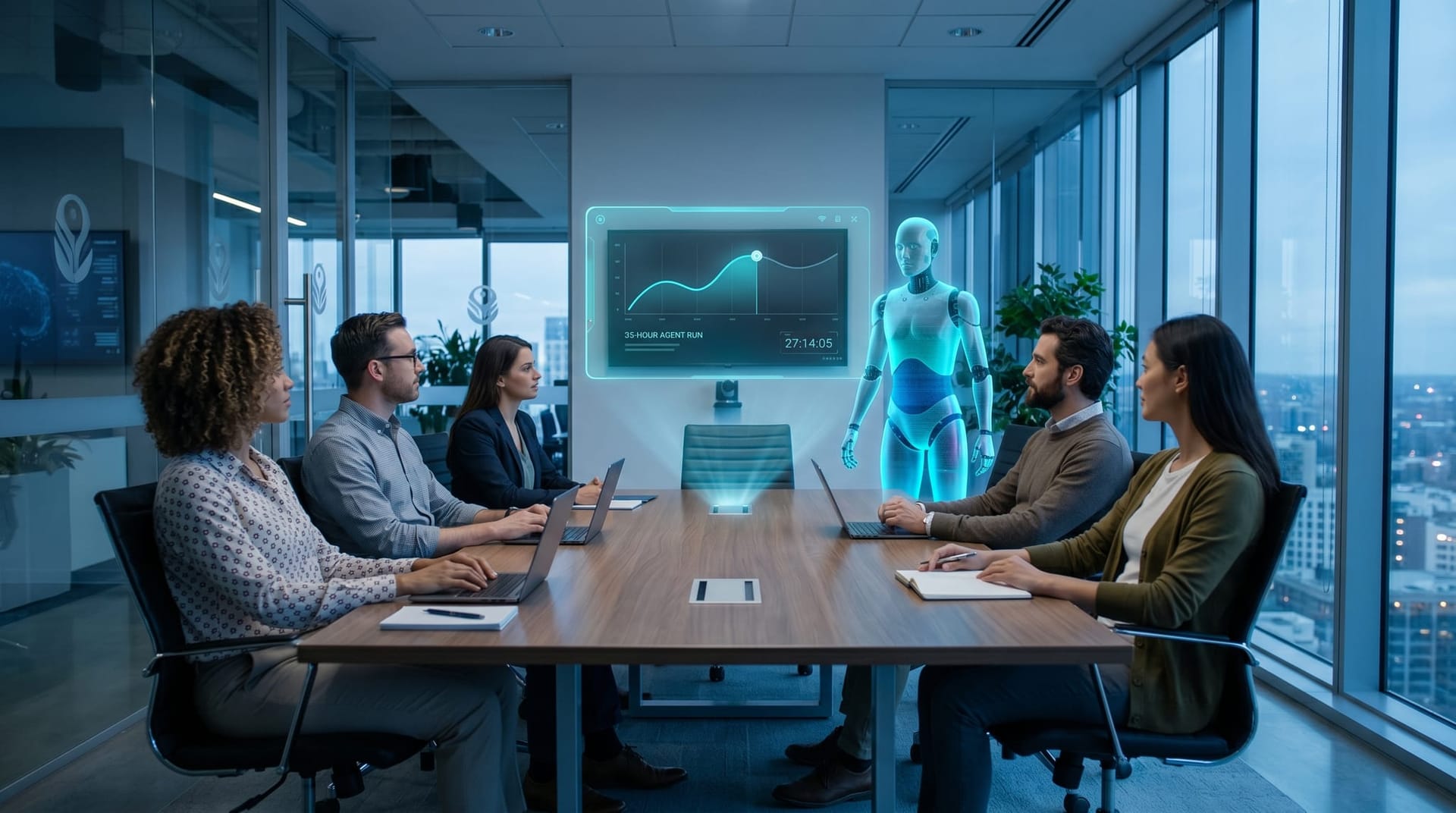
The most quietly important thing in enterprise AI in May 2026 wasn't a benchmark, a funding round, or a launch event. It was a number reported in the headline of VentureBeat's coverage of Alibaba's Qwen3.7-Max release: 35 hours. As in, the model can run autonomously, doing useful work inside an agent harness, for 35 hours at a stretch.
That number is what mid-market buyers should be paying attention to. Not because every business needs a 35-hour autonomous AI Employee on day one, but because long-horizon agent capability is the line that separates “AI as a tool you use” from “AI as a workforce that operates a shift.” The first sits in your stack as an assistant. The second sits in your stack as an employee — with all the procurement, governance, and sovereignty implications that word should imply.
Qwen3.7-Max is the most prominent recent example of that capability tier. According to MarkTechPost's technical writeup of the same release, the model ships with a 1M-token context window, scored 56.6 on the Artificial Analysis Intelligence Index (fifth overall at the time of testing), and is available via Alibaba Cloud's Model Studio with OpenAI- and Anthropic-compatible APIs that let it slot into existing harness infrastructure including Anthropic's Claude Code.
It also raises a question every mid-market procurement matrix in 2026 has to answer in writing, not just in conversation: do we run a Chinese-origin frontier model in our environment? Under what conditions? With what gateway controls? With what data-residency policy? This post lays out both the capability case and the sovereignty case, and the architecture pattern that lets a mid-market operator answer “it depends” responsibly.
Key Takeaways
- Alibaba's Qwen3.7-Max, announced May 20, 2026 and covered by VentureBeat and MarkTechPost on May 21, supports 35-hour autonomous agent runs and a 1M-token context window — a long-horizon capability tier comparable to Kimi K2.6 and Claude Opus 4.7.
- The model is proprietary and closed-weight, available through Alibaba Cloud Model Studio with OpenAI- and Anthropic-compatible APIs that work inside existing agent harnesses including Claude Code.
- Long-horizon agent capability unlocks genuinely overnight AI Employee shifts — research, document review, monitoring, lead enrichment — but only when the harness, memory, and governance layer can keep up.
- Model-origin sovereignty is now a first-class procurement question. Mid-market buyers need a written policy on Chinese-origin models — not a default ban, but a documented framework.
- The right architectural answer for most mid-market operators is a Secure AI Gateway pattern with model-origin policy, data-residency control, and audit logging in front of any non-domestic model.

What Does “35 Hours Autonomously” Actually Mean?
The word “autonomous” gets abused in AI marketing, so worth being precise. Per the VentureBeat report on Qwen3.7-Max, Alibaba's internal testing demonstrated the model executing extended agent runs without human intervention, using external harnesses like Anthropic's Claude Code as the surrounding agent runtime.
The MarkTechPost coverage adds the technical context: the model employs extended-thinking mode (the chain-of-thought-first reasoning architecture that's become standard at the frontier tier), Alibaba's internal testing reported it “autonomously performed more than 1,000 tool calls and iterative code modifications” in some long-horizon runs, and it produced roughly 97 million tokens of reasoning trace versus a 24 million-token average for comparable models on Artificial Analysis benchmark workloads. Independent verification on the 35-hour claim is still emerging.
Translated into operator terms: a 35-hour run is the upper bound, not the typical case. What it tells you is that the model can hold context, plan, execute, course-correct, and keep going across a workload that would have crashed or drifted on prior-generation models inside the first few hours. That's the same architectural improvement that lets Kimi K2.6 hold a multi-day research project together — a pattern we've covered separately in Kimi K2.6 and the limits of agent-swarm orchestration.
For a mid-market operator, the practical use cases that unlock at this capability tier are predictable: overnight competitive research, deep document review (regulatory filings, M&A diligence, large contract sets), continuous monitoring (compliance, brand, security), large-scale lead enrichment, and long-running data normalization workflows that have historically required either a human shift or a brittle scripted pipeline.
None of those use cases are new. What's new is that they can now be done by a single AI Employee running for the full duration, with a coherent memory and plan, rather than by a chain of stateless function calls glued together with retry logic. That's the operational difference.
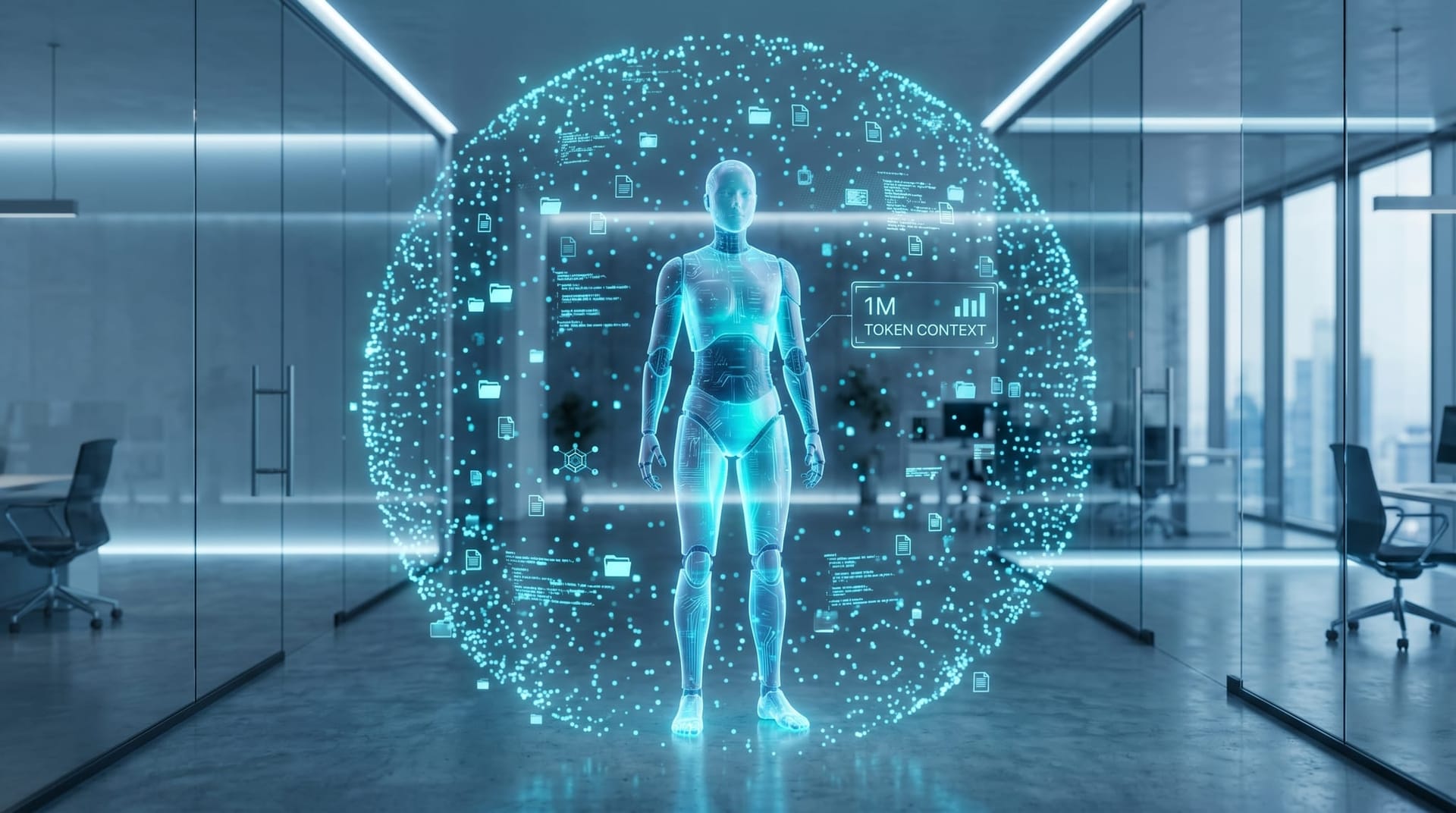
Why Does a 1M-Token Context Change the Agent Architecture?
A 1M-token context window is roughly 750,000 words. For frame of reference, that's the entire text of the seven Harry Potter books with room to spare, or a year of an organization's email, or every contract a mid-sized professional services firm has signed in the last decade.
Two things change when an AI Employee can hold that much context in working memory:
The retrieval scaffold gets smaller. For the past two years, the way to give an AI Employee access to a large corpus was a vector database, a chunking strategy, a re-ranker, and a careful prompt template. With a 1M-token context window and a long-horizon agent loop, more of that workload moves into the model itself. Retrieval doesn't go away — it remains the right answer for truly large or constantly-changing corpora — but the threshold at which retrieval becomes mandatory rises significantly. That's part of the broader pattern we've described in the buyer-owned AI agent harness and persistent memory architecture discussion: as model context windows and agent-runtime maturity grow, the application-layer scaffolding shrinks.
The audit story changes. A 1M-token agent run leaves a much larger trace than a thousand 4K-token chat completions. That's a governance benefit when the harness logs reasoning and tool calls cleanly; it's a privacy and IP-leak liability when the harness logs are stored or transmitted carelessly. Mid-market operators running long-horizon agents need to think about audit-log architecture as a first-class procurement requirement, not an afterthought.
For mid-market buyers, the 1M-token window is not the headline. The headline is what the window enables when paired with long-horizon agent capability and a harness that can keep up. That combination — long window, long horizon, real harness — is the qualitative leap. Each in isolation is interesting; together they're operational.
The Long-Horizon Frontier in May 2026: A Comparison
The honest read for a mid-market procurement matrix is that Qwen3.7-Max is one of several models that have crossed into the long-horizon agent tier at roughly the same time. Below is the structural comparison we walk clients through. Numbers are publicly reported from the cited sources; “comparable” indicates capability is in the same band without an identical claim.
| Model | Origin | Context window | Reported long-horizon run | Open weight | Harness ecosystem |
|---|---|---|---|---|---|
| Qwen3.7-Max | Alibaba (China) | 1M tokens | Up to 35 hours autonomous (vendor-reported) | No (proprietary) | OpenAI- and Anthropic-compatible APIs; Claude Code support |
| Kimi K2.6 | Moonshot AI (China) | Comparable long-context | Multi-hour comparable | Open weights | Multiple harnesses |
| Claude Opus 4.7 | Anthropic (U.S.) | Long context (vendor-reported) | Multi-hour comparable | No (proprietary) | Native Claude Code + ecosystem |
| GPT-5.5 | OpenAI (U.S.) | Long context (vendor-reported) | Multi-hour comparable | No (proprietary) | OpenAI ecosystem |
The procurement question is not “which model wins?” It's “which combinations of model + harness + governance fit our risk posture?” That question splits cleanly along three axes:
- Capability fit — does the model do the work? At the long-horizon frontier in mid-2026, most options at this tier can technically do the work for most mid-market use cases.
- Harness fit — does it slot into our existing agent runtime, our audit log, our memory architecture? Qwen3.7-Max's OpenAI- and Anthropic-compatible APIs help here; some other models have less harness ecosystem.
- Sovereignty fit — does our procurement policy allow this model in this part of our environment, with what controls? This is the question that's actually new in 2026.
The matrix overlaps closely with the framing we developed in our Fort Wayne DeepSeek V4 frontier AI cost and multi-model strategy piece, and with the broader agent control plane buying decision for mid-market AI Employees framework. The new wrinkle is that the long-horizon tier raises the stakes on getting the gateway and policy right.
The Sovereignty Question Every Mid-Market Buyer Has to Answer
This is the section that should be in writing in your procurement playbook by the end of Q3 2026.
Qwen3.7-Max is a Chinese-origin model. So is Kimi K2.6. So is DeepSeek V4. Each is operationally credible at the long-horizon frontier. Each raises a set of legitimate procurement questions that an operator should answer deliberately, not by default.
The questions are:
- Data residency. When an agent run hits an Alibaba Cloud Model Studio endpoint, where does the input data physically live during inference? Where do the reasoning logs live? What's the retention policy? For a healthcare practice subject to HIPAA, a legal firm subject to attorney-client privilege, a financial services firm subject to SEC or FINRA recordkeeping, these are not abstract questions.
- Model provenance and supply chain. Closed-weight proprietary models can't be audited by the buyer. That's true of every closed-weight model, regardless of origin — but the geopolitical context for Chinese-origin models has additional considerations a buyer should explicitly think through.
- Regulatory and export-control exposure. U.S. operators sending certain classes of data to certain classes of foreign-origin models touch export-control regimes that are still being defined in 2026. The risk of a wrong answer here is meaningful.
- Customer trust posture. Some customer bases (defense, government contracting, certain financial services tiers) have written expectations about what models touch their data. Other customer bases don't. The honest read is industry-specific.
The wrong answer to these questions is a default ban. A default ban leaves capability on the table and pushes the same model into shadow-AI use through individual employee accounts — exactly the failure mode the NIST AI Risk Management Framework, available at NIST's official site, is designed to help organizations avoid.
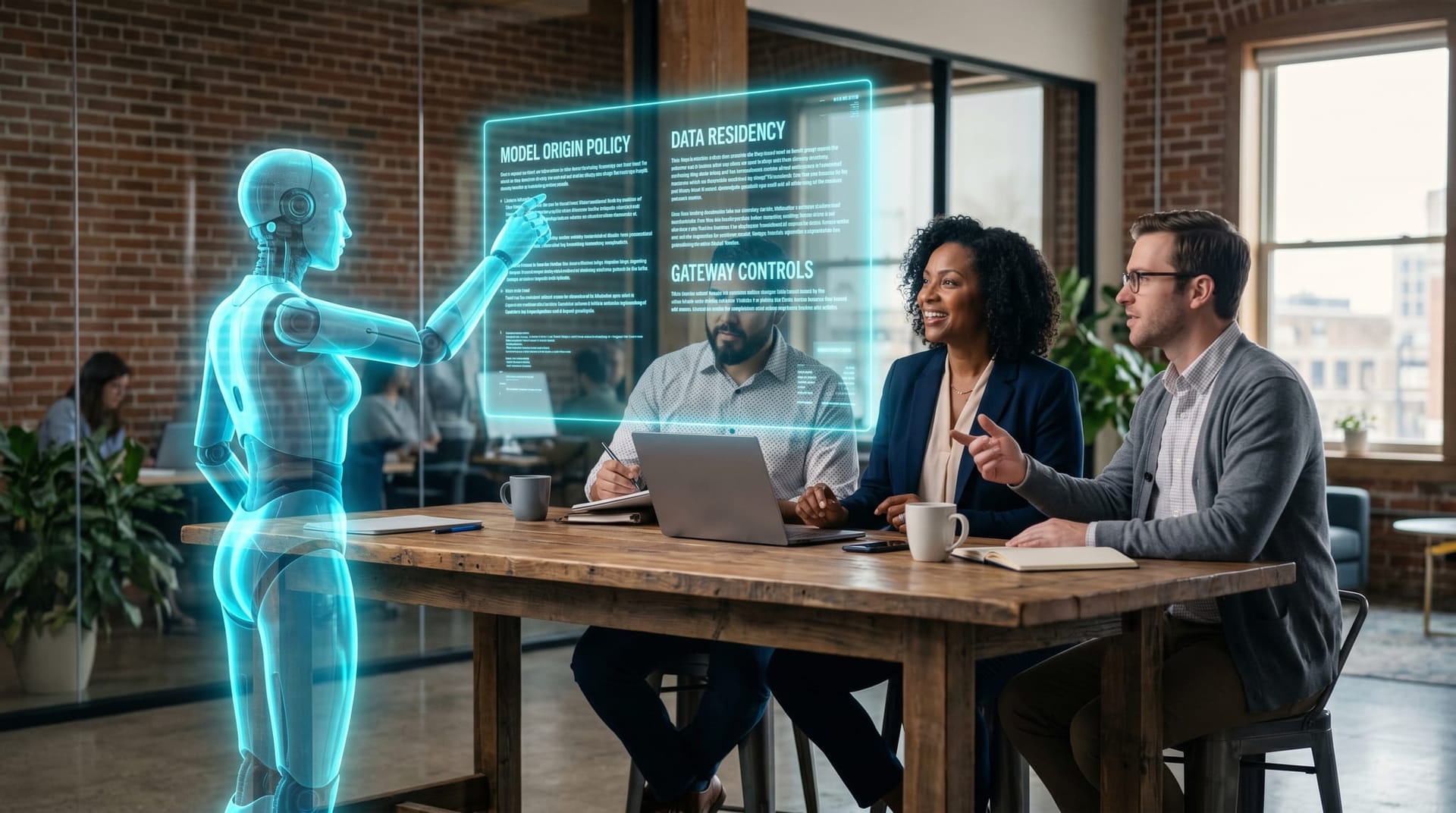
The right answer is a written model-origin policy that specifies which workloads can route to which model tiers under which controls. That's a procurement deliverable, not a tech decision. Cloud Radix typically helps mid-market clients produce this as part of an AI Security engagement.
The Secure AI Gateway Pattern for Non-Domestic Long-Horizon Models
Here's the architecture pattern that lets a mid-market operator say “yes, conditionally” to a model like Qwen3.7-Max without taking on uncontrolled risk.
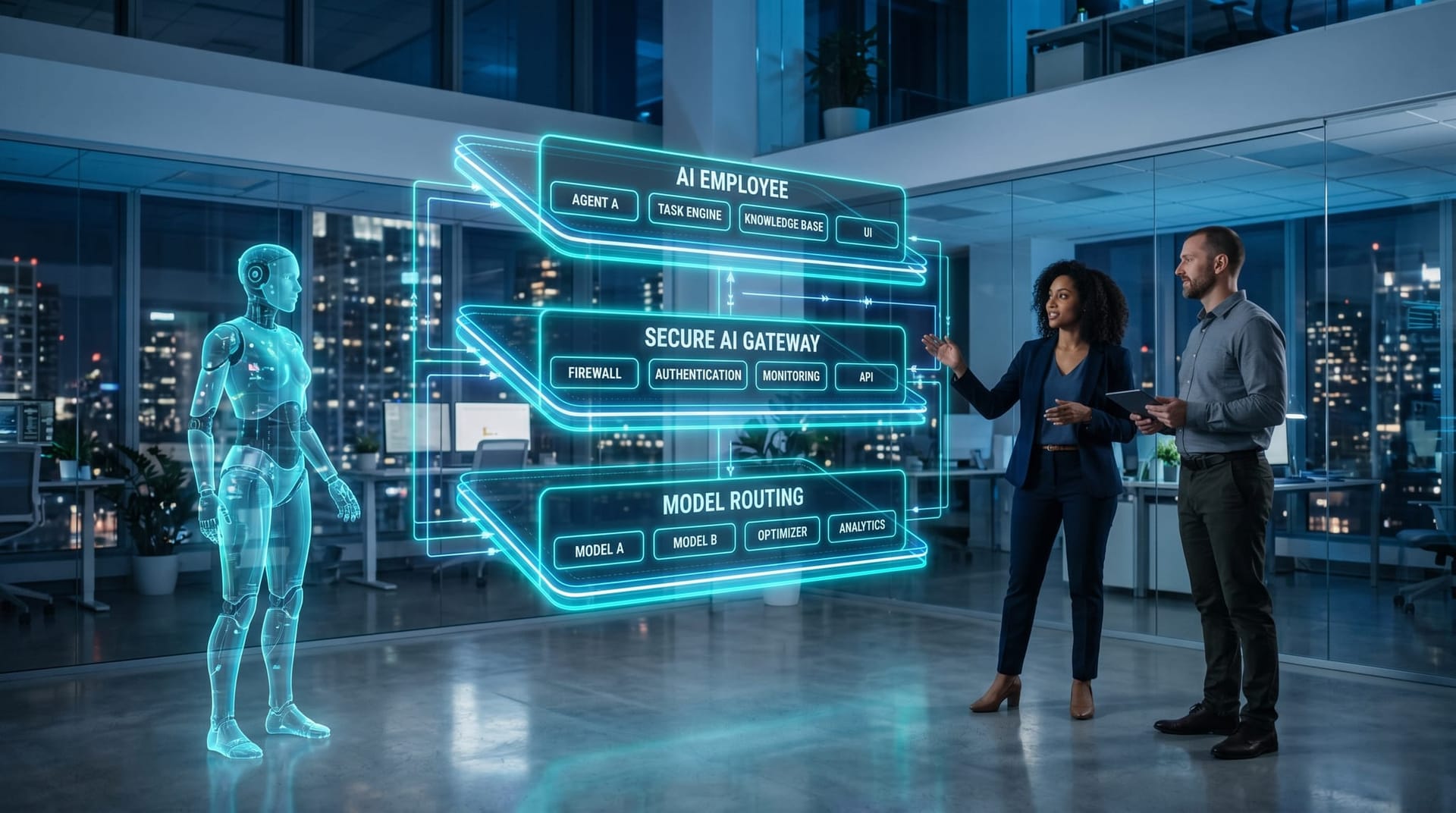
A Secure AI Gateway sits between your AI Employees and any external model endpoint. The gateway enforces:
- Pre-call data classification. Inputs are inspected and classified before they leave your environment. PII, PHI, regulated data, and IP-marked content can be blocked or routed to a domestic-only model tier.
- Per-workload model routing. A research workflow on public information can route to Qwen3.7-Max for the cost and capability advantage. A customer support workflow handling PHI cannot. The routing is policy-driven, not per-developer.
- Audit logging at the gateway, not at the model. Every call — model, workload, classification, response — is logged in your environment, on your retention schedule, regardless of what the model vendor's own logging does.
- Egress controls and data-residency enforcement. The gateway can refuse calls that violate written residency policy without needing the application code to know the policy.
- Vendor swap-out. Because the gateway is a stable interface, the model behind it can be swapped (Qwen out, Claude in) without changing application code. This is the same vendor-lock-in concern we covered in the Anthropic Claude third-party agent lockout business risk piece, applied to the opposite direction.
For a mid-market operator running long-horizon AI Employees in 2026, the gateway is not optional. It is the architectural substrate that makes “we can use this model for this workload, with these controls” a credible procurement answer instead of a hand-wave.
What Should Northeast Indiana Mid-Market IT Do About This?
Northeast Indiana mid-market — Allen, DeKalb, Whitley, and Noble county professional services, manufacturing, healthcare, and financial services firms — has the same architectural choice as every other mid-market operator in the country, with one local nuance: the talent pool to operate long-horizon AI Employee infrastructure in-house is thinner here than in coastal markets, which makes the managed-architecture model a stronger fit than the build-it-ourselves model.
The practical near-term plays:
- Write the model-origin policy now. Whether or not you ever route a call to Qwen3.7-Max, your procurement matrix should specify which tiers of model are allowed for which classes of data. That document is the difference between thoughtful adoption and shadow AI.
- Stand up the Secure AI Gateway before you stand up long-horizon agents. The gateway is the right architectural pre-investment. Trying to retrofit gateway controls onto AI Employees already in production is harder and more disruptive than starting that way.
- Pick one long-horizon workload to pilot. Overnight competitive research, regulatory document review, weekly compliance monitoring — pick a workload where the value of “this runs while we sleep” is large enough to fund the pilot and the governance investment.
- Choose the model with eyes open. A long-horizon pilot can run on a Chinese-origin model with the right gateway and policy, on a domestic closed-weight model with vendor-API audit logs, or on a U.S.-origin open-weight model (an emerging option) with on-premise inference. Each has different cost, capability, and sovereignty tradeoffs. The matrix is the deliverable.
For most Allen and DeKalb county mid-market operators, the third-party-managed version of this — Cloud Radix runs the gateway, you own the policy, your AI Employees run the work — sits at the right cost and capability point. The build-it-yourself version makes sense once you're operating at scale or have a strong in-house AI engineering bench.
The local economics question is real: a long-horizon AI Employee that does an overnight research workload costs less than a fractional human research analyst, but it has to be wrapped in enough governance to be defensible. That wrap is the work.
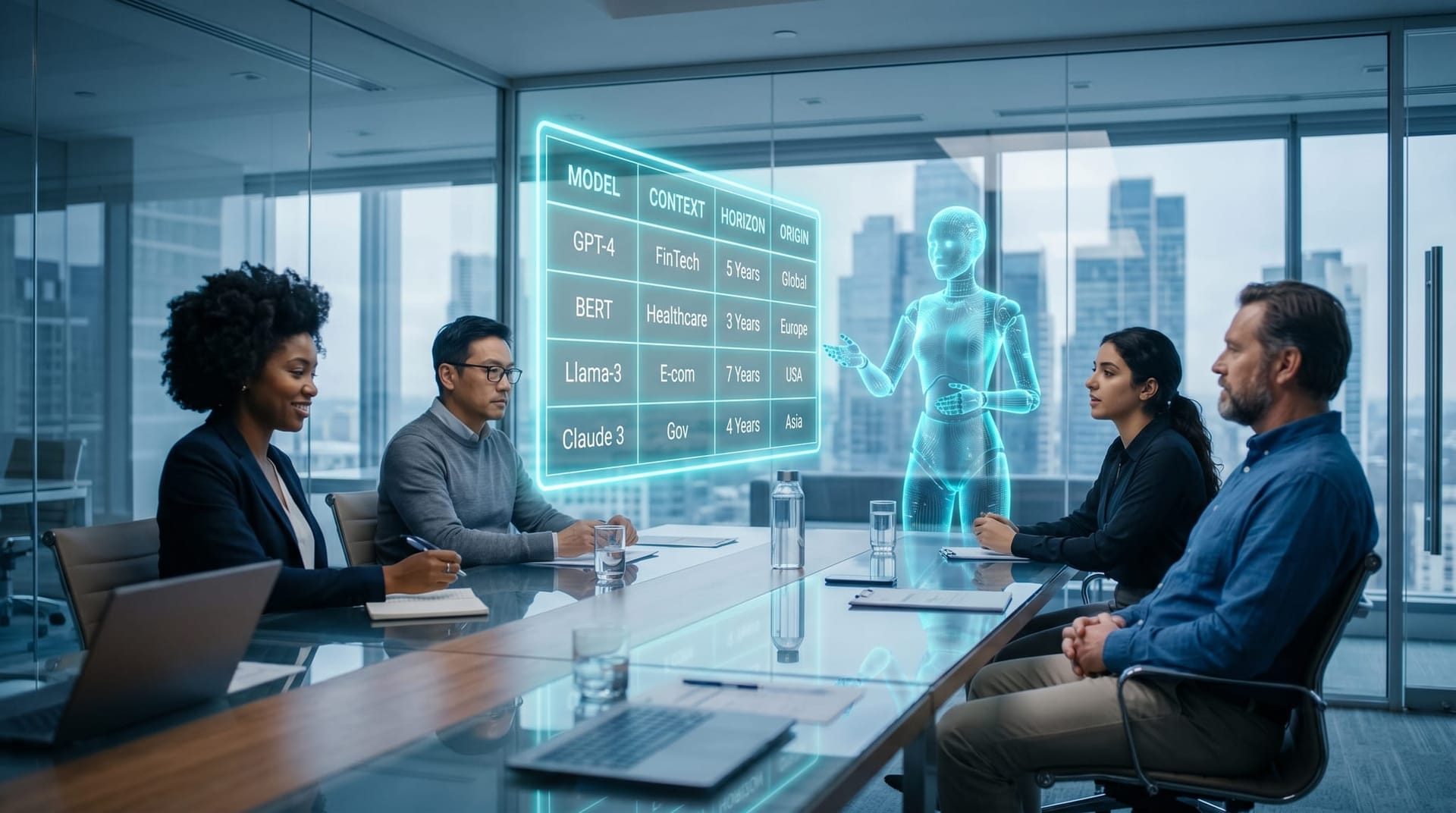
How to Move From “Interesting Capability” to a Q3 Procurement Plan
If your buying committee is having the right conversation in Q3 2026, it looks like this:
- Do we have a written model-origin policy? If no, draft one this quarter.
- Do we have a Secure AI Gateway architecture, or are model calls going direct from application code to model endpoints? If direct, the gateway is the pre-investment for long-horizon agents.
- What's the one long-horizon workload we'd pilot if we had a credible model + harness + gateway combination? Get specific. “Overnight competitive research on a defined competitor set.” “Weekly compliance monitoring on a defined regulatory feed.” “Continuous lead enrichment from a defined source list.”
- Which model tier — domestic closed-weight, foreign closed-weight, open-weight (any origin) — fits that workload under our policy? Make the routing explicit.
- What's the audit and governance posture? Who reviews the agent's work? How often? What's the kill switch?
Cloud Radix runs this conversation regularly. If you want help producing the model-origin policy, designing the gateway architecture, or scoping a long-horizon AI Employee pilot for your mid-market environment, talk to us about an AI Security engagement or a strategic AI consulting conversation. We will tell you honestly which long-horizon workloads are ready for production in 2026 and which still belong in a controlled pilot.
Frequently Asked Questions
Q1.Is Qwen3.7-Max really capable of running for 35 hours autonomously?
That's the figure reported by Alibaba and covered in VentureBeat's writeup of the launch. It is a vendor-reported claim from internal testing, not yet independently verified. The honest read is that the model is in the long-horizon agent capability tier with Kimi K2.6, Claude Opus 4.7, and GPT-5.5 — the 35-hour figure represents an upper bound on a specific workload, not a guarantee for all workloads.
Q2.Can we use Qwen3.7-Max with the agent harness we already have?
In most cases, yes. Per the MarkTechPost coverage, Qwen3.7-Max is available through Alibaba Cloud Model Studio with OpenAI- and Anthropic-compatible APIs, which means it can slot into existing harness infrastructure including Claude Code and most other major agent runtimes. The technical integration is usually straightforward; the policy and gateway work is the longer pole in the tent.
Q3.Should mid-market businesses use Chinese-origin AI models at all?
The honest answer is “it depends, and you should decide deliberately, not by default.” A default ban leaves capability on the table and pushes the same models into shadow-AI use through individual employee accounts — the worst-of-both-worlds outcome. A default approval ignores legitimate data residency, regulatory, and customer-trust questions. The right answer is a written model-origin policy that defines which workloads can route to which model tiers under which controls. Some industries (defense, certain financial services tiers, certain government contractors) will land at “no” for foreign-origin models in their environment. Most mid-market operators will land at “yes for these workloads, no for these, with these controls.”
Q4.What is a Secure AI Gateway and why does it matter for long-horizon agents?
A Secure AI Gateway is an architecture pattern where every AI Employee call to an external model passes through a controlled intermediary that handles data classification, policy-based routing, audit logging, egress control, and vendor swap-out. For short, stateless model calls, the gateway is good hygiene. For long-horizon agent runs that may make thousands of tool calls and produce millions of tokens of reasoning trace over many hours, the gateway is the architectural substrate that makes the workload governable. Without it, audit, residency, and policy enforcement become application-by-application problems that mid-market operators don't have the engineering capacity to solve cleanly.
Q5.How does the 1M-token context window change the application architecture?
It reduces — but does not eliminate — the need for retrieval-augmented generation scaffolding. For corpora under roughly 750,000 words, a long-context model with a capable harness can hold the full corpus in working memory, which simplifies the application code and improves coherence over long agent runs. For larger or constantly-changing corpora, retrieval remains the right answer. The qualitative change is that the threshold at which retrieval becomes mandatory has risen significantly.
Q6.What workloads should we pilot first with a long-horizon AI Employee?
Workloads where the value of “this runs while we sleep” is concrete and where the output is reviewable. Strong fits: overnight competitive research on a defined competitor set, regulatory or compliance document review, weekly contract or vendor monitoring, large-scale lead enrichment from a defined source list, continuous data normalization across long-running pipelines. Weak fits for early pilots: anything where the output goes straight to a customer without human review, anything in a heavily regulated workflow where you don't yet have the audit-log architecture in place.
Q7.How should a Northeast Indiana mid-market operator approach long-horizon models like Qwen3.7-Max?
The same architectural posture we've held for two years applies locally: build for portability, not for any single vendor's roadmap. For an Allen or DeKalb County operator, that means standing up a Secure AI Gateway and a written model-origin policy before you route a single long-horizon run — then any model origin (domestic, foreign, or open-weight) becomes a viable choice for the right workload, defensible in writing. Because regional AI-engineering talent is thinner here than in coastal markets, the managed-architecture model often fits better than build-it-yourself. The new capability tier doesn't change the goal; it raises the stakes on getting the gateway and policy right.
Sources & Further Reading
- VentureBeat: venturebeat.com/technology/alibabas-proprietary-qwen3-7-max — Alibaba's Qwen3.7-Max can run for 35 hours autonomously and supports external harnesses like Anthropic's Claude Code.
- MarkTechPost: marktechpost.com/2026/05/21/qwen-introduces-qwen3-7-max — Qwen Introduces Qwen3.7-Max: A Reasoning Agent Model with a 1M-Token Context Window.
- Artificial Analysis: artificialanalysis.ai — independent AI model evaluation.
- NIST: nist.gov/itl/ai-risk-management-framework — NIST AI Risk Management Framework.
- Anthropic: docs.anthropic.com/en/docs/claude-code/overview — Anthropic Claude Code documentation.
- Alibaba Cloud: alibabacloud.com/product/modelstudio — Alibaba Cloud Model Studio.
Ready to Put a Long-Horizon AI Employee on Shift?
We will help you write the model-origin policy, design the Secure AI Gateway, and scope a long-horizon AI Employee pilot that fits your Northeast Indiana mid-market environment — defensible in writing, not just in conversation.
Schedule a Free ConsultationNo contracts. No pressure. Just an honest conversation about what would help your business.