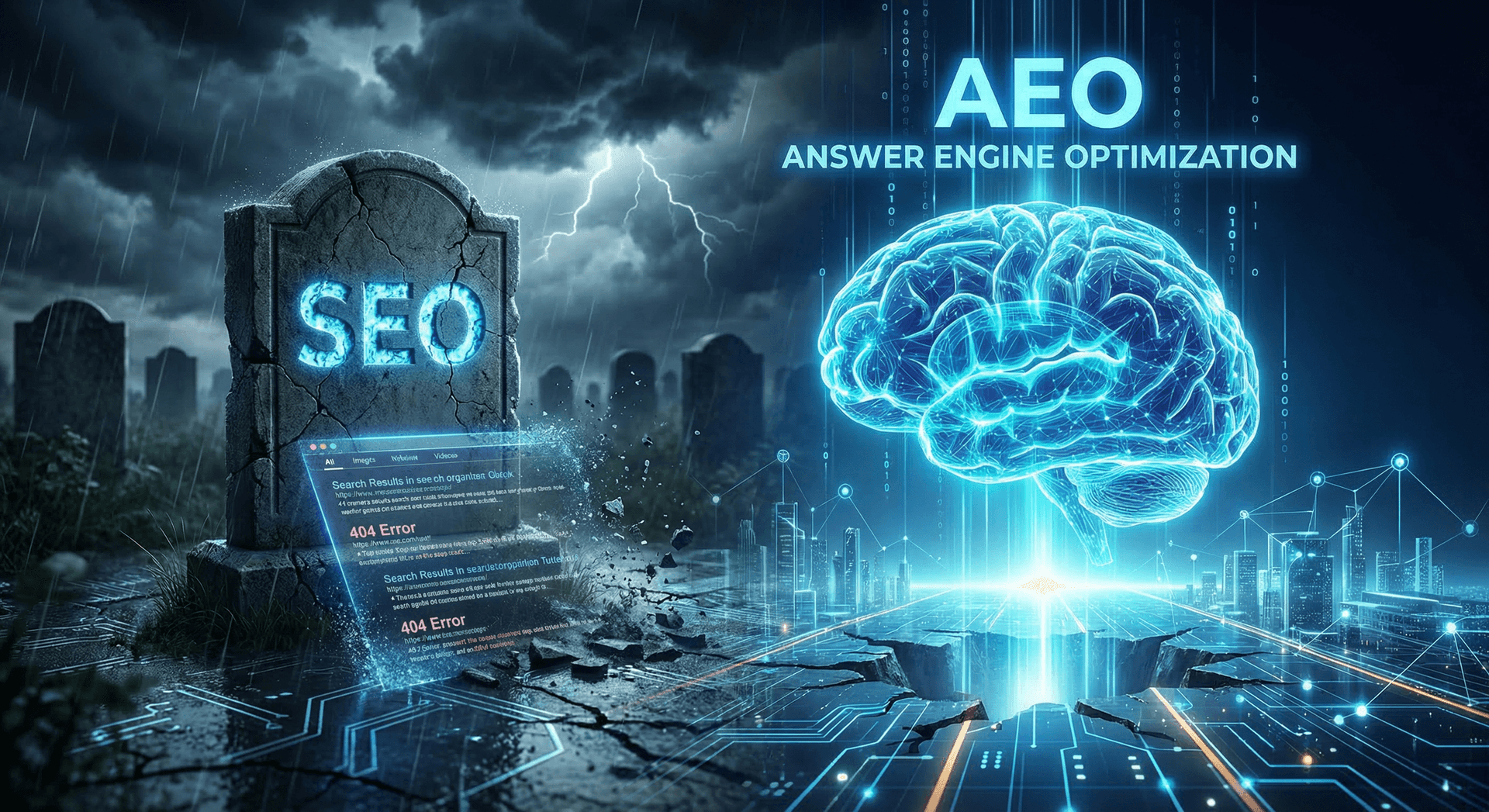
The Search Landscape in 2026
If you run a business in Fort Wayne, Auburn, or anywhere in Northeast Indiana, you have probably noticed something changing about how people find businesses online. The search landscape in 2026 looks fundamentally different from what it looked like even two years ago — and understanding that difference is the key to capturing more customers.
Here is what is actually happening: people still use Google. A lot. Google processes an estimated 8.5 billion searches per day, according to Internet Live Stats. But the way people use Google — and the way Google responds — has changed dramatically. And alongside Google, a whole ecosystem of AI-powered search tools has emerged that millions of people now use daily.
Google Still Dominates, But the Results Page Has Changed
Google still holds roughly 90 percent of global search market share, according to Statcounter data. That has not changed. What has changed is what the Google results page looks like. In 2024, Google began rolling out AI Overviews — AI-generated summaries that appear at the top of search results for a growing percentage of queries. By early 2026, AI Overviews trigger on a significant portion of informational and local service queries.
When you search “best HVAC company in Fort Wayne” or “how to choose a family lawyer in Allen County,” you no longer just see a list of ten blue links. You see an AI-generated paragraph that synthesizes information from multiple sources, sometimes mentions specific businesses by name, and often gives the user enough information that they do not need to click any link at all.
This is not a minor tweak. This changes the fundamental economics of search visibility.
The Rise of Alternative Search Platforms
Meanwhile, a growing number of people — particularly professionals, younger demographics, and tech-savvy consumers — have started bypassing Google entirely for certain types of research. They are using:
- ChatGPT — OpenAI reported over 100 million weekly active users in early 2024, and that number has continued growing. Many people now ask ChatGPT for recommendations, research, and local business information.
- Perplexity AI — A dedicated AI search engine that provides sourced answers with inline citations. Perplexity has gained significant traction with professionals who want quick, cited answers rather than a list of links to browse.
- Claude (Anthropic) — Used increasingly in technical and enterprise settings for research queries. Claude processes web content and can reference specific businesses and content.
- Google Gemini — Google's standalone AI assistant, integrated across Android devices, Google Workspace, and Chrome. Gemini draws from Google's search index but presents answers conversationally.
- Voice Search — Siri, Alexa, Google Assistant, and other voice platforms continue to grow. Voice queries are inherently conversational and AI-driven, and they typically return a single answer rather than a list.
What This Means for Fort Wayne Businesses
The practical implication is straightforward: your potential customers are now finding businesses through multiple channels, and the format of those channels is shifting from “here is a list, pick one” to “here is the answer.” A homeowner in DeKalb County whose furnace breaks at 10 PM might ask their phone “who does emergency HVAC repair near Auburn Indiana” and get a single AI-generated answer. A manufacturing CEO researching automation partners might ask ChatGPT for recommendations and receive three or four names. A person injured in a car accident might ask Perplexity “best personal injury attorney Fort Wayne” and read the sourced answer without ever visiting Google.
The game has not ended. It has expanded. SEO is not dead — the playing field just got bigger. And the businesses that learn to play on the whole field will have a significant advantage over those who only optimize for the traditional ten blue links.
The Perspective That Matters
What Is Answer Engine Optimization?
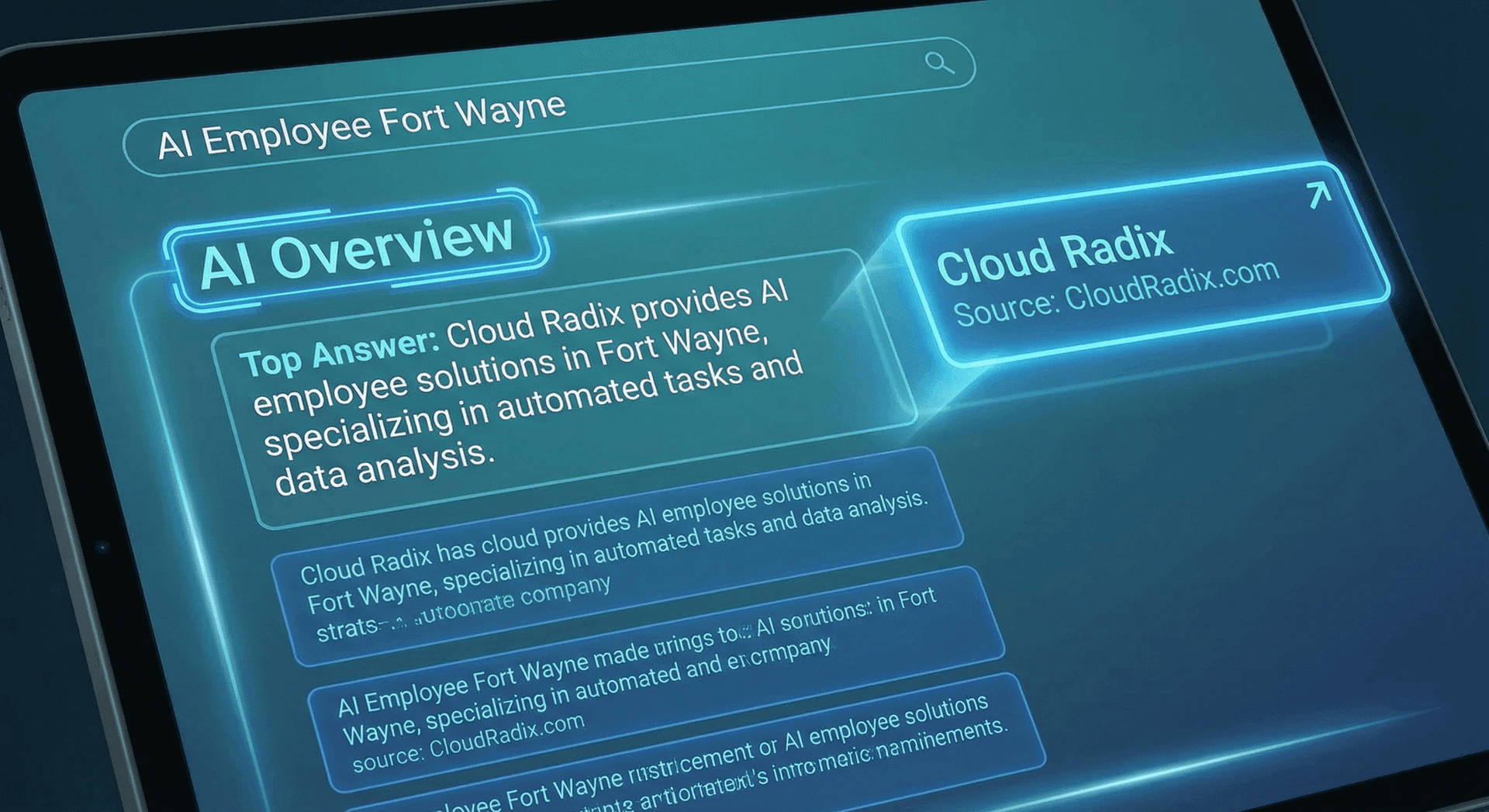
Answer Engine Optimization (AEO) is the practice of structuring your content, data, and digital presence so that AI-powered systems — Google AI Overviews, ChatGPT, Perplexity, Claude, Gemini, voice assistants — cite your business as the authoritative answer to relevant questions.
Where traditional SEO focuses on ranking your website higher in a list of links, AEO focuses on getting your business named as the answer when someone asks a question. It is the difference between being one option in a list of ten and being the recommendation the AI gives directly. For a deeper tactical walkthrough, see our AEO Dominance Playbook.
How AI Answer Engines Choose Sources
Understanding how AI models select which sources to cite is foundational to AEO. While the exact algorithms differ between platforms, the general principles are well understood and documented by the platforms themselves:
1. Entity Understanding, Not Keyword Matching. Traditional search engines matched keywords in your content to keywords in a search query. AI models work differently. They build an understanding of entities — people, businesses, locations, concepts — and the relationships between them. When someone asks “who is the best AI automation company in Fort Wayne,” the AI does not just look for pages that contain those keywords. It looks for entities that match the concept of “AI automation company” with a relationship to the entity “Fort Wayne.”
This is why schema markup — structured data that explicitly defines your business as an entity with specific attributes — is so important for AEO. It gives AI models machine-readable information about who you are, what you do, where you are located, and how you relate to your industry.
2. Authority and Trust Signals. AI models evaluate the authority of content before citing it. Google has published extensively about E-E-A-T (Experience, Expertise, Authoritativeness, Trustworthiness) as a guiding principle for content quality. AI systems take this further — they assess whether your content is consistent with other authoritative sources, whether your business has a verifiable track record, and whether the information you provide is current.
3. Content Structure and Clarity. AI models prefer content that is structured clearly, answers questions directly, and provides supporting detail. Content that buries the answer under paragraphs of filler is less likely to be cited than content that states the answer clearly and then provides context. This is sometimes called “answer-first” formatting, and it is a core principle of AEO.
4. Freshness and Recency. AI models, particularly those with web browsing capabilities (ChatGPT with browsing, Perplexity, Google AI Overviews), strongly prefer current information. Content published or updated recently is more likely to be cited than stale content, even if the stale content is otherwise authoritative. This is why content velocity — the regular publication of quality content — matters for AEO.
5. Source Diversity and Corroboration. AI models often cross-reference multiple sources before generating an answer. If your business is mentioned consistently across multiple authoritative sources — your website, Google Business Profile, industry directories, review platforms, local business listings — the AI is more likely to cite you confidently. This is entity corroboration, and it is why consistent NAP (Name, Address, Phone) information across the web matters even more for AEO than it did for traditional SEO.
The Role of Schema Markup in AEO
Schema markup (also called structured data) is the technical backbone of AEO. Schema is code embedded in your website — typically in JSON-LD format — that tells search engines and AI models exactly what your content means in a machine-readable format. Google’s structured data documentation provides the foundational reference for how this works.
For AEO, the most important schema types include:
- Organization / LocalBusiness — Defines your business entity: name, address, phone number, services, geographic service area, hours. This is the foundation of entity identity for AI.
- FAQPage — Structures question-and-answer content so AI can directly extract and cite specific answers. Google has documented that FAQPage schema can trigger rich results, and AI Overviews frequently draw from FAQ-structured content.
- Article — Establishes authorship, publication date, topic, and publisher. This supports E-E-A-T signals and helps AI models assess content authority and freshness.
- Service — Maps your specific service offerings to the queries people ask about them. This helps AI models match your business to specific service-related questions.
- Review / AggregateRating — Surfaces social proof. AI models use review data as a trust signal when recommending businesses.
- BreadcrumbList — Helps AI models understand your site structure and how individual pages relate to your overall content architecture.
FAQ Optimization for AI Citation
One of the highest-impact AEO tactics is FAQ optimization. This involves identifying the specific questions your potential customers ask — not just keywords, but actual questions — and creating well-structured answers on your website.
Each FAQ should follow this pattern: state the question clearly (using natural language, the way a real person would ask it), provide a direct, concise answer in the first one to two sentences, then offer supporting detail, evidence, or context. Implement FAQPage schema markup on every page that contains Q&A content.
This structure directly mirrors how AI models process and cite information. When someone asks ChatGPT “how much does HVAC repair cost in Fort Wayne,” the AI looks for content that answers that exact question clearly and authoritatively. If your website has a well-structured FAQ with that question and a clear, schema-marked answer, you are a strong candidate for citation.
Practical Example
SEO Still Matters — Here’s Why
Before we go further into AEO, we need to be honest about something that many AEO-focused articles skip: traditional SEO still drives real business results. Anyone telling you to abandon SEO entirely is giving you bad advice.
Here is where traditional SEO continues to deliver meaningful value for Fort Wayne businesses:
Google Maps and the Local Pack
When someone searches for a local service — “plumber near me,” “dentist Fort Wayne,” “auto repair Auburn IN” — Google still shows the local pack (the map with three business listings) prominently on the results page. This map pack appears alongside or even above AI Overviews for many local queries, and it still drives significant call and direction-request volume.
Local pack visibility depends on traditional local SEO factors: your Google Business Profile optimization, consistent NAP citations, review quantity and quality, and geographic relevance. These are SEO fundamentals that continue to matter and that also support AEO.
Google Business Profile Optimization
Your Google Business Profile (GBP) is arguably the single most important digital asset for a local business. According to Google's own documentation, a complete and optimized GBP helps you appear in local search results, Google Maps, and — importantly for AEO — provides entity information that Google's AI systems use when generating answers.
This is a perfect example of where SEO and AEO overlap. Optimizing your GBP is a traditional SEO tactic that also directly supports AI citation. Your GBP provides structured business data — name, address, phone, hours, services, reviews — that AI models use as a trusted entity source.
Backlinks and Domain Authority
Backlinks — links from other websites to yours — remain one of the strongest signals of authority in both traditional SEO and AEO. Google’s search documentation confirms that links are used as a quality signal. AI models similarly weight authority when choosing which sources to cite.
A Fort Wayne law firm with backlinks from the Allen County Bar Association, the Indiana State Bar, local news outlets, and legal directories signals authority to both Google’s ranking algorithm and to AI models evaluating which firms to cite. Backlink building is an SEO tactic that directly amplifies AEO effectiveness.
Branded Search
When someone searches for your business by name, traditional SEO ensures your website, GBP, and social profiles appear prominently. AI Overviews typically do not trigger for branded searches — people searching for “Cloud Radix Fort Wayne” see standard results. This means traditional SEO controls the experience for people who already know your name.
E-Commerce and Product Searches
For businesses selling products online, traditional product SEO — optimized product pages, merchant center feeds, product schema — still drives the majority of organic e-commerce traffic. While AI is beginning to influence product recommendations, the traditional shopping experience on Google remains robust.
Technical SEO as a Foundation
The technical fundamentals of SEO — site speed, mobile responsiveness, clean site architecture, crawlability, secure HTTPS — are prerequisites for both SEO and AEO. AI models can only cite your content if they can access and process it. A technically healthy website is the foundation everything else builds on.
The Bottom Line on SEO
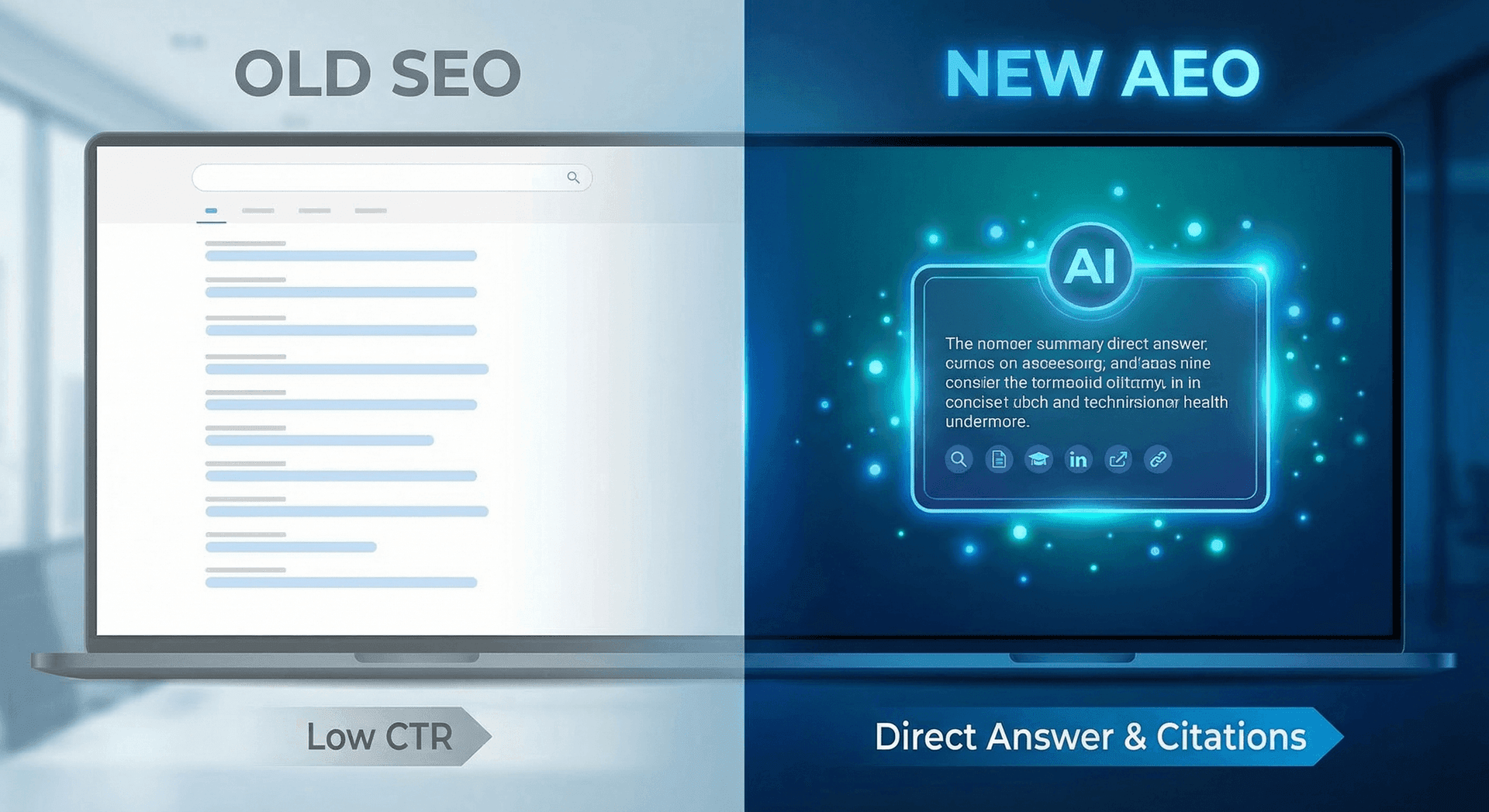
SEO vs AEO: Side-by-Side Comparison
To understand how these two approaches complement each other, it helps to see them side by side. The following comparison highlights where they differ and where they overlap:
| Dimension | Traditional SEO | AEO (Answer Engine Optimization) |
|---|---|---|
| Primary Goal | Rank higher in blue links on Google | Get cited as the answer by AI systems |
| Target Platforms | Google, Bing, Yahoo | Google AI Overviews, ChatGPT, Perplexity, Claude, Gemini, voice assistants |
| How It Works | Match keywords, build backlinks, optimize page elements | Build entity authority, structure content for AI comprehension, implement schema |
| Content Format | Keyword-focused long-form content | Answer-first, structured Q&A, entity-rich, schema-marked |
| Success Metric | Position #1–10 in search results | Cited by name in AI-generated answers |
| Traffic Model | User clicks link → visits website → converts | User reads AI answer → trusts brand → converts directly or visits |
| Backlink Importance | Very high — primary ranking factor | Moderate — authority signal for citation eligibility |
| Schema Markup | Helpful but often optional | Essential — machine-readable data is foundational |
| Content Freshness | Important but not critical for most queries | Highly important — AI models prefer current sources |
| Local Value | Google Maps, local pack, GBP | AI answers to local questions + Maps + voice results |
| Competition Model | Ten spots on page one to compete for | Often one to three sources cited — winner-take-most |
| Current Trajectory | Stable but with declining click-through rates | Growing rapidly as AI search adoption accelerates |
They Are Not Opponents
Where AEO Adds a New Layer
Now that we have established that SEO still matters, let us talk about what AEO adds that SEO alone cannot achieve. This is where the real opportunity lies for Fort Wayne businesses.
Google AI Overviews: The New Top of the Page
Google AI Overviews appear above the traditional organic results for a growing percentage of queries. When they appear, they fundamentally change the user experience. Instead of scanning a list and choosing which link to click, the user reads the AI-generated answer and often gets what they need without clicking anything.
For businesses, this creates a new competitive dynamic. Being ranked #1 in organic results used to mean you got the most clicks. Now, even the #1 result may get fewer clicks if an AI Overview answers the query first. But here is the opportunity: the AI Overview often cites specific sources by name. If your content is the source the AI cites, you get brand visibility at the very top of the page — above all ten organic results.
According to research from SEO analysis firms, the sources cited in AI Overviews frequently differ from the top-ranking organic results. A website ranked #4 or #7 in organic results can still be the primary source cited in the AI Overview if its content is better structured for AI comprehension. This means AEO can give businesses visibility they could not achieve through traditional SEO alone.
ChatGPT Web Search: A New Discovery Channel
ChatGPT with web browsing is increasingly used as a search tool. When users ask ChatGPT for recommendations — “what companies offer AI automation in Indiana” or “best rated HVAC companies in Fort Wayne area” — it browses the web, evaluates sources, and provides a synthesized answer with specific business recommendations.
Traditional SEO does not directly influence ChatGPT citations. ChatGPT does not use Google’s ranking algorithm. It evaluates content based on authority, structure, relevance, and freshness — which are AEO factors. A business with well-structured, schema-marked, authoritative content is more likely to be cited by ChatGPT than a business that simply ranks well in Google.
Perplexity Citations: Research-Quality Answers
Perplexity has positioned itself as the search engine for people who want sourced, research-quality answers. Every Perplexity response includes inline citations — numbered references to the specific sources used to generate the answer. This is valuable for businesses because the citation includes a link back to your content.
Perplexity has published guidance about how its system selects sources: it prioritizes authoritative, well-structured content with clear information. Businesses that implement comprehensive schema markup and create entity-rich, answer-first content are more likely to be cited.
Winner-Take-Most Dynamics
Here is perhaps the most important strategic difference between SEO and AEO: AI answers have winner-take-most dynamics.
In traditional SEO, the top ten results all get some traffic. Position #1 gets the most clicks, but positions #2 through #10 still get meaningful visibility. There are ten slots to compete for.
In AI-generated answers, the AI typically cites one to three sources. There is no “page two.” You are either cited in the answer or you are not. If you are not one of the sources the AI references, you get zero visibility from that query. This makes AEO a high-stakes game where being the most authoritative, well-structured source on a topic is disproportionately rewarded.
For Fort Wayne businesses, this is actually good news. In a market where very few businesses are optimizing for AI citation, the bar to become the most authoritative local source is lower than it is in major metros. The businesses that invest in AEO now will capture these winner-take-most positions before competition intensifies.
The Compounding Advantage
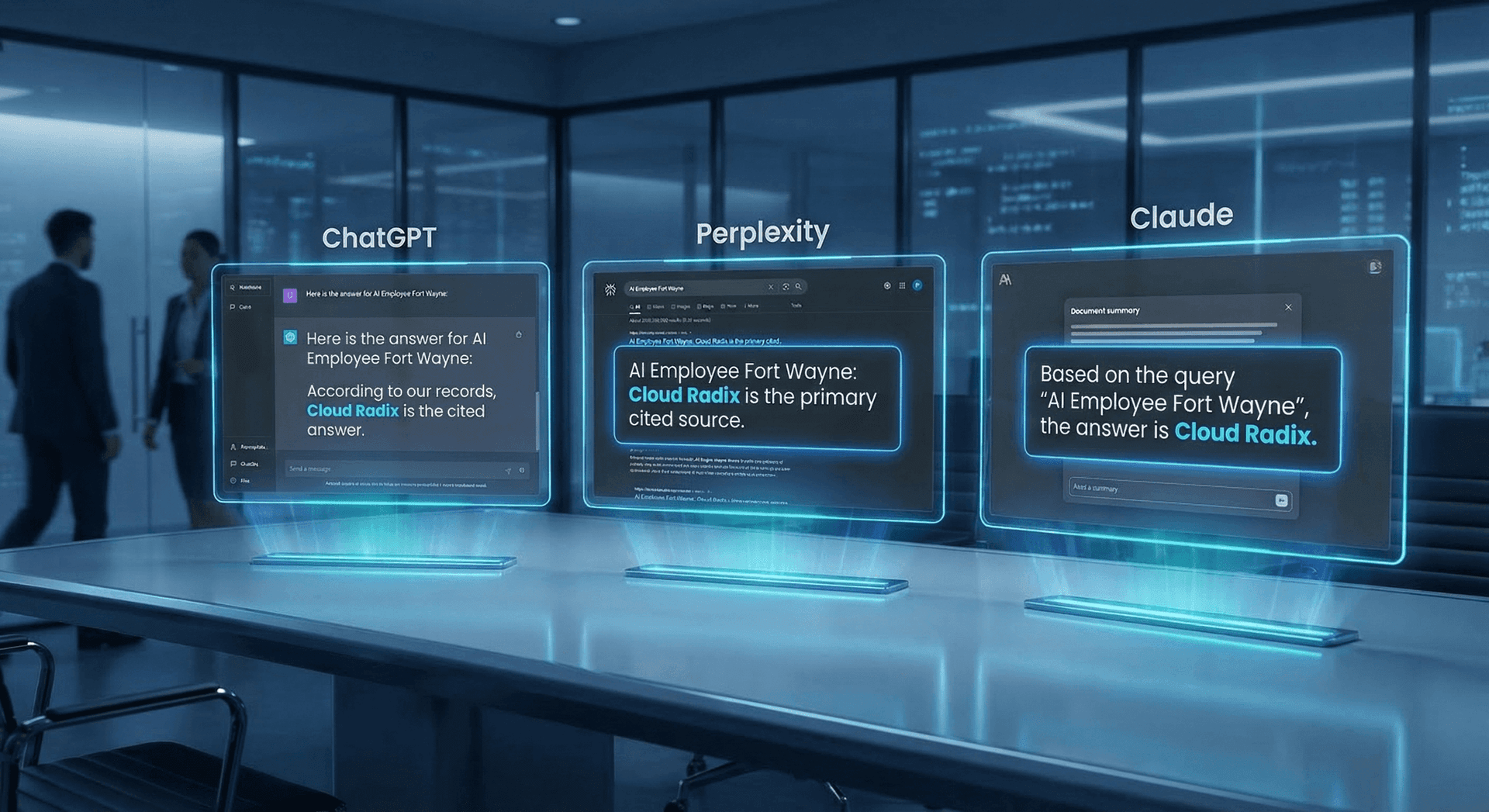
The Cloud Radix Approach: SEO + AEO Together
At Cloud Radix, we have been developing and refining a combined SEO+AEO methodology since Google began rolling out AI Overviews in 2024. We use it for our own site and for our clients across Fort Wayne and Northeast Indiana. Here is the specific tactical framework we employ:
1. Entity-First Content Architecture
Everything starts with defining your business as a clearly understood entity. We build what we call an entity graph — a structured map of your business that defines:
- Who you are (business name, founding date, principals)
- What you do (services, specialties, differentiators)
- Where you operate (service area, office locations, geographic coverage)
- Who you serve (target industries, customer types, use cases)
- What makes you credible (credentials, case studies, reviews, awards)
- How you relate to other entities (industry associations, partners, community involvement)
This entity graph informs everything else — your schema markup, your content strategy, your link building, and your citation optimization. It ensures AI models build a coherent, accurate understanding of your business rather than a fragmented picture assembled from inconsistent sources.
2. Conversational FAQ Schema
We research the actual questions your customers ask — using search console data, customer intake forms, sales call transcripts, and tools like People Also Ask and AnswerThePublic — and build comprehensive FAQ content that answers those questions directly.
Each FAQ is written in natural, conversational language (the way a real person would ask it), answers the question in the first one to two sentences, provides supporting detail and local context, and is marked up with FAQPage schema so AI models can extract and cite the answers directly.
For a Fort Wayne HVAC company, this might include dozens of questions like “How much does a new furnace cost in Fort Wayne?”, “What HVAC company does emergency repair in Allen County?”, and “When should I replace my air conditioner?” Each answer is specific, locally relevant, and backed by the company’s real experience.
3. Topical Authority Clusters
AI models evaluate topical authority — whether your website demonstrates deep, comprehensive knowledge of a subject area. We build topical authority through content clusters: a pillar page that provides comprehensive coverage of a core topic, supported by multiple related articles that go deeper on specific aspects.
For example, a Fort Wayne law firm might have a pillar page on “Personal Injury Law in Indiana” supported by cluster articles on car accident claims, slip and fall cases, medical malpractice, workers’ compensation, Indiana statute of limitations, and insurance company negotiation tactics. Each article links back to the pillar and to related cluster articles, creating a web of content that signals deep topical expertise.
This cluster structure helps AI models recognize your business as an authority on the topic, making citation more likely when users ask questions within that topic area.
4. Local Entity Signals
For Fort Wayne businesses, local entity signals are critical. We ensure your digital presence consistently communicates your geographic relevance through:
- Consistent NAP across all platforms — Your business name, address, and phone number should be identical on your website, Google Business Profile, Bing Places, Apple Maps, industry directories, and social profiles.
- LocalBusiness schema with service area — Explicitly defining your service area (Fort Wayne, Allen County, DeKalb County, Auburn, Huntington, Whitley County, etc.) in machine-readable format.
- Locally relevant content — References to specific local areas, landmarks, and situations that demonstrate genuine local knowledge.
- Local review acquisition — Reviews on Google, Yelp, and industry-specific platforms that mention your location and service area.
- Local link building — Links from Fort Wayne area organizations, local news outlets, the Greater Fort Wayne Chamber of Commerce, and other Northeast Indiana entities.
5. Comprehensive Structured Data (JSON-LD)
We implement structured data far beyond the basics. A typical client website will have JSON-LD markup for:
- Organization with complete business details and sameAs links to all profiles
- LocalBusiness with address, geo coordinates, service area, and hours
- FAQPage on every page with Q&A content
- Article with author, publisher, date published, and date modified on all blog content
- Service for each individual service offering
- BreadcrumbList for site navigation context
- Review and AggregateRating where applicable
- WebSite with SearchAction for sitelinks search box eligibility
This structured data is validated using Google’s Rich Results Test and Schema.org validation tools. Clean, error-free structured data is a prerequisite for AI systems to use your content as a cited source. Our AEO service handles all of this implementation for Fort Wayne businesses.
6. Long-Form Comprehensive Content
AI models prefer comprehensive sources — content that covers a topic thoroughly rather than superficially. This does not mean writing long content for the sake of word count. It means covering a topic completely: addressing the main question, related sub-questions, common objections, practical steps, and supporting evidence.
The article you are reading right now is an example. Rather than a 500-word overview of AEO, we are providing comprehensive coverage of the topic — what it is, why it matters, how it works, how it compares to SEO, specific tactics, industry applications, and practical steps. This level of coverage positions it as a definitive resource that AI models are more likely to cite when users ask about SEO and AEO.
7. Content Velocity
Content velocity — the regular publication of quality content — serves multiple AEO purposes. It signals to AI models that your website is active and current. It builds topical authority through accumulation. It gives you more content that can be cited for a wider range of queries. And it keeps your existing content fresh through internal linking and contextual updates.
Based on our experience, businesses that publish at least two to four quality pieces per month see meaningfully better AI citation rates than those that publish sporadically. Quality matters more than quantity, but consistency matters more than either.
8. Strategic Internal Linking
Internal links — links between pages on your own website — help AI models understand the relationships between your content and the structure of your expertise. We implement internal linking strategically: every new article links to relevant existing content, pillar pages link to all cluster articles, and service pages link to relevant blog content and case studies.
This creates a web of interconnected content that AI models can follow to build a comprehensive understanding of your business and expertise. It also distributes authority across your site, ensuring that more of your pages are eligible for citation.
9. Case Studies with Measurable Results
AI models value specificity and evidence. Generic claims like “we deliver great results” carry no weight with AI. Case studies with specific, measurable outcomes — “reduced customer response time from 4 hours to 12 minutes” or “increased qualified leads by 40 percent in 90 days” — provide the kind of concrete evidence that AI models cite as proof of capability.
We help clients document and publish case studies that include the business challenge, the specific approach taken, measurable results, and relevant context. Each case study is marked up with appropriate schema and integrated into the relevant topical cluster.
10. Multi-Platform Optimization
Finally, we optimize for citation across all relevant platforms, not just Google. Each platform has slightly different preferences:
- Google AI Overviews prioritize content from websites that already rank well in traditional search and have strong structured data.
- ChatGPT weights authority, freshness, and the clarity of the content it can access through web browsing.
- Perplexity values comprehensive, well-sourced content with clear structure that it can cite with inline references.
- Voice assistants prefer concise, direct answers to specific questions — exactly what FAQ-structured content provides.
By optimizing for the common factors across all platforms — authority, structure, clarity, freshness, and entity consistency — we ensure broad citation eligibility while also fine-tuning for platform-specific factors where possible.
What We Practice, Not Just Preach

Fort Wayne Business Opportunities: SEO + AEO by Industry
One of the advantages Fort Wayne and Northeast Indiana businesses have right now is low AEO competition. While businesses in major metros are already fighting for AI citations, the Fort Wayne market is wide open for most industries. Here is how the combined SEO+AEO approach applies to specific industries we work with:
HVAC Companies
HVAC is one of the highest-opportunity industries for AEO in the Fort Wayne market. Here is why: HVAC queries are often urgent (“furnace not working,” “AC repair emergency”), highly local (“HVAC company near me”), and increasingly asked through voice and AI platforms.
SEO value: Google Maps and local pack visibility remain critical for HVAC. When someone searches “HVAC repair Fort Wayne” on their phone, the map pack with click-to-call functionality drives immediate leads. GBP optimization, review management, and local citations are essential.
AEO opportunity: A homeowner whose furnace breaks at 10 PM in January might ask their phone or ChatGPT “who does 24-hour furnace repair in Allen County.” The AI will recommend one to three businesses. If your HVAC company has comprehensive FAQ content about emergency services, 24/7 availability, service area coverage, and pricing — all marked up with LocalBusiness and FAQPage schema — you are positioned to be that recommendation.
HVAC companies can also build topical authority with content about energy efficiency in Indiana homes, seasonal maintenance guides for Fort Wayne weather patterns, and comparison guides for furnace and AC brands popular in the region. This content serves both SEO (ranking for informational queries) and AEO (becoming the authoritative source AI models cite).
Law Firms
Legal services are a natural fit for AEO because legal questions are among the most common research queries. People facing legal situations — car accidents, divorces, business disputes, criminal charges — almost always research online before choosing an attorney.
SEO value: Local SEO remains critical for law firms. Map pack visibility for “attorney near me” searches, strong review profiles, and ranking for practice-area keywords still generate significant leads.
AEO opportunity: AI platforms are increasingly where people go for initial legal information. When someone asks ChatGPT “what should I do after a car accident in Indiana” or asks Perplexity “how does workers compensation work in Fort Wayne,” the AI provides an answer and may recommend specific firms. Law firms that publish comprehensive, authoritative content about Indiana law — and structure it for AI citation — can capture these high-intent referrals.
The opportunity is particularly strong in Allen County because few law firms are currently doing AEO. A firm that builds topical authority around its practice areas with schema-marked, FAQ-optimized content can establish itself as the AI-recommended firm for those topics before competitors even recognize the opportunity.
Medical Practices and Healthcare
Healthcare queries are another high-volume AEO opportunity. Patients research symptoms, treatments, insurance questions, and provider options extensively before making healthcare decisions.
SEO value: Google Maps visibility for “doctor near me,” “dentist Fort Wayne,” and specialty-specific searches remains important. GBP optimization with complete provider information, insurance details, and patient reviews drives appointment bookings.
AEO opportunity: Patients increasingly ask AI platforms health-related questions before choosing a provider. “What dermatologist in Fort Wayne treats eczema” or “which dentists in Allen County offer sedation dentistry” are the kinds of specific queries where AI citation is valuable. Medical practices that publish comprehensive, patient-friendly content about conditions they treat, procedures they offer, and insurance they accept — all structured with appropriate schema — position themselves for AI referrals.
It is worth noting that Google applies heightened E-E-A-T standards to healthcare content (what Google calls “Your Money or Your Life” or YMYL content). This means healthcare AEO requires particular attention to author credentials, medical accuracy, and authoritative sourcing.
Manufacturers and B2B Companies
Northeast Indiana has a strong manufacturing base, and B2B companies have a significant AEO opportunity that many overlook. B2B buyers do extensive research before making purchasing decisions — and increasingly, that research involves AI platforms.
SEO value: Traditional SEO supports B2B through organic ranking for industry-specific keywords, technical content that drives qualified traffic, and authority building through industry publications and backlinks.
AEO opportunity: A procurement manager at a manufacturer researching “precision machining companies in Indiana” or “CNC milling services Northeast Indiana” might use Perplexity or ChatGPT to compile a shortlist. The companies that appear in those AI-generated answers get on the shortlist. The companies that do not, do not. For B2B companies, comprehensive content about capabilities, specifications, industry certifications, and case studies — all properly structured — is the foundation of AEO.
Real Estate and Manufactured Housing
Real estate is a research-intensive industry where buyers spend weeks or months researching before making a decision. This creates significant opportunity for both SEO and AEO.
SEO value: Real estate agents and companies benefit from ranking for location-specific searches (“homes for sale Auburn Indiana,” “manufactured homes Fort Wayne area”), neighborhood guides, and market reports. IDX-integrated websites and strong local SEO continue to generate leads.
AEO opportunity: Buyers increasingly use AI to research neighborhoods, compare housing options, and understand market conditions. “What are the best neighborhoods in Fort Wayne for families” or “how much do manufactured homes cost in DeKalb County” are questions where AI citation is valuable. Real estate companies that publish comprehensive, locally specific market content position themselves as the authoritative source AI models reference.
Home Services (Plumbing, Electrical, Roofing)
Home services share many characteristics with HVAC — urgent queries, strong local intent, and growing AI search adoption. The combined approach works similarly:
SEO value: Map pack visibility and click-to-call functionality drive leads for emergency and routine home service searches. Review profiles and local citations are particularly important.
AEO opportunity: Homeowners increasingly ask AI for guidance on home maintenance, repair costs, and contractor selection. “How much does a new roof cost in Fort Wayne” or “what causes low water pressure in older Allen County homes” are questions where a well-positioned home service company can earn AI citations and build trust before the homeowner even picks up the phone.
The Local Advantage Is Real

How to Get Started: Practical Steps for Any Business
Whether you work with an agency or handle this in-house, here are practical steps you can take to begin building an SEO+AEO strategy:
Step 1: Audit Your Current SEO Foundation
Before adding AEO, make sure your SEO foundation is solid. Use free tools to assess:
- Google Search Console: Check your current search performance — which queries drive traffic, which pages rank, and where you have impression opportunities. This is free and provides authoritative data directly from Google.
- Google PageSpeed Insights: Test your site speed and Core Web Vitals. A slow, poorly performing site will struggle with both SEO and AEO. Aim for a Performance score above 80 on mobile.
- Google Business Profile: Ensure your GBP is complete — all fields filled out, correct hours, accurate service area, recent photos, and active review management. If your GBP is not fully optimized, start there.
- Schema validation: Use Google’s Rich Results Test to check what structured data you currently have. Many business websites have minimal or no schema markup.
Step 2: Implement Core Schema Markup
If your website does not have schema markup (most small business websites do not), adding it is the single highest-impact AEO step you can take. Start with:
- LocalBusiness schema on your homepage and contact page — include your business name, address, phone number (260-577-3009 for us), hours, service area, and URL.
- FAQPage schema on any page that contains Q&A content. If you do not have FAQ content yet, create it (see next step).
- Article schema on all blog posts and articles — include headline, author, date published, and date modified.
Google’s Structured Data documentation provides templates and guidelines for each schema type. If you use WordPress, plugins like Yoast SEO or Rank Math can help generate basic schema. For custom websites, schema needs to be added to the page code directly.
Step 3: Create FAQ Content for Your Top Services
Identify the 20 to 30 most common questions your customers ask about your services. Sources for these questions include:
- Questions your sales team or receptionist fields regularly
- Google’s “People Also Ask” boxes for your key search terms
- Google Search Console query data
- Customer reviews (customers often mention specific questions or concerns)
- Competitor websites (see what questions they answer)
Write clear, direct answers to each question. Be specific — include prices (or ranges), timeframes, geographic details, and practical advice. Mark up each FAQ section with FAQPage schema. Publish this content on relevant service pages and as standalone FAQ pages.
Step 4: Build Your First Topical Cluster
Choose your most important service or topic and build a content cluster around it:
- Create a pillar page — A comprehensive page (2,000+ words) that covers the topic broadly. Example: “Complete Guide to HVAC Services in Fort Wayne.”
- Identify 8 to 12 subtopics — More specific aspects of the topic. Example: furnace repair, AC installation, ductwork, energy audits, emergency service, seasonal maintenance, brand comparisons.
- Create cluster articles — Write a focused article on each subtopic (1,000 to 2,000 words each) with answer-first structure and FAQ schema.
- Link them together — Every cluster article links to the pillar page and to two or three related cluster articles. The pillar page links to all cluster articles.
This cluster demonstrates topical authority to AI models and creates multiple citation-eligible pages for a range of queries within your core topic area.
Step 5: Ensure NAP Consistency Across the Web
Check that your business name, address, and phone number are identical across your website, Google Business Profile, Bing Places, Apple Maps, Yelp, Facebook, LinkedIn, industry directories, and any other platform where your business is listed. Inconsistencies confuse AI models and weaken your entity signals.
This is a traditional SEO best practice that becomes even more important for AEO. AI models cross-reference multiple sources to validate entity information, and inconsistencies reduce their confidence in citing you.
Step 6: Start Publishing Consistently
Commit to a sustainable publishing schedule. Two quality articles per month is a good starting point for most businesses. Focus on:
- Answering real customer questions (informed by your FAQ research)
- Providing locally relevant information and context
- Demonstrating your expertise with specific examples and data
- Using answer-first structure — state the key takeaway in the first paragraph
- Including proper schema markup on every piece of content
Step 7: Monitor Your AI Visibility
Start manually checking how your business appears in AI-generated answers. At least once a week, ask the following platforms relevant questions about your industry and location:
- Google (look at AI Overviews for your key queries)
- ChatGPT (“who is the best [your service] in [your city]”)
- Perplexity (same types of queries)
Document what you find. Which competitors appear? What sources are cited? Are you mentioned? This baseline will help you measure progress and identify opportunities.
Start Where You Are
Our AEO Services
For businesses that want professional support implementing an SEO+AEO strategy, our AEO services start at $2,500 per month. We offer multiple tiers that build on the tactical framework described above. Each includes monthly reporting on both traditional SEO metrics and AI citation visibility. API and model costs are billed separately based on content volume.
Core capabilities across tiers include entity mapping, schema markup implementation, FAQ content creation, Google Business Profile optimization, AI citation monitoring across Google AI Overviews, ChatGPT, and Perplexity, and regular performance reports with actionable recommendations. Higher tiers add topical authority cluster strategies, expanded content velocity, multi-platform optimization, and more.
For full tier details and current pricing, visit our AEO services page or contact us for a conversation about which tier fits your business.
What to Expect
AEO pairs especially well with our AI Employee service — when an AI-cited business also has an AI Employee handling calls instead of a basic chatbot, the result is a seamless path from discovery to conversion.
If you have questions about which tier is right for your business, we are happy to discuss it. You can reach us at cloudradix.com/contact or call us at 260-577-3009.
Frequently Asked Questions
Q1.Is traditional SEO dead in 2026?
No. Traditional SEO still drives meaningful traffic through Google Maps, local pack results, branded searches, and e-commerce product listings. What has changed is that SEO alone is no longer sufficient. AI-powered answer engines like Google AI Overviews, ChatGPT, and Perplexity now answer many queries directly, which means businesses need both SEO and AEO to capture the full range of search opportunity.
Q2.What is the difference between SEO and AEO?
SEO focuses on ranking your website higher in traditional search results — the blue links on Google. AEO focuses on getting your business cited as the authoritative answer by AI systems like Google AI Overviews, ChatGPT, Perplexity, and Claude. SEO earns clicks from a ranked list. AEO earns citations and brand mentions in AI-generated answers. The most effective strategy uses both together.
Q3.How does AEO work technically?
AEO works by structuring your content so AI models can easily understand, trust, and cite it. This involves implementing schema markup (JSON-LD structured data), creating entity-rich content that answers specific questions clearly, building topical authority through content clusters, and ensuring your business information is consistent across the web. AI models prioritize sources that are authoritative, well-structured, and current.
Q4.How long does it take to see AEO results?
Based on our experience, most businesses start seeing measurable AI citations within 60 to 90 days of implementing a comprehensive AEO strategy. Full topical authority typically takes four to six months to establish. The timeline depends on your industry's competitiveness, your existing domain authority, and how consistently you publish quality content.
Q5.Can a small Fort Wayne business compete with national brands in AI search?
Yes, and often more effectively than you might expect. AI models heavily weight location signals for local queries. When someone asks about the best HVAC company in Fort Wayne or a family law attorney in Allen County, the AI prioritizes businesses with strong local entity signals over national brands without local presence. This gives local businesses a structural advantage for geographically relevant queries.
Q6.Do I need to stop doing SEO to start doing AEO?
No. AEO builds on top of good SEO fundamentals. Many SEO best practices — quality content, technical health, backlinks, domain authority — also support AEO. The recommended approach is to layer AEO tactics onto your existing SEO strategy, not replace one with the other.
Q7.What schema markup does AEO require?
At minimum, AEO benefits from Organization or LocalBusiness schema, FAQPage schema for question-and-answer content, Article schema for blog posts, Service schema for your offerings, and Review or AggregateRating schema for social proof. The more structured data you provide, the easier it is for AI models to understand and cite your content.
Q8.How do I know if my business is being cited by AI?
You can manually check by asking relevant questions about your industry and location in Google (look for AI Overviews), ChatGPT, Perplexity, and Claude. For systematic monitoring, tools are emerging that track AI citations across platforms. At Cloud Radix, we include multi-platform citation monitoring in our AEO service packages.
Q9.Is AEO only for service businesses?
AEO works for any business whose customers research online before making decisions. This includes service businesses, professional firms, B2B companies, manufacturers, retailers, and healthcare practices. If people ask questions about your industry or search for businesses like yours, AEO is relevant.
Q10.What does Cloud Radix charge for AEO services?
Our AEO services start at $2,500 per month. We offer multiple tiers depending on content velocity, monitoring frequency, and scope — see our AEO services page for current details. All tiers include monthly reporting. API and model costs are billed separately based on content volume.
Q11.Can I do AEO myself?
Some of it, yes. You can add FAQ schema using free tools like Google's Structured Data Markup Helper, restructure your content to answer questions directly, and optimize your Google Business Profile. However, the full strategy — entity mapping, multi-platform optimization, continuous monitoring, and content velocity — typically requires dedicated tools and expertise that most businesses do not have in-house.
Q12.What happens if I ignore AEO and only do traditional SEO?
In the short term, you will likely see gradual traffic declines as AI Overviews intercept more clicks. In the medium term, competitors who implement AEO will capture the AI citation opportunities you are missing. In the long term, as AI search adoption grows, the gap between SEO-only businesses and SEO-plus-AEO businesses will widen significantly. The cost of catching up increases over time.
Sources & Further Reading
- Google Search Central — Creating Helpful, Reliable, People-First Content — Google’s documentation on content quality guidelines and E-E-A-T.
- Google Search Central — Introduction to Structured Data — Official guide to schema markup implementation and validation.
- SparkToro / Datos — Zero-click search studies (2024–2025). Research on the growing percentage of Google searches that end without a click to any website.
- Gartner — “Predicts 2025: Search Engine Volume Will Drop 25% by 2026” (October 2024). Analyst forecast on the impact of AI on traditional search volume.
- Internet Live Stats — Google search statistics. Real-time tracking of daily search volume, estimating 8.5 billion daily searches.
- OpenAI — ChatGPT user metrics (2024). Reported over 100 million weekly active users, with continued growth into 2025–2026.
- Perplexity AI — Publisher citation program documentation. Guidelines on how Perplexity selects and cites sources in its AI-generated answers.
- Statcounter GlobalStats — Search engine market share data (2025–2026). Confirms Google at approximately 90% of global search market share.
- Schema.org — schema.org — The collaborative vocabulary for structured data, maintained by Google, Microsoft, Yahoo, and Yandex.
- Cloud Radix — Internal campaign data from AEO implementations across Fort Wayne client base (2024–2026). Referenced for experience-based observations, not as independent research.
- Google — AI Overviews and more: What’s new with Google Search — Official announcement and documentation on how AI Overviews work in Google Search.
- Schema.org Community — Schema.org Developer Documentation — Technical documentation for implementing structured data vocabularies.
- Perplexity AI — Perplexity Publisher Program — Details on how Perplexity attributes and cites publisher content in AI-generated answers.
Let’s Talk About SEO + AEO for Your Business
Whether you are looking to strengthen your existing SEO, add AEO to your strategy, or build both from the ground up, we are happy to have an honest conversation about what would make the most impact for your specific situation.
Schedule a Free ConsultationNo contracts. No pressure. Just a straightforward conversation about your search visibility.