
The question isn't whether your AI Employee can read your team's Slack. It's whether you want your team's Slack to live in a vendor SaaS. Every mid-market AI Employee program runs into the same conversational context capture gap by month three. The agent is sharp at the work it was told about — case files, claims, tickets, pull requests, manufacturing runs — and useless on the work that lives only in team conversation. The reason the agent looks suddenly limited at month three is not capability; it is input. Documents tell the agent what happened; conversations tell the agent why. Today's mid-market AI Employee programs over-feed the agent on the document source class and under-feed it on the conversation source class.
A SaaS-vendor answer is already on the market. SageOX, profiled by VentureBeat on 2026-05-05, markets “agentic context infrastructure” — a vendor-hosted pipeline that captures team conversations across Slack, Teams, Zoom, and Meet and feeds them into the customer's AI agent stack. The diagnosis is correct. The packaging is the problem. The conversations the customer most needs to capture — legal strategy, M&A discussion, customer-pricing negotiation, employee performance review, claim-disposition reasoning — are exactly the conversations that should not cross a vendor boundary without a much heavier set of controls than a typical SaaS read-access scope provides. The Cloud Radix architectural answer is structurally different: conversational context capture belongs on the customer's side of the Secure AI Gateway, running through buyer-owned connectors, redacted at the boundary, indexed into the buyer-owned compilation-stage knowledge layer covered in the beyond-RAG knowledge layer writeup.
Key Takeaways
- AI Employees are typically blind to team conversation by default — they ingest documents (tickets, files, PRs) and miss the Slack threads, meetings, and emails where most “why we did X” reasoning lives.
- For professional-services, healthcare, legal, and insurance verticals, the conversational channel often carries the majority of decision-grade reasoning that never reaches document-style sources the agent can read.
- The SaaS-capture answer is a data-residency landmine: exporting team conversations to a vendor SaaS recreates every shadow-AI and authorization-passing risk Cloud Radix has covered.
- The buyer-owned answer: a 4-step Conversational Context Capture pipeline running inside the customer boundary — channel inventory, buyer-controlled connectors, Gateway-side transcription and redaction, compilation-stage handoff.
- The Secure AI Gateway is the boundary where transcription, PII redaction, and indexing happen before any LLM sees the content. Captured segments become queryable artifacts in the buyer-owned knowledge layer.
- Conversational capture is the upstream input pipeline that feeds both the compilation-stage knowledge layer and the runtime context window — sitting one layer upstream of context engineering discipline.
Why are AI Employees blind to your team's conversations?
Three structural reasons explain the gap, and naming them is the precondition for closing it.
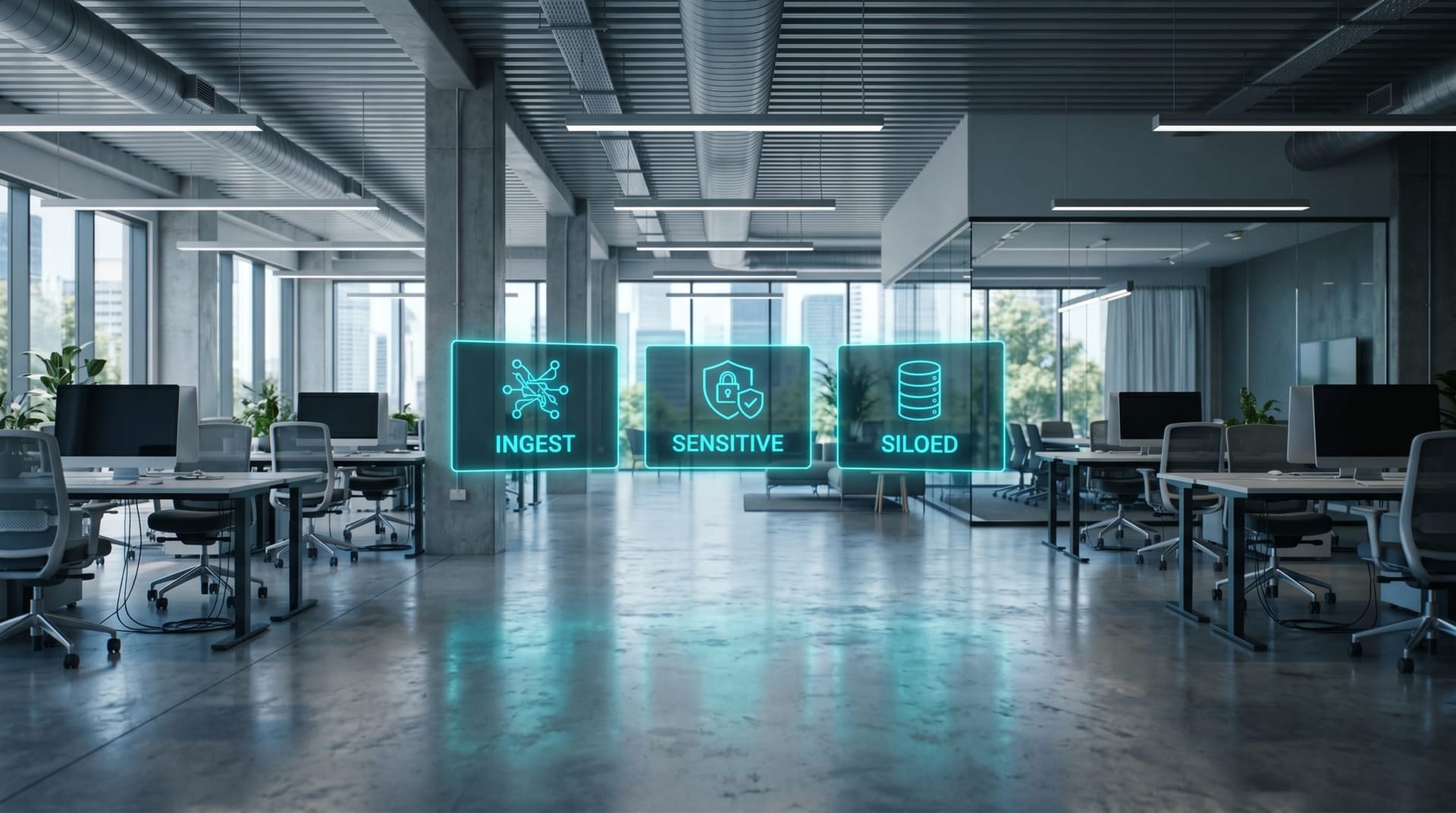
First, conversation is hard to ingest. Document-style sources — a Jira ticket, a case file, a pull request, a SOP — arrive at the agent already structured: title, body, labels, timestamps, author. The agent can compile against them with a thin adapter. Conversation-style sources — a Slack thread, a Teams chat, a Zoom transcript, an email back-channel — arrive unstructured: many participants, branching topics, off-topic interruptions, in-jokes, names without disambiguation, decisions in passing. The work to extract decision-grade content from a 200-message Slack channel is meaningfully harder than the work to extract it from a 200-word ticket.
Second, conversation is more sensitive. The reason your team uses Slack DMs and Zoom calls rather than tickets and documents for certain conversations is precisely that the medium signals lower formality and lower auditability. Pricing negotiation, employee performance, M&A consideration, legal strategy, claim-disposition reasoning — these conversations happen in channels the participants understand to be less archived than the document layer. The signal is real; mid-market AI Employee programs that ingest those channels uncritically inherit the sensitivity without inheriting the social contract.
Third, conversation lives in vendor-controlled silos by default. Slack messages are in Slack's database. Teams transcripts are in Microsoft's tenant. Zoom recordings are in Zoom's cloud. Each vendor offers a read-access scope a third-party tool can request, but the scope is broad — usually “read all messages in all channels the bot has access to” — and the audit trail of who reads what is at the vendor's discretion, not the customer's.
The result is a structural under-feeding of the AI Employee. The Stanford AI Index 2026 report tracks model capability against deployment effectiveness and notes that the gap between the two — the deployment-effectiveness gap — has widened, not narrowed, even as model capability has improved. Capability is not the constraint. Context is.
What share of decision-grade reasoning lives in conversation versus documents?
Cloud Radix's experience deploying AI Employees in professional-services, healthcare, legal, and insurance mid-market firms — Auburn manufacturers, Allen County healthcare practices, Allen County insurance brokers, DeKalb home-services firms, Fort Wayne law firms — converges on a recurring observation: for decision-heavy verticals, the conversational channel typically carries the majority of “why we did X” reasoning, while the document channel typically carries the what of the decision and the artifacts it produced.
We recommend treating that as a working hypothesis to test in your own firm, not as a fixed statistic. The right way to validate it is the channel-inventory exercise in Step 1 of the capture pattern below. The wrong way is to assume the document layer is sufficient and discover the gap at month three of the AI Employee deployment.
What is reliably true is the shape of the gap. The document layer captures decisions; the conversation layer captures the deliberation that produced them. For an AI Employee tasked with anything other than rote execution — for any task that requires judgment, escalation reasoning, precedent recall, or interpretation of an ambiguous case — the deliberation layer is the load-bearing source. An AI Employee that compiles only against the document layer can execute; one that compiles against both layers can decide.
The shape also varies by vertical. A high-volume transactional vertical — say, a 12-attorney consumer-bankruptcy law firm — runs heavier in document-mode because the workflow is artifact-shaped. A judgment-heavy vertical — a 4-attorney M&A boutique, a specialty medical practice negotiating reimbursement cases, an independent insurance broker handling complex commercial policies — runs heavier in conversation-mode because the workflow is deliberation-shaped. Cloud Radix's tribal knowledge capture writeup covered a sibling case — retiring-expert tacit knowledge — that is a different source class from active-team-conversation capture but shares the structural property of being expensive to ingest because it does not arrive pre-structured.
What is the data-residency problem with vendor-hosted conversational capture?
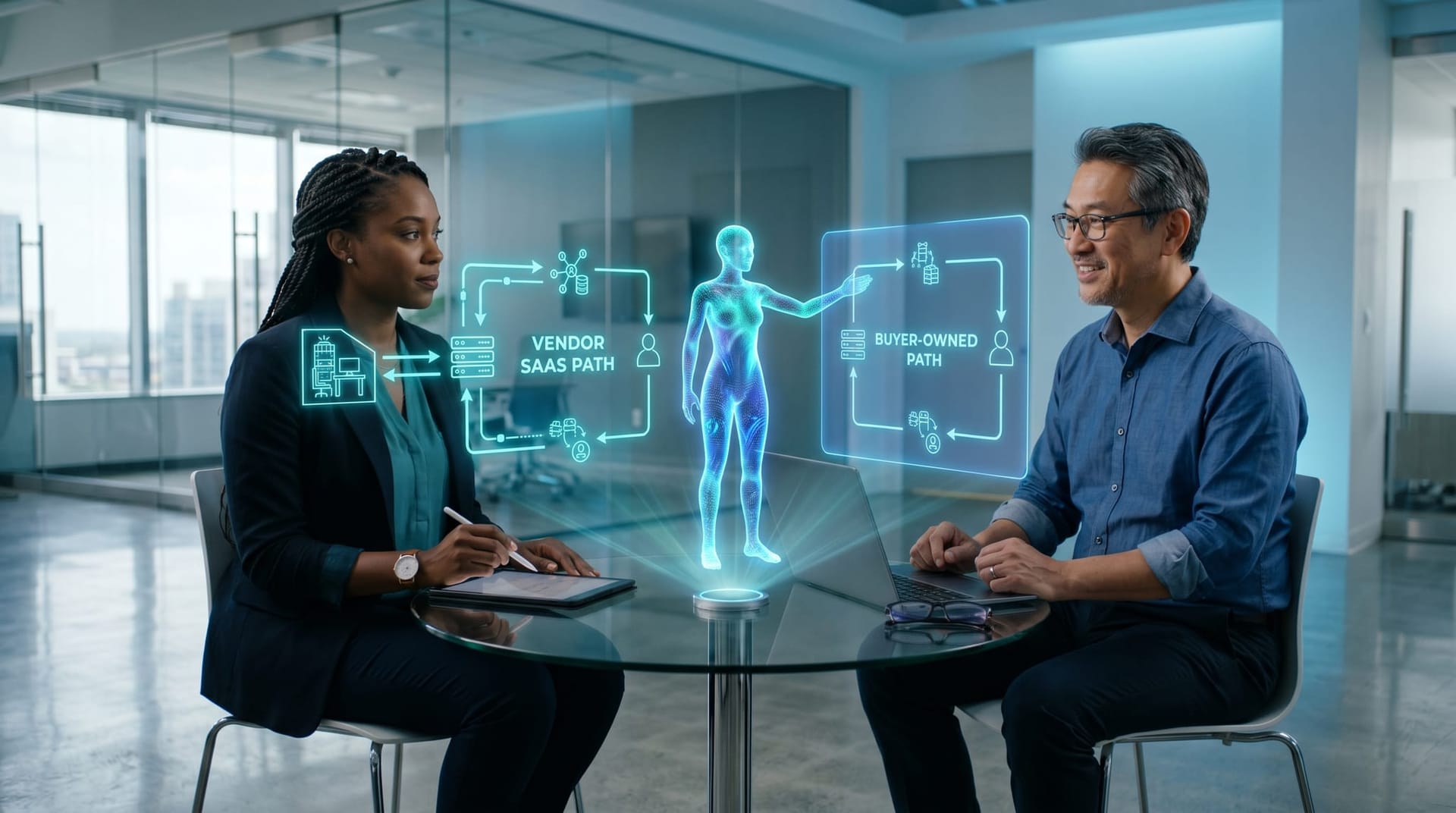
The SaaS-capture answer profiled in the VentureBeat SageOX writeup solves the ingestion problem by hosting the capture pipeline in the vendor's cloud. The vendor's bot joins Slack, Teams, and Zoom with broad read access, the vendor's pipeline performs transcription and indexing, the vendor's API exposes the indexed segments to the customer's AI agent stack. It works technically. It creates a data-residency problem that several of Cloud Radix's prior security writeups already mapped.
The Fort Wayne vibe-coded shadow AI S3 data leak playbook covered the pattern of customer data ending up in vendor-uncontrolled cloud storage as a consequence of a well-intentioned tool integration. The Fort Wayne AI agent authorization audit playbook covered the runtime authorization side of the same boundary — what an agent should be allowed to do with data that has crossed into its scope. Vendor-hosted conversational capture sits inside the same risk family: the data being captured is sensitive by class, the vendor's access scope is broad by default, and the audit trail of who reads what is the vendor's responsibility rather than the customer's.
The regulated-industry verticals are exposed first. The HIPAA Security Rule covers PHI that may surface in clinical-team Slack discussions or care-coordination Zoom calls; a vendor-hosted capture system that ingests those conversations becomes a Business Associate by default and requires a BAA the buyer must negotiate and audit. The FTC Safeguards Rule under GLBA covers customer-financial information that may surface in commercial-insurance broker conversations or wealth-management team discussions; vendor-hosted capture creates a service-provider relationship the customer must oversee. The Indiana Attorney General's Consumer Protection Division is the relevant state notification authority for non-regulated consumer data exposure if the vendor-hosted capture system experiences a breach.
The structural argument is not that vendor-hosted capture is unworkable. It is workable — with the right contracts, the right attestations, and the right audit cadence. The structural argument is that for mid-market firms with thin in-house compliance capacity, the buyer-owned alternative is materially less risky and only marginally more work to operate.
What is the 4-step Conversational Context Capture Architecture Pattern?
The pattern below is four steps in the order to execute them. Each step is sized for a mid-market firm with one to three engineers participating; the full pipeline can stand up in roughly six to eight weeks for a 50-to-500-employee firm.
Step 1 — Channel inventory and sensitivity classification
Before any capture infrastructure is built, the firm needs to know which conversational channels carry decision-grade content and which carry operational chatter. The exercise is structured: list every conversational channel in active use — Slack public channels, Slack DMs, Slack private channels, Teams chats, Teams transcripts, Zoom recordings, Meet recordings, recorded internal calls, email threads — and classify each by sensitivity tier and decision-density.
A workable classification has three tiers. Tier 1 — capture and index by default: operational team channels where decisions are documented in passing and the conversation history is the search-of-record (engineering deploys, project standups, customer onboarding handoffs). Tier 2 — capture with redaction and access controls: cross-functional channels carrying customer-pricing, claim-disposition, employee-performance, or strategic-planning content. Tier 3 — exclude from automated capture: DMs by default, board-level discussion, legal strategy, HR investigations, M&A consideration. The Tier 3 list is the explicit out-of-scope boundary for the capture pipeline.
The output is a single document: channel name, tier, classification rationale, designated owner. The same document is the input to the security review for the capture infrastructure, the regulatory review for HIPAA or GLBA exposure, and the cadence review for retention windows. It is intentionally not a one-time exercise; we recommend revisiting the channel inventory quarterly.
Step 2 — Buyer-controlled connector layer
Connectors to Slack, Teams, Zoom, Meet, and email pull conversational content into the customer environment. The architecturally important decision is who runs the connector. The vendor-SaaS answer runs the connector in the vendor's cloud, with a broad read-access scope into the customer's communication tools. The buyer-controlled answer runs the connector inside the customer's environment, using a service principal or app registration the customer owns and audits.
For Slack, the buyer-controlled connector is a custom Slack app installed in the customer's workspace, scoped to a specific list of channels (informed by the Step 1 inventory), running against the customer's Slack Enterprise Grid or Business+ tier with logging enabled. For Teams, the equivalent is a Microsoft Graph application registered in the customer's Azure tenant with channel-level permissions and an audit log streamed to the customer's SIEM. For Zoom, the equivalent is a webhook-driven recording-completion handler that pulls the transcript from the customer's Zoom account to the customer's storage. For email, the equivalent is a journaling rule routing flagged threads to a customer-controlled archive.
The connector layer terminates inside the customer's network or VPC, not the vendor's. The vendor whose product helps build the connector (Cloud Radix, in our case) does not run the connector in our environment; we help build it to run in yours.
Step 3 — Gateway-side transcription, redaction, and indexing
Captured conversations pass through the Secure AI Gateway before any LLM sees the content. Three transformations happen at the gateway: transcription (for audio and video sources), redaction (for PII, PHI, customer-pricing data, and any tier-3 content that slipped through the channel-inventory filter), and indexing (turning the redacted segments into a queryable artifact).
The transcription path uses customer-controlled model endpoints — either a self-hosted Whisper deployment, a customer-controlled cloud transcription service running under a BAA or DPA, or, for tier-2 content, a vendor-hosted endpoint behind a contractual data-handling commitment. The choice depends on the sensitivity tier from Step 1: tier-1 content can use a vendor-hosted endpoint; tier-2 content typically needs a customer-controlled endpoint.
Redaction is policy-driven, not best-effort. The gateway runs a redaction pass against named-entity recognition, regex for known PII patterns (SSNs, account numbers, MRNs), and a customer-specific dictionary for proprietary terms (customer names, pricing levels, internal codenames). Anything that matches a tier-2 or tier-3 pattern is redacted before the segment is indexed. The OWASP Top 10 for LLM Applications 2025 calls LLM02 (Sensitive Information Disclosure) out as one of the primary failure modes; gateway-side redaction is the structural defense.
Indexing produces structured records — speaker, timestamp, channel, sensitivity tier, redaction summary, decision class — that the AI Employee can compile against at task time without re-reading the raw content. The records live in the customer's vector store or knowledge graph, not in the vendor's.
Step 4 — Compilation-stage handoff to the buyer-owned knowledge layer
The indexed records feed the compilation-stage knowledge layer covered earlier. The handoff is structured: the capture pipeline emits compilation-ready chunks, the knowledge layer compiles them against the firm's task taxonomy, and the AI Employee at task time queries the compiled layer rather than the raw conversation index.
The structural point of the handoff is that the compilation-stage layer is also the destination for document-style sources, retiring-expert tribal knowledge, and any other input class the firm chooses to feed. Conversation capture is one input pipeline; documents and tribal knowledge are others. All three feed the same compiled artifact, and the AI Employee compiles against that artifact at task time. This is what makes the context engineering discipline work: context engineering is what you do with compiled context; the four-step pattern above is how you produce it.
The handoff includes provenance metadata: each compiled chunk carries a reference back to the originating conversation segment, the channel, the timestamp, and the redaction tier. When the AI Employee returns an answer grounded in compiled conversation content, the buyer can trace the answer back to the source. The NIST AI Risk Management Framework's Measure function treats this kind of traceability as a baseline for auditable AI use.

How does this fit with the upstream and downstream pieces of the AI Employee architecture?
Conversational capture is the input pipeline. It sits between the raw conversational channels and the compilation-stage knowledge layer. Upstream of capture is the channel inventory and authorization layer — what the firm allows to be captured and on what terms. Downstream of capture is the compilation and context engineering layer — what the firm does with the captured content once it lands in the knowledge layer.
The full input-side architecture for a mid-market AI Employee program looks like this. The channel inventory and authorization layer (Step 1 above) governs what gets captured. The buyer-controlled connector layer (Step 2) governs how the capture happens. The Gateway-side redaction and indexing layer (Step 3) governs what crosses the LLM boundary. The compilation-stage handoff (Step 4) connects the input pipeline to the rest of the knowledge layer.
On the runtime side, the authorization audit playbook covers what the AI Employee is allowed to do with compiled context once it has it. The runtime authorization layer and the capture authorization layer are siblings; both depend on the buyer-owned policy model, and both terminate at the Secure AI Gateway. A firm that has built one without the other has a partial posture.
On the runtime infrastructure side, the self-hosted Kubernetes AI agent runtime writeup covered the option of running the AI Employee's execution layer inside the customer boundary. Self-hosted runtime and buyer-owned capture pipeline are architectural siblings — full architectural sovereignty means both the input pipeline and the execution layer live inside the customer's boundary. For regulated-industry firms with PHI, GLBA-covered data, or attorney-client privileged content, the combination is the recommended baseline.
How does Cloud Radix run a 6-week conversational capture pilot?
The honest answer is that conversational capture is mostly architecture work, not product work. Cloud Radix offers a 6-week Conversational Context Capture pilot for 50-to-500-employee NE Indiana firms — Auburn manufacturers, DeKalb home-services firms, Allen County healthcare practices, Allen County insurance brokers, Fort Wayne professional-services firms. The pilot runs the channel-inventory exercise in week 1, stands up the buyer-controlled connector for Slack or Teams in weeks 2-3, configures the Gateway-side redaction and indexing pipeline in week 4, and integrates the compilation-stage handoff to the AI Employee in weeks 5-6. The output is a working pipeline against one to three tier-1 and tier-2 channels, a written architecture document, and a quarterly cadence for revisiting the channel inventory.
Cloud Radix's AI Employees service ships behind the Secure AI Gateway by default and supports the compilation-stage knowledge layer that consumes the captured content. The pilot is sized to deliver a working capture pipeline without committing the customer to a wider AI Employee rollout; firms that want to expand from the pilot into a production rollout follow a separate engagement.

Frequently Asked Questions
Q1.What is conversational context capture for AI Employees?
Conversational context capture is the input pipeline that ingests team conversation content — Slack, Teams, Zoom, Meet, recorded calls, email back-channels — and turns it into a structured, queryable artifact the AI Employee can compile against at task time. It complements document-style ingestion (tickets, files, PRs) and tribal-knowledge capture (retiring-expert tacit knowledge). The structural point is that decision-grade reasoning often lives in conversation, not documents, and an AI Employee that compiles only against documents has a partial view of the firm.
Q2.Why not just use a vendor SaaS like SageOX for conversational capture?
For tier-1 operational content, vendor-hosted capture works and is the lower-effort path. For tier-2 content (customer-pricing, claim-disposition, employee-performance) and tier-3 content (legal strategy, board discussion, HR investigations), vendor-hosted capture creates data-residency exposure that mid-market firms typically cannot absorb without significant additional contracts, attestations, and audit cadence. The buyer-owned alternative is marginally more work to build and materially less risky to operate.
Q3.Does a 4-engineer mid-market firm have the capacity to run buyer-owned conversational capture?
Yes, with Cloud Radix's pilot framing. The 6-week pilot is sized to stand up a working pipeline against one to three channels with one engineer participating from the customer side and Cloud Radix running the architecture work. A firm without an engineer to participate can still run the pilot, but the post-pilot operational cadence requires at least a part-time engineering owner.
Q4.What regulated-industry exposures should a firm consider before capturing conversational content?
Three regulated-industry exposures map to most NE Indiana mid-market firms. HIPAA exposure applies if clinical conversations may surface in captured channels — a healthcare practice should treat the capture pipeline as a Business Associate and either keep it fully buyer-owned or execute a BAA with the vendor running any part of it. GLBA exposure applies if customer-financial conversations may surface — insurance brokers, wealth managers, and accountants should treat the capture pipeline as a service provider under the FTC Safeguards Rule. Attorney-client privilege applies for law firms; the recommended posture is to exclude all legal-strategy channels from the automated capture pipeline at the channel-inventory stage.
Q5.Where does conversational capture sit in the broader AI Employee architecture?
It is the input pipeline that feeds the compilation-stage knowledge layer. Upstream of capture is the channel inventory and authorization layer. Downstream of capture is the compilation layer and the context engineering discipline that determines what context the AI Employee receives at task time. On the runtime side, the authorization audit playbook and the optional self-hosted runtime layer complete the architecture. Conversational capture is one of three input pipelines (alongside document ingestion and tribal-knowledge capture) feeding the same buyer-owned knowledge layer.
Q6.Does Cloud Radix run the capture pipeline or does the customer?
The customer runs the capture pipeline; Cloud Radix helps build it and operates the Secure AI Gateway it terminates at. The buyer-owned model is the load-bearing architectural commitment — Cloud Radix's role is in design, deployment, and operational support, not in hosting the captured content. The pilot ends with the customer owning the connector, the redaction policy, and the indexed knowledge artifact.
Q7.How should a Fort Wayne law firm or NE Indiana healthcare practice handle conversational capture for privileged content?
For Fort Wayne and NE Indiana law firms, the recommended posture is to exclude all attorney-client privileged channels — case-strategy Slack channels, partner-client Zoom calls, M&A deal rooms — from the automated capture pipeline at the Step 1 channel inventory stage. Capture the operational and administrative channels where the workflow signal lives, leave the privileged channels alone, and let the engagement lawyer make the call on any borderline channel. For Allen County healthcare practices, the equivalent rule is to exclude clinical-team channels carrying PHI from automated capture unless the entire pipeline — connector, transcription endpoint, redaction layer, indexed storage — operates under a Business Associate Agreement with every party touching it. Cloud Radix's pilot framing is designed to make these exclusion decisions explicit at the start, not discovered later.
Sources & Further Reading
- VentureBeat: venturebeat.com — AI agents are missing all the discussions your team is having — SageOX coverage of agentic context infrastructure (2026-05-05).
- OWASP GenAI Security Project: genai.owasp.org/llm-top-10 — OWASP Top 10 for LLM Applications 2025 (LLM02 Sensitive Information Disclosure).
- NIST: nist.gov/itl/ai-risk-management-framework — AI Risk Management Framework Measure function for AI traceability.
- U.S. Department of Health and Human Services: hhs.gov — HIPAA Security Rule — baseline for PHI handling in clinical-team conversational channels.
- Federal Trade Commission: ftc.gov — FTC Safeguards Rule (GLBA) — service-provider oversight obligations for customer-financial conversational data.
- Stanford Institute for Human-Centered AI: hai.stanford.edu/ai-index/2026-ai-index-report — 2026 AI Index Report on the deployment-effectiveness gap.
- State of Indiana: in.gov/attorneygeneral/consumer-protection-division — Indiana Attorney General Consumer Protection Division (state notification authority).
Run a 6-Week Conversational Capture Pilot
Channel inventory in week one, buyer-controlled connectors in weeks two and three, Gateway-side redaction and indexing in week four, compilation-stage handoff to your AI Employee in weeks five and six — with the customer owning the resulting pipeline.