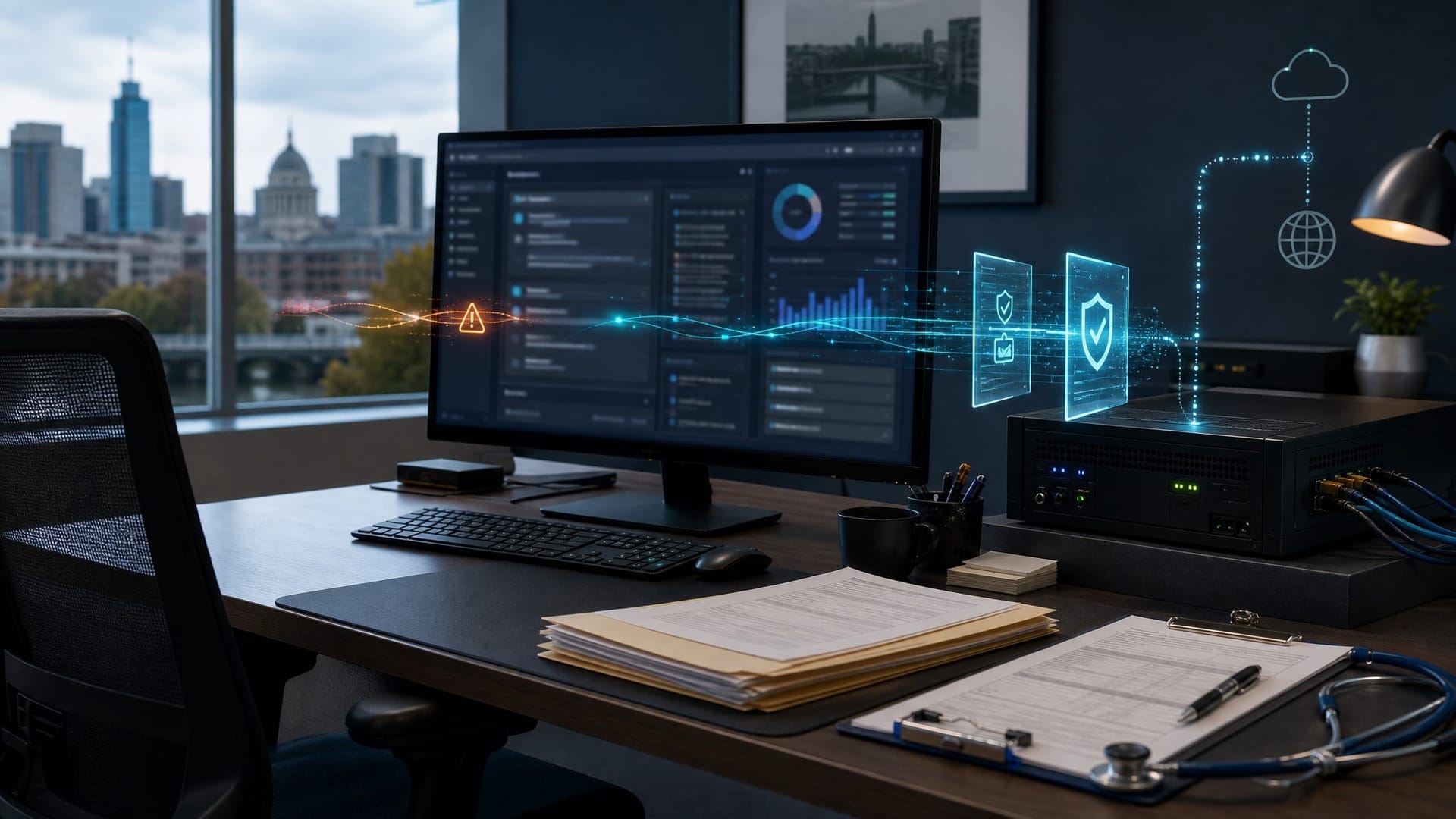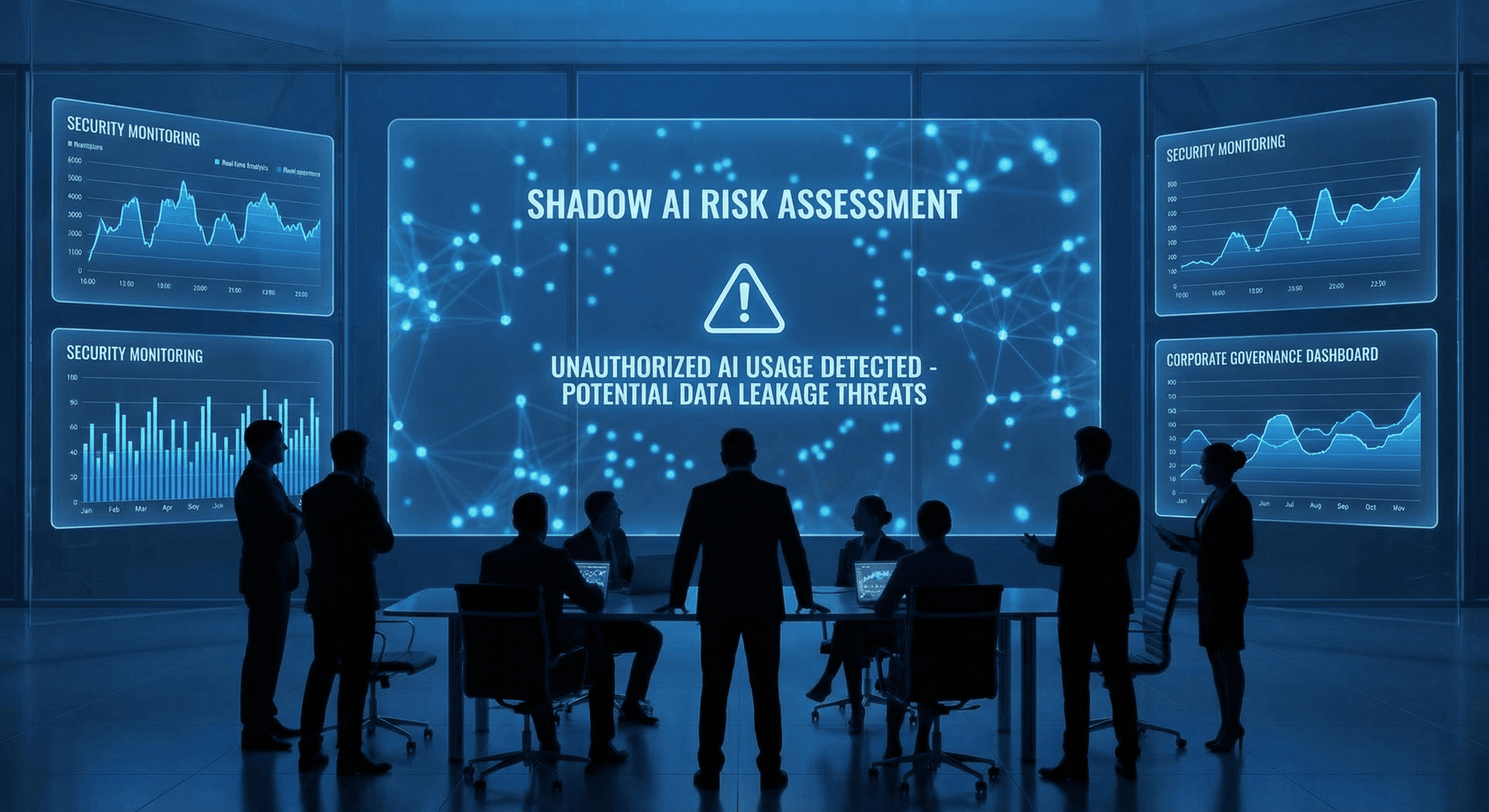
The office manager at a Fort Wayne family medicine clinic asks ChatGPT to “build me a quick app to track patient intake.” Two evenings later, she has a working web form, a backend that writes to a database, and a small dashboard the front-desk team can use. She is delighted. She paid nothing. She wrote no code. She did not file a ticket with anyone. The app lives on her personal AWS account, and the storage bucket behind it is publicly readable by default.
That is the vibe-coded shadow AI failure pattern in one paragraph, and according to VentureBeat's May 8 reporting, it is now common enough to constitute a category of data exposure with a name. The pattern is not that AI tools cannot generate functioning apps — they can, easily, in 2026. The pattern is that a much larger share of business staff than ever before can now generate functioning apps without the IT department ever knowing the app exists. The “vibe-coding” term captures the workflow: describe what you want in natural language, accept what the AI produces, deploy on whatever cloud account you have a credit card attached to. The output is a real app that touches real data on infrastructure no one inside the business is auditing.
This is a Fort Wayne problem before it is a national problem because Northeast Indiana mid-market organizations are a near-perfect fit for the threat profile: 40-to-250-seat headcounts, lean or non-existent dedicated IT, regulated verticals carrying PHI, PII, and IP, high enthusiasm for AI tooling, and an organizational culture that treats “build it on your laptop and ask forgiveness” as a virtue rather than a violation. The post you are reading is the playbook the Fort Wayne IT lead should be running, this quarter, against this exact failure mode.
Key Takeaways
- VentureBeat's May 8, 2026 reporting documented a category they call “vibe-coded shadow AI” — staff generating functioning apps via AI tools and deploying them on personal cloud accounts, with the resulting storage often publicly readable by default.
- The Fort Wayne and Northeast Indiana threat profile fits exactly: lean IT, regulated verticals (healthcare, legal, financial services, manufacturing IP), enthusiastic AI adoption, and a culture that rewards initiative over IT process.
- The breach responsibility stays with the business regardless of whose AWS account the data lived on — HIPAA, the Indiana AG's data breach guidance, and most professional liability carriers do not care that the deployment was unsanctioned.
- Four data classes should never leave a sanctioned environment in a vibe-coded app: PHI, PII, financial records, and intellectual property. A four-line policy can codify this and is genuinely workable at mid-market scale.
- The positive substitute is sanctioned AI capability — Cloud Radix's AI Employees plus the Secure AI Gateway — that gives staff what they wanted (working apps, fast, no waiting on IT) on infrastructure the IT lead actually controls and audits.
What Is Vibe-Coded Shadow AI, and Why Is It Different From the Shadow AI You Already Know?
The shadow AI we have been writing about for two years is mostly a data-flow story: a staff member pastes confidential text into a consumer AI tool, the consumer AI tool retains or processes that text outside the business's sanctioned environment, and the regulated data has effectively left the building. We covered that pattern in shadow AI is your biggest data risk in 2026. It remains the largest single category of shadow AI exposure, and the policy and tooling responses are well understood.
Vibe-coded shadow AI is a different pattern, with a different set of failure modes. It is a build-and-deploy story rather than a copy-and-paste story. The staff member is not just sharing data with a consumer AI; the staff member is using the AI to construct a piece of software that itself processes business data on infrastructure outside the business's perimeter. The artifact is not a chat transcript — it is an app, with its own storage, its own endpoints, its own service identities, and its own attack surface. The business inherits all of that exposure without ever ratifying the deployment.
Three things make this category newly dangerous in 2026:
Generation quality crossed a usability threshold. AI tools now produce apps that work on first deployment for non-developer authors — full-stack web forms, simple CRMs, dashboard tools — without the prior requirement of an engineer sitting next to the user to make the deployment work. The friction floor that used to keep non-developers from shipping production apps has been removed.
Cloud deployment is one click and a credit card. Personal AWS, Vercel, Replit, Render, and similar accounts make standing up internet-reachable infrastructure trivial. The cost is small enough to disappear into a personal expense category. There is no procurement gate to flag the activity.
Default storage configurations are not safe by default. S3 buckets, blob containers, and equivalent storage primitives across multiple providers default to configurations that, when combined with novice deployment patterns, frequently end up publicly readable. AWS has spent years making this harder by default, but the failure mode persists particularly when an AI tool generates the deployment script and a non-developer accepts it without reviewing the access policy. The long history of misconfigured-bucket incidents — well documented across AWS's published security bulletins — is the ledger that vibe-coded apps are the newest contributor to.
The composite effect is that a Fort Wayne office manager can now deploy a customer-facing app over a long weekend, on her personal AWS account, with a publicly readable storage bucket, processing real business data, and the IT department has no signal that this happened. That is the threat model. Mitigations have to address it as the threat model it is, not as the older shadow-AI threat model.
Why Is the Fort Wayne Mid-Market the Exact Fit for This Risk?
The threat model lands hardest where five conditions co-occur: regulated data, lean IT, enthusiastic AI adoption, a culture of individual initiative, and small-to-mid headcounts that put administrative staff close to operational decisions. Fort Wayne and Northeast Indiana mid-market organizations are full of organizations where all five conditions are present. The result is not a hypothetical risk profile; it is the specific shape of the conversations we have been having with FW IT leads over the last six weeks.
Healthcare practices across Allen and DeKalb counties. Multi-physician primary care groups, pediatric specialty practices, dental and orthopedic groups, behavioral health practices, ambulatory surgery centers — all subject to HIPAA, all carrying PHI, all running with one or two IT staff supporting fifty to two hundred clinicians and front-desk personnel. The intake-app scenario at the top of this post is not invented; it is a composite of conversations we have had this spring.
Law firms in downtown Fort Wayne and across Whitley, Noble, and Steuben counties. Mid-size firms with attorney rosters in the twenty-to-fifty range, supporting client matter data that carries privilege and regulatory sensitivity. The vibe-coding scenario here looks like a paralegal building a quick “matter-status tracker” because the firm's case management system is clunky. The data inside that quick app includes attorney-client privileged matter notes.
CPA and financial-services firms in Auburn, Columbia City, and the broader I-69 corridor. Practice managers building “client document tracking” apps because the existing portal is awkward. The data classes inside include tax IDs, financial account information, and personal information at the level Indiana's data-breach statute treats as sensitive.
Manufacturing back-office IT across the DeKalb County and Allen County industrial base. A purchasing manager at a 220-seat manufacturer builds a “vendor onboarding tracker” because the ERP module is too slow. The data inside includes vendor banking information, ITAR-adjacent product specifications, and pricing data the company treats as IP.
The pattern in every case is identical: capable, well-meaning operational staff use AI to solve a real problem fast, the deployment lands outside the business's perimeter, and the IT lead does not learn about it until something goes wrong. We described the regulated-services counterpart in Fort Wayne AI compliance automation for law firms and CPAs, and the healthcare-specific PII-scrubbing companion in the Fort Wayne OpenAI privacy filter playbook for healthcare and legal. The vibe-coded sub-class needs its own playbook because the mitigations are different.

What Does the Regulatory Exposure Look Like for Indiana Businesses?
The first thing every Fort Wayne IT lead needs to internalize is that the breach responsibility stays with the business regardless of where the data lived. Three frameworks are load-bearing here:
HIPAA, for any healthcare-touching organization. The HHS HIPAA Security Rule guidance makes the covered entity responsible for the safeguards on PHI. An office manager building an unsanctioned app on her personal AWS account does not transfer that obligation to her personally — the practice owns the breach, the OCR notification timeline, and the compliance review. The HHS OCR breach portal shows a steady pace of misconfigured-cloud-storage breaches; vibe-coded apps are the newest contributor.
Indiana state law, for breach notification of any Indiana resident's personal information. The Indiana Attorney General's identity theft resources summarize the state's disclosure obligations. The notification clock starts on discovery, regardless of whether the breach occurred on primary infrastructure or a personal cloud account. Disclosure and remediation duties follow the data, not the deployment topology.
Professional liability and cyber insurance. Most policies require disclosure of data processing activities, security controls, and incident response capability. A breach traced to an undocumented vibe-coded app on a personal account is, at minimum, a coverage conversation; in some policy language, it is a coverage exclusion. Do not assume the policy has a backstop.
The aggregate position: from the perspective of regulators, plaintiffs, and carriers, the deployment topology is irrelevant. What matters is what data was exposed and what safeguards were in place. “It was on Sandra's personal AWS” is not a defense; it is a description of how the breach happened.
What Is the Citizen-Developer and Shadow-AI-App Inventory Exercise?
Step one of the playbook is the inventory. You cannot govern what you cannot see. The inventory is a focused two-week exercise; it does not require expensive tooling, and the most important version of it is a spreadsheet the IT lead can fill in from interviews and a few targeted technical checks.
Week 1: Interview-based discovery. Sit down for thirty minutes with each department head — practice administrator, managing partner, office manager, controller, operations manager, plant manager — and ask three questions. What AI tools have you or your team been using this year? Has anyone built an “app” or “tool” using one of these tools? Where is that app running, and what data does it touch? Write the answers down without judgment. The objective is not to enforce policy in the conversation; the objective is to surface what exists. Some of what you will find is benign. Some of what you will find is the exact pattern this post describes.
Week 1, parallel: Technical signals. Pull expense report data for any line items at AWS, Vercel, Render, Replit, Supabase, Firebase, or comparable cloud and PaaS providers in personal expense categories — these are the financial fingerprints of personal-account deployments. Pull email signatures and Slack/Teams channels for mentions of “I built a quick tool” or “I made an app that does X.” None of these signals is conclusive; all of them are leads.
Week 2: Catalog and triage. For each app you identified, document: who built it, what data it touches, where it runs, who has access to it, whether it is reachable from the public internet, and whether the storage layer is publicly readable. The last two questions are the priority triage filter — anything reachable publicly with sensitive data needs immediate action; anything internal-only with sensitive data needs a remediation plan within the quarter. The NIST AI Risk Management Framework is the broader frame for this kind of mapping work; the inventory is the specific operational implementation at mid-market scale.
Outputs of the inventory: a written list of every shadow AI app, classified by data sensitivity and exposure status, with a remediation owner and target date for each. This becomes the backlog for the rest of the playbook. We have yet to run this exercise with a Fort Wayne client and find fewer than three apps the IT lead did not know about; the number is consistently larger than expected.
What Four Data Classes Should Never Leave a Sanctioned Environment in a Vibe-Coded App?
The four-class rule is the core of the policy. It is short, defensible, and easy to communicate to non-technical staff:
Protected Health Information (PHI). Any data covered by HIPAA — patient identifiers, diagnoses, treatment information, payment information for healthcare services. PHI in a vibe-coded app on a personal cloud account is a HIPAA breach by configuration. There is no version of this that ends well.
Personally Identifiable Information (PII). Names combined with any of: social security number, driver's license, financial account number, payment card number, biometric data, account credentials. The combination is what triggers most breach notification statutes. Indiana's data breach statute, like most state statutes, defines a sensitive set of identifier combinations. PII in a vibe-coded app is a state-level breach by configuration.
Financial records. Bank account information, payment account information, financial statements, transaction records, tax records. Coverage varies by industry — banking has its own statutory regime, accounting practices have professional standards, businesses generally treat this as confidential — but the operational rule for vibe-coded apps is the same: do not let it leave a sanctioned environment.
Intellectual property and trade secrets. Product designs, manufacturing specifications, customer lists, pricing models, proprietary algorithms, source code for products under development. The legal protection for IP often depends on demonstrating that the business treated the material as confidential. A vibe-coded app on a personal cloud account is not “treated as confidential” in any defensible sense.
The four classes are not exhaustive. Many businesses will want to add a fifth (regulated industry-specific data), a sixth (export-controlled data for ITAR-touching manufacturers), or a seventh (privileged communications for legal practices). The four are the baseline. They also map cleanly to the OWASP LLM Top 10 categories — particularly LLM06 Sensitive Information Disclosure — which is useful when justifying the policy to a board or compliance committee.

The Four-Line Policy Every Fort Wayne Managing Partner or Practice Admin Should Publish This Quarter
The policy is short by design. The longer the policy, the lower the compliance rate. Four lines, posted in the staff handbook and announced in a single all-hands message:
- No business data — including PHI, PII, financial records, or proprietary information — may be processed in any AI-built app deployed outside the firm's sanctioned environment.
- Sanctioned environments are listed in the IT-approved tools registry, which the IT lead maintains and updates monthly.
- Any staff member who has already deployed such an app must notify IT within two business days of this policy taking effect, with no penalty for the disclosure.
- Staff with a legitimate business need to build a working app or tool with AI assistance should request a sanctioned development path through IT — Cloud Radix offers AI Employees as the sanctioned alternative for most use cases.
The amnesty clause in line 3 is critical. Without it, the existing inventory of shadow apps stays hidden. With it, you get the disclosures, you can triage them against the four data classes, and you can move the high-risk ones to remediation before they become incidents. The first time we ran this with a Fort Wayne client, the disclosures in the first week tripled the IT lead's known inventory.
The fourth line is the constructive answer. Vibe-coded shadow AI is not a problem you can ban your way out of. The underlying staff need is real — the office manager wanted an intake tracker because the existing system was inadequate, and that need is not satisfied by telling her not to use AI. The need is satisfied by giving her a sanctioned path to get the same outcome. We covered the architectural pattern in zero-trust AI agents and credential isolation and the dev-team parallel in AI coding agents and prompt-injection secret leak — the unifying answer is that when the business provides a sanctioned, fast, capable AI path, the demand for the unsanctioned path mostly evaporates. People want to do their jobs. They will use the official tool when the official tool works.

Why Is Cloud Radix's AI Employees + Secure AI Gateway Architecture the Positive Substitute?
The substitute has to do four things at once: give staff working AI capability at the speed they expected from the consumer tools, keep the data inside infrastructure the IT lead controls, produce an audit trail that satisfies HIPAA and the Indiana AG's expectations, and scale to the actual budget of a mid-market business. AI Employees behind the Secure AI Gateway are designed exactly to that brief.
Sanctioned AI capability at consumer-tool speed. The whole point of the Employees is that staff get a real AI partner that can do the work — drafting, summarizing, scheduling, intake processing, document generation — without waiting on a development project. The reason vibe-coded apps spread is that staff cannot wait for the IT roadmap to deliver the capability; the Employees close that gap directly.
Data stays inside the sanctioned environment. The Employees process work inside infrastructure the IT lead controls, not on personal cloud accounts. The four-data-class policy works because there is a sanctioned alternative for the legitimate work that previously had no sanctioned path.
Audit trail and identity discipline. The gateway provides per-Employee identities (we covered the IAM pattern in detail in our recent agent IAM gap post) and an immutable audit trail of every action, prompt, and tool call. When the OCR notification timeline question arrives, the answer is a defensible record, not a frantic search across personal cloud accounts.
Mid-market budget fit. The Employees and gateway are sized and priced for 40-to-500-seat organizations. They do not require a Fortune 500 SOC, a dedicated AI infrastructure team, or a six-month deployment timeline. Most engagements ship the first sanctioned use cases within a quarter.
The honest position: the substitute does not eliminate every shadow-AI risk. Staff can still copy data into consumer tools, find creative workarounds, or deploy unsanctioned apps despite the policy. What the substitute does is shrink the demand surface — when the sanctioned path is faster and easier than the shadow path for most use cases, most staff use the sanctioned path most of the time. That is the realistic win condition. The remaining residual risk is what the four-line policy and the inventory practice are designed to catch.
Local Note: What Is at Stake for Northeast Indiana Practices?
Cloud Radix is based in Auburn, and our IT-lead clients across Allen, DeKalb, Whitley, Noble, and Steuben counties have been carrying this risk without a clear name for it. The vibe-coding pattern names it. The good news is that Northeast Indiana mid-market is also the right scale to fix it: inventory takes two weeks, the four-line policy takes a quarter to land, and the sanctioned substitute is mid-market priced. The county-government IT shops we covered in Fort Wayne and Allen County public-sector AI Employees face the same problem with the added weight of public records law, and the shape of the answer is the same.
If your organization fits the threat profile, this is the playbook to run this quarter. Do not wait for a breach to discover what your staff have been building. Run the inventory. Publish the policy. Stand up the substitute. The order matters; the speed matters more.

Ready to Run the Vibe-Coded Shadow AI Audit on Your Organization?
Cloud Radix runs a fixed-fee 30-day vibe-coded shadow AI audit for Fort Wayne and Northeast Indiana mid-market organizations. Inventory in week one, regulatory exposure assessment in week two, four-line policy drafted and reviewed in week three, sanctioned-substitute pilot scoped in week four. Outputs: a written audit memo, a posted policy, a prioritized remediation backlog, and a scoped pilot for the AI Employee + Secure AI Gateway substitute. No surprises, no slide decks, fixed fee. Contact Cloud Radix to schedule the audit and we will return within one business day with a calendar hold and a pre-call discovery questionnaire.
Frequently Asked Questions
Q1.How do I know if my organization has vibe-coded shadow AI apps running today?
If you employ more than twenty people, your staff uses any consumer AI tools, and you have not run the inventory exercise in the last six months, the answer is almost certainly yes. The two-week inventory is the cheap way to find out. We have not run the inventory at any FW mid-market organization this year and found zero apps; the smallest result we have seen was three, and the most common answer is between five and twelve.
Q2.Can we just block AWS, Vercel, Replit, and similar tools at the network perimeter?
Partially, and the partial works against you. Network blocks create useful friction but staff with personal devices and remote-work patterns route around them easily. A hard block without a sanctioned alternative drives the activity underground — staff deploy from home where you have even less visibility. The right pattern is policy plus substitute, with network controls as a supplementary signal.
Q3.What if the app was built on the practice's own AWS account, not a personal one — is that better?
Better in one way (the data is nominally inside the practice's cloud presence) and not better in several others (the IT lead still does not know it exists, the deployment may be misconfigured, the audit trail is disconnected from normal monitoring). The inventory, the data classes, and the policy all still apply. The cloud account's owner is one variable in the risk picture, not the controlling one.
Q4.Does the four-data-class rule mean staff cannot use AI for work that touches PHI or PII?
It means staff cannot deploy their own apps that process PHI or PII outside sanctioned infrastructure. A sanctioned AI Employee operating inside a HIPAA-compliant environment can absolutely do that work, with the audit trail and safeguards the regulation requires. The rule is about deployment topology, not about the underlying use case.
Q5.How does vibe-coded shadow AI compare to the older 'staff pasted PHI into ChatGPT' failure mode?
Same root cause — staff want AI capability and the official path is too slow — different exposure shape. The older mode leaks data into a consumer AI vendor's environment. The newer mode deploys an entire app, with its own attack surface, outside the business perimeter. The newer one is worse because the persistent app is reachable by anyone who finds the URL and the storage configuration is frequently public.
Q6.What is the realistic time-to-fix for a Fort Wayne mid-market organization starting from zero?
Thirty days for inventory and policy. Sixty to ninety days to stand up the sanctioned substitute for the most common use cases. Six months to migrate the bulk of existing shadow-app workload onto the substitute. The full discipline becomes operationally sustainable around the one-year mark, when quarterly inventory reviews catch new shadow apps before they accumulate sensitive data.
Q7.Is the Cloud Radix substitute the only option, or are there other paths?
Other paths exist. Microsoft's enterprise AI tooling (Copilot Studio with proper governance), Google's Workspace AI offerings, and dedicated enterprise AI platforms all provide sanctioned alternatives at various price points. Cloud Radix's Employees + Gateway is our answer for mid-market Fort Wayne organizations because it is priced and sized for that scale and we operate the IAM layer locally. The principle — sanctioned AI capability with an IT-controlled audit trail — is general. The mistake to avoid is having the policy without any substitute; that is the configuration in which staff route around IT regardless of the policy.
Sources & Further Reading
- VentureBeat: venturebeat.com — Vibe-Coded Apps and the Shadow AI S3 Bucket Crisis — The May 8, 2026 report that named the vibe-coded shadow AI category.
- U.S. Department of Health and Human Services: hhs.gov — HIPAA Security Rule Guidance — The covered-entity safeguards framework, applicable regardless of deployment topology.
- HHS Office for Civil Rights: ocrportal.hhs.gov — OCR Breach Portal — The public ledger of HIPAA breaches, including the steady pace of misconfigured-cloud-storage incidents.
- Indiana Office of the Attorney General: in.gov — Indiana Identity Theft Prevention and Data Breach Resources — Indiana's data breach disclosure obligations and identity-theft resources.
- OWASP: genai.owasp.org/llm-top-10/ — OWASP Top 10 for LLM Applications — LLM06 Sensitive Information Disclosure and the broader LLM Top 10 risk catalog.
- National Institute of Standards and Technology: nist.gov — AI Risk Management Framework — The vendor-neutral policy scaffolding for the broader shadow-AI mapping work.
Run the 30-Day Vibe-Coded Shadow AI Audit
Inventory in week one, regulatory exposure in week two, four-line policy in week three, sanctioned-substitute pilot in week four. Fixed fee. No slide decks. Reach out and we will return within one business day with a calendar hold.