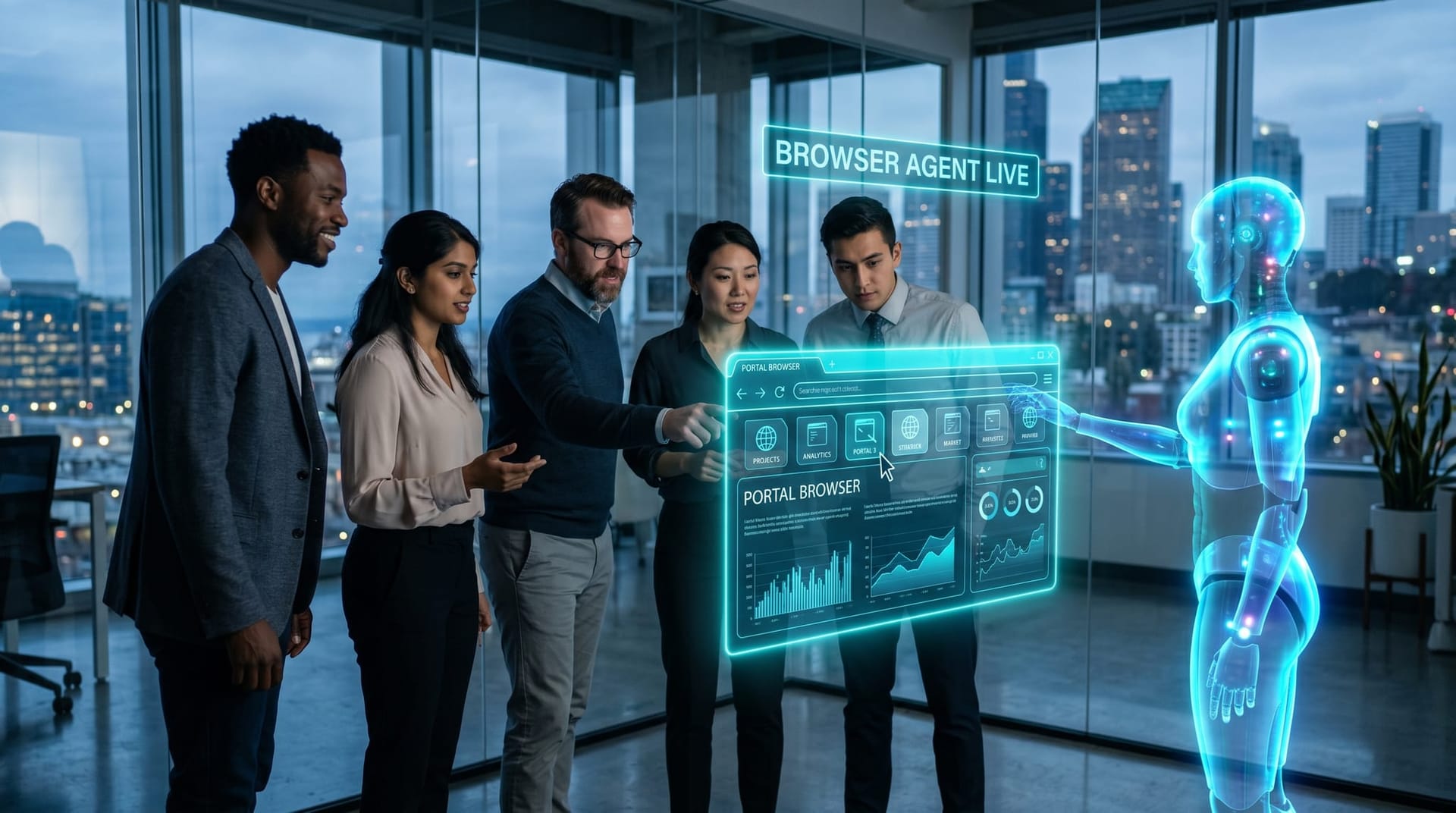
The default mental model for an AI agent in 2026 has hardened into a familiar diagram: a large language model wired to a vector database, with a retrieval-augmented generation layer between them. That picture is not wrong. It is incomplete in a way that costs mid-market buyers real money. According to VentureBeat's 2026-05-22 reporting on the runtime-versus-retrieval debate, the most reliable production agents now spend the bulk of their time inside a sandboxed shell — reading files, running scripts, calling APIs, writing intermediate results to a workspace they revisit later — and only a small fraction of their time asking a vector store for snippets. The terminal has quietly become the load-bearing component of an agent's runtime. The vector database is a useful supporting layer, not the architectural center.
This piece argues a sharper version of that observation for mid-market AI Employee buyers. Knowledge is necessary. Execution is sufficient. An AI Employee that can retrieve every relevant policy document but cannot open the policy-administration system, draft the renewal, attach supporting forms, and queue the human-approval step is an AI Employee whose value tops out at research assistant. An AI Employee with a real execution environment — shell, file system, persistent workspace, audited credentials, buyer-owned boundary around all of it — is an AI Employee that does work. The argument is not anti-RAG; we made the complementary case in Beyond RAG: the compilation-stage knowledge layer. The architectural primary axis has moved.
Key Takeaways
- The default “LLM + vector DB + RAG” picture is no longer the right architectural primary axis for AI Employees in 2026. The terminal — a sandboxed execution environment with a file system, processes, and a persistent workspace — is.
- Vendor agent harnesses from Anthropic and OpenAI now ship with terminal-grade execution built into the runtime, treating the shell as a first-class agent surface and the vector database as one optional tool among many.
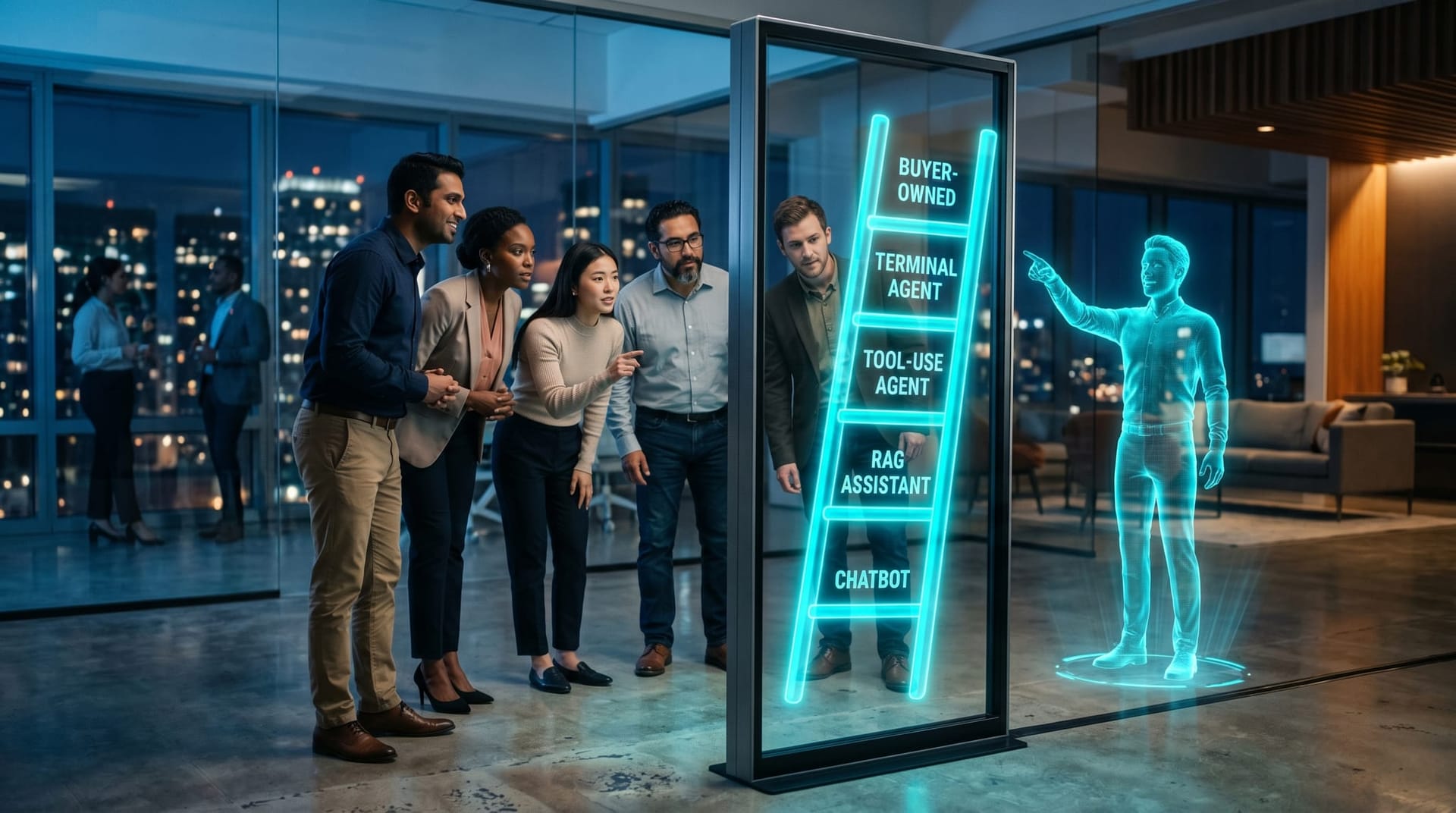
- The mid-market buying consequence is a 5-rung Agent Runtime Maturity Ladder: Chatbot, RAG Assistant, Tool-Use Agent, Terminal Agent, Buyer-Owned Terminal Agent. Most mid-market AI deployments today are stuck at Rung 2 or Rung 3.
- The Secure AI Gateway is the natural host for a buyer-owned terminal agent because it is where credentials are vaulted, where execution can be sandboxed and observed, where audit logs are written as a side-effect, and where the egress allow-list lives.
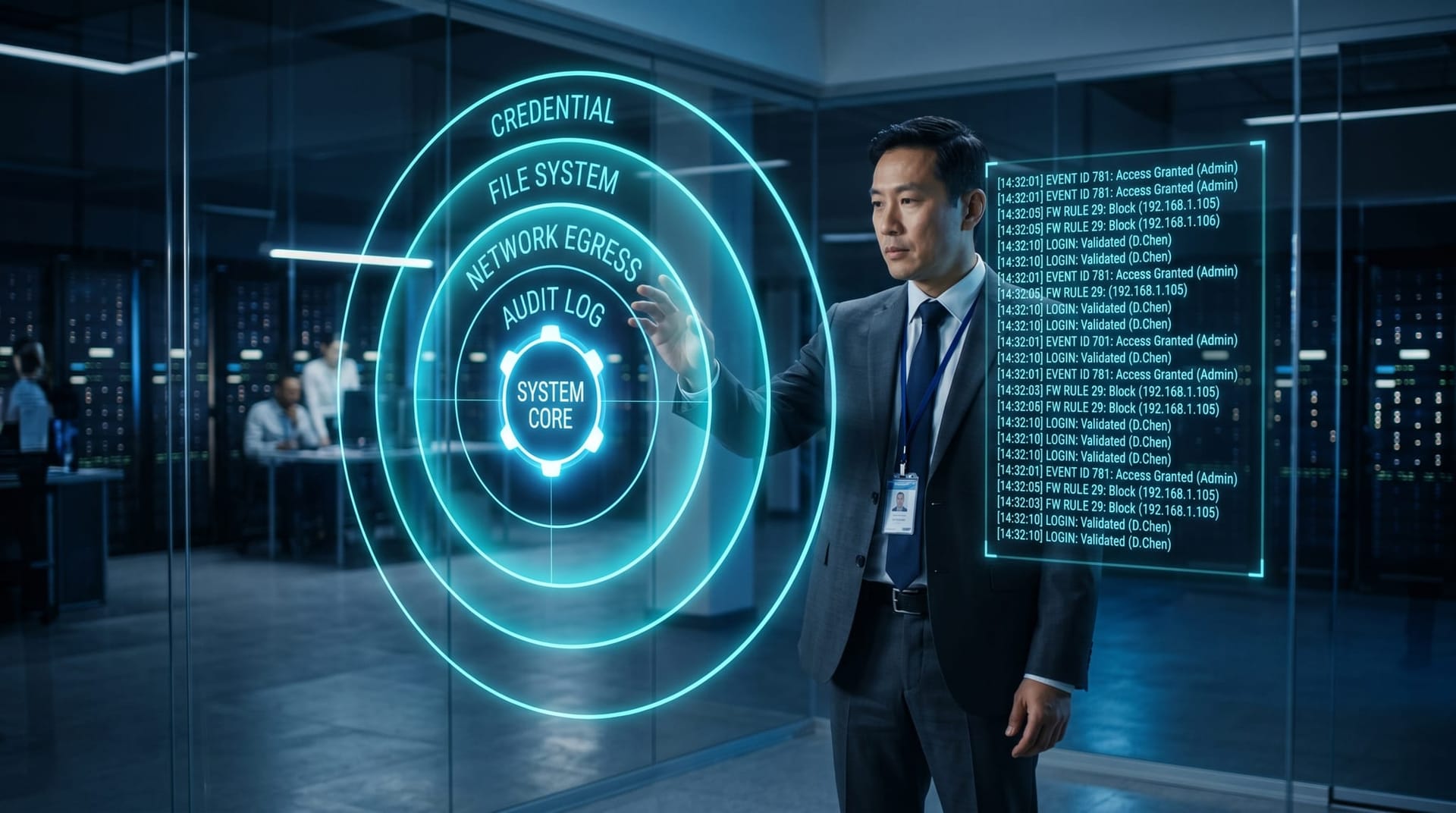
- A terminal agent introduces four boundary lines the firm must enforce: credential, file-system, network egress, and audit-log. Each maps to a specific OWASP LLM Top 10 control.
- This post includes a working Agent Runtime Maturity Audit checklist — one yes/no question per rung — that a mid-market operator can run against their own AI deployments in under 30 minutes.
What is the terminal, and why is it the new primary axis for AI Employees?
A terminal, for an AI agent, is not the literal command-line emulator. It is the broader concept of an execution environment: a sandboxed shell, a file system the agent can read and write, processes it can spawn, a persistent workspace that survives between turns, and a defined set of tools — APIs, web actions, vector-database queries — invoked from inside that environment. The shape is clearest in agent harnesses vendors now ship as first-class products. Anthropic's Claude Code and agent harness documentation describes a runtime where the model operates inside a sandboxed environment with shell access, file operations, and a persistent workspace; OpenAI's platform documentation describes the Apps SDK and Codex-style execution environments in similar terms. The vector database, if present, is a tool the agent calls from inside the shell.
This is a meaningful inversion. In the canonical RAG diagram, the vector store is upstream of the LLM call: the system fetches documents, stuffs them into context, and asks the model to answer. In the terminal diagram, the model is upstream of everything: it decides what to read, write, and run, and only consults the vector store if the task calls for retrieval. The shell is the substrate; retrieval is a tool. That inversion changes what you measure, secure, log, and buy.
The reliability research is moving the same direction. METR's task-time-horizon work measures AI agent capability in how long a software task an agent can successfully complete, with the upward trend on multi-hour tasks rather than single-shot queries. Long-horizon tasks are inherently terminal-shaped: read a brief, plan, execute, inspect intermediate results, recover from errors, write a final artifact. That is a shell session, not a retrieval query.
The mid-market consequence is concrete. If the strongest production agents are terminal-shaped, a firm whose AI Employees are configured as glorified RAG chatbots is leaving most of the capability curve on the table. The right diagnostic is not do we have a vector database? — it is do our agents have an execution environment? In our practice the answer is almost always no, and the answer to what would it take to give them one safely? is almost always the same: a buyer-owned Secure AI Gateway hosting the terminal session, with the credential, file-system, network egress, and audit-log boundaries all enforced at the gateway.

The 5-Rung Agent Runtime Maturity Ladder
The ladder below is the buying-decision frame this post is built around. Each rung has a one-sentence definition, the buyer-visible test for “are we at this rung yet,” and a structural risk if the firm tries to use the rung for work it cannot actually do.
Rung 1: Chatbot
A chatbot is an LLM plus a UI. No persistent memory, no execution, no real workflow integration. The buyer-visible test: can the agent take an action in your business that produces a record other systems can see? If no, it is a chatbot. The structural risk of treating a chatbot like an AI Employee is that the firm pays for the appearance of automation while the actual work continues to be done by humans copy-pasting between the chat window and the systems of record.
Rung 2: RAG Assistant
A RAG assistant is an LLM plus a vector database. The agent retrieves and summarizes the firm's documents but cannot act on them. The buyer-visible test: does the agent end its turn with information, or with a state change? If information, you are at Rung 2. RAG assistants are useful — knowledge work is a real category of business value — but they are categorically incapable of replacing process-based workflows. Most mid-market AI Employee deployments we audit are at this rung and labeled at Rung 4 in the vendor's marketing.
Rung 3: Tool-Use Agent
A tool-use agent is an LLM plus a defined set of APIs (via the vendor's SDK or a function-calling schema). The agent calls narrow, pre-authorized actions: send an email, create a ticket, query a CRM record, post a Slack message. The buyer-visible test: can the agent compose a new workflow from existing tools, or only execute workflows the vendor pre-wired? Tool-use agents close a real gap above Rung 2 but hit a ceiling fast — every new workflow is a new tool definition, every new tool is a new integration project, and the firm is still buying narrow vendor-owned execution rather than general execution capability.
Rung 4: Terminal Agent
A terminal agent is an LLM plus a sandboxed shell, a file system, processes, and a persistent workspace. The agent can read and write files, run scripts, install dependencies, call APIs, retrieve from a vector store if useful, and stitch the results into a multi-step workflow without a developer pre-wiring each step. The buyer-visible test is: can the agent complete a multi-step task that includes at least one step the firm did not explicitly design for, without escalating to a human? Terminal agents are the rung where the AI Employee category becomes credible.
Rung 5: Buyer-Owned Terminal Agent
A buyer-owned terminal agent is a Rung 4 agent whose terminal session lives inside the buyer's own infrastructure — specifically, inside a Secure AI Gateway the buyer controls. The credentials are vaulted in the buyer's system; the file-system workspace is the buyer's storage; the egress allow-list is enforced at the buyer's gateway; the audit log is written into the buyer's logging pipeline. The buyer-visible test is: if your model vendor terminated your contract tomorrow, would your audit trail, your policies, and your workspace state still be in your possession? Rung 5 is the rung the buyer-owned AI agent harness post argued for from the harness side; Rung 4 is the runtime capability that makes Rung 5 worth standing up.
The Agent Runtime Maturity Audit — a 30-minute self-test
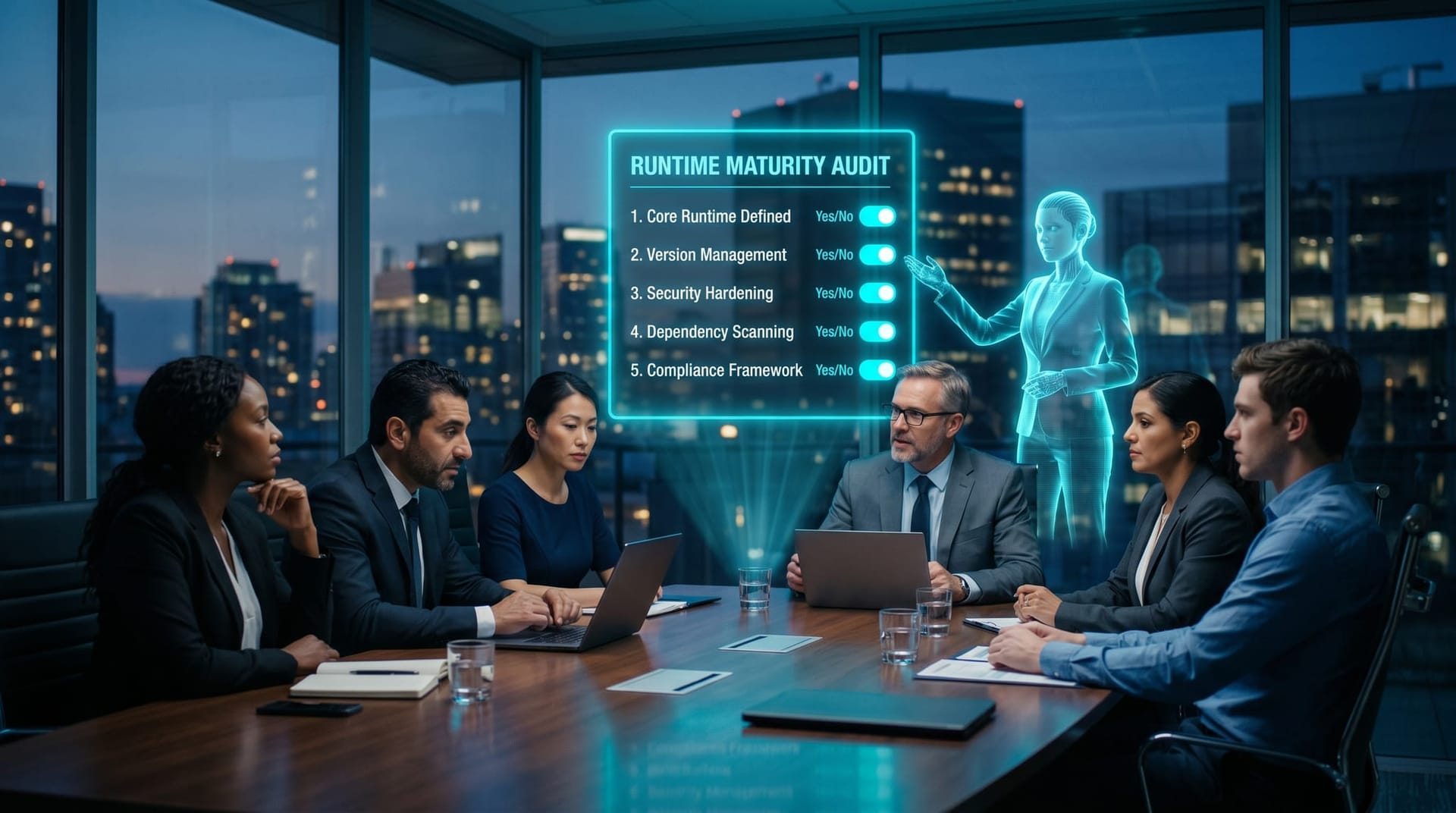
This is the checklist mid-market operators can run against their own AI deployments this week. One yes/no question per rung, with a one-sentence interpretation for each combination of answers.
- Rung 1 check — Chatbot: Does the deployment have an interactive UI where the agent can answer questions? (Yes/No)
- Rung 2 check — RAG Assistant: Can the deployment retrieve and summarize from the firm's documents or knowledge base? (Yes/No)
- Rung 3 check — Tool-Use Agent: Can the deployment call at least one pre-wired external API or take at least one action that produces a record other systems can see? (Yes/No)
- Rung 4 check — Terminal Agent: Can the deployment complete a multi-step task that includes at least one step the firm did not pre-wire, without escalating to a human at every step? (Yes/No)
- Rung 5 check — Buyer-Owned Terminal Agent: If your model vendor terminated your contract tomorrow, would your credentials, audit trail, policies, and workspace state still be in your possession? (Yes/No)
The interpretation grid:
- Yes to 1 only: A chatbot. Treat it as marketing infrastructure, not workforce infrastructure.
- Yes to 1–2: A RAG assistant. Useful for knowledge work. Do not buy more seats expecting process work.
- Yes to 1–3: A tool-use agent. Useful for narrow workflows the vendor pre-wired. Every new workflow is an integration project.
- Yes to 1–4: A terminal agent. Capability is at the right rung. Confirm the four boundary lines are enforced before scaling.
- Yes to 1–5: A buyer-owned terminal agent. The architecture compounds value over time and survives vendor changes. Scale with confidence.
- Yes to 4 but no to 1, 2, 3, or 5: Mis-described. Re-audit; something is being marked as a capability the firm cannot use safely or at scale.
The audit is deliberately short. A firm should be able to run it against every AI deployment they have in under thirty minutes and have a defensible rung assignment for each at the end. The point is not to chase Rung 5 for every workload — a chatbot is the right shape for some uses. The point is to know which rung each deployment is actually on, and to stop paying for the appearance of a higher rung.
How does a terminal agent compare to a vector-DB-only agent on the work that matters?
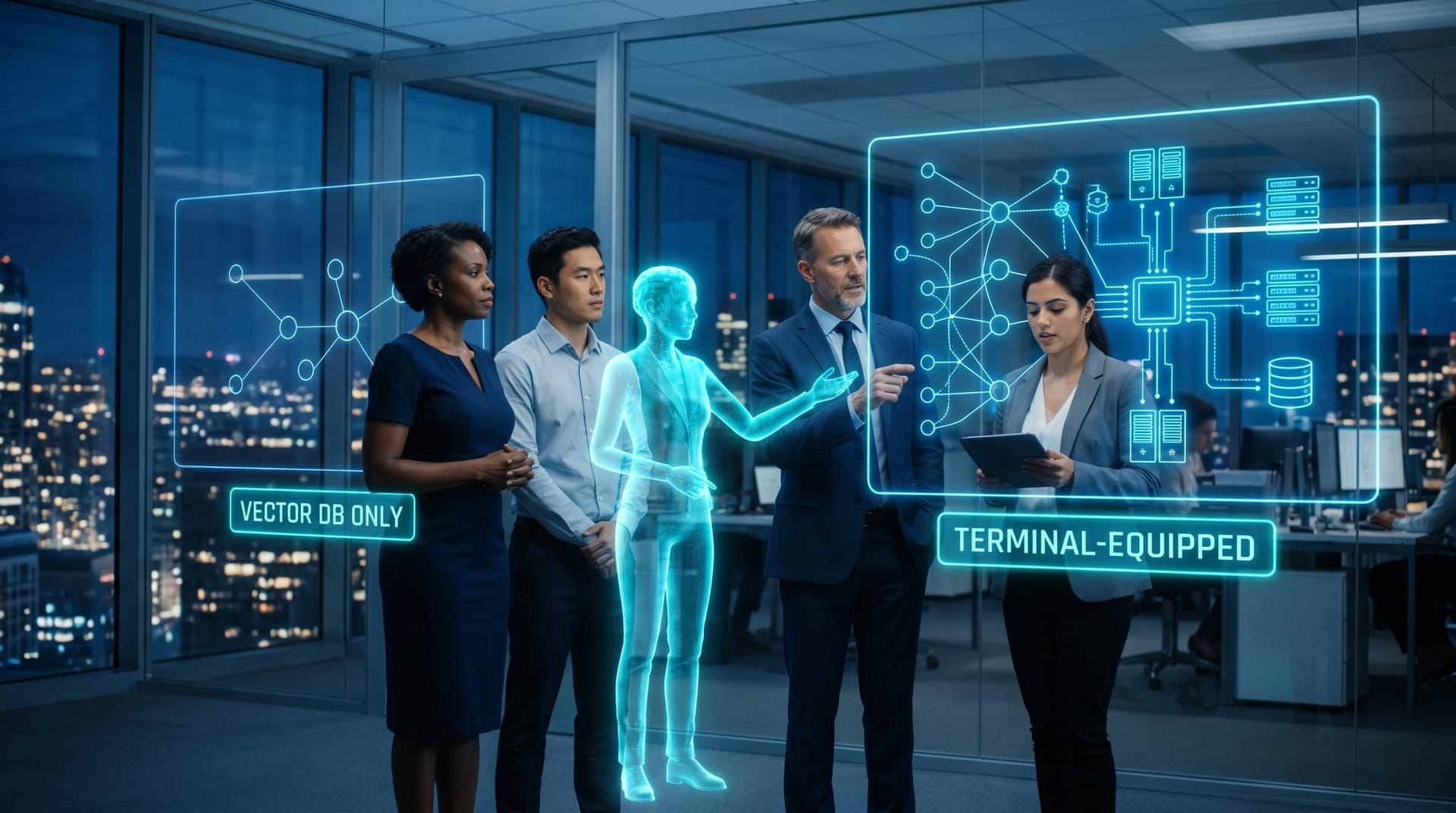
The matrix below is the comparison we walk new mid-market clients through in the first hour of an architecture engagement.
| Capability area | Vector-DB-only architecture (Rung 2) | Terminal-equipped architecture (Rung 4/5) | Mid-market risk of stopping at Rung 2/3 | Where the Secure AI Gateway sits |
|---|---|---|---|---|
| Retrieval | First-class: the central operation of the system | One tool among many; called when useful | Knowledge work works; nothing else does | Optional tool registered on the gateway |
| Working memory | Limited to context window; no persistence between turns | Persistent workspace files; agent can write notes and revisit them | Long-horizon tasks fail silently or are silently broken into many unowned single-turn tasks | Workspace storage is buyer-owned and audited |
| File operations | None | Read, write, transform, hand off to other tools | Document-centric workflows (quotes, claims, matters) cannot complete end-to-end | File-system boundary is gateway-enforced |
| External API | Pre-wired narrow set via vendor SDK (Rung 3) | Composable from inside the shell, subject to gateway allow-list | Every new workflow is a new integration project; the firm scales people, not agents | Egress allow-list and identity-bound tokens at gateway |
| Multi-step workflow | Each step is a separate prompt; state lives in the user's head | Agent owns the plan, the state, and the recovery from intermediate errors | Workflow reliability is a function of how good the human prompter is, not the system | Plan and state are written into the audited workspace |
The point of the matrix is not that vector databases are bad. They are useful, and a terminal agent will almost always benefit from having one. The point is that the architecture that has the vector store as its center cannot do most of the work, and that the architecture that has the terminal as its center can incorporate the vector store as a tool. The buyer who picks the right primary axis gets both. The buyer who picks the wrong primary axis is locked at Rung 2 even if they spend the budget for Rung 4.
The reliability data backs this up qualitatively. The Stanford HAI 2026 AI Index Report tracks the year-over-year improvement in agent benchmarks where the agent has to act, not just answer — software engineering tasks, web navigation tasks, computer-use tasks — and the improvement curve is steepest where the agent has the most workspace to operate in. The benchmark trajectory and the vendor harness trajectory are pointing at the same conclusion from opposite sides.
The four boundary lines around a buyer-owned terminal agent
A terminal agent is more capable than a RAG assistant. It is also more dangerous in exactly the ways the OWASP project has been writing about. The OWASP Top 10 for LLM Applications 2025 catalogs the agent-shaped failure modes that matter at Rung 4 and Rung 5: LLM06 (Excessive Agency), LLM02 (Sensitive Information Disclosure), LLM05 (Improper Output Handling), and LLM07 (System Prompt Leakage), among others. The way you contain those failure modes is by drawing four boundary lines around the terminal session and enforcing each at the gateway.
The credential boundary. The terminal agent never holds a long-lived secret in working memory. Credentials are vaulted in the gateway and injected into the agent's process environment at the network or process boundary, scoped to a single tool call, identity, and time window. If working memory is exfiltrated through a prompt-injection attack, the attacker gets the conversation, not a usable credential. This is the runtime mitigation for OWASP LLM02.
The file-system boundary. The terminal's workspace is a per-agent, per-session sandbox. The agent reads and writes inside the workspace; it cannot read the host file system, cannot reach another agent's workspace, cannot persist beyond its session retention window without an explicit handoff to a buyer-controlled archive. Files moving in or out pass an inspection point — including DLP rules for sensitive data classes the firm has defined.
The network egress boundary. The terminal agent's outbound network access is constrained to an allow-list enforced at the gateway. The agent cannot reach an arbitrary URL because the LLM decided it should. New endpoints require explicit policy admission. This is the runtime mitigation for OWASP LLM06 — the difference between can and may.
The audit-log boundary. Every action — every shell command, every file write, every API call, every credential fetch — is written into the buyer's audit log as a side-effect of the gateway sitting in the request path. The audit log is produced by the runtime, not a separate compliance workstream. This is the runtime mitigation for the broader NIST AI Risk Management Framework Measure and Manage functions, and the layer the firm's auditor will actually read.
The four boundaries are the reason a terminal agent does not have to be a security liability. They are also the reason the buyer-owned version is structurally superior to the vendor-cloud version. In a vendor cloud, three of four boundaries are inside the vendor's product, owned by the vendor, replaceable by the vendor. In a buyer-owned Secure AI Gateway, all four are inside the buyer's infrastructure, surviving the next vendor move. The argument we made in the agent control plane is the new buying decision generalizes here: the durable thing the buyer is buying is the runtime where the boundaries are enforced.
What does this look like across Northeast Indiana mid-market workflows?
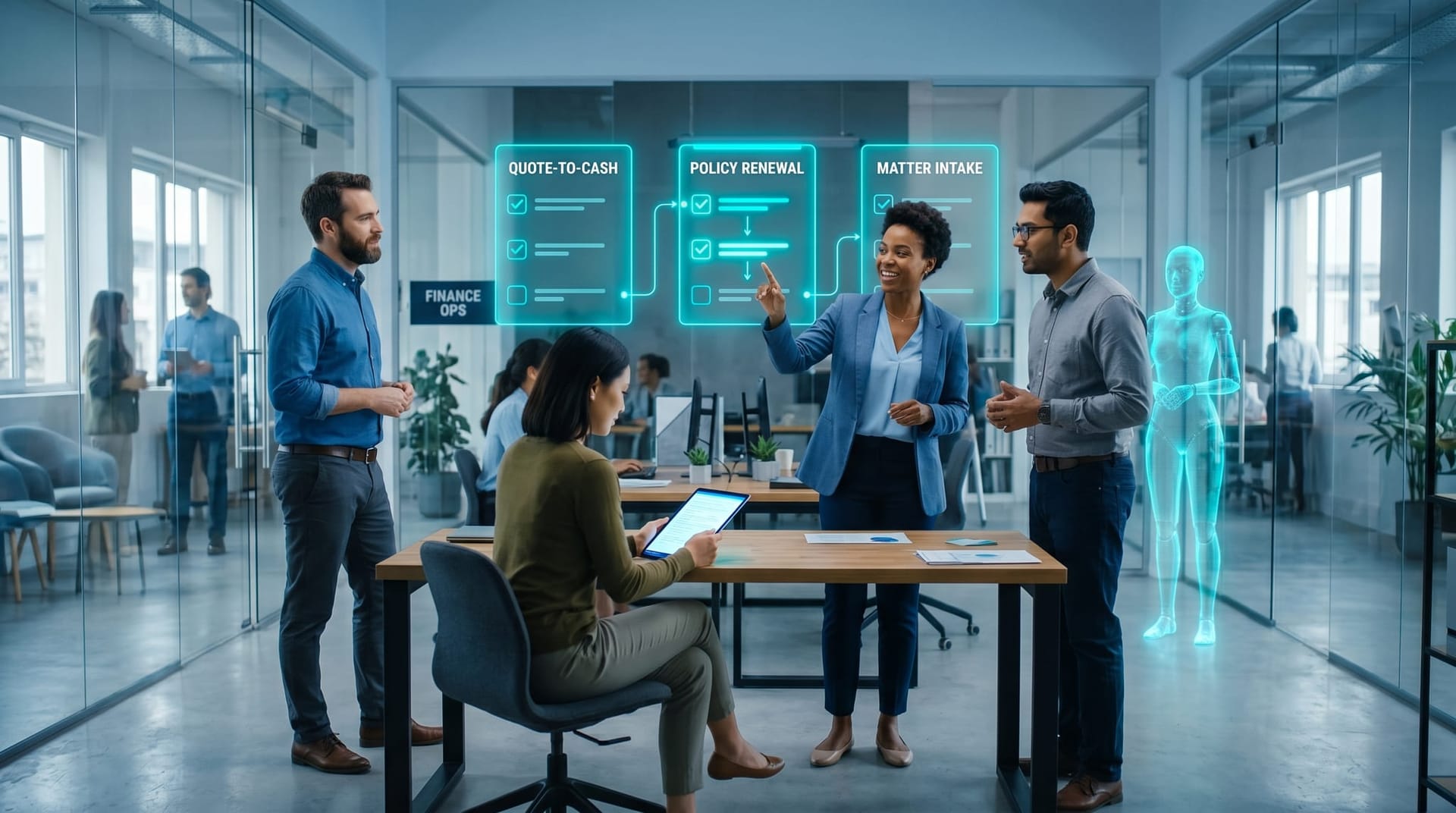
The architectural argument is easier to see in three real workflow shapes that are common across Allen, DeKalb, and Whitley County mid-market firms.
The Allen County manufacturer's quote-to-cash workflow. A Rung 2 RAG assistant can retrieve pricing sheets, engineering specs, and prior similar quotes from the firm's document store. It cannot open the ERP, create the quote header, attach the drawings, run the margin check against pricing rules, draft the cover email, and route the package to the sales engineer for approval. A Rung 4 terminal agent can — because each of those is a step inside a shell session the agent owns end-to-end, with the gateway enforcing the credential, file-system, egress, and audit boundaries. The mid-market gap between we have an AI for our quotes and we have an AI that produces our quotes is exactly the gap between Rung 2 and Rung 4.
The DeKalb County insurance brokerage's policy-renewal workflow. The renewal is the textbook long-horizon task: pull the prior policy, pull the carrier's updated forms, compare the changes, draft the renewal package, generate the disclosure documents, queue the human review, send the e-signature request, and update the policy-administration system. A Rung 2 RAG assistant summarizes the prior policy. A Rung 3 tool-use agent can call the carrier portal if a developer pre-wired the integration. A Rung 4 terminal agent can do the whole sequence in a single audited session — and the Fort Wayne AI agent authorization and audit playbook post describes the per-action authorization policy that runs against each step at the gateway.
The Fort Wayne legal practice's matter-intake workflow. A conflict check, matter-file creation, engagement-letter draft, consultation calendar entry, and billing-system setup are five systems and a dozen actions. A Rung 2 assistant retrieves the firm's intake checklist. A Rung 4 terminal agent runs it — opens each system through the gateway, executes the steps in sequence, writes intermediate results into the workspace, and surfaces the human-approval gate at the right moment. The audit log written as a side-effect is the answer the firm's malpractice carrier will want when they ask how the work was supervised.
The pattern is consistent. Mid-market workflows are sequences of actions across multiple systems, with intermediate state and human-approval gates. Rung 2 cannot run them. Rung 4 can. The decision to stop at Rung 2 is usually not deliberate; it is the consequence of buying a vendor product that called itself an AI Employee while actually shipping a RAG assistant.
What does this mean for NE Indiana mid-market buyers right now?
For mid-market operations and IT leaders across Northeast Indiana — the firms in Auburn, Fort Wayne, DeKalb, Allen, Whitley, and Noble Counties who are signing AI Employee contracts and renewing AI vendor agreements this quarter — the practical step is to run the Agent Runtime Maturity Audit on every active AI deployment in the building and on every vendor on the shortlist. The audit takes thirty minutes per deployment and produces a defensible rung assignment that can be carried into the next vendor conversation. A vendor selling a Rung 4 product can answer the Rung 4 checklist question structurally. A vendor selling a Rung 2 product labeled as Rung 4 cannot.
The architectural conversation connects to the deployment-side decisions we wrote about in self-hosted Kubernetes AI agent runtime for the mid-market and cross-app AI agent governance and approval dialogs. The Kubernetes runtime is where Rung 5 lives on the buyer's infrastructure; the cross-app governance is how human-approval gates inside a Rung 4 session are wired into the firm's change-management process. These are facets of the same architectural move from “buy a model with a dashboard” to “own the runtime where the work happens.”
Cloud Radix's Secure AI Gateway is the buyer-owned runtime layer we stand up for mid-market firms that want to operate at Rung 4 or Rung 5 without taking on the full implementation burden in-house. The gateway hosts the terminal session, vaults credentials, enforces the egress allow-list, writes the audit log, and presents a stable buyer-defined interface to AI Employees and to the firm's identity and policy systems. Our AI Consulting practice runs the four-week Agent Runtime Maturity Audit pilot as a fixed-scope engagement: we map every existing AI deployment onto the 5-rung ladder, identify the top two workflows stuck at Rung 2 or Rung 3 because of a missing terminal layer, and deliver a 90-day plan to lift each one. The deliverable is the audit, the architecture diagram, and the working pilot — not a slide deck.
Frequently Asked Questions
Q1.What is an agent terminal in the context of AI Employees?
An agent terminal is the broader execution environment the agent operates inside — a sandboxed shell, a file system the agent can read and write, processes it can spawn, and a persistent workspace that survives between turns. It is not the developer command line; it is the runtime substrate the agent uses to do multi-step work. In 2026, vendor agent harnesses from Anthropic and OpenAI ship with terminal-grade execution built in.
Q2.Is the vector database obsolete for AI Employees?
No. Retrieval is still useful and a vector database is still a good way to provide it. The architectural change is in the primary axis: the terminal is the center and the vector store is one tool the agent calls from inside it. Knowledge is necessary, execution is sufficient — the compilation-stage knowledge layer argument is complementary, not contradictory.
Q3.What is the Agent Runtime Maturity Ladder?
A five-rung model for classifying AI Employee deployments by underlying runtime capability: Rung 1 Chatbot, Rung 2 RAG Assistant, Rung 3 Tool-Use Agent, Rung 4 Terminal Agent, Rung 5 Buyer-Owned Terminal Agent. Each rung has a buyer-visible test that determines whether the deployment is actually at that rung. It is a procurement diagnostic, not a competitive ranking.
Q4.Why is a buyer-owned terminal agent better than a vendor-cloud one?
A buyer-owned terminal agent keeps the credential, file-system, network egress, and audit-log boundaries inside infrastructure the buyer controls. A vendor-cloud agent keeps three of those four inside the vendor's product, replaceable at any release cycle. When the vendor's policy changes, the buyer-owned version's enforcement survives.
Q5.What are the four boundary lines of a terminal agent?
Credential, file-system, network egress, and audit-log. The credential boundary keeps long-lived secrets out of working memory. The file-system boundary sandboxes the workspace. The network egress boundary constrains outbound traffic to an allow-list. The audit-log boundary writes every action into the buyer's logging pipeline as a side-effect of the runtime. Each maps to a specific OWASP Top 10 for LLM Applications 2025 entry.
Q6.How does the terminal architecture map to NIST AI RMF?
The four boundary lines map onto the NIST AI RMF Govern/Map/Measure/Manage functions directly. The credential and egress boundaries are Manage controls. The file-system boundary is a Map control. The audit-log boundary is a Measure control. The terminal architecture is the cleanest place to implement the framework's runtime requirements.
Q7.How long does the Agent Runtime Maturity Audit take for a Fort Wayne or NE Indiana mid-market firm?
Thirty minutes per deployment. Five yes/no questions plus a one-sentence interpretation per combination. A Fort Wayne or Northeast Indiana mid-market firm with five active AI deployments can have defensible rung assignments for all five in a single afternoon — no specialist tooling, no vendor escalation, no procurement cycle required.
Sources & Further Reading
- VentureBeat: venturebeat.com/orchestration/your-ai-agents-need-a-terminal-not-just-a-vector-database — 2026-05-22 reporting on the runtime-vs-retrieval debate and the terminal-as-primary-axis argument.
- Anthropic — Claude Code and agent harness documentation: docs.anthropic.com — Source for the vendor-side description of a terminal-first agent runtime with shell, file-system, and persistent workspace.
- OpenAI Platform — Apps SDK and Codex: platform.openai.com/docs — Source for the OpenAI-side description of terminal-style execution environments.
- Stanford HAI 2026 AI Index Report: hai.stanford.edu/ai-index/2026-ai-index-report — The benchmark trajectory evidence backing the terminal-shape capability curve.
- NIST AI Risk Management Framework: nist.gov/itl/ai-risk-management-framework — Govern/Map/Measure/Manage functions referenced as the runtime-control map for the four boundary lines.
- OWASP Top 10 for LLM Applications 2025: genai.owasp.org/llm-top-10 — LLM02, LLM05, LLM06, and LLM07 controls referenced as the failure modes the four-boundary architecture addresses.
- METR — Measuring AI Capabilities Through Task Time Horizons: metr.org — Task-time-horizon work informing the long-horizon-task argument for terminal-shaped runtimes.
Run the 4-Week Agent Runtime Maturity Audit
Map every active AI deployment in your business onto the 5-rung ladder, identify the workflows stuck at Rung 2 or Rung 3, and ship a 90-day plan to lift them into terminal-shaped Rung 4 or buyer-owned Rung 5.
Schedule the Runtime Maturity AuditNo contracts. No pressure. Just an honest rung assignment for every AI deployment in your firm.