
Something quietly broke in the way work gets done this year, and most leaders are still measuring the wrong half of it. When the cost of producing things — code, copy, analysis, first drafts of almost anything — falls toward zero, the value of deciding what to produce goes through the roof. The bottleneck did not disappear. It moved. And the team that wins in 2026 is the one that notices where it moved to.
The clearest signal came out of Anthropic itself. As VentureBeat reported, Claude Code turned every engineer into roughly three — and now the company needs more product thinkers. When each person can ship three times the work, the constraint stops being hands on keyboards. It becomes the judgment to point those hands at the right thing. This is not only a software story. It is the shape of every knowledge-work team's next two years — and it is genuinely good news for businesses willing to redeploy their people toward the work that AI cannot do.
Key Takeaways
- AI coding agents have made each engineer roughly 3x as productive, moving the bottleneck from execution to deciding what to build.
- Anthropic reportedly told its growth team to hire more product managers — the new constraint is product thinking, not typing.
- One AWS engineering team reportedly completed an 18-month rearchitecture, originally scoped for 30 engineers, with 6 people in 76 days.
- The scarce skill is now judgment: deciding what's worth building, what “good” looks like, and where a human must own the call.
- AI amplifies what a team already has — strong judgment compounds, weak judgment ships faster mistakes.
- For mid-market firms, the play is to deploy AI Employees for execution and redeploy people toward product sense, domain expertise, and quality oversight.
At Cloud Radix we build AI Employees for a living, so let me say the quiet part plainly: the value of an AI Employee is not that it replaces your people. It is that it frees them to do the one thing the AI still can't — decide what actually matters. Here is what the shift looks like, and how to be on the right side of it.

What Does “One Engineer Becomes Three” Actually Mean?
The “3x” figure is a useful shorthand, not a precise law, and it is worth understanding where it comes from. Over the past few years, AI-assisted development moved through distinct phases. Early chat tools sat in a browser tab, outside the real workflow. Then the model moved inside the editor with access to the whole codebase. Then larger context windows turned what used to require tickets, design docs, and a full sprint into a single working session. By 2026, agents run on their own — you can set a swarm of them going before bed and review the results in the morning.
Each phase compressed the time between intent and output. The effects reported by VentureBeat are concrete: Amazon's Kiro team reportedly compressed certain feature builds from two weeks to two days, and one AWS engineering team completed an 18-month rearchitecture — originally scoped for 30 engineers — with 6 people in 76 days. When output per person climbs like that, the old staffing math inverts. The same report notes the traditional ratio of roughly one product manager to eight engineers now plays out closer to an effective one-to-twenty, because each engineer ships so much more per day. The people who decide what to build are suddenly the scarce resource.
It is worth being precise about what the multiplier is and is not. It does not mean every person triples their value overnight, and it does not apply evenly across every role. It means the production step — the part where you turn a clear intent into a working artifact — has collapsed in cost. Everything upstream of that step (deciding the intent) and downstream of it (verifying the result) has not collapsed at all. In fact, those steps now consume a larger share of the total work, because they are the parts that did not get cheaper. That is the whole game in one sentence: when the middle of the workflow gets automated, the value migrates to the ends.
This is the same structural truth we described in AI as an operating layer for your workforce: the machines handle execution; humans handle direction. The 3x is real. The question is whether your organization is set up to spend it well.
Why Is Judgment the New Bottleneck?
Here is the part leaders miss. Three times the output is only valuable if it is three times the right output. Triple the speed on the wrong roadmap just gets you to the wrong place faster. When execution is cheap, the expensive, scarce skill becomes the judgment to choose well — what is worth building, what “good” looks like, and where a human must own the decision.
Harvard Business Review framed this directly in its analysis of how workers develop good judgment in the AI era. The author, David S. Duncan, noticed that generative AI helped him — an experienced practitioner — far more than it helped his junior colleagues. The reason is telling: AI handles execution well, but evaluating whether its output is actually good still requires accumulated judgment that less-experienced people have not yet built. AI does not level the playing field. It amplifies the gap between those who can judge the work and those who can only produce it.
That word — amplify — keeps recurring in the data. Google's 2025 DORA report concluded that AI does not fix a team; it amplifies what is already there. Strong teams with clear judgment get dramatically better. Struggling teams find their existing problems magnified. Faros AI's research on the productivity paradox across 22,000 developers puts numbers to the risk: teams shipped far more — but bugs per developer rose and the correlation between AI adoption and company-level results often evaporated. More output, not necessarily more value. The missing ingredient between the two is judgment.

What Exactly Is “Judgment” — and Can You Hire For It?
“Judgment” can sound like a soft, unteachable trait. It is not. In practice it breaks down into a few concrete capabilities your business already values — and now needs more of:
- Problem selection. Deciding which problems are worth solving at all, and in what order. This is product sense: understanding the customer, the market, and where value actually lives.
- Quality definition. Knowing what “good” looks like for your context — your customers, your regulatory environment, your brand — so you can recognize when AI output meets the bar and when it only looks finished.
- Domain expertise. The accumulated, hard-won knowledge of how your industry actually works, which lets you catch the plausible-but-wrong answer AI confidently produces.
- Accountability for the call. Deciding where a human must own the decision — the cases where being fast and confidently wrong is far worse than being slower and right.
These are exactly the capabilities that compound with experience, which is why the dynamic is uneven. We covered this in why only a handful of your people get smarter from AI: the gains pool around the people who already have strong judgment, while everyone else mostly produces more. Boston Consulting Group raised the flip side of the same coin, warning that when everyone uses AI, companies risk losing critical skills — if junior people only ever direct AI and never build the underlying expertise, the pipeline of future judgment quietly dries up. The skill you need most is the one over-reliance on AI can erode fastest. That tension is the central workforce challenge of the next few years.
How Should Mid-Market Leaders Restructure Around This?
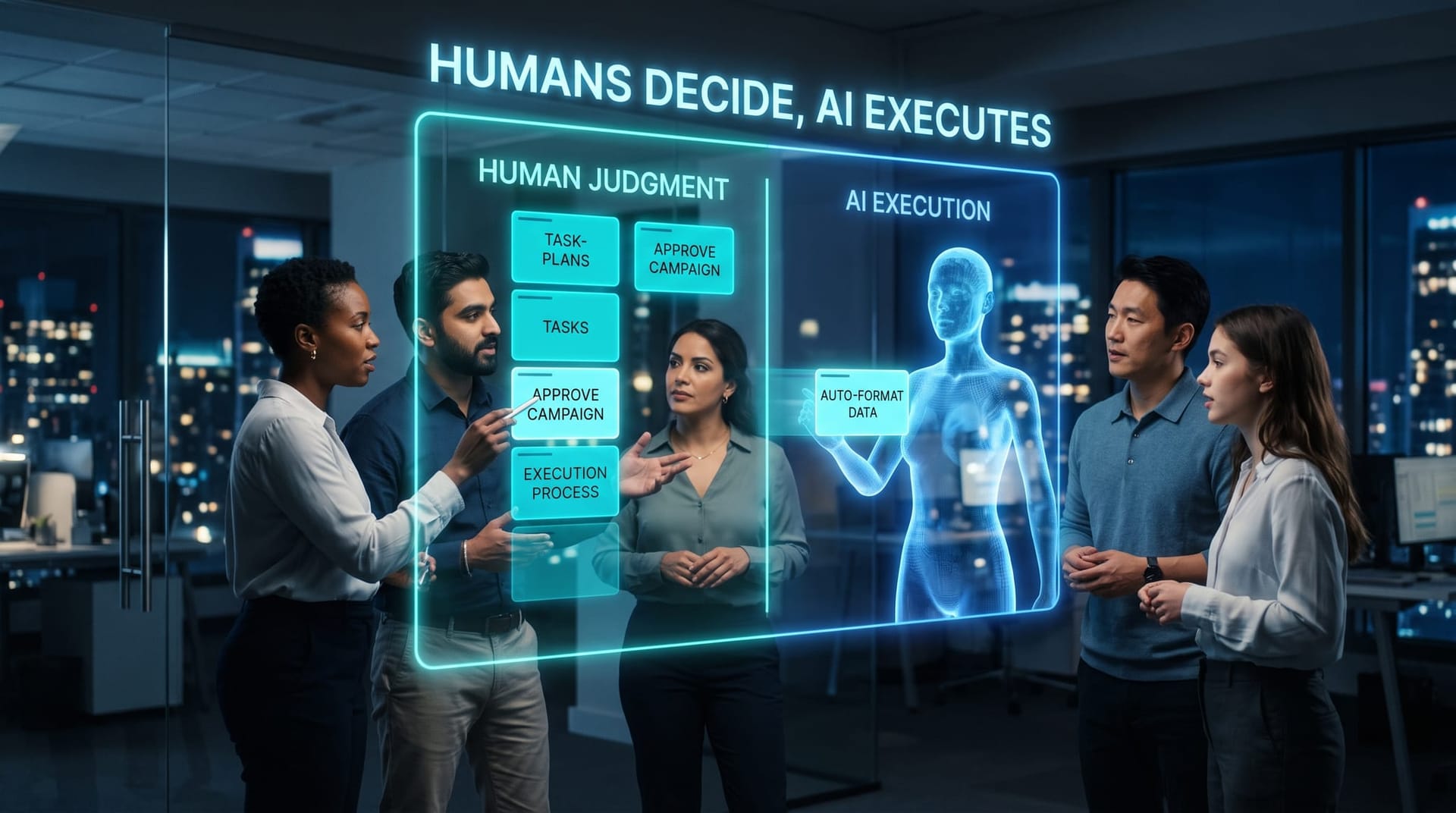
The strategic move is not complicated to state, though it takes discipline to execute: deploy AI for execution, and redeploy your people toward judgment. Concretely, that means a few shifts.
First, automate the execution-heavy work that does not require your team's judgment — research, drafting, data cleanup, first-pass analysis, routine outreach. This is precisely the lane AI Employees are built for: autonomous agents that handle the volume so your people do not have to. Second, move your best people up the stack — toward defining what to build, reviewing AI output against a clear quality bar, and owning the calls that carry real consequences. Third, protect the judgment pipeline. Do not let your junior staff become button-pushers; deliberately give them the exposure, feedback, and “good and bad work to compare” that builds taste over time, exactly the development BCG warns is at risk.
A practical way to start is to inventory your team's week and sort it into two buckets: work that produces something (drafting, formatting, data pulls, first-pass research) and work that decides something (what to prioritize, whether the output is good enough, who the customer really is). The first bucket is where AI Employees earn their keep almost immediately. The second is where you want more of your people's hours, not fewer. Most teams discover the producing bucket is far larger than they assumed — which is exactly the capacity the multiplier frees up.
This is a redeployment, not a layoff — and the distinction matters enormously, both ethically and practically. We laid out a humane version of this transition in our Fort Wayne workforce transition playbook, and we have been honest about the harder edges of it in our look at the entry-level squeeze and what the multiplier does to roles. The multiplier is real either way. Whether it produces a stronger team or a more anxious one depends on how intentionally you manage the shift.
The Volume Side: Why This Is Urgent Now
It would be easy to file this under “interesting trend, revisit next year.” The pace argues against waiting. When AI authors a small slice of your work, judgment is a nice-to-have. When it authors the majority, judgment becomes the entire game. As we detailed in when 80% of your code is AI-authored — drawing on Anthropic's report that Claude now writes more than 80% of its new production code — once the machine produces most of the output, your competitive edge is entirely in what you choose to point it at and how well you evaluate what comes back. The firms building that muscle now will compound the advantage; the ones waiting will be drowning in fast, plausible, unreviewed output.
What the “1 = 3” Shift Means for Northeast Indiana

There is a real opportunity here for businesses in Fort Wayne, Allen County, DeKalb County, and across Northeast Indiana — and it runs counter to the usual story about the Midwest losing to the coasts on tech. Regional mid-market firms have never been able to out-hire Silicon Valley. You cannot win a headcount war against a coastal enterprise with a hundred engineers and venture funding to burn. But the “one becomes three” shift changes what the contest is even about.
If each of your people now ships roughly three times the work, a lean Northeast Indiana professional-services firm, manufacturer, or agency can operate with the output of a team several times its size — without the payroll. And the deciding factor is no longer raw headcount; it is judgment. A Fort Wayne firm with deep domain expertise, real relationships with local customers, and decades of hard-won knowledge about how its industry actually works holds exactly the scarce asset the AI era rewards. You cannot out-hire the coasts. But you can out-judge them, because judgment comes from being close to the work and the customer — and that is the Midwest's home-field advantage. Pair that domain judgment with AI Employees handling execution, and a mid-market Indiana business punches dramatically above its weight class. That is not a someday story. The tools are here now.
Give Your Team Superpowers — Then Point Them at What Matters
The “one engineer becomes three” era is an invitation, not a threat. The businesses that thrive will be the ones that hand the execution to AI and free their people to do what only people can: decide what is worth doing. Cloud Radix builds AI Employees that take the research, drafting, analysis, and routine execution off your team's plate — so your best people spend their hours on judgment, product sense, and the calls that move your business. If you are a Fort Wayne or Northeast Indiana leader wondering how to redeploy your team for the multiplier era, let's talk. We will help you map which work to automate and where your people's judgment creates the most value.
Frequently Asked Questions
Q1.Does "one engineer becomes three" mean I should cut two-thirds of my team?
No. The shift is about redeployment, not reduction. When each person can produce roughly three times the output, the constraint becomes deciding what to build and ensuring it is actually good — work that requires more human judgment, not less. The strongest play is to automate execution-heavy tasks and move your people toward product thinking, quality oversight, and domain expertise.
Q2.Why is judgment more valuable than coding skill now?
Because AI has made execution cheap and abundant, while the ability to decide what is worth building remains scarce. Three times the output on the wrong roadmap just gets you to the wrong place faster. Harvard Business Review found that AI helps experienced people — who can evaluate its output — far more than juniors who can only produce, which means judgment is the differentiator.
Q3.What is "judgment" in concrete business terms?
It breaks down into four capabilities: problem selection (choosing what's worth solving), quality definition (knowing what 'good' looks like for your context), domain expertise (catching the plausible-but-wrong answer), and accountability (owning the decisions that carry real consequences). These are concrete, valued skills — not a vague personality trait.
Q4.How can a small Northeast Indiana business compete with this?
By out-judging rather than out-hiring. The productivity multiplier lets a lean Fort Wayne or Allen County firm produce the output of a much larger team without the payroll, and the deciding factor becomes domain judgment rather than headcount. Local firms with deep customer relationships and industry knowledge hold exactly the scarce asset the AI era rewards.
Q5.What's the risk if we lean too hard on AI for everything?
Skill erosion. Boston Consulting Group warns that when everyone uses AI for execution, junior staff may never build the underlying expertise that becomes senior judgment — quietly draining the pipeline of future decision-makers. The fix is to deliberately give your developing people the exposure and feedback that builds judgment, even as AI handles the routine production.
Q6.How do AI Employees fit into this shift?
AI Employees handle the execution-heavy work — research, drafting, analysis, routine outreach — that does not require your team's judgment. That frees your best people to focus on the decisions, quality oversight, and product sense that AI cannot do on its own. The goal is a team where humans own the judgment and AI owns the volume.
Sources & Further Reading
- VentureBeat: venturebeat.com/infrastructure/claude-code-turned-every-engineer-into-three — Claude Code turned every engineer into three. Now companies need more product thinkers.
- Harvard Business Review: hbr.org/2026/02/how-do-workers-develop-good-judgment-in-the-ai-era — How Do Workers Develop Good Judgment in the AI Era?
- Boston Consulting Group: bcg.com/publications/2026/when-everyone-uses-ai-companies-risk-critical-skills — When Everyone Uses AI, Companies Risk Losing Critical Skills.
- Faros AI: faros.ai/blog/ai-software-engineering — The AI Productivity Paradox: What 22,000 Developers Reveal About AI's Real Impact.
- Google Cloud / DORA: cloud.google.com/blog/products/ai-machine-learning/announcing-the-2025-dora-report — Announcing the 2025 DORA Report: State of AI-assisted Software Development.
- VentureBeat: venturebeat.com/technology/anthropic-says-80-of-its-new-production-code-is-now-authored-by-claude — Anthropic says 80% of its new production code is now authored by Claude.
Ready to Redeploy Your Team for the Multiplier Era?
Cloud Radix builds AI Employees that take execution off your team's plate — so your best people spend their hours on judgment, product sense, and the decisions that move your business. We will help you map which work to automate and where your people's judgment creates the most value.
Schedule a Free ConsultationFort Wayne & Northeast Indiana. No contracts, no pressure — just an honest conversation about where AI fits.