
Most 2027 headcount plans being built right now in Fort Wayne and across Northeast Indiana share the same quiet flaw: they assume every unit of work capacity is a person. Heads times availability equals what you can get done. Need more output? Open a req. That math has worked for a century, and it is about to produce a plan that is wrong on day one — because AI Employees are a genuinely new kind of capacity, and they do not fit in a headcount cell.
An AI Employee does not cost a salary and benefits; it shows up as compute and usage. It does not take PTO; it needs human oversight. It does not scale by hiring; it scales by scenario and by how much autonomy you grant it. If you drop that into a spreadsheet designed for people, one of two things happens: the agent becomes invisible (planned as nothing), or it shows up as a lump of software spend with no link to the work it does. VentureBeat argued that most planning models simply are not ready for this shift — and the corroborating research backs that up.
Key Takeaways
- AI Employees are a distinct capacity pool, not a headcount line. Their cost is usage-based, their constraint is oversight, and they scale by scenario — so planning them like people (or like SaaS) both fail.
- Deloitte's distinction is the one that matters: plan agentic AI like humans (a separate capacity type), and treat generative AI as a productivity shift for the people you already have.
- Plan the work, not the roster. Deconstruct roles into tasks, score each task for automation and augmentation potential, then decide where an AI Employee is the right unit of capacity.
- Model agents as a separate line with usage-based cost and an oversight ratio — every dollar of AI compute tied to an outcome, and an explicit autonomy level per agent.
- Plan across adoption scenarios, not one forecast, and revisit continuously as costs, capability, and your own comfort change.
- You do not need a data-science team to do this — a Fractional AI Integrator can stand up the capacity line and run the oversight.
The good news: you do not need to throw out workforce planning. You need to add one capacity type to it and change what you measure. This piece lays out a practical model for doing exactly that — grounded in a 2026 Deloitte strategic guide on AI in workforce planning and a strategic workforce planning framework from Tempo — and translated for a business owner or operations manager who is about to decide whether the next “hire” is a person or an AI Employee.
Why does planning capacity by headcount break with AI?
Headcount planning assumes a stable unit. One person is roughly one unit of capacity, available a predictable number of hours, with a ramp time measured in weeks and a cost measured in salary. You forecast demand, divide by that unit, and open reqs for the gap. The whole discipline — what Tempo calls getting the “five rights” of the right number, skills, level, place, and cost — is built on that unit being a human.
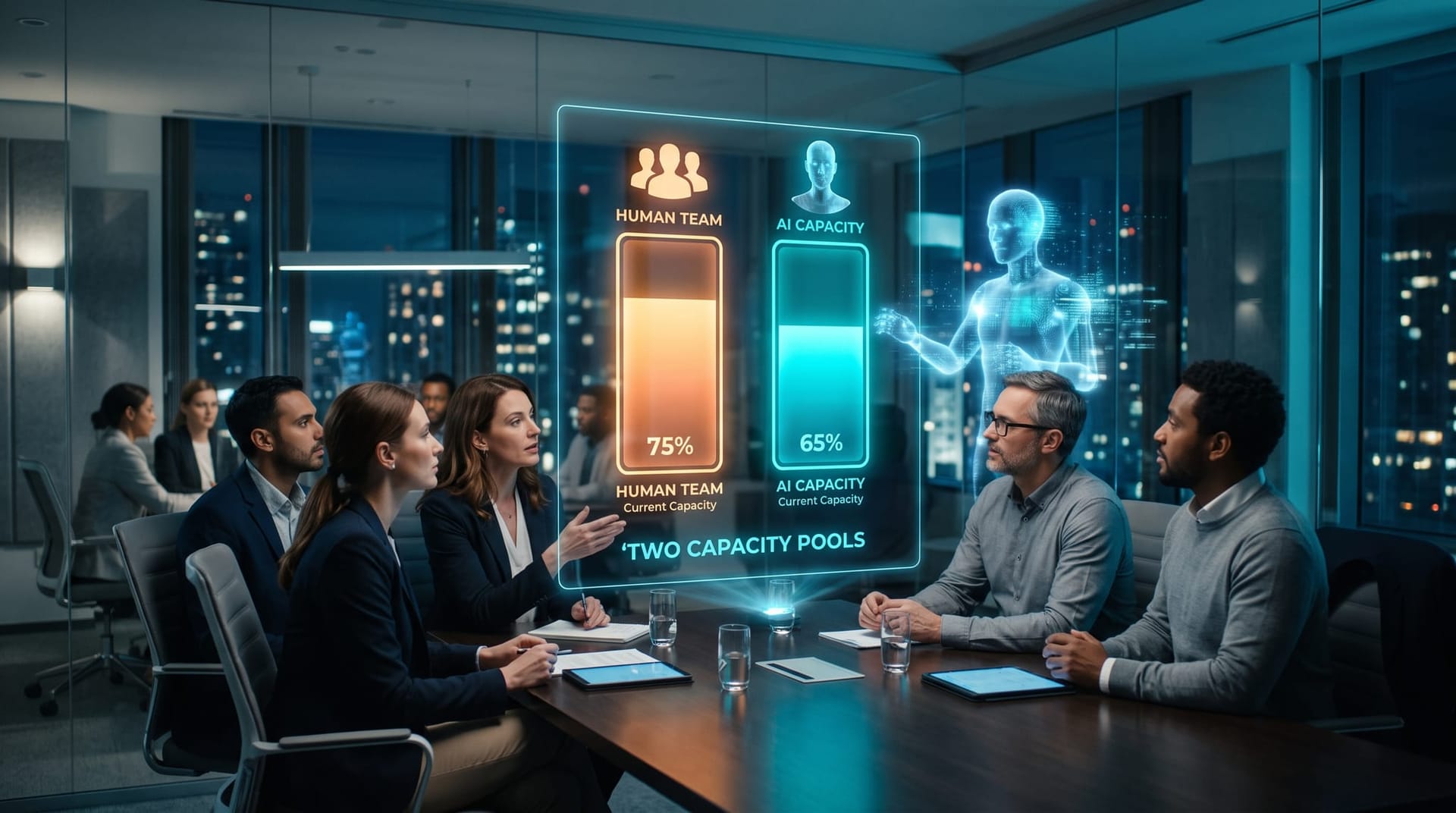
AI Employees break the unit. As Tempo puts it, humans and agents are simply different capacity units: people are fixed and discrete, with ramp time in months, while agents are elastic and continuous, scaling with compute and billing while they run. An agent is not 1.0 of anything. It can be 0.1 of a role on a quiet week and 5.0 of it during a surge, and its cost moves with that usage rather than sitting fixed. Try to express that as a headcount number and you lose the information that makes it plannable.
The scale of the gap is not hypothetical. According to Tempo's 2026 State of SPM survey of 667 planning and PMO leaders across 43 countries, capacity planning now ranks as the top barrier to executing strategy — ahead of prioritization and budget. Only 37% of leaders report good or complete visibility across their projects, and 46% review their plans just quarterly or annually. The planning cadence most businesses run was slow before AI arrived; it is dangerously slow now that a new capacity type can be switched on in an afternoon.
The appetite is there even if the readiness is not. The Deloitte guide cites research that 82% of respondents say freeing up worker capacity is important, yet only 8% report making great progress — and that 88% of leaders call it extremely or very important to accelerate how people, skills, and resources get orchestrated, while only 7% say they are doing it well. The will is nearly universal; the planning muscle is rare. That gap is the opportunity.

What is the difference between agentic AI and generative AI for planning?
This is the single most useful distinction in the Deloitte guide, and it resolves most of the confusion. The two kinds of AI belong in different parts of your plan.
Generative AI is a productivity shift for the people you already have. When your bookkeeper drafts client emails faster, your estimator summarizes spec sheets in seconds, or your marketer produces first drafts with a model, nobody's seat changed. The work got faster. You plan this the way you would plan any tooling upgrade: it changes how much a role can do, so you re-baseline that role's real capacity — not its headcount.
Agentic AI should be planned like humans — as a distinct pool of capacity that does work, not a tool that speeds up a person. An AI Employee that handles inbound lead qualification, runs a nightly security audit, or answers the phone after hours is not making someone faster; it is doing a unit of work on its own, under oversight. Deloitte's blueprint is blunt about it: redefine your planning entities so agentic AI is planned like humans while generative AI is treated as a productivity shift to the existing workforce.
Get this backwards and the plan breaks in predictable ways. Treat an autonomous agent as mere “productivity” and you will under-resource the oversight it needs and overstate your human capacity. Treat a GenAI assist as a separate “hire” and you will double-count capacity that is really just one faster person. The table below is the quick test.
| Question | Generative AI (productivity shift) | Agentic AI (distinct capacity) |
|---|---|---|
| What does it change? | Speed/quality of an existing role | Does a unit of work on its own |
| How do you plan it? | Re-baseline the human role's capacity | Add a separate capacity line |
| What is the cost basis? | Part of the role's tooling | Usage/compute tied to its output |
| What is the main constraint? | Adoption and skill | Oversight and autonomy limits |
| Example | Drafting, summarizing, research help | Lead qualification, phone agent, audits |

If you want the deeper version of why an autonomous agent is a different animal than a chatbot that helps a human type, we covered the capacity case in why AI Employees exist and the coordination layer that lets several of them work together in our piece on the AI operating layer and workforce architecture.
How do you build the plan? A four-step capacity model
Here is a model a non-enterprise business can actually run. It borrows the “measure, plan, execute” spine from Deloitte and the practical sequencing from Tempo's four-step plan, compressed for a shop that does not have a workforce-analytics department.
Step 1: Inventory the work, not the headcount
Deconstruct your roles into their core tasks and label each one by how routine, creative, or interpersonal it is — Deloitte calls this building a dynamic taxonomy of tasks and measuring the share that is routine. You are not trying to replace a job; you are finding the tasks inside it that an AI Employee could carry. A “customer service rep” is really a dozen tasks, and maybe four of them (after-hours FAQ, appointment reminders, order-status lookups, first-pass triage) are strong agent candidates while the rest stay human. Plan at the task level and the agent-versus-person decision gets concrete.
Step 2: Model agents as a separate capacity line
Create a line in your plan that is not headcount. For each AI Employee, record what work it covers, its expected usage-based cost, and — critically — its oversight ratio: how much human review it needs per unit of output. Tempo's rule is the discipline to copy: every dollar, including AI compute, should tie to an outcome, so an agent never shows up as unexplained spend. This is also where our AI automation ROI worksheet earns its keep — it gives you the handling-time, review-effort, and released-capacity numbers that make the capacity line honest rather than aspirational.
Step 3: Set an autonomy posture for each agent
Before you scale an agent, decide how much rope it gets. Tempo frames three levels cleanly: Observe (the agent surfaces a signal, a human decides), Assist (the agent recommends, a human approves), and Delegate (the agent acts within limits people set). Your oversight ratio flows directly from this posture — an Observe agent needs little; a Delegate agent needs guardrails and audit. This is not a nice-to-have. A plan that scales autonomy without first setting the posture is planning risk, not capacity. We wrote about the practical version of this — teaching AI Employees to know when to ask a human — because the escalation rule is the oversight model.
Step 4: Plan across scenarios and revisit continuously
Do not build one 2027 forecast. Build a few. Deloitte's most forward-looking move is treating strategic planning as an on-demand scenario-modeling capability — model low, medium, and high AI-adoption paths and watch how capacity, cost, and role mix shift in each. Then revisit on a real cadence. Deloitte's own maturity roadmap runs from a foundation stage, through connecting planning to decisions, to an “always-on and predictive” state where simulations run on live signals rather than an annual ritual. You will not start there. You start by moving off a once-a-year plan — because, as Tempo found, mature adaptive planners realize measurable ROI on 81% of projects versus 45% for the least mature, and the highest-performing planners use AI extensively (30.3%) while the lowest use it not at all.

What does this look like in practice?
Consider the most-cited live example. In reporting on remarks by McKinsey CEO Bob Sternfels, IDN Financials described a firm running roughly 40,000 human employees alongside about 25,000 AI agents, with Sternfels expecting the agent count to match human headcount by the end of 2026. The agents handle research, synthesis, and first drafts through an internal platform, and the firm reports large time savings. Treat those specific numbers as one company's self-reported, press-relayed figures rather than an industry benchmark — but notice the shape. McKinsey did not report that figure as “headcount.” It reported two different capacity pools, measured differently, planned differently.
That is the point for a business a fraction of that size. You do not need 25,000 agents to face the same planning question. You need a plan that can hold “three people and two AI Employees” without pretending the two agents are either invisible or just more people. McKinsey has even argued that the future of work is agentic and that managing an AI workforce starts to look like an HR-style discipline — selecting, onboarding, and overseeing agents the way you would any new capacity.
Gartner's guidance for the next year points the same direction without the hype. As UNLEASH reported, Gartner recommends a “now-next” strategy: get the most from your current workforce over the next 12 months while planning for deeper change over the following one to three years, and build executive alignment on skill gaps and the implications of using AI to fill them. That is scenario planning in plain clothes — exactly what Step 4 asks for.
Planning your next unit of capacity in Fort Wayne and Northeast Indiana
Here is how this lands for a real business in Allen or DeKalb County. Picture a professional-services firm — a regional accounting practice, a manufacturer's inside-sales desk, a growing home-services company in Fort Wayne — that is maxed out on a repetitive function. Intake, scheduling, after-hours phone coverage, first-pass lead qualification. The default move is to post a req and hope the Northeast Indiana labor market cooperates, which lately it has not. The hire takes weeks to find, months to ramp, and locks in a fixed cost whether the phones are busy or quiet.
The capacity-planning move is to run the same decision through the four-step model before opening that req. Inventory the actual tasks. Ask which are routine enough for an AI Employee and which genuinely need a person's judgment. Model the agent as a separate line with usage-based cost and an honest oversight ratio, and set its autonomy posture — probably Assist at first, graduating to Delegate on the narrow, well-understood tasks. Run two scenarios: a slow quarter and a surge. In most of these shops, the answer is not “person or agent.” It is a smaller human role doing the judgment work plus an AI Employee absorbing the elastic, after-hours, repetitive load that a person would resent anyway.

What a Fort Wayne business usually lacks is not the idea — it is the person to stand up that capacity line and run the oversight. That is the role of a Fractional AI Integrator: someone who builds the plan, deploys the AI Employees, sets the autonomy postures, and keeps a human in the loop — without you hiring a data-science team to do it. If you want to see what that capacity looks like deployed locally, our AI Employees for Fort Wayne page walks through the functions they cover.
How to build your AI capacity line
If your 2027 plan currently has one column — headcount — it is missing the fastest-moving capacity you have access to. You do not have to rebuild workforce planning to fix that. You have to add one line, measure it honestly, and decide one thing at a time whether the next unit of work belongs to a person or an AI Employee.
Cloud Radix builds and runs that capacity for businesses in Fort Wayne and across Northeast Indiana. We deploy AI Employees as a planned, overseen capacity pool — not a science experiment — and our Fractional AI Integrator sits inside your planning cycle so agents stay tied to outcomes. Start with our Fractional AI Integrator service to model your first capacity line, or tell us the function that is maxing out your team and we will help you decide whether your next hire is a person or an AI Employee.
Frequently Asked Questions
Q1.Should AI Employees be counted as headcount?
No. AI Employees are a distinct capacity pool, not a headcount line. Their cost is usage-based rather than a salary, their main constraint is human oversight rather than availability, and they scale by scenario rather than by hiring. Deloitte's guidance is to plan agentic AI as its own capacity type while treating generative AI as a productivity boost to existing roles.
Q2.What is the difference between agentic AI and generative AI in workforce planning?
Generative AI makes the people you already have faster — drafting, summarizing, researching — so you re-baseline a human role's capacity. Agentic AI does a unit of work on its own under oversight, so it earns its own capacity line with usage-based cost and an autonomy level. Planning the two the same way leads to either double-counting capacity or under-resourcing oversight.
Q3.How do I estimate the cost of an AI Employee?
Model it as usage, not a flat seat. Record the work it covers, its expected compute/usage cost, and the human oversight it requires per unit of output, then tie every dollar to a specific outcome. An ROI worksheet that captures handling time, review effort, and released capacity turns that estimate from a guess into a number you can plan against and revisit.
Q4.What is an oversight ratio?
An oversight ratio is how much human review an AI Employee needs per unit of work it produces. It flows from the agent's autonomy posture: an "observe only" agent needs very little, an agent that acts within set limits needs guardrails and auditing. Setting the posture before you scale an agent is what keeps growing AI capacity from quietly becoming unmanaged risk.
Q5.Do I need a data-science team to plan for AI Employees?
No. The planning model — inventory the work, add a capacity line, set autonomy, plan across scenarios — is a management discipline, not a technical one. A Fractional AI Integrator can build the plan, deploy and oversee the AI Employees, and keep them tied to outcomes, which is how smaller Fort Wayne and Northeast Indiana businesses add this capacity without building an analytics department.
Q6.How often should I revisit an AI workforce plan?
More often than the annual headcount cycle most businesses run. AI cost, capability, and your own comfort with autonomy all change quickly, and planners who review continuously consistently outperform those who review only quarterly or annually. Start by moving to a quarterly or event-triggered review, and plan across adoption scenarios rather than committing to a single forecast.
Sources & Further Reading
- Deloitte / Anaplan: deloitte.com/content/dam/assets-zone3/us/en/docs/alliances/2026/workforce-planning-ai-strategic-guide-0726.pdf — The AI Future: A Strategic Guide to AI in Workforce Planning
- Tempo: tempo.io/blog/strategic-workforce-planning — Strategic Workforce Planning
- UNLEASH (reporting on Gartner): unleash.ai/future-of-work/gartner-4-key-priorities-for-chros-in-2026-to-lead-the-ai-driven-future-of-work — Gartner: 4 Key Priorities for CHROs in 2026 to Lead the AI-Driven Future of Work
- McKinsey & Company: mckinsey.com/capabilities/people-and-organization/our-insights/the-future-of-work-is-agentic — The future of work is agentic
- IDN Financials: idnfinancials.com/news/60221/bob-sternfels-reveals-mckinseys-strategy-to-utilise-ai — Bob Sternfels reveals McKinsey's strategy to utilise AI
- VentureBeat: venturebeat.com/orchestration/ai-is-redefining-the-workforce-and-most-planning-models-arent-ready — AI is redefining the workforce, and most planning models aren't ready
Model Your First AI Capacity Line
Tell us the function that is maxing out your team. Our Fractional AI Integrator will build the capacity plan, deploy the AI Employees, and keep them tied to outcomes — so your next unit of capacity is a decision, not a guess.