A top-10 US bank just handed its AI flaw-finder to the entire internet, for free.
Capital One has open-sourced VulnHunter, an agentic AI security tool that scans source code the way an attacker would read it — finding exploitable vulnerabilities, mapping how an adversary would actually reach them, and proposing targeted fixes before the code ships. VentureBeat calls it one of the most ambitious attempts yet by a major financial institution to turn offensive AI capability into a public defensive resource.
Here's the confident take, and I'll stand behind it: this is the commoditization moment for AI-assisted security review. When bank-grade flaw-hunting is an Apache-licensed repo on GitHub, two things become true at once. Every defender on earth — including every mid-market software vendor, MSP, and IT shop serving businesses like yours — just got tooling that only a handful of institutions could build for themselves. And every attacker got a preview of exactly how machine-speed flaw discovery works.
Both edges of that blade point at the same conclusion: the bar labeled “we couldn't have known” just dropped to the floor.
Key Takeaways
- Capital One has released VulnHunter, its agentic AI code-security tool, as open source on GitHub under the Apache 2.0 license, per VentureBeat.
- VulnHunter inverts conventional “sink-first” scanning: it starts at attacker-accessible entry points and reasons forward along the attacker's actual path, per Capital One's announcement.
- A built-in falsification engine tries to disprove the tool's own findings — hunting for broken assumptions and blocked exploit paths — to cut false-positive noise.
- Capital One validated it internally across thousands of repositories before release, reporting speed and efficiency well beyond its previous manual triage.
- The procurement consequence: “is AI-assisted vulnerability scanning part of your process?” is now a fair question for every software vendor and IT provider — because the tooling is free.
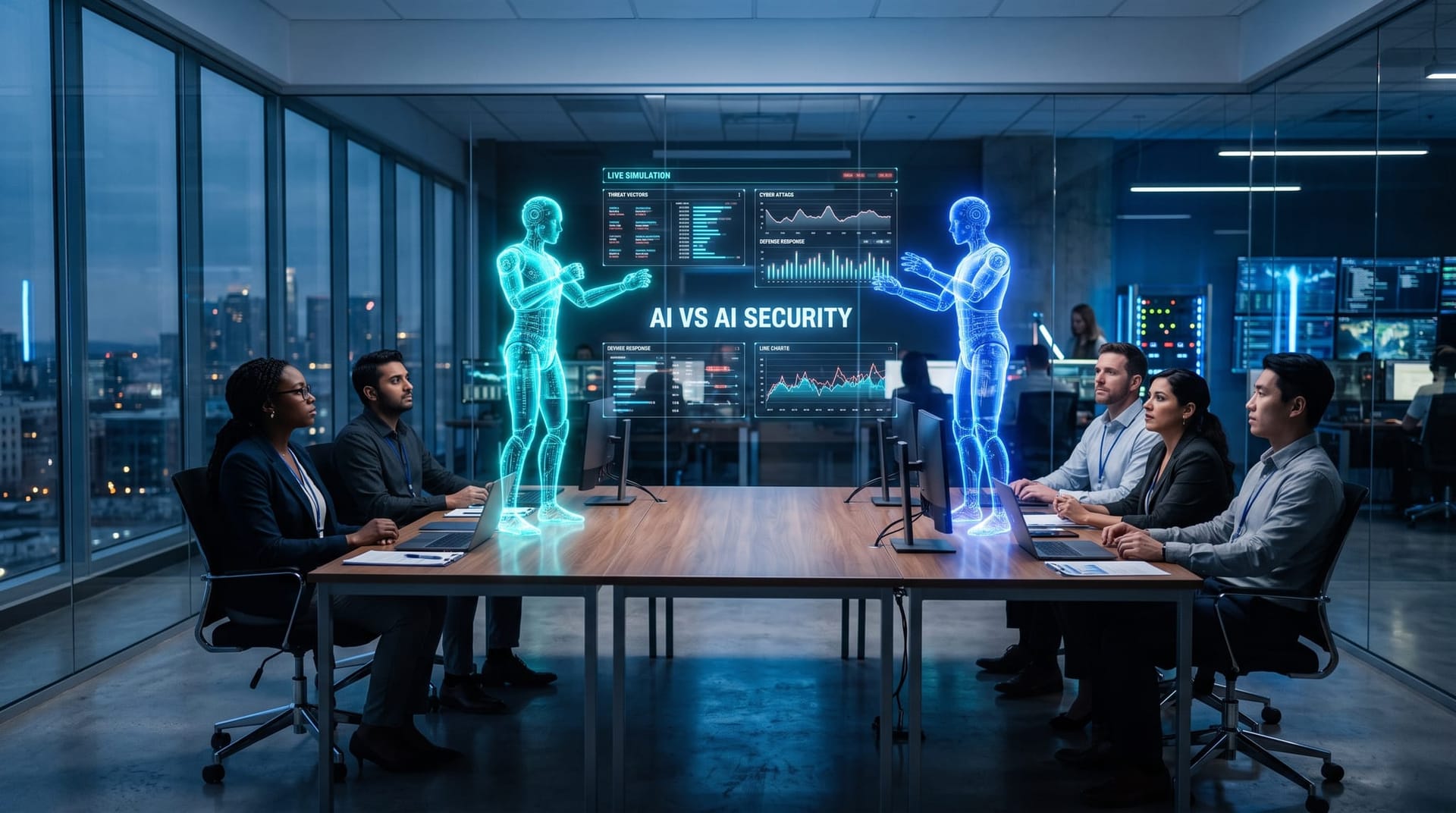
- Combined with vendor-side automated red-teaming like OpenAI's GPT-Red, the direction is unmistakable: AI-vs-AI security is the 2026 default, and an annual pen-test is a 2019 budget line.
What Is VulnHunter and How Does It Work?
Per Capital One's technical announcement, VulnHunter is an agentic AI workflow that applies what the company calls attacker-first analysis directly to source code. That inversion is the interesting part.
Conventional static-analysis tools are largely “sink-first”: they find dangerous code patterns — the unsanitized query, the risky function call — and flag them, leaving humans to figure out whether anyone could actually reach them. VulnHunter flips the direction of reasoning. It begins at the entry points an attacker can actually touch and reasons forward — simulating the adversary's journey step by step to evaluate whether an attacker can genuinely break through to the flaw. The output isn't “this line looks dangerous.” It's “here is a reachable path from the outside world to this weakness, and here's a targeted fix.”

The second design choice worth understanding is the falsification engine. After VulnHunter builds an exploit argument, a structured reasoning workflow attacks that argument — actively hunting for assumptions that don't hold, logical gaps in the exploit path, and conditions that would stop the attack from succeeding. Findings that survive their own cross-examination are the ones that reach a human. Anyone who has drowned in static-analyzer false positives understands why this matters: the historical failure mode of code scanning isn't missing everything, it's flagging so much noise that engineers stop reading the reports. A tool that argues against itself before it argues with you is a genuinely different experience. It's the same adversarial-verification principle we push in our red-team-before-deployment playbook — a claim isn't trustworthy until something has tried hard to break it.
Under the hood, per Capital One, the tool currently runs on Anthropic's Claude Opus 4.8 inside a Claude Code environment, with a framework designed to be portable to other foundation models and coding harnesses. It's on GitHub under Apache 2.0 — a permissive license that means any company, including every vendor who sells you software, can use it commercially, today, for free.
Why Would a Bank Give Away Its Security Tooling?
Because a bank's security perimeter stopped being the bank's own code a long time ago.
Capital One says it validated VulnHunter internally before release by running it across thousands of repositories spanning tens of business areas, and reports that it identified and remediated vulnerabilities with speed and efficiency far beyond what its teams previously achieved through manual triage. So why hand a tested internal advantage to the world — including competitors and criminals?
Ecosystem defense. A financial institution is wired into thousands of vendors, processors, and software dependencies; their flaws are its breach surface. Every vendor that adopts VulnHunter hardens code the bank ultimately depends on. Open-sourcing turns an internal tool into herd immunity — the same logic that pushes companies to fund fixes in the open-source software they depend on, but applied to the scanning layer instead of the code layer. There's self-interest here, and that's fine; self-interest is what makes the strategy durable.

There's a second-order benefit for Capital One too: a public tool gets public scrutiny. The Hacker News discussion started within hours of release — practitioners probing the approach, comparing it to their own tooling, kicking the tires. That feedback loop is something no internal tool ever gets. For the rest of us, that public shakedown is exactly what makes an open tool more trustworthy over time than a proprietary black box.
What Does Commoditized AI Flaw-Hunting Change?
Let's put the facts in one place, then draw the uncomfortable conclusion.
| VulnHunter fact | Detail (per Capital One / VentureBeat) |
|---|---|
| What it is | Agentic AI code-security tool with attacker-first analysis |
| Core method | Starts at attacker-accessible entry points, reasons forward along the exploit path |
| Self-checking | Falsification engine that attempts to disprove its own findings |
| Validation | Run across thousands of internal repositories, tens of business areas |
| Reported result | Found and remediated flaws well beyond prior manual-triage speed |
| Engine | Anthropic's Claude Opus 4.8 in a Claude Code environment, designed to be model-portable |
| License / availability | Apache 2.0, public on GitHub |
| Price | Free |
Now the asymmetry argument. Attackers industrialized first — automated scanning, automated exploitation, and increasingly AI-assisted discovery have been the offensive reality for years, and defenders have largely answered with annual penetration tests and compliance checklists. What changed this week is the defender side of the ledger: the excuse that machine-speed flaw discovery is a nine-figure-budget capability is gone. It's a git clone.
Be clear-eyed about the dual use, though: attackers can read an Apache-licensed repo too. An attacker-first reasoning engine that finds reachable exploit paths is useful to both sides of the fight. That's precisely why this is a ratchet, not a choice — once the tooling is public, the side that declines to use it is the only side disadvantaged by its existence. And the honest caveats cut the other way as well: an AI flaw-finder is not a security program. It won't govern the shadow AI your employees already pasted your data into, it won't catch the hallucinated package an AI coding tool just invented into your supply chain, and it says nothing about how your deployed agents behave — where, per VentureBeat's survey research, 54% of enterprises have already had an AI agent incident or near-miss. Code scanning is one layer. Runtime governance is another. You need both.

We saw the offensive mirror image of this story just days ago: OpenAI built GPT-Red, an automated red-teamer that outperformed human testers at finding working attacks — we broke down what that signal means for buyers last week. Put the two releases side by side and the 2026 thesis writes itself: AI-vs-AI security is now the default posture. Vendors are red-teaming their models with AI. Banks are scanning code with AI and giving the scanner away. A business whose security assurance still consists of an annual human pen-test is budgeting for 2019 — a point-in-time snapshot in a continuous game.
What Should You Ask Your Software Vendors Now?
Here's the practical payoff, and it requires zero technical staff: procurement pressure.
Every piece of software your business runs — your CRM, your practice-management system, the custom portal your MSP built, the integrations holding it together — was written by a vendor who can now scan their code with bank-grade AI tooling for free. Which makes this a fair, non-hostile question on every renewal and every RFP in 2026:
“Is AI-assisted vulnerability scanning part of your development process? Which tools, how often, and how are findings triaged?”
Fair, because the cost objection is dead — the tool is public. Revealing, because the answer sorts vendors instantly: the good ones will name their tools and cadence without flinching; the concerning ones will treat the question as exotic. You are not asking them to be Capital One. You're asking whether they picked up what Capital One just handed them.
In our experience, this question travels well beyond software vendors — put it to your MSP, your IT provider, and anyone whose code or configuration touches your data. For a Fort Wayne or Northeast Indiana business without a security team, vendor pressure is honestly the highest-leverage security action available: you don't have to run the scanner to benefit from it, you just have to make your vendors tell you whether they do. The renewal conversation is the natural moment — the question costs you one line in an email, and the answer tells you more about a vendor's engineering culture than any compliance badge on their website. Ask it this quarter, before the first breach traced to an unscanned dependency makes it the question everyone asks. And note the trajectory this sets for procuring AI systems as well — the buyer-side scrutiny we've been recommending for AI vendors now has a free reference tool behind it.

One more honest limitation: a vendor saying “yes, we run VulnHunter” is a floor, not a guarantee. Scanning cadence, triage discipline, and what happens to the findings matter more than the logo of the tool. But floors matter. “We couldn't have known” was always partly a statement about tooling economics — and the economics just changed.
What Would Actually Adopting VulnHunter Look Like?
For the minority of readers who do ship code — the software shops, the MSPs with custom tooling, the manufacturers with in-house integrations — here's the realistic adoption picture, with the caveats stated plainly.
The tool itself is a clone away, but “free” describes the license, not the operation. Per Capital One, VulnHunter currently runs on Anthropic's Claude Opus 4.8 inside a Claude Code environment — so running it means paying for model usage, and agentic analysis that reasons through exploit paths across a codebase consumes meaningfully more tokens than a one-shot lint pass. Budget for that the way you'd budget for CI compute: a real line item, still a rounding error next to a single incident response. The framework is designed to be portable to other models and harnesses, which matters for anyone with model-vendor constraints, but the supported path today is the one Capital One ships. The project's README is blunt about why: the attacker-first reasoning leans on frontier-class model capability, and you bring your own model access — this is a methodology packaged as a tool, not a turnkey appliance.
We recommend treating a first run the way you'd treat any new scanner: point it at one actively-maintained repository — not your whole estate — and judge it on the quality of the surviving findings, not the quantity. The falsification engine exists precisely so that what reaches you has already been argued against; if a finding survives, walk the exploit path it hands you before dismissing it. Then make the human decision the tool can't: who owns triage, what severity gates a release, and where the results feed into your existing process. A scanner without an owner is a dashboard, not a defense.
And if you're not a code shop at all, this section is still useful as calibration — it's the answer you should hear when you ask your vendors the procurement question above. A vendor who has genuinely adopted AI-assisted scanning will talk about model costs, triage ownership, and false-positive rates unprompted. A vendor who hasn't will talk about the press release.
Where Cloud Radix Fits
Code scanning secures what vendors ship. Cloud Radix secures what runs — our Secure AI Gateway governs, logs, and gates every action your AI systems take, and our AI security practice covers the layer VulnHunter doesn't: the agents, permissions, and data flows inside your business. If you want help turning this week's news into a one-page vendor-security questionnaire — or an audit of your own AI attack surface — talk to us. The tooling went free; the standard just went up.
Frequently Asked Questions
Q1.What is VulnHunter?
VulnHunter is an open-source, agentic AI code-security tool released by Capital One in July 2026. It scans source code for exploitable vulnerabilities using attacker-first analysis — starting from entry points an attacker can reach and reasoning forward along the exploit path — then proposes targeted fixes. It's available on GitHub under the Apache 2.0 license.
Q2.How is VulnHunter different from a normal code scanner?
Two ways. Direction: conventional tools flag dangerous code patterns (“sink-first”) and leave reachability to humans, while VulnHunter simulates the attacker's actual journey to confirm a flaw is genuinely reachable. Self-skepticism: its falsification engine runs a structured reasoning pass designed to disprove its own exploit argument, filtering out findings that don't survive — which targets the false-positive noise that makes traditional scanner reports unread.
Q3.Why did Capital One open-source VulnHunter?
Ecosystem defense. A major bank depends on thousands of vendors and software dependencies, and their flaws become its breach surface — so every vendor that hardens its code with the free tool reduces the bank's own risk. Capital One validated the tool internally across thousands of repositories before releasing it publicly.
Q4.Is VulnHunter free for commercial use?
Yes. It's published under the Apache 2.0 license, which permits commercial use, modification, and redistribution at no cost. Per Capital One, it currently runs on Anthropic's Claude Opus 4.8 inside a Claude Code environment — so operating it involves model-usage costs and setup, but the tool itself is free.
Q5.Does my business need to run VulnHunter ourselves?
Probably not directly — most non-software businesses benefit through vendor pressure. Ask every software vendor, MSP, and IT provider whether AI-assisted vulnerability scanning is part of their process, which tools they use, and how often. Now that bank-grade scanning is free, “it's too expensive” is no longer a credible answer.
Q6.Does an AI code scanner replace penetration testing or AI governance?
No. VulnHunter examines source code before it ships; it doesn't test your live environment, govern deployed AI agents, or watch your data flows — and survey research shows 54% of enterprises have already had an AI agent incident or near-miss. Treat AI-assisted code scanning as one required layer, alongside runtime governance and periodic human-led adversarial testing.
Sources & Further Reading
- VentureBeat: venturebeat.com/technology/capital-one-releases-vulnhunter — Capital One releases VulnHunter, an open-source AI tool that finds software flaws before hackers do (2026-07-17).
- Capital One Tech: capitalone.com/tech/open-source/announcing-vulnhunter — VulnHunter: an open-source, agentic AI code security tool (2026-07).
- GitHub: github.com/capitalone/vulnhunter — capitalone/VulnHunter repository (2026-07).
- Hacker News: news.ycombinator.com/item?id=48946692 — VulnHunter: Capital One's agentic AI code security tool — discussion (2026-07).
- VentureBeat: venturebeat.com/ai/the-agent-security-gap — The agent security gap: 54% of enterprises have already had an AI agent incident, and most still let agents share credentials (2026-07-16).
- Apache Software Foundation: apache.org/licenses/LICENSE-2.0 — Apache License, Version 2.0 (2004).
The Tooling Went Free. The Standard Went Up.
We will help you turn this week's news into a one-page vendor-security questionnaire — or audit the AI attack surface inside your own business, from agents to permissions to data flows.
No contracts. No pressure. Just an honest conversation about what would help your business.