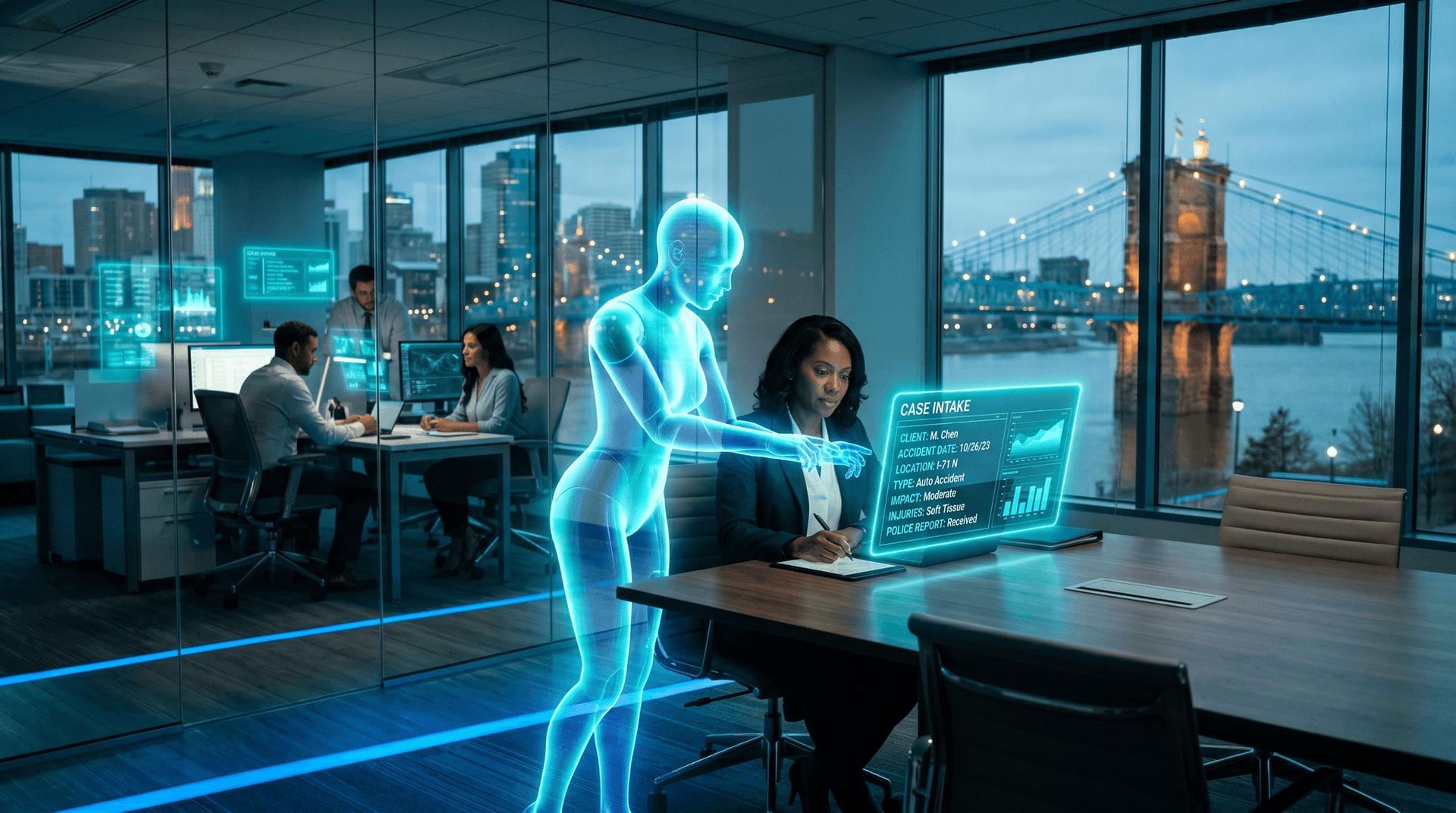
One platform, intake to settlement
After-hours intake is just the front door. The same AI Employee can run an entire personal injury practice — medical-records analysis, lead scoring, demand letters, and custom case management software with a built-in CRM — on one Personal Injury Platform instead of a chain of disconnected tools. See it running live at the Delventhal Law Office deployment.
The Midnight Problem
It's 11:52 p.m. on I-75 just north of the Brent Spence Bridge, where southbound traffic funnels down toward the river crossing into Kentucky. A family driving home from a Reds game is rear-ended by a fatigued box-truck driver who misjudged the merge. No one is seriously hurt, but the car is totaled, a passenger's neck is already stiffening, and everyone is rattled. Within the hour the driver is home, phone in hand, searching “Cincinnati car accident lawyer” and dialing the first three results.
The firm that answers signs the case. The two that send the call to voicemail never hear from that family again. This is the quiet math of personal injury in Cincinnati: the most valuable cases rarely arrive between 9 and 5. They come at night, on weekends, during Reds and Bengals games, and over holidays — exactly when most firms in Hamilton County are closed and the phones are forwarded to an answering machine.
Cincinnati is a competitive legal market. Drive down Vine Street, flip on local TV during a Bengals broadcast, or scroll an injury search on your phone, and you will see a dozen firms fighting for the same caller. In a market that crowded, the differentiator is no longer who has the biggest billboard on I-71. It is who picks up the phone first.
Why Voicemail Loses Cases
Speed-to-lead is everything. Decades of research on inbound lead response consistently show that the odds of connecting with and converting a lead fall off sharply within minutes — not hours. An injured person who is in pain, frightened about medical bills, and unsure whether they even have a case will not leave a voicemail and patiently wait for a callback. They dial the next firm on the list, and the one after that, until a human voice answers.
The traditional fixes all leak cases. Generic answering services use untrained operators who read from a flat script, mispronounce Cincinnati neighborhoods and highway names, mangle the medical and accident details, and leave callers feeling like a number. After-hours intake staff are expensive, hard to retain, and burn out fast on the overnight shift. And plain voicemail does the most damage of all: it quietly hands your six-figure case to a competitor while your team sleeps.
The cost is invisible, which is what makes it dangerous. A firm never sees the case it lost at 1 a.m. There is no missed-call report that says “this was a $400,000 truck case.” The revenue simply never shows up, and the firm assumes the market was slow that month.
What an AI Employee Does
A Cloud Radix AI Employee is not a chatbot, an auto-attendant, or a voicemail-transcription gimmick. It is a dedicated worker that answers the phone, speaks naturally with the caller, screens the matter against your firm's criteria, captures the facts that matter, and books a consultation — all in the first conversation, day or night.
When that family from the I-75 wreck calls at midnight, the AI Employee picks up on the first ring. It listens, expresses genuine empathy, and asks the right questions in the right order: where the crash happened, whether anyone went to the emergency room, whether a police report was filed, and whether the at-fault driver was working for a company at the time. It logs every detail, schedules a morning consultation with an attorney, and sends an immediate confirmation — so by the time the firm opens, the case is already in the pipeline rather than lost to a competitor.
Just as importantly, it never has a bad night. It does not get flustered by a distraught caller, does not forget to ask about the statute of limitations, and does not let a promising lead slip because the overnight operator was juggling three other accounts. Every caller gets the same calm, thorough, on-brand experience.
Cincinnati Roads & Risk
Cincinnati is one of the great river-city logistics hubs of the Midwest, and that shapes the kind of injury work that flows into local firms. Three interstates converge on the metro: I-75 runs the north-south freight spine from Michigan to the Gulf, I-71 angles northeast toward Columbus and Cleveland, and I-275 forms the beltway that loops the entire region across Ohio, Kentucky, and Indiana. Layer in the river port, the rail yards, and the constant truck traffic feeding warehouses and distribution centers, and you have a metro where commercial vehicles share the road with commuters at every hour.
That mix matters because truck and commercial-vehicle collisions tend to produce the most serious injuries and the most valuable claims — and the most complicated ones. A wreck involving a freight carrier on I-75 can implicate the driver, the trucking company, a logistics broker, a maintenance contractor, and one or more insurers. The caller does not know any of that at midnight. They just know they are hurt and scared. A well-tuned AI Employee can quietly flag the telltale signs of a high-value commercial case — a box truck, a semi, a delivery van, an employer's name on the door — so the attorney walks into the morning consultation already knowing this is a matter worth moving on fast.
- I-75 corridor: Heavy north-south freight, chronic congestion near the river crossing, and frequent rear-end and merge collisions.
- I-71 corridor: High-speed travel toward Columbus with commuter and commercial mix through the northeast suburbs.
- I-275 beltway: A tri-state loop where lane changes, interchanges, and out-of-state drivers raise crash risk.
- Surface arterials & neighborhoods: Pedestrian, cyclist, and intersection collisions across Hamilton County's dense urban core.
Ohio Comparative Negligence
Ohio follows a modified comparative negligence rule, and it is one of the first things that shapes whether a case is worth pursuing. Under Ohio law, an injured person can recover damages only if they are found to be 50% or less at fault. Cross that line — 51% or more at fault — and recovery is barred entirely. This is what practitioners mean by the “51% bar.” And even when a plaintiff is allowed to recover, their award is reduced in proportion to their own share of fault: a claimant found 20% responsible collects 80% of their damages.
This rule has practical consequences on the very first call. The way a caller describes the crash — who hit whom, who had the green light, whether they were distracted — starts to shape the comparative-fault picture immediately. A thoughtfully configured AI Employee can gather those facts cleanly and neutrally, without leading the caller or offering legal conclusions, so the attorney has an accurate early read on the fault landscape. It can also set honest expectations: it never promises an outcome, because under Ohio's 51% bar the outcome genuinely depends on the facts and on a licensed attorney's judgment.
The Two-Year Clock
In Ohio, the statute of limitations for most personal injury claims is two years from the date of injury. That clock is unforgiving, and it is one of the most common ways a viable case quietly dies — not because it lacked merit, but because no one acted in time. A caller who reaches voicemail at midnight, gets discouraged, and tells themselves they will “deal with it later” can let months slip away before they call again.
An always-on AI Employee changes that dynamic. By engaging the caller the moment they reach out — capturing the date of the incident, logging it, and booking a consultation — it starts the firm's internal clock on day one instead of week twelve. The same system can flag matters where the two-year window is already running short, surfacing time-sensitive intakes so the attorney can prioritize them. Statute deadlines are exactly the kind of high-stakes detail that should never depend on whether someone happened to listen to the right voicemail on a busy Monday.
Statute deadlines are non-negotiable
Nothing here is legal advice, and exceptions and special rules can apply. The point is operational: capturing the date of injury on the first contact and surfacing the two-year deadline early is a workflow advantage, and a licensed Ohio attorney must always make the final call on timing and strategy.
From Intake to Settlement
Answering the midnight call is just the front door. The reason Cloud Radix built a full Personal Injury Platform rather than a standalone answering bot is that the same AI Employee can keep working the case long after the consultation is booked. Instead of stitching together a phone service, a CRM, a document tool, and a case-management system that all speak different languages, a Cincinnati firm can run the whole lifecycle on one platform.
- Intake & lead scoring: Screen every caller, score the matter, and route high-value commercial-vehicle cases to the right attorney first.
- Medical-records analysis: Organize and summarize records so attorneys spend time on strategy, not page-flipping.
- Demand letters: Draft first-pass demand packages from the case file for attorney review and signature.
- Case management & CRM: Track deadlines, communications, and case status in custom software with a built-in CRM — including that all-important two-year statute clock.
This is the same architecture behind James, the first personal injury AI Employee Cloud Radix deployed. You can read how that worker was built and what it actually does in our breakdown of James, the first personal injury AI Employee.
Guardrails & Attorney Oversight
The single most important thing to understand about a Cloud Radix AI Employee is what it does not do. It does not practice law, it does not give legal advice, and it does not sign clients on its own. Every legal decision — whether to take a case, how to value it, how to advise a client — is made by a licensed Ohio attorney. The AI handles the repetitive, time-sensitive, after-hours work; the lawyer keeps the judgment, the ethics, and the relationship.
The platform is built with custom personal injury skills wrapped in guardrails: it stays within the topics the firm approves, it escalates anything ambiguous to a human, and it is explicit with callers that a consultation with an attorney is the next step. Just as important, it runs on dedicated on-premises hardware the firm owns. Privileged client data stays inside the building — it does not get shipped off to a public cloud across the river, and it never trains some outside company's model. For a profession built on confidentiality, that ownership is not a nice-to-have; it is the whole point.
The attorney approves every legal decision
The AI Employee qualifies leads, books consultations, and prepares paperwork — but a human attorney reviews and approves every case decision before anyone is signed or advised. The technology amplifies the lawyer; it never replaces the lawyer's judgment.
Getting Started
Standing up an AI Employee is more turnkey than most Cincinnati firms expect. There is no sprawling IT project and no months of integration. Cloud Radix installs the dedicated hardware on-site — our team drives down from Auburn, Indiana, just a couple of hours up I-69 — and tunes the intake skills to the case types your firm actually wants. Most firms are live within a few weeks.
- Discovery: We map your current intake flow, your case criteria, and where calls are leaking today.
- On-site install: The hardware is delivered and set up at your office; privileged data stays on your premises.
- Skill tuning: Intake and screening logic is configured for Ohio law and your practice, then tested.
- Go live: The AI Employee starts answering every call, day and night, with your team and attorneys in the loop.
The next six-figure case in Hamilton County is going to come in after hours. The only question is whether your firm answers the phone or your competitor does. If you want to see the full intake-to-settlement system in action, start with the Personal Injury Platform and the live Delventhal Law Office deployment.
Sources & Further Reading
For readers who want to verify the legal and safety context in this article, the following authoritative bodies publish the underlying law and data. This article is general information, not legal advice; consult a licensed Ohio attorney about any specific matter.
- Ohio Revised Code — the statutes governing the two-year personal injury statute of limitations and Ohio's modified comparative negligence (51% bar) rule.
- Ohio Department of Transportation (ODOT) — Ohio roadway and crash data, including the I-75, I-71, and I-275 corridors through the Cincinnati metro.
- National Highway Traffic Safety Administration (NHTSA) — national crash and commercial-vehicle safety statistics.
- Insurance Institute for Highway Safety (IIHS) — research on crash causes, severity, and large-truck collisions.
- Ohio State Bar Association — guidance on the attorney's professional and ethical responsibilities, including confidentiality and the supervision of non-lawyer tools.