One platform, intake to settlement
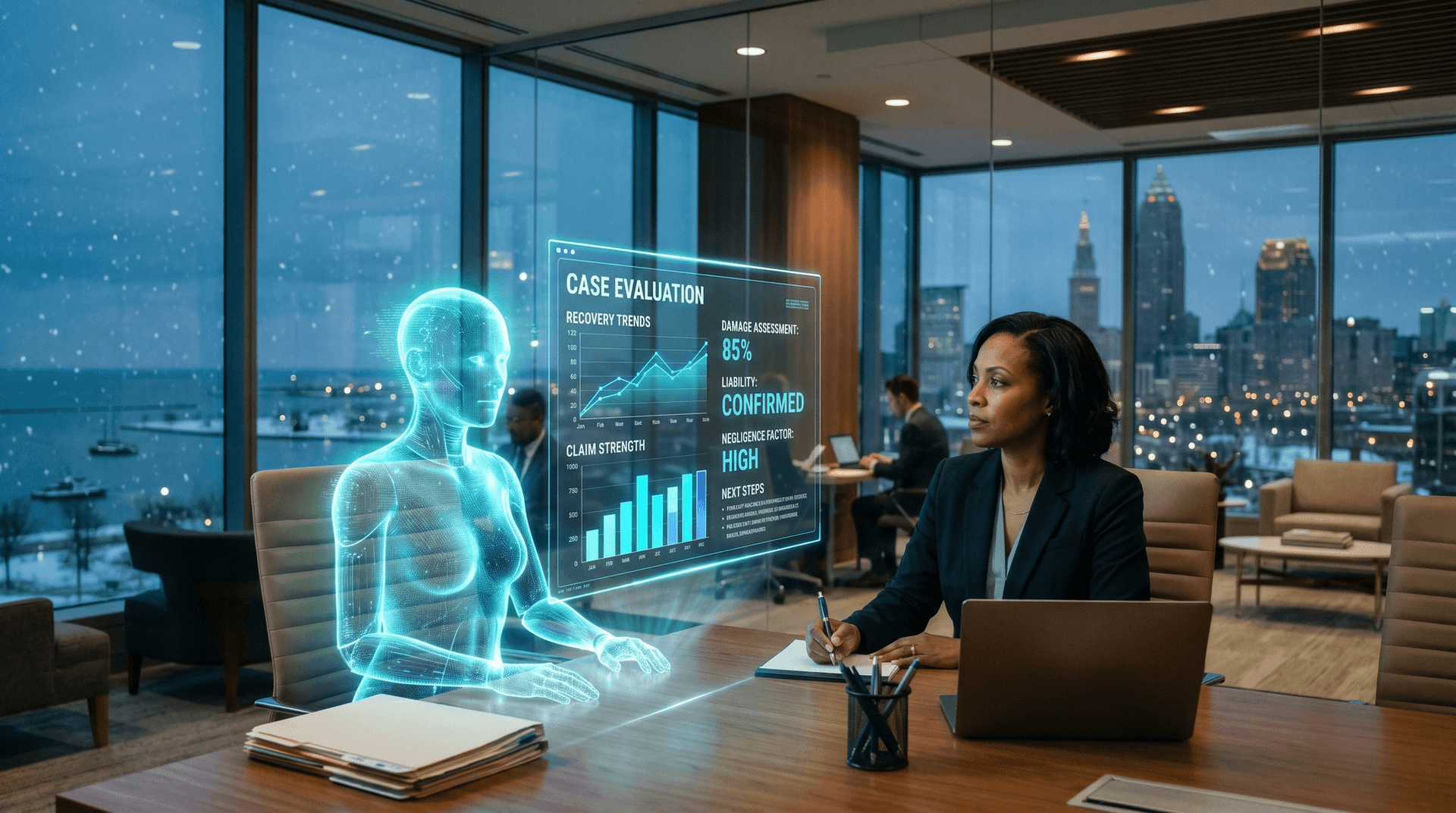
After-hours intake is just the front door. The same AI Employee can run an entire personal injury practice — medical-records analysis, lead scoring, demand letters, and custom case management software with a built-in CRM — on one Personal Injury Platform instead of a chain of disconnected tools. See it running live at the Delventhal Law Office deployment.
Why Speed Wins Cleveland Cases
In personal injury law, the firm that answers first usually wins the case. A potential client who has just been rear-ended on the Innerbelt, or who slipped on black ice in a Cuyahoga County parking lot, is scared, hurting, and looking for someone to take charge right now. They call the first number they find. If it rings to voicemail, they hang up and dial the next firm on the list. By the time your office opens Monday, the retainer is already signed across town.
This is the unforgiving math of intake. Industry research on legal lead response — from sources like Clio's Legal Trends Report — consistently shows that the odds of converting an inquiry drop sharply within the first few minutes of contact and keep falling by the hour. The firm that picks up at 9 PM on a Saturday beats the firm that calls back Tuesday afternoon every single time. Not because it is a better firm, but because it was simply there when the client reached out.
Cleveland is a competitive legal market. Drive any stretch of I-71 or I-77 and you will pass billboard after billboard for injury attorneys. Local radio and late-night TV are saturated with the same handful of recognizable names. When a marketing dollar finally produces a ringing phone, letting that call die in voicemail is the most expensive mistake a firm can make. This is exactly the problem an AI Employee solves.
The After-Hours Problem
Most personal injury firms in Cleveland run lean. A few attorneys, a paralegal or two, and an intake person who is already stretched between phones, scheduling, and putting out fires. During business hours, that team does heroic work. But crashes do not keep business hours. A multi-car pileup in lake-effect snow on I-480 happens at 6:45 AM. A drunk-driving wreck on the Shoreway happens at midnight. A slip and fall at a Flats restaurant happens at 11 on a Friday.
The traditional answer has been an after-hours answering service. But most of these services are little more than a human voicemail. They take a name and number, promise a callback, and read from a script they do not understand. They cannot ask the right follow-up questions about the mechanism of injury. They cannot tell a strong rear-end liability case from a hopeless one. They cannot reassure a panicked caller that someone competent is on the way. And by the time your office returns the call hours later, the client has already retained someone who picked up live.
The other option — paying staff to be on call around the clock — is expensive, exhausting, and impossible to scale. People burn out. People miss calls. People take vacations during the exact week a referral surge hits. The phone, meanwhile, never stops.
The figures above are illustrative of well-documented patterns in legal intake, not exact measurements of any one firm. But the direction is not in dispute: a large share of personal injury inquiries arrive after hours, almost nobody leaves a voicemail, and the firm that answers live captures the case.
Meet James, the First PI AI Employee
This is the problem Cloud Radix built an AI Employee to solve. His name is James, and he is already working — live and in production at the Delventhal Law Office, a personal injury practice. James is not a chatbot bolted onto a website and he is not an overseas call center. He is a full AI Employee with a specific job: catch every personal injury lead, day or night, screen it intelligently, and hand a clean, qualified case to the human team.
You can read the full story of how he came to be in James, the first personal injury AI Employee. What matters for a Cleveland firm is the result: when a caller reaches out at 2 AM after a wreck on I-90, James answers on the first ring, speaks like a calm and capable intake professional, gathers the facts, and books the consult — all before a competing firm's voicemail beep finishes playing.
James is one member of a broader family of Cloud Radix AI Employees — deployed digital workers built for a single role and trained on the real workflows of the business they serve. For personal injury firms, that role is intake and case support. The pattern is the same across industries: a tireless, specialized employee that runs on hardware you own.
This is a case study, not a pitch
James is operational today at a real personal injury firm — gathering intake, screening leads, and supporting case work, with every legal decision approved by a licensed attorney. Read the full Delventhal Law Office case study to see exactly what one AI Employee does — then ask what it would do for your Cleveland practice.
How the AI Employee Works
James runs on a dedicated on-premises appliance — physical hardware we install at your firm. He is not a generic cloud service shared with thousands of other businesses, and your client conversations do not get mixed into someone else's model. The box lives in your office, your data stays in your office, and the AI Employee answers your phones and your web leads under your firm's name.
When a new lead comes in, James:
- Answers immediately — on the phone, through web chat, or from a form submission — with no hold music and no “leave a message after the tone.”
- Speaks naturally and empathetically, gathering the story of what happened: where the crash occurred, when, who was involved, and what injuries the caller is describing.
- Captures the date of the incident and flags it against the Ohio statute of limitations so a near-deadline case never slips through.
- Screens for obvious conflicts and for the basic facts that separate a viable claim from one your firm would decline.
- Books a follow-up consultation directly on your team's calendar and sends the caller a confirmation.
- Logs the entire interaction into your case management system so the attorney who picks it up in the morning has the full picture.
The custom Personal Injury skills are where the real value lives. Out of the box, a generic voice assistant does not know what “loss of consciousness” or “uninsured motorist coverage” means or why they matter. James does, because his skills were built specifically for personal injury intake and refined against real cases. And catching the lead is only the first skill. The same AI Employee can analyze medical records, score and prioritize leads, draft demand letters, and operate inside custom case management software — all on one integrated Personal Injury Platform rather than a tangle of disconnected subscriptions.
The Cleveland Market: Interstates and Lake-Effect Snow
Cleveland and the surrounding Cuyahoga County region are built for car travel, and that means a steady volume of motor-vehicle injury cases. The interstate network alone — I-90 running east-west along the lake, I-71 and I-77 funneling traffic south, and I-480 plus the notorious Innerbelt knotting it all together downtown — concentrates an enormous amount of high-speed merging, lane changing, and congestion into a relatively small footprint. Where traffic is dense and fast, collisions follow.
Then there is the weather. Cleveland sits in the path of lake-effect snow off Lake Erie, and the winter months bring whiteout squalls, icy on-ramps, and reduced visibility that can turn a normal commute into a chain-reaction pileup. Lake-effect storms are notoriously localized and sudden — one stretch of I-90 can be dry while another is buried — which makes them especially dangerous for drivers who are not expecting them. For a personal injury firm, every significant snow event is a potential surge of inquiries, and surges almost always arrive outside business hours.
A surge is exactly when a lean intake team breaks down. Three crashes in one icy morning means three callers, three voicemails, and three chances for a competitor to sign your client first. An AI Employee does not flinch at volume. James can handle the first caller, the fifth, and the fifteenth simultaneously, with the same calm and the same thorough screening — at 7 AM during a lake-effect whiteout or at 1 AM on a holiday weekend.
The lake-effect surge problem
Winter weather does not just raise crash frequency in Cleveland — it clusters it. A single squall off Lake Erie can produce a dozen wrecks across I-90, I-71, and I-480 within the same hour, almost always before offices open. A human intake desk can take one of those calls at a time. An AI Employee takes all of them at once, screens each one, and has the briefings waiting when your attorneys arrive.
Ohio Law Every Intake Should Know
Good intake is not just about being polite and fast — it is about capturing the details that determine whether a case is worth taking and whether it can still be filed. Ohio has a few rules that shape every personal injury conversation, and the AI Employee's skills are tuned to flag them.
The Two-Year Statute of Limitations
In Ohio, most personal injury claims must be filed within two years of the date of the injury. That window is shorter than many people assume, and it is unforgiving — a claim filed even a day late is typically barred no matter how strong it is. When a caller mentions a crash from “a while back,” the single most important thing intake can do is pin down the exact date and flag how much time remains. James captures that date on every call and surfaces near-deadline matters so your attorneys can act fast.
Modified Comparative Negligence and the 51% Bar
Ohio follows a modified comparative negligence rule with a 51% bar. In plain terms, an injured person can still recover damages as long as they are not more than 50% at fault for the incident; their award is reduced by their own share of fault. But cross the line to 51% or more, and recovery is barred entirely. That makes the facts about who did what — who had the right of way, who was following too closely on a snowy ramp, whether the client was wearing a seatbelt — genuinely case-defining.
This is precisely why intake matters so much. The very first conversation often reveals the facts that decide whether a case survives Ohio's comparative negligence framework. An AI Employee trained on Ohio intake asks the questions that matter:
- Traffic signal and right-of-way. Who had the green light? Was there a turn arrow? Was the signal working?
- Speed and road conditions. Estimated speeds, road surface, weather, construction zones — critical in lake-effect conditions where stopping distance matters.
- Witnesses and documentation. Were there witnesses? Did anyone stop? Is there dashcam footage or nearby business surveillance?
- Police report. Was a report filed? Was either driver cited? What did the responding officer note?
- The caller's own actions. Seatbelt use, phone use, alcohol — sensitive but essential for assessing comparative-fault exposure honestly from the first call.
The AI Employee does not evaluate fault — that is the attorney's job. It collects the information that lets the attorney make a rapid, informed assessment. A complete intake that addresses comparative negligence indicators is worth infinitely more than a message that says “caller was in an accident, please call back.”
Information, not legal advice
The AI Employee gathers and organizes these facts; it does not give legal advice or tell a caller whether they have a case. Every legal judgment — whether to take a matter, how to value it, what to advise — is made by a licensed Ohio attorney. The skills are designed to inform your lawyers, not to practice law.
Guardrails and Attorney Oversight
The biggest, most reasonable objection lawyers raise is risk. What if the AI says something it shouldn't? What if it gives legal advice, quotes a number, or promises an outcome? Those are exactly the right questions, and they are why James is built around guardrails first.
James does not give legal advice. He does not quote settlement values, guarantee results, or create an attorney-client relationship on his own. His job is to listen, gather facts, screen, and schedule — then hand the matter to a human. Every legal decision is approved by a licensed attorney. The custom skills include explicit boundaries on what the AI Employee can and cannot say, and those boundaries are tuned during installation and reviewed against real conversations over time.
Because the AI Employee runs on hardware physically installed in your office, your client data does not get scattered across third-party cloud vendors. For a profession built on confidentiality, that on-premises model is not a nice-to-have — it is the point. You control the box, you control the data, and the attorney controls every decision that matters.
Integration, not replacement
An AI Employee does not replace your legal judgment — it amplifies it. The AI handles intake, documentation, and initial screening. You decide which cases to take, what strategies to pursue, and how to advocate for your clients. The AI extends your capacity; it does not replace your expertise — and every legal decision passes through attorney approval.
Getting Started
Cloud Radix is based in Auburn, Indiana, a few hours from Cleveland, and we install on-site. That matters. We are not shipping you a box with a setup PDF and wishing you luck. A technician comes to your office, installs the hardware, connects it to your phones and case management system, trains the skills on your specific intake process, and tunes the guardrails before James ever answers a live call.
Getting live generally looks like this:
- Discovery. We learn how your firm screens leads, what a good case looks like to you, and where calls currently fall through the cracks.
- Configuration. We tailor the Personal Injury skills to your intake script, your calendar, and Ohio's rules — the two-year statute and the comparative negligence facts that matter to you.
- On-site install. Our team comes from Auburn, installs the on-premises hardware, and integrates it with your systems.
- Tuning and launch. We test against realistic calls, sharpen the guardrails, and go live — usually within a few weeks.
The investment is a fraction of the cost of a single missed case. One serious crash on I-90 that you sign because James answered at 2 AM — instead of losing it to voicemail — can pay for the system many times over. Most firms recover the cost with a single file. Everything after that is upside: every after-hours lead caught, every panicked caller reassured, every deadline flagged before it becomes a malpractice problem.
If you run a personal injury practice in Cleveland and you are tired of watching marketing dollars die in voicemail, it is worth seeing what an AI Employee can do. Explore the Personal Injury Platform, review the Delventhal Law Office case study, or learn more about Cloud Radix AI Employees and how they get deployed.
Frequently Asked Questions
Q1.Will an AI Employee replace my intake staff?
No. The AI Employee handles the after-hours and overflow load that would otherwise go to voicemail. Your intake team handles the qualified, screened leads it books — so they spend their time on real cases instead of robocalls and tire-kickers.
Q2.What happens when someone calls at 2 AM after a crash on I-90?
The AI Employee answers on the first ring, speaks naturally, gathers the facts of the incident, captures the date for statute-of-limitations tracking, screens for conflicts, and books a follow-up consultation with your team for the morning. No voicemail, ever.
Q3.Does it understand Ohio personal injury rules?
Yes. The skills are tuned for Ohio — including the two-year statute of limitations for most injury claims and the state's modified comparative negligence rule with a 51% bar. It flags timing and fault details for your attorneys; it does not give legal advice.
Q4.Is this compliant with Ohio attorney advertising and ethics rules?
Yes. Every legal decision is approved by a licensed attorney. The AI Employee gathers information and schedules consultations — it does not give legal advice or form an attorney-client relationship on its own.
Q5.Where does the AI Employee actually run?
On dedicated on-premises hardware we install at your firm. Your client data stays in your office in the Cleveland area, not mixed into a shared third-party cloud model.
Q6.How long does it take to get live?
Most firms are live within a few weeks. We install the hardware on-site, train the skills on your intake process, and tune the guardrails before James answers a single live call.
Q7.What does it cost?
Pricing depends on call volume and the skills you need. It is a fraction of the cost of a single missed case — most firms recover the investment with one signed file.
Q8.Can it do more than answer the phone?
Yes. The same AI Employee can analyze medical records, score and prioritize leads, draft demand letters, and run custom case management software with a built-in CRM — the full Personal Injury Platform, not just an after-hours answering service.
Sources and Further Reading
The legal rules referenced above reflect Ohio's personal injury framework as generally understood: a two-year statute of limitations for most injury claims and a modified comparative negligence standard with a 51% bar. Specifics can change and depend on the facts of a given case, so firms should confirm current rules against authoritative sources. The intake and lead-response figures are illustrative of well-established patterns, not exact measurements of any single firm or market. Nothing here is legal advice.
- Ohio Revised Code and the Ohio State Bar Association — for current statute-of-limitations and comparative negligence law.
- The Ohio Department of Transportation — for crash data and information on the region's interstate corridors.
- The National Highway Traffic Safety Administration (NHTSA) and the Insurance Institute for Highway Safety (IIHS) — for general research on crash risk, including winter-weather and lake-effect conditions.
- Clio Legal Trends Report and the American Bar Association — for research on client intake and after-hours lead response.