For most of the past three years, two things were true about enterprise AI procurement: the strongest models were closed-weight (GPT-class, Claude, Gemini), and “citations” were a thing you bolted on with retrieval-augmented generation, a vector database, and a re-ranker. Cohere just collapsed both of those assumptions in a single release.
On May 21, 2026, Cohere shipped Command A+, a 218B-parameter sparse Mixture-of-Experts model under a full Apache 2.0 license that runs on as few as two NVIDIA H100 GPUs — and emits source citations natively during inference, not as a downstream post-processing layer. That's a procurement reset, an architectural reset, and — if you operate mid-market in 2026 — an Answer Engine Optimization reset all at once.
This post is what I'd put in front of a buying committee weighing their next AI Employee stack. It walks through what Cohere actually shipped, why the citation-as-inference design matters for businesses being indexed by ChatGPT, Perplexity, Claude, and Google's AI Overviews, what the two-H100 cost envelope means for the mid-market, and how Northeast Indiana operators should think about adding Command A+ to their procurement matrix.
Key Takeaways
- Cohere released Command A+ on May 21, 2026 — the first full Apache 2.0-licensed frontier-class enterprise model with native citation emission during inference.
- The 218B-parameter sparse MoE activates 25B parameters per token across 128 experts; W4A4 quantization lets it run on two H100s or one B200.
- Native citations move source attribution from a scaffolding concern (RAG + re-ranker + post-hoc URL injection) into the model itself, which changes the AEO threat model.
- Mid-market mattered because closed-weight licensing and DGX-class hardware kept frontier capability out of reach; Apache 2.0 + 2x H100 changes the access economics.
- The right question for Northeast Indiana buyers is not “Cohere or Claude?” — it's “what should sit behind our Secure AI Gateway in Q3, and at what cost-per-citation?”
What Did Cohere Actually Ship on May 21?
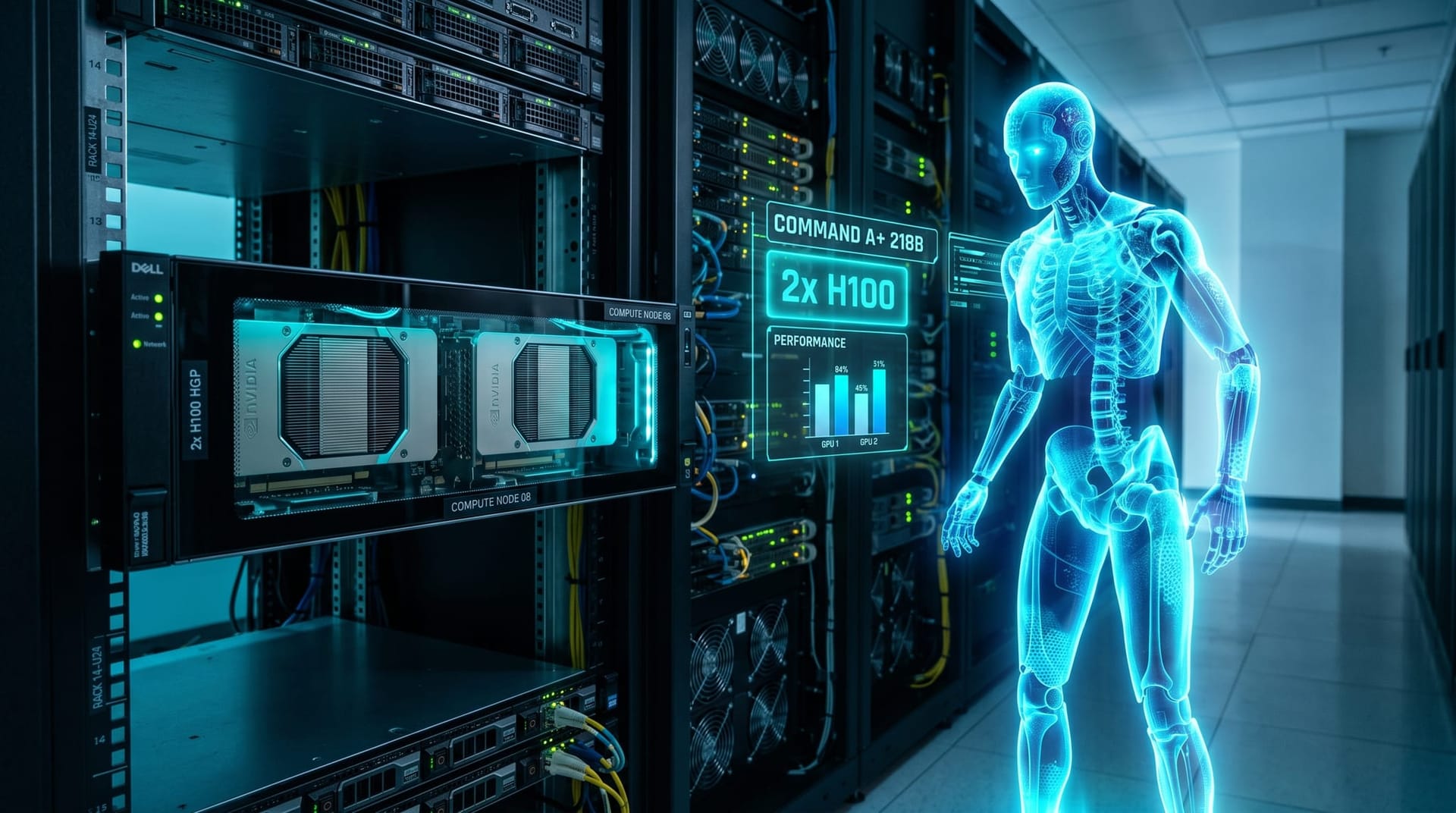
Per MarkTechPost's technical writeup of the release, Command A+ is a 218B-total-parameter sparse Mixture-of-Experts model with 25B active parameters per token, 128 experts of which 8 fire per token plus a single shared expert. It is Cohere's first multimodal reasoning model — text and image inputs, with reasoning traces in the output stream — and ships with a 128K input context and a 64K maximum generation length.
The hardware story is the headline most procurement teams will care about first. The W4A4 quantized variant — NVFP4 4-bit weights and activations applied to the MoE experts only, with full precision preserved through attention pathways — runs on a single NVIDIA B200 or two NVIDIA H100 GPUs. That is the difference between “we'll need a DGX-class cluster and a six-figure budget conversation” and “we can stand this up on the two-card server we already have in the rack.” MarkTechPost reports up to 63% higher output tokens per second and 17% lower time-to-first-token versus the previous Command A Reasoning generation.
The benchmark gains MarkTechPost reports are wide. τ²-Bench Telecom climbed from 37% to 85%. Terminal-Bench Hard agentic coding moved from 3% to 25%. Agentic QA accuracy improved 20 points over the prior version. Multilingual coverage expanded from 23 to 48 languages. None of these are toy improvements; they are the difference between “the model can almost do this job” and “the model is the job.”
The licensing story is where this gets architecturally interesting. According to VentureBeat's coverage of the launch, Command A+ is released under Apache License, Version 2.0 — not a “research-only” community license, not a usage-cap license, but the same permissive license used by Kubernetes, Spark, and most of the open-source enterprise stack. The model weights are downloadable from Cohere's Hugging Face organization, and integration docs live at Cohere's developer documentation. For mid-market buyers who have spent two years building procurement matrices around closed-weight API vendors, this is the first time a frontier-class enterprise model has shipped without commercial-use friction.
Why Native Citations Rewrite the AEO Threat Model
The phrase “native citations” sounds like a small thing. It isn't.
For the past two years, getting an AI Employee to cite its sources reliably required a multi-layer scaffold: a vector database to store the corpus, a retrieval step to pull candidate chunks, a re-ranker to filter them, a careful prompt template to inject the chunks with citation metadata, and a parser to extract and verify URLs from the model's output. This scaffolding is exactly what we've described elsewhere as the AI scaffolding layer that's quietly collapsing as the models swallow it. Native citations are the next swallow.
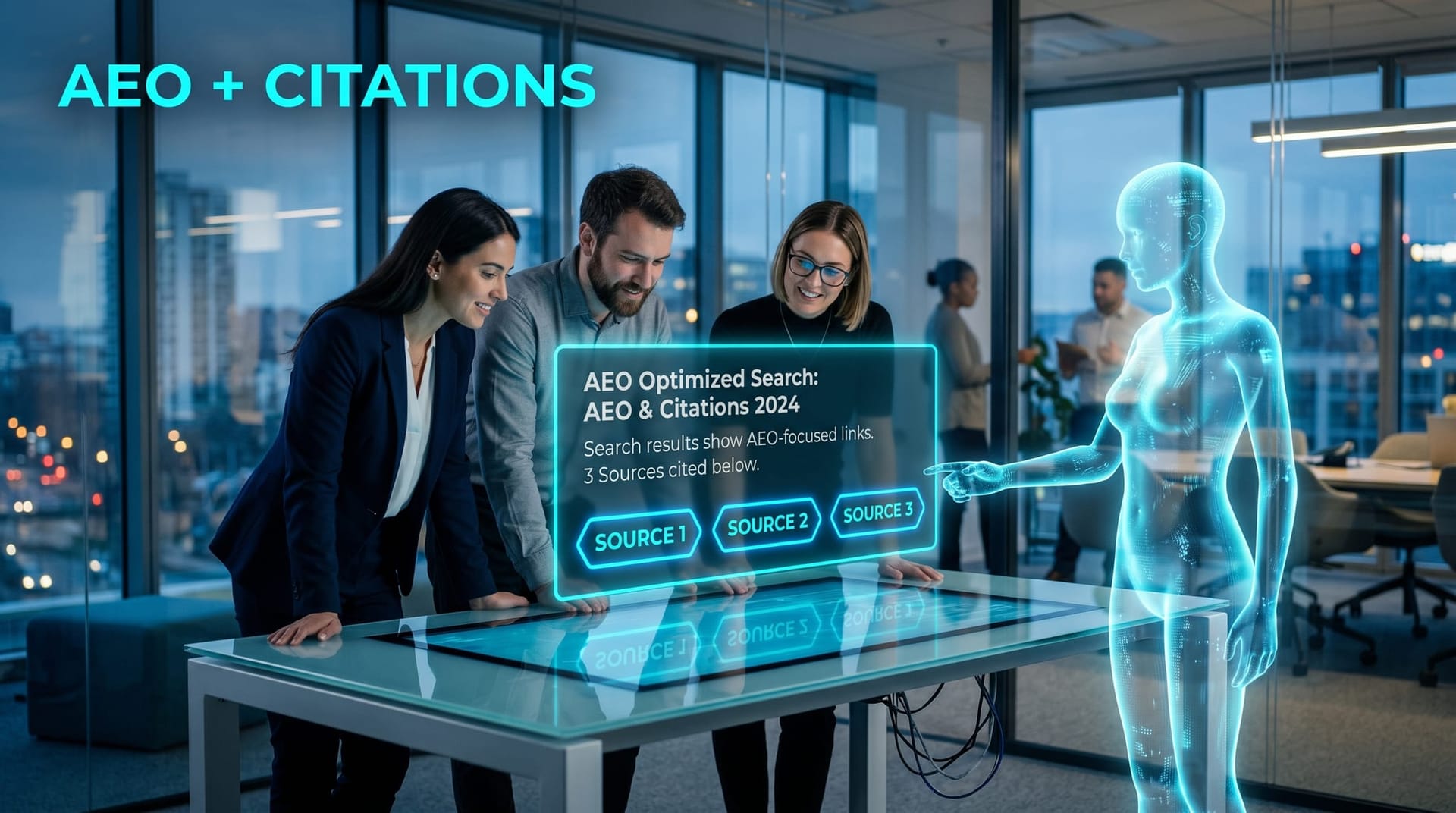
What “native citation” means in practice is that the model emits source attributions as a structured property of its own inference — the same way it emits tool calls or reasoning tokens — rather than the application layer being responsible for proving where the answer came from. For an answer engine like Perplexity, Claude, or Google's AI Overviews surface, the cited source IS the answer. If your business is what gets cited, you get the click and the trust. If you don't, you don't exist in the new search reality. That's the entire premise of our AEO Dominance Playbook — and Cohere's release pushes the same logic one layer down the stack.
The procurement implication: a buyer can now reasonably ask, “Does our model emit verifiable citations as a property of its own architecture, or are we relying on a scaffolding layer that may not survive the next model generation?” That is a very different question from “what's the RAG accuracy of our chatbot?” The first question is structural; the second is configuration.
For Cloud Radix clients running AI Employees that answer real customer questions — whether that's a custom-tuned model behind a portal or a Q&A endpoint indexed by Perplexity — the practical reading is this: native-citation models reduce the surface area where citations can go wrong, which means fewer hallucinated URLs, fewer broken attribution links, and a higher trust signal to the answer engines that decide what shows up when a prospect Googles your category.
Why Do Two H100s Change the Mid-Market Math?
Frontier-class AI has had a hardware tax that priced most mid-market firms out of self-hosted inference. A DGX H100 SuperPOD is a multi-million-dollar capital purchase; even renting comparable compute from the hyperscalers gets expensive fast. The result, for most Allen and DeKalb County operators, was a binary choice: pay per-token to a closed-weight API and accept the vendor-lock risk, or live with smaller open-weight models that couldn't hold a long agent run together.
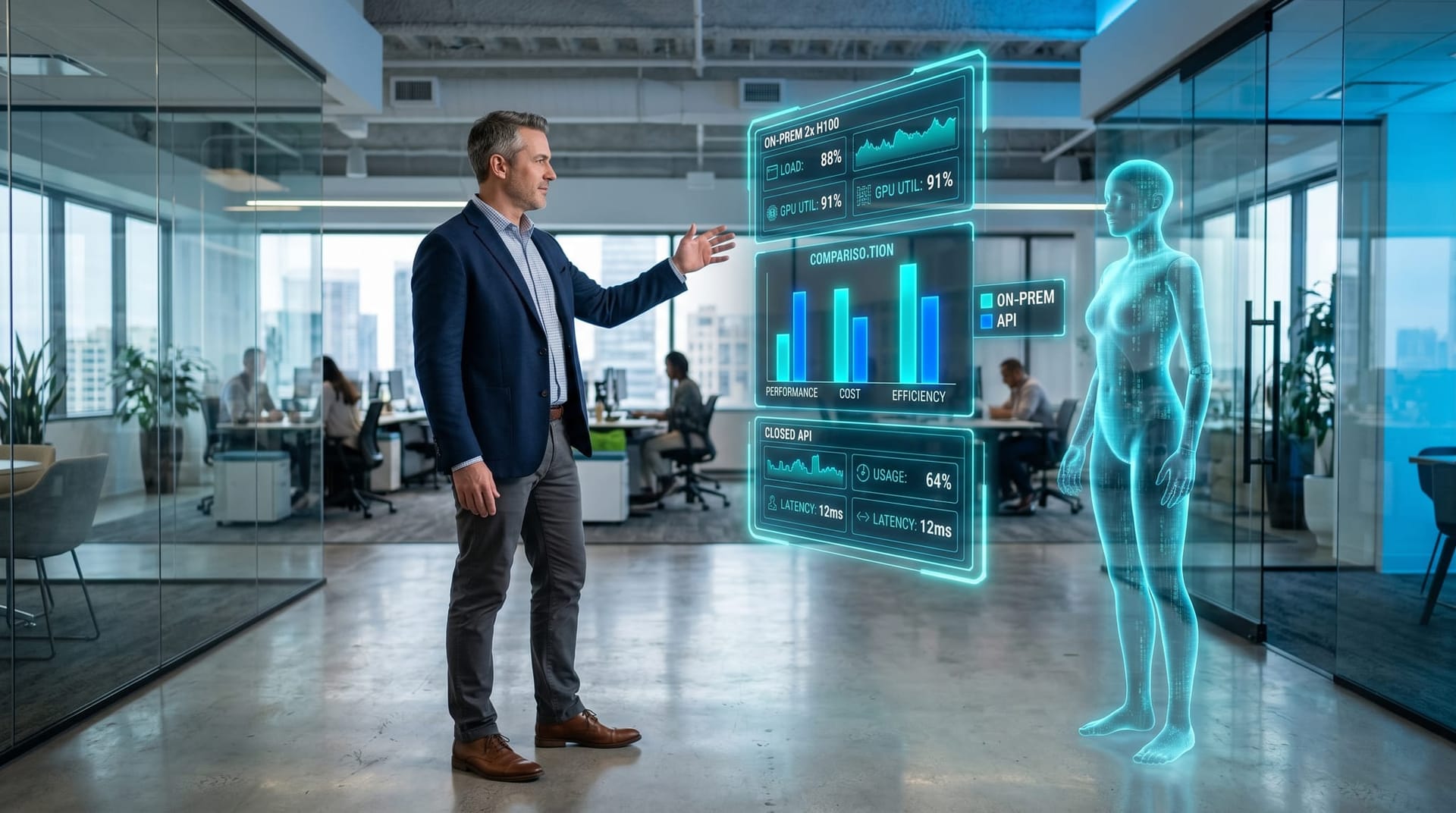
A 2x H100 deployment is not the same problem. NVIDIA's H100 PCIe and SXM5 cards are widely available through every major server OEM and most managed colocation providers. A two-card server lives in the same physical and budget envelope as the high-end database or virtualization host you already have. It does not require a new substation, a new chilled-water loop, or a new procurement category. That's the door Apache 2.0 + W4A4 quantization just opened.
The procurement question for a mid-market operator is no longer “can we afford a frontier model?” It is “should we run one on-premise, behind a Secure AI Gateway, with the cost of our own iron amortized across multiple AI Employees?” That math has been adjacent to the math we've laid out before for the DeepSeek V4 multi-model strategy in Fort Wayne, but Apache 2.0 changes the licensing risk significantly: there is no “what happens to our commercial deployment if Cohere changes terms?” overhang.
We are honest about the limits. Two H100s with W4A4 quantization will not deliver the same throughput as a B200 cluster; latency under heavy concurrent load will degrade, and the multimodal pathways are more compute-hungry than text-only inference. For a 40-seat shop running 4–6 internal AI Employees with bursty usage, that's a fine envelope. For a 24/7 customer-facing answer engine serving thousands of queries an hour, you'll want to model out a multi-card scale-out path or a hybrid local-plus-API design.
How Does Command A+ Compare to the 2026 Open-Weight Frontier?
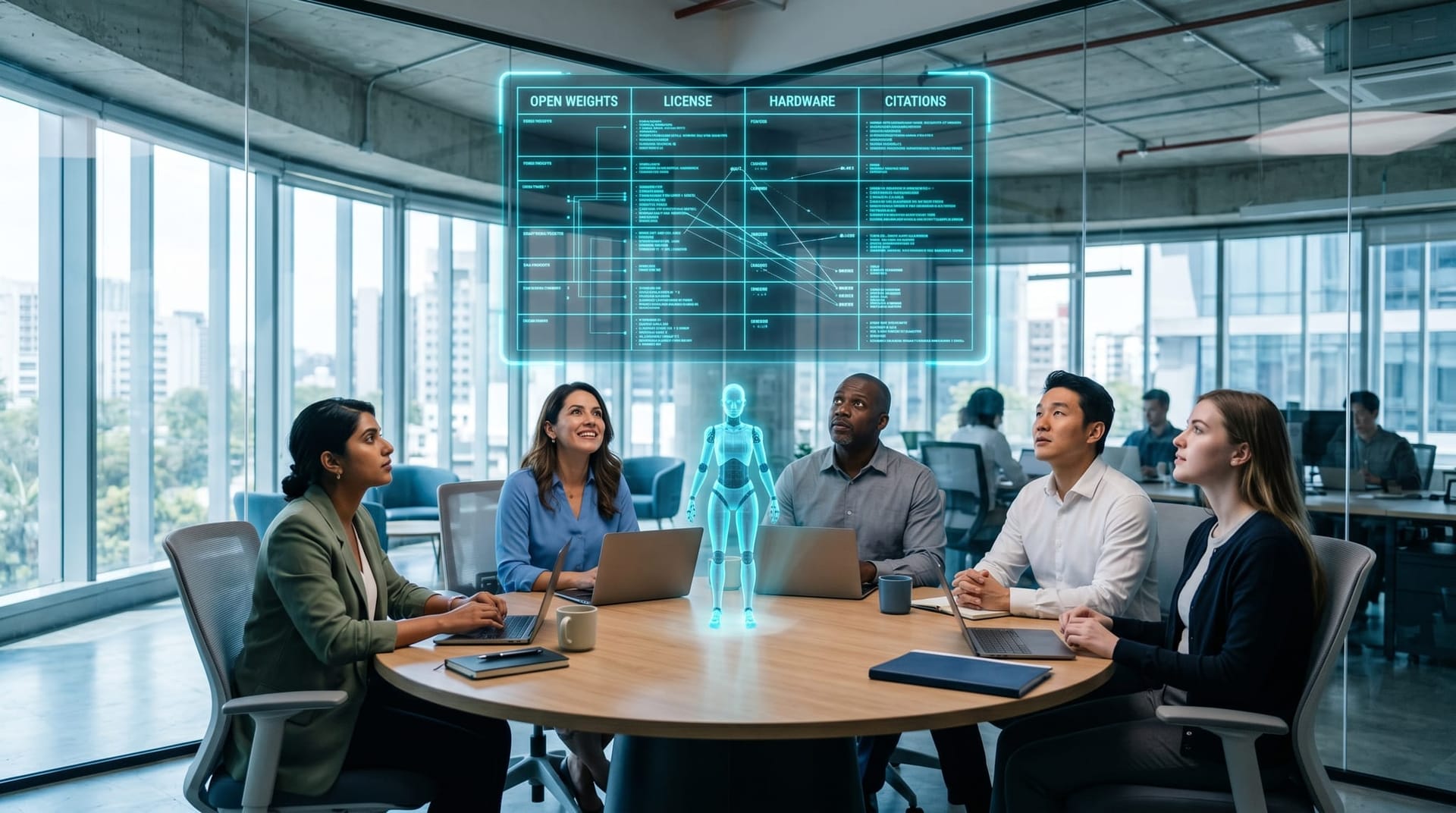
The procurement question is not “Cohere or nothing.” It's “what does Command A+ change about the matrix we already have?” Below is a structural comparison of the licensing posture and deployability of the frontier-class options a mid-market buyer is realistically evaluating in mid-2026.
| Model | License | Min self-host hardware (quantized) | Native citation emission | Multimodal input |
|---|---|---|---|---|
| Cohere Command A+ (May 2026) | Apache 2.0 | 2x H100 or 1x B200 | Yes (inference-native) | Text + image |
| Llama 4 family (Meta) | Llama Community License (not Apache 2.0; restrictions above 700M MAU) | Varies by variant | No (scaffold-required) | Varies |
| Closed-weight frontier (GPT-5.5, Claude Opus 4.7, Gemini Ultra) | Vendor API only, no self-host | N/A (API only) | Varies by vendor / scaffold | Yes |
| DeepSeek V4 / Qwen family | Open weights (varies) | Varies | No (scaffold-required) | Some |
The Apache 2.0 column is the column the buying committee should care about. A model under a true permissive license can be embedded in commercial products, redistributed in customer-facing infrastructure, and run behind your own gateway without legal review on every deployment. That is structurally different from a “community license” that carves out usage caps, geographic restrictions, or vendor-favor clauses. For mid-market buyers who have been waiting for an open-weight frontier model they can actually deploy without a legal-team escalation, Command A+ is the first one that ships clean.
For deeper procurement framing on how these tradeoffs cascade through a buying decision, we maintain a longer Mid-Market Reader's Guide to Enterprise Agentic AI Platforms 2026 that walks through control plane vs. execution plane, harness ownership, memory architecture, and the rest of the matrix.
What This Looks Like for Northeast Indiana Mid-Market Operators
Northeast Indiana mid-market — Allen, DeKalb, Whitley, Noble counties — runs on lean IT budgets and pragmatic procurement. The 2x H100 envelope lands inside the operating budget of a typical 50–250-employee professional services firm, regional healthcare practice, or specialty manufacturer. It does not land inside the budget of the average 10-employee shop, which is why the right play for that segment remains a managed-AI relationship rather than self-hosted inference.
For Fort Wayne mid-market specifically, we see three near-term plays:
- Behind a Secure AI Gateway. Run Command A+ self-hosted on a two-H100 server, route AI Employee calls to it through your existing Secure AI Gateway, and use the native citation output as your AEO signal pipeline. This works well for healthcare and legal practices that cannot ship customer data to a third-party closed-weight API.
- As the citation layer in a multi-model stack. Keep closed-weight frontier models in the mix for tasks that need their long-tail capability, but route any task where the answer must be defensible (customer-facing Q&A, regulatory documentation, compliance research) to Command A+ so citations are emitted at the model layer, not stitched together in the application code.
- As the on-prem layer for a hybrid AEO presence. For firms whose business depends on being cited by answer engines — local services, professional firms, anyone whose discovery surface is shifting from Google to ChatGPT and Perplexity — running a citation-native model behind a public Q&A endpoint becomes a defensible business asset, not just an internal tool.
The plays look different by industry, but the through-line is the same: native citations + Apache 2.0 + two H100s removes the three biggest reasons mid-market operators have been forced to live downstream of closed-weight vendors for the past three years.
How to Move From “Interesting” to a Q3 Procurement Plan
If your buying committee is asking the right questions in Q3 2026, the conversation looks like this:
- What does our AEO surface area look like today, and which AI Employees are answering questions in our voice? (If you don't have a clean inventory, that's the first deliverable.)
- Of those AI Employees, which need defensible citations as a feature, not as a nice-to-have? (Customer support, sales discovery, regulatory and compliance, partner enablement — all yes.)
- For the citation-required workloads, what would it take to host a native-citation model on our own hardware, behind our existing Secure AI Gateway? (Two H100s in a 2U server is the new benchmark.)
- What's the Q4 plan for shifting from a single-vendor closed-weight API spend to a multi-model architecture that includes at least one open-weight frontier option?
Cloud Radix runs this conversation for mid-market operators every week. If you'd like a no-pressure read on where Command A+ fits inside your specific AI Employee stack — or whether your AEO surface area is ready for citation-native answer engines — talk to us about a strategic AI consulting engagement or our Answer Engine Optimization service. We will tell you honestly which workloads belong on the new model, which should stay on closed-weight APIs, and what the realistic three-quarter roadmap looks like for your size of operation.
Frequently Asked Questions
Q1.What does “native citations” actually mean in Command A+?
It means the model emits source attributions as a first-class output of its own inference — the same way it emits tool calls or reasoning tokens — rather than relying on a separate retrieval and re-ranking layer to inject and verify citations after generation. The application code receives citations as structured metadata instead of having to parse them out of free text. The architectural consequence is that citation quality becomes a property of the model itself, not of the scaffolding wrapped around it.
Q2.Can we self-host Cohere Command A+ on hardware we already own?
If you already operate a server with two NVIDIA H100 GPUs or a single B200, yes — the W4A4 quantized variant is sized to run in that envelope per Cohere's release notes. If you're running A100s, L40S, or older silicon, the answer depends on the specific configuration and quantization choices; budget for a hardware refresh or rent the compute from a colocation provider. Most mid-market IT shops will find that a two-H100 deployment is a comparable purchase to a high-end virtualization host, not a datacenter buildout.
Q3.Why does Apache 2.0 matter compared to other “open” model licenses?
Apache 2.0 is a true permissive license — commercial use, redistribution, modification, and embedding in proprietary products are explicitly allowed without usage caps, monthly active user thresholds, or geographic restrictions. Many “open” model licenses (including Llama's Community License) include carve-outs that require legal review on every deployment and can restrict redistribution or commercial use above certain thresholds. For a buyer who wants to embed a model in customer-facing infrastructure or product offerings, the Apache 2.0 license removes a category of legal risk entirely.
Q4.Does Cohere Command A+ replace our existing closed-weight AI vendor?
Not on day one. The right move for most mid-market buyers is to add Command A+ to a multi-model architecture for workloads where native citations, on-premise deployment, or licensing predictability are decisive — and keep a closed-weight frontier model in the mix for the long-tail capability tasks where it still wins. Over time, the share that lives on the open-weight model usually grows. That's a strategic procurement decision, not a one-time switch.
Q5.What's the AEO angle on native citation models?
Answer engines decide which businesses appear as cited sources in AI-generated answers based on a combination of content quality, schema, freshness, and machine-readability. If you're running an AI Employee that answers questions in your category — and that AI Employee emits clean citations from the model layer itself — the answer engine indexing your Q&A surface gets a higher-trust signal. Native citation models make your AEO surface area more defensible, because the citations are structurally consistent instead of stitched together by application code.
Q6.How does this affect AI vendor lock-in?
Apache 2.0 + downloadable weights + native enterprise capabilities is the closest the AI industry has come to a “freedom-to-leave” frontier model. Buyers can run Command A+ on their own hardware behind their own gateway today, swap inference vendors tomorrow, and not lose access to their model. That changes the negotiating posture in every multi-year API contract conversation — even with closed-weight vendors you have no plans to leave.
Q7.How should a Northeast Indiana mid-market operator approach Command A+?
The same way we advise every mid-market client: optimize for portability, not for any single vendor's roadmap. For an Allen or DeKalb County operator weighing self-hosted inference, Command A+ is the first frontier-class option that runs behind your own Secure AI Gateway, on hardware in your own rack, with your data never leaving your environment — and a 2x H100 envelope that fits a typical regional IT budget rather than a datacenter buildout. Command A+ joins a small but growing list of options that let mid-market operators run frontier-class AI on their own terms. The architectural goal hasn't changed. The list of credible options just got longer.
Sources & Further Reading
- VentureBeat: venturebeat.com/technology/cohere-cracks-lossless-quantization-and-native-citations — Cohere cracks lossless quantization and native citations with first full Apache 2.0-licensed open model Command A.
- MarkTechPost: marktechpost.com/2026/05/21/cohere-releases-command-a — Cohere Releases Command A: A 218B Sparse MoE Model for Agentic Workflows That Runs on as Few as Two H100 GPUs.
- Apache Software Foundation: apache.org/licenses/LICENSE-2.0 — Apache License, Version 2.0.
- NVIDIA: nvidia.com/en-us/data-center/h100 — NVIDIA H100 Tensor Core GPU.
- Hugging Face: huggingface.co/CohereForAI — CohereForAI model weights on Hugging Face.
- Cohere: docs.cohere.com — Cohere developer documentation.
Ready to Build Your Multi-Model AI Employee Stack?
We will read your current AEO surface area, map which workloads need native citations, and show you exactly what it takes to run a frontier-class open-weight model behind your own Secure AI Gateway.
Schedule a Free ConsultationNo contracts. No pressure. Just an honest conversation about what would help your Fort Wayne business.