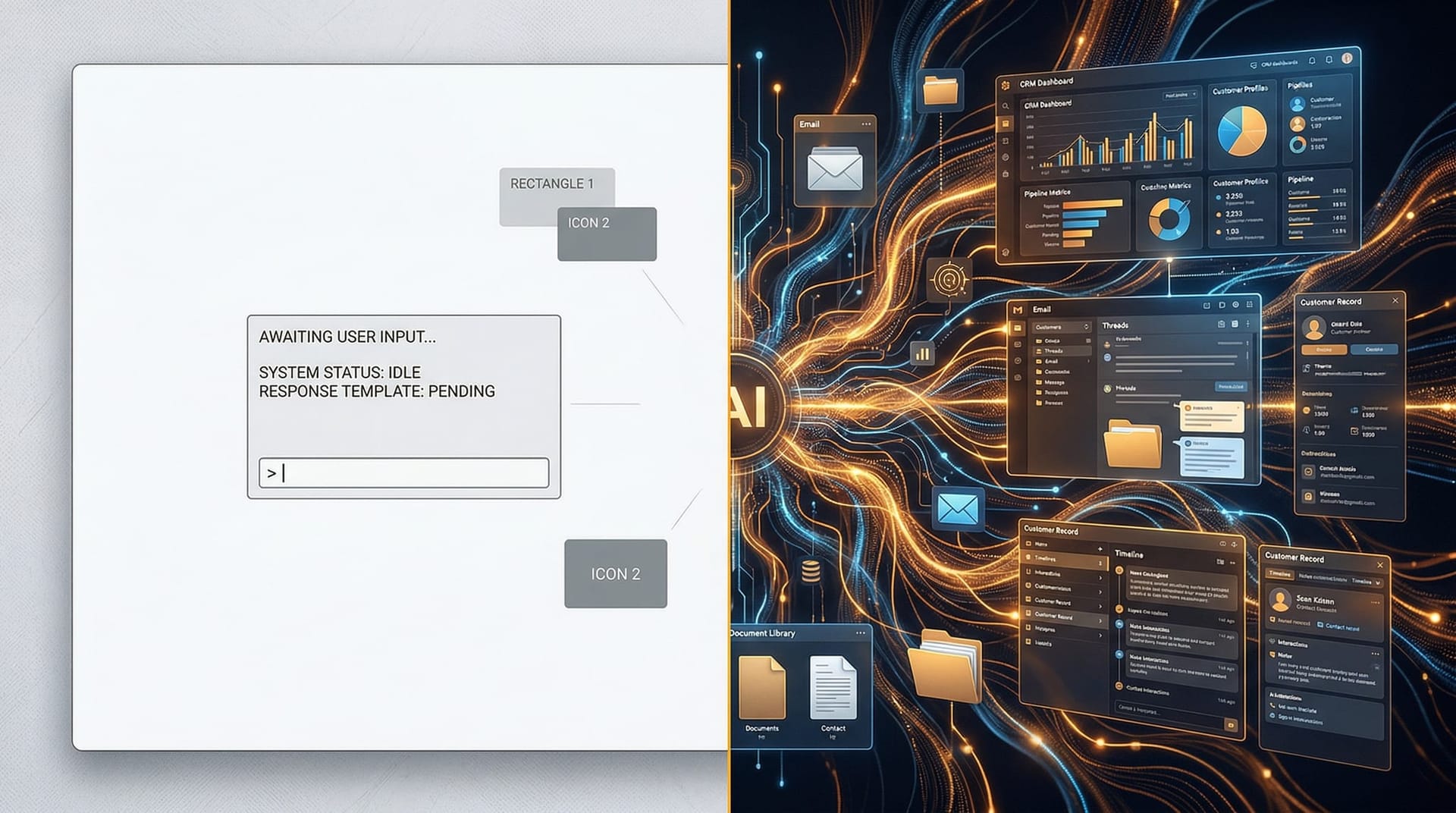
For the last two years, the agentic AI stack had a middle. LangChain, LangGraph, CrewAI, AutoGen, and the long tail of Python frameworks built around the same idea — wrap the foundation model API, give it tools, give it memory, give it planning, give it loops, give it observability hooks — were the AI scaffolding layer between the model below and the application above. The argument for the middle was always the same: foundation models would stay general-purpose, applications would stay specific, and the scaffolding would do the translation work in between.
That argument is collapsing in real time. In a VentureBeat interview last week, LlamaIndex CEO Jerry Liu — who built one of the original scaffolding-layer companies and watched a generation of competitors do the same — argued that the foundation-model vendors are moving the orchestration inside their own platforms. Anthropic's Claude Managed Agents, OpenAI's Workspace Agents, Google's Deep Research, Salesforce's Agentforce Operations: each is moving the planning, the tool-calling, the memory, and the loop control into the platform itself. The middle is being eaten.
For mid-market AI Employee buyers signing twelve-month contracts this quarter, the implication is concrete and uncomfortable. If your AI Employee vendor's moat is “we have a LangChain integration” — or any architectural equivalent — you are buying a layer that is structurally on the wrong side of the consolidation curve. The buyer test that follows from this thesis is the rest of this piece.
Key Takeaways
- The generic Python framework layer that wraps foundation-model API calls — the scaffolding layer — is being absorbed into the foundation-model platforms themselves, per LlamaIndex CEO Jerry Liu's 2026-05-01 VentureBeat interview.
- Three layers survive the collapse: the interface layer the user actually touches, the data and knowledge layer that gives the agent its substrate, and the governance and gateway layer that enforces the firm's policy boundary.
- The mid-market AI Employee buyer test is whether the vendor's moat sits in one of the surviving three layers or in the scaffolding layer that is being absorbed.
- LlamaIndex itself has pivoted publicly to “agentic document processing” — owning the data and knowledge layer rather than the framework layer — which is the live example of the architectural pivot the thesis predicts.
- The 3-row vendor-moat comparison table later in this post is the operational test. A vendor whose moat is on the scaffolding row is a vendor whose moat is being absorbed.
- For NE Indiana mid-market buyers, the practical implication is to read every 2026 AI Employee contract through the three-layer test before signing.
What does it mean for the AI scaffolding layer to collapse?
The scaffolding layer's job description, for most of the last two years, was simple in shape: take a foundation model API call and wrap it with everything the model could not do natively — tool definitions, function calling, state management, planning loops, retrieval augmentation, observability, evaluation harnesses, multi-agent coordination. LangChain was the first popular implementation. LangGraph extended it with explicit graph-based control flow. CrewAI, AutoGen, and a dozen smaller projects each offered slightly different shapes of the same idea. Most production agentic systems in 2024 and 2025 had at least one of these frameworks somewhere in the stack.
The collapse argument, as the VentureBeat coverage of Liu's interview presents it, is that the foundation-model vendors are absorbing the framework's job into the platform. The model API is no longer just “give me a completion”; it is “give me a managed agent with tools, memory, planning, retrieval, evals, and observability — and I will operate it for you.” Anthropic's enterprise platform documentation describes the managed-agent posture explicitly on the Claude for Enterprise page — the vendor's job is no longer ending at the model boundary. OpenAI Workspace Agents moves the same scope. Google Deep Research does it for the research workflow specifically. Salesforce Agentforce Operations does it inside the CRM stack. Each platform has its own version of what used to be the scaffolding layer's job, integrated more deeply with the platform's identity, data, and policy surfaces than any external framework can match.
The pattern follows the usual shape of platform absorption. A generic open-source library does enough of the job to spawn an ecosystem; the platform vendor watches the ecosystem mature, identifies the parts that are differentiated and the parts that are commodity, ships native implementations of the commodity parts, and lets the rest of the ecosystem either move up the stack into the differentiated layers or move out of the way. The same pattern absorbed the standalone analytics layer into the cloud data warehouse, the standalone payments-gateway layer into the e-commerce platform, and the standalone CRM-orchestration layer into the underlying CRM. There is nothing AI-specific about the dynamic, but there is something AI-specific about the speed.
LlamaIndex's own public pivot is the live illustration of the thesis. The LlamaIndex blog describes the company today as “agentic document processing” — best-in-class document infrastructure for agentic work automation — not as a generic framework. The company is moving up the stack into the data and knowledge layer, away from the scaffolding layer it helped invent. Liu is making the argument and executing the pivot. That combination is the most credible version of an architectural thesis: someone whose business depends on being right about the prediction is acting on it.

Which three layers survive the agentic AI consolidation?
The three layers that survive — the layers any 2026 mid-market AI Employee vendor needs a defensible position in — are the interface layer, the data and knowledge layer, and the governance and gateway layer. They survive because each does work the foundation-model platform structurally cannot do for the buyer.
The interface layer. The interface layer is what the user actually touches — the conversation surface, the in-product action surface, the phone call, the email reply, the dashboard, the embedded sub-agent. The foundation-model platform delivers raw managed-agent capability; it does not deliver a clinic intake workflow, a personal-injury law firm's case-intake conversation, an HVAC contractor's dispatch surface, or a community bank's branch operations dashboard. The interface is where the model becomes a useful operational employee, and the interface is shaped by the buyer's vertical, the buyer's brand, and the buyer's existing workflow — none of which the foundation-model platform has visibility into. We made this argument in more depth in why AI interfaces matter more than the models themselves, and the scaffolding-layer collapse strengthens it. The argument was load-bearing then. It is more load-bearing now.
The data and knowledge layer. The data and knowledge layer is what gives the agent its substrate — the persistent memory, the compiled domain knowledge, the world model the agent reasons against, the retrieval indices that ground its outputs. The foundation-model platform offers a generic version of each, but every version is provider-locked, generic in its abstractions, and unaware of the buyer's specific document corpus, decision history, and operational context. The substrate layer is the part of the agent that compounds value over time — every interaction adds to the corpus, every decision refines the memory, every retrieval improves the next one. We covered the architecture in detail in Karpathy's LLM knowledge base architecture beyond RAG, the substrate evolution in world models as the next AI architecture for AI Employees, the memory dynamics in Google ReasoningBank and compounding agent memory, and the data-stack reshaping in the data stack rebuilt for AI agents. These four posts compose the architectural arc; the scaffolding-layer collapse is the framing that pulls them into a single thesis.
The governance and gateway layer. The governance and gateway layer is what enforces the buyer's policy boundary — the egress allow-list, the data-class redaction, the identity-bound capability tokens, the audit log, the human-approval gate for high-tier actions, the runtime detection for confused-deputy patterns. The foundation-model platform supplies its own controls, and they are improving quickly, but they enforce the vendor's policy boundary, not the buyer's. A firm that wants its policy to be “this agent may only call these six APIs, only with these data classes, only on behalf of this user identity, only with audit logs written to this storage account” cannot get that policy delivered by the foundation-model platform alone. The shape of the governance layer follows the NIST AI Risk Management Framework Govern/Map/Measure/Manage functions and the OWASP Top 10 for LLM Applications 2025, particularly LLM06 (Excessive Agency). The architectural shape lives in the AI operating layer and workforce architecture piece — the governance layer is the operating layer's enforcement edge.
The three layers are independent — a vendor can have a defensible position in one, two, or all three — but the structural argument is that one is not enough. An interface-only vendor is replaceable. A data-only vendor is undifferentiated against the platform's native retrieval. A governance-only vendor is a single-feature checkpoint, not a system. The mid-market AI Employees that compound value are the ones that own all three layers as a single integrated product.

What is the 3-row vendor moat test for an AI Employee buyer?
The test below is the one we use internally when buyers ask us how to evaluate other AI Employee vendors. It is not a competitive scorecard; it is a structural question about which layer the vendor's moat actually sits in. Each row names a moat shape, the kind of vendor that claims it, what the test reveals, and what the buyer should do about it.
| Moat shape | Vendor claim | What the test reveals | Buyer action |
|---|---|---|---|
| Scaffolding moat (eroding) | "We have a LangChain (or LangGraph, CrewAI, AutoGen) integration. Our orchestration framework is what makes us defensible." | This moat sits in the layer that is being absorbed by the foundation-model platforms. Twelve to twenty-four months from now, the vendor will either pivot up the stack into one of the surviving layers or be obsoleted by the platform's native orchestration. | Ask the vendor for their 18-month roadmap on which surviving layer they are moving into. A vendor with no answer is a vendor whose business model has not caught up with the architectural reality. |
| Interface + knowledge moat (defensible) | "We own the user interface, the vertical workflow integration, and the persistent knowledge corpus. The model is a swappable component." | This moat sits across two surviving layers — interface and knowledge — and treats the foundation-model platform as the commodity it is becoming. Model-portability is a strong indicator the vendor understands the consolidation curve. | Verify the model-portability claim. Ask which foundation models the vendor has deployed in production for which workloads, and what the swap process looks like operationally. |
| Full three-layer moat (compounding) | "We own the interface the user touches, the knowledge corpus the agent reasons against, and the governance gateway that enforces the firm's policy boundary." | This is the full surviving stack. The model-platform absorption does not erode the vendor's position because the vendor's value is in the layers the platform does not own. | The diligence question shifts from "is this moat real?" to "is this vendor executing well in three layers simultaneously?" Ask for production references that exercise all three. |
Two notes on running this test. First, the table is structural, not competitive — a small, vertically focused vendor can win on the three-layer test against a large, generically positioned vendor. The size of the vendor is irrelevant; the layer position is the test. Second, the test is most useful at contract signing time, not at vendor-shortlist time. Most vendors can produce a marketing answer to the moat question at shortlist; far fewer can produce a credible operational answer when the contract terms get specific about model portability, data ownership, and governance boundary enforcement.
A broader observation on the consolidation curve, consistent with the thesis work published on the Andreessen Horowitz AI portal on agentic AI infrastructure: the winners at the platform layer accumulate the most generic capability, and the winners at the application layer accumulate the most specific capability. The middle gets squeezed from both ends. The scaffolding-layer collapse is the middle getting squeezed. The vendor-moat test is whether the AI Employee buyer is buying the middle or one of the two ends.

Why does this matter for AI Employee buyers specifically?
The scaffolding-layer collapse argument matters more for AI Employee buyers than for generic AI tool buyers because the AI Employee category is structurally a long-duration relationship with the vendor, not a transactional one. A buyer who picks an AI Employee in 2026 is committing to a vendor whose substrate the firm's operations will be shaped around for two to five years. The substrate has to age well. A vendor whose moat is in the layer being absorbed will not age well.
The honest answer in some cases is that the buyer is better off waiting one more vendor generation. The 2024–2025 wave of AI Employee vendors was disproportionately built on the scaffolding layer because that was the available open-source substrate. The 2026 wave is being built on the surviving three layers because that is now the architectural consensus. Buyers who can wait a quarter or two are getting a structurally different product than buyers who signed twelve-month contracts in 2024. We made the same argument earlier in the year in why generic AI tools fail and custom AI Employees don't — the layer position is the test, not the vendor's marketing.
The second-order effect worth naming is operational discipline. A buyer who internalizes the three-layer test changes how they evaluate every vendor demo. The demo question stops being “does this work?” — every modern AI Employee works in a demo — and starts being “which layer does the value in this demo come from?” If the value is coming from the foundation model, the vendor is showing you what the platform already does. If the value is coming from the interface, the knowledge corpus, or the governance boundary, the vendor is showing you something the platform structurally cannot deliver. The disciplined buyer learns to read demos for layer position. The undisciplined buyer signs the contract.
The forward-looking observation is that the consolidation curve has not finished. The scaffolding layer is the first to be absorbed; the boundary between the interface layer and the application layer is the next conversation, and it will not look the same. AI Employees that ship today as “the interface to the work” will, three years from now, be tested on whether the interface is also the work itself — whether the AI Employee owns the entire vertical operation, not just the conversation around it. That is the next architectural compression. But that is a 2027 piece.
What does this mean for NE Indiana mid-market AI Employee buyers?
For NE Indiana operators reading this — the 25-to-250-seat firms across Auburn, Fort Wayne, DeKalb, Allen, Whitley, and Noble Counties who are evaluating AI Employee contracts this quarter — the practical advice is to bring the three-layer test to every vendor conversation in 2026. Ask which layer the moat lives in, ask for the 18-month roadmap, ask for production references that exercise the interface, the knowledge corpus, and the governance boundary. The vendors whose answers are structurally coherent will look different from the vendors whose answers are marketing-coherent; that difference is the signal worth listening for.
Cloud Radix AI Employees are deliberately built across the three surviving layers — the interface the operator's customers and team touch, the persistent knowledge corpus that compounds across every interaction, and the Secure AI Gateway that enforces the firm's policy boundary at runtime. We publish the three-layer test rather than hide it because the test is the right diligence either way; a buyer who runs it on Cloud Radix and on every alternative will arrive at the right answer whether the answer is us or not. The structurally interesting moment in mid-market AI is the consolidation, not the marketing around it. The buyers who internalize the architecture will be operating two to three years ahead of the buyers who do not. NE Indiana operators have the same opportunity to lead on this as anyone else in the country — the math does not require coastal latitude. If you are running this test on your shortlist and want a second pair of eyes on the layer-position read, contact Cloud Radix and we will walk it with you.

Frequently Asked Questions
Q1.What is the AI scaffolding layer?
The AI scaffolding layer is the middle layer of the agentic AI stack — the framework code that sits between the foundation-model API and the application, doing tool definition, function calling, state management, planning loops, retrieval augmentation, observability, and multi-agent coordination. LangChain, LangGraph, CrewAI, and AutoGen are the most widely used examples. The collapse argument is that the foundation-model platforms are absorbing the scaffolding layer's job into their own managed-agent products, leaving the framework layer structurally redundant for most production use cases.
Q2.Why is the scaffolding layer being absorbed by foundation-model vendors?
The platform-absorption pattern follows the usual shape. A generic open-source library does enough of a job to spawn an ecosystem; the platform vendor watches the ecosystem mature, identifies the commodity parts, ships native implementations of those parts, and leaves the differentiated parts to the ecosystem. Anthropic Claude Managed Agents, OpenAI Workspace Agents, Google Deep Research, and Salesforce Agentforce Operations are each shipping native versions of what the scaffolding layer used to do. The integration depth with the platform's identity, data, and policy surfaces is the structural advantage the external framework cannot match.
Q3.Which three layers of the agentic AI stack survive the scaffolding collapse?
The three surviving layers are the interface layer the user actually touches, the data and knowledge layer that gives the agent its substrate (memory, compiled knowledge, retrieval), and the governance and gateway layer that enforces the firm's policy boundary. Each survives because it does work the foundation-model platform structurally cannot do for the buyer — the interface is shaped by vertical, brand, and workflow; the substrate is shaped by the firm's specific corpus and decision history; the governance layer enforces the buyer's policy, not the vendor's.
Q4.What does the 3-row vendor moat test reveal?
The test reveals whether the AI Employee vendor's defensible position sits in the scaffolding layer that is being absorbed, in two of the three surviving layers (interface and knowledge), or across all three (interface, knowledge, and governance). A vendor whose moat is the scaffolding row is structurally on the wrong side of the consolidation curve and will either pivot up the stack within 18 months or be obsoleted by platform-native orchestration. A vendor whose moat is across all three surviving layers is positioned to compound value over time because the platform absorption does not erode the layers the vendor owns.
Q5.How should a mid-market buyer evaluate an AI Employee vendor in 2026?
Bring the three-layer test to every vendor conversation. Ask which layer the moat lives in, ask for the vendor's 18-month roadmap on layer position, and ask for production references that exercise the interface, knowledge, and governance layers separately. Read every demo for layer position — if the value comes from the foundation model itself, the vendor is showing you what the platform already does; if the value comes from the surviving layers, the vendor is showing you something the platform structurally cannot deliver. The disciplined buyer reads demos for layer position. The undisciplined buyer signs the contract.
Q6.Is LangChain dead?
Not yet, and not entirely. The framework still has a large installed base and is useful for prototyping, internal tooling, and use cases where the platform's native orchestration is not yet feature-complete. The collapse argument is structural, not immediate — over the next 12 to 24 months, the platform's native orchestration will close most of the gap, and the framework layer's role will compress to the use cases where platform-native is not the right answer. Production AI Employees being built today on a framework-only moat are the ones with the highest pivot risk; buyers should weight that risk in contract terms.
Q7.How does the collapse affect AI governance and the Secure AI Gateway?
The governance layer is one of the three surviving layers and is structurally strengthened by the scaffolding collapse, because the foundation-model platforms enforce the vendor's policy boundary, not the buyer's. A Secure AI Gateway-style egress chokepoint that sits between the AI Employee and the outside world becomes more important as more of the orchestration moves inside the platform — the gateway is the buyer's enforcement surface for the policy decisions the platform cannot make on the buyer's behalf. The architectural shape follows the NIST AI Risk Management Framework's Govern and Manage functions.
Sources & Further Reading
- VentureBeat: venturebeat.com/infrastructure/the-ai-scaffolding-layer-is-collapsing-llamaindexs-ceo-explains-what-survives — The AI scaffolding layer is collapsing. LlamaIndex's CEO explains what survives.
- LlamaIndex: llamaindex.ai/blog — LlamaIndex Blog — Agentic Document Processing.
- NIST: nist.gov/itl/ai-risk-management-framework — AI Risk Management Framework.
- Andreessen Horowitz: a16z.com/ai — Andreessen Horowitz — AI.
- OWASP GenAI Security Project: genai.owasp.org/llm-top-10 — OWASP Top 10 for LLM Applications 2025.
- Anthropic: anthropic.com/enterprise — Anthropic — Claude for Enterprise.
Run the Three-Layer Test on Your Shortlist
Bring your current AI Employee shortlist to Cloud Radix and we will walk the scaffolding-vs-surviving-layer read with you — vendor by vendor, claim by claim, contract by contract.