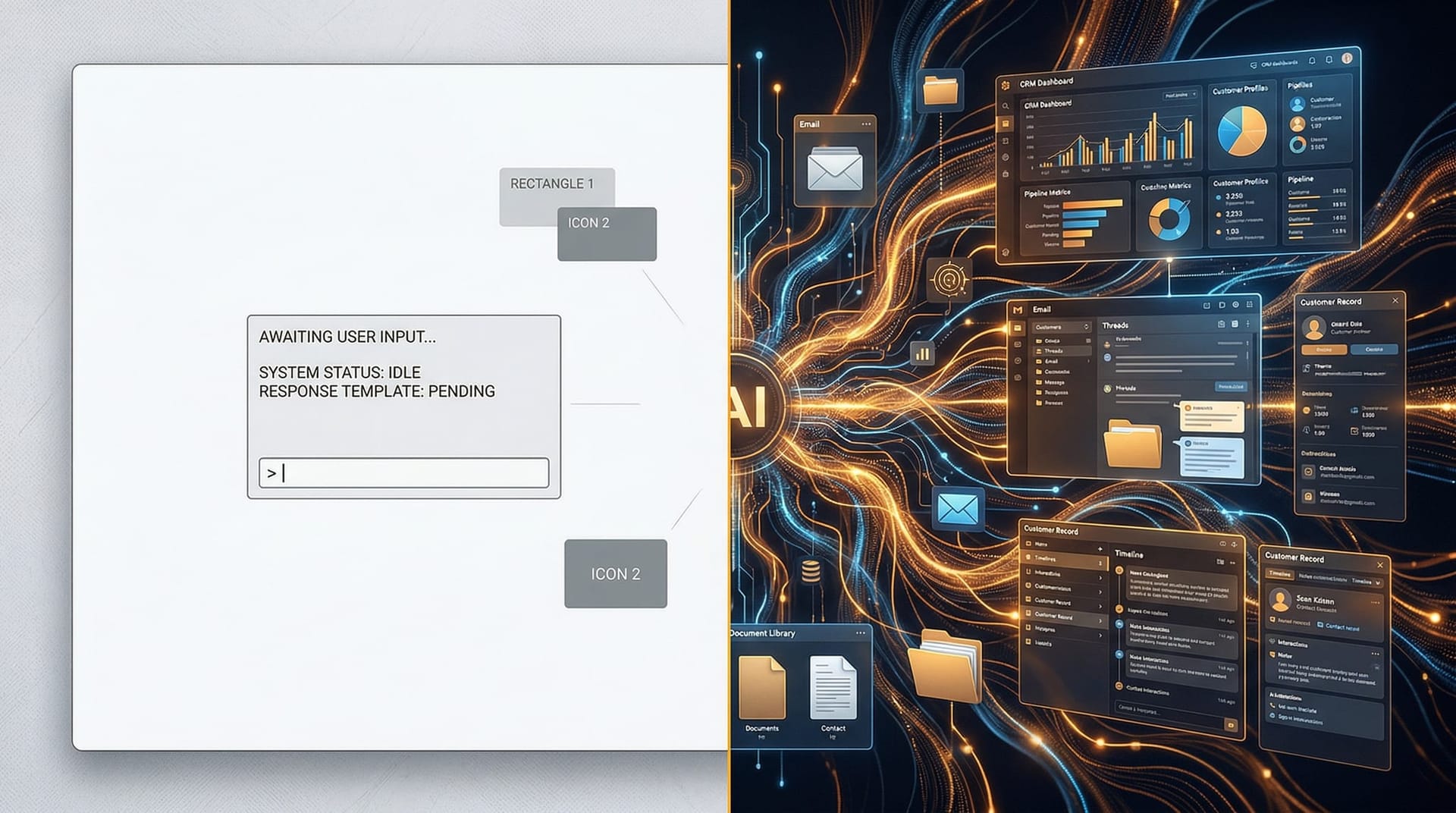
For most of the last two years, “custom AI” was a phrase that meant something specific and operationally out of reach for the mid-market: hire an ML team, label thousands of examples, run a fine-tuning pipeline, deploy and monitor the resulting model, and re-do all of it every quarter as the data drifts. A 60-person manufacturer in DeKalb County, a 120-person clinic group in Allen County, or a 40-person law firm in Auburn could read the playbook and immediately do the headcount math: no in-house ML team, no $400K-per-year MLOps engineer, no path. The default was to keep using the same generic Claude or GPT endpoint everyone else was using and hope the prompt engineering held up.
A recent VentureBeat report reframes that math. The reporting argues that production workflow telemetry — the CRM records that get closed, the dispatch logs that get resolved, the support tickets that get satisfied, the billing exceptions that get cleared, the line-monitoring events that get acknowledged — is now a first-class training-data substrate in its own right. The labeling burden has collapsed because workflow outcomes already carry implicit labels: closed-won versus closed-lost, shipped versus RMA'd, paid versus disputed. The training pipeline that used to sit on a dedicated ML team's roadmap is being absorbed into the same operational data plane the firm already runs.
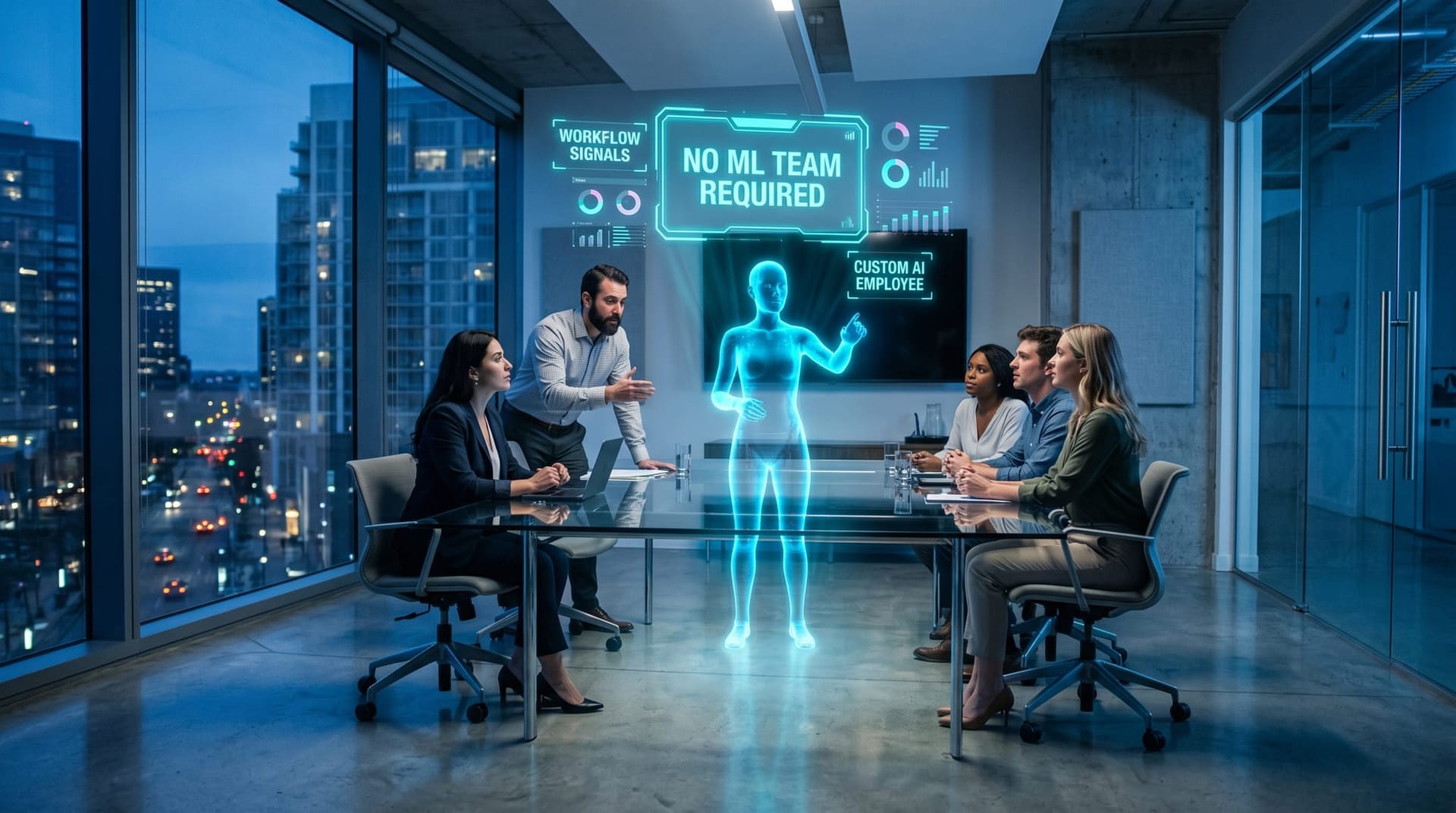
The phrase “no ML team required” is the operational unlock, not the marketing line. It means a mid-market firm with zero ML headcount can now ship a custom AI Employee that learns from its own work product over a quarter — and the buyer test that separates a real custom AI from a fine-tuned wrapper is whether the system learns from its own operational outcomes over that quarter. The rest of this piece is the mechanism.
Key Takeaways
- Production workflow telemetry — CRM closes, dispatch outcomes, billing exceptions, line-monitoring events — is now a first-class training-data substrate for custom AI Employees, with no dedicated ML team required.
- The labeling burden has collapsed because workflow outcomes carry implicit labels: closed-won/closed-lost, shipped/RMA'd, paid/disputed, resolved/escalated.
- The governance perimeter shifts: the Secure AI Gateway now mediates training-data egress, not just model API calls — every signal that becomes training data has to cross the same policy boundary as every prompt.
- The buyer test for a real custom AI Employee is whether the system measurably learns from its own operational outcomes over a single quarter — not whether it sounds smart in a demo.
- The 4-row vertical adoption table later in this post maps the no-ML-team mechanism to mid-market manufacturing, healthcare operations, professional services, and home services with named NE Indiana scenarios.
- The 90-day pilot pattern Cloud Radix runs is one workflow signal ingested per quarter — predictable, auditable, and operationally honest about what the AI Employee will and will not learn in that window.
Why does the “no ML team” framing matter for mid-market AI buyers?
For most of 2024 and 2025, the structural assumption baked into AI vendor proposals was that custom AI required custom ML headcount. Even the vendors who never said it out loud assumed it implicitly: their pricing, their onboarding timeline, and their “data science partnership” language were all sized for a buyer who could absorb the ML staffing footprint. The mid-market could not, which is why most mid-market AI deployments in 2024–2025 ended up on generic endpoints — a vanilla Claude or GPT call wrapped in a prompt template and a handful of system instructions.
The generic endpoint approach has a ceiling. The model is trained on the internet, not on your firm's operational corpus, and it cannot tell you which of your supplier disputes typically resolve in your favor, which of your prior-auth submissions historically get approved on the first try, or which of your roofing leads typically convert at full margin. The substrate is wrong. We argued the structural form of this ceiling earlier in why generic AI tools fail and custom AI Employees don't — the substrate has to compound on the firm's actual decisions for the value to be real.
The “no ML team” mechanism changes what is possible because it removes the headcount precondition. The training data is the workflow telemetry the firm is already producing. The label is the workflow outcome the firm is already recording. The pipeline is a side-effect of the same operational data plane the firm already runs for CRM, ERP, dispatch, billing, and case management. The training itself happens inside the foundation-model platform's managed fine-tuning surface — Anthropic, OpenAI, Databricks Mosaic AI, Snowflake Cortex, and the open-source equivalents have all been moving in this direction over the last twelve months — and the operational team's job is no longer “build a model” but “decide which workflow signal to expose and govern its egress.”
The implication for the mid-market is concrete. The first AI Employee that learns from a firm's own production workflow signal is the AI Employee that compounds value across the rest of the firm's operations. The second-quarter pipeline, the third-quarter pipeline, and the fourth-quarter pipeline get easier. The buyer who runs one no-ML-team pilot per quarter in 2026 has a fundamentally different AI Employee in 2027 than the buyer who is still on a generic endpoint. The Stanford HAI 2026 AI Index Report documents the broader curve of operational AI adoption versus generic deployment, and the gap widens in 2026 — the firms that have started compounding on their own signals are pulling away from the firms that have not.

What workflow signals become training data?
The workflow signals that work as training data share three properties: they are produced as a side-effect of normal operations, they carry an outcome that is recorded somewhere in the firm's existing system of record, and they describe a decision the AI Employee will be asked to assist with. Anything that does not have all three is not training data yet — it is operational telemetry waiting for an outcome to be appended.
The pattern is easier to see in concrete signal examples than in abstract specifications:
- CRM dispositions. Every closed lead — won, lost, no-show, ghosted, unqualified — is an implicit label paired with the conversation transcript, the prior emails, the meeting notes, and the firmographic context. The AI Employee that drafts the first-touch email learns which framings produce a closed-won; the one that triages the inbox learns which inquiries are real and which are tire-kickers.
- Dispatch and field-service outcomes. Every service call that closes “completed,” “callback required,” “warranty,” or “no charge” pairs the original ticket with the resolution and the on-site notes. The AI Employee that takes the inbound call learns which symptom descriptions predict which truck-roll outcomes — including the cases where the right answer is “do not roll a truck, do this on the phone.”
- Billing exceptions. Every invoice that gets disputed, adjusted, written off, or paid on time pairs the line items with the outcome. The AI Employee that reviews the AR queue learns which exception patterns are recoverable and which are write-off candidates from the first read.
- Prior-auth and claims outcomes. Every healthcare prior-authorization that comes back approved, denied, or pended pairs the submitted package with the outcome. The AI Employee that prepares the next submission learns which documentation patterns shorten the cycle.
- Quality-event and RMA outcomes. Every line-monitoring event that resolves “false positive,” “minor adjustment,” or “stop the line” pairs the sensor trace with the resolution. The AI Employee that watches the stream learns which signal patterns warrant an interrupt.
- Engagement closeouts. Every professional-services engagement — legal matter, accounting close, insurance claim, consulting deliverable — has a closeout outcome. The AI Employee that drafts the first-draft scope learns which engagement shapes typically finish on budget.
A useful way to think about the signal taxonomy is that the workflow outcome is the cheap label — it costs nothing extra to record because the firm is already recording it. The expensive labels of the 2020–2024 era (“a human annotator decides whether this transcript is good or bad”) were the bottleneck that made custom AI hard. The cheap labels are the bottleneck breaker. We covered the architectural shape of this kind of compounding-knowledge substrate in Karpathy's LLM knowledge base architecture beyond RAG — the workflow-outcome signal is the practical version of the substrate that piece described in the abstract.
The signal taxonomy is also why the no-ML-team mechanism does not work everywhere. Workflows without recorded outcomes do not yield training data. Workflows whose outcomes are recorded weeks or months later — a long-cycle litigation matter, a multi-year construction job — yield training data slowly and the iteration cadence is slow with them. The first pilot signal is usually the workflow with the shortest outcome cycle: a CRM disposition, a dispatch close, a billing exception, a prior-auth response. Long-cycle signals come later.

What does the 4-row vertical adoption table look like in the mid-market?
The table below is the operational shape of the no-ML-team pattern across four mid-market verticals Cloud Radix sees most often in NE Indiana. Each row names the workflow signal that becomes training data, the data owner who must sign off on it, the named NE Indiana scenario, and the first 60 days of the pilot.
| Vertical | Workflow signal | Data owner | NE Indiana scenario | First 60 days |
|---|---|---|---|---|
| Mid-market manufacturing (25–250 employees) | Line-monitoring events + RMA dispositions + supplier dispatch outcomes — paired sensor trace, work-order context, and resolution code. | Operations Director (line monitoring) and Quality Manager (RMA) share ownership; IT signs the egress agreement. | A DeKalb County food-grade fabrication shop running a custom AI Employee that listens to its OEE event stream and learns which alerts historically warranted a stop-the-line versus a continue-and-flag. | Days 1–14: catalog signals and define implicit labels. Days 15–30: stand up signal egress through the Secure AI Gateway with redaction. Days 31–60: train, deploy read-only AI Employee, log predictions for the quarter. |
| Mid-market healthcare operations (25–250 employees) | Scheduling exception dispositions + prior-auth outcomes — paired patient context, submission package, and approval/denial/pended response. | Director of Revenue Cycle (prior-auth) and Practice Manager (scheduling); compliance signs the PHI handling agreement. | An Allen County multi-site specialty group running a custom AI Employee that drafts prior-auth submissions and learns which documentation patterns shorten the approval cycle for the specific payer mix. | Days 1–14: PHI inventory and BAA review. Days 15–30: train against a redacted historical corpus inside the gateway boundary, no PHI leaves the perimeter. Days 31–60: shadow-mode behind a human approver. |
| Professional services (25–250 employees) | Engagement closeouts + billing exceptions — paired matter context, time entries, scope changes, and final realization or write-off outcome. | Managing Partner and Director of Finance share ownership; Compliance Officer signs the privilege boundary. | A Whitley County insurance brokerage running a custom AI Employee that drafts renewal proposals and learns which proposal shapes correlate with retention versus shop-out. | Days 1–14: privilege boundary mapping. Days 15–30: train on five years of closed-out engagements with realization labels; deploy as draft-only AI Employee. Days 31–60: every renewal A/B against the human draft. |
| Home services (25–250 employees) | Dispatch outcomes + estimate-to-job conversion — paired call transcript, technician notes, estimate, and final invoice or no-sale disposition. | Operations Manager and Sales Manager share ownership; IT signs the call-recording egress agreement. | A Noble County multi-trade home-services operator running a custom AI Employee that takes the inbound call, qualifies the lead, and learns which call patterns convert to a sold estimate versus a no-show. | Days 1–14: TCPA and consent inventory for call recordings. Days 15–30: train against a redacted call corpus with conversion labels. Days 31–60: deploy as co-pilot to the call team, every transcript scored against actual outcome. |
Two patterns are worth naming across the four rows. First, the data owner is never IT alone — every workflow signal has an operational owner who has to sign off on what becomes training data and what does not, and the no-ML-team pattern only works if that operational owner is in the room from day one. Second, the first 60 days are dominated by signal hygiene, not model training — cataloging, redacting, governing egress, and getting the policy perimeter right. The actual fine-tuning is the cheap part. We covered the operational discipline of running this kind of program in how to measure AI Employee performance — the measurement framework gates whether the AI Employee is actually learning, and the framework only works if the signal-hygiene work is done first.
The 80–90% video-AI cost compression covered in the Perceptron Mk1 mid-market playbook — published yesterday with the same four-vertical table shape — is the cost half of the same architectural compression: cheaper inference and operationally tractable training compound in the same direction. A buyer who started a custom-AI-from-workflow-signals pilot in Q2 of 2026 will see both lines move in their favor through 2027.

How does the Secure AI Gateway change when training data moves through it?
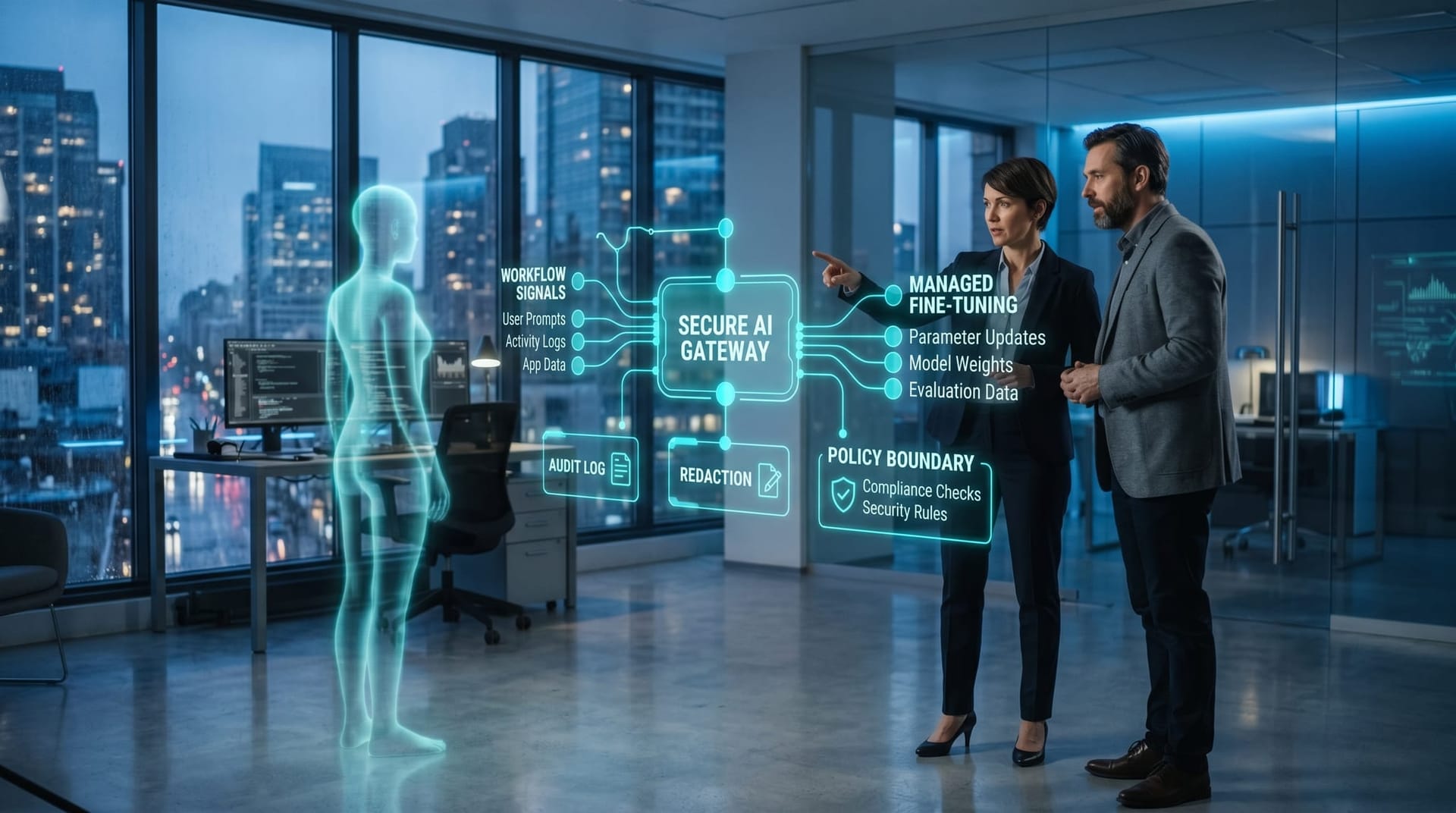
The architectural shift that makes the no-ML-team pattern operationally safe is that the gateway between the firm and the foundation-model platform now mediates training-data egress, not only model API calls. In the 2024–2025 deployment pattern, the gateway's job was a request-time policy check: every prompt that went out carried a redaction pass, an identity check, an egress allow-list, and an audit log entry. The training-data ingest pipeline did not exist for most mid-market firms, so the gateway had nothing to enforce at training time.
In the 2026 pattern, the Secure AI Gateway sits in front of both surfaces. Every signal that becomes training data — the CRM disposition feed, the dispatch outcome stream, the prior-auth response log, the line-monitoring event trace — passes through the gateway on its way to the training pipeline. The gateway applies the same redaction rules, the same data-class enforcement, the same egress allow-list, and the same audit log, except now the policy decisions are being made at training-data-ingest time, not just at prompt-emit time. The architectural shape follows the NIST AI Risk Management Framework Govern and Manage functions, and the same kind of egress chokepoint pattern recommended in OWASP Top 10 for LLM Applications 2025 LLM06 (Excessive Agency).
Three governance properties matter for the mid-market buyer in particular. First, the gateway is the buyer's enforcement surface, not the vendor's — the policy boundary is the firm's policy, defined by the firm's compliance, legal, and operational stakeholders, and the foundation-model platform never sees the raw signal. Second, the audit log is generated as a side-effect of the ingest, so the compliance evidence the firm needs to demonstrate “we know what data went into training this model” exists by default. Third, the policy boundary is enforced at runtime, not at procurement — the firm does not have to trust the vendor to keep doing the right thing; the gateway makes the policy enforceable independently of the vendor's behavior. The structural argument follows what we covered in the AI operating layer and workforce architecture — the gateway is the operating layer's enforcement edge for both runtime and training-time data flow.
The ISO/IEC 42001 management-system standard formalizes the same governance posture at the organizational level. The ISO/IEC 42001 framework describes an AI management system that covers training-data lifecycle, model lifecycle, and operational lifecycle as a single integrated program; the gateway is the practical control surface that makes the management system enforceable in production. For mid-market buyers who are signing 2026 AI Employee contracts and reading their cyber-liability insurance policies in parallel, the ISO/IEC 42001 alignment is increasingly being asked for at renewal time.
The platform-side tooling that makes the no-ML-team mechanism feasible — managed fine-tuning surfaces inside Anthropic, OpenAI, Google, Snowflake Cortex, and Databricks Mosaic AI — solves the model-side of the training problem, but only the gateway solves the data-side of it. The buyer who picks a vendor with a managed fine-tuning offer and no gateway story is solving half the problem.
The architectural pattern is also the right shape for a self-optimizing AI agent that learns from its own deployed-mode outcomes — an idea we covered separately in AutoAgent and self-optimizing AI agents. Workflow-signal training is the data-substrate version of the same compounding-improvement loop.
What does the 90-day no-ML-team pilot look like in practice?
The 90-day pilot is the operational form of the no-ML-team mechanism. Cloud Radix runs the cadence as one workflow signal ingested per quarter — predictable, auditable, and bounded in scope. The structure is the same across the four verticals in the adoption table; the contents change.
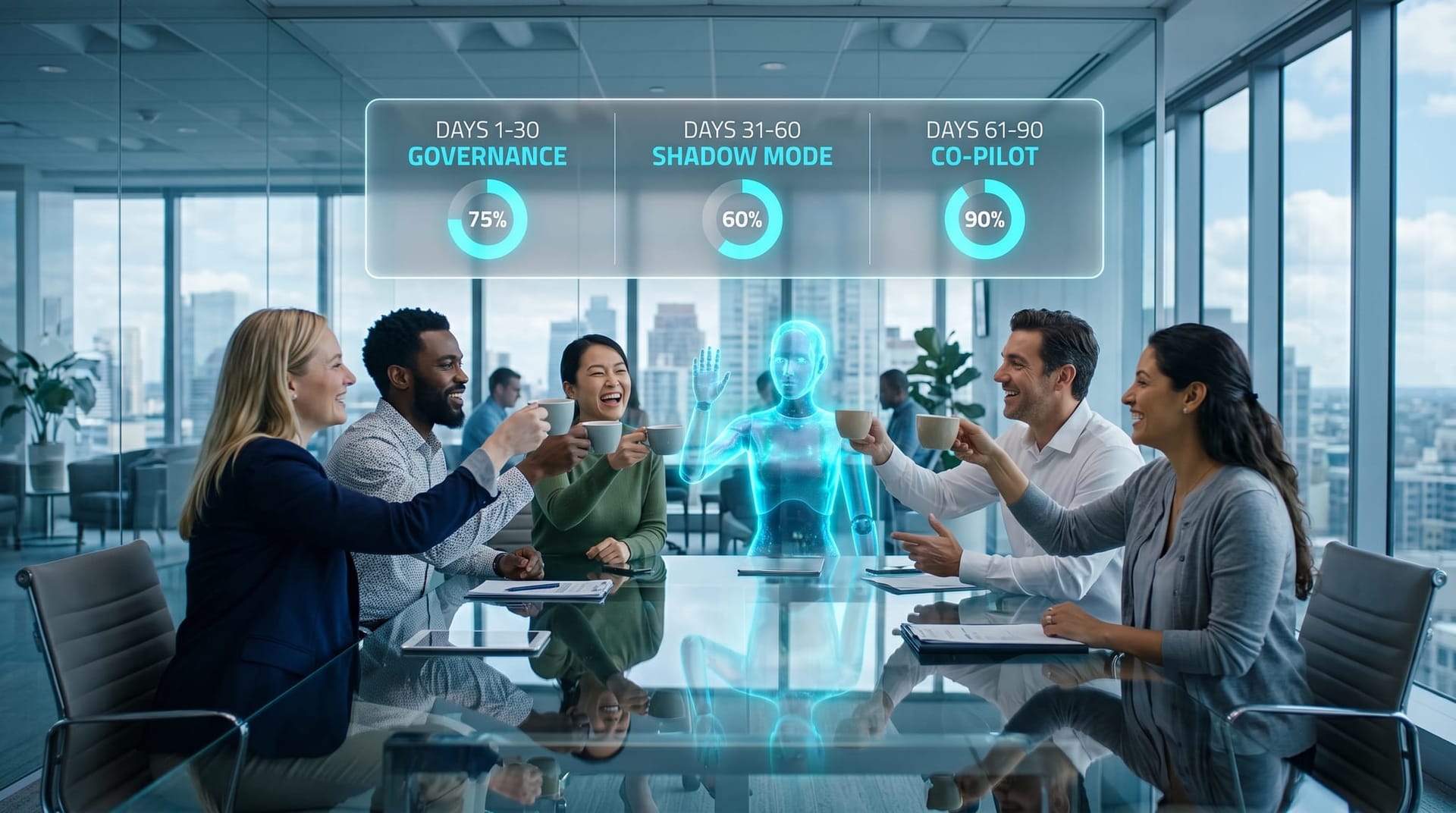
The first 30 days are signal selection and governance. The operational owner names the workflow signal, the data owner signs the egress agreement, and the Secure AI Gateway is configured with the redaction rules, the data-class enforcement, the identity boundary, and the audit-log destination. The first deliverable is not a model — it is a written description of what signal is being exposed, what is being held back, and who has to approve a change. Most pilots that fail in 2024–2025 failed because this 30-day window was skipped. The buyer that does it right has a defensible policy story for the next two years regardless of what happens to the underlying model.
The middle 30 days are training and shadow deployment. The managed fine-tuning runs against the redacted signal corpus inside the gateway's policy boundary. The resulting AI Employee is deployed in shadow mode — it generates the draft, the prediction, or the recommendation, but a human still ships the actual output. Every shadow-mode decision is logged with the workflow outcome that follows, so the measurement loop is closed before the AI Employee ever takes a live action.
The final 30 days are controlled production. The AI Employee moves from shadow mode to co-pilot mode — its output is the default, but a human approval gate stays in place for the high-tier actions identified in days 1–30. The measurement framework documented in how to measure AI Employee performance gates progression: the AI Employee earns more autonomy on a workflow when its prediction quality meets a defined bar, and the bar is the same bar a new human hire would be held to in the same role.
The buyer test at the end of the 90-day window is the one named in the introduction: does the system measurably learn from its own operational outcomes over the quarter? The answer is provable from the audit log if the gateway was set up right and the measurement loop was closed in days 31–60. A “yes” answer means the AI Employee is the real custom thing, not a fine-tuned wrapper. A “no” answer means the pilot caught the wrapper before the firm signed a multi-year contract on top of it — which is the right outcome too.
The 2026 pattern Cloud Radix runs is one workflow signal per quarter, four quarters per year, so a firm that starts in Q2 of 2026 has four custom AI Employees compounding by Q1 of 2027. The pace is deliberately slow enough to keep the governance and signal-hygiene work honest, and deliberately fast enough that the buyer does not lose a year to vendor-style “transformation programs” that produce slide decks instead of operational AI. The Fort Wayne manufacturers SAP AI governance playbook covered the same cadence shape for the ERP-side of the architecture.
What does this look like for NE Indiana mid-market operators?
For NE Indiana operators reading this — the 25-to-250-employee firms across Auburn, Fort Wayne, DeKalb County, Allen County, Whitley County, and Noble County who are sitting on quarter-end budget conversations about AI in 2026 — the no-ML-team mechanism is not a coastal-only opportunity. The signals that matter for a DeKalb fabrication shop, an Allen County multi-site clinic group, a Whitley County insurance brokerage, or a Noble County home-services operator are produced inside the firm and live inside the firm; the foundation-model platform never has to see them in raw form, and the firm never has to hire a coastal ML team to make the signals useful. The architectural compression is the equalizer.
The realistic constraint in NE Indiana is signal hygiene, not signal volume. Most mid-market firms in the region have five to ten years of operational data, which is more than enough to train a useful first AI Employee — the work to do is in cataloging, redacting, and governing it, not in producing more of it. The firms that are pulling ahead in 2026 are the ones whose operations directors have spent the first quarter mapping which workflow signals carry implicit labels, which carry sensitive data classes, and which fit the 90-day pilot shape. The technical work follows the operational decisions, not the other way around.
The honest trade-off is that the no-ML-team mechanism still requires some in-house time — typically the operations director, the IT lead, and a compliance reviewer for four to six hours per week through the first pilot, then declining as the signal-hygiene work amortizes. The pattern is not “no in-house effort.” It is “no in-house ML team.” For a 25-to-250-person mid-market firm, the difference is the difference between feasible and infeasible.
Cloud Radix runs the no-ML-team pattern as a productized 90-day pilot: one workflow signal ingested per quarter through the Secure AI Gateway, one custom AI Employee deployed in shadow then co-pilot mode, one auditable proof at the end of the quarter that the system is learning from your own operational outcomes. The buyer test is built into the pilot — the same test outlined above — and the pilot ends with a written answer the firm's compliance, legal, and operational stakeholders can sign off on.
Frequently Asked Questions
Q1.What does “no ML team required” actually mean for a mid-market firm?
It means the firm does not need to hire ML engineers, data scientists, or MLOps specialists to deploy a custom AI Employee in 2026. The training data is the workflow telemetry the firm is already producing, the labels are the workflow outcomes the firm is already recording, and the fine-tuning happens inside a managed platform surface. The operational team’s job shifts from “build a model” to “decide which workflow signal to expose and govern its egress.” The pattern is not zero-effort, but the effort is operational and governance work the firm is already partway through, not specialized ML engineering work.
Q2.Which workflow signals work as training data for a custom AI Employee?
Signals that are produced as a side-effect of normal operations, that carry an outcome recorded somewhere in the firm’s system of record, and that describe a decision the AI Employee will be asked to assist with. Examples include CRM dispositions, dispatch outcomes, billing exceptions, prior-auth approvals or denials, RMA dispositions, line-monitoring resolutions, and engagement closeouts. The defining property is the implicit label — the outcome that already exists in the data the firm collects.
Q3.How does training-data egress through the Secure AI Gateway work?
The Secure AI Gateway sits in front of every signal flowing into the training pipeline, applying the same redaction rules, data-class enforcement, egress allow-list, and audit logging that the gateway applies to runtime prompts. The foundation-model platform never sees the raw signal — it sees the redacted, policy-checked version. The audit log is generated as a side-effect of the ingest, so the firm has documentary evidence of what data was used to train the model. The architectural posture follows NIST AI RMF Govern and Manage functions and the OWASP LLM Top 10 (particularly LLM06 Excessive Agency).
Q4.What is the buyer test for a real custom AI Employee versus a fine-tuned wrapper?
The buyer test is whether the system measurably learns from its own operational outcomes over a single quarter. A real custom AI Employee improves on the firm’s specific workflow signals across the quarter, and the improvement is provable from the audit log of shadow-mode predictions versus actual outcomes. A fine-tuned wrapper does not improve in the same closed loop because it was tuned once at deployment and is being run against drift it cannot correct. The test is the same regardless of which vendor the buyer is evaluating.
Q5.How long does the no-ML-team pilot take in practice?
The Cloud Radix pattern is 90 days end-to-end. Days 1–30 are signal selection and governance — cataloging, redacting, and configuring the Secure AI Gateway policy boundary. Days 31–60 are managed fine-tuning and shadow-mode deployment, with every prediction logged against the actual workflow outcome. Days 61–90 are controlled production deployment in co-pilot mode behind a human approval gate, with the measurement framework gating any expansion of autonomy. The pace is one workflow signal per quarter so the governance and hygiene work stays honest.
Q6.Does the no-ML-team mechanism work for healthcare and regulated industries?
Yes, with additional governance work in the first 30 days. The PHI inventory, BAA review, and HIPAA Security Rule compliance work happens before any signal leaves the firm’s policy perimeter; the Secure AI Gateway enforces the redaction and egress rules at runtime so PHI never reaches the foundation-model platform in raw form. The same pattern applies to financial services under GLBA, to legal under privilege rules, and to insurance under the Indiana Department of Insurance regulatory framework. Regulated industries are not excluded — they front-load more of the governance work.
Q7.Why “no ML team” and not “no ML at all”?
The training, the inference, and the model lifecycle still involve ML — it has not disappeared. What has changed is who runs it. The managed fine-tuning surfaces inside Anthropic, OpenAI, Google, Snowflake Cortex, and Databricks Mosaic AI take over the work that used to require in-house ML engineering. The firm’s operational team owns the signals, the governance, and the deployment; the foundation-model platform owns the training infrastructure. The “no ML team” phrasing captures the headcount reality for a mid-market buyer, which is the operational decision the buyer is actually making.
Sources & Further Reading
- VentureBeat: venturebeat.com/data/enterprises-can-now-train-custom-ai-models-from-production-workflows-no-ml-team-required — Enterprises can now train custom AI models from production workflows — no ML team required.
- NIST: nist.gov/itl/ai-risk-management-framework — AI Risk Management Framework.
- OWASP GenAI Security Project: genai.owasp.org/llm-top-10 — OWASP Top 10 for LLM Applications 2025.
- Stanford HAI: hai.stanford.edu/ai-index/2026-ai-index-report — Stanford HAI 2026 AI Index Report.
- International Organization for Standardization: iso.org/standard/81230.html — ISO/IEC 42001:2023 Information technology — Artificial intelligence — Management system.
- Databricks: databricks.com/product/machine-learning/mosaic-ai — Databricks Mosaic AI Model Training.
Ready to Ship One Custom AI Employee Per Quarter?
Walk a candidate workflow signal through the no-ML-team framework with Cloud Radix before committing to the 90-day pilot. One signal per quarter, audited learning, no coastal ML team required.