
Key Takeaways
- DeepSeek's architectural innovations — compressed-sparse attention, distillation-by-design, and MoE routing applied at training time — are structural, not promotional. They push marginal per-token cost down by roughly an order of magnitude across the industry.
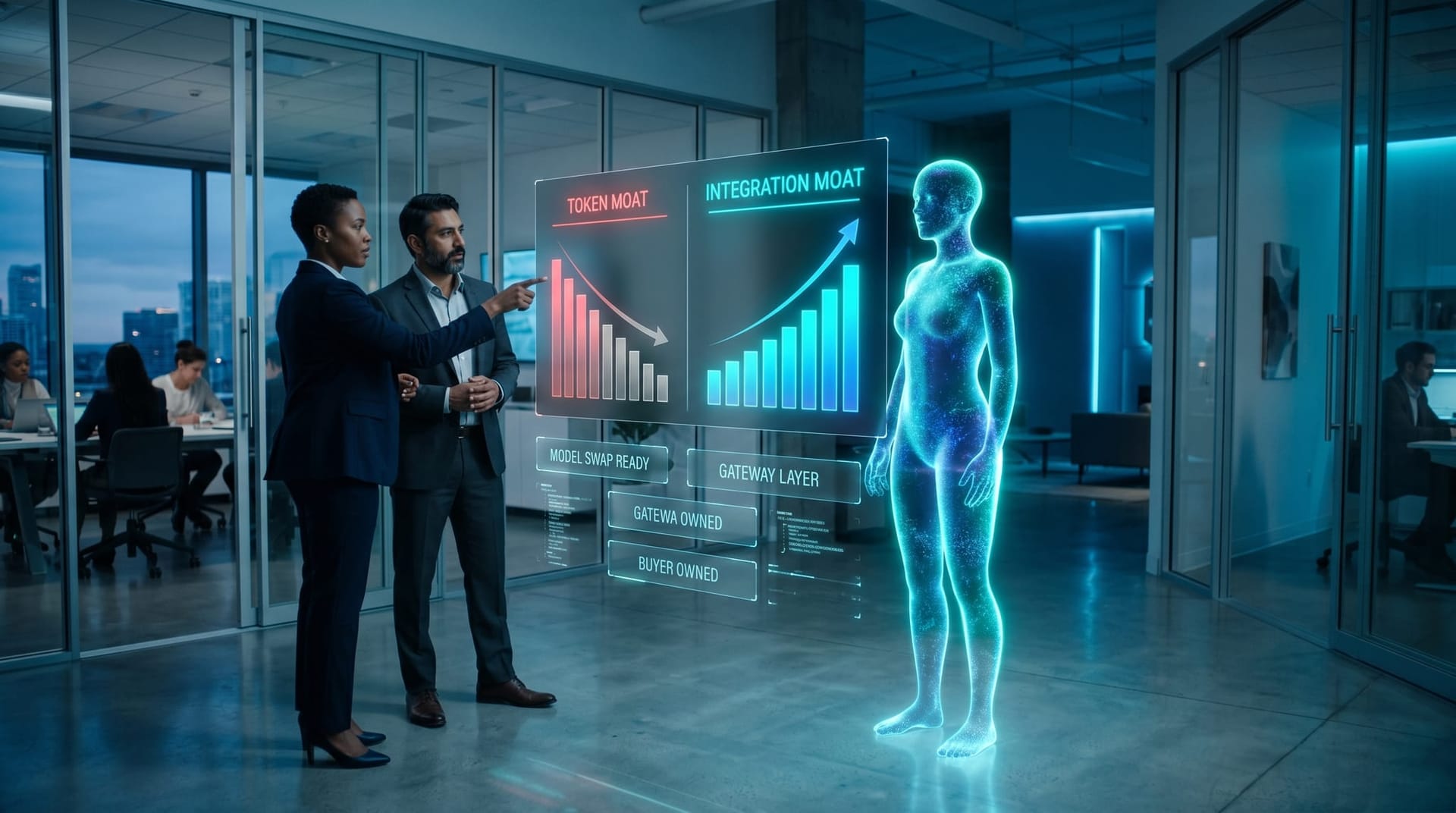
- The token-moat that US frontier labs relied on to lock in buyers is collapsing. What remains is the integration moat.
- A buyer-owned Secure AI Gateway is the integration moat. It sits between your business workflows and any model — swapping the model layer becomes a config change, not a re-platforming.
- Any 2026 procurement decision that locks you into a single US frontier-lab price tier deserves hard scrutiny.
- The 90-day model-swap test is your minimum bar: if your contract or architecture cannot support a model swap in 90 days, you are exposed.
The Token-Moat Is Gone. What Replaced It?
For the past three years, the business model of the major US AI frontier labs — OpenAI, Anthropic, Google — rested on a quiet architectural assumption: producing frontier-quality intelligence at scale required hardware, training infrastructure, and institutional knowledge that only a handful of companies could afford. Per-token pricing reflected that scarcity. High input and output costs were not just a monetization choice; they were the moat itself.
That assumption is now structurally broken.
VentureBeat reported on May 28, 2026 that DeepSeek's latest architecture release is “shattering Silicon Valley's token moat.” The real story is deeper than a single cheap-model release. The techniques DeepSeek has now open-sourced — with weights public on Hugging Face — compressed-sparse attention, distillation-by-design (the training loop itself targets a more compressible model), and mixture-of-experts (MoE) routing applied at training time — are reproducible. Open-source communities, EU and Asian research labs, and independent inference providers are already replicating them.
Calling it a “DeepSeek price cut” misses the point. A new lower bound on frontier-quality inference cost per token has been demonstrated publicly, which means the market will price toward it. The token-moat was never a wall — it was a toll gate. The gate is down.
For mid-market buyers in 2026, the procurement implication is immediate and concrete: the AI cost floor is no longer set by US frontier labs. Frontier-lab pricing from OpenAI and Anthropic remains the visible benchmark — but it is no longer the structural floor. Any procurement plan that treats current frontier-lab pricing as a stable baseline is working from the wrong spreadsheet.
Why This Is Structural, Not a Promo
The distinction between a promotional price cut and a structural cost-floor collapse matters enormously for procurement decisions:
- A promo is a vendor lowering price temporarily to gain share. The moat returns when the promo ends.
- A structural collapse is when the underlying cost of production drops, because a superior production method becomes widely known — a trend the Stanford HAI AI Index has tracked across successive model generations. The moat does not return.
DeepSeek's compressed-sparse attention reduces per-token computation by activating only a fraction of the model's parameters for any given input — the core MoE insight, a direction Google DeepMind's research and others have advanced in parallel. DeepSeek's addition: distillation-by-design — the training pipeline itself targets a smaller, more efficient model as primary output, not byproduct. Applied at training time rather than retrofitted at inference, the resulting model runs efficiently on cheaper hardware. Open-source communities now have a reproducible recipe. The cost floor for frontier-class inference has moved. It will not move back.
What Is the Integration Moat — and Why Does It Matter Now?
Here is the framing every mid-market AI buyer in 2026 needs:
The token-moat: Controlled by the model provider. Based on scarcity of production. Now collapsing.
The integration moat: Controlled by whoever owns the layer between your business workflows and the model API. Based on how deeply AI is woven into your operations, data, and processes. Getting stronger.
This is not an abstract distinction. It is a procurement decision you are making right now, whether you recognize it or not. Every organization that built directly on a single frontier lab's API — no abstraction layer, no model-neutral routing, no buyer-owned control plane — is now on the wrong side of this transition. When the cost floor shifts again (it will), re-platforming is expensive and slow.
The buyer-owned Secure AI Gateway is the integration moat. It is the architectural surface that sits between your business workflows and any model provider's API. Model selection becomes a configuration parameter, not a re-platforming event. A Secure AI Gateway means:
- Your business logic, prompts, and workflow orchestration live in infrastructure you control.
- The model layer is pluggable — DeepSeek today, a distilled open-weight model from a US lab tomorrow, a sovereign on-premises model the day after that.
- Audit logs, access controls, and cost telemetry are yours, not the vendor's.
We covered the integration-moat concept in detail in our companion post on agent control plane buying decisions for mid-market AI Employees. If you have not read it alongside this one, you should.
Token-Moat Collapse Impact Matrix
The table uses qualitative cost-band language where hard numbers are not available from published sources. “Before” reflects typical 2024–2025 frontier-lab pricing for high-quality models. “After” reflects the new cost floor demonstrated by DeepSeek-class architectures and the inference provider market's response. The shift is directional, not an invented per-token figure.
| Workflow Type | Cost Band (Before) | Cost Band (After) | Buyer-Side Implication | Time-to-Action |
|---|---|---|---|---|
| Customer intake / call qualification | High (frontier-lab input pricing) | Order-of-magnitude lower with routed open-weight models | AI Employee call-qualification workflows that penciled out at moderate volume now pencil out at low volume | Immediate — re-evaluate ROI thresholds now |
| Document summarization / report generation | Moderate-to-high (long-context frontier models) | Significantly lower; distilled models handle most doc-summary tasks well | Report-generation AI Employees become economical for tasks previously priced out of ROI range | 30–60 days — audit current per-document costs and compare against open-weight alternatives |
| Lead-research deep web crawl | High (multi-step agentic + frontier model per step) | Lower per step; cost reduction compounds across multi-step chains | Agentic lead-research workflows that required careful rationing now have headroom to run more steps | 30–60 days — identify your highest-token-count agentic workflows first |
| Code generation / dev assist | Moderate (dedicated code models, frontier pricing) | Low-to-very-low; code-specialized distilled models are strong | Dev-assist tooling cost drops significantly; economic case for broader developer rollout improves | Immediate — most organizations can swap code-assist models with minimal workflow disruption |
| Long-running multi-step agentic workflow | Very high (frontier model per agent step, many steps) | Moderate; MoE routing uses cheaper models for most steps and frontier only for reasoning bottlenecks | Long-horizon AI Employees become more economical; the “too expensive to run at scale” objection weakens | 60–90 days — requires model-neutral routing layer to capture savings without re-platforming |
One important caveat the throughput-paradox post makes well: cheaper tokens do not automatically lower your AI bill. When per-token cost drops, usage tends to expand. Your total spend can rise even as your per-task cost falls. The cost floor collapse is an opportunity to expand AI Employee deployment economically — it is not a guarantee of lower total spend without intentional cost governance.
The 5-Question Mid-Market AI Cost-Floor Audit
Use these five questions to score your current procurement position. Acceptable-answer bands are provided for each. Score one point for each “yes.” Tally at the end.
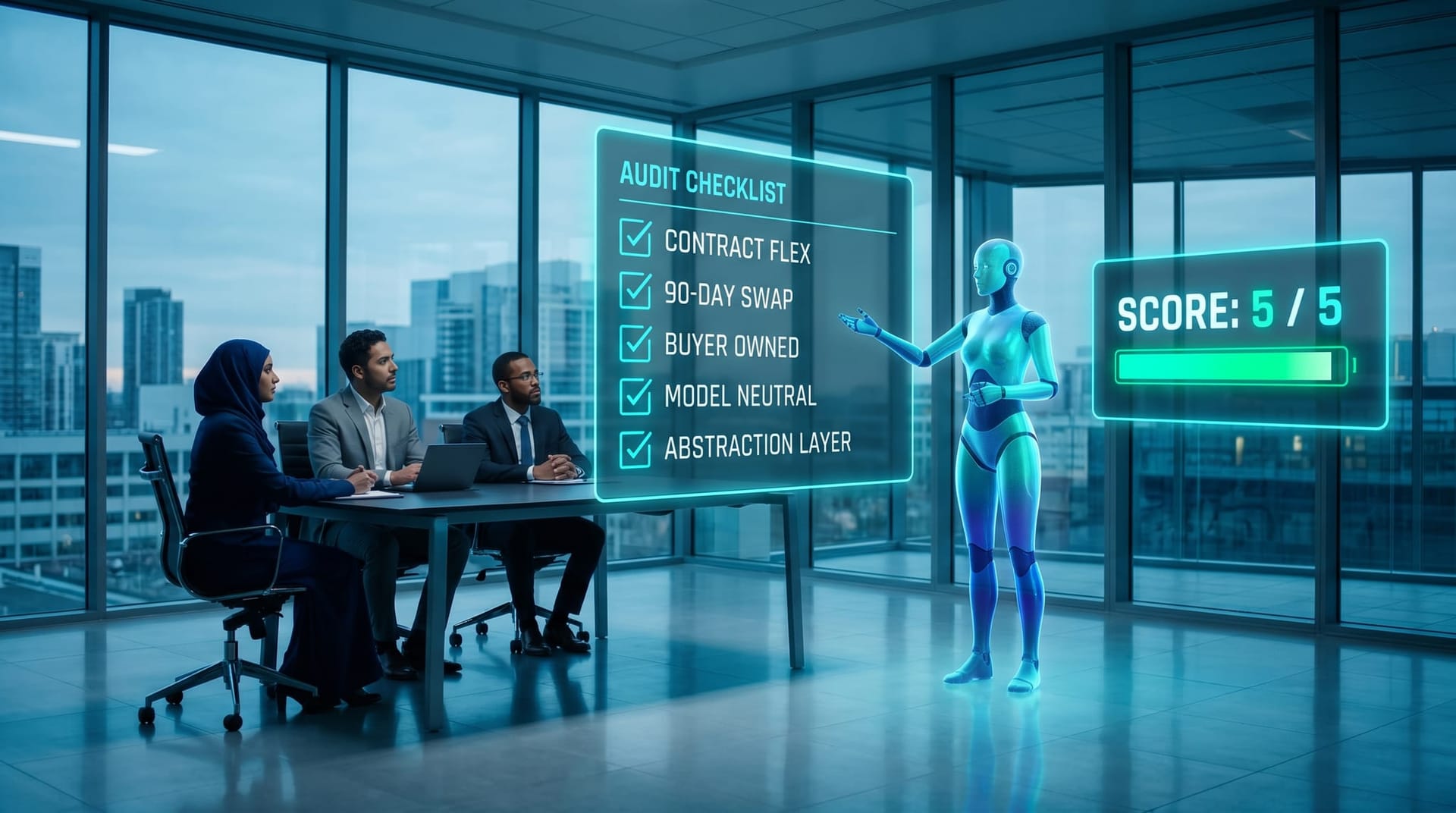
Q1: Does your AI contract let you swap the model layer in 90 days or less?
What we're testing: Whether your architecture and vendor agreements allow you to replace the underlying LLM without a re-platforming event.
Acceptable answer: Yes — your Secure AI Gateway or integration layer abstracts the model API, and your vendor contract does not restrict model substitution. You have tested this swap in a staging environment.
Partial credit zone: You have a gateway layer but have not tested a swap. Or your contract allows it but your architecture makes it painful.
Exposed answer: Your workflows are built directly on a single frontier-lab SDK, API key, and proprietary tooling. Swapping the model requires renegotiating contracts, re-writing integrations, and re-training internal users.
Q2: Is your per-task AI cost falling year-over-year?
What we're testing: Whether you are capturing the benefit of the cost-floor decline or whether your architecture is stranded at 2024 pricing despite the market moving.
Acceptable answer: Yes — you track cost-per-task (not just total spend), and the trend is down YoY. You have a model-routing layer that allows cheaper models to handle appropriate task classes.
Partial credit zone: You track total AI spend but not per-task cost. You have no visibility into which tasks are consuming which percentage of your token budget.
Exposed answer: You do not track per-task cost at all, or your contract locks pricing for a multi-year term without model-substitution rights.
Q3: Is the integration moat owned by you or by your vendor?
What we're testing: Whether the layer that connects your business workflows to the model API is buyer-controlled or vendor-controlled.
Acceptable answer: You own the orchestration layer — your prompts, your agent logic, your routing rules, your audit logs live in infrastructure you control. The model provider is a compute vendor, not a platform dependency.
Partial credit zone: You use a third-party orchestration platform that provides some portability but is itself a vendor dependency.
Exposed answer: Your AI workflows live inside a frontier lab's proprietary platform (e.g., a managed agent product where the orchestration logic is opaque and non-portable). Switching costs are high.
Q4: Do you have a model-neutral evaluation layer?
What we're testing: Whether you can objectively compare model performance across providers on your actual business tasks — or whether you only have vendor-supplied benchmarks.
Acceptable answer: Yes — you run your own evals on representative task samples before promoting any model to production. Your eval harness is model-agnostic. We covered the architecture of this in our multi-model AI agent eval neutral layer post.
Partial credit zone: You rely on published benchmarks (MMLU, HumanEval, etc.) but do not run evals on your specific business tasks.
Exposed answer: You have no eval process. You adopt a new model when your vendor recommends it, without independent verification.
Q5: Is there an architectural surface that abstracts model selection from your business workflows?
What we're testing: Whether your business logic is cleanly separated from the model layer — or whether model-specific assumptions are baked into your workflow code.
Acceptable answer: Yes — your workflows call an abstraction layer (a gateway, a router, an orchestration API) that handles model selection. Changing the model is a config change in the gateway, not a code change in your business workflow.
Partial credit zone: You have some abstraction but it is inconsistently applied — some workflows go through the gateway, others call model APIs directly.
Exposed answer: Your business workflow code contains hardcoded references to specific model APIs, model names, or provider-specific prompt formats. Every model change requires a code deployment.
Scorecard
| Score | Status |
|---|---|
| 0–2 yes | Exposed. Your AI procurement plan is structured around the old token-moat world. As the cost floor shifts, you will be re-platforming reactively rather than adapting proactively. |
| 3–4 yes | Partially hedged. You have the right instincts but gaps in execution. The 90-day model-swap test is your clearest next step. |
| 5 yes | Integration-moat protected. You are positioned to capture the cost-floor decline as it continues, and your AI Employee deployments can scale economically as the market moves. |
How the Secure AI Gateway Makes the Model Swap Routine
The architectural mechanism that separates exposed buyers from integration-moat-protected ones is not complicated. It is a discipline decision made early in procurement.

Here is the model-swap routine when a Secure AI Gateway is in place:
- Step 1 — Monitor. The Gateway's cost telemetry layer tracks per-task token spend by workflow type. When a new lower-cost model becomes available (via DeepSeek, an open-weight release, or a frontier lab's own pricing adjustment), the Gateway's model registry flags it as a candidate.
- Step 2 — Eval. The Gateway routes a sample of real production tasks to the candidate model in shadow mode — it runs alongside the incumbent but does not affect production outputs. The model-neutral eval layer scores the candidate on your actual tasks.
- Step 3 — Promote. If the candidate meets or exceeds the incumbent's quality threshold at lower cost, the Gateway's routing config is updated. No workflow code changes. No contract renegotiation. No re-platforming.
- Step 4 — Audit. The Gateway logs the switch, the eval scores, the cost delta, and the date. Your compliance and procurement teams have a paper trail.
With a mature Gateway, the cycle from “new model available” to “running in production” completes in 30–90 days. Without one, the same cycle requires architecture reviews, integration work, vendor negotiations, and regression testing across every workflow that touched the old model — a 6–18 month process in most mid-market organizations.
The Sakana 7B router post covers the routing layer in detail — small router models direct tasks to the cheapest capable model in real time rather than on a monthly procurement cycle. That is the next level of optimization once the Gateway foundation is in place.
What Does the New AI Cost Floor Mean for Northeast Indiana?

The token-moat collapse is not a Silicon Valley story. It lands directly in Auburn, Fort Wayne, and the surrounding counties of Allen, DeKalb, Whitley, and Noble. Here is what it looks like in four concrete Northeast Indiana scenarios. Cost bands below are qualitative and directional — actual figures depend on workflow design, volume, and model selection.
Auburn Manufacturer: Customer-Intake AI Employee
An Auburn precision manufacturer runs an AI Employee on inbound customer inquiries — quoting requests, order status, lead qualification. In 2024–2025, frontier-class per-interaction cost forced selective routing — only certain inquiry types triggered AI handling. At the new cost floor, the same workflow (or an extended version) runs at a fraction of that cost. More of the intake funnel becomes viable without ROI gymnastics.
DeKalb County Home Services: Lead-Qualification AI Employee
A DeKalb County home-services operator — HVAC, plumbing, electrical — runs a lead-qualification AI Employee that screens web leads, asks qualification questions via SMS and email, and routes hot leads to a human rep. Each chain involves multiple model calls. At 2024–2025 frontier pricing, multi-step chains accrued cost quickly, capping how many steps were justified per lead. At the new cost floor, the same chain can run more steps — better qualification, more follow-up, richer routing — at lower or comparable total per-lead cost. Qualification quality goes up as the cost constraint loosens.
Allen County Dental Practice: Scheduling AI Employee
An Allen County dental group uses an AI Employee for scheduling, cancellation recovery, and insurance pre-authorization status checks. Each interaction is low-complexity but volume is high — a busy practice runs hundreds of scheduling events per week. At the new cost floor, distilled-model per-interaction cost drops to the point where single-location practices can justify deployment without the volume thresholds that previously gated AI Employee access to larger groups. The cost-floor collapse opens access down-market within the vertical.
Allen County Insurance Brokerage: Report-Generation AI Employee
An Allen County independent insurance brokerage uses an AI Employee to generate client coverage summary reports — pulling from policy data, carrier documentation, and client profile data, then producing a structured narrative. Report generation is long-context: read a lot, write a structured output. Frontier large-context models carry a premium. At the new cost floor, long-context distilled models handle the same document loads at significantly lower per-token cost — making report generation economical even for smaller brokerages that previously outsourced the task to junior staff.
For a localized cost-playbook companion that goes deeper on specific DeepSeek model comparisons in the Northeast Indiana context, see the Fort Wayne DeepSeek frontier AI cost multi-model post. This post focuses on the industry-wide structural inevitability; the companion post handles the local implementation specifics.
One More Thing: The Plumbing Has to Work First
A collapsing cost floor only benefits you if your AI infrastructure is already operational. The token-moat collapse does not help organizations that are still running pilots, still debating governance, or still waiting for the “right model” before committing to deployment. The structural advantage of the new cost floor flows to buyers who already have working AI Employee deployments and can route them to cheaper models as the floor descends — not to buyers who are starting from scratch at each pricing inflection.
If your organization is still in the pilot phase, the more urgent read is our post on moving from AI pilots to AI Employees as an execution differentiator. The cost-floor changes only matter if the plumbing already works. Get the plumbing working first.
Take the 4-Week Token-Cost-Floor Audit
We run a focused four-week engagement for mid-market organizations in Northeast Indiana and beyond who want to know exactly where they stand on the five audit questions above — and what it would take to reach a score of 5.
The engagement covers:
- A review of your current AI contracts and model dependencies against the 90-day model-swap test.
- A per-task cost analysis across your existing AI workflows (or a cost projection if workflows are not yet deployed).
- An architectural assessment of your current integration layer against the Secure AI Gateway reference architecture.
- A prioritized roadmap with specific actions to close integration-moat gaps.
The output is a written Token-Cost-Floor Audit report and a 90-day action plan — not a sales deck.
Start with the Secure AI Gateway architecture covered above, then contact our AI consulting team to schedule the engagement.
Frequently Asked Questions
Q1.What is the “token moat” and why does its collapse matter for mid-market buyers?
The token moat refers to the structural cost advantage that US frontier AI labs (OpenAI, Anthropic, Google) held because producing frontier-quality model outputs required enormous capital investment in training infrastructure. Per-token pricing was high partly because true production costs were high — and partly because the moat justified premium pricing. As DeepSeek and others demonstrate architectural techniques (MoE routing, compressed-sparse attention, distillation-by-design) that dramatically reduce the marginal cost of frontier-quality inference, the production cost basis collapses. For mid-market buyers, this means any procurement plan anchored to current frontier-lab pricing as a stable floor is working from a false assumption. The cost floor will continue to move down.
Q2.Does this mean I should immediately switch all my AI workflows to DeepSeek?
No. The structural point is not “use DeepSeek specifically” — it is “own an integration layer that lets you use any model.” Switching everything immediately to any single provider replaces one moat with another. The procurement discipline that protects you is model-neutral architecture: a Secure AI Gateway that lets you route tasks to the best-value model for each task class, evaluate candidates objectively, and swap the model layer without re-platforming. DeepSeek's architecture is important as a demonstration that the cost floor has moved; it is not necessarily the right model for every workflow in your organization.
Q3.How do I know if my current AI vendor contract is “locked in” to old pricing?
Look for three things: (1) Does your contract specify which model or model family you are using, and restrict substitution? (2) Does your integration architecture make it technically difficult to swap models even if the contract allows it? (3) Do you have visibility into per-task token costs, or only aggregate spend? If you answered “yes” to any of these, you have exposure. The five-question audit in this post is a starting framework.
Q4.Is the cost-floor collapse happening fast enough to matter for a 2026 procurement decision?
Yes. The VentureBeat analysis published May 28, 2026 documents that the architectural techniques responsible for the cost-floor decline are already in the market and being replicated beyond DeepSeek. The organizations that will capture the benefit in 2026 are those that already have model-neutral integration layers in place. Organizations making procurement decisions now that lock them into a single frontier-lab model tier for 24–36 months are taking real risk.
Q5.What is the difference between a Secure AI Gateway and a simple API proxy?
An API proxy sits in front of model calls and can log or rate-limit them. A Secure AI Gateway is architecturally richer: model-neutral routing, eval integration, identity and access management (credential-isolated, auditable AI agent access), cost telemetry (per-task, not just aggregate), and a model registry (available models, performance profiles, cost characteristics). The Gateway is the integration moat. A proxy is a logging layer.
Q6.How does the DeepSeek token moat collapse affect on-premises AI for Northeast Indiana operators?
The same architectural techniques that DeepSeek has demonstrated — MoE routing, compressed-sparse attention, distillation-by-design — are being applied to open-weight models that can be deployed on-premises or in a private cloud. This means the cost-floor collapse extends to sovereign deployment scenarios, not just cloud API calls. For Northeast Indiana organizations in regulated industries (healthcare, financial services, manufacturing with export-controlled IP), the ability to run frontier-class models on infrastructure you control is becoming economically viable in a way it was not in 2024. Our Fort Wayne air-gapped AI sovereign deployment work covers this scenario specifically.
Q7.What should a mid-market organization do in the next 30 days in response to this shift?
Three actions in priority order: (1) Score yourself on the five-question audit above. If you score below 3, that is your roadmap — work backward from the gaps. (2) Pull your current AI vendor contracts and identify any model-restriction clauses or pricing-lock provisions. (3) Map your top five AI workflows by token volume and estimate what the per-task cost would be at the new cost floor if you had a model-neutral routing layer. That delta is the business case for the integration moat.
Sources & Further Reading
- VentureBeat: venturebeat.com/infrastructure/how-deepseeks-radical-architecture-is-shattering-silicon-valleys-token-moat — How DeepSeek's radical architecture is shattering Silicon Valley's token moat (May 28, 2026)
- Hugging Face: huggingface.co/deepseek-ai — DeepSeek AI open-weight model releases
- OpenAI: openai.com/api/pricing — OpenAI API Pricing
- Anthropic: anthropic.com/pricing — Anthropic Model Pricing
- Stanford HAI: hai.stanford.edu/ai-index — AI Index Report
- Google DeepMind: deepmind.google/research — Google DeepMind Research
Score Your Token-Cost-Floor Position
Find out where your AI procurement stands on the 5-question integration-moat audit — and how to close the gaps before your next contract renewal.