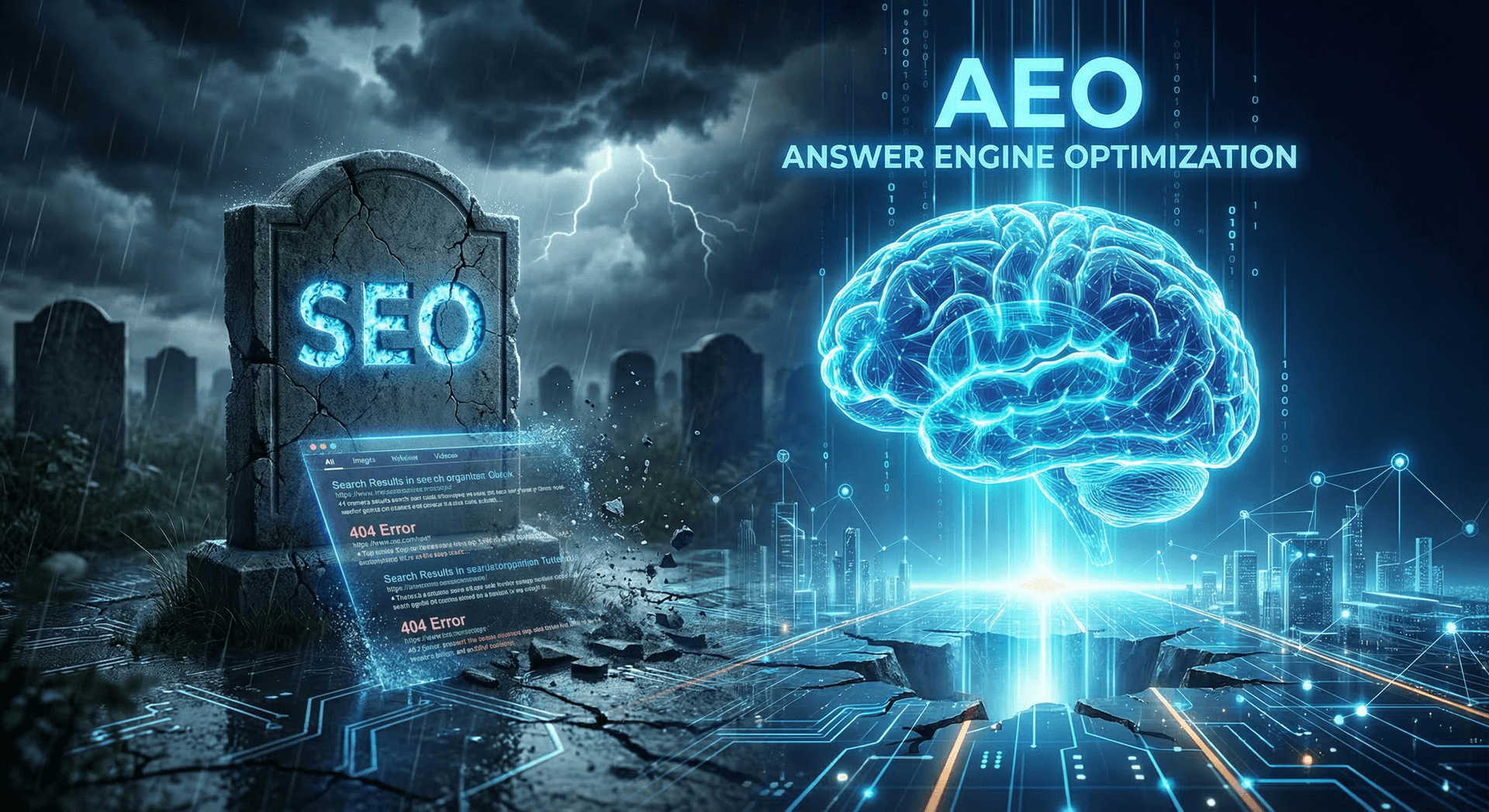
The highest-converting traffic source of 2026 isn't Google Ads. It isn't organic SEO. It's AI search — and most Fort Wayne businesses don't even know it exists.
When a potential customer asks ChatGPT, Claude, or Perplexity “who's the best HVAC company in Fort Wayne?” and the AI recommends a specific business by name, that referral converts at a rate that makes traditional marketing channels look broken. According to VentureBeat's reporting on LLM-referred traffic, businesses seeing AI search referrals are converting at 30 to 40%, compared to the single-digit conversion rates most Fort Wayne businesses see from organic search and paid ads.
The reason is straightforward: the intent signal is different. When someone asks an AI assistant for a recommendation and it names your business, that carries implicit trust. The AI has already done the research, compared options, and selected you. The prospect arrives pre-qualified.
This shift is powered by Answer Engine Optimization (AEO) — the practice of structuring your business's digital presence so AI systems can find, understand, and cite you. If you've been following our breakdown of how SEO and AEO work together for Fort Wayne businesses, you know the foundations. This post is about the data that makes AEO non-optional.
Key Takeaways
- LLM-referred traffic converts at 30 to 40%, compared to 2-5% for traditional organic search
- AI agents are replacing traditional search for research, recommendations, and purchasing decisions
- Fort Wayne businesses in home services, legal, healthcare, and professional services are prime candidates for AEO
- Structured, authoritative content with clear expertise signals is what AI systems cite
- YouTube presence and brand mentions are among the strongest predictors of AI search visibility
- Businesses that aren't optimizing for AI search are becoming invisible to a growing share of high-intent buyers
Why Does AI-Referred Traffic Convert 10x Higher Than Traditional Search?
The math behind AI search conversion rates isn't complicated, but it is counterintuitive for anyone who grew up on SEO metrics.
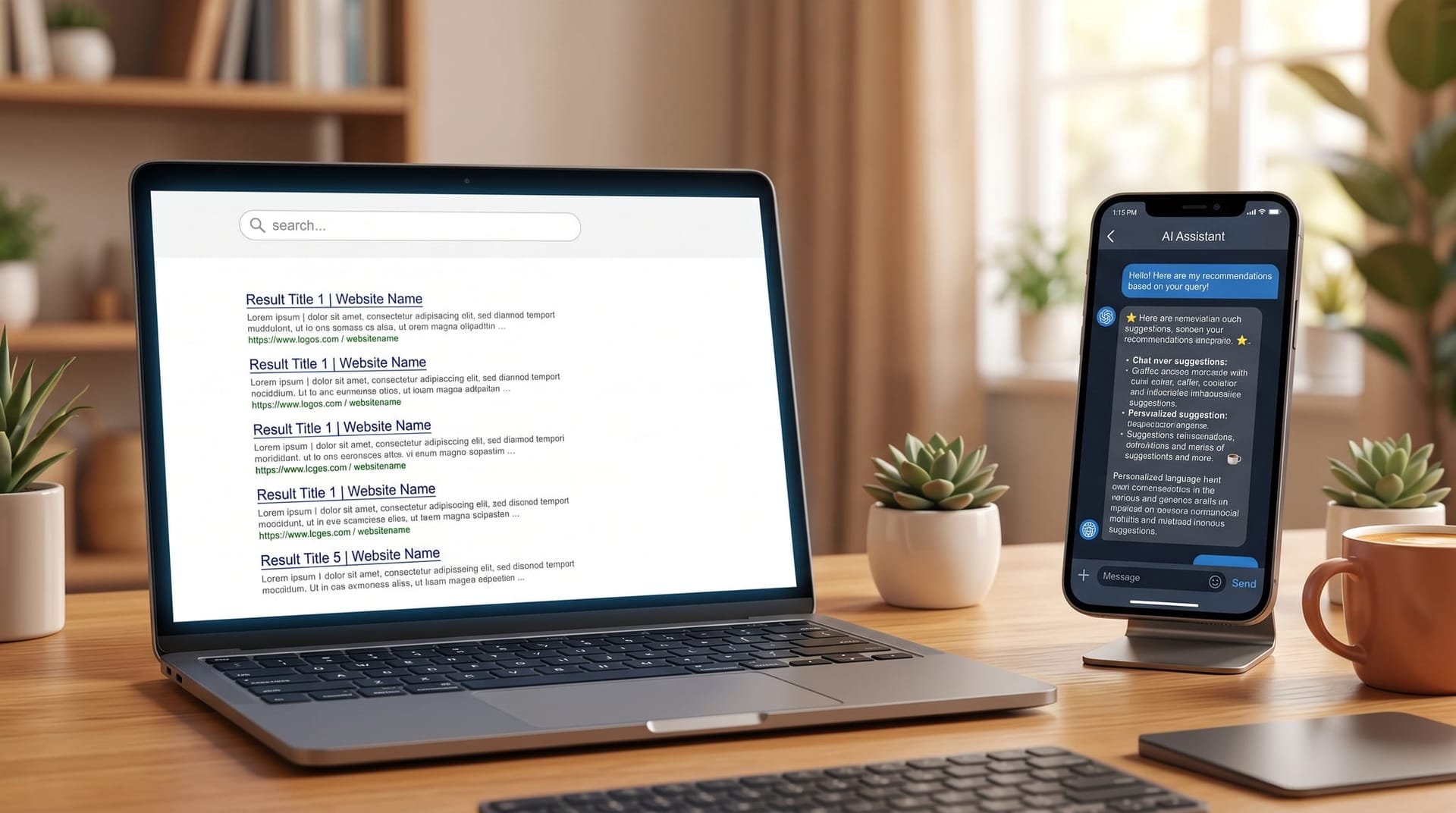
Traditional search works on a browse-and-choose model. A Fort Wayne homeowner searches “best plumber near me,” gets a list of 10 blue links, clicks through 3 or 4 websites, compares pricing, reads reviews, and eventually picks one. Conversion rates for that journey typically land between 2% and 5% because every step introduces friction and drop-off.
AI search collapses that entire funnel. When that same homeowner asks an AI assistant to find them a plumber, the AI doesn't return a list of links. It returns an answer: “Based on reviews, pricing, and service area, here are the top options in Fort Wayne...” and names specific businesses. The user gets a curated recommendation, not a search results page to wade through.
Wyatt Mayham, an analyst at Northwest AI Consulting, told VentureBeat that LLM-referred traffic at his firm is converting at 30 to 40%. “The intent signal is just different when someone is having a conversation with an AI and it recommends you by name,” Mayham said.
That conversion premium exists because AI recommendations carry a form of third-party validation. The AI did the comparison shopping for the user. By the time someone lands on your website from an AI referral, they've already been told you're a strong match for what they need.
| Traffic Source | Typical Conversion Rate | Intent Level | Friction |
|---|---|---|---|
| Organic SEO | 2-5% | Medium — user still browsing | High — multiple clicks to convert |
| Paid Search (Google Ads) | 3-7% | Medium-High — keyword-targeted | Medium — ad skepticism |
| Social Media | 1-3% | Low — passive discovery | High — not in buying mode |
| LLM-Referred (AI Search) | 30-40% | Very High — pre-qualified recommendation | Low — arrives with trust |
For Fort Wayne businesses spending thousands per month on Google Ads to capture leads at 3-7% conversion, these numbers should trigger an immediate strategic conversation. If you're already tracking how AI employees impact your bottom line, the ROI case for AEO follows the same logic: invest in the channel that delivers the highest return per dollar.
What Is Answer Engine Optimization and How Does It Work?
AEO is the practice of making your business's content, reputation, and digital presence optimized for AI systems — not just human searchers. The term is sometimes used interchangeably with Generative Engine Optimization (GEO), though AEO is the more established label.
As Dustin Engel, founder of consultancy Elegant Disruption, put it in VentureBeat's report: “AEO is the next layer of discovery” — what he calls “zero-click discovery.” In this model, the user may never visit your website at all. The AI synthesizes an answer from your content and delivers it directly. Your job isn't to rank on page one. It's to be the source the AI cites.
Adam Yang of Quora reinforced this shift: “SEO isn't dead. But the optimization target has shifted from ‘rank on page 1’ to ‘get cited in the answer.’”
Here's what AI systems look for when deciding which businesses to recommend:
Structured, Clear Content. AI agents don't browse the way humans do. They analyze content for semantic clarity — does this page directly answer the question being asked? Content stuffed with keywords but lacking clear, concise answers gets passed over. Carlos Dutra, CEO of Vindler Solutions, offered a practical test: “Ask an LLM a question your page is supposed to answer, without giving it the URL. If it can't construct the answer from your content, you have a problem.”
Authority Signals. Google's EEAT framework (Experience, Expertise, Authority, Trust) is relevant here. Shashi Bellamkonda of Info-Tech Research Group noted in the same VentureBeat reporting that businesses producing content written by genuine experts, with robust “About Us” pages highlighting thought leaders' credentials, are better positioned for AI citation.
Brand Presence Across Platforms. Your website alone isn't enough. AI models are trained on data from Wikipedia, Reddit, LinkedIn, YouTube, and industry publications. Jeff Oxford of SEO agency Visibility Labs found that YouTube mentions have the “strongest correlation” with AI visibility across ChatGPT, AI Mode, and AI Overviews. Brand mentions are the second-highest correlated factor.
Freshness. Stale content gets deprioritized. Regularly updated pages with current data, recent publication dates, and timely information signal ongoing authority.
For Fort Wayne businesses that have already invested in traditional SEO, AEO isn't a replacement — it's an additional layer that compounds your existing investment. We covered this dual-strategy approach in our guide to how Fort Wayne businesses can build an AI workforce, and the same principle applies to search strategy: the businesses that win in 2026 are running both playbooks simultaneously.
Which Fort Wayne Industries Stand to Gain the Most From AEO?
Not every business benefits equally from AI search optimization. The highest-value opportunities are in industries where customers ask specific, intent-laden questions and expect curated recommendations.
Home Services (HVAC, Plumbing, Electrical, Roofing)
When a Fort Wayne homeowner's furnace breaks at 10 PM in January, they're increasingly asking an AI assistant rather than scrolling through Google Maps. “Find me an HVAC company in Fort Wayne that does emergency repairs” is the kind of query where AI search shines — and where the business that gets named captures a lead with immediate, high-value intent.
The HVAC company that has structured its website with clear service descriptions, published customer reviews, maintained a Google Business Profile with accurate hours and service areas, and established presence on platforms like Reddit and YouTube will be the one the AI recommends. The one relying solely on Google Ads for “Fort Wayne HVAC” keywords will be invisible in this channel.
Legal Services (Personal Injury, Family Law, Criminal Defense)
Legal searches are some of the most expensive keywords in traditional PPC. A Fort Wayne personal injury attorney might pay $50-150 per click on Google Ads, with conversion rates in the low single digits. When someone instead asks an AI “find me a personal injury attorney near Fort Wayne with good reviews,” and the AI names a specific firm, that referral arrives with far higher intent and at zero marginal cost per click.
Healthcare and Dental
“Find me a dentist in Fort Wayne that accepts Delta Dental and has Saturday hours” — this is exactly the type of specific, multi-criteria query that AI assistants handle well. Practices that have their services, insurance acceptance, hours, and patient reviews structured in AI-readable formats will capture these referrals. Those relying on a generic website and Google Maps listing will lose them.
Professional Services (Accounting, Financial Planning, IT Services)
B2B and professional service queries are where AI search adoption is advancing fastest. Mayham told VentureBeat that for work-related research, he's “barely” using traditional search anymore: “When I need to understand a company or a person professionally, agents do it faster and give me a more useful output than a page of blue links ever did.”
For Fort Wayne accountants, financial planners, and IT consultants, being citable by AI means having clear service descriptions, thought leadership content, and a professional presence on LinkedIn and industry platforms.
How Are AI Agents Actually Replacing Traditional Search Right Now?
This isn't a theoretical future state. The shift is already happening in daily workflows across businesses of every size.
Mayham described how his firm built a Claude Skills function that powers their entire sales operation. Before a discovery call, team members trigger a skill that automatically pulls a prospect's LinkedIn profile, scrapes their company website, and gathers revenue, team size, and tech stack data from sources like ZoomInfo. “It's collapsed what used to be a full hour of sales prep into a few minutes,” Mayham said in the VentureBeat report.
Dutra at Vindler Solutions reported a similar shift. He uses Claude Code for most of his coding work, and the surprise wasn't the speed — “it was the fact that I didn't need to open and keep track of browser tabs. Not because I'm lazy, but because the answers are better.” He still uses Google for pricing pages and breaking news, but for technical reasoning, “agents have mostly replaced search for me personally.”
Quora's Yang has been using AI agents daily for content strategy, knowledge management, and competitive research. “Workflows that used to take half a day now take 30 minutes,” he said. The shift in his habits was telling: “I've started treating agent search as my first stop, not Google. Traditional search is now where I verify, not where I discover.”
This matters for Fort Wayne businesses because your customers are adopting the same behaviors. The business owner researching IT consulting firms, the operations manager evaluating automation solutions, the practice administrator comparing dental software — they're increasingly asking AI assistants before opening a browser tab.
AI systems like Claude, ChatGPT, Perplexity, and Google's AI Overviews are reshaping how people discover local businesses. We explored how AI interfaces are now more important than the underlying models — and the interface people are increasingly choosing is a conversation with an AI, not a list of search results.
What's the Step-by-Step AEO Playbook for Fort Wayne Businesses?
Based on the expert recommendations from VentureBeat's report, here's what Fort Wayne businesses should implement now:
1. Audit Your AI Visibility
Before optimizing, benchmark where you stand. Ask ChatGPT, Claude, and Perplexity questions your ideal customers would ask — “who's the best [your service] in Fort Wayne?” — without providing your URL. Note whether you're mentioned, how you're described, and which competitors appear instead. This is your baseline.
2. Restructure Content for AI Consumption
Your website content needs to directly answer the questions customers ask. Move away from keyword-stuffed marketing copy toward clear, declarative content organized around conversational intent. Every service page should include:
- Direct answers to common questions (FAQ schema)
- Clear service descriptions with geographic specificity
- Pricing transparency where appropriate
- Expertise signals (credentials, experience, certifications)
This is fundamentally different from traditional SEO copywriting. Dutra put it well: “AEO is about whether your content survives being chunked, embedded, and semantically retrieved.” If your content doesn't make sense when pulled out of context and summarized by an AI, it needs rewriting.
3. Build Brand Presence Where AI Models Train
Oxford's research at Visibility Labs — cited in the VentureBeat reporting — identifies the platforms that matter most:
| Platform | AI Visibility Impact | Action for Fort Wayne Businesses |
|---|---|---|
| YouTube | Strongest correlation with AI visibility | Create service walkthroughs, Q&A videos, local project showcases |
| Most-cited domain in AI search | Engage authentically in r/fortwayne and industry subreddits | |
| Professional authority signal | Publish thought leadership, maintain complete company profiles | |
| Industry Publications | Authority and expertise validation | Contribute articles, get quoted in trade publications |
| Google Business Profile | Local AI citation source | Maintain accurate, complete, regularly updated profile |
4. Invest in Original Data and Expertise
AI systems prioritize original research, expert opinions, and unique data. Fort Wayne businesses that publish original content — case studies with real numbers, industry surveys, local market analysis — create the kind of authoritative content that AI models prefer to cite.
Bellamkonda's advice in VentureBeat: “Original long-form content will be valued by AI-powered answer engines. Copycat strategies or trying to game the system are taboo in this era.”
5. Establish Expert Authority
AI systems evaluate who creates content, not just what the content says. Your team's expertise needs to be visible and verifiable. Ensure your website's “About Us” page includes detailed bios highlighting credentials and experience. Have your experts share insights across multiple channels. The goal, as Bellamkonda described, is that “a good focus on the end user is a great way to succeed.”

What Fort Wayne Businesses Should Know About the Limits of AI Search
The shift to AI-driven discovery is real, but it comes with legitimate limitations that deserve honest acknowledgment.
Mayham noted in VentureBeat's coverage that LinkedIn is “aggressive” about blocking automated access, and many sites are implementing similar protections. “The reliability isn't 100% yet, and that's probably the biggest thing holding broader adoption back,” he said. AI agents can hit walls when websites block automated scraping, which means businesses with restrictive bot policies may actually be hurting their own AI discoverability.
Traditional search still performs well for specific use cases. As Mayham pointed out, personal tasks like finding nearby restaurants or local service providers still benefit from Google's integrated maps, reviews, and photos interface — “that experience is just better” in those cases.
AEO is also not a replacement for proven marketing fundamentals. Bellamkonda cautioned that businesses already producing expert-driven, audience-focused content “are in a good position to be cited in AI-powered search” without radical changes. The businesses that need to worry are those relying on thin, keyword-stuffed content or generic marketing copy.
For Fort Wayne businesses, the practical takeaway is that AEO complements your existing strategy — it doesn't replace it. Traditional SEO, Google Business Profile optimization, and paid advertising still have roles. AEO is the additional layer that captures the growing share of high-intent traffic flowing through AI channels.
The businesses that understand this — and that invest in custom AI solutions rather than generic tools — will be best positioned as AI search adoption accelerates.

How Fort Wayne Businesses Can Start Capturing AI Search Traffic This Month
The window for early-mover advantage in AEO is open right now, but it won't stay open indefinitely. As more businesses optimize for AI search, the competitive landscape will tighten — just as it did with SEO over the past two decades.
Here's what makes Fort Wayne's market particularly well-suited for AEO:
Local specificity is an AEO advantage. AI systems responding to local queries need to cite businesses with clear geographic relevance. A Fort Wayne HVAC company with content specifically mentioning Fort Wayne, Allen County, and Northeast Indiana service areas has a structural advantage over a national chain with a generic website.
Fort Wayne's business community is still early. Most Fort Wayne businesses haven't heard of AEO yet. The ones that start now build AI citation authority while competitors are still debating whether AI search matters. By the time the market catches up, early adopters will have months of compounding visibility.
Service businesses have the highest AEO upside. Fort Wayne's economy is built on the service businesses — healthcare, legal, home services, manufacturing, professional services — that align perfectly with AI search query patterns. These are the industries where “find me the best X in Fort Wayne” queries drive the most valuable leads.
Cloud Radix's AEO service is built specifically for this opportunity. We optimize your business's digital presence for AI search citation — structuring your content, building your authority across the platforms AI models reference, and monitoring which AI systems mention your business. Because we combine AEO with the full range of AI employee capabilities, including automated content creation, review monitoring, and competitive analysis, the optimization compounds over time rather than requiring constant manual effort.
The 30-40% conversion rate from AI search referrals isn't a future promise. It's happening now, for businesses that have positioned themselves correctly. The question for Fort Wayne business owners isn't whether AI search traffic is worth capturing — the data answers that definitively. The question is whether you'll be visible when your next customer asks an AI for a recommendation.

Frequently Asked Questions
Q1.What is Answer Engine Optimization (AEO)?
AEO is the practice of optimizing your business's digital presence so AI systems — like ChatGPT, Claude, Perplexity, and Google AI Overviews — can find, understand, and cite your content when users ask questions. Unlike traditional SEO, which focuses on ranking in search results, AEO focuses on being the source AI recommends in its answers. It involves structured content, brand authority across multiple platforms, and expertise signals that AI models use to evaluate trustworthiness.
Q2.Does AEO replace traditional SEO for Fort Wayne businesses?
No. AEO builds on top of your existing SEO foundation. Many of the same principles — quality content, authority signals, structured data — benefit both channels. The difference is that AEO adds optimization for AI-specific citation patterns, platform presence on YouTube and Reddit, and content structuring that allows AI to extract and summarize your information accurately. Fort Wayne businesses should run both strategies simultaneously.
Q3.How do I check if AI systems are recommending my Fort Wayne business?
Start by asking ChatGPT, Claude, and Perplexity the questions your customers would ask — for example, "who's the best HVAC company in Fort Wayne?" or "recommend a personal injury attorney near Fort Wayne." Note whether your business appears, how it's described, and which competitors are mentioned instead. This manual audit gives you a baseline for measuring improvement.
Q4.How long does it take to see results from AEO?
AI models update their knowledge at different rates. Google AI Overviews can reflect changes relatively quickly because they pull from live search data. ChatGPT and Claude update their training data periodically, with citation patterns shifting over weeks to months. Building brand presence on platforms like YouTube, Reddit, and LinkedIn takes consistent effort over several months. Most businesses see measurable improvement within 60-90 days of focused AEO work.
Q5.What types of Fort Wayne businesses benefit most from AEO?
Service businesses with local customers benefit the most: HVAC, plumbing, electrical, legal services, dental and healthcare practices, accounting firms, IT consultants, and professional services. These are industries where customers ask specific, intent-laden questions that AI assistants can answer with curated recommendations. E-commerce businesses and national chains can also benefit, but local service businesses have the strongest alignment with AI search query patterns.
Q6.Is the 30-40% conversion rate from AI search realistic for my business?
The 30-40% figure comes from Wyatt Mayham at Northwest AI Consulting, describing his firm's experience with LLM-referred traffic. Your actual conversion rate will depend on your industry, the quality of your website's conversion funnel, and how well the AI's recommendation matches the user's needs. The key insight isn't the exact percentage — it's that AI-referred traffic consistently converts at multiples of traditional search traffic because the user arrives pre-qualified by the AI's recommendation.
Sources & Further Reading
The following sources informed the analysis, statistics, and expert quotes in this post:
- VentureBeat: venturebeat.com/technology/llm-referred-traffic-converts-at-30-40-and-most-enterprises-arent-optimizing — The reporting that documents 30 to 40% LLM-referred traffic conversion rates and includes expert commentary from Mayham, Engel, Yang, Dutra, Bellamkonda, and Oxford.
Want to Capture AI Search Traffic for Your Fort Wayne Business?
We will audit how your business currently shows up in AI search, identify the highest-impact AEO opportunities, and show you what it would take to be the source AI recommends.
Schedule a Free ConsultationNo contracts. No pressure. Just an honest conversation about what would help your business.