Most organizations do not need another AI demonstration. They need someone who can turn a promising idea into a workflow their people can actually run—and someone accountable when the workflow stops working.
That is the gap Cloud Radix’s fractional AI integrator service is designed to fill. A human specialist works with your organization on a defined, part-time basis to prioritize opportunities, connect systems, train an internal owner, and improve what has been installed. The goal is usable internal capability, supported by an ongoing technical relationship—not permanent dependence on an outside person for every small change.
This guide explains the offer, where it fits, when a full-time role makes more sense, and how to evaluate an engagement before buying. The examples, schedules, and numbers below are planning illustrations, not customer results or a quotation. Explore the fractional AI integrator service.
The short answer: what is a fractional AI integrator?
A fractional AI integrator is a human implementation and adoption partner who reserves part of their working capacity for your organization. They translate operational problems into a prioritized implementation plan, coordinate the necessary technical work, teach your employees how to operate the resulting systems, and review performance against agreed measures.
“Fractional” describes the engagement model. It does not mean unlimited support for a reduced price, nor does it guarantee that one person is a strategist, developer, security engineer, trainer, and help desk all at once. The assigned integrator coordinates the right expertise within the agreed scope.
At Cloud Radix, an AI Employee is the software agent or system doing authorized computer-based work. The AI integrator is the person helping your organization deploy and use it responsibly. Your employees remain the business owners, subject-matter experts, and decision-makers. Keeping those three roles distinct prevents a great deal of confusion.
Why buying tools is not the same as building capability
Imagine a Fort Wayne distributor whose staff copy quote requests from email into a spreadsheet, check inventory, and ask a manager to approve unusual terms. Buying an AI subscription does not resolve who owns inventory accuracy, which prices can be shown to which customers, or what happens when an incoming attachment contradicts the email.
A good integration starts with those questions. It maps the real process, including the exceptions that experienced people handle without thinking. It decides which steps can be automated deterministically, which benefit from AI, and which should remain with a person. Sometimes the best initial improvement is a clean intake form or a reliable system connection—not a more capable model.
The output should be an operating workflow: a request arrives, the system processes it, a person reviews the right exceptions, the result reaches its destination, and a record shows what happened. A generated draft that never reaches the reviewer is not a completed workflow. Neither is a form that claims success while its notification silently fails.
Choose the right engagement model
| Model | Best fit | What your organization still supplies | Main trade-off |
|---|---|---|---|
| Project-based AI consulting | You need a decision, assessment, or bounded recommendation | Executive sponsor and implementation owner | Advice alone does not provide ongoing execution |
| Fractional integrator plus internal lead | You have capable staff but need implementation expertise and a repeatable operating approach | A named lead, backup, protected time, and process authority | Capacity and response expectations must be explicit |
| Client-employed integrator with Cloud Radix support | Workload justifies a permanent internal role | Hiring, management, compensation, and coverage | Internal control increases, but specialist help may still be needed |
| Dedicated Cloud Radix on-site integrator | Work requires sustained physical presence and a scoped staffing commitment | Site access, process owners, sponsorship, and agreed supervision | Higher commitment and less scheduling flexibility |
Our preferred starting point is the second model: build capability inside your team, then retain us for support and improvement. It can also be a transition toward a client-employed integrator if the workload grows. Dedicated on-site arrangements are considered following scope, staffing, and commercial assessment; they are not an assurance that a person is available for immediate placement.
The employment model is settled in the agreement. An integrator can remain a Cloud Radix employee delivering a managed service, or we can support onboarding and training for someone your organization hires. Duties, supervision, confidentiality, coverage, and any transition terms need to be explicit before placement.
What you should receive—not just hours on a calendar
An engagement should leave behind evidence of progress that another capable person could understand. The specific deliverables belong in the statement of work, but this is the standard of clarity to ask for:
- Workflow inventory: the process, owner, inputs, outputs, systems, volume, exceptions, and current pain.
- Prioritized backlog: why each candidate is worth doing, what blocks it, and what would count as success.
- Access and data map: which accounts and information the system uses, who authorizes access, and who can revoke it.
- Working integration and acceptance record: tested happy paths, failures, approval steps, and recovery behavior.
- Operating instructions: how to run the system, identify bad output, handle exceptions, and escalate trouble.
- Training evidence: practical exercises completed by the internal lead and backup—not attendance alone.
- Improvement record: changes made, reasons for them, test results, unresolved issues, and the next priority.
A monthly meeting without these artifacts can feel productive while leaving the organization no more capable. Ask to see the actual deliverables, not just a slide showing how many prompts were written.
A practical first-90-days plan
The following is an illustrative rollout, not a fixed delivery promise. Access approvals, software limitations, workflow complexity, and staff availability determine the actual schedule. Narrow the initial scope enough that the first acceptance decision can be made with evidence.
Days 1–15: observe and choose
Interview the sponsor and the people doing the work. Walk through a normal case and an exception. Record handling time and error/rework patterns for a representative baseline; a busy Monday alone is not representative of the whole month. Identify existing automation before introducing new tools.
Choose one department and one priority workflow, with a small backlog of subsequent candidates. Name the process owner and the person authorized to accept the result. Agree on what is out of scope. The deliverable is a workflow brief with a measurable target and a realistic access plan—not a promise to transform every department.
Days 16–45: build and test in a bounded setting
Use approved sample data or a controlled test environment. Establish the correct destination for outputs and the human approval point. Test missing inputs, conflicting records, provider outages, duplicate requests, and rejected permissions—not merely the ideal case.
A useful gate is whether the team can demonstrate the complete journey without the developer narrating away unfinished steps. If a failed integration would affect customers, money, or sensitive records, rehearse the manual fallback before moving real work into it. The decision to go live should identify who accepts remaining limitations.
Days 46–75: train and operate alongside staff
Have the internal lead run actual approved examples while the integrator observes. Then swap roles: ask the lead to explain an exception, show the audit trail, and recover from a staged failure. Bring the backup through the same exercises. Training should expose weak instructions while there is still time to repair them.
Expand use gradually and compare results against the baseline. Record complaints and workarounds as design feedback. If staff are copying results back into another spreadsheet, find out whether the integration is missing a necessary step before blaming adoption.
Days 76–90: accept, hand over, and decide
Review measured performance, support demand, total operating cost, and staff competency. Confirm owners for credentials, software bills, documentation, and escalation. Agree whether to keep the scope steady, add another workflow, reduce outside capacity, or stop a weak experiment.
Stopping an unhelpful workflow is a legitimate outcome. The point is an informed operating decision, not protecting a pilot because money has already been spent. A useful handoff ends with your team knowing what it can run independently and when to call for help.
Train an internal AI lead—and a backup
The strongest candidate is not necessarily the employee most excited about AI. Look for someone who knows how work actually gets done, documents carefully, communicates well, and is willing to challenge a plausible but wrong answer. Give that person management support and protected time. Adding “AI lead” to a full workload without removing anything else is not a training plan.
Microsoft’s guidance for Power Platform champions supports a people-centered adoption model: clear expectations, manager support, learning resources, and a feedback loop. It also distinguishes champions from a support team. Our recommendation is therefore not to turn an enthusiastic employee into an unpaid substitute for IT. Microsoft: supporting internal champions.
Use a practical competency checklist. Can the lead choose the right approved workflow, recognize information that should not be submitted, review output against the source, explain approval limits, spot a failed run, and find the fallback procedure? Can the backup do the same without the lead in the room?
Measure training with teach-back exercises and observed runs. A certificate, an hour-long presentation, or a list of clever prompts does not establish operational readiness. Include a plan for onboarding the next employee so capability survives turnover and vacations.
Make responsibilities visible before a failure
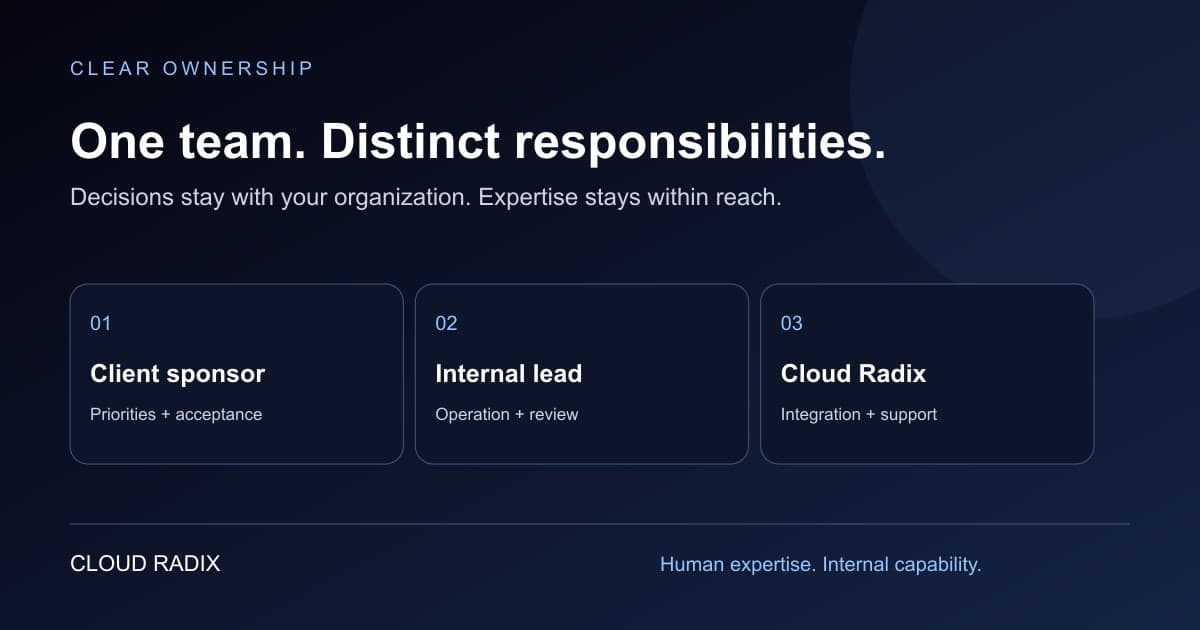
| Responsibility | Client owner | Cloud Radix role |
|---|---|---|
| Business priorities and acceptable outcomes | Executive sponsor | Advise, estimate effort, and surface trade-offs |
| Accuracy of source records and process rules | Department/process owner | Map, validate, and flag inconsistencies |
| Approved integration implementation | Named acceptance owner | Build or coordinate scoped technical work and tests |
| Routine operation and first-line checks | Trained internal lead and backup | Train, document, and provide agreed escalation support |
| Sensitive actions and external commitments | Authorized client approver | Implement agreed approval boundaries |
| Access, retention, and vendor decisions | Client security/IT and authorized management | Document dependencies and recommend controls |
| Ongoing priorities and performance | Sponsor plus internal lead | Review outcomes and deliver scoped improvements |
This is a starting matrix, not a replacement for a contract. It is especially important to decide what happens outside the integrator’s reserved hours. Does an urgent issue pause the workflow and go to an internal manager, an existing IT provider, or a contracted support channel? “We will work it out” is not an escalation policy.
Govern the workflow, not just the chatbot
For every proposed integration, ask where information enters, which systems receive it, what actions can occur, and how the business can stop those actions. Local hardware does not automatically mean every request remains local; external model calls and connected services must be identified in the architecture.
The NIST AI Risk Management Framework provides a voluntary foundation for considering trustworthiness during the design, use, and evaluation of AI systems. It is a reference for organizing risk work—not a certification granted by publishing a policy. NIST AI Risk Management Framework.
Our practical recommendation is to maintain a workflow-level record of permitted data, approved tools, access owners, human-review steps, retention decisions, and fallback procedures. Keep administrative credentials separate from day-to-day execution. Test whether revoked access actually stops subsequent runs. Do not assume that a successful login means the application has only the permissions it needs.
A malicious instruction inside an email or document must not become authority to take a new action. Limit tool permissions and require explicit approval for consequential operations. Vendor promises alone do not replace testing your own workflow. Relevant security review should reflect the actual information and industry involved, rather than treating every business as identical.
Measure value without inventing ROI
Separate three things: processing efficiency, operational outcomes, and financial impact. Minutes saved can create capacity, but they become cash savings only when spending actually falls. Faster responses may improve customer experience without producing a provable revenue increase. Keep those distinctions in the review.
Consider this deliberately hypothetical worksheet:
| Input | Illustrative value |
|---|---|
| Eligible cases per month | 600 |
| Previous human handling time per case | 12 minutes |
| New handling time, including review | 7 minutes |
| Gross capacity released | 600 × 5 ÷ 60 = 50 hours/month |
| Additional exception/support time | 10 hours/month |
| Net capacity released | 40 hours/month |
| Illustrative loaded labor value | $45/hour |
| Capacity value—not cash savings | 40 × $45 = $1,800/month |
Now subtract all relevant costs when evaluating an investment: integration setup, retained support, software subscriptions, AI usage, hosting, internal training, and ongoing review. If total recurring costs exceed the quantified value, either identify additional credible benefits, reduce scope/cost, or do not proceed. These numbers are not Cloud Radix pricing and are not a customer result.
A simple financial view is monthly realized benefit minus incremental recurring cost. Only when that difference is positive does setup cost divided by that difference produce a meaningful simple payback estimate. Do not count the same saved hour as both reduced payroll and extra billable work. Document the assumptions and revisit them after a full operating cycle.
What the retained relationship should look like
Retained consultation and support should buy more than permission to call someone. Define a recurring rhythm: an issue review, a short outcome scorecard, a prioritized improvement backlog, and training refreshers tied to actual changes. Distinguish incidents that restore intended behavior from enhancements that create new behavior.
An illustrative month might include reviewing failed runs, sampling outputs for quality, refreshing a changed integration, coaching the internal lead, and implementing one approved improvement. That is an example agenda—not a promise that every item fits every retainer. Reserved capacity, response windows, on-site days, travel, coverage, and carryover rules belong in the written scope.
Keep a change log. Before changing prompts, models, permissions, or connected software, identify which acceptance examples to rerun. A system that worked last quarter may behave differently after a vendor update. Ongoing improvement should make the operating record clearer, not produce a trail of undocumented adjustments only the integrator understands.
Northeast Indiana examples: start with work, not industries
A Fort Wayne professional-services office: a useful first scope could organize incoming documents, identify missing items, and draft a follow-up for review. The person responsible for the engagement decides whether the follow-up is accurate and appropriate. Do not make professional advice or automatic submission the initial promise.
An Auburn manufacturer: begin with an internal request workflow that assembles approved information for a coordinator. Preserve source references and clearly flag missing or conflicting values. Do not promise autonomous production control or safety decisions just because an AI can summarize a procedure.
A Northeast Indiana home-service business: standardize inquiry capture, check service-area and scheduling inputs, and draft a response for a dispatcher. Measure dropped inquiries and time to first reviewed response. A tidy customer experience depends on the form, destination, notification, and staff handoff working together.
These are illustrative use cases, not descriptions of contracted fractional engagements. The common thread is a bounded process with an owner, a visible outcome, and a recoverable failure path. That is a stronger starting point than deciding the organization needs “AI everywhere.”
When to hire a full-time person instead
A permanent internal role becomes more compelling when the work consistently requires daily availability, substantial on-site coordination, or deep ownership across several departments. Assess actual workload, not the number of AI ideas in a brainstorming document. Some needs require a team of specialists rather than one permanent generalist.
A client-employed integrator can retain Cloud Radix for advanced integration, training, and technical consultation. A Cloud Radix-employed person can be considered for a dedicated on-site managed engagement when staffing and contract requirements fit. Neither structure automatically wins: compare total cost, coverage, management burden, continuity, and control.
Plan the transition before it happens. Specify documentation delivery, ownership or licensing of custom work and reusable components, access transfer, offboarding, and any agreed hiring terms. A healthy service should make a future transition understandable. It should not rely on undocumented systems or inaccessible accounts to retain the client.
Questions to ask before signing
- Which exact workflow will we improve first, and who accepts it?
- What baseline will we measure before changes begin?
- What deliverables do we receive besides meeting hours?
- Who is our integrator, and which specialist work requires additional scope?
- What access and data are required, and who authorizes them?
- What must a person approve before the system acts?
- How will our internal lead and backup demonstrate competency?
- What are the support window, escalation route, and coverage limits?
- Which implementation, software, AI-usage, hosting, and travel costs are separate?
- How do we recover from a failed run or vendor outage?
- What will we own or be licensed to use, and what happens at exit?
- What evidence will determine whether we expand, hold, or stop?
Bring one real process to the first conversation: the tools involved, approximate volume, a sanitized example, the current owner, and the frustration you want removed. Do not email passwords or sensitive client records to start an assessment. The initial discussion should identify the appropriate next step and safe way to examine the work.
Build internal capability, then keep improving
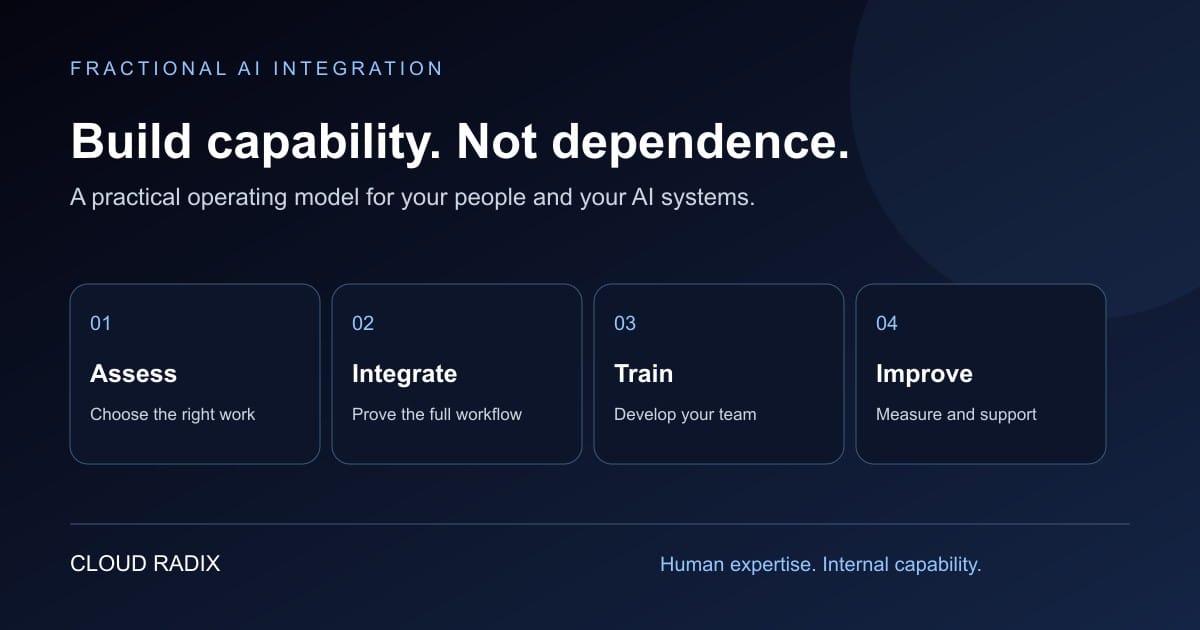
Cloud Radix’s approach is assessment, scoped implementation, practical training, and retained improvement. We help your people put AI to work—and stay accountable for making the agreed systems useful. Based in Auburn and serving Fort Wayne and other organizations by arrangement, we scope remote and on-site support around the work rather than a one-size-fits-all package.
See the fractional AI integrator service and engagement options. If you already have someone who could become your internal AI lead, say so. That person may be the most important asset in the project, not a reason to postpone it.
Frequently asked questions
Is a fractional AI integrator a human or an AI Employee?
The integrator is a human implementation and training partner. An AI Employee is the software system they help your people deploy, operate, and improve.
Can you train someone already on our team?
Yes. Our preferred model develops a named internal lead and backup through practical workflow training, operating documentation, and observed exercises. Protected time and management support are essential.
Can we retain Cloud Radix after training?
Yes. Retained consultation, troubleshooting, training refreshers, and ongoing integration improvements can be scoped with defined capacity, response windows, and responsibilities.
Can the on-site integrator work for us instead?
Yes. We can support training and onboarding for a client-employed integrator. A dedicated Cloud Radix-employed on-site arrangement can also be considered, subject to scope, staffing availability, and written terms.
How much does fractional AI integration cost?
Pricing follows assessment of the workflows, systems, training needs, support capacity, and on-site requirements. Implementation, recurring support, software, AI usage, hosting, and travel are identified separately in the proposal; there is no universal published retainer.
Does this replace our IT team or guarantee savings?
No. We coordinate with your existing IT and process owners. Outcomes are measured against agreed baselines; time released is not automatically cash saved, and no fixed savings or headcount reduction is guaranteed.
Have a process in mind?
Start with one workflow, its owner, and the outcome you want to improve.
Explore our fractional integrator service →