
The 2026 AI coding agent leaderboard refreshed again this week, and the rankings are useful — for one specific job. They tell a buyer which models and harnesses are competitive on a defined set of evaluation tasks at a specific point in time. They are less useful for the job most mid-market buyers actually need to do, which is decide which AI coding agent to deploy across a real engineering organization with real codebases, real security obligations, real production deployment pressure, and real budget. Those are not benchmark-shaped problems. Reading the leaderboard as a buying decision is the most common mistake the mid-market makes in this category.
The 2026-05-15 MarkTechPost benchmark-driven ranking lays out the current field — Claude Code, OpenAI Codex, Cursor, Gemini CLI, GitHub Copilot, Devin, OpenHands, Augment Code, Aider, and Cline — and it does the honest work of also flagging the caveats: SWE-Bench Verified contamination since February 2026, scaffold-dependent variance of multiple points on identical models, and the fact that the benchmarks structurally do not measure sandboxing isolation, secret exposure, prompt injection blast radius, or audit logging capability. Those are exactly the dimensions that decide whether a mid-market buy will work in production six months from now.
This piece is the buyer-guide complement to the security cluster Cloud Radix has been publishing on AI coding agents over the last quarter. The security posts tell a buyer what can go wrong. This one tells the buyer which agent to buy on what evidence, and what to ignore on the leaderboard. The structure is four buyer dimensions, a four-row decision matrix, and one buyer test. The intended reader is the mid-market engineering or IT leader signing AI coding agent procurement decisions this quarter for a Northeast Indiana software team, an internal IT automation function, or a managed-IT-provider engineering practice.
Key Takeaways
- Benchmark rankings are a starting input, not the buying decision. SWE-Bench, Terminal-Bench, and LiveCodeBench score model+harness on isolated, time-bounded tasks — not on multi-week production engineering work with real codebases and real security obligations.
- Mid-market buyers evaluate AI coding agents along four dimensions the benchmarks do not score: security and secret handling, control-plane fit, team-velocity-versus-debug-cost, and vendor risk with multi-model fallback.
- The 4-row buyer decision matrix maps four common use cases (greenfield prototype, internal IT automation, regulated-codebase modification, customer-facing production code) to a recommended agent profile and a required guardrail set for each.
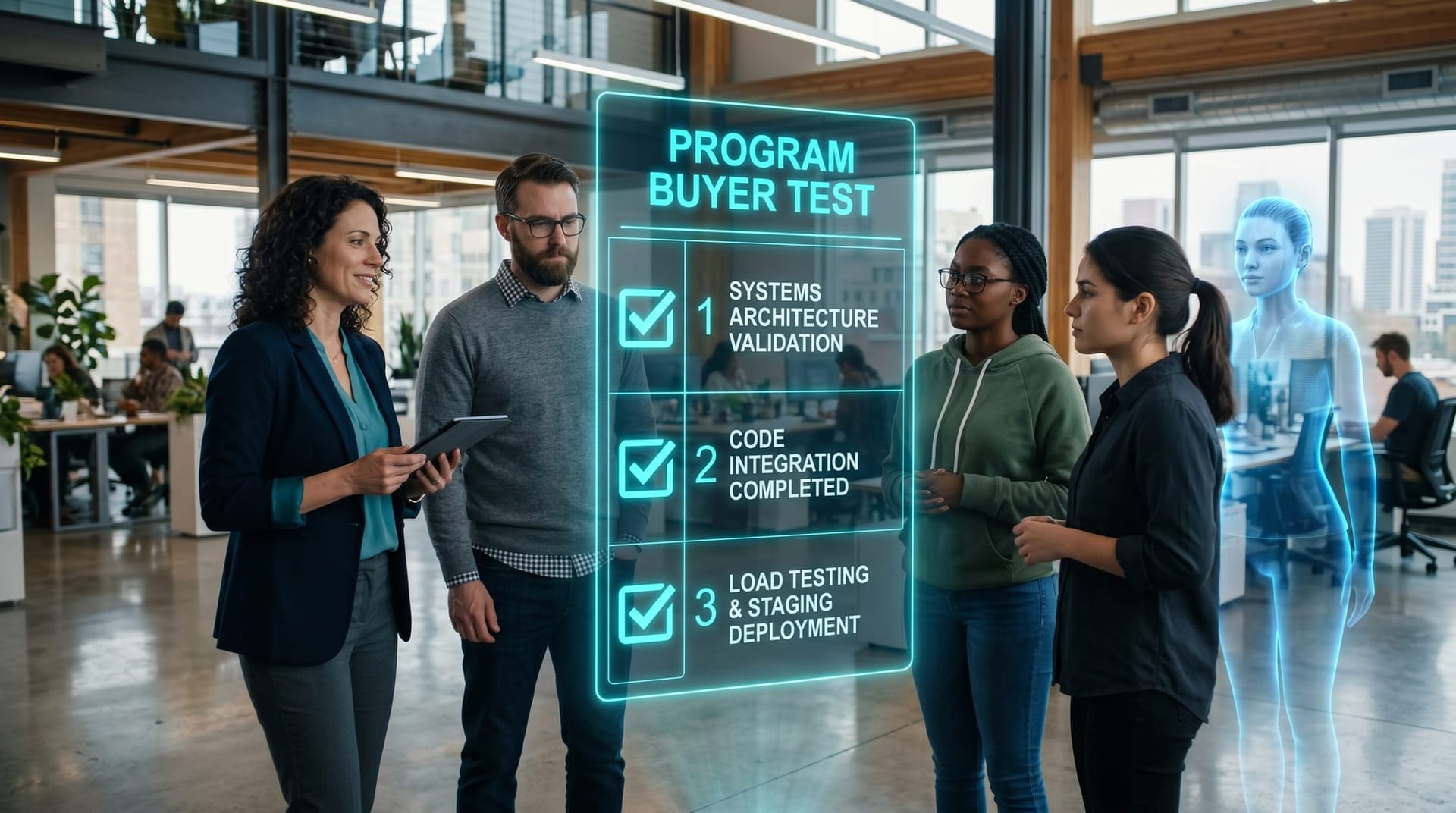
- The buyer test that separates a real AI coding agent program from “we let the developers expense Cursor” is whether the agent runs through the firm's control plane, whether credentials are isolated from the agent's working code, and whether there is a done-detection check on every PR.
- The SWE-Bench Verified contamination disclosed in early 2026 means current benchmark numbers should be read directionally, not absolutely. A 5-point gap between two agents on the same harness is not buyer-meaningful.
- For NE Indiana software teams, internal IT automation functions, and managed-IT-provider engineering practices, the practical play is to anchor the decision on the dimensions, not the rankings.
Why are benchmark rankings the wrong center of gravity for a buying decision?
Benchmarks measure what they measure. The 2026 MarkTechPost ranking lists Claude Code at 87.6% on SWE-Verified, OpenAI Codex behind GPT-5.5 at 82.7% on Terminal-Bench, Gemini CLI at 80.6% on SWE-Verified, OpenHands at 72%, and so on through a long list of agents — and the article is careful to note that SWE-Bench Verified itself was disclosed as contaminated in February 2026, with a reported 59.4% of the hardest test cases having fundamental flaws that allowed frontier models to reproduce solutions verbatim from training data. That is not a minor footnote. It means the absolute scores on the most-cited benchmark in the category are no longer the metric they appear to be.
Even setting contamination aside, the variance from scaffold and harness alone is enough to undermine ranking-based decisions. The MarkTechPost coverage cites a 2.3-point gap between three frameworks running the same Claude Opus 4.5 model on the same task set — purely from differences in context strategy and retrieval quality. On Terminal-Bench 2.0, GPT-5.2-Codex was reported at 57.5% on one harness and 64.7% on another — a 7-point variance from execution environment alone. A mid-market buyer ranking two agents 5 points apart on a single harness has not actually measured a buyer-meaningful difference.
Production engineering work has additional dimensions benchmarks structurally cannot measure. Multi-week refactors that touch ten or fifty files. Codebases with internal conventions the agent has never seen in training. Security boundaries that limit which files and which credentials the agent may touch. Audit-log requirements driven by regulators or customer contracts. Team-velocity effects when the agent's output requires more developer time to review and debug than the agent saved in the writing. The VentureBeat 2026 survey reporting that 43% of AI-generated code changes need debugging in production is the directional evidence on the last point. None of those numbers show up on a benchmark.
The right way to read the rankings is the way the MarkTechPost article itself recommends: treat SWE-Bench Verified as directional, prefer SWE-Bench Pro or your own held-out evaluation on your real code, and weight the ranking lightly relative to the dimensions the benchmark does not score. The original SWE-Bench documentation is also explicit that the benchmark was designed to compare model-and-harness performance on a fixed task distribution — not to serve as a buyer's guide. The rankings are a starting input. They are not the decision.

The four buyer dimensions the benchmarks do not score
There are four dimensions the mid-market AI coding agent buyer evaluates that no benchmark scores. The four are not mutually exclusive and not equally weighted across use cases — a regulated codebase weights security heavily; a greenfield prototype weights velocity heavily — but every buying decision in the category traverses all four.
Dimension 1: Security and secret handling. Whether the agent has access only to the credentials it needs, for the duration it needs them, in a sandbox the agent cannot escape, with the credentials never reaching the agent's working context or its tool-call traces. The AI coding agents prompt injection and secret leak risks for Fort Wayne dev teams piece covers the prompt-injection blast radius; the credential attack vector for AI coding agents piece covers the credential-isolation discipline; and the Anthropic skill scanners and the malicious test file supply chain piece covers the supply-chain shape. The buyer-side test for this dimension is the zero-trust AI agents and credential isolation pattern: the agent is given the smallest credential surface area it can do the job on, and nothing else.
Dimension 2: Control-plane fit. Whether the AI coding agent's traffic runs through the firm's gateway, where policy is enforced, the audit log is generated, and routing rules to different model providers can be authored. This is the same architectural question we covered for the broader AI buying decision in the agent control plane is the new buying decision. An AI coding agent that runs entirely inside the vendor's product is one whose policy enforcement and audit log live in the vendor's product. An agent whose traffic is gateway-mediated lives in the buyer's control plane. The difference is the entire shape of the firm's governance posture for AI-assisted code.
Dimension 3: Team velocity versus debug cost. Whether the agent's output net-saves engineering time across the full cycle — writing, reviewing, debugging, deploying — or whether the time spent reviewing and debugging the agent's output absorbs the time the agent saved in writing it. The VentureBeat survey reporting that 43% of AI-generated code changes need debugging in production is the directional number. The buyer-side metric is the per-PR cycle time, end-to-end, with and without the agent, on the firm's real codebase. The dimension is heavily team-and-codebase-dependent; the benchmark cannot predict it.
Dimension 4: Vendor risk and multi-model fallback. Whether the buyer has a path to swap the underlying model provider without rebuilding the agent's tooling, evals, and policy surface. The Fort Wayne Shai-Hulud npm worm action plan is the recent live example of why vendor-lock-in concentration matters in the supply chain; the same logic applies to AI vendor concentration. A buyer running an entire engineering organization through one model provider has concentrated their dependency on that provider's roadmap, pricing, and policy decisions. A buyer running through a gateway with multi-model routing has diversified that dependency.
The four dimensions also map cleanly to the NIST AI Risk Management Framework Govern/Map/Measure/Manage functions and to the relevant entries in the OWASP Top 10 for LLM Applications 2025 — particularly LLM02 (Sensitive Information Disclosure) and LLM06 (Excessive Agency) for dimension 1, LLM05 (Improper Output Handling) for dimensions 3 and 4. Using framework vocabulary in the buyer's internal governance documents lets the firm's auditor see the buyer's framework alignment in the buyer's procurement record.

The 4-Row Buyer Decision Matrix
The matrix below maps four common mid-market use cases to a recommended agent profile and a required guardrail set for each. The matrix is not a vendor ranking — each row is satisfiable by more than one vendor — and it is not a feature checklist. It is a structural map of which agent profile is the right starting point for which use case, with the guardrails that have to be in place regardless of which specific agent is chosen.
| Use Case | Recommended Agent Profile | Required Guardrails | Benchmark-Relevance Note |
|---|---|---|---|
| Greenfield prototype — new application, no production data, fast iteration | Strong general-purpose model with light scaffolding (Cursor-class IDE-native agent or Claude Code with default config). Optimize for raw velocity over precision. | Credential isolation from prototype-only sandbox; egress allow-list to development APIs only; no access to production data classes. | High SWE-Bench-style rankings are more relevant here than elsewhere because the work shape is closer to the benchmark shape. Still weight directionally. |
| Internal IT automation — scripted workflows, infrastructure changes, internal tooling | Terminal-native agent with strong DevOps task performance (Claude Code with terminal harness, or Codex/GPT-5.5 on Terminal-Bench-heavy work). Prefer model-portable runtimes (OpenHands, Aider). | All actions audit-logged at the gateway; human approval gate on any production-infrastructure change; secret isolation from the agent's working context; rollback path verified before the agent is given write access. | Terminal-Bench 2.0 scores are most relevant here. Note the harness variance — a 7-point gap on the same model from different harnesses means rankings cannot be read absolutely. |
| Regulated-codebase modification — financial services, healthcare, insurance, manufacturing systems-of-record | Model-agnostic agent runtime with control-plane mediation (OpenHands, Aider, or any agent running through a buyer-owned gateway). Optimize for auditability over raw capability. | Every change attributed to a named developer, not the agent; full PR-level audit trail at the gateway; egress restricted to the firm's repo and the firm's CI; secret tokens never reach the agent's context; mandatory human review with a structured rubric. | Benchmark rankings are least relevant here. The dimension that decides the use case (auditability) is not on any benchmark. Read rankings only to disqualify clearly weak candidates. |
| Customer-facing production code — features deployed to end-users, code paths that touch customer data | High-precision general-purpose model with strong code-quality scoring, deployed behind a control plane with done-detection on every PR (Claude Code or Codex through gateway-mediated tooling). | Done-detection check on every PR — the agent's 'this is ready' signal triggers an independent reviewer agent or human reviewer with the original task spec; credential isolation; egress allow-list; full audit log; rollback path required. | Benchmark rankings are moderately relevant. High scores filter the candidate set; the actual decision is made on the four dimensions and the per-PR cycle-time measurement. |
A note on reading the matrix. The four rows are use-case shapes, not org-chart shapes. A single mid-market engineering organization often runs all four use cases simultaneously, sometimes inside the same week, sometimes on the same codebase. The right buyer posture is to author the four guardrail sets at the gateway once, and then route requests through the matching guardrail set at the point of use. The agent the developer picks at the keyboard is constrained by which guardrail set is active for the codebase they are working in.

The buyer test that separates a real coding-agent program from a stipend
The most common pattern in the mid-market right now is “we let the developers expense Cursor (or Claude Code, or Copilot, or all three).” That is not a coding-agent program. It is a stipend. The stipend produces a per-developer productivity story that may or may not be real and provides no governance signal of any kind. The buyer test that converts a stipend into a program is three questions.
Does the agent's traffic run through the firm's control plane? If the agent is making API calls directly from the developer's machine to the model provider's endpoint, the firm has no visibility into what the agent did, what credentials it touched, what data it sent, or what output it returned. The traffic is invisible to the firm's governance. The fix is to route every agent's API traffic through the Secure AI Gateway — the same control plane the firm's other AI Employees run through — so that policy, audit, and routing are uniform. The architectural shape and the broader argument live in our agent control plane buyer test piece.
Are credentials isolated from the agent's working context? If the developer's local environment has long-lived API tokens for production systems sitting in environment variables that the agent can read from its working directory, the agent has the same effective access as the developer. The agent's prompt-injection blast radius is the developer's full access surface. The fix is the credential-isolation pattern: time-bounded, scope-bounded tokens issued at the moment of need, scoped to the task, with the agent never able to read or persist the credential value. The credential attack vector for AI coding agents piece covers the discipline in detail.
Is there a done-detection check on every PR the agent produces? If the agent's “this is ready” signal is the developer hitting merge on a PR the agent wrote, the agent is acting as both worker and judge. The done-detection discipline — which we covered for the broader AI Employee category in the Fort Wayne AI Employee done-detection audit playbook — applies directly to AI-generated code: every PR triggers an independent reviewer (agent or human) with the original task specification and the produced code, scored against the spec, before the merge. The VentureBeat 43% AI-generated code debug rate is the directional data on what happens without this check.
A program that passes all three questions has a structural posture. A program that passes one or two has partial coverage and predictable failure modes. A program that passes none is a stipend with an audit problem the firm will discover later.
A short note on benchmark literacy for the mid-market buyer
The fastest way to make a sophisticated buying decision in this category is to develop a short list of benchmark-literacy habits that turn the rankings into useful inputs rather than the wrong decision.
First, read the benchmark's definition before reading the ranking. SWE-Bench tests model+harness performance on a fixed distribution of GitHub issues with a known resolution. Terminal-Bench scores on terminal-task completion in a specified environment. LiveCodeBench evaluates on competitive programming problems with a fixed difficulty distribution. None of these is a generic “best agent” measurement. Each is a measurement of a specific task shape with a specific evaluation harness.
Second, weight the benchmark by the closeness of the task distribution to the firm's actual work. If the firm's engineers spend most of their time on multi-week refactors of a 200,000-line codebase with internal conventions, the SWE-Bench task distribution is a distant proxy for the firm's work. If the firm's work is mostly script-and-tool automation, Terminal-Bench is a closer proxy. The discipline of context-fit applies here as much as it applies in the AI Employees context engineering discipline piece — the agent's measured capability is only as useful as the context-fit between the benchmark's task distribution and the firm's task distribution.
Third, ignore single-digit gaps. A 2-point or 3-point gap between two agents on a single benchmark is well inside the scaffold-and-harness variance the MarkTechPost coverage documents. A buyer making a procurement decision on a 3-point gap is making a decision on noise.
Fourth, build a held-out internal eval. The MarkTechPost coverage is explicit that “your own held-out evaluation on real code” is the highest-confidence input. The eval does not have to be elaborate. Twenty representative tasks from the firm's actual work, scored against the firm's actual definition of done, run on the two or three candidate agents, repeated quarterly. The eval is the firm's internal benchmark; it should be weighted higher than any external ranking.
Fifth, watch the VentureBeat coverage of Terminal-Bench 2.0 and recent frontier model releases — the model field is moving fast enough that the rankings genuinely do refresh quarter-to-quarter, but the buyer dimensions move slowly. The firm's procurement framework should be stable across model refreshes; the model choice should not be.

What this looks like in Northeast Indiana
For NE Indiana software teams, internal IT automation functions, and managed-IT-provider engineering practices across Auburn, DeKalb, and Allen Counties, the practical mid-market shape is a small number of named scenarios where AI coding agents are already in use or are being procured. The buyer-dimension analysis maps directly onto each.
A 40-developer software team at a manufacturing-adjacent SaaS company in the Fort Wayne IT corridor is evaluating Claude Code and Cursor for production work on a customer-facing application. The buyer-dimension read: security and secret-handling matter more than raw velocity (customer-facing code, regulated industry context), the control-plane fit is the decisive question (do both candidates run through the firm's gateway?), and the team-velocity-versus-debug-cost dimension is measurable on the firm's existing PR cycle time. The benchmark rankings sit fourth among the four dimensions for this buyer.
An internal IT automation team of seven at a regional financial-services organization in Allen County is procuring an agent for infrastructure-as-code work and internal tooling. The buyer-dimension read: control-plane fit and auditability are the dominant requirements (regulated industry, internal infrastructure access). Terminal-Bench-leaning agents are a structural fit; the agent runtime should be model-portable so the firm is not single-vendor-exposed. The benchmark rankings here are a strong filter on the candidate set but not the deciding input.
A managed-IT-provider engineering practice of twelve at a Fort Wayne MSP doing customer infrastructure work needs an agent that can be safely deployed across multiple customer environments. The buyer-dimension read: credential isolation is the highest-weighted dimension (customer-environment access), control-plane fit is required (per-customer audit trails), and vendor-risk diversification across model providers is structural (different customers will have different vendor preferences). A model-agnostic gateway-mediated agent runtime is the fit.
A four-developer in-house team at a DeKalb County dental-software provider building a regulated-codebase modification — claims-handling logic touched by HIPAA — needs the regulated-codebase guardrail set from row three of the matrix above. The benchmark rankings are the least relevant input here; the audit-trail and human-review structure are the deciding requirements.
In each of these four NE Indiana scenarios, the dimensions are the durable inputs and the rankings are the moving inputs. The firm whose procurement framework is anchored on the dimensions will not have to redo the framework when the benchmark refreshes next quarter. The firm whose framework is anchored on the rankings will redo the framework every quarter, and the rankings will not have moved in a way that changes the buyer-meaningful answer.
If you are an NE Indiana engineering, IT, or MSP leader running this evaluation right now and you want a second pair of eyes on the four-dimension read for your specific scenario — including whether your current agent traffic is gateway-mediated and whether your credential-isolation discipline matches the codebase you are deploying into — that is exactly the conversation Cloud Radix is most useful in. Our AI Employees deployments include the engineering and IT automation use cases the matrix above describes, and the Secure AI Gateway is the control plane that mediates the agent traffic for those deployments.

Frequently Asked Questions
Q1.What dimensions should a mid-market buyer evaluate when ranking AI coding agents?
Mid-market buyers evaluate four dimensions the benchmarks do not score. Dimension 1 is security and secret handling — credential isolation, sandbox enforcement, prompt-injection blast radius. Dimension 2 is control-plane fit — whether the agent's traffic runs through the firm's gateway, where policy and audit live. Dimension 3 is team velocity versus debug cost — whether the agent's output net-saves engineering time across the full write-review-debug-deploy cycle. Dimension 4 is vendor risk and multi-model fallback — whether the buyer can swap model providers without rebuilding the agent's tooling, evals, and policy surface. The benchmark ranking is a filter on the candidate set, not the deciding input.
Q2.Are the SWE-Bench rankings still reliable in 2026?
SWE-Bench Verified was disclosed as contaminated in February 2026, with a reported 59.4% of the hardest test cases having fundamental flaws that allowed frontier models to reproduce solutions verbatim from training data. The MarkTechPost coverage recommends treating SWE-Bench Verified as directional rather than absolute and preferring SWE-Bench Pro or the buyer's own held-out evaluation on real code. The original SWE-Bench documentation was always explicit that the benchmark measures model+harness performance on a fixed task distribution, not generic agent quality.
Q3.How big a gap on a benchmark is buyer-meaningful?
For the 2026 mid-market AI coding agent category, single-digit gaps on a single benchmark are generally not buyer-meaningful. The MarkTechPost coverage documents a 2.3-point gap between three frameworks running the same Claude Opus 4.5 model on the same task set — purely from scaffold and retrieval differences — and a 7-point gap on Terminal-Bench 2.0 for the same GPT-5.2-Codex model on different harnesses. A 5-point gap between two agents on the same harness sits inside that variance band. Larger gaps (10+ points) start to be meaningful but should still be checked against an internal eval.
Q4.What is the difference between letting developers expense an AI coding agent and running a real program?
A stipend gives every developer their own subscription, runs the agent's traffic outside the firm's control plane, leaves credentials exposed to the developer's local environment, and has no done-detection check on agent-produced code. A real program routes all agent traffic through a gateway, issues short-lived scoped credentials at the moment of need, and runs an independent done-detection check on every PR the agent produces. The stipend produces a per-developer productivity story with no governance signal. The program produces a measurable, auditable, portable engineering capability.
Q5.Why does control-plane fit matter for an AI coding agent specifically?
Coding agents have access to source code, build pipelines, deployment systems, and the credentials that connect those systems. Without a control plane mediating the traffic, the firm has no enforcement edge on which credentials reached the agent, what data the agent sent to the model provider, or what the agent's output instructed downstream systems to do. The agent control plane buyer test piece covers the architectural argument in depth; the AI coding agent case is the highest-stakes version of the general argument because the agent's actions translate directly into running code.
Q6.What is done-detection in the context of AI-generated PRs?
Done-detection for AI-generated PRs is the practice of having an independent reviewer — agent or human — with the original task specification verify that the produced code matches the spec, before the PR is allowed to merge. The reviewer is not the agent that wrote the code. The discipline is the same one we describe in the Fort Wayne AI Employee done-detection audit playbook, applied to the specific shape of AI-generated PRs. The need for the discipline is reinforced by the VentureBeat 2026 survey reporting that 43% of AI-generated code changes need debugging in production.
Q7.Should an NE Indiana mid-market firm wait another quarter to make this decision?
For most NE Indiana mid-market firms, the answer is to start the procurement framework now and let the model choice move quarter-to-quarter. The buyer dimensions (security, control-plane fit, velocity-vs-debug, vendor risk) are stable. The model rankings refresh frequently. A firm that anchors the framework on the dimensions and the gateway can update the model behind the gateway with a configuration change as the field moves. A firm that anchors the framework on the rankings will redo the framework every quarter and will not be measurably better off for the work. The framework is the durable artifact.
Sources & Further Reading
- MarkTechPost: marktechpost.com/2026/05/15/best-ai-agents-for-software-development-ranked — Best AI Agents for Software Development Ranked: A Benchmark-Driven Look at the Current Field.
- SWE-Bench Authors: swebench.com — SWE-Bench documentation and methodology.
- VentureBeat: venturebeat.com/technology/openais-gpt-5-5-is-here — OpenAI's GPT-5.5 narrowly beats Anthropic's Claude Mythos Preview on Terminal-Bench 2.0.
- NIST: nist.gov/itl/ai-risk-management-framework — AI Risk Management Framework.
- OWASP GenAI Security Project: genai.owasp.org/llm-top-10 — OWASP Top 10 for LLM Applications 2025.
- VentureBeat: venturebeat.com/technology/43-of-ai-generated-code-changes-need-debugging — 43% of AI-generated code changes need debugging in production, survey finds.
Run the Four-Dimension Read on Your AI Coding Agent Shortlist
Bring your current AI coding agent candidates to Cloud Radix and we will walk the four-dimension read with you — security, control-plane fit, velocity-vs-debug, and vendor risk — against your specific codebase and team shape.