
Most of the AI coverage aimed at business owners is about fear of missing out: adopt now, pick a platform, move fast. The smarter question — the one a $200-billion-plus mutual insurer actually answered this year — is how to capture the upside without handing your operation to a single model vendor who can change the price, the terms, or the model itself whenever they like.
According to VentureBeat's reporting on MassMutual's AI strategy, the 170-plus-year-old, policyholder-owned insurer did something most companies don't have the discipline to do: it deliberately capped its AI vendor contracts at 12 months, ran more than one model under the hood, and still reported roughly a 30% gain in developer productivity. The strategy isn't “bet on the winner.” It's “stay portable, measure everything, and keep the exit door open.”
That is, almost word for word, the thesis Cloud Radix has been arguing for two years. AI value should be portable, measurable, and never hostage to one provider. The difference now is that a Fortune 500 company has published a working playbook — and the architecture that makes it possible scales down to a 20-to-200-person firm in Fort Wayne far more easily than the enterprise budget does. This is the offensive version of the lock-in conversation. Our earlier writing covered the business risk when a vendor quietly cuts off agent access; this piece is about how you architect contracts and a gateway so you collect the productivity and keep your freedom.
Key Takeaways
- MassMutual capped AI vendor contracts at 12 months on purpose. Short terms keep the company free to swap to best-of-breed tools as the market moves — and still produced a reported ~30% developer productivity gain.
- Portability is an architecture, not a vibe. The companies that built an abstraction layer first could switch providers with far less rework than those wired directly to one vendor's API.
- A secure AI gateway is the neutral control point. Route every AI request through one layer you own, and the model behind it becomes a swappable component instead of a dependency.
- Lock-in hides in five places — the model, the orchestration, the data, your governance evidence, and your team's know-how — and orchestration lock-in is growing fastest.
- Measure in dollars per agent, not hype. MassMutual's wins were concrete: help-desk resolution times cut from minutes to about one. If you can't put a number on it, you can't defend keeping it.
- Mid-market firms can copy the posture, not the budget. Month-to-month terms plus a gateway let a lean NE Indiana team pilot, measure, and switch models without re-platforming.
What Did MassMutual Actually Do — and Why Does It Matter for Smaller Firms?

Strip away the Fortune 500 scale and MassMutual's approach is refreshingly simple. The company splits its AI work into two buckets, as VentureBeat described: broad enablement — putting productivity tools like Copilot and virtual assistants in front of all employees — and deepen-and-focus initiatives, where a team targets one specific workflow that meaningfully changes life for advisors, policyholders, or staff. Crucially, it runs a multi-model architecture and keeps every vendor relationship “on a clock,” capped at roughly a year, so the company always retains the option to move to a better tool as the field matures.
The results it reports are not abstract. In a separate VentureBeat account of how MassMutual and Mass General Brigham turned AI pilot sprawl into production results, MassMutual cited a 30% developer productivity gain, IT help-desk resolution times cut from 11 minutes to about one, and customer-service calls compressed from roughly 15 minutes to one or two. The throughline of that story is discipline replacing chaos: ungoverned pilots that never reach production were shut down in favor of a smaller number of governed, measured workflows.
None of that requires a Fortune 500 balance sheet. What it requires is a posture: short contracts, more than one model, governance up front, and a number attached to every deployment. A mid-market operator can adopt every one of those without an enterprise procurement department. In fact, the smaller you are, the more this matters — you have less margin to absorb a surprise price hike or a model deprecation that breaks a workflow you quietly came to depend on.
It's worth being honest about one thing the coverage glosses over: MassMutual spent years on the unglamorous part first. Its CIO Sears Merritt, as Yahoo Finance reported, led a roughly 36-month cloud data-platform overhaul before the AI wins landed, and the company still keeps its generative-AI tools internal to employees rather than exposing them to policyholders. The lesson for a smaller firm isn't “move slower.” It's that portability and governance are what let you move fast safely — and you can stand those up in weeks, not years, at your scale.
Why Is AI Vendor Lock-In the Risk Nobody Budgets For?
Lock-in is easy to ignore because it feels like a future problem. It isn't. In its review of the 2026 enterprise agentic-AI landscape, Kai Waehner summarizes survey data showing that a large share of enterprises say vendor lock-in has already hindered their ability to adopt better tools, that roughly two-thirds now actively aim to avoid high dependency on a single AI provider, and that close to three in four anticipate real operational disruption if a vendor's service were terminated. Those are not hypotheticals — they're the lived experience of companies that wired themselves to one provider in 2024 and are now paying to unwind it.
The trap is that lock-in doesn't live in one place. As the AI Assembly Lines risk framework lays out, dependency accumulates across five distinct layers — the model itself, the orchestration that strings calls together, your data, your governance and audit evidence, and the institutional knowledge your team builds inside one vendor's console. Orchestration lock-in, that analysis notes, is the fastest-growing category, because the “glue” connecting your agents is the hardest thing to rebuild somewhere else.
Here's the part that should reframe your procurement: switching cost is largely an architecture choice you make on day one. According to SoftwareSeni's analysis of multi-model portability, enterprises that built an abstraction layer into their first AI deployment were later able to add a secondary provider or switch their primary one with dramatically less migration effort than firms that coded directly against a single vendor's API. The same analysis points to how the giants hedge: Snowflake committed a reported $200 million to OpenAI while keeping live partnerships with Anthropic, Google, Meta, and Mistral, and ServiceNow signed multi-year deals with both OpenAI and Anthropic. If the largest software companies refuse to single-source their models, a 50-person firm probably shouldn't either.
| Lock-in layer | What it looks like | Mid-market mitigation |
|---|---|---|
| Model | One vendor's model is hard-coded into every workflow | Route through a gateway; keep at least one fallback model configured |
| Orchestration | Agent “glue” lives in a proprietary console | Own your orchestration logic; treat the vendor as a swappable engine |
| Data | Prompts, embeddings, and history trapped in a vendor store | Keep an exportable copy of data and embeddings you control |
| Governance evidence | Audit logs only exist inside the vendor | Log requests and approvals at your gateway, not theirs |
| Knowledge | Your team only knows one vendor's UI | Document workflows model-agnostically so know-how is portable |
How Does a Secure AI Gateway Make You Portable?

The single most useful idea from the MassMutual approach, translated for a smaller team, is the neutral control point. Instead of letting each tool talk directly to a model vendor, you route every AI request through one layer you own and operate — a secure AI gateway. To the model vendors, your gateway is the customer. To your team, the gateway is where models get swapped, where spend gets metered, and where security policy lives.
That one architectural decision quietly solves several problems at once. Portability stops being a migration project, because the gateway is the abstraction layer SoftwareSeni's research describes — switching from one model to another becomes a configuration change, not a rebuild. Governance gets easier, because every request and every human approval is logged in a place you control rather than scattered across vendor dashboards. And cost discipline becomes possible, because you can see exactly which workflow is spending what — the prerequisite for being able to measure real dollars per AI Employee instead of guessing.
It also changes your negotiating position. When a model is one configurable component behind your gateway rather than the foundation of your stack, a vendor's price increase or a model change underneath you becomes a manageable event instead of an emergency. You can run a quiet bake-off, route a slice of traffic to a challenger model, compare quality and cost, and switch — the same disciplined, evidence-based approach behind building a neutral evaluation layer that keeps your models swappable. The gateway is what makes that evaluation actionable instead of academic.
We'll be candid about the trade-off: a gateway is one more piece of infrastructure to run, and abstraction can occasionally cost you a vendor's newest bleeding-edge feature for a few weeks until you wire it in. In our experience that's a price worth paying. The alternative — a stack that quietly fuses to one vendor over 18 months — is far more expensive to undo, and you usually discover the bill at the worst possible moment.
What Does a Copyable Mid-Market Playbook Look Like?
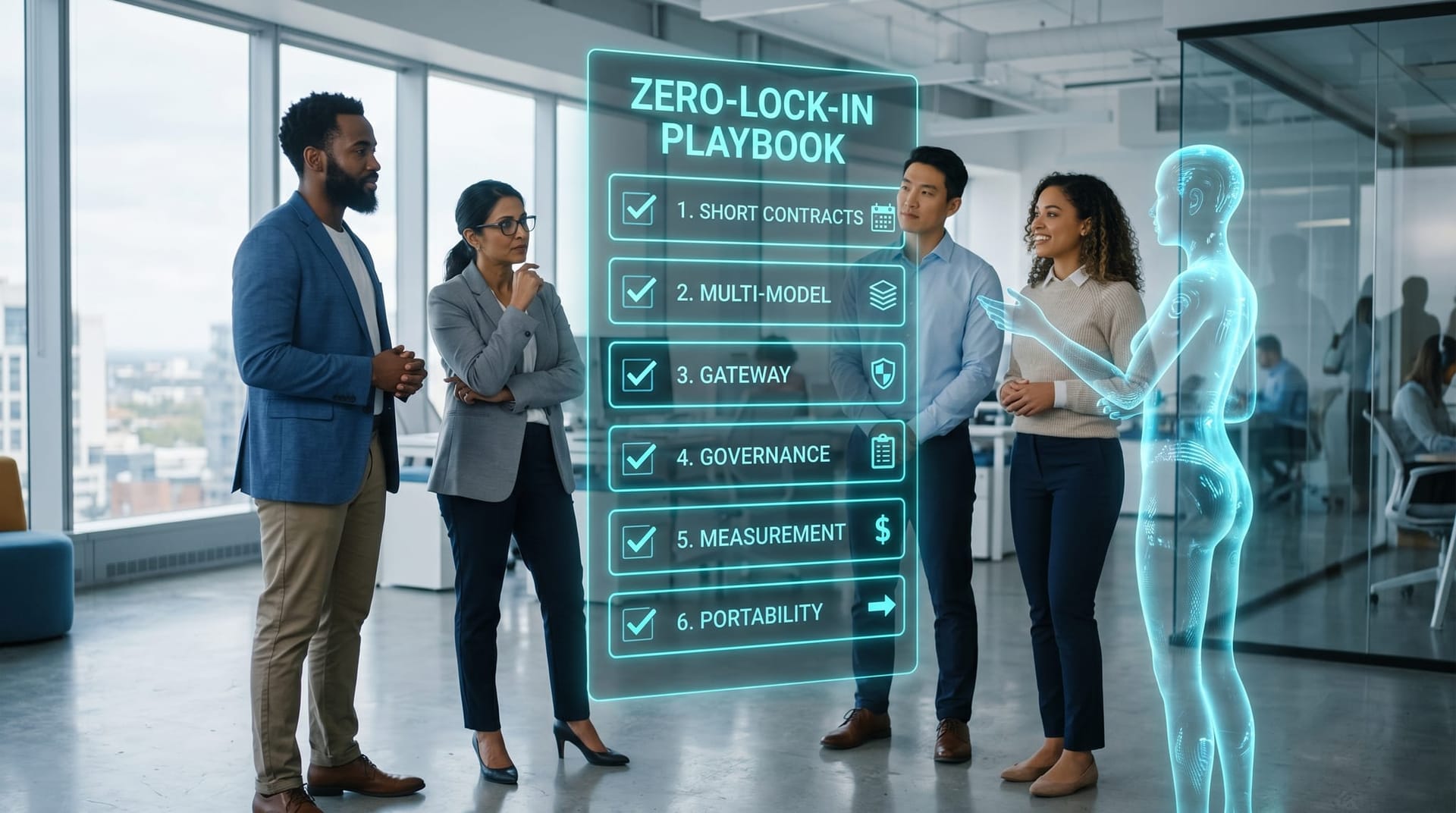
You don't need MassMutual's headcount to run MassMutual's posture. Here's the concrete version for a 20-to-200-person firm.
1. Cap your contract terms. Default to month-to-month or 12-month maximums on AI vendors, not multi-year commitments. The discount for a three-year lock-in is rarely worth surrendering your optionality in a market that reprices every quarter. Short terms are how MassMutual keeps its leverage; they cost you almost nothing to adopt.
2. Insist on multi-model from day one. Even if you only actively use one model, architect so a second can be swapped in. Configure a fallback. The goal is that no single vendor outage, deprecation, or price change can take a core workflow offline.
3. Put a gateway in the middle. Route AI traffic through one secure layer you own. This is the linchpin — it's what makes 1 and 2 real rather than aspirational, and it's where your security and logging live.
4. Govern before you scale, not after. MassMutual's wins came after it killed ungoverned pilot sprawl. Decide up front who can deploy an agent, what it's allowed to touch, and where its actions are logged. Governance is cheaper to install at five workflows than to retrofit at fifty.
5. Attach a number to every deployment. Help-desk minutes saved, calls deflected, hours of admin reclaimed, dollars per agent per month. If a workflow can't show a number after a fair trial, you retire it — without ceremony. This is also how you keep spending honest and right-size AI cost without cutting capability.
6. Keep your data and your know-how portable. Maintain an exportable copy of the data and embeddings your agents rely on, and document each workflow in model-agnostic terms so your team's expertise isn't trapped in one vendor's interface.
Run those six and you've reproduced the spine of the strategy a Fortune 500 insurer published — minus the enterprise overhead. The posture is the product here, and the posture is free.
How Does This Play in Fort Wayne and Northeast Indiana?

For a professional-services, manufacturing, or home-services firm across Allen and DeKalb counties, the enterprise version of this story can feel like it's about somebody else. It isn't. The whole point of the gateway-plus-short-terms posture is that it's more valuable the leaner your team is, because you have less slack to absorb a vendor surprise.
Picture a 60-person Fort Wayne firm that wants MassMutual-grade results on a Northeast Indiana budget. With a secure AI gateway and a month-to-month posture, that firm can pilot an AI Employee on one workflow — say, after-hours lead intake or back-office document handling — measure the dollars it saves over a fair trial, and either scale it or swap the model behind it without re-platforming a single downstream tool. No three-year commitment. No emergency migration when a vendor changes terms. The firm captures the productivity locally instead of exporting both the work and the leverage to an out-of-state platform.
That last point matters for a regional economy. When a Fort Wayne business owns its gateway, its data, and its workflow logic, the efficiency gains compound inside the company and the community — not inside a vendor whose pricing power grows the more dependent you become. Staying portable is, in the most practical sense, a way of keeping the value of your own automation here at home. For local owners weighing where to start, the right first move is usually one well-scoped, well-measured workflow — not a platform-wide bet.
Frequently Asked Questions
Q1.What is AI vendor lock-in, in plain terms?
AI vendor lock-in is the accumulated cost and difficulty of leaving one AI provider once your business depends on it. It builds up across five layers — the model, the orchestration that connects your agents, your data, your audit and governance evidence, and your team's familiarity with one vendor's tools. The more of those layers fuse to a single provider, the more leverage that provider has over your price, terms, and roadmap.
Q2.Did MassMutual really get a 30% productivity gain while avoiding lock-in?
According to VentureBeat's reporting, MassMutual reported roughly a 30% developer productivity gain while deliberately capping vendor contracts at about 12 months and running a multi-model architecture. It also cited help-desk resolution times falling from 11 minutes to about one. Those are the company's own reported figures; your results will depend on your workflows, your data quality, and how disciplined your governance is.
Q3.What is a secure AI gateway and do I need one?
A secure AI gateway is a single layer you own that all of your AI requests pass through before reaching any model vendor. It's where you swap models, enforce security policy, and log every request and approval. You don't strictly need one to start experimenting, but it's the practical prerequisite for staying portable, controlling cost, and governing AI at any real scale.
Q4.Isn't running multiple models more complicated than just picking one?
Slightly, yes — that's the honest trade-off. Running multi-model means a bit more infrastructure and occasionally waiting to wire in a vendor's newest feature. But the firms that build that abstraction up front switch providers with far less effort later, and they're never held hostage by a single outage or price change. For most businesses the modest added complexity is cheaper than the cost of being trapped.
Q5.Can a small Fort Wayne business actually do this without an enterprise budget?
Yes. The MassMutual posture — short contracts, multi-model design, a gateway in the middle, governance first, and a number on every deployment — is essentially free to adopt and scales down better than it scales up. A lean local team can stand up a gateway and pilot one measured workflow in weeks, which is exactly the kind of engagement we help Northeast Indiana firms run.
Q6.Where should a mid-market firm start if it wants to avoid lock-in?
Start with the gateway and a single, well-scoped workflow. Route that one workflow's AI traffic through a layer you control, attach a clear dollar or time metric to it, and keep the contract short. Once you've proven the value and the portability on one workflow, the same pattern extends to the next — without ever committing your whole operation to one vendor.
Sources & Further Reading
- VentureBeat: venturebeat.com/orchestration/massmutuals-ai-strategy-12-month-contracts-30-productivity-gains-zero-lock-in — MassMutual's AI strategy: 12-month contracts, 30% productivity gains, zero lock-in.
- VentureBeat: venturebeat.com/orchestration/how-massmutual-and-mass-general-brigham-turned-ai-pilot-sprawl-into — How MassMutual and Mass General Brigham turned AI pilot sprawl into production results.
- Yahoo Finance: finance.yahoo.com/news/massmutual-cio-says-years-long-192425000.html — MassMutual's CIO says a years-long data overhaul helped prepare the insurer for the AI boom.
- SoftwareSeni: softwareseni.com/how-to-avoid-enterprise-ai-agent-platform-lock-in-with-multi-model-portability — How to avoid enterprise AI agent platform lock-in with multi-model portability.
- AI Assembly Lines: aiassemblylines.com/post/how-to-avoid-ai-vendor-lock-in — How do you avoid AI vendor lock-in? A risk framework for enterprise operations leaders.
- Kai Waehner: kai-waehner.de/blog/2026/04/06/enterprise-agentic-ai-landscape-2026-trust-flexibility-and-vendor-lock-in — Enterprise agentic AI landscape 2026: trust, flexibility, and vendor lock-in.

Capture the Upside, Keep the Exit Door Open
Cloud Radix builds exactly that architecture for Northeast Indiana businesses: a secure AI gateway as your neutral control point, AI Employees deployed on measured workflows, and a portability-first posture so you never end up trapped. If you want the Fortune 500 playbook sized for your team, let's scope a single workflow and put a real number on it.