Most companies are asking the wrong question about AI. The question on the table is usually “which agents should we deploy?” — and it's a fine question, but it's a starting line dressed up as a finish line. The businesses that will pull ahead in 2026 figured out something subtler: an AI agent is only as valuable as the organization's ability to learn from it. Deploying agents is the easy part. Turning every agent interaction into knowledge the whole company keeps is the part that compounds.
VentureBeat recently argued that agentic enterprises need to become learning systems — that the point of deploying autonomous agents isn't just to offload tasks, but to build an organization that gets measurably smarter from each one. That reframe matters. It moves AI from a tooling decision to an operating-model decision. A company with brilliant agents and no feedback loop is just automating its current mistakes faster. A company that closes the loop turns every month of operation into an advantage that competitors can't simply buy off the shelf.
This is a thought-leadership piece, not a product pitch, but the bias is worth stating up front: the way you architect your AI workforce determines whether it becomes a learning system or an expensive collection of disconnected demos.
Key Takeaways
- Deploying AI agents is step one; the durable advantage comes from turning every agent interaction into organizational learning.
- A “learning system” is people, process, and agents in a loop — not an agent that merely improves its own code.
- The maturity ladder is deploy → measure → feedback → compound; most companies stall at the first rung.
- Human approval gates aren't friction — they're the richest source of corrective signal your organization produces.
- Persistent memory and performance metrics are what let learning accumulate instead of resetting every session.
- The competitive moat isn't your model; it's the compounded knowledge your loop captures over time.
Why Isn't Deploying AI Agents the Finish Line?
There's a comfortable story that goes: pick a vendor, switch on some agents, watch the productivity arrive. It rarely plays out that way, and the reason is structural. An agent deployed into a workflow that nobody is watching, measuring, or correcting will keep doing exactly what it did on day one — including the parts it got wrong. Automation freezes a process in place. If that process had flaws, you've now scaled the flaws.
VentureBeat's coverage of agentic design patterns frames this as the missing link between AI demos and enterprise value: a slick demo proves an agent can do a task once, but enterprise value comes from the patterns that make agents reliable, observable, and improvable in production. The gap between “it worked in the demo” and “it makes us better every quarter” is exactly the gap between a tool and a learning system.
We've made a version of this argument before — that execution, not strategy, separates the companies turning AI pilots into real AI Employees. The deeper point here is that even good execution at deployment is not enough. Deployment is when the learning is supposed to begin, not end. The finish line keeps moving on purpose, because a learning system is never finished — that's the whole idea.

What Does It Mean for a Company to Become a Learning System?
It helps to be precise, because “learning system” gets used loosely. We are not talking about an agent that rewrites its own harness or self-optimizes its prompts in isolation — that's a narrow technical capability about one agent improving itself. We're talking about something bigger and more organizational: a company in which people, processes, and agents form a loop where what's learned in one corner becomes available everywhere.
Concretely, an organizational learning system has four properties. It captures what happened — every agent action, decision, and outcome is recorded rather than evaporating. It evaluates what worked and what didn't against real measures, not vibes. It feeds corrections back to both the agents and the humans who supervise them. And it retains that knowledge so the same lesson never has to be learned twice. Strip out any one of those and the loop breaks: capture without evaluation is just logging; evaluation without feedback is just a report nobody acts on.
This is where the technical and the organizational meet. VentureBeat's piece on designing the agentic enterprise for measurable performance stresses cascading KPIs from the enterprise down to individual agents — so that an agent's behavior is tied to outcomes a human actually cares about. Reflective agent patterns reinforce the same instinct at the micro level: an agent that drafts a plan, executes it, and critiques its own output before handing it over is running a tiny internal feedback loop, and that loop is often what separates a wrong answer from a right one. A learning organization simply does this at every level — agent, team, and company.
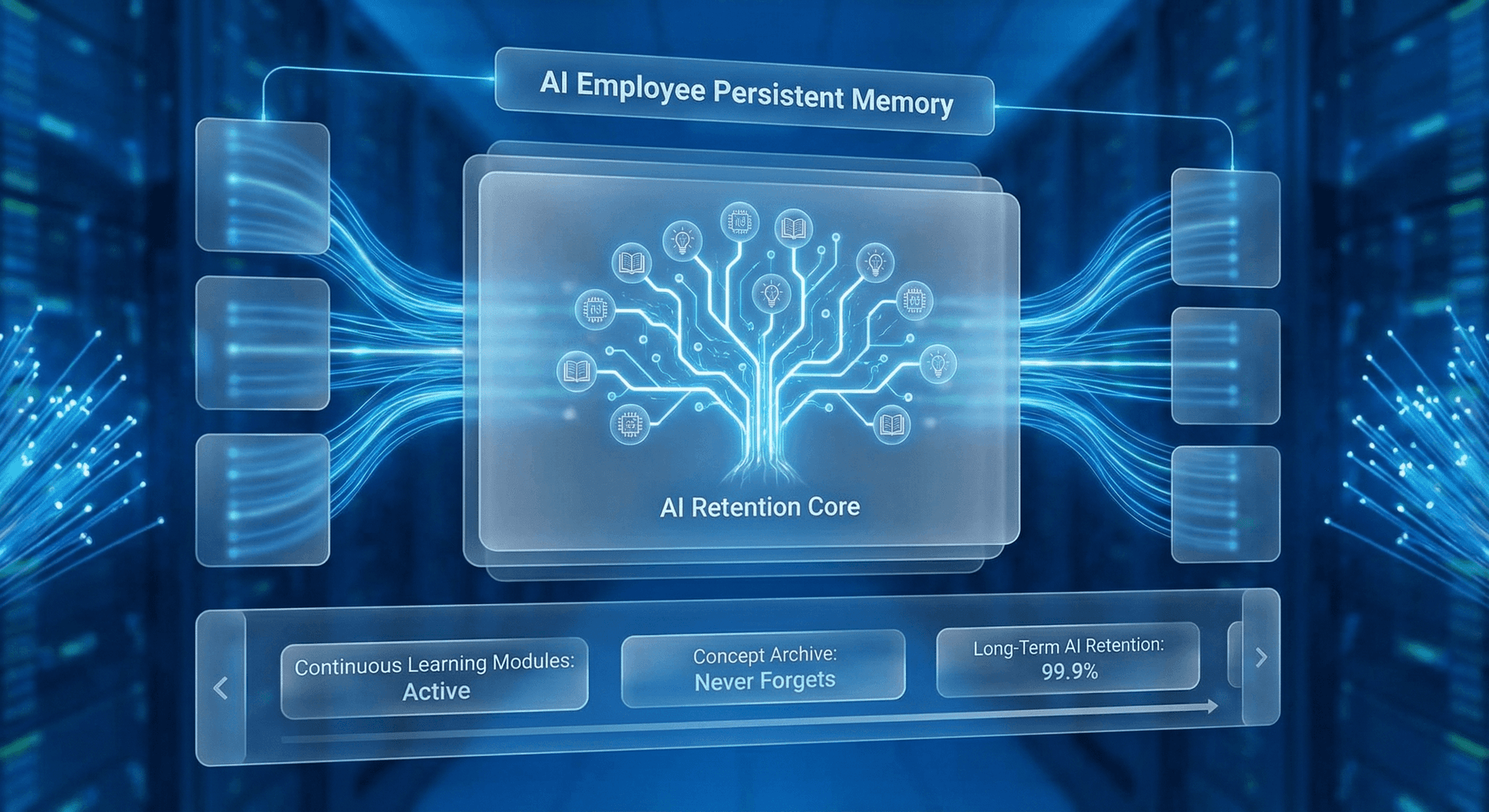
Memory is the substrate that makes it possible. An AI workforce that forgets everything between sessions can't compound anything; it starts from zero each morning. That's why we keep returning to the idea that your AI Employee should never forget — persistent memory is the difference between an organization that accumulates expertise and one that re-learns its own lessons indefinitely.
What Are the Four Stages of the Agentic Learning Ladder?
Abstract frameworks don't help an operator on a Monday morning, so here's a concrete maturity ladder. Most organizations can place themselves on it honestly, and the value is in seeing the next rung clearly.
| Stage | What it looks like | What's missing | The next move |
|---|---|---|---|
| 1. Deploy | Agents are live and doing tasks | No measurement; success is anecdotal | Define what "good" means for each agent |
| 2. Measure | Agent outcomes tracked against KPIs | Data is collected but not acted on | Route the signal to a human who can change something |
| 3. Feedback | Corrections flow back to agents and supervisors | Lessons stay trapped in one team | Make the learning shared and durable |
| 4. Compound | Knowledge accumulates and transfers across the org | The hardest rung to hold — entropy pulls you back | Protect the loop as core operating discipline |
The pattern most companies fall into is stalling at Stage 1 — agents running, nobody quite sure if they're helping. Getting to Stage 2 is mostly a discipline of choosing AI Employee performance metrics that actually matter instead of vanity counts of tasks completed. Stage 3 is where the human element becomes non-negotiable, and Stage 4 is rare precisely because it requires treating the loop itself as something worth defending against organizational entropy.
A useful caution: don't mistake buying more agents for climbing the ladder. Adding agents at Stage 1 just gives you more unmeasured automation. The ladder is about depth of learning, not breadth of deployment.

Where Do Human Approval Gates Fit Into a Learning Loop?
It's tempting to treat human-in-the-loop approval as a temporary tax — friction you tolerate until the agents are “trusted enough” to remove it. That framing misses what approval gates actually produce. Every time a human approves, edits, or rejects an agent's proposed action, they generate a labeled example of what good and bad look like in your specific business. That is corrective signal of a quality you cannot buy.
VentureBeat's reporting on adopting agentic AI without neglecting supervision makes the case that supervision and AI fluency are not training wheels but durable parts of the operating model — employees who actively participate in catching and correcting agent errors build both better agents and a more capable workforce. The approval gate, seen correctly, is a data-generation engine pointed at your own edge cases.
The practical implication is to instrument your gates, not just staff them. When a human overrides an agent, capture why. When they approve, note what made it acceptable. Over weeks, those decisions become a map of your business's actual judgment — the tacit knowledge that usually lives only in senior employees' heads. This connects directly to the broader idea of AI as an operating layer for your business: the approval layer isn't a checkpoint bolted on top, it's where the organization's judgment gets encoded into the system. Remove the gates too early and you don't just add risk — you switch off your best source of learning.

There's a sequencing lesson here too. The goal isn't to keep every gate forever — it's to earn the right to relax a gate based on evidence rather than impatience. When the captured data shows an agent has handled a category of decision correctly across a meaningful run of cases, you can widen its autonomy on that narrow slice with confidence, while keeping humans in the loop everywhere the agent hasn't yet proven itself. That's a learning system setting its own thresholds: autonomy expands where the evidence supports it and contracts where it doesn't, instead of being granted or revoked by gut feel. The companies that get this right treat the question “where can we safely remove a human?” as an output of the loop, not an input to it. Done well, the gate becomes self-pruning — it earns its own removal by generating the proof that it's no longer needed, and that proof is reusable the next time you onboard a similar agent.
How Do AI Employees Capture and Compound Organizational Knowledge?
This is the question that turns the framework into an advantage. Compounding requires that knowledge gained in one place become usable in another, and that it persists. Three mechanisms make it real.
Persistent memory means an agent carries forward what it learned — a customer's history, a process's quirks, last quarter's correction — instead of resetting. Without it, every interaction is amnesiac and nothing accumulates.
Performance metrics turn fuzzy impressions into a signal the organization can act on. If you can't see that an agent's accuracy on a task improved after a correction, you can't tell learning from luck.
Human approval gates generate the corrective signal, as above — the raw material the loop runs on.
Put together, these are why we describe an AI workforce as something you build deliberately, not buy in a box. An AI Employee designed for a learning organization is one whose memory, metrics, and approval flows are wired to feed each other. VentureBeat's look at a framework for simplifying the agentic landscape lands on a similar conclusion from the architecture side: the value isn't any single agent but the platform fabric that lets goals, feedback, and governed data flow between them. And the governance literature agrees that this has to be continuous — the NIST AI Risk Management Framework treats measuring and managing AI systems as an ongoing function, not a launch-day checkbox. A learning system is just that principle taken seriously: the management never stops, and that's the point.

What This Looks Like for Mid-Market and Northeast Indiana Operators
You don't need an enterprise to run this playbook — in some ways a focused Northeast Indiana mid-market operator has the advantage, because the loop between an agent's action and a decision-maker who can change something is short. A Fort Wayne firm can see a correction, decide on it, and propagate the lesson in days, where a large enterprise might take a quarter. That tightness is exactly what a learning system rewards. The businesses around Allen and DeKalb counties that treat their first AI Employees as the start of a learning loop — measured, supervised, and remembered — will compound an edge that a competitor can't replicate by simply licensing the same software. For a grounding in what agentic AI means in practical terms here, our primer on agentic AI for Fort Wayne businesses is a good companion to this strategy.
Build the Loop, Not Just the Agents
The takeaway is simple to state and hard to live: stop measuring AI success by how many agents you've deployed and start measuring it by how much your organization learns from them. Deploy, measure, feedback, compound — that ladder is the difference between automating your current state and out-learning your competition. The agents are the easy part. The loop is the moat.
Cloud Radix designs AI Employees built for exactly this — persistent memory, real performance metrics, and human approval gates that turn every interaction into corrective signal your business keeps. Talk to us about building an AI workforce that learns, and we'll help you architect the loop, not just the agents.
Frequently Asked Questions
Q1.What does it mean for a company to become a learning system?
It means people, processes, and AI agents operate in a loop that captures what happened, evaluates it against real measures, feeds corrections back, and retains the knowledge so lessons aren't re-learned. It's an organizational capability, distinct from a single agent that merely optimizes itself in isolation.
Q2.Why isn't deploying AI agents enough on its own?
Because automation freezes a process in place. An agent deployed into an unmeasured, unsupervised workflow will repeat both the good and the flawed parts indefinitely. Without a feedback loop, you scale your current mistakes faster rather than getting better over time.
Q3.What is the agentic learning maturity ladder?
It's a four-stage progression: deploy (agents are live), measure (outcomes tracked against KPIs), feedback (corrections flow back to agents and supervisors), and compound (knowledge accumulates and transfers across the organization). Most companies stall at the deploy stage with agents running but no measurement.
Q4.Are human approval gates just temporary friction?
No. Each approval, edit, or rejection generates a labeled example of what good and bad look like in your specific business — corrective signal you can't buy. Instrumented properly, approval gates are a data-generation engine that encodes your organization's judgment into the system, not training wheels to remove as fast as possible.
Q5.Why does persistent memory matter for organizational learning?
Memory is the substrate that lets learning accumulate. An AI workforce that forgets everything between sessions starts from zero each day and can't compound knowledge. Persistent memory is the difference between an organization that builds expertise and one that re-learns the same lessons indefinitely.
Q6.How is this different from agents that optimize themselves?
Self-optimizing agents improve their own behavior in isolation — a narrow technical capability. A learning system is organizational: it connects agents, people, and processes so that knowledge gained anywhere becomes usable everywhere. The moat comes from the compounded, shared knowledge, not from any single self-improving agent.
Q7.How can a smaller business start building a learning loop?
Begin by defining what "good" means for each deployed agent, then route its outcomes to a human who can act on them. Capture why humans approve or override agent actions, and ensure that knowledge persists in memory. Smaller, focused teams often close this loop faster than large enterprises because the path from signal to decision is short.
Sources & Further Reading
- VentureBeat: venturebeat.com/orchestration/why-agentic-enterprises-need-to-become-learning-systems — Why agentic enterprises need to become learning systems.
- VentureBeat: venturebeat.com/ai/adopting-agentic-ai-build-ai-fluency-redesign-workflows-dont-neglect-supervision — Adopting agentic AI? Build AI fluency, redesign workflows, don't neglect supervision.
- VentureBeat: venturebeat.com/orchestration/designing-the-agentic-ai-enterprise-for-measurable-performance — Designing the agentic AI enterprise for measurable performance.
- VentureBeat: venturebeat.com/infrastructure/agentic-design-patterns-the-missing-link-between-ai-demos-and-enterprise — Agentic design patterns: The missing link between AI demos and enterprise value.
- VentureBeat: venturebeat.com/orchestration/new-framework-simplifies-the-complex-landscape-of-agentic-ai — New framework simplifies the complex landscape of agentic AI.
- NIST: nist.gov/itl/ai-risk-management-framework — AI Risk Management Framework (AI RMF).
Build an AI Workforce That Learns
Cloud Radix designs AI Employees with persistent memory, real performance metrics, and human approval gates — so every interaction becomes corrective signal your business keeps. We'll help you architect the loop, not just the agents.
Talk to Cloud RadixServing Fort Wayne, Auburn, and Northeast Indiana mid-market businesses.