
If you have read anything we have published about AI agent security, you have already heard the argument that AI Employees need their own identity. We have made the case for why the gap exists, in our breakdown of the 2026 agent IAM gap that RSAC made impossible to ignore, and the case for how to audit what an agent is actually allowed to do, in our Fort Wayne AI agent authorization audit playbook. This post is the missing third piece: the practical buyer's guide for the business owner or IT lead who has accepted the premise and now has to actually pick a way to authenticate their AI Employees — and the Model Context Protocol (MCP) servers and tools those agents call.
The timing matters. As MarkTechPost's 2026 roundup of authentication platforms for AI agents and MCP servers documents, MCP crossed roughly 97 million monthly SDK downloads by late 2025, and Gartner figures cited in the same roundup project that 40% of enterprise applications will include task-specific AI agents by the end of 2026, up from less than 5% today. That is a lot of software identities about to start logging into your systems. On the same day, WorkOS published auth.md, an open agent-registration protocol built on OAuth standards — a sign the industry is converging on how agents should authenticate, not just whether they should.
Key Takeaways
- AI agents and the MCP servers they call now authenticate as their own identities. The default workaround — a raw API key or a copied session token — is unscoped, hard to audit per session, and effectively impossible to revoke selectively.
- The industry is converging on OAuth 2.1 with PKCE as the authentication primitive for MCP, alongside HTTPS-only endpoints, discoverable authorization-server metadata, and the RFC 9728 Protected Resource Metadata standard.
- The platform field splits into four roles: enterprise authorization servers (WorkOS, Auth0, Stytch), agent integration platforms (Composio, Nango, Arcade), MCP gateways (TrueFoundry), and edge runtimes (Cloudflare). Most real deployments combine two or three.
- WorkOS's new auth.md adds an open, vendor-neutral way for an agent to discover how to register with a service it has never seen before — using OAuth metadata it can read at request time.
- For a 10–50 person business, the right answer is rarely “build an IAM program.” It is a secure-by-default gateway pattern that gives you scoped credentials, per-session revocation, and audit logs without a dedicated identity team.

Why Do AI Agents Need Their Own Authentication?
Traditional web authentication assumes a human at a browser, typing a password and clicking through a consent screen. An AI Employee does none of that. As the auth.md announcement frames the problem, agents are “already writing code, opening pull requests, triaging tickets, querying systems, and updating records” — and they are doing it without the registration and consent machinery that exists for human users.
So teams reach for the nearest workaround: they give the agent a raw API key or paste in a long-lived session token. The MarkTechPost coverage of auth.md is blunt about why that is a problem. Those credentials are “unscoped, hard to audit per session, and impossible to revoke selectively.” If one agent's key leaks, you cannot tell which session did what, and you often cannot kill that one credential without breaking every other process that shares it.
This is the same failure mode we documented in our analysis of AI coding agent security, where every recent exploit went for the credential rather than the model. The attacker rarely needs to jailbreak the model. They need to find the static key the agent is carrying around. Proper agent authentication replaces that static key with a scoped, short-lived, auditable credential — which is also the foundation of the credential-isolation, zero-trust posture we have argued for.
There is a second, less obvious reason. An AI Employee is not one thing. It is an agent plus the tools it calls — and in 2026 those tools increasingly live behind MCP servers. Authenticating the agent to your systems is half the job. The other half is authenticating the agent to each MCP server, and authenticating those MCP servers to the downstream APIs they wrap. Every hop is an identity boundary, and every boundary is a place a static key can leak.
What Are the Building Blocks of AI Agent Authentication in 2026?
Before comparing products, it helps to know the primitives, because every platform below is some combination of them. The good news for buyers is that the field has converged: the authentication layer is composable, which means you are choosing how to assemble standards, not betting on a single proprietary stack.
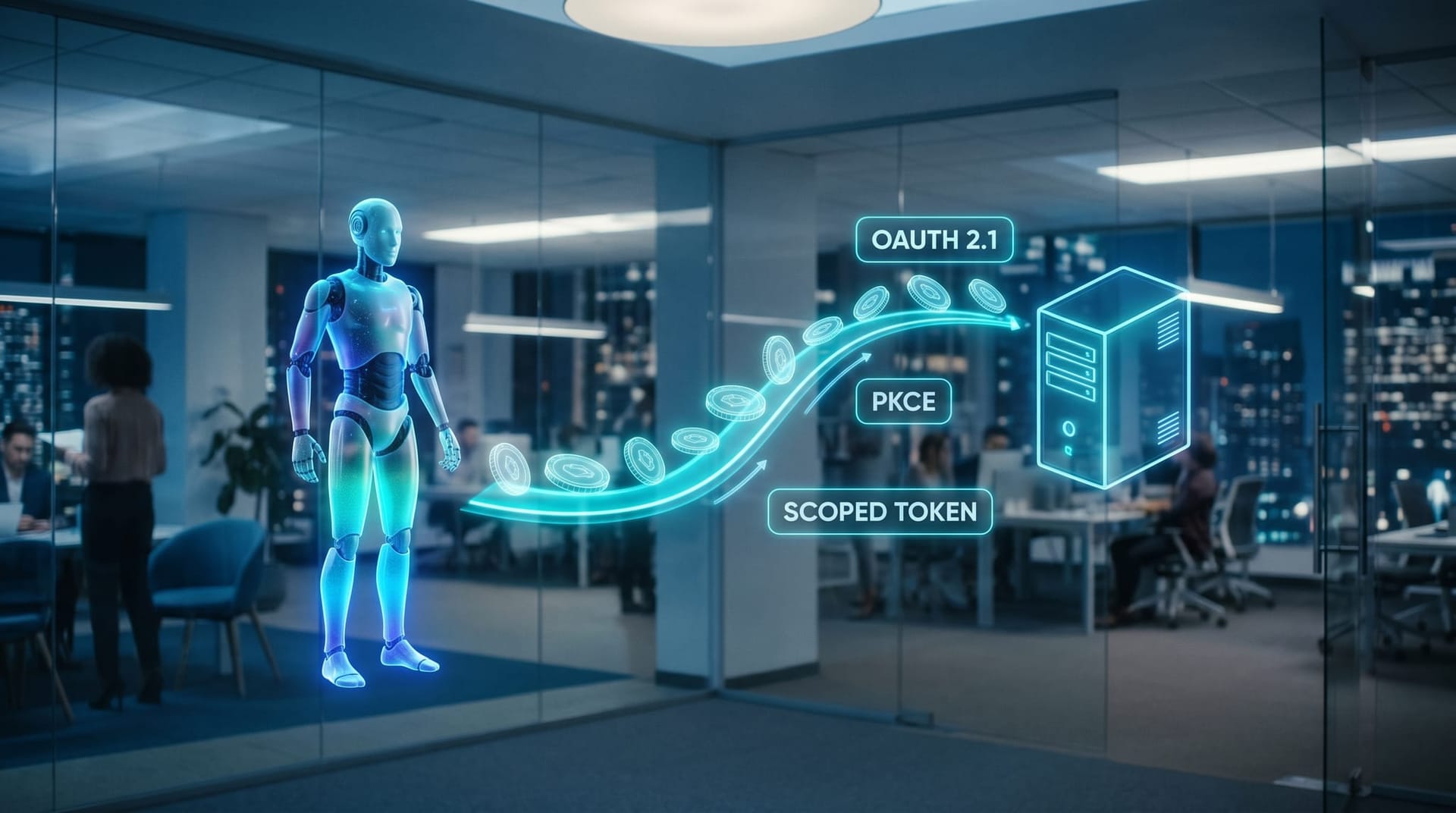
The foundation is OAuth. The MCP specification now treats OAuth 2.1 as its authorization primitive. For MCP deployments that implement authorization, the spec requires OAuth 2.1 with PKCE, mandates that all endpoints use HTTPS, requires authorization-server metadata to be discoverable by clients, requires Protected Resource Metadata per RFC 9728 to be exposed, and requires Resource Indicators (RFC 8707) to be validated. In plain terms: an agent should be able to walk up to an MCP server, discover where to authenticate, prove who it is over an encrypted channel, and receive a token scoped to exactly that resource.
The piece that is genuinely new for agents is registration. A human user is registered once, by hand. An agent may need to register with a server it has never encountered. Two mechanisms address this:
- Dynamic Client Registration (DCR) lets a client self-register with a server it has never seen, without a human completing a manual step. The MarkTechPost roundup notes DCR is still operationally useful but is treated as a “may-level fallback” in current guidance.
- Client ID Metadata Documents (CIMD) is the “should-level preferred” approach. Providers that support CIMD rather than DCR are still spec-compliant — the point is that the ecosystem now has a preferred path and a fallback, rather than a free-for-all.
If your eyes glaze at RFC numbers, that is fine — the practical takeaway is simpler. A 2026 AI agent authentication stack should give you scoped tokens (not all-or-nothing keys), short lifetimes (so a leak expires), per-session auditability (so you know which run did what), and selective revocation (so you can kill one credential without breaking everything). Those four properties are what to demand from any vendor, regardless of which RFCs they cite.

How Do the AI Agent Authentication Platforms Compare?
The MarkTechPost roundup surveys eight notable platforms. They are not all competing for the same slot — they fall into roles, and most real deployments combine two or three. The table below summarizes the field as reported; treat performance figures as vendor-reported.
| Platform | Role | What It Does | Notable Detail (as reported) |
|---|---|---|---|
| WorkOS | Enterprise authorization server | OAuth 2.1 + SSO, fine-grained authorization | SCIM provisioning, audit logging; author of auth.md |
| Auth0 by Okta | Authorization server (extend existing) | Extends existing identity infrastructure to agents | CIMD registration, on-behalf-of token exchange, MCP server support |
| Stytch (Twilio) | B2B SaaS auth layer | Auth for agent-facing SaaS | DCR, PKCE, Cloudflare Workers integration, Trusted Auth Tokens |
| Composio | Agent integration platform | Pre-built connectors + managed OAuth | Tool schemas, observability |
| Nango | Code-first OAuth + sync | OAuth plus data sync for 800+ APIs | Webhooks, triggers, reported sub-100ms overhead |
| Arcade | Security-first MCP runtime | Identity-based tool permissions | 7,500+ prebuilt tools across 81 MCP servers |
| TrueFoundry MCP Gateway | MCP gateway | Multi-agent orchestration + tool-level scoping | Virtual MCP Server abstraction, 7 outbound auth methods; reported 3–4ms latency (~10ms under load), 350+ req/sec on a single vCPU |
| Cloudflare Workers + Agents SDK | Edge runtime | Edge-native agent deployment | OAuth 2.1 flow support, session state via Durable Objects |
The decision is not “which one wins.” It is “which roles do I actually need?” A small business deploying a couple of AI Employees against existing SaaS may need only an integration platform that brokers OAuth on its behalf. A firm running many agents against many internal MCP servers needs a gateway in the middle to scope tools and centralize audit. A team already standardized on an identity provider extends that provider to agents rather than adopting a new one. We walk through this same role-based buying logic, applied to the broader agent stack, in our agent control plane buying decision for mid-market AI Employees.

What Is auth.md and Why Does an Open Agent-Registration Protocol Matter?
The day's most interesting release was not another platform — it was a protocol. WorkOS's auth.md is, at its core, a Markdown file a service publishes at a predictable location (for example, https://service.com/auth.md) that describes how an agent can register, what scopes are supported, and how credentials are issued. Crucially, the announcement stresses that the protocol is “not tied to WorkOS infrastructure” and is meant to function as an open standard.
Discovery uses the OAuth metadata machinery already described above, in a two-hop process: an agent reads Protected Resource Metadata at the well-known endpoint, then the authorization-server metadata that points it at the agent-registration block. On any 401 response, the service returns a WWW-Authenticate header telling the agent where to look. The agent does not need a human to pre-arrange a relationship with the service.
auth.md defines two registration flows, and the distinction is the part worth understanding:
- Agent Verified Flow leans on identity providers (the announcement names OpenAI, Anthropic, and Cursor). The agent requests an audience-specific token from its provider and presents it; the service validates the signature and standard claims. A notable security constraint: access tokens issued this way “must not include a refresh token” — the agent has to re-prove itself rather than hold a long-lived renewable credential.
- User Claimed Flow uses a one-time-passcode ceremony so a human can claim and upgrade what an agent is allowed to do — either starting anonymously and upgrading later, or withholding the credential until an email OTP completes.
Why does this matter to a buyer rather than a protocol nerd? Because an open registration standard is what keeps you from getting locked into one vendor's agent-onboarding scheme. It is the authentication-layer version of the portability argument we make constantly: standardize on the open primitive, keep the freedom to swap the implementation. auth.md also bakes in auditability from the start, defining standard events like registration.created, claim.requested, otp.generated, and registration.revoked. That last one — selective revocation — is exactly the property a raw API key cannot give you.
How Should You Authenticate the MCP Servers Your Agents Call?
This is the part most “AI agent identity” coverage skips, and it is where small teams get hurt. Authenticating your agent is necessary but not sufficient. The agent calls MCP servers; those servers call real APIs and databases. If the MCP server in the middle holds a god-mode key to your CRM, then scoping the agent's access perfectly accomplishes very little — the blast radius just moved one hop downstream.
Two patterns address this, and they map directly onto the platform roles above:
- Identity-based tool permissions at the runtime. A security-first MCP runtime (Arcade is the example in the roundup) enforces permissions per tool and per identity, so an agent only gets the specific tools its identity is authorized for, not the whole server.
- A gateway in front of the MCP servers. A gateway (TrueFoundry's MCP Gateway is the roundup's example) presents a “Virtual MCP Server” abstraction, supports multiple outbound authentication methods, scopes access at the tool level, and centralizes the audit log. Every agent call passes through one controlled point where policy lives.
That gateway pattern is the same architecture we recommend for almost everything in agent security, and it is the heart of our Secure AI Gateway approach: put one policy-enforcing intermediary between your AI Employees and everything they touch, so credential scoping, per-session audit, and revocation are properties of the architecture rather than something each integration has to get right on its own. It is also the control surface where governance policy actually gets enforced rather than merely written down — a gap we covered in the AI Employee Governance Playbook.

What Should a Fort Wayne or Northeast Indiana Business Do?
Here is the honest part. A 10–50 person business in Allen or DeKalb County is not going to stand up an enterprise IAM program to deploy its first two AI Employees. It does not have an identity team, and it should not pretend it does. The mistake we see most often in Northeast Indiana is the opposite of over-engineering: a local firm wires an AI agent to its systems with a single admin API key copied into an environment variable, ships it, and moves on. That key is the whole farm.
The good-enough, secure-by-default path for a Fort Wayne mid-market operator does not require choosing among all eight platforms above. It requires three decisions:
- Never hand an agent a static admin key. Route agent access through a broker or gateway that issues scoped, short-lived credentials. Even adopting a single integration platform that manages OAuth on your behalf is a categorical improvement over a pasted key.
- Put one gateway between your AI Employees and everything they touch. It is where you get per-session audit logs and selective revocation without writing identity code in every integration.
- Write down which agent is allowed to touch what — before it goes live, not after an incident. This is the authorization step, and it is the one our authorization audit playbook exists to walk you through.
For most local operators, the managed version of this — where Cloud Radix runs the gateway and you own the policy — lands at the right cost and effort point. The build-it-yourself version makes sense once you have an in-house engineering bench and enough agents to justify it.
How Do You Choose Your Path?
The buying decision comes down to scale. If you are running a handful of AI Employees against existing SaaS, start with an integration platform that brokers OAuth for you, and skip the gateway until you outgrow it. If you are running many agents against internal MCP servers, the gateway is not optional — it is the thing that keeps your audit story and your blast radius under control. If you have already standardized on an identity provider, extend it to agents before adopting anything new. And in every case, demand the four properties: scoped tokens, short lifetimes, per-session audit, selective revocation.
If you want help mapping your specific deployment to the right combination — or you just want someone to look at how your AI Employees authenticate today before something leaks — talk to us about an AI Security engagement or a Secure AI Gateway review. We will tell you honestly whether you need one platform or three, and whether you are ready to build or better off with a managed gateway. The framework we use to make those calls aligns with the NIST AI Risk Management Framework, so the result is defensible to an auditor, not just convenient for an engineer.
Frequently Asked Questions
Q1.Why can't I just give my AI agent an API key?
You can, and many teams do, but it is the riskiest option. A raw API key is unscoped (it usually grants more than the agent needs), hard to audit per session (you cannot tell which run did what), and impossible to revoke selectively (killing it breaks everything that shares it). Modern agent authentication replaces the static key with a scoped, short-lived, auditable credential — so a leak expires on its own and you can trace and revoke a single session without collateral damage.
Q2.What is MCP server authentication, and how is it different from authenticating the agent?
MCP (Model Context Protocol) servers are the tools and integrations your AI Employees call. Authenticating the agent proves who the agent is; authenticating the MCP server controls what the tools behind it can reach. Both matter, because if the MCP server in the middle holds a god-mode key to your database, scoping the agent perfectly just moves the risk one hop downstream. The fix is identity-based tool permissions at the runtime, a gateway in front of the servers, or both.
Q3.What is auth.md and do I need to adopt it?
auth.md is an open, OAuth-based agent-registration protocol released by WorkOS in May 2026. It lets an agent discover how to register with a service it has never seen — by reading a Markdown file the service publishes plus standard OAuth metadata. Most businesses will not implement auth.md directly; they will benefit from it as the platforms they buy adopt it. Its importance to buyers is that it is vendor-neutral, which protects you from getting locked into one company's agent-onboarding scheme.
Q4.Which AI agent authentication platform is best for a small business?
There is no single best — it depends on your role needs. A small business deploying a few AI Employees against existing SaaS is usually best served by an agent integration platform that brokers OAuth on its behalf (Composio and Nango are examples in the field). A team running many agents against internal tools needs an MCP gateway for tool-level scoping and centralized audit. A firm already standardized on an identity provider should extend that provider (Auth0, WorkOS) to agents rather than adopt a new stack.
Q5.Is OAuth 2.1 actually required for MCP?
When an MCP deployment implements authorization, the specification requires OAuth 2.1 with PKCE, HTTPS-only endpoints, discoverable authorization-server metadata, Protected Resource Metadata (RFC 9728), and validated Resource Indicators (RFC 8707). The convergence on OAuth 2.1 is generally seen as the right long-term direction because it makes the authentication layer composable — you can mix and match authorization servers, gateways, and integration platforms instead of betting on one proprietary stack.
Q6.How does a small Fort Wayne business get per-session audit and revocation without an identity team?
Route everything through one gateway. A Secure AI Gateway sits between your AI Employees and the systems and MCP servers they touch, issuing scoped short-lived credentials, logging every call by session, and giving you a single place to revoke a credential. That makes auditability and revocation properties of the architecture rather than code each integration has to get right. For most 10–50 person businesses, a managed gateway is far less effort than building IAM in-house.
Sources & Further Reading
- MarkTechPost: marktechpost.com/2026/05/25/best-authentication-platforms-for-ai-agents-and-mcp-servers-in-2026 — Best Authentication Platforms for AI Agents and MCP Servers in 2026.
- MarkTechPost: marktechpost.com/2026/05/25/workos-releases-auth-md — WorkOS Releases auth.md, an Open Agent-Registration Protocol Built on OAuth Standards.
- Model Context Protocol: modelcontextprotocol.io — Specification and documentation.
- OAuth.net: oauth.net/2.1 — OAuth 2.1 Authorization Framework.
- IETF / RFC Editor: rfc-editor.org/rfc/rfc9728 — RFC 9728, OAuth 2.0 Protected Resource Metadata.
- National Institute of Standards and Technology: nist.gov/itl/ai-risk-management-framework — NIST AI Risk Management Framework.
How Do Your AI Employees Authenticate Today?
If the answer is “a copied API key in an environment variable,” that is the engagement to scope now. We will review how your AI Employees and MCP servers authenticate and tell you honestly whether you need one platform or a managed gateway.