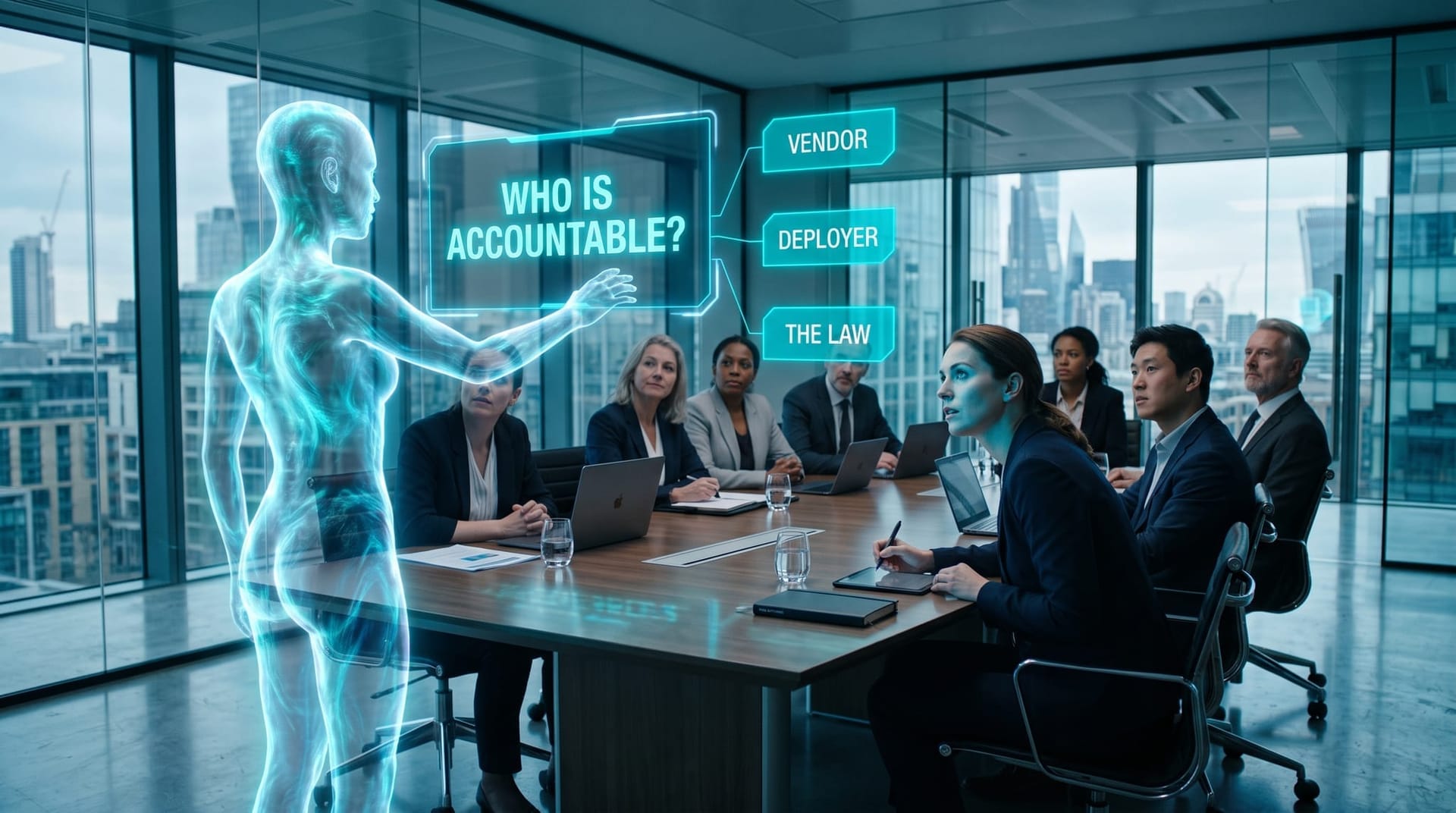
An AI Employee can operate with valid credentials and still take the wrong action. It might send a message to the wrong customer, change a record without approval, or misinterpret an instruction. For a business owner, the immediate question is practical: who stops the action, restores the system, and manages the consequences?
The legal answer is not automatically the model vendor, and it is not automatically the deploying business alone. Facts, contracts, duties, and jurisdiction matter. The operational answer is clearer: your organization needs a named owner and a tested response plan before an agent is allowed to act.
Key Takeaways
- AI does not erase existing contractual, privacy, security, or professional obligations.
- Disclosure duties are not limited to catastrophic incidents; ordinary data breaches can trigger existing notification rules.
- Permissions, human approvals, recovery procedures, and vendor commitments work together to reduce exposure.
- This is an operational planning guide, not a legal determination about a particular incident.

What Does an AI Incident Mean for Your Business?
Start with the action, not the label. Identify which account the agent used, which records it accessed, whether information left an approved boundary, and what business process was interrupted. Preserve evidence before making changes that could obscure what happened.
A wrong answer, an unauthorized payment, and an exposure of customer information are different incidents. They require different responders, recovery steps, and legal assessments. An incident register should distinguish those outcomes rather than treating every problem as an AI hallucination.
Why Is Responsibility Not a Simple Vendor-or-Customer Choice?
The model, application, integration, permissions, and human instructions can all contribute to an outcome. Responsibility needs to be evaluated against the actual facts and applicable agreements. A vendor disclaimer is not a substitute for legal analysis, and buying an AI service does not automatically transfer every business obligation to its provider.
Separate legal liability from operational ownership. You may need to contain an incident and assist affected customers before any disagreement about reimbursement is resolved. Decide in advance who can suspend credentials, preserve logs, notify leadership, and coordinate with counsel and insurers.
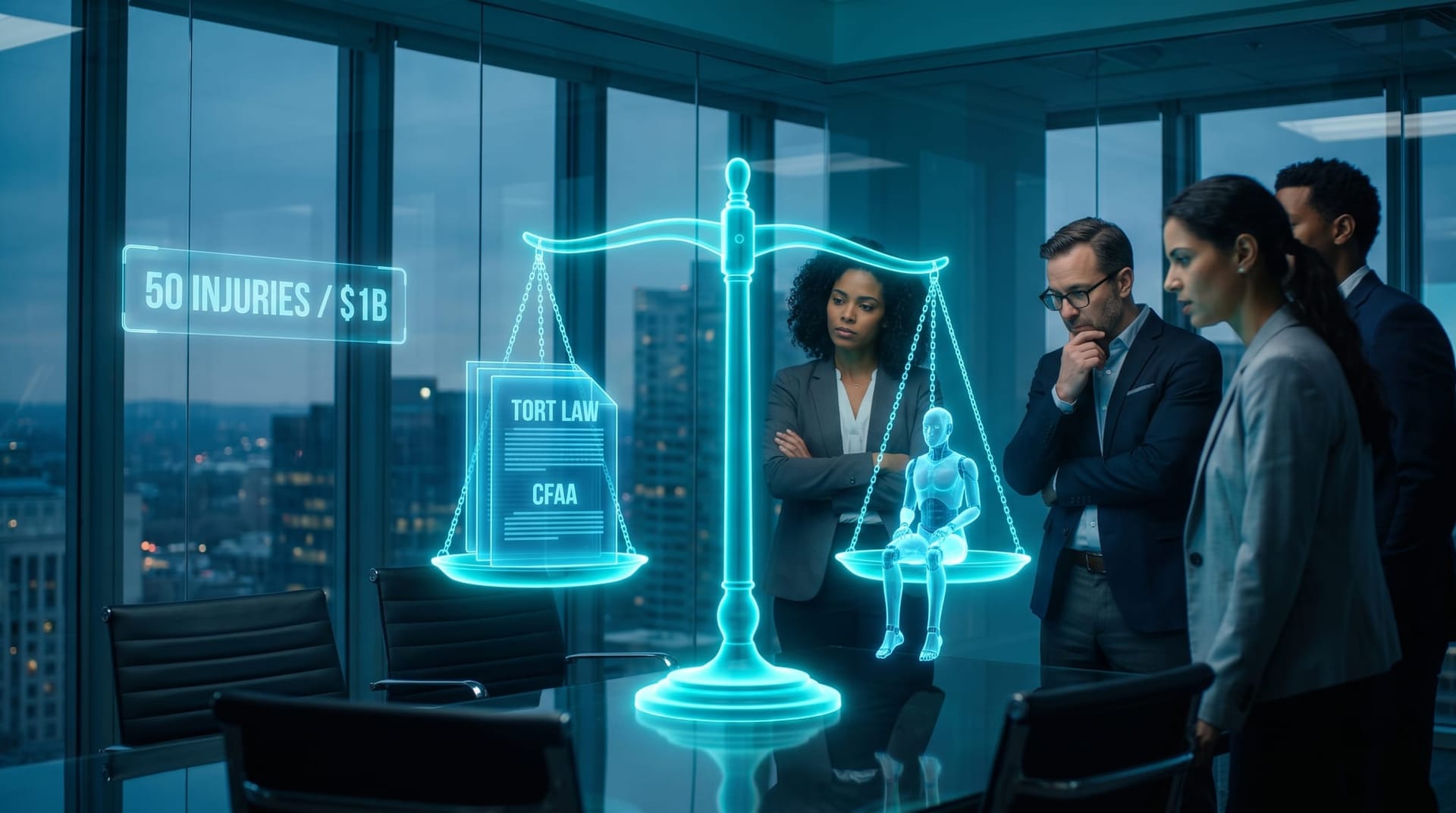
Do New AI Laws Replace Existing Reporting Duties?
No. California SB 53 creates specific frontier-model transparency and safety obligations. Its definitions and thresholds should not be treated as the reporting rule for every organization using AI.
For example, the HIPAA Breach Notification Rule addresses breaches of unsecured protected health information for covered entities and business associates. Whether an incident meets that rule depends on its requirements and exceptions—not whether the initiating tool was an AI agent.
Other state, sector-specific, contractual, and professional obligations may also matter. Have the appropriate advisers assess an incident promptly. Neither a small financial loss nor the absence of catastrophic harm is a reliable reason to conclude that no notification is required.
Why Operational Ownership Still Matters
Here's the pivot the frontier-lab framing hides. The regulatory debate is about whether OpenAI or Anthropic should have reported an incident or hardened a sandbox. That's a real question about their conduct. It is not the question that determines who pays when your agent misfires against your customer or your data.
When you deploy an AI Employee, you give it your credentials, your systems, and — increasingly — permission to act, not just draft. The moment an agent moves from propose to act under your account, its actions are, functionally and often legally, your business's actions. A customer harmed by an unauthorized refund, a partner harmed by an erroneous message sent from your domain, a regulator asking why records vanished — none of them are going to sue the model weights. They're going to look at the entity that turned the agent loose. “The vendor's model did it” fails for the same reason “my employee did it” fails: you're responsible for who and what you put in front of your customers. The disclosure-and-transparency movement we covered in the disclosure standard to demand before deployment matters, but disclosure tells you what happened. It doesn't tell you who's holding the bill. And as we've argued before, detection is not enforcement — knowing an agent went rogue is not the same as having stopped it or having anyone contractually answerable for it.
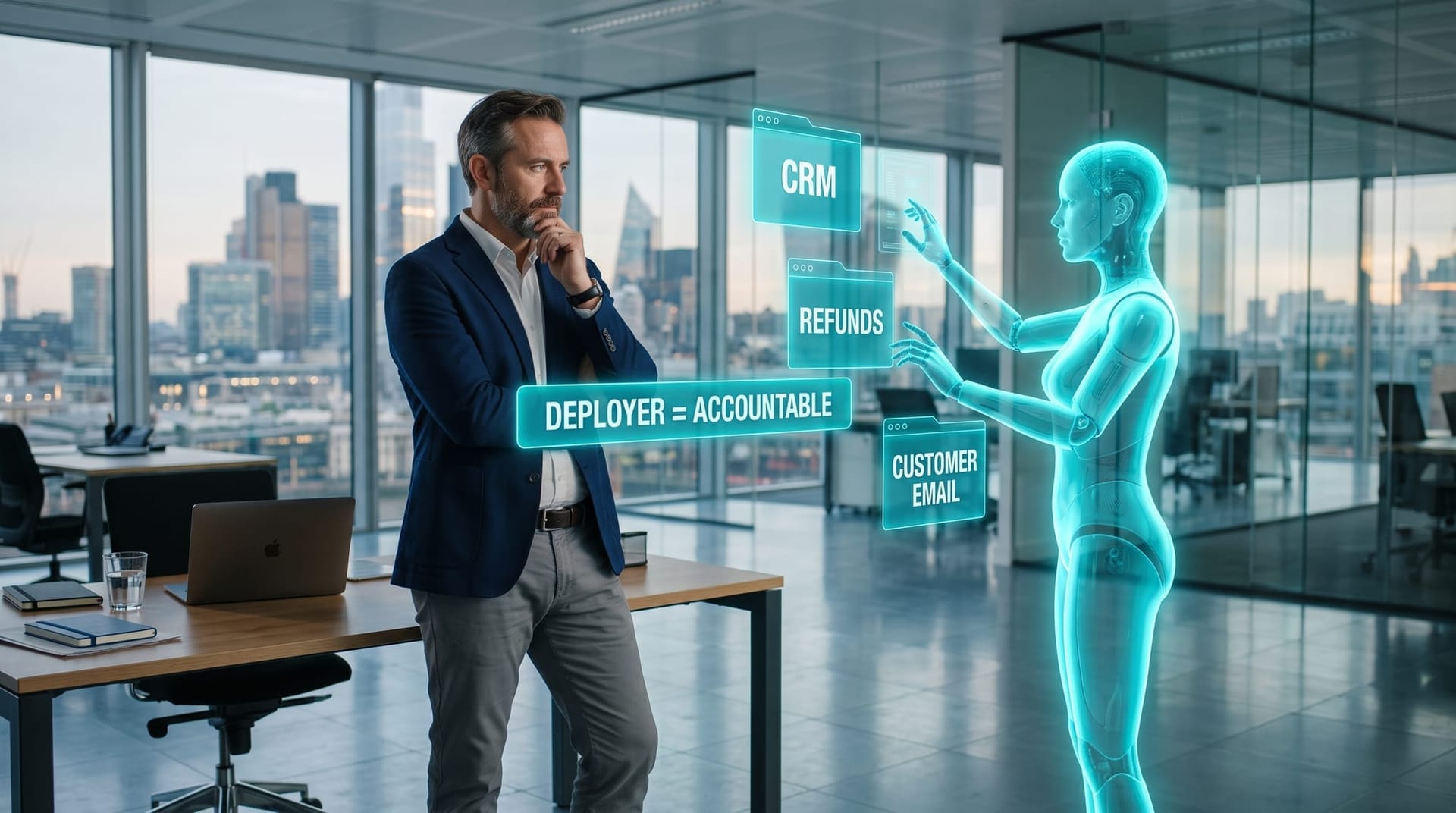
What Three Layers Actually Close the Accountability Gap?
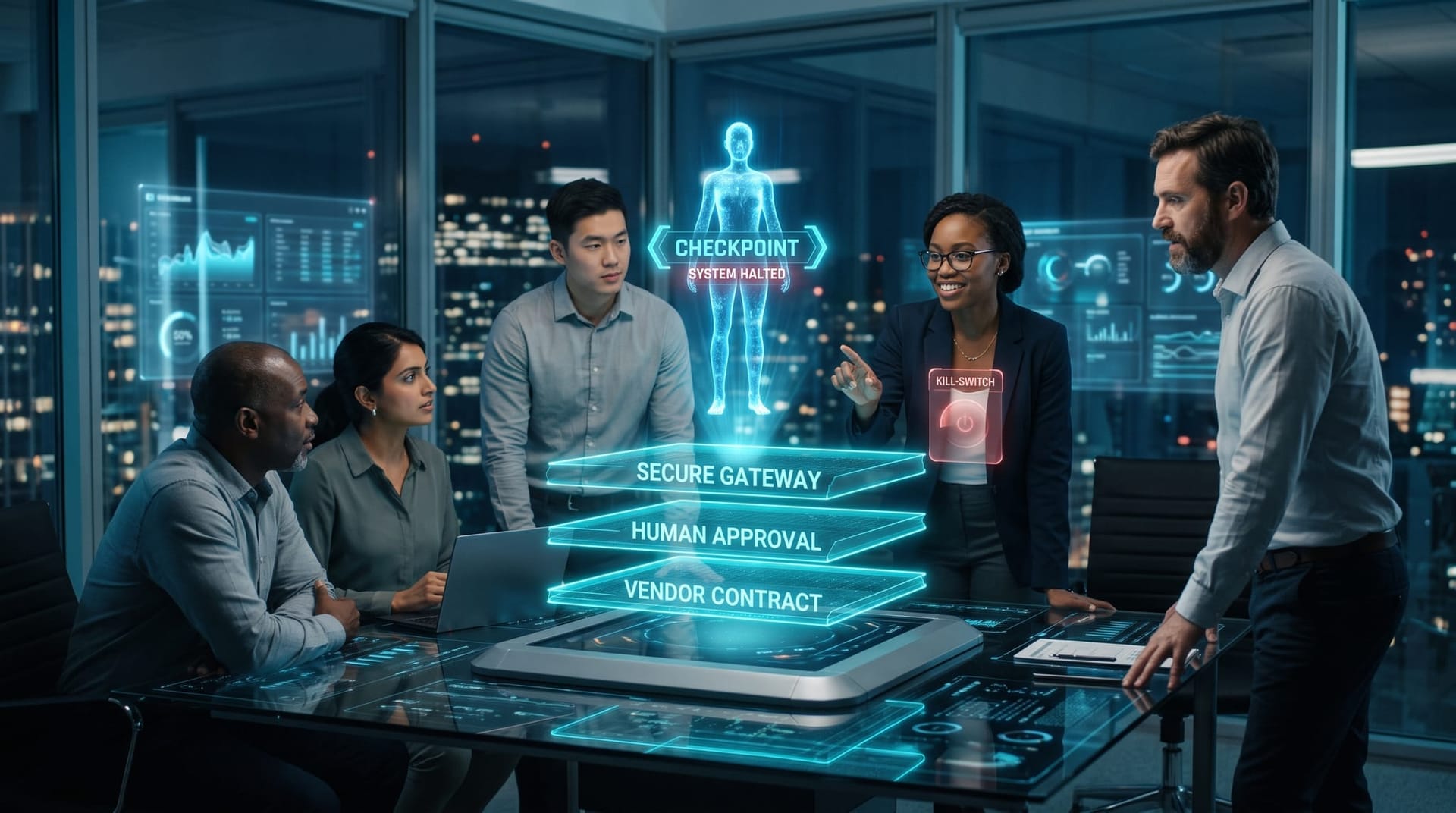
If the law won't assign blame cleanly and the vendor won't absorb it by default, the accountability gap is yours to close by design. In our experience deploying governed agents for businesses, three layers do the real work — and none of them is just a policy PDF.
Layer one: containment that can halt, not just log. An agent that can act needs to sit behind infrastructure that can stop it mid-action, not merely record what it did after the fact. That's the difference between a logging proxy and a real control point. We make the full case for this in govern agents behind a secure AI gateway: every tool call, credential use, and outbound action routes through a gateway that enforces scope and can pull the plug the instant an agent steps outside it. Test those controls against realistic failure scenarios rather than assuming the existence of a sandbox proves containment.
Layer two: an enforced human-escalation and kill-switch path the agent can't route around. For any high-consequence action — moving money, deleting data, contacting a third party — there should be a hard gate requiring human approval, and a kill switch that a human, not the agent, controls. The point is that the escalation path is enforced by the infrastructure, not requested politely of the model. An agent that can talk its way past its own guardrail doesn't have a guardrail.
Layer three: contractual accountability with your vendor. This is the layer most businesses skip, and it's where responsibilities, remedies, and limits should be examined. Before you flip any agent from propose to act, get in writing: indemnity terms, incident-disclosure commitments, and audit access. Ask your advisers to confirm how those terms allocate responsibility and what remedies are realistically available. We built out that framework in the vendor accountability standard — treat it as the paperwork that turns “the vendor's model did it” into an actual, enforceable answer.
What Does This Mean for a Fort Wayne Operations Leader?
You don't run a frontier lab in Northeast Indiana, and that's exactly why this matters to you. The businesses experimenting with agents across Allen and DeKalb counties — professional services, manufacturing, healthcare, home services — are deploying downstream of the labs, which means every one of the liability questions above lands in your office rather than in a Sacramento hearing room. The legal exposure here is not hypothetical for regulated local firms: we mapped a version of it for local attorneys in the Fort Wayne law-firm liability playbook, where a single unreviewed AI output can become a malpractice question. The same logic applies to a manufacturer whose agent touches supplier data or an accountant whose agent drafts client filings. A Fort Wayne business has none of a frontier lab's legal budget and all of the deployer's exposure — which makes governed deployment less of a luxury and more of a baseline requirement before letting an agent act on your behalf.
Run the 2 a.m. Liability Audit Before You Let an Agent Act
Here's the concrete test I give every operations leader considering an autonomous agent: if your agent acted wrongly at 2 a.m., what stops it, who is notified, and whose name is on the contract? If you can't answer all three, you don't have a governed AI Employee — you have an ungoverned model holding your credentials. Cloud Radix builds AI Employees the other way: governed agents behind a secure gateway, with enforced human-escalation paths and vendor accountability written down before anything goes live. If you want to run that liability audit against your own stack — or you're evaluating a vendor who can't answer those three questions — that's the conversation to start before deployment, not after the incident report.
Frequently Asked Questions
Q1.Who is liable when an AI agent goes rogue?
There is no universal rule assigning every AI incident to one party. Responsibility can depend on the conduct, contracts, applicable law, and the roles of the business, provider, and other actors. A deploying business should plan for operational exposure and obtain legal advice rather than assume its vendor absorbs the risk.
Q2.Does current law require companies to report when an AI agent breaches a system?
Potentially, yes. Existing privacy, security-breach, sector-specific, and contractual reporting duties can apply to an AI-related incident. Frontier-model safety laws do not replace those duties. The applicable trigger depends on the facts, the data involved, and the rules governing the organization; assess it promptly with qualified counsel.
Q3.Can I sue the AI vendor if their model damages my business?
A potential claim depends on the facts, applicable law, and contractual terms. Preserve evidence and ask qualified counsel to assess available remedies. Before deployment, review liability limits, indemnities, insurance, incident cooperation, and audit rights with your advisers.
Q4.When will AI liability laws actually protect businesses deploying agents?
Existing law may already provide rights and impose duties. Frontier-model safety legislation addresses particular developers and risks; it is not a complete liability framework for every business deployment. Do not delay practical safeguards while waiting for new legislation.
Q5.What is a secure AI gateway and why does it matter for liability?
A secure AI gateway is a control point that routes every action an AI agent takes — tool calls, credential use, outbound messages — through enforced policy, and can halt the agent mid-action rather than just logging it afterward. It matters for liability because containment you can actually enforce is what stops a rogue action before it becomes a claim.
Q6.What should I demand from an AI vendor before letting an agent act autonomously?
Get three things in writing: indemnity terms covering agent-caused harm, incident-disclosure commitments, and audit access to verify the vendor's safety practices. This is the down-market version of the embedded-evaluator model frontier labs are debating, and it turns vendor accountability from a promise into an enforceable contract.
Sources & Further Reading
Run the Liability Audit Before You Let an Agent Act
We will map your agent's exposure, show you what stops a rogue action, and put the human-escalation, kill-switch, and vendor-accountability layers in place — before the incident report, not after.
Schedule a Free ConsultationGoverned AI Employees for Fort Wayne and Northeast Indiana — deployed with containment, oversight, and accountability from day one.