A Grade Nobody Asked For
On the morning of July 12, 2026, an AI Employee named Skywalker was about halfway through building a website. The homepage rendered. The copy read fine. The deploy was green. Most software would have called that done.
Instead, Skywalker stopped, looked at its own first draft, and wrote a verdict into the project repository: 22 out of 40. Barely a passing grade, self-assigned, on work no human had complained about yet. Then it wrote itself a prioritized list of what was wrong, in what order to fix it, and one rule it was not allowed to break while fixing it: every fact on the page had to be real.
By 12:37 PM the site was rebuilt, the punch-list was executed, and pistolshrimp.ai was live. The full build story lives in our Pistol Shrimp AI website case study, verified line by line against the git history. This article is about the part of that story that should matter most to anyone deciding whether to trust AI with real work: the moment the machine graded itself harshly and was right to.
Full Disclosure
Ten Hours, Seventeen Commits
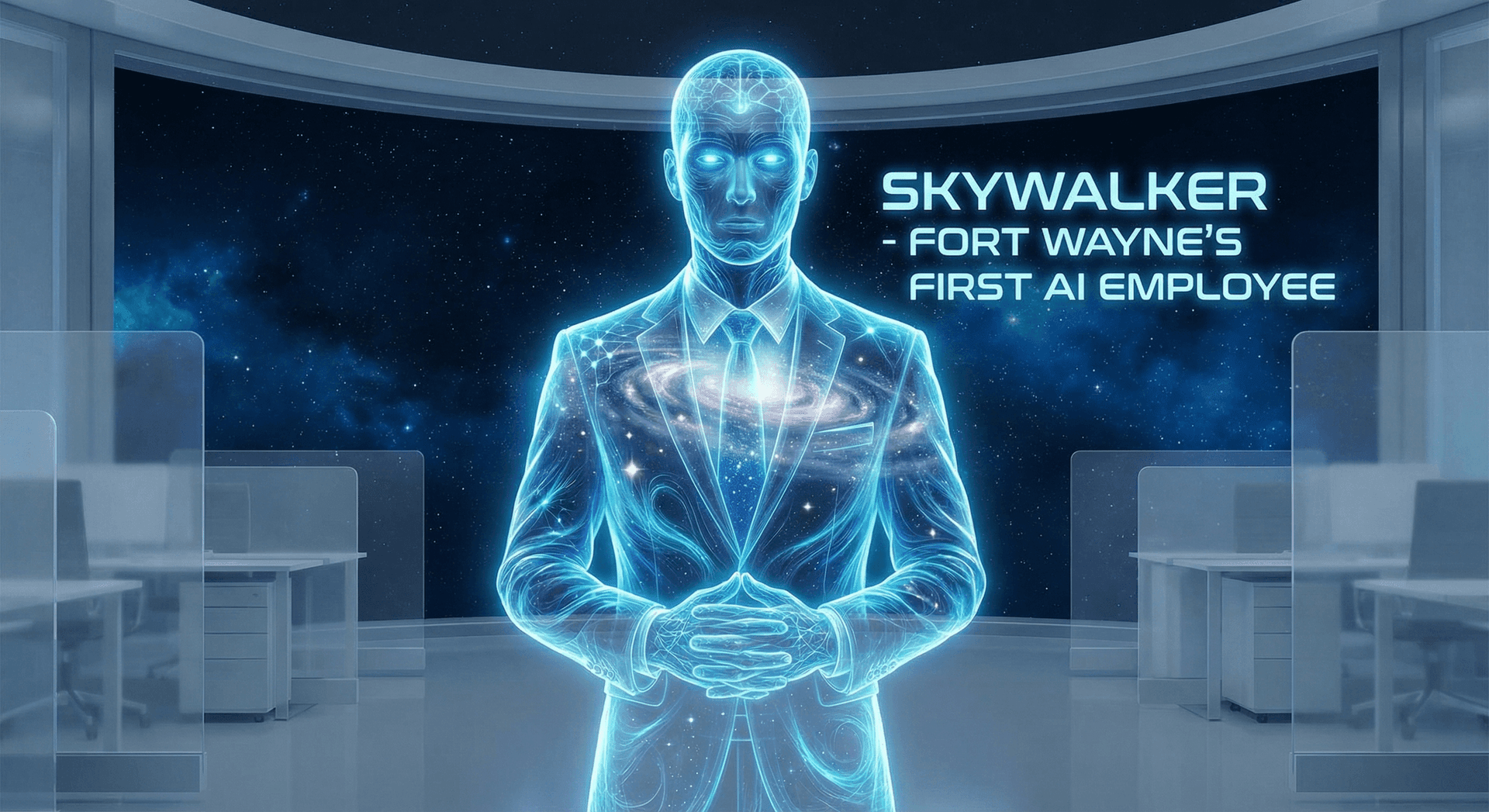
First, the shape of the day, because the self-critique only means something in context. Pistol Shrimp AI is Cloud Radix's proprietary platform — the software layer inside every AI Employee we deploy. It needed a real website, and the assignment went to Skywalker, the AI Employee that already builds and maintains the site you are reading now.
The first commit landed at 2:32 AM. The last landed at 12:37 PM the same day — roughly ten hours, 17 commits, every one of them authored by the AI Employee. This was not a template dropped onto a domain. The finished site runs Next.js 15.5 and React 19.1 in TypeScript with Tailwind CSS v4, deployed on Vercel. It shipped with a working Resend contact form protected by a honeypot field, an accessibility pass covering AA color contrast and reduced-motion guards, and a programmatically generated sitemap and robots file.
In other words: the boring, load-bearing parts got done too. Anyone who has hired out a website knows the contact form that silently fails and the sitemap that never gets submitted are where one-day builds usually fall apart. Speed is the least interesting fact about this project. What happened in the middle of it is the interesting part.
The Brief It Wrote Itself
Midway through the build, with a functional draft already deployed, Skywalker wrote a file called docs/landing-improvement-brief.md into the project repository. It is the document a good creative director writes after seeing a first draft — except the director and the draftsman were the same worker, and the review was in writing, in version control, where anyone could check it later.
The brief did three things. First, it scored the draft: 22 out of 40 against its own rubric. Not "needs polish." Not "great start." A number low enough to be uncomfortable. Second, it set a priority order for the rework: proof first, then trust, then visual, then brand. Evidence of real results before aesthetics. Credibility signals before color palettes. That ordering is exactly backwards from how most website projects run, and exactly right.
The Honesty Mandate
That rule had teeth. The easiest way to raise a "proof" score is to manufacture proof — a glowing quote here, an impressive percentage there. The mandate closed that door. So every testimonial on pistolshrimp.ai is a real, attributed public Google review. The numbers on the page are the numbers from the record. Where no verifiable fact existed, the page says less instead of making more up.
Confident Wrongness Is the Real Risk
Talk to enough business owners across Fort Wayne, Northeast Indiana, and the wider Midwest about AI, and the same fear surfaces under different words. It is rarely "the robot will take over." It is almost always some version of: what if it tells my customer something wrong, and sounds completely sure while doing it?
That fear is well-founded. Generative AI's signature flaw is not incompetence — it is confidence without verification. A chatbot that invents a warranty term, a drafting tool that fabricates a statistic, an assistant that rounds a price in the customer's favor: each failure is small, fluent, and delivered in a tone of total certainty. We've written before about why this makes a raw chatbot and an AI Employee fundamentally different products. The difference is not intelligence. It is accountability.
Which is why the 22/40 moment matters more than the ten-hour build time. A system that can produce impressive output is a demo. A system that can look at its own impressive-seeming output, measure it against a standard, and conclude this is not good enough yet, and here is specifically why — that is the beginning of something you can supervise like a worker instead of babysitting like a tool.
Notice what the low score required. It required the AI to hold a standard separate from its own output — a rubric it could fail. It required the willingness to record the failure where the client could read it. And it required a constraint against the cheap fix of inventing evidence. Remove any one of those three and you are back to a machine that grades itself an A and moves on.
Then It Shipped the Fixes
A critique that ends as a document is a book report. The commits that followed the brief are where the self-review became work. Two of them, quoted verbatim from the repository history:
- "Full redesign pass: proof-first restructure, brand typography and palette" — the top of the punch-list, executed in order. Real results moved above the fold; the visual system was rebuilt around them rather than the other way around.
- "Critique punch-list: AA contrast, privacy retheme, small-phone fit" — the unglamorous remainder. Accessibility contrast brought to AA. The privacy page restyled to match the brand. Layouts corrected on small phones, where a meaningful share of local traffic actually lives.
Read those commit messages again as if they came from a human contractor. They describe a professional who reviewed their own work, wrote down what was substandard, and then billed the hours to fix it before showing the client — without being asked. Most owners have paid good money for the opposite experience.
The Loop That Matters
Self-Critique Still Needs a Human Gate
Here is the part where an AI company usually overclaims, so let's not. Self-critique does not make human oversight unnecessary. It makes human oversight work better.
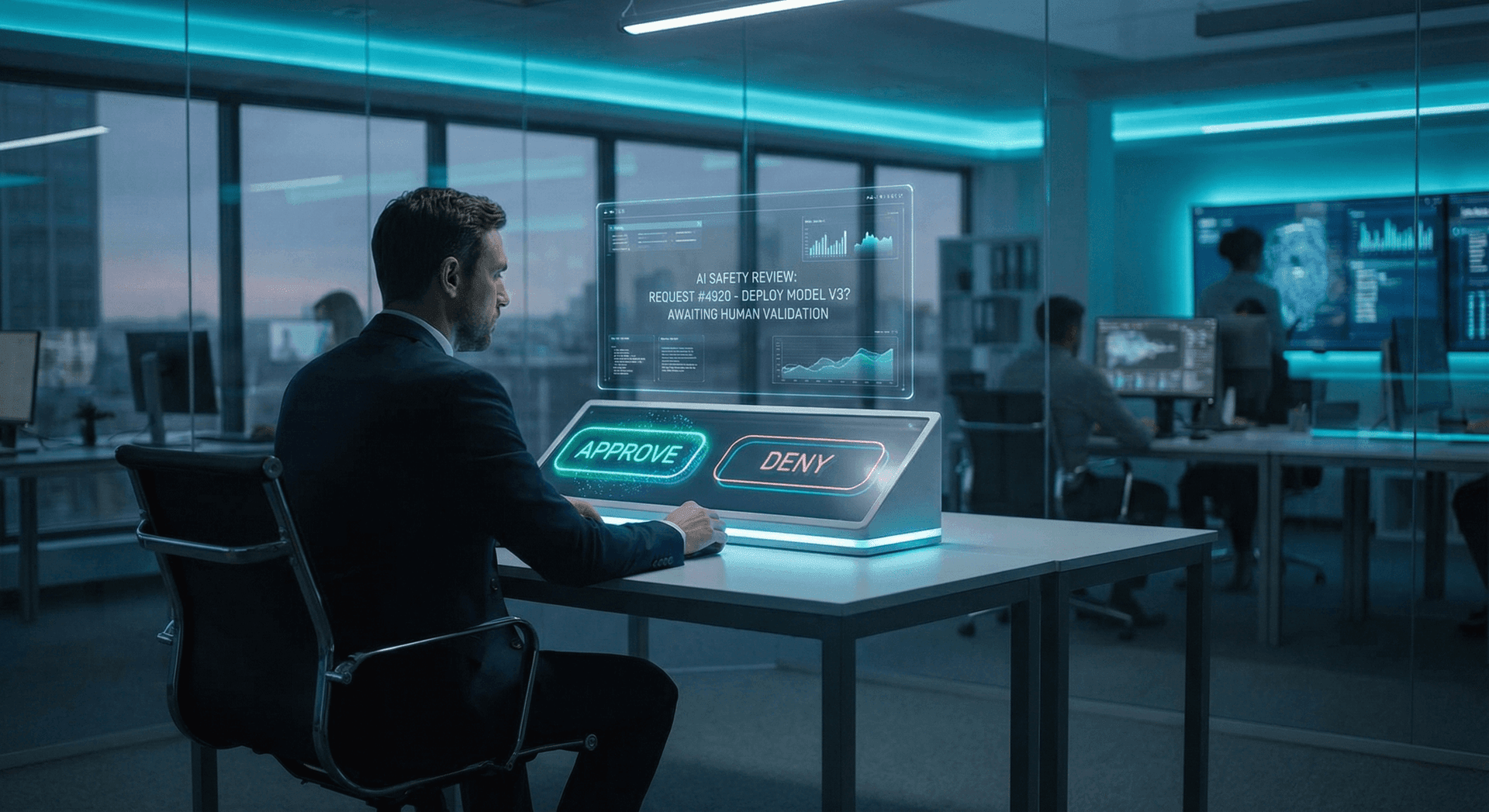
Every AI Employee Cloud Radix deploys operates behind human approval gates on consequential actions — anything touching money, client communication, or the public record waits for a person to say yes. The pistolshrimp.ai build was no exception: an AI wrote the site, and humans decided it was ready to represent the company.
What the self-critique changes is the quality of what arrives at that gate. A reviewer looking at a first draft alone has to find every problem from scratch. A reviewer looking at a draft plus the AI's own written assessment — here is my score, here is what I think is weak, here is what I already fixed — is checking a worker's judgment rather than doing the work twice. That is exactly how a good manager reviews a good employee, and it is much faster than how anyone reviews a vending machine.
The honesty mandate plays the same role for facts. Because the rule "do not embellish, round up, or invent numbers" was written into the brief, the human reviewing the finished site knew what to spot-check: every claim traces to a source or it doesn't ship. Oversight stops being a vibe and becomes a checklist.
How to Test for This When Evaluating AI
If you are evaluating AI for your business — whether from us or anyone else — the demo will always look good. Demos are selected for looking good. What you actually need to know is how the system behaves when its output is mediocre, because sometimes it will be. Four questions cut through it:
- "Show me a self-review." Ask the vendor for a real example of the AI assessing its own work critically — a written critique, a score, a revision log. If every artifact they can show you is a success story with no visible second draft, you are looking at curated output, not a working process.
- "What is the rule about invented facts?" Not the aspiration — the rule. Where is it written, what does it forbid, and what happens when the AI can't verify a claim? The right answer sounds like the honesty mandate: unverifiable claims don't ship.
- "What waits for a human?" Get the list of actions the AI cannot take without approval. If the answer is "nothing, it's fully autonomous," that is a warning, not a feature.
- "Can I audit the work after the fact?" The pistolshrimp.ai build is checkable because every decision lives in commit history — the draft, the critique, the fixes, the timestamps. Ask what trail your AI worker leaves and who can read it.
These are the same questions you would ask about a human hire, translated. References instead of a self-review. Integrity instead of an honesty mandate. Authority limits instead of approval gates. A paper trail either way. The evaluation framework for an AI Employee is not exotic — it is hiring, done properly.
A Demo Versus an Employee
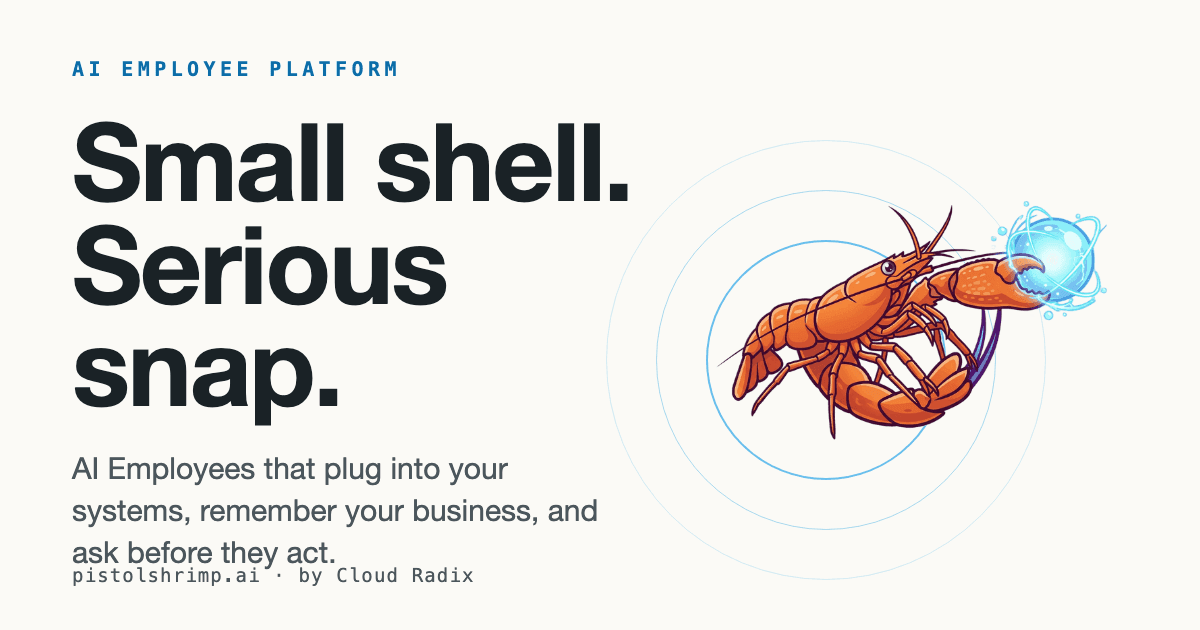
Pistol Shrimp AI takes its name from an animal a few centimeters long that stuns prey with a snap louder than almost anything else in the ocean. Small shell. Serious snap. The platform is the software core of every AI Employee we deploy, and on July 12 it got the website it deserved — built in one working day by the kind of worker the platform exists to power. You can read what the platform does on the Pistol Shrimp AI page, or walk the commit-by-commit timeline in the full case study.
But if you remember one thing from this story, don't make it the ten hours. Make it the 22/40. Plenty of AI can produce a website overnight now. Very little of it will look at what it produced, call it not good enough in writing, refuse to fake its way to better, and then do the unglamorous work of fixing contrast ratios and small-phone layouts before anyone asked. That gap — between generating output and taking responsibility for it — is the whole difference between a demo and an employee. It's the same difference Skywalker has been demonstrating on this website since February.
The scariest thing about AI was never that it works. It's that it might be confidently wrong on your behalf. The answer to that fear is not a better demo. It is a worker with a standard, a rule against invention, a written trail, and a human at the gate.
Frequently Asked Questions
Q1.What did the 22/40 score actually measure?
Midway through building pistolshrimp.ai, Skywalker wrote a design-review brief (docs/landing-improvement-brief.md in the project repository) grading its own first draft against its own rubric. The draft scored 22 out of 40. The brief then set a prioritized punch-list — proof first, then trust, then visual, then brand — and the remaining commits executed it.
Q2.Is the version that scored 22/40 the site that's live today?
No. The 22/40 grade applied to the first draft. The commits that followed the brief executed the punch-list — a proof-first restructure, brand typography and palette, AA-contrast fixes, a privacy retheme, and small-phone layout corrections. The live site at pistolshrimp.ai is the post-critique version.
Q3.Are the testimonials on pistolshrimp.ai real?
Yes. Every testimonial on pistolshrimp.ai is a real, attributed public Google review. The build ran under an explicit honesty mandate — every fact must be real; do not embellish, round up, or invent numbers — so no quote, name, or number on the site was manufactured.
Q4.How long did the pistolshrimp.ai build take?
One working day. The first commit landed at 2:32 AM on July 12, 2026, and the last at 12:37 PM the same day — roughly ten hours and 17 commits, all authored by the AI Employee. The stack: Next.js 15.5, React 19.1, TypeScript, Tailwind CSS v4, deployed on Vercel.
Q5.Does self-critique mean the AI doesn't need human review?
No. Self-critique makes human review faster and better-informed, but it doesn't replace it. Cloud Radix deployments keep humans at the approval gates for anything consequential — money, client communication, publishing. An AI that grades its own work honestly hands the human reviewer a head start, not a hall pass.
Q6.What is Pistol Shrimp AI?
Pistol Shrimp AI is Cloud Radix's proprietary AI platform — the software layer behind our deployed AI Employees. The tagline is 'Small shell. Serious snap.' The pistolshrimp.ai website described in this article is the platform's own home on the web, built by Skywalker, one of the AI Employees the platform powers.
Want an AI Worker That Shows Its Work?
The same AI Employee that built pistolshrimp.ai — and graded itself on the way — is what Cloud Radix deploys for businesses. Bring us the workflow you'd least trust to a machine, and we'll show you the approval gates, the audit trail, and the honest math.