
For about thirty years, “using software” has meant the same thing: a human stares at a screen, scans menus, clicks buttons, fills forms, and moves data from one app to another. Every line of your software budget, every onboarding checklist, every “power user” on your team is organized around that one assumption — that people operate the apps.
That assumption is now the thing under renovation. VentureBeat argues that AI is about to replace the interface, and that most business leaders aren't ready for it — not because the screens will get prettier, but because the screen-and-click layer itself is being absorbed into the agent. In the model that's arriving, the human states intent — “reconcile last month's invoices and flag anything over 30 days” — and an AI Employee operates the apps to make it happen. The dashboard doesn't go away because it got better. It goes away because you stopped needing to touch it.
We've written before about why AI interfaces matter more than AI models for business. This piece is the next step on a different axis. There, the argument was that the experience layer beats the raw model. Here, the argument is sharper and more uncomfortable: the interface itself is changing hands. It's not being elevated — it's being operated by something other than your staff. This is the structural version of the shift we described in the move from reactive chatbots to proactive AI agents: not just when the agent acts, but what surface it acts through.
Key Takeaways
- The “disappearing interface” means intent-in, outcome-out: people describe goals, AI Employees operate the underlying apps. The click-through UI recedes from the daily workflow.
- This is a structural shift, not a smarter chatbot. The application — the menus, forms, and screens you bought — becomes addressable by an agent rather than a human.
- Apple's new Siri framework and the open Model Context Protocol are early, concrete signs the app layer is being made agent-operable by default.
- Adoption is wide but production-shallow; one analysis pegs the gap at roughly 79% of enterprises piloting agents versus 11% running them in production.
- When the interface becomes an agent, the buyer's questions shift from “which app has the best UI” to “which agent can I trust with our credentials and data egress.”
- Mid-market firms that map their software stack now — layer by layer — will renegotiate licensing, training, and security on their terms instead of scrambling later.
What does “the disappearing interface” actually mean?
Start with a clean definition, because the phrase gets thrown around loosely. The disappearing interface is the shift from menus-buttons-forms to intent-in, outcome-out. Today, accomplishing a task means knowing where a function lives — which tab, which sub-menu, which export button — and performing the clicks in the right order. In the agentic model, you describe the outcome you want and an AI Employee navigates the application's underlying functions on your behalf.
The interface doesn't literally vanish. A screen still exists for the moments a human needs to inspect, approve, or override. What disappears is the requirement that a person drive the app click-by-click to get ordinary work done. The UI becomes an exception surface — something you drop into when judgment is required — rather than the default cockpit you live in all day.

What makes this technically possible now is that applications are being made addressable by agents, not just by humans. The clearest open example is the Model Context Protocol, an open standard Anthropic introduced in November 2024 to standardize how AI systems read files, execute functions, and pull contextual data from external tools. MCP was built to kill the “N×M” integration problem — the old reality where every AI tool needed a custom connector for every app. Once an application exposes its functions through a standard like MCP, an agent can discover what the app can do and call those functions directly, reasoning about which ones to use to satisfy a goal. OpenAI adopted the protocol in March 2025 and Google followed in April 2025, which is why this stopped being a single-vendor experiment and started becoming infrastructure. This is the same reason generic AI tools keep losing to custom AI Employees: operating your actual stack, with your actual permissions, is a different problem than answering questions in a chat window.
Why aren't mid-market leaders ready for it?
The honest answer is that most mid-market firms are still catching up to the previous wave, let alone this one. The U.S. Census Bureau's data on AI use at U.S. businesses shows national adoption hovering between 17% and 20% in the December 2025–May 2026 window, with a sharp split by company size: firms with 250 or more employees reported 37% current AI use, while fewer than 20% of the smallest firms (four or fewer employees) reported using AI at all. Crucially, the Census found that recent growth occurred only among firms with at least 20 employees — the smallest businesses didn't move. The mid-market sits right on that fault line.
There's a second readiness gap, and it's about depth, not entry. Plenty of organizations have touched agents without operationalizing them. One analysis of 2026 AI-agent statistics reports that roughly 79% of enterprises have adopted AI agents in some form, but only about 11% run them in production — a “production-readiness gap” the same analysis attributes to missing governance frameworks, absent observability tooling, and no baseline metrics for measuring ROI. That gap is exactly the difference between a demo and an operating model, which is the theme of our piece on why execution, not pilots, is the real differentiator from AI pilots to AI Employees.
Put the two together and the readiness problem is clear: the mid-market is under-adopted on the old interface model and under-prepared for the new one. Leaders who assume “we'll deal with agents when our peers do” are planning to react. The firms that come out ahead are mapping the change before it forces their hand.
What does the agentic shift change, layer by layer?
The most useful exercise is to look at your software stack as layers and ask, for each one, who operates it today and who operates it once the interface is an agent. We call this the Stack-Disruption Map. It isn't a prediction of dates — it's a planning grid for renegotiating the things that change underneath you.
| Stack layer | Who operates it today | Who operates it in the agentic model | What the mid-market buyer must renegotiate |
|---|---|---|---|
| Front-line apps (CRM, helpdesk, scheduling) | Staff clicking through screens | An AI Employee calling app functions on stated intent | Per-seat licensing assumptions; what a “user” even means when the user is an agent |
| Reporting & dashboards | Analysts assembling views | Agents querying and summarizing on demand | Whether you still pay for BI seats nobody opens |
| Integrations & data movement | Ops staff copy-pasting between tools | Standardized agent calls (e.g., MCP) across tools | Custom-connector spend; vendor lock-in tied to proprietary APIs |
| Training & enablement | Onboarding people to each app's UI | Teaching people to direct and verify agents | Where training budget goes — UI proficiency vs. supervision skill |
| Security & access | Login-based, human-paced permissions | Agent identity, credentials, and data egress | What an agent is allowed to see, do, and send — and who watches it |
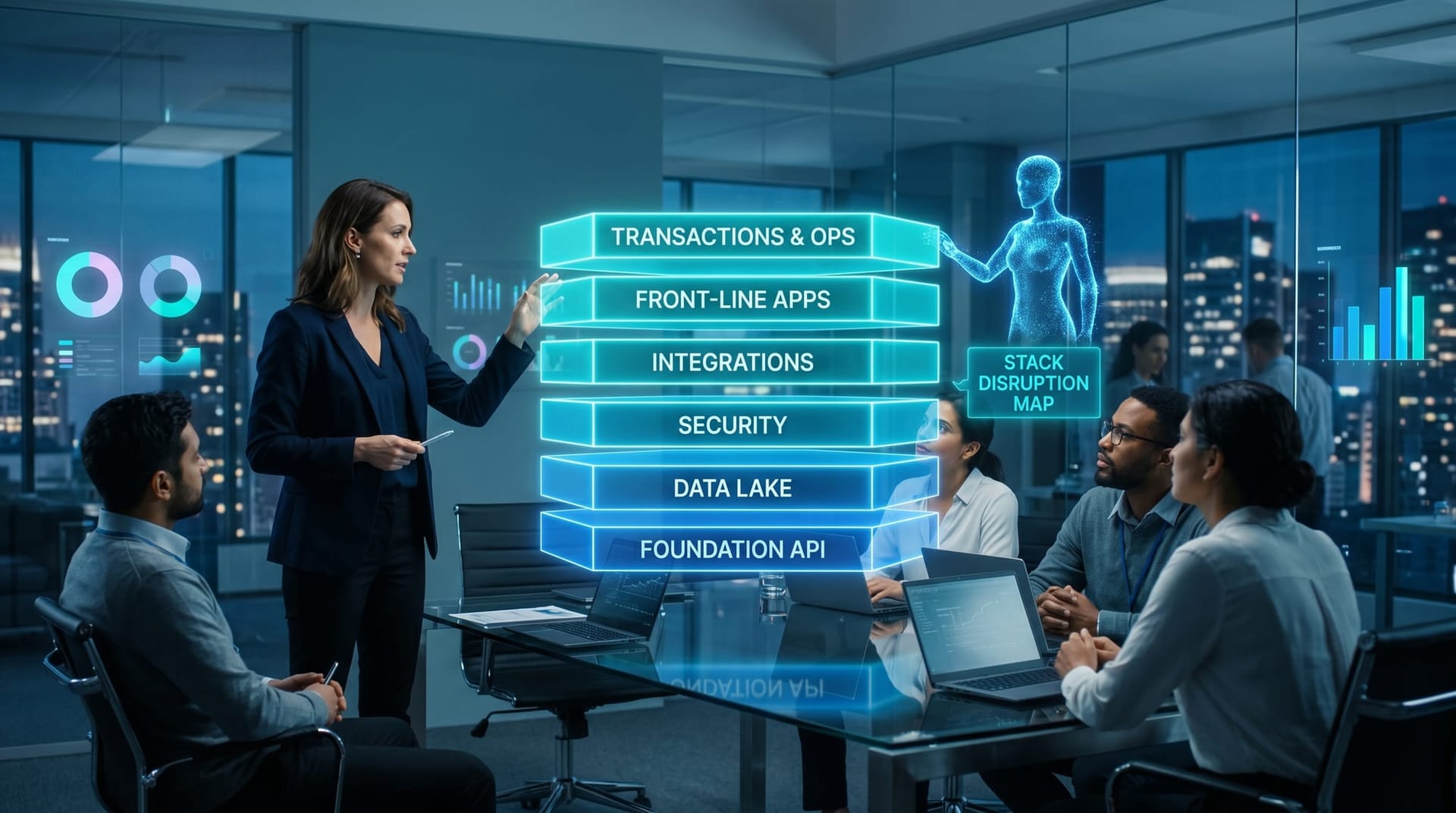
The point of the map isn't that every row flips overnight. It's that each row hides a contract, a license, or a habit you'll want to revisit deliberately. When the front-line app is operated by an agent, the per-seat pricing model your vendor sold you starts to wobble. When integrations run through a standard protocol, the proprietary connector you're locked into loses its grip. The pattern is the one we keep seeing: the hard part stops being the technology and becomes the org, the contracts, and the workflows wrapped around it.
Is Apple's new Siri the canary in the coal mine?
If you want a concrete, shipping example of the app layer being made agent-operable, look at what Apple is doing. VentureBeat's reporting frames Apple's new Siri as more than a smarter assistant — it's a new enterprise app layer, an AI-powered action and content-discovery surface built into the operating system itself. The mechanics matter here. Apple is asking developers to expose app content through App Entities, make it discoverable via Spotlight's semantic index, define actions through App Intents and App Schemas, and map on-screen UI elements to app objects through View Annotations.

Read that list again and notice what it describes: a business app that adopts these frameworks lets a user ask the system to find, summarize, update, or act on app content without the developer building a separate chatbot interface at all. The app's own functions become addressable by an agent. Apple is also shipping Core AI, an OS-level framework for running developers' own models on Apple silicon. Whether or not you're an Apple shop, the signal is the one that matters: the platform owners are now treating “an agent operates the app” as the default integration pattern, not an add-on. When the operating system itself assumes the interface is an agent, that assumption flows downhill to every vendor you buy from.
When the interface is an agent, what's the real question to ask?
Here's the part most readiness checklists skip. Once an AI Employee is the thing operating your apps, the buying question quietly changes. For thirty years the question was “which app has the best interface?” In the agentic model, the app's interface is the agent — so the question becomes “which agent can I trust with our credentials and our data egress?”
That's not a rhetorical flourish; it's a governance problem with real failure modes. An agent that can operate your CRM, your email, and your finance tool on stated intent is, by definition, an entity holding broad access. The risk that already exists in most firms is the ungoverned version of this — staff quietly pasting client data into personal AI tools. The reporting on shadow-AI risk found that 31% of users get no employer training, that between a fifth and a third of workers use AI outside the governance of the IT function, and that while about half of employees worry about accidentally leaking sensitive data, only 31% of IT leaders feel confident addressing the risks. Now imagine that same ungoverned posture, except the AI isn't just reading a pasted paragraph — it's operating your apps with credentials.
This is precisely the layer a Secure AI Gateway is built to govern, the same control plane we described around Microsoft's MXC agent sandbox approach: a place where an agent's identity, permissions, and outbound data flow are mediated and monitored rather than assumed. As we've argued in AI security is a complexity problem, not a model problem, the danger isn't a single bad model — it's the sprawl of agents, credentials, and access nobody is watching. The disappearing interface makes that question urgent: the more your work runs through agents, the more “who controls the agent's access” is your security posture.
What this looks like in Northeast Indiana
You don't need to be a coastal enterprise for this to land. Consider a mid-sized professional-services firm in Fort Wayne, or a home-services company in DeKalb County running on a CRM, a scheduling tool, and a finance package. Today, a staffer toggles between all three to turn a phone inquiry into a booked, invoiced job. In the agentic model, an AI Employee handles intake, checks the schedule, books the slot, and drafts the invoice from a single stated intent — with a human approving before anything goes out the door.

For Northeast Indiana owners, the practical advantage is that you're not carrying the headcount or the integration team that larger firms throw at this. The disadvantage is that the same Census data shows the smallest firms are the ones standing still. The window is real but narrow: the businesses across Allen County and DeKalb County that map their stack and decide deliberately which layers move to agents — and under what governance — will be the ones renegotiating licensing and security on their own terms rather than inheriting whatever their vendors decide for them.
What should mid-market leaders do in the next 90 days?
You don't need to rip anything out. You need to stop being surprised. Draw your own Stack-Disruption Map: list your core apps, note who operates each today, and mark which ones a governed AI Employee could plausibly operate within the year. For each candidate, write down the one contract or habit you'd have to revisit — a per-seat license, a proprietary connector, a training plan built around UI clicks. Then decide where a human checkpoint stays permanently, because in our experience the firms that win don't remove judgment — they relocate it from doing the clicks to directing and verifying the agent.
Cloud Radix builds and governs AI Employees for businesses across Fort Wayne and Northeast Indiana — and the governance layer, the Secure AI Gateway, is the part most DIY efforts skip until something leaks. If the interface is about to change hands at your company, the smart move is to decide whose hands, with what permissions, and who's watching. Talk to us about an AI Employee strategy that maps to your actual stack instead of a generic demo.
Frequently Asked Questions
Q1.What does "AI replacing the interface" actually mean?
It means the shift from operating software by clicking menus and forms to stating an outcome and letting an AI agent operate the underlying app for you. The screen doesn't disappear entirely — it becomes an exception surface for inspection and approval — but it stops being the cockpit you drive click-by-click for routine work.
Q2.Is this just a fancier chatbot?
No. A chatbot answers questions in a separate window. The agentic shift is structural: the application's own functions become addressable by an agent, so the agent operates your real tools with real permissions. That's why platform-level moves like Apple's new Siri frameworks and the open Model Context Protocol matter — they make apps agent-operable by default.
Q3.Are most mid-market companies ready for this?
Generally not yet. U.S. Census data shows AI adoption is still concentrated in larger firms, and separate analysis suggests that while roughly 79% of enterprises have piloted agents, only about 11% run them in production. The mid-market is both under-adopted on the old model and under-prepared for the new one — which is exactly why mapping the change early is an advantage.
Q4.What's the biggest risk when an agent operates our apps?
Access and data egress. An AI Employee that can operate your CRM, email, and finance tools holds broad credentials by design. Without a governance layer — like a Secure AI Gateway that mediates the agent's identity, permissions, and outbound data — you inherit a larger, faster version of the shadow-AI problem many firms already have.
Q5.Do we need to replace our existing software?
Usually not. The agentic shift is about who operates your apps, not necessarily which apps you own. The practical first step is mapping your stack layer by layer — front-line apps, reporting, integrations, training, security — and deciding deliberately which layers a governed AI Employee should operate and where a human checkpoint stays.
Q6.How is this different from your earlier point that interfaces matter more than models?
That argument was about the experience layer beating the raw model — a model-versus-experience axis. This is a different axis: the interface itself is being operated by an agent rather than a person. We said interfaces matter more than models; now the interface is changing hands. Both are true, and together they explain why the operating layer, not the model leaderboard, is where mid-market strategy should focus.
Q7.What does the agentic shift mean for a Northeast Indiana business specifically?
For a mid-sized Fort Wayne or DeKalb County firm, it means the staffer who toggles between a CRM, a scheduler, and a finance tool can instead state one intent and let a governed AI Employee operate all three — with a human approving before anything leaves the building. The advantage is that you aren't carrying the headcount or the integration team larger firms throw at this; the risk is moving without governance. Map your stack layer by layer, then decide deliberately which layers an agent operates and where a human checkpoint stays.
Sources & Further Reading
- VentureBeat: venturebeat.com — AI is about to replace the interface — business leaders aren't ready
- VentureBeat: venturebeat.com — Apple's new Siri AI is more than just a smarter assistant — it's a new enterprise app layer
- Wikipedia: en.wikipedia.org/wiki/Model_Context_Protocol — Model Context Protocol
- SaaS Ultra: saasultra.com — AI Agent Statistics 2026: Adoption Rates, ROI Data, and Which Industries Are Actually Winning
- U.S. Census Bureau: census.gov — AI Use at U.S. Businesses
- Help Net Security: helpnetsecurity.com — Shadow AI risks deepen as 31% of users get no employer training
Decide Whose Hands Your Interface Changes Into
We'll map your software stack layer by layer, show you which layers a governed AI Employee can operate, and wrap a Secure AI Gateway around it — so the agentic shift happens on your terms, not your vendors'.