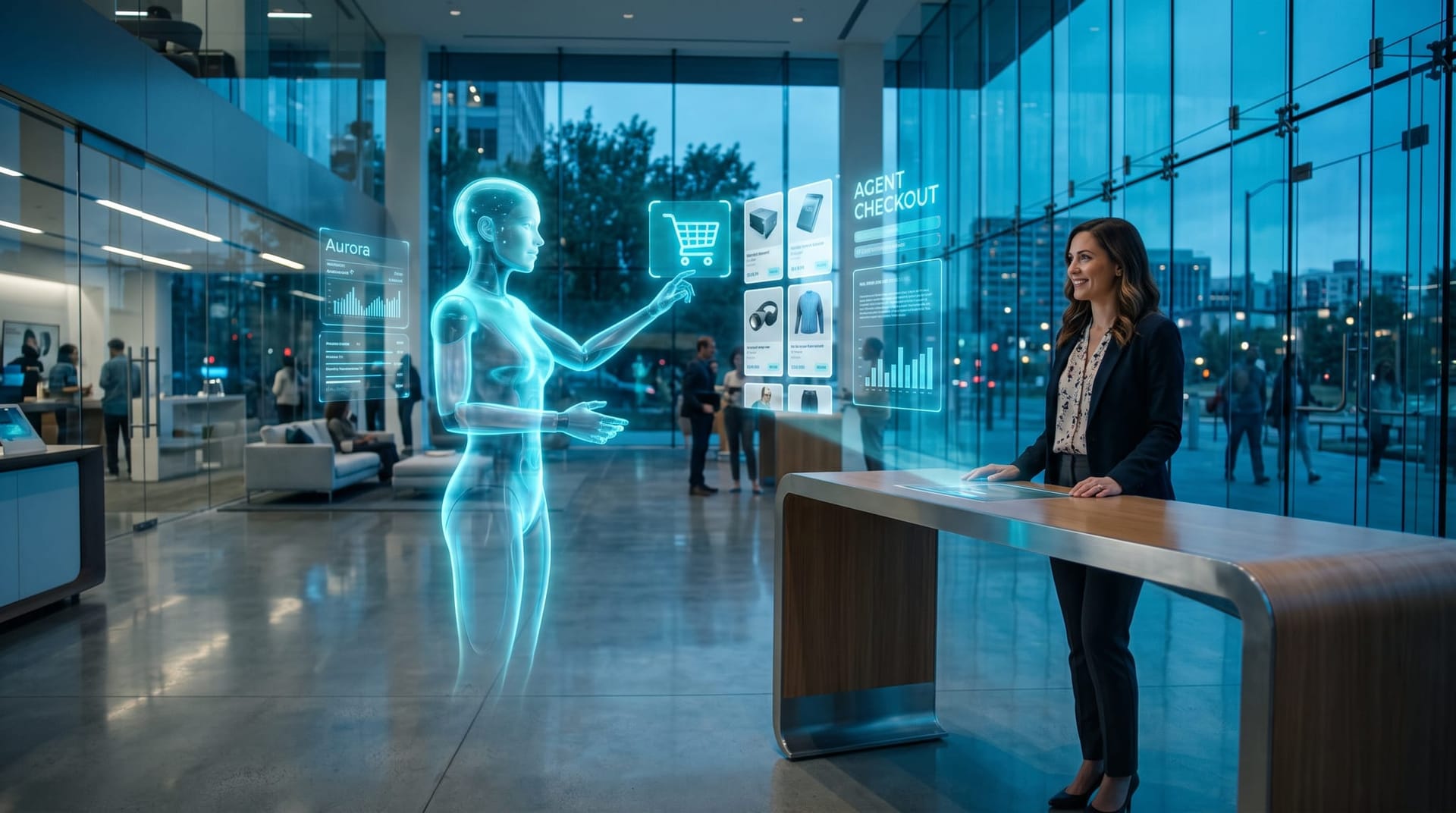
There is a new kind of visitor arriving at your website, and it is neither a human nor the search-engine crawler you have spent years optimizing for. It is a personal AI agent — software a customer has asked to go find a plumber, book a table, compare quotes, or just buy the thing — and it shops on their behalf. In a span of weeks this fall, personal agents went from a demo to a mass-market habit. Meta's Muse app passed 5 million U.S. downloads in 22 days, according to Crypto Briefing, faster than ChatGPT reached the same milestone, and OpenAI pushed agentic product discovery into ChatGPT at the same time.
That matters for a business in Auburn, Fort Wayne, or anywhere in Northeast Indiana for one blunt reason: if a customer's agent can't read your hours, understand your prices, or complete a booking, the agent moves on to a competitor it can work with — and your human customer may never see that you existed. A recent MIT Technology Review piece by James O'Donnell, on whether a better internet for agents means a worse one for people, lays out both the opportunity and the mess. This post translates that national story into a concrete, near-term decision for local owners.
Key Takeaways
- Personal AI agents are now a third category of web visitor — distinct from humans and from traditional search bots — and the majority of their activity targets e-commerce and local commerce.
- Being “agent-reachable” means your hours, prices, services, and booking or checkout flow are machine-readable, not trapped in images or a design only a human can navigate.
- Platforms are splitting into two camps: some (like Shopify) are building dedicated agent checkout lanes, while others (like Amazon) are actively blocking outside agents.
- The real risks for local businesses are per-agent pricing, verification friction that annoys human customers, and undisclosed commissions steering agents toward national competitors.
- The practical move is not a rebuild. It is structured data, clean service and pricing pages, an agent-friendly booking path, and someone watching how agents actually interact with your site.
What Is the Agentic Web, and Why Did It Arrive So Fast?
The “agentic web” is shorthand for the growing share of internet activity driven by AI agents acting for a person rather than the person clicking around themselves. The shift is not theoretical. HUMAN Security's 2026 State of AI Traffic report documented agentic AI traffic growing 7,851% year over year, and MIT Technology Review, citing the same firm, reports that agentic web traffic tripled in the single stretch from August to September 2026. Crucially for Main Street, that traffic is not evenly spread: retail and e-commerce now account for 46.6% of all agentic traffic, per PYMNTS' reporting on HUMAN Security's data. Agents are overwhelmingly here to find things and buy things.
What tipped it from research project to consumer behavior was distribution. When Meta put Muse on phones at scale and OpenAI wired product discovery into a tool hundreds of millions of people already open daily, delegating a task to an agent stopped being a power-user trick. The agent fills forms, compares options, and — increasingly — completes the purchase.

For a local owner, the mental model is simple. You already optimize so a human finds you on Google and so an AI answer engine quotes you. The agentic web adds a step: after the agent finds and recommends you, it tries to act. That is a higher bar than being mentioned. It is the difference between showing up in an answer and being transactable through one.
How Do AI Agents Shop — and Where Do They Get Blocked?
The agent ecosystem is splitting into two philosophies, and the split directly affects whether an agent can complete a sale on your behalf. On one side, platforms are building lanes for agents. Shopify extended its WebMCP tooling to checkout in late September 2026, so an agent running in a buyer's browser can read, update, and submit a checkout — with tools to inspect the cart, change delivery details, and place the order. The Paypers notes a buyer still has to authorize before anything is submitted, and Shopify has formed agentic-commerce partnerships with agents including Muse. Actual buying is still the frontier rather than the norm: HUMAN Security's data shows only about 2.3% of agentic activity reaches checkout today — but that sliver is exactly what these new agent lanes are built to grow.
On the other side, large players are slamming the door. Amazon blocked Meta's Muse agent and has fought Perplexity's shopping assistant in court; a federal appeals panel vacated the injunction Amazon had won against Perplexity in August 2026, finding it was the user — not Perplexity — accessing Amazon's systems. Amazon's core worry, per MIT Technology Review's reporting, is that agents blur the line between ads seen by humans and impressions served to bots, which threatens its advertising business. TechCrunch has separately documented people hitting walls on sites including Yelp and Pizza Hut, with Yelp declining to let AI book restaurant reservations.
| Platform posture | What it means for an agent | What it means for you |
|---|---|---|
| Welcomes agents (e.g. Shopify checkout lanes) | Agent can browse and complete a purchase | Your storefront is transactable; you capture agent-mediated sales |
| Blocks agents (e.g. Amazon vs. outside agents, Yelp reservations) | Agent is turned away or degraded | Customers route around the block — or around you |
| Undecided / unstructured (most small-business sites) | Agent guesses, misreads, or gives up | You are invisible to agent-mediated customers by default |

Most local businesses sit in that third row today — not blocking agents, but not readable by them either. That is the gap worth closing, and it is far cheaper to close than a platform war. It is also why we covered how to run the agent-readiness audit on your own site: before you change anything, grade how an agent actually experiences your pages.
What Does “Agent-Reachable” Mean for a Fort Wayne Business?
“Agent-reachable” is less exotic than it sounds. An agent is trying to answer a few concrete questions on a customer's behalf: Are you open? Do you do the specific thing I need? What does it cost, roughly? Can I book or buy right now? If those answers live only in a hero graphic, a PDF menu, or a phone-only booking process, the agent stalls.
Making a site legible to agents overlaps heavily with good web development for Fort Wayne businesses and with the same structured-data work that powers Answer Engine Optimization for Fort Wayne. In practice it comes down to a short list:
- Machine-readable core facts. Hours, service area, services offered, and starting prices expressed as text and schema markup — not baked into images.
- A clean services-and-pricing page. Agents reason over structure. A page that clearly maps “service → what's included → price range” is easy to quote and act on.
- An agent-friendly path to the next step. A bookable calendar, a form an agent can fill, or a checkout that doesn't depend on a human recognizing a cleverly styled button.
- Consistency across the web. Your name, address, and hours should match on your site, your profiles, and anywhere an agent might cross-check — mismatches make agents distrust and skip you.
This is the transactional layer sitting on top of the discovery work we have written about before. We have shown that AI search traffic converts at 30-40% for Fort Wayne businesses that optimize for it; the agentic web raises the stakes because the agent doesn't just send a high-intent visitor, it tries to close the loop itself.

What Are the Risks Local Owners Should Watch?
This is not a story where you flip a switch and win. MIT Technology Review's reporting is candid about the downsides, and several hit small businesses harder than they hit the platforms.
Per-agent pricing. O'Donnell describes a future where the same sweater could show different prices to different people's agents. For a local business, dynamic or opaque pricing is a reputation risk: if a customer learns their neighbor's agent got a better number, trust erodes fast. We generally recommend transparent, consistent pricing precisely because agents will surface inconsistencies you used to be able to hide.
Verification friction. As businesses try to tell human from agent, they add checks — and those checks also annoy real people. The article only half-jokes about iris scans. The practical lesson: don't bolt on anti-agent friction that makes your site worse for the humans who still visit it directly.
Undisclosed commissions and steering. A customer may not know whether an agent's recommendation was shaped by advertising or a platform commission. That can quietly steer agents toward national chains that pay for placement and away from the independent shop down the street. Your defense is to be the most machine-legible, best-structured option in your category so an agent has an easy, high-confidence reason to pick you.
Customer-service overload. Wharton's Ethan Mollick, quoted by MIT Technology Review, warns that once people realize agents can request refunds and negotiate, agents could overwhelm customer-service channels. On LinkedIn he put the flip side plainly: “Humans will eventually get very annoyed when their agents aren't allowed to do this on their behalf.” For a small team, a flood of agent-initiated requests is a real operational question — one worth planning for before it arrives, not after.

None of these cancel the opportunity. They argue for doing this deliberately, with someone accountable for watching how agents behave on your site — which is exactly the kind of ongoing monitoring our AI Employees for Fort Wayne are built to handle. If you run a mid-market operation with procurement on the other side, the business-to-business version of this shift — where agents spend against pre-authorized rules — is worth reading in our breakdown of intent contracts for mid-market agentic commerce.
Fort Wayne and Northeast Indiana: The Near-Term Choice
For owners in Fort Wayne, Auburn, DeKalb County, and across Northeast Indiana, the agentic web is not a coastal abstraction. The customers delegating errands to Muse or ChatGPT live here, and the agents they send don't care that you are a trusted local name if they can't read your site. The choice in front of a local business over the next few quarters is narrow but real: become reachable and transactable by agents, or quietly go invisible to agent-mediated customers while national competitors — already on Shopify, already structured — scoop them up. The window is not generous: agentic traffic tripled in a single month this fall, and with nearly half of it already aimed at commerce, the gap between agent-ready and agent-invisible businesses widens every quarter.
The encouraging part is that local businesses start with an advantage agents reward: specificity. A regional HVAC company, a Fort Wayne law firm, or an Auburn retailer that clearly states what it does, where, when, and for roughly how much is easier for an agent to recommend and act on than a vague national page. It also fits a pattern we have already seen locally — your customers say they distrust AI but use it daily, and increasingly they will let an agent do the legwork whether or not they admit to loving it. Meet them where they are heading.
Your Do-This-Now Checklist
You do not need to rebuild your site this week. You need to make it legible to a motivated, impatient new kind of visitor. In order:
- Audit how an agent sees you. Run an agent-readiness check and note what breaks — unreadable hours, image-only pricing, a booking flow that dead-ends.
- Fix the core facts first. Put hours, service area, services, and price ranges into real text with schema markup.
- Open one clean path to action. A bookable calendar or an agent-completable form or checkout for your single most common request.
- Keep your details consistent everywhere. Align name, address, hours, and services across your site and profiles.
- Decide your agent policy on purpose. Choose where you welcome agents and where a human must step in — and make sure any verification you add doesn't punish real customers.
- Assign someone to watch it. Agent behavior will change monthly; treat this as ongoing, not a one-time project.
Ready to Make Your Site Agent-Reachable?
Cloud Radix builds the structured-data, web-development, and AEO foundations that let AI agents find, understand, and act on your business — and we deploy AI Employees to monitor how those agents behave over time so you are not flying blind. If you run a business in Fort Wayne or Northeast Indiana and want to know whether a customer's agent can actually reach you today, start with our Answer Engine Optimization for Fort Wayne service, or talk to us about putting an AI Employee for Fort Wayne on the job. The agents are already shopping. The question is whether they can find a way to buy from you.
Frequently Asked Questions
Q1.What is an AI shopping agent?
An AI shopping agent is software a person directs to browse, compare, book, or buy on their behalf, such as Meta's Muse or product discovery inside ChatGPT. It acts as a third kind of web visitor — not a human clicking manually and not a traditional search crawler — and the majority of its activity targets retail and local commerce sites.
Q2.Will AI agents hurt my Fort Wayne business?
They can, if your site isn't readable by them. When an agent can't parse your hours, services, pricing, or booking flow, it routes the customer to a competitor it can work with. The risk is invisibility by default rather than a deliberate attack, and it is largely fixable with structured data and a clean path to action.
Q3.How do I make my website agent-reachable?
Put your core facts — hours, service area, services, and starting prices — into real text with schema markup instead of images, build a services-and-pricing page with clear structure, and offer at least one booking or checkout path an agent can actually complete. Keep your business details consistent across your site and profiles so agents trust the information.
Q4.Do AI agents really complete purchases, or just browse?
Both, and increasingly they complete purchases. Shopify extended its WebMCP tooling in late September 2026 so browser-based agents can read, update, and submit a checkout, with the buyer still authorizing the order. Other platforms, including Amazon for outside agents, currently block agent transactions, so the ability to buy varies by platform.
Q5.Why is Amazon blocking AI agents while Shopify welcomes them?
Amazon has argued that agents threaten its advertising business by blurring the line between ads seen by humans and impressions served to bots, and it fought Perplexity's shopping assistant in court before an appeals panel vacated its injunction in August 2026. Shopify took the opposite approach, building dedicated agent checkout lanes and partnering with agent providers.
Q6.What are the biggest risks of the agentic web for local businesses?
The main risks are per-agent pricing that can erode customer trust if it looks inconsistent, verification friction that frustrates human visitors, undisclosed commissions that steer agents toward national competitors, and a potential surge in agent-initiated customer-service requests. Each is manageable with transparent pricing, careful site design, strong machine-legibility, and a clear plan for handling agent traffic.
Sources & Further Reading
- MIT Technology Review: technologyreview.com/2026/10/19/1147186 — Making the internet better for AI agents might make it worse for everyone else.
- HUMAN Security: humansecurity.com/newsroom — 2026 State of AI Traffic & Cyberthreat Benchmark Report.
- The Paypers: thepaypers.com/payments/news — Shopify extends WebMCP support to checkout for AI agents.
- Retail Insight Network: retail-insight-network.com/news — US court overturns Amazon injunction against Perplexity.
- Crypto Briefing: cryptobriefing.com/meta-muse-5-million-downloads-22-days — Meta's Muse hits 5 million downloads in 22 days, outpacing ChatGPT.
- PYMNTS: pymnts.com/artificial-intelligence-2 — Bots run the internet now. Someone has to run them.
Can a Customer's Agent Actually Reach You?
We will audit how an AI agent experiences your Fort Wayne business today, fix the structured data and pricing that agents read, and open a clean path to action — so you capture agent-mediated customers instead of going invisible to them.
Schedule a Free ConsultationNo contracts. No pressure. Just an honest look at whether agents can find and buy from you.