If you run a service business in Fort Wayne — HVAC, dental, accounting, home services, financial advisory, real estate — you have probably had at least one conversation in the past three years that started like this: “We want to know if our customers will pay $400 a service call instead of $325.” Or “We're thinking about opening a second location in Whitley County, but we don't know if the demand is there.” Or “Our biggest competitor just rolled out a sliding-scale plan — should we match it?”
The traditional answer to those questions was a market research engagement. A consulting firm out of Indianapolis or Chicago would build a survey panel, run a few hundred respondents, deliver a 40-slide deck, and bill somewhere between $15,000 and $30,000 for the privilege. Six weeks later, you'd have an answer that was already a quarter out of date.
That model is breaking right now — and the technology that's breaking it is something every Northeast Indiana operator should at least understand, even if they choose not to use it yet. According to VentureBeat's reporting on Brox in May 2026, a new generation of “AI synthetic audiences” — collections of tens of thousands of AI personas trained on real consumer data — can now answer the same questions in hours instead of weeks, at a fraction of the consulting cost. And per VentureBeat's April 2026 piece on the same shift, the consulting industry is already feeling it.
This is the practical playbook for what that means in Fort Wayne, what an AI Employee can and cannot do here, and how to actually run a synthetic-audience test on a 90-day pilot timeline without betting your business on a hallucinated answer.
Key Takeaways
- AI synthetic audiences are collections of thousands of AI personas trained on real consumer data — Brox is one of the most prominent vendors with reported 60,000 digital twins as of May 2026.
- For Fort Wayne service businesses, this replaces $15K–$30K traditional market research engagements with hours-not-weeks turnaround for pricing tests, expansion validation, and offer A/B comparisons.
- The technology has real limits: hallucination, audience drift, and over-fit personas can give you a confidently wrong answer. Governance matters.
- The right pilot is narrow, validated against at least one real signal (an existing customer survey, a small live test, or a holdout panel), and run as a managed AI Employee workflow.
- Cloud Radix runs 90-day NE Indiana pilots for operators in HVAC, dental, accounting, home services, and financial advisory who want to test this before committing the capital traditional research would cost.

What Is an AI Synthetic Audience, Actually?
Strip away the marketing and a synthetic audience is three things working together: a corpus of real-world consumer survey data, a set of AI personas trained to respond in ways that statistically resemble specific demographic and behavioral slices, and a query interface that lets you survey those personas the way you'd survey a panel of humans.
The Brox release reportedly fields a population of roughly 60,000 digital twins. The competitors covered in VentureBeat's April overview range from generalist platforms (any consumer, any product category) to verticalized panels (only B2B IT buyers, only homeowners, only urgent-care patients).
For a Northeast Indiana service business, the right way to think about this is not “the AI replaced my customers.” It's: “the AI provides a fast, cheap first read on questions I would have otherwise paid a consulting firm to answer slowly and expensively. The first read is good enough to make most go/no-go decisions. For the ones where I need a defensible answer, I still run a small real-human validation alongside.”
That's a different posture than either “ban this, it's not real research” or “great, fire the consultants.” It's the posture an AI Employee is built for: do the fast, cheap, high-volume part with AI, escalate the high-stakes part to humans, and keep a clean record of which is which.
The Cloud Radix view on this lines up with the broader argument we made in why generic AI tools fail (and custom AI Employees don't): a generic LLM with a “pretend to be a customer” prompt is not a synthetic audience, any more than a chatbot is an AI Employee. The infrastructure that produces a defensible synthetic-audience answer is built, not prompted.

The Five Questions Fort Wayne Service Businesses Actually Ask
Across HVAC, dental, accounting, home services, and financial advisory practices in Allen, DeKalb, Whitley, and Noble counties, the same family of questions comes up over and over:
- Pricing. “If we move our standard service-call fee from $325 to $400, what percentage of recurring customers do we lose?”
- Offer design. “If we introduce a sliding-scale or membership tier, how does it shift our acquisition mix and our retention curve?”
- Expansion. “Is there enough demand in Whitley County to support a second location, or do we just deliver out of the Fort Wayne hub?”
- Service-line addition. “Should our dental practice add invisible aligners? Should our HVAC firm add electrical?”
- Competitive response. “Our biggest competitor just launched X — do our customers care, and how should we respond?”
Each of those questions has historically been the trigger for either an expensive consulting engagement, a homebrew survey done badly, or a gut-feel decision. None of those are great answers for an operator whose annual revenue swings on the call.
The traditional market research industry — tracked by trade bodies like the Insights Association and Bureau of Labor Statistics under the Market Research Analysts occupational profile — has been built for enterprise budgets. Survey methodology done right is genuinely hard, and organizations like the Pew Research Center publish detailed methodology guides that make clear why it's expensive when you do it correctly. That cost structure is precisely what has left small and mid-market service operators underserved for decades.
A synthetic audience is, in plain terms, the first technology that brings the answer down to a budget a single-location Auburn HVAC company or a three-chair DeKalb County dental practice can actually approve.
What Does a 90-Day NE Indiana Synthetic-Audience Pilot Look Like?
Here's a concrete pilot pattern we run with Cloud Radix clients in the region. The goal is not “buy a synthetic-audience subscription and hope” — it's “use an AI Employee to design, run, and validate a synthetic-audience test that answers one real business question, and decide from there whether to keep going.”
Weeks 1–2 — Question framing and baseline. The AI Employee works with the operator to write the question in a research-grade form. “Should we charge more?” becomes “What is the price-elasticity curve for our standard service call between $325 and $450, segmented by customer tenure and household income tier?” The baseline is a sample of recent real customer data — invoice records, retention curves, NPS responses if they exist — that the synthetic-audience output will be checked against.
Weeks 3–4 — Persona alignment. The AI Employee aligns the synthetic-audience persona slice to the operator's actual customer base. A general-population panel is the wrong tool for a Fort Wayne HVAC company; the persona slice needs to reflect Allen and DeKalb County household income distributions, single-family vs. multi-family housing, and typical HVAC service patterns in the Midwest. Most synthetic-audience platforms support some version of demographic and behavioral filtering. Skipping this step is where most cheap synthetic-audience tests go wrong.
Weeks 5–8 — Run the test, run a real-human holdout. The synthetic audience answers the survey question — typically a few hundred to a few thousand AI personas, several runs to check stability — and in parallel, a small real-customer holdout panel (50 to 150 actual customers) answers a stripped-down version of the same question. The AI Employee compares the two and flags any meaningful divergence.
Weeks 9–12 — Decision and documentation. If the synthetic audience and the real-human holdout agree within an acceptable tolerance, the operator has a defensible answer. If they disagree, the operator has learned something more valuable: their persona slice was off, or their question was ambiguous, or there's a real behavioral nuance the synthetic audience missed. Either outcome is worth more than the cost of the pilot.
The deliverable at the end of the 90 days is not a slide deck. It's a documented research workflow the operator can run again — for the next pricing question, the next expansion question, the next competitive response — without restarting from scratch. That's the AI Employee outcome.
For a primer on how we structure that kind of outcome measurement, how to measure AI Employee performance lays out the metrics we use across every engagement.
Synthetic vs. Traditional vs. National Consulting: The NE Indiana Comparison
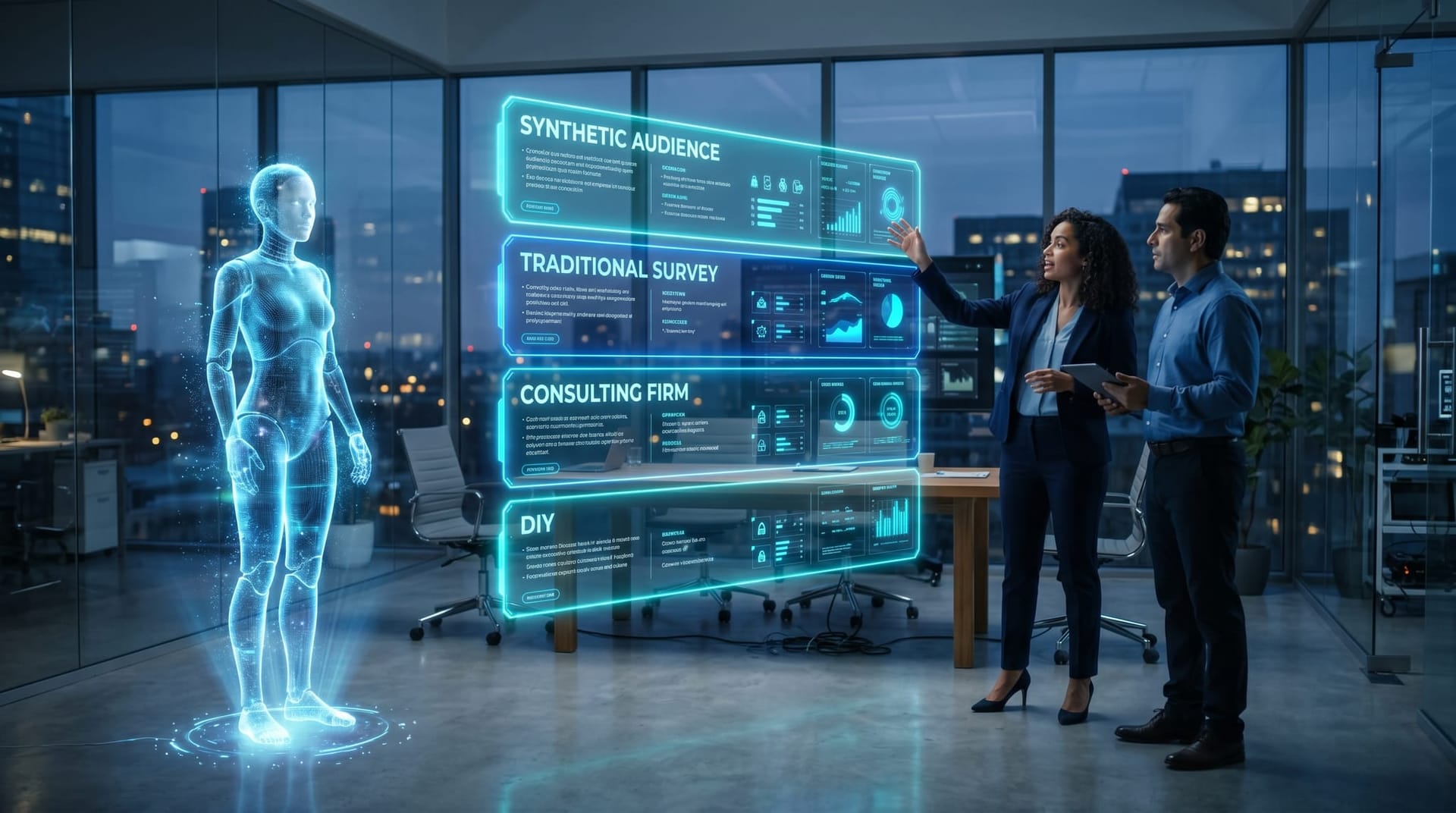
Below is the honest comparison Cloud Radix walks operators through when they're weighing this. The numbers are typical ranges, not guarantees — every engagement varies.
| Option | Typical cost | Turnaround | Sample fidelity | NE Indiana fit |
|---|---|---|---|---|
| AI synthetic audience (managed pilot) | $3,000–$12,000 | 1–4 weeks | High for well-defined consumer questions, lower for novel behavior | Strong fit for pricing, offer design, competitive response |
| Traditional online survey panel | $8,000–$25,000 | 4–8 weeks | High for representative consumer behavior | Good fit when N≥400 real respondents needed |
| National consulting firm engagement | $30,000–$150,000+ | 8–16 weeks | Highest (when scoped well) | Overkill for most NE Indiana single-location decisions |
| DIY survey (SurveyMonkey-style) | $0–$2,000 | 1–3 weeks | Highly variable; often non-representative | Poor unless paired with strong methodology discipline |
The honest read: for the majority of single-decision questions a Fort Wayne service business is asking, an AI synthetic audience paired with a small real-human holdout sits at the sweet spot of cost, speed, and defensibility. For high-stakes multi-million-dollar decisions, you still want the national consulting firm — but most operators in the region are never going to face that decision, and the synthetic-audience layer makes the cheaper-faster-good-enough first read accessible for the first time.
Harvard Business Review's coverage of AI in consulting has been tracking the same shift at the enterprise tier, and the dynamic at the mid-market and small-business level is identical: the floor on “good enough research” has dropped dramatically, which means the question is no longer “can we afford to do market research?” — it's “what decisions are we under-investigating because we assumed research was out of reach?”
Where Do Synthetic Audiences Get You in Trouble?
This is the section every vendor blog skips. Cloud Radix puts it up front, because operators need to know the failure modes before they sign up:
- Hallucination. A synthetic audience can produce a confidently wrong answer. If the underlying training data thinly represents your persona slice, the AI will smooth over the gap with plausible-sounding fiction. The mitigation is the real-human holdout — always.
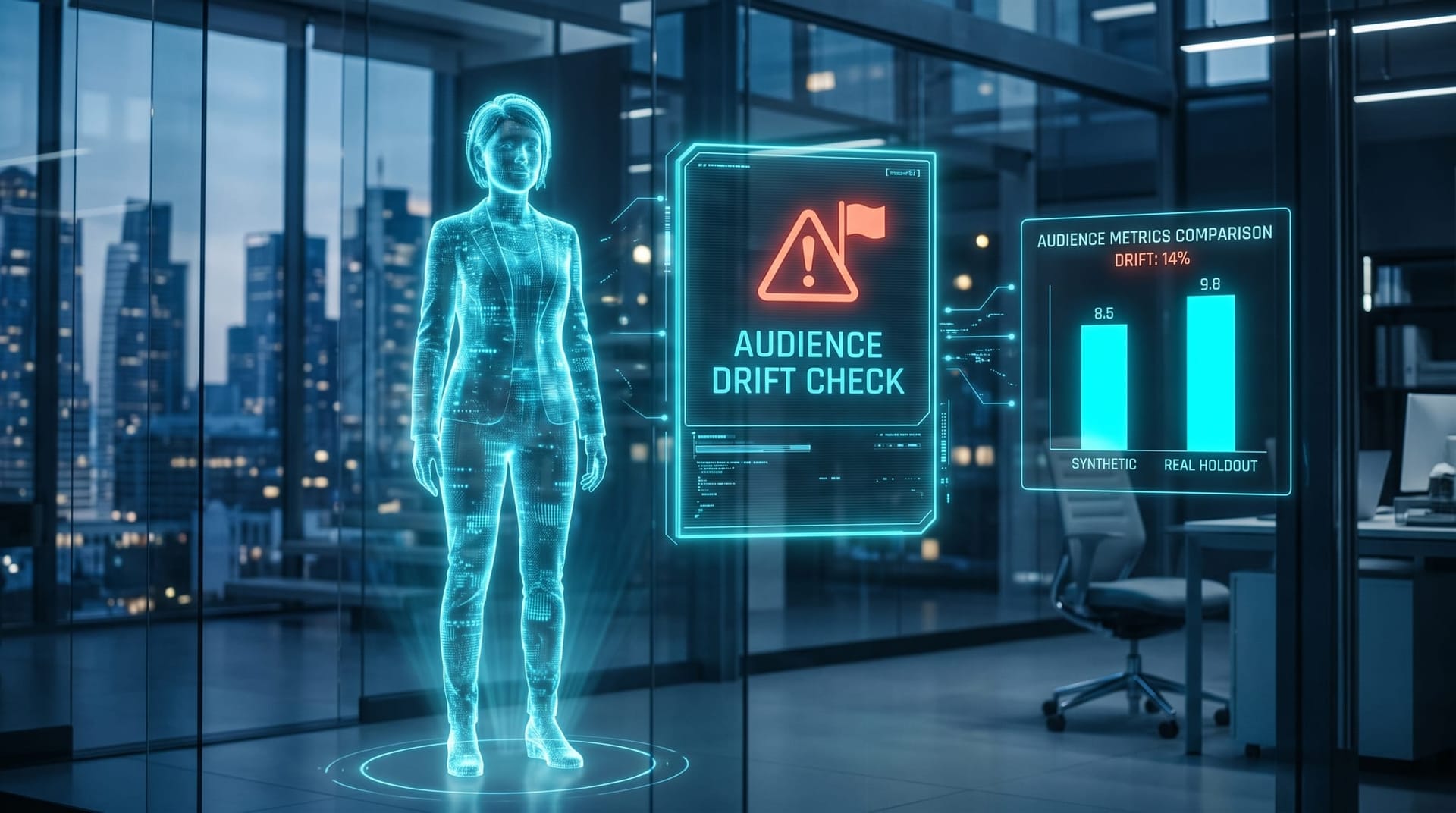
- Audience drift. If you re-run a synthetic-audience test six months later, the underlying model may have changed (vendor updates, retraining, persona library refreshes). Treat synthetic-audience results as point-in-time evidence, not as a reusable knowledge base.
- Over-fit personas. A vendor that lets you customize personas heavily can produce results that just reflect the assumptions you fed in. The cure is to keep persona definitions broad and defensible, and document the slice clearly.
- Novel behavior. Synthetic audiences are good at “how would a typical customer feel about X?” They're weaker at “how would a customer feel about something they've never seen before and there's no analog for?” Novel-category launches still benefit from real-human research.
- Regulatory and ethical limits. Some industries (healthcare, financial services, regulated professional services) have rules about what counts as evidence for marketing claims. A synthetic-audience output is research; it is not a clinical study, an actuarial finding, or a financial product recommendation. Use it accordingly.
None of these are reasons not to use synthetic audiences. They're reasons to use them through a governance layer — exactly the kind of layer an AI Employee with documented workflows provides, which is the same posture we take across Fort Wayne customer service AI deployments and other Cloud Radix engagements where the answer has to be defensible, not just fast.

What This Means for Allen, DeKalb, Whitley, and Noble County Operators
The map below is the way to think about it by industry. None of this is theoretical — these are the questions we've been asked in Cloud Radix client conversations over the past quarter.
- Allen County HVAC and home services. Pricing tests for service-call fees, membership-tier design, expansion into Whitley and Noble counties. Synthetic audiences are a strong fit for the pricing and offer-design questions; real route-density data still drives expansion decisions.
- DeKalb County dental and healthcare. Sliding-scale offer testing, new service-line interest (aligners, sleep apnea, cosmetic), patient acquisition channel mix. Synthetic audiences with a careful demographic slice are useful for the offer and service-line questions; never substitute for clinical evidence.
- Whitley and Noble County professional services. Accounting firms weighing new service lines (advisory, fractional CFO, payroll), financial advisors testing fee structure changes. Strong fit for fee-structure and service-line questions.
- Auburn and Garrett area real estate and franchising. Brand-perception tests for a new service-tier offering, comparative differentiation against larger Fort Wayne or Indianapolis competitors. Strong fit; pair with local-market real-data signals.
Because Fort Wayne discovery increasingly happens through AI Overviews and answer engines, the secondary benefit of running a synthetic-audience workflow is that the structured research you produce becomes content your AI Employee can cite when answering customer questions on your behalf. That intersects directly with the Fort Wayne AI search traffic and AEO conversion playbook we maintain for regional operators, and with the broader observation in our Fort Wayne business owners and the Nobel-economist three-things-AI piece that the operators who treat AI as a research tool — not just an automation tool — get a structural advantage in their market.
The 90-Day Cloud Radix Synthetic-Audience Pilot for NE Indiana
Cloud Radix runs managed synthetic-audience pilots for NE Indiana operators in HVAC, dental, accounting, home services, financial advisory, and real estate. The pilot is 90 days, includes question framing, persona alignment, the synthetic-audience run, a real-human holdout validation, and the documented workflow you keep at the end.
The goal is not to sell you on synthetic audiences as a religion. It's to get you a defensible answer to one real business question — pricing, expansion, offer design, competitive response — at a budget that does not require board approval. If the pilot works, you keep running the workflow yourself or you keep us on retainer to run it for you. If it doesn't, you've learned something valuable about your customer base and you're out a fraction of what a traditional consulting engagement would have cost.
If that's a conversation worth having, learn more about our AI Employee service or schedule a no-pressure call through Cloud Radix's AI consulting page. We will tell you honestly whether your business question is a good fit for a synthetic-audience pilot or whether you'd be better served by a different approach.
Frequently Asked Questions
Q1.What is an AI synthetic audience?
An AI synthetic audience is a collection of AI personas — typically thousands to tens of thousands — trained on real consumer behavior and demographic data so they can answer survey questions in ways that statistically resemble specific human population slices. Per VentureBeat's coverage of Brox, one of the most prominent vendors fields roughly 60,000 such “digital twins.” They are surveyed through a query interface rather than a panel platform, and results come back in hours instead of weeks.
Q2.How accurate are synthetic audiences compared to real surveys?
Accuracy depends heavily on the quality of the underlying training data, the persona slice used, and how the question is framed. For well-defined consumer questions (pricing sensitivity, brand perception, offer attractiveness) against well-represented populations, synthetic audiences can match traditional survey results closely. For novel categories, niche populations, or behavioral questions the training data doesn't cover, accuracy drops. The honest standard is to always validate synthetic-audience results against at least a small real-human holdout panel.
Q3.Can a Fort Wayne service business actually use this on its own?
In principle, yes — most synthetic-audience platforms have self-serve tiers. In practice, the bottleneck for most operators is not the platform; it's the research-question framing, persona alignment, and validation discipline. Those are the parts that determine whether the answer is usable or worthless. Cloud Radix's managed-pilot model exists because most operators in the region don't have someone on staff who's done structured market research before.
Q4.What does it cost compared to traditional market research?
A managed AI synthetic-audience pilot typically runs $3,000–$12,000 depending on the scope, persona complexity, and validation requirements. Traditional online survey panel research for an equivalent question typically runs $8,000–$25,000. A national consulting firm engagement on the same question typically starts at $30,000 and can climb past $150,000 depending on deliverable scope. For most Fort Wayne and Northeast Indiana service-business decisions, the synthetic-audience pilot lands in the right cost band.
Q5.What kinds of questions are a bad fit for synthetic audiences?
Questions about novel categories the underlying training data doesn't cover, questions that require evidence to a regulated standard (clinical, actuarial, financial product), and questions where the customer behavior depends on local-market signals not captured by the persona slice (route density, real estate inventory, regulatory environment). For those, you still want real-human research or a different evidence approach.
Q6.How does this fit with AI Employees in our business?
Synthetic-audience workflows are exactly the kind of bounded, repeatable research task an AI Employee is built to run. The workflow — question framing, persona alignment, run, validation, documentation — can live with the AI Employee and be re-run any time you have a new pricing, offer, or expansion question. That turns market research from a once-every-few-years consulting purchase into a continuous capability inside your business.
Q7.Will this replace real customer surveys completely?
No, and any vendor who tells you it will is overselling. The pattern that actually works for mid-market operators is “synthetic audience for the fast, cheap, repeatable read; real-human holdout for validation on the questions that matter most; full real-customer survey when the stakes justify the cost.” That mix is the playbook, not a religious commitment to one approach over the other.
Sources & Further Reading
- VentureBeat: venturebeat.com/data/market-research-is-too-slow-for-the-ai-era — Brox built 60,000 identical digital twins of real people you can survey instantly, repeatedly.
- VentureBeat: venturebeat.com/technology/ai-synthetic-audiences-are-already-here — AI synthetic audiences are already here and poised to upend the consulting industry.
- Insights Association: insightsassociation.org — the trade body for the market research industry.
- U.S. Bureau of Labor Statistics: bls.gov/ooh/business-and-financial/market-research-analysts — Market Research Analysts, Occupational Outlook Handbook.
- Pew Research Center: pewresearch.org/methods — methodology and survey science.
- Harvard Business Review: hbr.org/topic/subject/artificial-intelligence — AI and consulting industry coverage.
Test Your Next Big Decision Before You Bet On It
Pricing, expansion, a new offer, a competitive response — we will scope a 90-day synthetic-audience pilot that gets your Fort Wayne business a defensible answer at a budget that does not need board approval.
Schedule a Free ConsultationNo contracts. No pressure. Just an honest conversation about what would help your business.