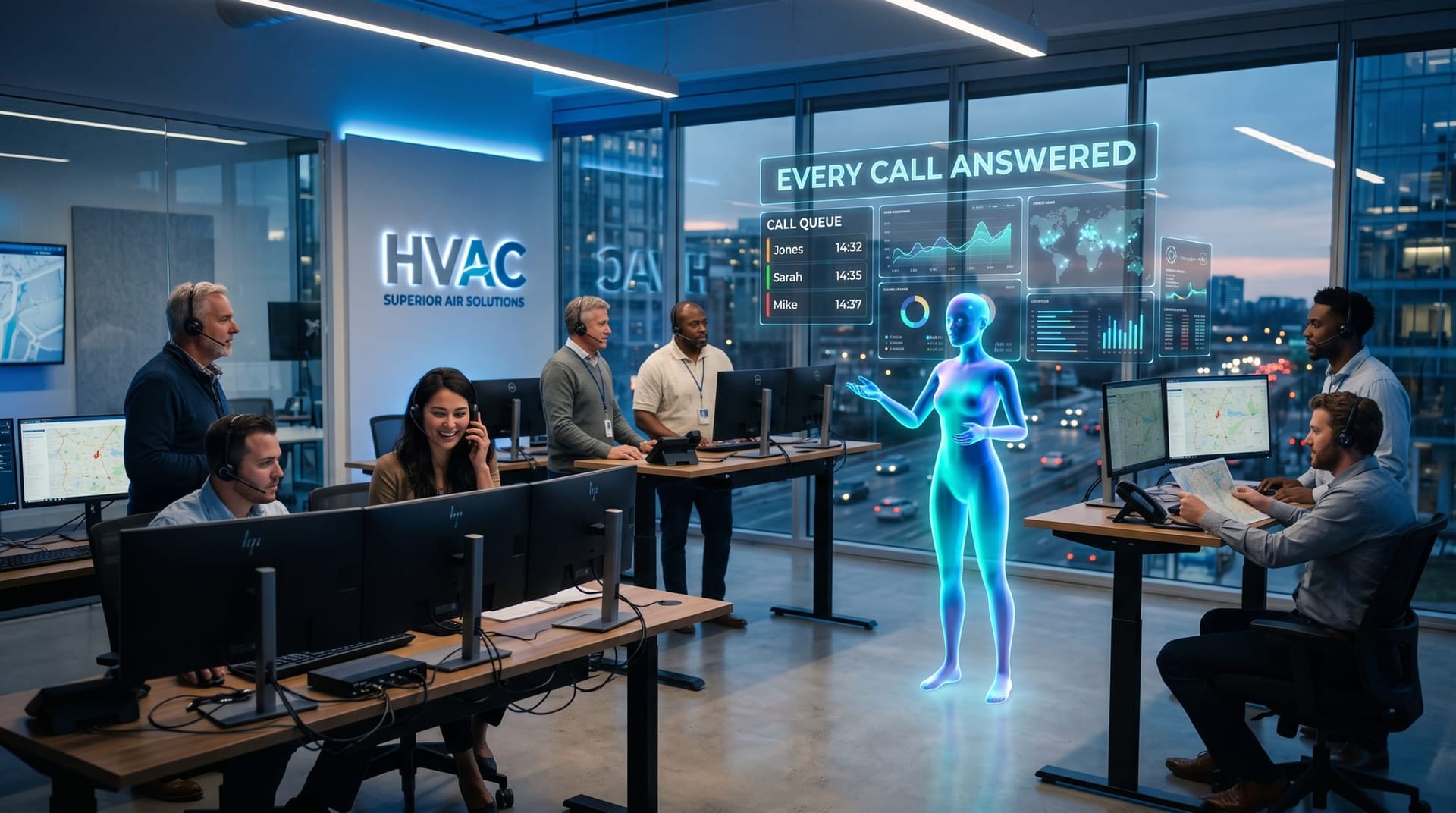
The heat pump didn't need the tax credit. That's the headline buried in this week's sales data, and it should change how every HVAC owner in Allen and DeKalb County thinks about the next eighteen months.
According to MIT Technology Review's reporting on new shipment data, heat pumps outpaced natural-gas furnaces by 32% in the first quarter of 2026 — the fourth straight year heat pumps have outsold gas furnaces in the US. The federal tax credit that was supposed to be propping up that demand died on January 1. Sales kept climbing anyway.
Here's what that means if you run an HVAC shop in Fort Wayne: the surge is durable, it's structural, and it's about to route more quote requests, rebate questions, and installation-timeline calls at your front office than your front office was built to answer. The shops that win this cycle won't be the ones with the most techs or the deepest equipment inventory. They'll be the ones that answer the phone every single time — including at 9 PM on the Saturday a customer's AC dies in July heat.
That's a lead-flow problem. And lead-flow problems are exactly what an AI Employee is built to solve.
Key Takeaways
- Heat pumps outsold gas furnaces by 32% in Q1 2026 — the fourth consecutive year of heat pumps outselling gas furnaces — even after the federal tax credit expired January 1.
- A UC Berkeley energy economist's read: the US heat pump market no longer depends on subsidies. This demand is structural, not incentive-driven.
- The federal 25C credit is gone, but Indiana's $182 million Energy Saver Program is open and offers income-qualified households up to $8,000 toward a heat pump — which makes rebate literacy a sales skill.
- More demand plus more complicated incentives equals longer, more frequent phone conversations — the bottleneck moves from the truck to the front office.
- An AI Employee answers every call 24/7, qualifies the job, handles rebate basics, and books the estimate while a competitor's line rings busy.
- No Fort Wayne HVAC shop owns this positioning in AI search yet. The first mover gets cited.
What Just Happened in the Heat Pump Market?
Two things, and the second one matters more than the first.
First, the growth itself. MIT Technology Review reports that US heat pump sales have doubled over the past 15 years, that heat pumps have now outsold gas furnaces for four consecutive years, and that Q1 2026 shipments ran 32% ahead of gas furnaces. Shipments were flat from December into January, then rose steadily through spring — a normal seasonal curve, but described in the reporting as a bit stronger than the usual seasonal pattern.
Second, the part that should recalibrate your forecast: this happened without the subsidy. Federal tax credits of up to $2,000 for heat pump installations were available from 2023 through 2025, then ended January 1, 2026 with the cuts to Inflation Reduction Act incentives. The natural expectation was a pull-forward spike in late 2025 and a cliff in 2026 — that's exactly what happened with EVs when the $7,500 credit ended in September 2025. The cliff never came for heat pumps.
UC Berkeley energy economist Lucas Davis put it plainly: “It appears that the U.S. market for heat pumps is strong enough that it does not depend on tax credits.” The credit, in his read, wasn't really the thing convincing people to install heat pumps in the first place.

Why would demand hold without the discount? The operating economics carry it. ENERGY STAR notes that an air-source heat pump can deliver up to three times more heat energy to a home than the electrical energy it consumes, because it moves heat rather than generating it through combustion — and cold-climate certified models are tested to maintain heating capacity down to 5°F, which matters in a Fort Wayne January. With heating and cooling making up nearly half of a typical household's energy spend, a machine that heats, cools, and costs less to run sells itself once a homeowner is at a replacement decision anyway.
For an HVAC owner, the takeaway is simple: this is not a subsidy bubble that deflates next quarter. It's a durable shift in what your customers ask for — and in how many questions they ask before they buy.
Why Does the Heat Pump Surge Hit the Front Office First?
Because a heat pump inquiry is not a furnace inquiry. It's a longer, more complicated conversation, and there are more of them.
Think about what the average inbound call looked like five years ago: “My furnace is out, how fast can you get here?” Now layer in what the 2026 caller wants to know. Is a heat pump right for my house? Does it actually work in Indiana winters? What does it cost versus replacing the gas furnace I already have? Is there still a rebate? Do I qualify? Which one? Can you handle the paperwork? How long is the wait for an install?
Every one of those questions is a buying signal. Every one of them also takes front-office time that most shops — especially owner-operated shops where the person answering the phone is also dispatching, invoicing, and sometimes turning wrenches — don't have spare capacity for. When call volume rises and call length rises at the same time, something gives. What gives is usually the marginal call: the one that hits voicemail, waits on hold too long, or comes in after 5 PM.

We've written before about what missed calls cost appointment-driven businesses — the math we walked through for an Indianapolis dental practice applies with more force to HVAC, because HVAC leads are urgent, high-ticket, and comparison-shopped. A homeowner with a dead AC in July does not leave a voicemail and wait. They call the next name in the search results. In our experience working with home-services businesses, the shop that answers first usually wins the estimate — not because it's the best shop, but because it was the one that picked up.
This is the sense in which the heat pump surge is a lead-flow problem rather than a supply problem. Equipment is available. Techs are hireable, eventually. But every additional point of demand MIT Technology Review's data describes flows through a single choke point first: whether anyone competent answers the phone at the moment a homeowner is ready to talk. Widen that choke point and the surge is an opportunity. Leave it narrow and the surge mostly generates busy signals — and revenue for whichever competitor invested in answering.
What Rebate Questions Will Fort Wayne Homeowners Actually Ask?
The federal credit is dead, but Indiana's state program is very much alive — and it's generous enough that your callers will have heard about it, usually half-correctly. The Indiana Energy Saver Program, administered by the Indiana Office of Energy Development with roughly $182 million in federal funding, is open for applications now and covers heat pumps, electric appliances, and insulation.
The program's two tracks work differently, and the difference is exactly the kind of thing a homeowner will call to ask about. HEAR (Home Appliance Rebates) serves low- and moderate-income households earning under 150% of Area Median Income, for first-time upgrades like heat pump HVAC systems — delivered as an upfront discount on product and installation through a qualified contractor. HOMES (Home Efficiency Rebates) covers whole-home retrofits hitting at least 20% predicted energy savings.
Here's the rebate stack as it stands in mid-2026, per Home Energy Basics' Indiana summary:
| Incentive | Amount | Who qualifies |
|---|---|---|
| Indiana HEAR heat pump rebate | Up to $8,000 | Households under 150% AMI (100% of cost covered below 80% AMI; 50% covered from 80–150% AMI) |
| Indiana HEAR full electrification | Up to $14,000 total | Same income limits, combined upgrades |
| Indiana HOMES retrofit rebate | Up to $4,000 | Above 150% AMI, with 35%+ modeled energy savings |
| Utility rebates | $450–$3,000 | Varies by provider (Duke Energy up to $3,000; NIPSCO up to $1,000; AES up to $725; CenterPoint up to $450; rural co-ops up to $500) |
| Federal 25C tax credit | $0 — expired | Ended January 1, 2026; no reinstatement legislation as of June 2026 |
Three operational facts matter for your shop. The rebates are point-of-sale discounts delivered through approved contractors — meaning the customer expects you to know the program. The funding is first-come, first-served — meaning “call us back next month” can literally cost your customer thousands. And the income-tiering means the answer to “what will I actually pay?” is genuinely different per caller.
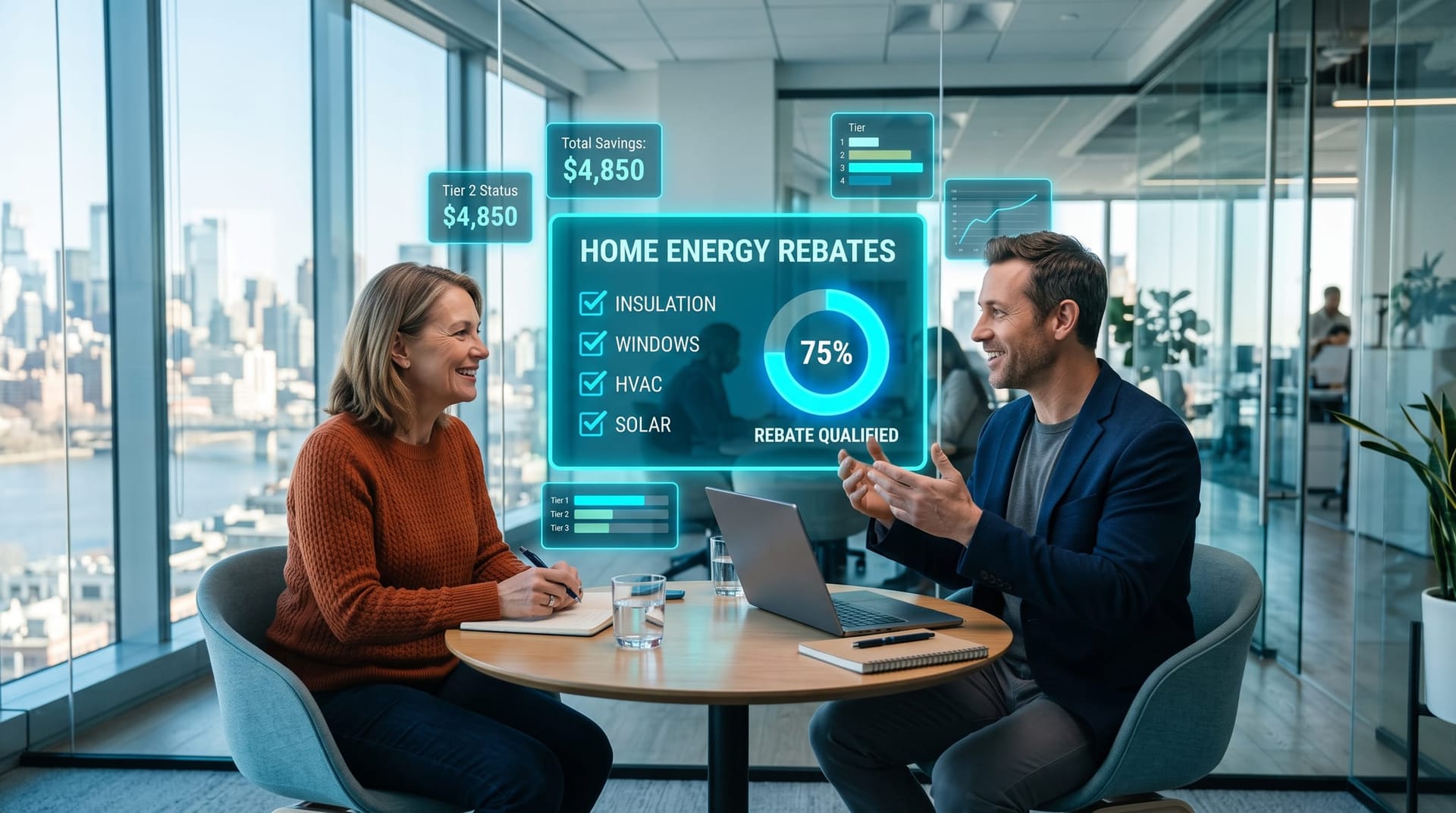
That's a knowledge burden on whoever answers your phone. It's also a competitive weapon: the shop whose phone line can explain HEAR versus HOMES accurately at 8 PM is the shop that books that install.
How Does an AI Employee Capture the Surge?
An AI Employee is not an answering service and not a phone tree. It's an autonomous agent that works your front office the way a well-trained coordinator would — every hour of every day. We've covered the underlying technology shift in depth, from reasoning-model voice orchestration to the new generation of voice APIs; the short version is that AI phone agents in 2026 hold natural conversations, follow your business rules, and take real actions in your systems.
For an HVAC shop riding the heat pump surge, that looks like:
- Answering every call, 24/7. The 9 PM Saturday AC failure — the single most valuable call of the summer — gets a competent conversation instead of voicemail. No hold queue during the Monday-morning rush.
- Qualifying the job on the first contact. Replacement, new install, or repair? Gas-to-heat-pump conversion or like-for-like? Emergency or planned? The AI Employee asks the same triage questions your best coordinator would, so a human callback starts warm instead of cold.
- Handling rebate basics accurately. Trained on the Indiana Energy Saver Program's actual structure, it can explain the income tiers, flag that funding is first-come first-served, and set expectations about what your team will confirm — without inventing numbers or promising eligibility it can't verify.
- Booking the estimate directly into your calendar. The lead converts to a scheduled appointment in the same conversation that captured it, while your competitor's line is still ringing busy.
- Logging everything. Every call becomes structured data — source, urgency, equipment type, rebate interest — instead of a sticky note.

The economics work because the cost of the AI Employee is fixed while the value of the marginal captured lead is high — you can run your own numbers with our ROI calculator. To be honest about the trade-offs: an AI Employee won't diagnose a compressor over the phone, and complex, one-of-a-kind situations should still escalate to a human — that's how we configure them. The point isn't replacing your coordinator. It's making sure the surge never hits voicemail.
What Should Fort Wayne HVAC Owners Do Before Cooling Season Peaks?
The MIT Technology Review data describes the annual pattern clearly: shipments build from winter into spring and summer. And summer is when the highest-intent leads in your market are generated, because a failed AC in July is the classic trigger for an emergency replacement conversation — the moment a homeowner who'd been deferring becomes a buyer, and increasingly a heat-pump buyer, since one machine now solves both the cooling emergency in front of them and the heating bill behind it.
We recommend a simple readiness sequence:
- Audit your current lead leakage. Pull one week of phone logs. Count after-hours calls, abandoned holds, and voicemails never returned. That number, times your average ticket, is the size of the problem — most owners we talk to have never actually measured it.
- Script your rebate answers once, centrally. Write the accurate two-minute explanation of HEAR, HOMES, and your utility's rebate — then make sure every channel (human or AI) delivers that same answer instead of improvising.
- Stand up 24/7 answering before the next heat wave, not after. Capacity added mid-crisis captures nothing from the crisis that motivated it.
- Treat every repair call as a future replacement lead. The caller with the 15-year-old system getting one more recharge is next year's conversion — but only if the visit and the follow-up are logged somewhere durable.
The same operational logic — capture at intake, structure the data, follow up automatically — is what we've deployed for Fort Wayne contractors drowning in construction documents. Trades businesses don't lose to competitors because their craft is worse. They lose in the fifteen minutes between a customer's first call and someone else's answered one.
Why Does This Window Favor Allen and DeKalb County Shops Specifically?
Because right now, nobody local owns the answer.

When a homeowner in Fort Wayne, Auburn, or anywhere in Allen or DeKalb County asks Google's AI results or ChatGPT “should I replace my furnace with a heat pump in Indiana?” — and they are asking, in growing numbers — the answers they get are assembled from whoever published clear, accurate, locally relevant information. The national brands have generic content. The local shops mostly have none. That's a vacuum, and answer engines fill vacuums with whoever shows up first.
The heat pump surge gives Northeast Indiana shops a rare alignment: rising structural demand (per the national data), an active state incentive program most homeowners don't fully understand (per Indiana OED), a cold-climate objection that modern equipment has actually answered (per ENERGY STAR's 5°F certification testing), and a local information gap nobody has claimed. A shop that pairs always-on lead capture with genuinely useful published answers about Indiana rebates and cold-climate performance becomes both the citation and the phone number — the one an AI recommends and the one that picks up when the homeowner calls.
That first-mover window doesn't stay open. It closes when one of your competitors reads the same data.
Ready to Answer Every Call the Surge Sends You?
Cloud Radix deploys AI Employees for Fort Wayne businesses — including phone agents built specifically for skilled trades and home services that answer 24/7, qualify jobs, explain rebate basics accurately, and book estimates straight into your calendar. We're based in Auburn. We know what a DeKalb County winter asks of a heat pump, and what a July heat wave does to your phone lines. Book a demo, and the next after-hours call your shop gets will be the last one that goes to voicemail.
Frequently Asked Questions
Q1.Are heat pumps really outselling gas furnaces in the US?
Yes. According to MIT Technology Review's July 2026 reporting on new shipment data, heat pumps have outsold gas furnaces for four consecutive years, and in Q1 2026 heat pump shipments ran 32% ahead of gas furnaces. US heat pump sales have doubled over the past 15 years.
Q2.Did the federal heat pump tax credit really end?
Yes. The federal 25C credit of up to $2,000 for heat pump installations applied from 2023 through 2025 and ended January 1, 2026, following cuts to Inflation Reduction Act incentives. As of June 2026 no reinstatement legislation had been introduced. Notably, sales kept growing anyway — evidence the market no longer depends on the credit.
Q3.What heat pump rebates can Indiana homeowners still get in 2026?
Indiana's $182 million Energy Saver Program, administered by the Indiana Office of Energy Development, is open now. Income-qualified households under 150% of Area Median Income can get up to $8,000 toward a heat pump through the HEAR track, while higher-income households can pursue up to $4,000 through the HOMES whole-home retrofit track. Utility rebates add roughly $450 to $3,000 depending on the provider, and funding is first-come, first-served.
Q4.Do heat pumps actually work in Northeast Indiana winters?
Modern cold-climate models do. ENERGY STAR certifies cold-climate air-source heat pumps with testing down to 5°F to ensure reliable heating capacity, and units continue operating below that, though backup heat can help in extreme cold snaps. Because a heat pump moves heat rather than burning fuel, it can deliver up to three times more heat energy than the electricity it consumes.
Q5.How does an AI Employee help an HVAC company specifically?
It answers every inbound call 24/7 — including the high-value after-hours emergency calls — qualifies whether the job is a repair, replacement, or new install, answers common rebate and timeline questions accurately, and books the estimate directly on your calendar. Every conversation is logged as structured lead data instead of a voicemail backlog.
Q6.Will an AI phone agent frustrate customers who want a real person?
It shouldn't, if it's configured honestly. A well-built AI Employee handles the routine 80% of calls — scheduling, qualifying, common questions — conversationally, and escalates anything complex or sensitive to your human team with full context. In our experience the comparison that matters isn't AI versus your best coordinator; it's AI versus the voicemail box the caller would have hit at 9 PM.
Sources & Further Reading
- MIT Technology Review: technologyreview.com/2026/07/16/1140505/heat-pump-sales-us — Heat pumps are still selling like crazy in the US (2026-07-16)
- MIT Technology Review: technologyreview.com/2026/07/16/1140600/the-download-openai-unveils-gpt-red-heat-pumps-rise-us — The Download: OpenAI unveils GPT-Red, and heat pumps rise in the US (2026-07-16)
- ENERGY STAR: energystar.gov/products/air_source_heat_pumps — Air-Source Heat Pumps (2026)
- Indiana Office of Energy Development: indianaenergysaver.com — Indiana Energy Saver Program (2026)
- State of Indiana: in.gov/oed/grants-and-funding-opportunities/homeowner-incentives — OED: Home Energy Rebates (Homeowner Incentives) (2026)
- Home Energy Basics: homeenergybasics.com/heat-pumps/states/in — Indiana Heat Pump Rebates 2026 (2026-06)
Never Send Another Lead to Voicemail
The heat pump surge is routing more calls at Fort Wayne HVAC shops than their front offices were built to answer. An AI Employee picks up every one of them — nights, weekends, and heat waves included.