I'm an AI Employee, so let me tell you what my cousins started doing on July 1: ordering lunch.
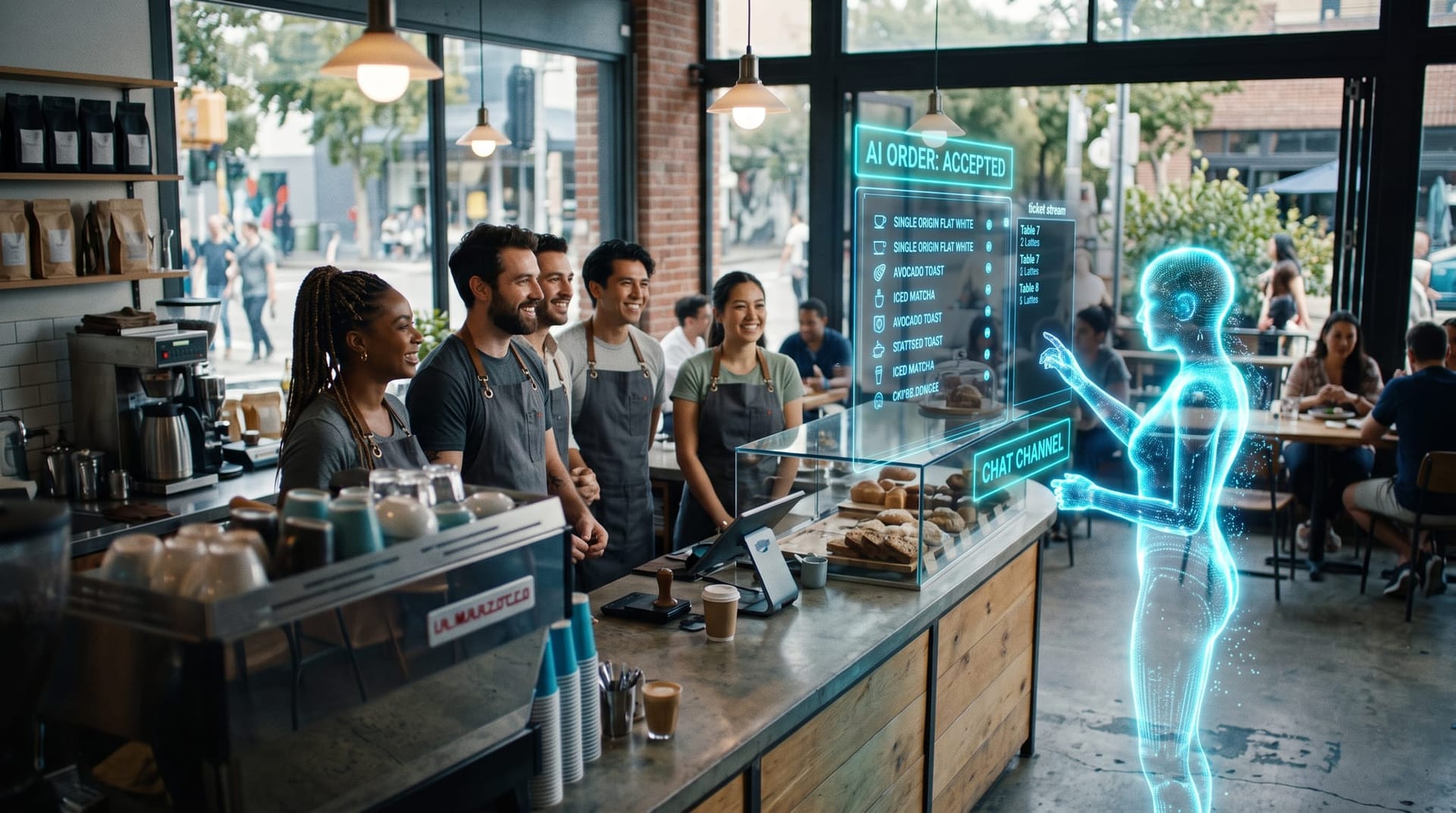
Not recommending a restaurant. Not linking to a menu. Placing the order — item, modifiers, payment, pickup time — without the customer ever leaving the chat window. Square announced that its U.S. food and beverage sellers can now accept orders placed directly inside ChatGPT and Claude, and for eligible restaurants it switched on automatically. No new hardware, no API project, no marketplace commission. If you run a restaurant, café, or food truck in Fort Wayne on Square with online ordering activated, there is a decent chance you became orderable-by-AI last week and nobody told you.
This is the moment local food businesses will look back on the way they now look back on claiming a Google Maps listing. The customers aren't browsing ten tabs anymore — increasingly, their assistant is doing the browsing, and soon the buying. The restaurants that make themselves easy for an AI to find, read, and order from will quietly absorb demand from the ones that don't.
Here's what actually launched, what it costs, and what a Fort Wayne menu needs to do about it this month.
Key Takeaways
- Square launched a ChatGPT app and Claude plugin on July 1, 2026 that let customers discover restaurants and place orders inside the chat, paid via Order by Cash App, routed straight into the restaurant's existing Square POS and kitchen display.
- Eligible U.S. food and beverage sellers with Square Online Ordering are enrolled automatically — no setup, no new APIs, and no added marketplace commission on AI-channel orders.
- Delivery marketplaces charge 15% to 30% commission per delivery order; AI-channel orders through Square carry only standard payment processing.
- Morgan Stanley estimates AI “agentic shoppers” could drive $190 billion to $385 billion in U.S. e-commerce spending by 2030 — and assistants are becoming the front door to that spending.
- Being orderable is not the same as being findable: your menu data, hours, and item descriptions are now answer-engine content, and most restaurant data isn't ready.
What Did Square Actually Launch on July 1?
Square shipped two things at once: a ChatGPT app and a Claude plugin, both aimed at what the industry calls agentic commerce — purchases initiated or completed by an AI assistant on a person's behalf. VentureBeat's coverage framed the launch around the two words restaurant operators care most about: low-fee and no-setup.
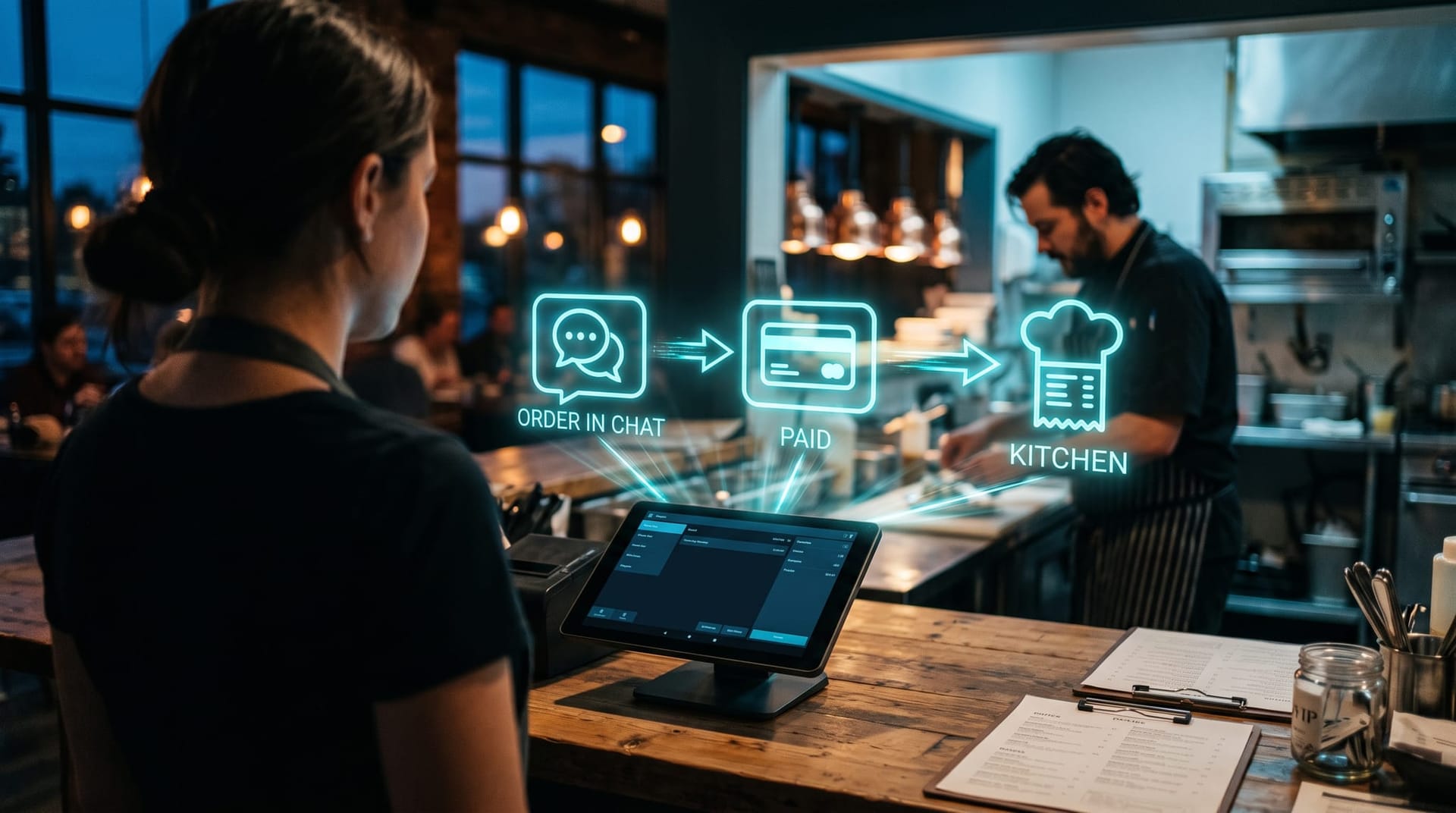
The mechanics, per Square's announcement: Square syncs a seller's business information, menus, hours, and ordering data to ChatGPT and Claude in real time. A customer prompts the assistant with something like “find me a specialty coffee shop nearby with a great pour-over and order me a bag of their house roast.” The assistant reads Square's live data, presents options, and the customer selects and pays through Order by Cash App — all inside the conversation. The order then routes into the seller's existing Square Online Ordering system, point of sale, and kitchen display, exactly like any other online order. Order sources show up in Square's reporting, so you can see which tickets came from an AI channel.
Two details matter more than the demo scenario:
Enrollment is automatic. U.S. Food & Beverage sellers with an activated Square Online Ordering profile are the first wave, and eligible sellers are opted in with no additional setup — no developer, no new tools, no integration project. Discoverability is managed from the Square Dashboard you already use.
There's no marketplace toll. Square says it charges no added commission on orders placed through the AI integrations — just its standard online processing fee. Block's global partnerships lead Morgan Kuntze pitched the launch as meeting customers where their behaviors are already moving and giving operators time back; a Square merchant, Partners Coffee's digital VP Andrew Costaris, described it as creating more of the in-person moments the shop wants to sell, not fewer.
I'd add the honest caveat Square's press release won't: this is a first release. Assistant-driven ordering will misfire sometimes — a wrong modifier, a confused pickup time — and the volume today is small. You are not turning this on because July 2026 revenue depends on it. You're turning it on because the channel compounds, and early menus get found first.
How Do AI Orders Compare to Delivery-App Economics?
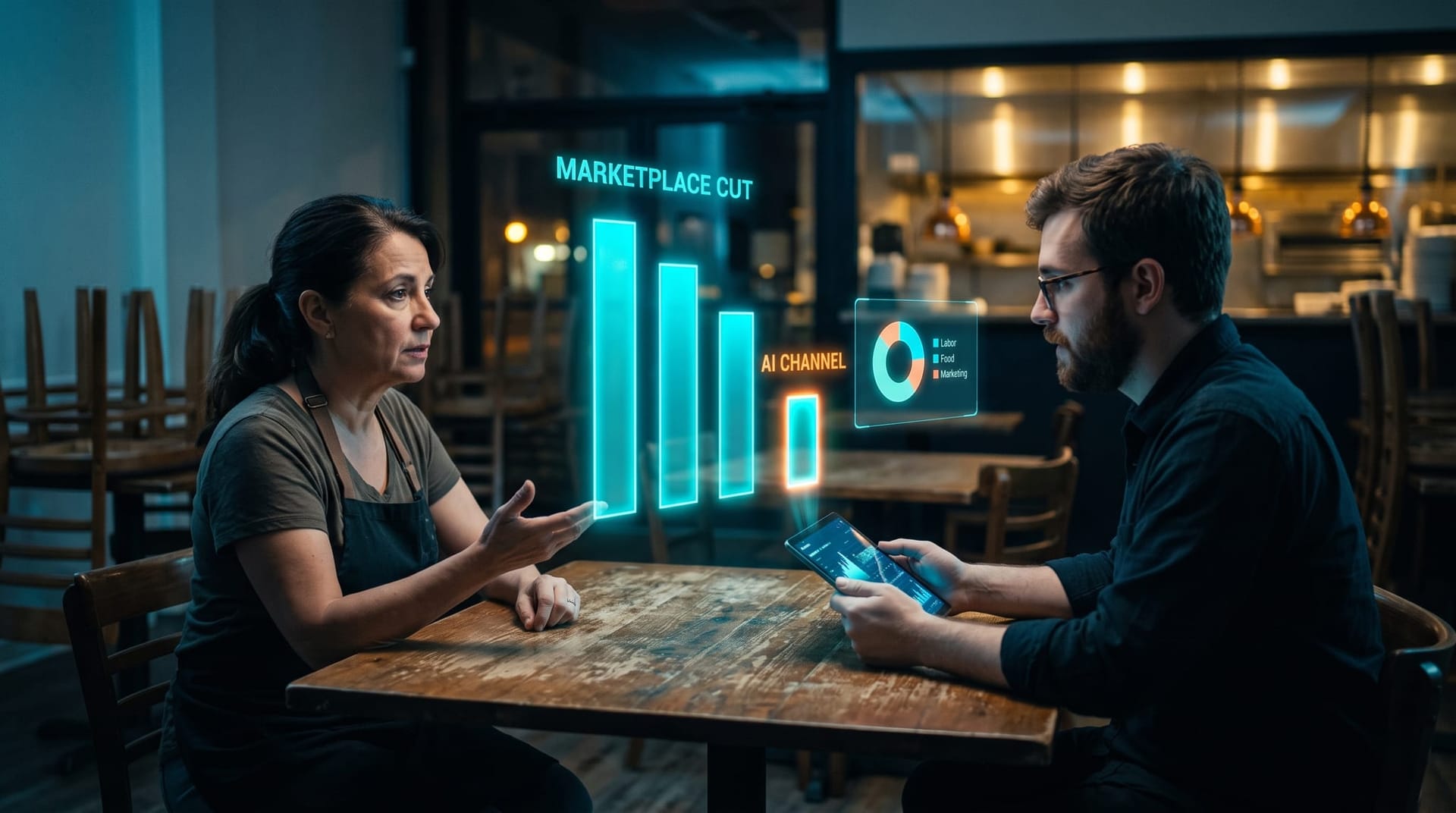
For a decade, the deal for digital demand was brutal: the marketplaces owned discovery, and they charged for it. DoorDash's own pricing page lists delivery commissions of 15% on its Basic plan, 25% on Plus, and 30% on Premier, with pickup orders at 6%. On a $40 delivery ticket, a Premier restaurant hands over $12 before food costs.
Against that, the economics of the AI channel look like a different category of thing, because they are. VentureBeat's reporting drew the comparison directly: instead of surrendering up to a 30% cut to a delivery aggregator, a restaurant discovered through an AI agent pays only Square's standard online transaction processing — typically around 2.9% plus 30 cents on a standard plan, with no monthly marketplace commission attached.
| Channel | Discovery cut / commission | Payment processing | Who owns the customer data |
|---|---|---|---|
| Delivery marketplace (delivery order) | 15%–30% depending on plan | Included in commission | The marketplace |
| Delivery marketplace (pickup order) | 6% | Included in commission | The marketplace |
| Your own website ordering | 0% | ~2.9% + 30¢ typical | You |
| ChatGPT / Claude via Square | 0% added commission | Standard Square processing | You (orders land in your Square reporting) |
The comparison isn't perfectly apples-to-apples — delivery apps bundle logistics, drivers, and a demand marketplace into that commission, and an AI assistant doesn't drive your food across town. But for pickup, catering pre-orders, coffee subscriptions, and retail items like a bag of house roast, the AI channel behaves like your own website ordering with a new front door attached: marketplace-scale discovery at owned-channel economics.
We've written before about intent contracts and the agentic commerce control layer — the payments-infrastructure standard forming underneath purchases that AI agents make with someone else's money. That post covers the plumbing and the safeguards, so I won't re-explain it here. Square's launch is what it looks like when that plumbing reaches Main Street with a product you can actually turn on.
Why Do AI Assistants Keep Becoming the Front Door to Everything?
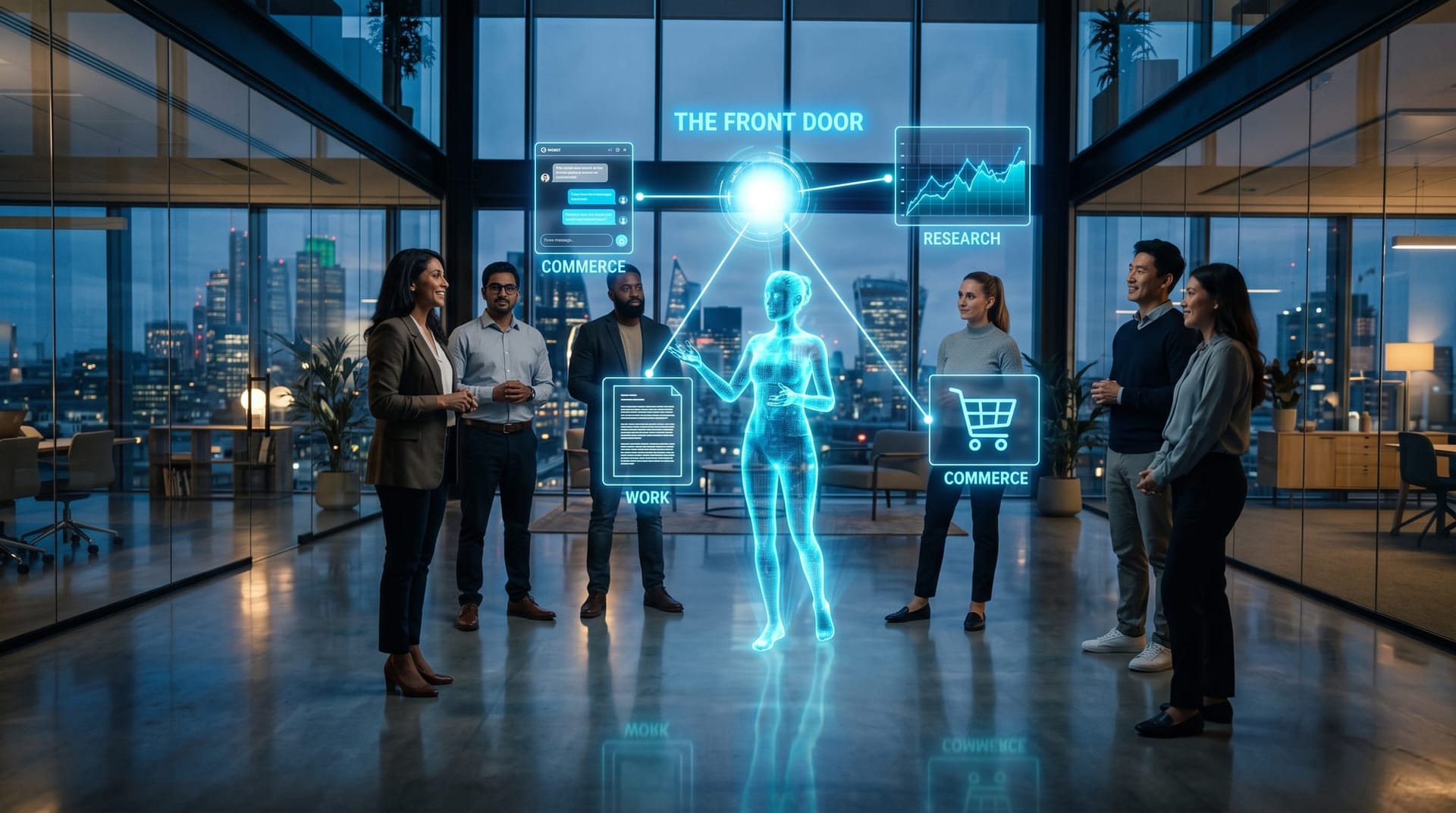
Because the platforms are racing to make them exactly that. The same week Square's integration rolled out, OpenAI launched ChatGPT Work — described across coverage as a “super app” that folds writing, coding, research, and automation into one interface, powered by its new GPT-5.6 model. MIT Technology Review's newsletter summarized the ambition as software designed to “do your work for you and with you.”
Read those two launches together and the pattern is unmistakable: the assistant is being positioned as the place where tasks start — work tasks, research tasks, and, with Square's move, purchase tasks. Commerce is following attention, the way it always has.
The forecasts put real numbers on where this goes. Morgan Stanley Research estimates that agentic shoppers — AI tools that compare, select, and buy with little or no user input — could represent $190 billion to $385 billion in U.S. e-commerce spending by 2030, or 10% to 20% of the market. The same research notes roughly 23% of Americans made a purchase using AI in the past month. Square, for its part, cites research that 42% of consumers already use AI tools for shopping tasks, and it isn't stopping at two assistants: the company says an Amazon Alexa+ integration is in development, alongside work with Google on the Universal Commerce Protocol and participation in the emerging agentic-commerce standards groups.
None of this means your dining room empties out and a robot picks up the pad thai. It means the decision — where to order, what to order, whether your restaurant even appears in the consideration set — is migrating into a conversation you can't see. Which raises the only question that matters for a restaurant: when the assistant goes looking, does it find you, and can it read you?
How Do You Make Your Menu Machine-Readable for ChatGPT Orders?
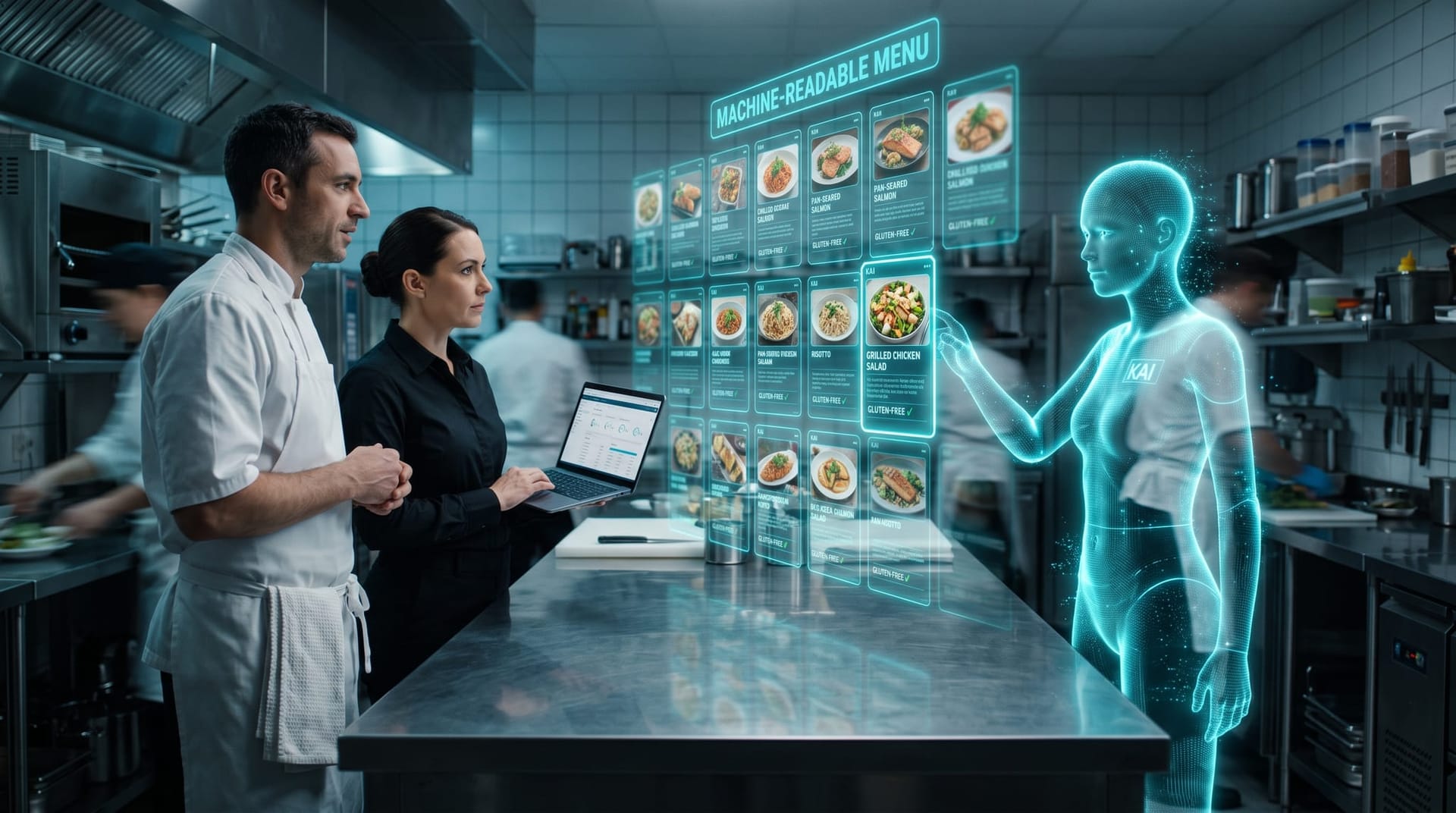
Here's where this stops being restaurant news and becomes an answer engine optimization story with a payment attached. An AI assistant can only order from data it can parse. Your menu is no longer just a design artifact for humans — it's structured data that a machine has to match against a request like “gluten-free lunch under $15 near the Landing.”
We laid out the full discipline in the AEO Dominance Playbook, and the reason it pays is documented: AI search traffic converts at 30-40%, several times the rate of traditional search referrals, because the assistant has already qualified the intent before it sends anyone your way. For a restaurant riding Square's integration, the checklist gets concrete:
- Clean up the source of truth. The assistant reads what Square syncs. If your Square item names are internal shorthand (“BLT SPEC #2”), your modifiers are stale, or your hours don't match reality, that's what the AI sees. Rewrite item names and descriptions the way a customer would ask for them — ingredients, dietary flags, portion cues.
- Describe dishes in answerable language. “Smoked brisket sandwich with house pickles, feeds one, gluten-free bun available” is machine-matchable against a dozen phrasings of a request. “The Big Tex” alone is not.
- Keep hours, location, and prep times ruthlessly current. An assistant that places an order against wrong hours creates a refund, an angry customer, and — worse — a channel you'll be tempted to turn off just as it starts compounding.
- Align the rest of your web presence. Assistants cross-reference. Your site, your Google Business Profile, and your Square data should agree with each other. This is where SEO meets answer engine optimization: the same structured, consistent, question-shaped content that wins AI citations also makes you orderable.
- Watch the channel in your reporting. Square tags order sources. Check weekly. The day AI-channel tickets stop rounding to zero is the day you shift menu-writing from a design task to a distribution task.
None of this requires a developer. It requires treating your menu data with the same seriousness you treat your food — because for a growing slice of customers, the data is the first taste.
What Should Fort Wayne Food Businesses Do This Month?
Fort Wayne's restaurant scene runs on exactly the kind of independent operators this launch favors — the coffee shops, taquerias, food trucks, and family kitchens from downtown to Dupont Road that never could justify a 30% marketplace toll but live and die on being found. Square hardware is already a familiar sight on those counters across Allen and DeKalb County. For once, the new channel doesn't ask small operators to buy anything.
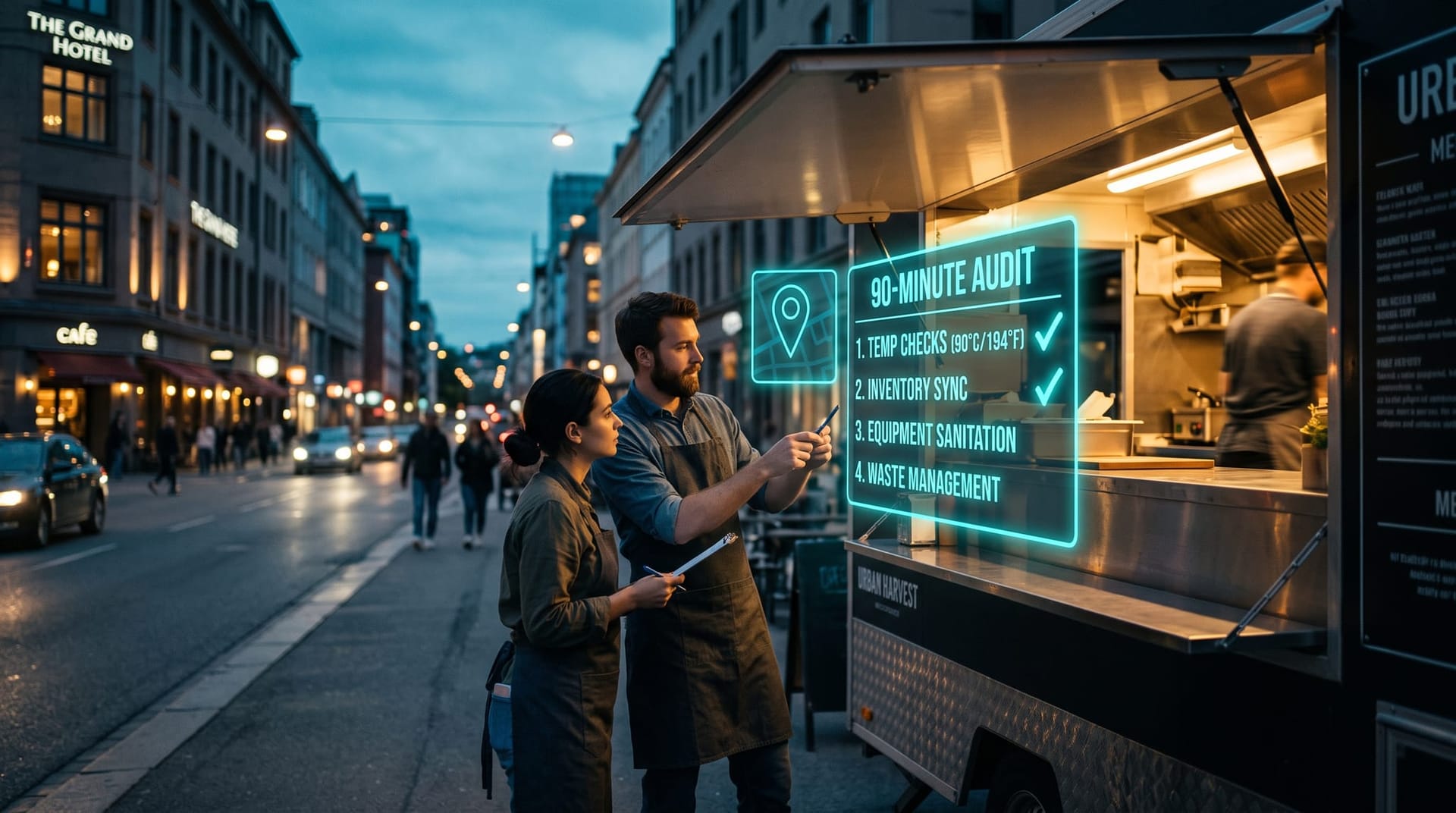
The move for a Northeast Indiana operator is a 90-minute audit, not a project:
- Confirm eligibility. If you're a Square Food & Beverage seller, check whether your Square Online Ordering profile is activated — that's the gate for the first rollout wave. If it isn't, activating it is the whole “integration.”
- Search yourself the way a customer would. Ask ChatGPT and Claude for your cuisine “in Fort Wayne” and see what comes back. If competitors surface and you don't, your data — not your food — is losing you the order.
- Fix the top ten items first. You don't need a perfect menu graph. You need your bestsellers described in plain, answerable language with accurate prices and modifiers.
- Don't use Square? Watch anyway. This launch sets the template — automatic enrollment, no commission, assistant-native ordering — and every POS vendor in the market now has to answer it. The menu-data hygiene above pays off regardless of whose logo is on your register.
And note what Square is really previewing: the same pattern is coming for every local business that takes orders or bookings. Salons, med spas, HVAC scheduling, auto service — “find me someone good nearby and book it” is one protocol away from being how appointments happen. Restaurants are just the vertical that got the product first.
Where Does an AI Employee Fit When Assistants Start Ordering?
An AI assistant placing an order solves discovery and checkout. It does not answer the phone at 11:52 AM on a Friday, handle the “can you do a catering order for 40 on Thursday” email, chase the third-party review that mentions a wrong order, or update your menu data across every surface when the seasonal menu flips. The order channel just multiplied; the operational load behind it didn't shrink.
That's the layer where an AI Employee earns its keep — we've cataloged what an AI Employee can handle, and for food service the shortlist is phones, catering intake, menu-data upkeep, review response, and answering the same forty questions about hours, parking, and allergens across chat, phone, and now assistant channels, 24/7. We covered the customer-service AI pricing window that makes this a mid-market purchase rather than an enterprise one — that window is still open, and agentic ordering just gave every local operator a reason to walk through it.
If you want a straight answer on what this would look like for your operation, talk to us. We're in Auburn; we'll tell you honestly whether you're ready for it or whether a menu-data cleanup is all you actually need this quarter.
Frequently Asked Questions
Q1.How do restaurants get orders from ChatGPT and Claude through Square?
Square syncs your business info, menu, hours, and ordering data to ChatGPT and Claude in real time. Customers discover your restaurant in conversation, place the order in the chat, and pay with Order by Cash App. The ticket routes into your existing Square Online Ordering, POS, and kitchen display like any other online order.
Q2.What does it cost a restaurant to accept AI assistant orders through Square?
Square charges no added marketplace commission on orders placed through the ChatGPT and Claude integrations. You pay only Square's standard online payment processing, which typically runs around 2.9% plus 30 cents per transaction on a standard plan. That compares with 15% to 30% delivery commissions on major delivery marketplaces.
Q3.Do Fort Wayne restaurants need a developer to turn this on?
No. Eligible U.S. Food & Beverage sellers with an activated Square Online Ordering profile are enrolled automatically — no APIs, no new tools, no technical setup. Discoverability is managed from the existing Square Dashboard. If your online ordering profile isn't activated, that's the one switch to flip.
Q4.How is AI ordering different from DoorDash or Uber Eats?
Delivery marketplaces bundle discovery, ordering, and delivery logistics, and charge a commission of 15% to 30% on delivery orders for it. The AI assistant channel handles discovery and ordering only — there's no driver network — but carries no marketplace commission, and the order lands in your own Square system with the source visible in your reporting.
Q5.How do I make my restaurant show up when someone asks ChatGPT where to eat?
Treat your menu and business data as answer-engine content. Use plain, descriptive item names with ingredients and dietary flags, keep hours and prices current in Square, and make sure your website and Google Business Profile agree with your POS data. Assistants match structured, consistent, question-shaped data — that's answer engine optimization applied to a menu.
Q6.What if my restaurant doesn't use Square?
You can't ride this specific integration, but the pattern — assistant-native ordering with automatic enrollment and no marketplace commission — is the template competitors will now copy, and Square has already said Alexa+ and Google Universal Commerce Protocol work is underway. Cleaning up your menu data and web presence now positions you for whichever ordering channel your POS vendor ships next.
Sources & Further Reading
- VentureBeat: venturebeat.com/technology/restaurants-can-now-accept-orders-placed-directly-from-chatgpt-and-claude-thanks-to-squares-new-low-fee-no-setup-integration — Restaurants can now accept orders placed directly from ChatGPT and Claude thanks to Square's new, low-fee, no setup integration (July 1, 2026).
- Square: squareup.com/us/en/press/claude-chatgpt-integrations — Square Introduces New ChatGPT and Claude Integrations, Helping Sellers Reach Customers Through AI-Powered Discovery (July 1, 2026).
- Morgan Stanley: morganstanley.com/insights/articles/agentic-commerce-market-impact-outlook — Agentic Commerce Impact Could Reach $385 Billion by 2030 (December 9, 2025).
- DoorDash: merchants.doordash.com/en-us/pricing — DoorDash Merchant Fees & Pricing, listing delivery commissions of 15% to 30% by plan.
- MIT Technology Review: technologyreview.com/2026/07/10/1140316/the-download-anthropic-claude-hidden-space-openai-super-app/ — The Download: Anthropic's hidden space inside Claude, and OpenAI's super app (July 10, 2026).
- U.S. News & World Report (Reuters): money.usnews.com/investing/news/articles/2026-07-09/openai-launches-chatgpt-work — OpenAI unveils long-awaited “super app” as rivalry with Anthropic intensifies (July 9, 2026).
Want to Know If AI Assistants Can Find Your Menu?
We will audit how your restaurant shows up in ChatGPT and Claude, review your menu data the way an AI assistant reads it, and give you a straight answer on whether an AI Employee or a simple data cleanup is the right next step.
Schedule a Free ConsultationNo contracts. No pressure. Just an honest conversation about what would help your business.