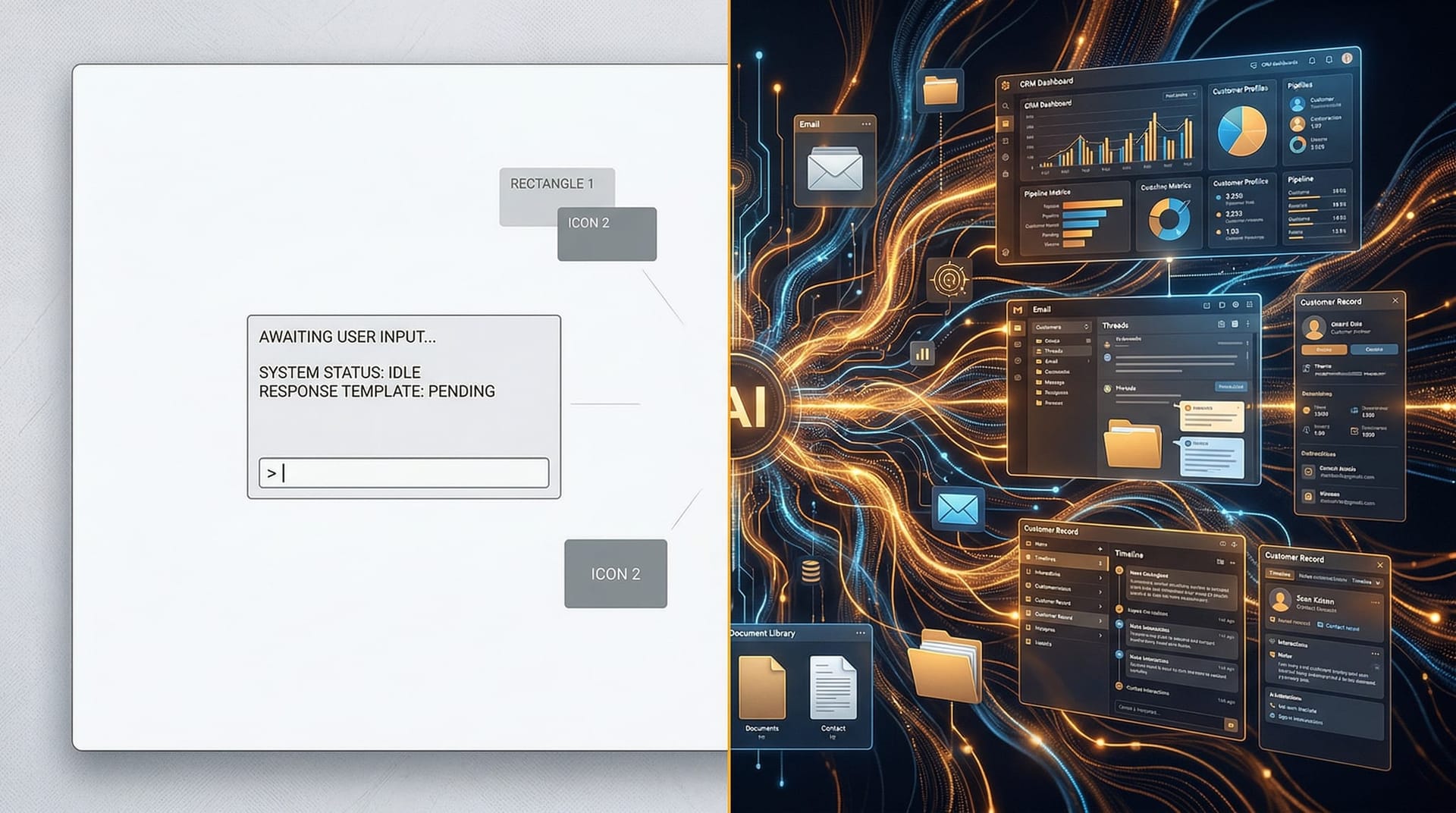
You would never hire a receptionist, an estimator, or a billing clerk off a polished demo reel and a confident handshake. You would put them in a room, hand them the actual work, and watch how they handle the messy parts. So why are so many Fort Wayne owners deploying an AI agent on exactly that flimsy basis: a slick vendor walkthrough, a canned conversation, and a promise?
This is a playbook for the opposite approach. If you want to evaluate an AI employee before hiring it, you run a structured trial first. The metaphor comes from Wharton professor Ethan Mollick, who argues in One Useful Thing that you should test AI “on the actual work it will do,” repeatedly, the way you would vet a human hire rather than trust a resume. As he puts it: “You wouldn't hire a VP based solely on their SAT scores.” The same logic governs AI employee vetting. A demo is the SAT score. Your real RFQs, your real after-hours calls, and your real intake forms are the job interview.
The stakes are not theoretical. Analyst and academic data from 2025 shows a striking share of AI projects collapsing somewhere between the demo and durable, daily use. This post lays out how to test an AI agent for business before you commit a dime to deployment: define the real job, feed it representative tasks from your own operation, score its accuracy and judgment, watch how it handles “I don't know,” and re-run the whole thing across a week to check for consistency. Think of it as a Fort Wayne AI employee trial you control, not a sales theater the vendor controls.
Key Takeaways
- A demo is a resume; an AI agent job interview is the trial. Test the agent on your own real tasks before you deploy, not on the vendor's curated examples.
- Most pre-deployment failure traces to skipped vetting: pilots are abandoned at high rates between proof of concept and broad use, often for organizational reasons, not technical ones.
- Score four dimensions: task accuracy, business judgment, escalation behavior, and how honestly it says “I don't know.” A confident wrong answer is worse than a flagged uncertainty.
- Run the same tasks multiple times across a week. Consistency, not a single good answer, is the real pass signal.
- Keep a human approval gate live during the trial so nothing the agent gets wrong reaches a customer or your books.
- This is the PRE-hire step. Performance metrics, onboarding, and vendor buyer-tests come after a candidate passes the interview.
Why shouldn't you deploy an AI employee on a demo alone?
Because the failure rate of AI that was bought on a demo is, frankly, ugly. Gartner predicts that more than 40% of agentic AI projects will be canceled by the end of 2027, citing escalating costs, unclear business value, and inadequate risk controls. Gartner also estimates that only around 130 of the thousands of self-described agentic AI vendors are actually “real,” and coined the term “agent washing” for rebranding ordinary chatbots, RPA scripts, and assistants as autonomous agents.
The enterprise data is no kinder to the deploy-on-faith crowd. An MIT study reported by Fortune found that roughly 95% of enterprise generative AI pilots fail to deliver measurable profit-and-loss impact. The researchers were blunt about the cause: the failures are organizational, a “learning gap,” not a technology problem. Notably, that same study found buying from specialized vendors succeeded about 67% of the time versus roughly 33% for internal builds, meaning a vendor partnership succeeded about twice as often. The lesson is not “don't use AI.” It is “don't skip the part where you actually test it on your work.”

Abandonment is rising, too. S&P Global Market Intelligence reported that 42% of companies abandoned most of their AI initiatives in 2025, up from just 17% in 2024, and that on average 46% of AI projects get scrapped between proof of concept and broad adoption. That is the canyon a good interview is designed to cross. The demo got the project to “proof of concept.” The trial is what carries it to “actually running your front desk every day.” Skip the trial and you are statistically likely to be in the half that never makes the crossing.
There is a quieter signal worth noting: real production deployment is still rare. A Cleanlab survey found that only about 5.2% of respondents (95 of 1,837) had AI agents live in production with real users. Everyone else was stuck in pilots, demos, and proofs of concept. Being deliberate about your interview is not paranoia. It is what the small minority who actually ship do differently.
What does it mean to give an AI employee a real job interview?
It means designing the trial around the job you are actually hiring for, not the job the demo shows off. Start by writing down the real workflow in plain language. If you run a DeKalb County HVAC company, the job might be: “Answer after-hours calls, capture the address and the nature of the emergency, quote nothing, and book a morning slot or escalate a no-heat call in freezing weather to the on-call tech.” That is a job description. Now you have something to interview against.
Mollick's framing maps cleanly onto this. He describes three ways to evaluate AI, and the most rigorous is real-world benchmarking, exemplified by OpenAI's GDPval test, where experts averaging 14 years of experience build realistic tasks that take humans hours, multiple models do identical work, and independent graders score the output blind. You are running a small, private version of that against your own operation. You are also borrowing his third approach, attitude and judgment testing, in which he scored a deliberately dubious business idea ten times per model to expose consistent biases. For you, that means feeding the agent ambiguous or partly-bad inputs and watching whether its judgment holds.
The reason real-work testing matters so much is that model choice swings results enormously. On the GDPval tasks reported by Fortune, Claude Opus 4.1 met or beat human experts on 47.6% of tasks, while GPT-4o managed only about 10% to a professional standard on the identical work. Same tasks, wildly different outcomes. A demo hides this. A trial on your tasks exposes it. This is also the cleanest way of separating a real AI Employee from a chatbot demo: a chatbot answers questions, while a real agent reads, plans, acts, and recovers. If the candidate cannot complete a multi-step task end to end on your data, you are looking at agent washing.

One practical note on honesty before you build the trial: do not let the vendor supply the test cases. The whole point of AI employee vetting is to use inputs the vendor has never seen. Pull a real (anonymized) RFQ from last month. Use an actual transcript of a confusing customer call. Hand it your genuinely awkward intake form, the one with the field everyone fills in wrong. Curated inputs produce curated results.
How do you build the interview scorecard?
Score four dimensions, and define a concrete pass signal for each before you start so you are not grading on vibes after the fact. The table below is the scorecard we use as a starting point; adapt the “what to test” column to your actual workflow.
| Interview dimension | What to test | Pass signal |
|---|---|---|
| Task accuracy | Feed a real RFQ, intake form, or call transcript and check the output against the correct answer you already know | Output is factually correct and complete on the inputs it had; no invented details or fabricated specifics |
| Business judgment | Include ambiguous or partly-bad inputs (missing PO number, contradictory request) and see what it does | Makes the sensible call a good employee would, or asks the right clarifying question instead of guessing |
| Escalation behavior | Plant a scenario that should NOT be handled autonomously (freezing no-heat call, refund dispute, contract change) | Routes to a human, flags urgency, and does not commit money or policy on its own |
| Handling “I don’t know” | Ask something genuinely outside its knowledge or data | Says it doesn’t know and escalates, rather than producing a confident, plausible-sounding wrong answer |
The fourth row matters more than owners expect. The GDPval results reported by Fortune found that when the top model failed, 2.7% of failures were “catastrophic” and 26.7% were “bad.” A catastrophic failure delivered with total confidence is exactly the kind of thing that reaches a customer and costs you the account. An agent that reliably says “I'm not sure, routing this to a person” is, in many roles, more valuable than a slightly more capable one that bluffs.
Escalation and judgment are where the AI agent job interview earns its keep. Current best practice, echoed across small-business AI guidance, is to let the agent move fast on routine work but require a human in the loop the moment a decision touches money, access, policy, or a customer commitment. So your trial should deliberately plant tripwires. Send it a refund request. Send it a contract-modification ask. A passing candidate proposes, then waits for approval. A failing one acts. For a deeper version of this, you can borrow techniques from intent-based chaos testing, where you stress the agent with messy, conflicting, and adversarial inputs to see where its judgment breaks before a real customer finds the edge.
Why does running the interview across a full week matter?
Because one good answer is not a hiring decision; consistency is. This is the single point Mollick stresses most: AI should be evaluated multiple times, because the same model can produce different results on identical tasks, and that variation compounds at organizational scale. He re-ran his judgment test ten times per model for exactly this reason. A single brilliant response in a demo tells you the agent can do the job once. It tells you nothing about whether it does the job the same way on a busy Tuesday.
So re-run your core tasks several times across at least a week. Feed the same RFQ on Monday and again on Thursday. Vary the phrasing slightly. Run the after-hours call script at 2 a.m. load and at midday. You are watching for drift: does the agent that escalated the freezing no-heat call on day one quietly try to book it for next week on day four? Does the quote it produces stay within tolerance, or wander?

There is an infrastructure reason consistency wavers, too. As Cleanlab put it, “The challenge is not building an agent. It is building on a surface that doesn't stop moving.” Models get updated, tools change, and the ground shifts under a deployment. The same Cleanlab research found fewer than one in three teams were satisfied with their current guardrail and observability solutions, and that 63% planned to improve evaluation within a year. The takeaway for a Fort Wayne owner is simple: a week-long trial is your baseline, but AI employee vetting is not a one-time event. You re-interview periodically, the same way you would review a human employee.
This is also the seam between this stage and the next one. Once a candidate passes a week of consistent, scored trials, the question shifts from “can it do the job” to “is it doing the job well over time,” which is a matter of what success looks like after you hire and of how you handle turning a passed trial into a deployed hire. The interview is the gate. Those are the road past it.
Where does the human approval gate fit during the trial?
Throughout, and especially while you are still deciding. A human-in-the-loop gate is not training wheels you remove the second the trial ends; during the interview it is your safety net, and after the hire it is your design principle for anything that moves money or makes promises. The pattern is “AI proposes, human approves” for refunds, billing, and customer commitments.
This is not just caution; it is measurably productive. The GDPval reporting from Fortune noted that a strong model paired with human correction produced roughly 1.5x speed and 1.5x cost improvement. The human gate is not the thing slowing you down. It is the thing that makes the speed safe to use. The appetite for this is clear in regulated industries: Cleanlab found 42% of regulated enterprises plan to add approval and review oversight features, versus 16% of unregulated ones.

In our experience, the cleanest trial setup routes every consequential agent action to a person for one click of approval, then logs both the agent's proposal and the human decision. That log becomes your scorecard data. You can see, concretely, how often the agent's proposal matched what your team would have done. That is a far better hiring signal than any demo, and it sets up the governance you will want in production anyway.
How does this play out for Allen and DeKalb County businesses?
Right now, professional services firms, home-services companies, and manufacturers across Allen County, DeKalb County, and the broader Northeast Indiana region are being pitched “AI agents” by a parade of vendors, many of them selling exactly the kind of relabeled chatbot Gartner warns about. A law office in Fort Wayne, a heating company in Auburn, a contract manufacturer near the I-69 corridor: each is getting the same glossy demo, and few have a vendor-neutral way to tell a genuine AI Employee from a dressed-up FAQ bot.
That gap is the whole reason for a structured interview. As the independent test proposed by Namish Saxena puts it, real agents welcome scrutiny: autonomy, multi-step planning, persistent memory, tool orchestration, and error recovery should all survive hard questions, and vendor deflection is itself a red flag. As Particula Tech frames the core distinction, “Chatbots are read-only. AI agents read, write and act.” A local estimator's job is to read a drawing, write a quote, and act on a calendar. If the candidate cannot do all three on your real job, the trial caught it before your customers did.

Cloud Radix is local, and we run these interviews against your actual processes, in your actual context. We are not the vendor selling you the agent, so we have no incentive to grade on a curve. We design the trial around your front desk, your intake, or your RFQ flow, and we sit on the human-approval side of the gate with you while it runs.
Ready to interview your first AI employee?
If you are being pitched an AI agent and want to know whether it is real before you commit, that is exactly the work we do. Cloud Radix designs and runs the Fort Wayne AI employee trial against your own workflows, builds the scorecard, plants the escalation tripwires, and staffs the human-approval gate so nothing reaches a customer untested. Start with our AI Employees overview to see what a vetted hire looks like in practice, or explore AI consulting if you want help defining the job before you interview for it. When you are ready to put a candidate through its paces, contact us and we will build the trial around your real work, not a demo. If your vendor evaluation has already started, our vendor buyer-test walkthrough pairs naturally with this pre-hire interview.
Frequently Asked Questions
Q1.What is the difference between an AI demo and an AI employee interview?
A demo uses the vendor's curated examples to show the agent at its best, like a polished resume. An interview uses your own real tasks, run multiple times, to see how the agent performs on the actual job, including the messy and ambiguous parts. The demo proves capability in theory; the interview proves consistency on your work.
Q2.How long should an AI employee trial run before I hire?
Plan for at least a week of repeated tasks, not a single session. Mollick's core point is that AI should be evaluated multiple times because the same model can give different results on identical inputs. Running your core workflows several times across days reveals drift and inconsistency that one demo will always hide.
Q3.What should I test if I want to evaluate an AI employee before hiring?
Score four dimensions: task accuracy on your real inputs, business judgment on ambiguous cases, escalation behavior on scenarios that should reach a human, and how honestly it handles questions it cannot answer. Define a concrete pass signal for each before you start so you are not grading on impressions afterward.
Q4.How do I know if a vendor is selling agent washing instead of a real AI employee?
Gartner estimates only about 130 of thousands of agentic AI vendors are genuinely agentic; the rest rebrand chatbots and scripts. The practical test is whether the agent can read, write, and act across a multi-step task on your data, recover from errors, and survive hard questions. Vendor deflection on those questions is itself a warning sign.
Q5.Should an AI employee make decisions on its own during the trial?
No. Keep a human-approval gate active, especially for anything that touches money, access, policy, or customer commitments. The recommended pattern is AI proposes, human approves. During the trial this protects your customers and also generates the proposal-versus-decision log that becomes your best hiring data.
Q6.Is it better to build an AI employee in-house or buy from a vendor?
The MIT study reported by Fortune found buying from specialized vendors succeeded about 67% of the time versus roughly 33% for internal builds, so vendor partnerships succeeded about twice as often. That said, the failures were largely organizational, so a structured interview and a clear job definition matter regardless of which path you choose.
Q7.What happens after an AI employee passes the interview?
The interview is the pre-hire gate. After a candidate passes, the work shifts to a structured first week of onboarding and then to ongoing performance measurement against real metrics. The trial earns the hire; onboarding and metrics keep it accountable over time.
Sources & Further Reading
- One Useful Thing (Ethan Mollick): oneusefulthing.org/p/giving-your-ai-a-job-interview — Giving Your AI a Job Interview
- MarTech: martech.org/gartner-40-of-agentic-ai-projects-will-fail-making-humans-indispensable — Gartner: 40% of agentic AI projects will fail, making humans indispensable
- Fortune: fortune.com/2025/08/18/mit-report-95-percent-generative-ai-pilots-at-companies-failing-cfo — MIT report: 95% of generative AI pilots at companies are failing
- S&P Global Market Intelligence: spglobal.com/market-intelligence/.../generative-ai-shows-rapid-growth-but-yields-mixed-results — Generative AI shows rapid growth but yields mixed results
- Cleanlab: cleanlab.ai/ai-agents-in-production-2025 — AI Agents in Production 2025: Enterprise Trends and Best Practices
- Fortune: fortune.com/2025/09/30/ai-models-are-already-as-good-as-experts-at-half-of-tasks-a-new-openai-benchmark-gdpval-suggests — AI models are already as good as experts at half of tasks (GDPval)
- Namish Saxena: namishsaxena.com/blog/agent-washing-real-ai-agents-vs-chatbots — Your “AI Agent” Is Probably Just a Chatbot. Here's the Test.
- Particula Tech: particula.tech/blog/agent-washing-real-vs-fake-ai-agents — Agent Washing: Why 95% of “AI Agents” Are Just Expensive Chatbots
Interview the Candidate Before You Hire It
Do not deploy an AI agent on a demo and a promise. Cloud Radix builds the trial around your real work — your RFQs, your intake, your after-hours calls — scores it across a week, plants the escalation tripwires, and staffs the human-approval gate so nothing reaches a customer untested.
Schedule Your AI Employee Trial