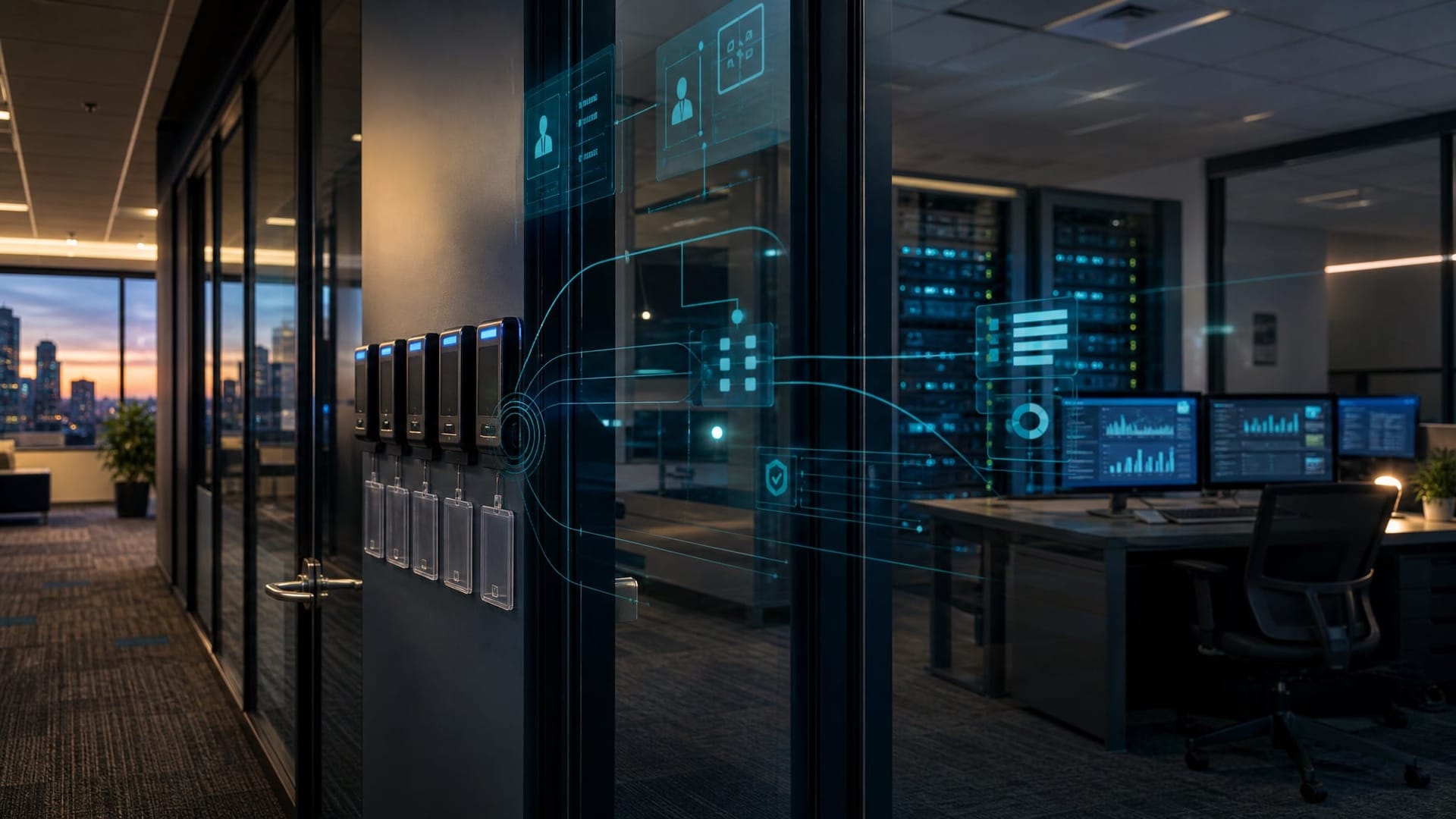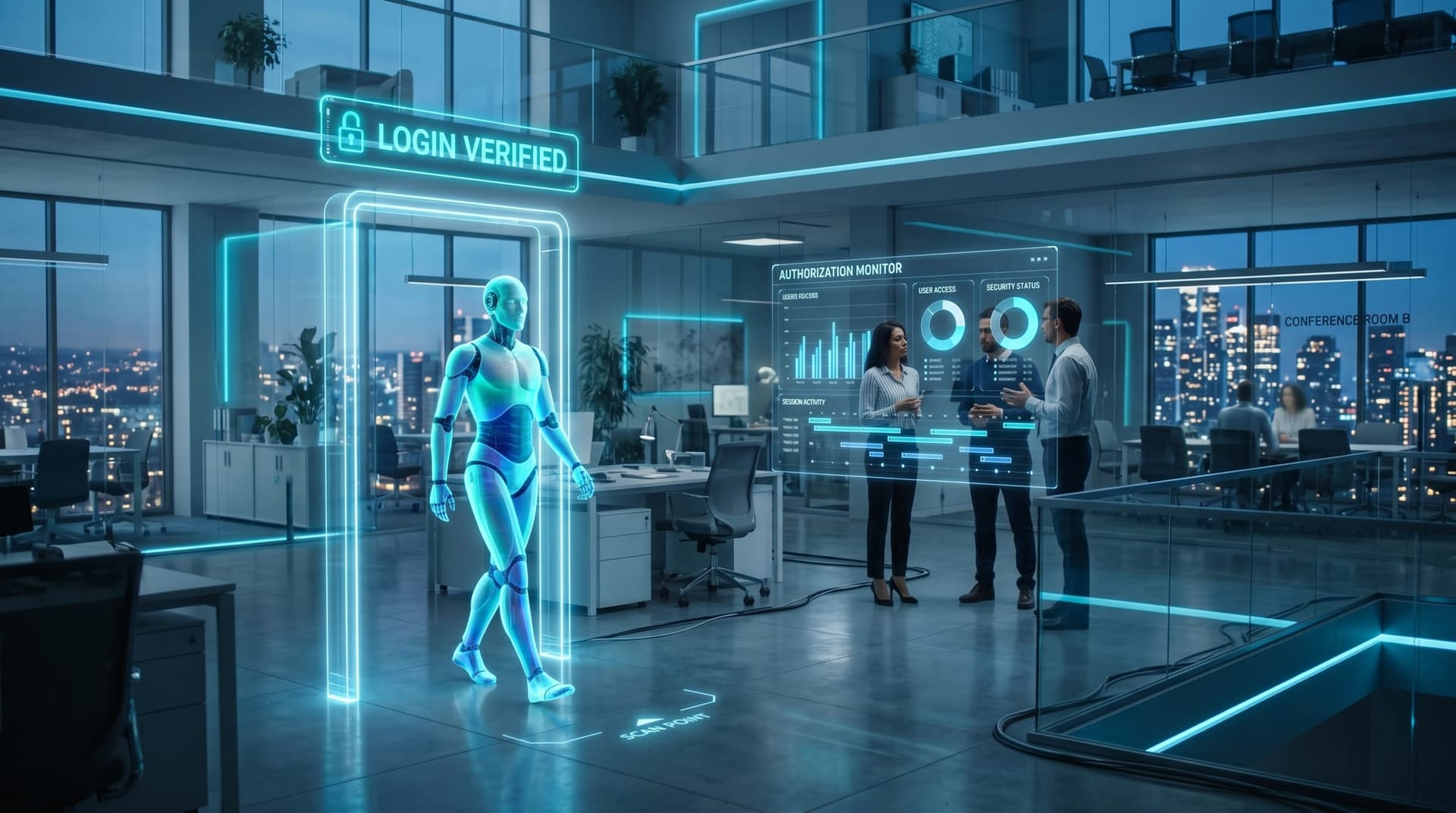
Here is an uncomfortable truth most Fort Wayne IT leaders have not internalized yet: the security control you trust most was never designed to watch the thing you should fear most. The whole conversation about MFA authentication vs authorization comes down to a single sentence from VentureBeat's reporting this spring — multi-factor authentication “proves identity at a single point in time, then it goes blind.” MFA confirms who walked through the door. It has no opinion at all about what that identity does once it is inside. For human users, that blindness has always been a manageable risk. For AI agents, it is the AI agent authorization gap that should be keeping you up at night.
The reason is structural, not theoretical. An AI Employee logs in exactly once, then operates continuously — querying records, moving data, calling other systems, sometimes triggering actions across half a dozen tools before lunch. Every one of those actions inherits a session that MFA waved through hours ago. The login was legitimate. The behavior afterward is where the real story lives, and almost nobody in Northeast Indiana is watching that part of the tape. That is the case for post-login behavior monitoring, and it is why a real secure AI gateway Fort Wayne organizations can stand up matters more than another identity provider integration. As VentureBeat frames it, authentication tells you the login was real; it tells you nothing about whether the session is still behaving.
We are not here to scare you off AI Employees. We deploy them. We think they are the obvious next step for a regional manufacturer, a multi-office law firm, a community health system, or a credit union that wants to do more without hiring its way out of every bottleneck. But the operators who win this decade will be the ones who treat agent authorization — not authentication — as the control plane. This is the playbook for AI agent identity in Northeast Indiana, written for the person who has to answer for it.
Key Takeaways
- MFA authenticates the login event and then goes blind; it has no visibility into what an authenticated AI agent does next.
- Authentication proves identity; authorization governs runtime behavior. Conflating the two is the core gap for AI Employees.
- Verified survey data shows enterprises are running agents broadly while very few have runtime visibility into agent behavior.
- A secure AI gateway is the control plane that watches post-login behavior, scopes per-agent credentials, and gates high-risk actions.
- The fix is operational, not a single product: separate auth from authorization, scope credentials, log and gate risky actions, and run a local audit.
What Is the Difference Between MFA Authentication and Authorization?
Start with the distinction the rest of this post hangs on, because the two words get used interchangeably and that sloppiness is exactly how the gap opens. Authentication answers one question: is this identity who it claims to be? MFA is the strongest answer we have to that question — a password plus a token plus, ideally, a device check. Authorization answers a completely different question: given that we know who this is, what is this identity allowed to do, and is what it is actually doing appropriate right now?
Zenity Labs puts the sharpest point on it: “Authorization tells you what an agent was permitted to do. It says nothing about whether what it actually did was appropriate.” That is the whole problem in one line. You can have flawless authentication, a clean permission grant, and a green compliance dashboard — and still have an agent quietly doing something nobody intended. Zenity's example is two CRM sessions that look identical in IAM logs: one is legitimate work, one is data exfiltration triggered by a prompt injection. Identity controls cannot tell them apart. Only behavioral context can.

The Cloud Security Alliance, in a piece authored by an Okta engineer, names the downstream consequence the “attribution gap” — “the distance between what an agent did and your ability to prove who authorized it and what it was permitted to do.” Notice that authentication does not help you here at all. Knowing the login was real does not let you reconstruct, after the fact, whether the eleventh action in a session was something you would have approved. We have written separately about the IAM gap that opens when agents get human-style permission models, and we will not re-litigate that mechanics here. The point for this post is narrower and, frankly, more uncomfortable: MFA is an authentication control, full stop. Treating it as if it governs behavior is the category error at the root of the AI agent authorization gap.
| Dimension | Authentication (what MFA does) | Authorization (what governs agents) |
|---|---|---|
| Core question | Is this identity who it claims to be? | What is this identity allowed to do, and is it behaving appropriately? |
| When it acts | Once, at the login event | Continuously, on every action after login |
| What it proves | The session started legitimately | Each action stays within intended scope and purpose |
| Visibility into behavior | None after the door closes | The whole point — runtime behavior is the signal |
| Failure mode for AI agents | A valid session does undesired things unwatched | Over-scoped or misused permissions go undetected |
| Control that addresses it | MFA, identity providers | Secure AI gateway, approval gates, behavior monitoring |
Read that “When it acts” row twice. MFA fires once. An AI Employee acts thousands of times per day on the strength of that single check. The asymmetry is the gap.
Why Does MFA Go Blind After an AI Agent Logs In?
MFA was built for a human rhythm: a person logs in, works for a while, logs out. The login is the riskiest moment, so we hardened it. That logic held up reasonably well when the actor was a person whose behavior was bounded by, well, being a person — one set of hands, one screen, human-speed clicks.
AI agents break every assumption baked into that model. They do not log out at 5 p.m. They operate continuously, often holding a long-lived session or a service credential that authenticated once and stays warm. The Hacker News describes the resulting risk plainly: agents get deployed with permissions “covering more systems, actions, and data than any single user would typically require,” and “a user with limited access can indirectly trigger actions or retrieve data they would not be authorized to access directly, simply by going through the agent.” The login was clean. The blast radius afterward is enormous. This is the over-authorized confused-deputy agents problem in its native habitat.

It gets worse from an investigation standpoint. The Hacker News notes that when an agent acts, execution is attributed to the agent identity, so “the user context is lost, eliminating reliable detection and attribution.” So even when something goes wrong, the trail leads to the agent, not the human or upstream trigger behind it. And the scale is not hypothetical. Palo Alto Networks reports that organizations now manage an average of 109 machine identities for every human identity, with AI agents forecast to grow 85 percent over the following twelve months — the fastest-growing identity category by a wide margin. CyberArk puts the broader machine-to-human ratio at 82 to 1 and finds that 42 percent of machine identities carry privileged or sensitive access.
Now layer the authentication blindness on top of that population. You have a vast and rapidly growing fleet of non-human identities, many of them privileged, all of them waved through by an MFA check that then stops watching. This is distinct from the MFA token-theft defense problem, where an attacker steals a valid token — there, the threat is a stolen credential. Here, the threat is a perfectly legitimate credential doing things nobody is monitoring. Same blindness, different cause. Both demand that you watch behavior, not just logins.
How Big Is the AI Agent Authorization Gap in Practice?
The honest answer is that most organizations cannot even measure it, which is itself the finding. The verified survey data from 2026 paints a consistent picture: broad adoption, almost no runtime control.
Start with access. The Saviynt 2026 CISO AI Risk Report — a survey of 235 senior security leaders — found that 71 percent say AI already has access to core business systems like Salesforce and SAP, but only 16 percent govern that access effectively. The same report found that 92 percent of organizations lack full visibility into AI identities, 86 percent do not enforce access policies for AI identities, and just 5 percent feel confident they could contain a compromised AI agent. Sit with that last number. Nineteen out of twenty security leaders surveyed do not believe they could stop one of their own agents if it went sideways.

The behavioral-visibility gap shows up just as starkly in VentureBeat's three-wave enterprise survey, reported via OODAloop: 88 percent of enterprises reported an AI agent security incident in the prior twelve months, yet only 21 percent have runtime visibility into what their agents are actually doing. Meanwhile 82 percent of executives say their policies protect them from unauthorized agent actions — a confidence-versus-reality split the reporting calls the enforcement gap. The same survey found 97 percent of leaders expect a material agent-driven incident within twelve months while only 6 percent of security budgets address it.
The corroboration runs deep. CyberArk found that 68 percent of organizations lack identity security controls for AI and 47 percent cannot secure shadow AI usage. Saviynt separately found 75 percent had already discovered unsanctioned AI tools running in production. Read together, these are not five different problems. They are one problem — behavior after login is unmonitored and ungoverned — measured by five different instruments. The numbers describe the AI agent authorization gap as a present-tense operating condition, not a future risk.
What Does a Secure AI Gateway Actually Do After Login?
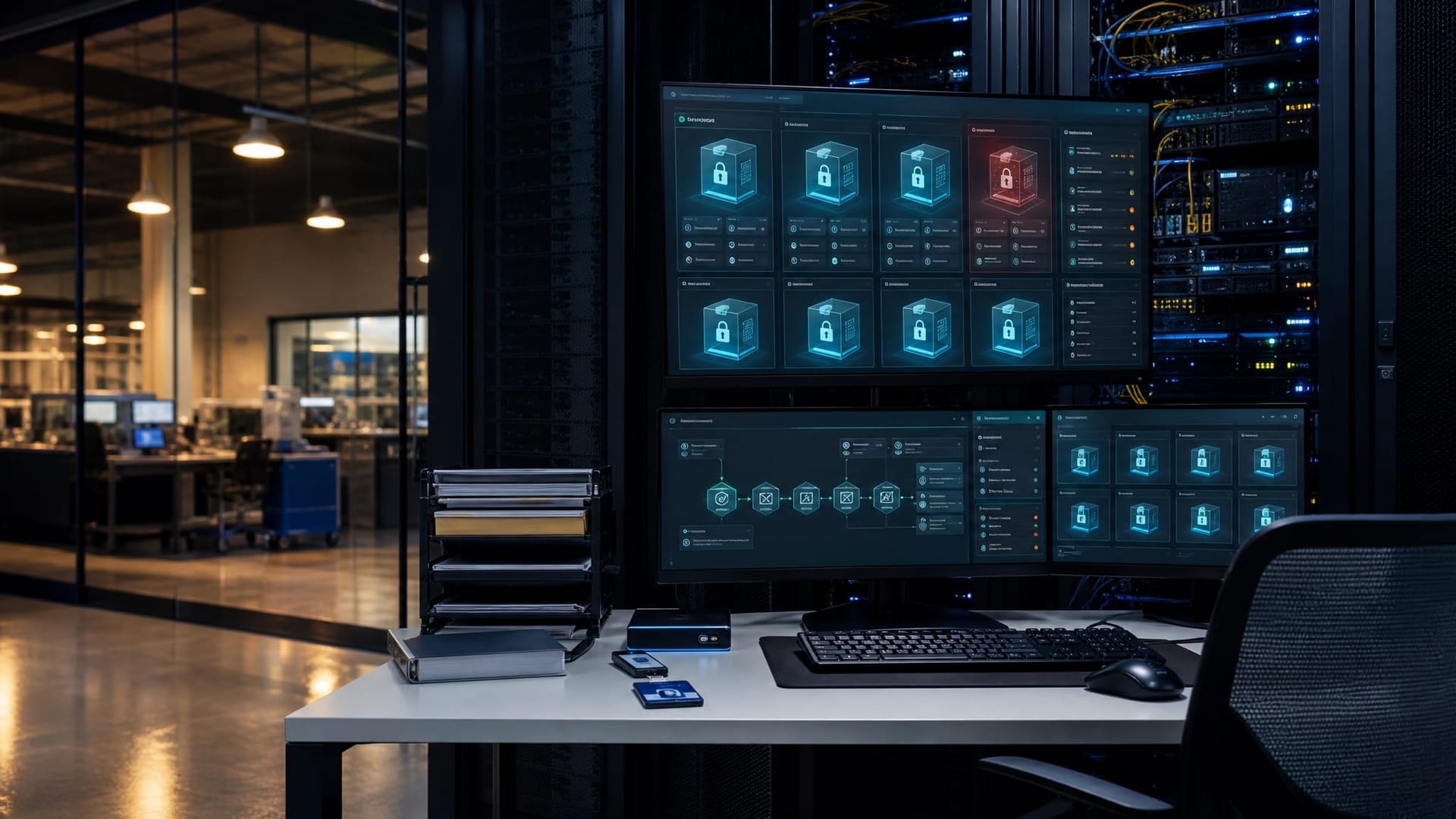
This is where the conversation gets constructive, because the gap has a control plane that closes it. A secure AI gateway is not another login wall. It is the layer that sits between your AI Employees and the systems they touch, and it does the job MFA structurally cannot: it watches and governs what happens after authentication. Think of MFA as the badge reader at the front door and the gateway as the floor supervisor who actually sees what each worker does all day.
A gateway built for this gives you four things MFA never could. First, per-agent identity — every AI Employee gets its own scoped identity rather than borrowing a shared service account or a human's session, so actions are attributable. This is closely related to but distinct from credential isolation, which we have covered in depth elsewhere; identity is about who the agent is, isolation is about keeping its secrets contained. Second, scoped, least-privilege credentials so an agent built to draft intake summaries cannot reach into payroll. This matters because more than half of organizations in Palo Alto Networks' research cannot consistently enforce least-privilege access for service accounts across cloud, SaaS, and on-prem.

Third, approval gates on high-risk actions — the gateway can pause a sensitive operation for human sign-off before it executes. The Cloud Security Alliance argues that genuine human oversight requires three capabilities: “pause before issuance, revoke in flight, and refuse a revoked credential at the enforcement point.” A gateway is where those three live. Fourth, continuous authorization monitoring — logging every action with full context so a deviation from normal behavior surfaces while it is happening, not in a post-incident forensic review. Recall that Palo Alto Networks found investigators needed evidence from two or more distinct sources in 87 percent of identity incidents; a gateway consolidates that evidence into one authoritative log.
In our experience deploying AI Employees for regional clients, the gateway is the difference between an agent you hope behaves and an agent whose every action you can see, scope, and stop. We recommend treating it as foundational infrastructure, installed before the first agent touches a production system — not bolted on after an incident forces the question.
Why Does This Matter Specifically for Northeast Indiana Organizations?
Fort Wayne, Auburn, and the broader Allen County and DeKalb County economy run on exactly the regulated, data-heavy industries where the authorization gap bites hardest: community healthcare and dental networks, multi-office law firms, manufacturers with valuable process IP, and the credit unions and community banks that anchor Northeast Indiana's financial sector. These are organizations with real obligations around sensitive data and meaningful exposure if an AI Employee touches the wrong record.

The regulatory clock is already ticking. The Cloud Security Alliance notes the Colorado AI Act takes effect June 30, 2026, EU AI Act high-risk requirements land December 2, 2027, and penalties scale to as much as 35 million euros or 7 percent of global turnover for prohibited uses. Even a DeKalb County manufacturer that does not sell into Europe should read that as the direction of travel — regulators everywhere are converging on the same demand: prove who authorized what an agent did. The CSA piece points to four 2025 vulnerabilities rated CVSS 9.3 to 9.4 across major platforms that all followed the same pattern: agents retrieving data the requesting user lacked permission to access.
Picture a Fort Wayne dental front desk running an AI Employee for scheduling and insurance pre-checks. Authenticated cleanly, it nonetheless has a session that could, if over-scoped, reach patient records it never needed. MFA would not see it. A gateway with scoped credentials and behavior monitoring would. That is the local stakes, and it is why we recommend every regional organization running agents run a structured authorization audit before scaling further.
Frequently Asked Questions
Q1.Is MFA still worth using if it cannot watch AI agent behavior?
Absolutely. MFA remains the strongest control for the question it was built to answer — proving an identity at login. The point is not to abandon MFA but to recognize its boundary: it secures authentication, not authorization. You need MFA at the door and a secure AI gateway watching behavior after the door closes.
Q2.What is the difference between authentication and authorization for AI agents?
Authentication confirms an agent's identity is genuine, typically once at login. Authorization governs what that agent is allowed to do and whether its actual behavior stays appropriate across an entire session. For AI agents that act continuously after a single login, authorization is the control that actually matters at runtime.
Q3.What does a secure AI gateway do that MFA does not?
A secure AI gateway operates after authentication. It assigns each agent a scoped per-agent identity, enforces least-privilege credentials, gates high-risk actions for human approval, and continuously monitors authorization so deviations surface in real time. MFA does none of these things because it stops watching once the login succeeds.
Q4.How common are AI agent security incidents?
Verified 2026 survey data reported by VentureBeat found that 88 percent of enterprises experienced an AI agent security incident in the prior twelve months, while only 21 percent had runtime visibility into agent behavior. Saviynt separately found just 5 percent of security leaders felt confident they could contain a compromised agent.
Q5.We are a small Fort Wayne business. Is this gap relevant to us?
Yes, often more so. Smaller organizations frequently grant AI tools broad access to move fast and lack a dedicated security team to monitor behavior. Saviynt found 71 percent of organizations give AI access to core systems while only 16 percent govern it effectively — a gap that is usually wider, not narrower, in lean operations.
Q6.How do we start closing the authorization gap?
Begin by separating authentication from runtime authorization in how you think about controls, then scope every agent's credentials to least privilege, log and gate high-risk actions, and run a structured authorization audit of what your agents can actually reach. A secure AI gateway operationalizes all four steps in one control plane.
Q7.Does this replace our existing IAM or identity provider?
No. A secure AI gateway complements your identity provider rather than replacing it. Your IAM still handles authentication and human identity; the gateway adds the runtime authorization layer for AI agents that traditional IAM was never designed to govern.
Sources & Further Reading
- VentureBeat: venturebeat.com/security/mfa-verifies-who-logged-in-it-has-no-idea-what-they-do-next — MFA verifies who logged in. It has no idea what they do next.
- Zenity Labs: zenity.io/blog/security/authorization-trap-ai-agent-behavior — The Authorization Trap: Why Your IAM Controls Don't Cover AI Agent Risk
- Cloud Security Alliance: cloudsecurityalliance.org/blog/2026/05/26/the-attribution-gap — The Attribution Gap: Why Every AI Regulation Leads Back to Identity and Authorization
- Saviynt / Cybersecurity Insiders: cybersecurity-insiders.com/2026-ciso-ai-risk-report — 2026 CISO AI Risk Report
- Palo Alto Networks / Help Net Security: helpnetsecurity.com/2026/05/14/2026-identity-security-landscape-report — 2026 Identity Security Landscape Report
- CyberArk: cyberark.com/press/machine-identities-outnumber-humans-by-more-than-80-to-1 — Machine Identities Outnumber Humans by More Than 80 to 1
- The Hacker News: thehackernews.com/2026/01/ai-agents-are-becoming-privilege.html — AI Agents Are Becoming Authorization Bypass Paths
- VentureBeat (via OODAloop): oodaloop.com/briefs/technology/most-enterprises-cant-stop-stage-three-ai-agent-threats — Most enterprises can't stop stage-three AI agent threats
Ready to Close Your Authorization Gap?
If you operate in Fort Wayne, Auburn, or anywhere across Northeast Indiana and you are running — or about to run — AI Employees, stop relying on the login to protect the runtime. Cloud Radix builds and operates a secure AI gateway that gives every agent a scoped identity, gates high-risk actions for human approval, and monitors authorization continuously after login. If you want help mapping where agents fit, our AI consulting practice starts with your real systems and obligations.
Scope a Local Authorization ReviewThe organizations that win this decade are the ones watching what happens after the door closes.