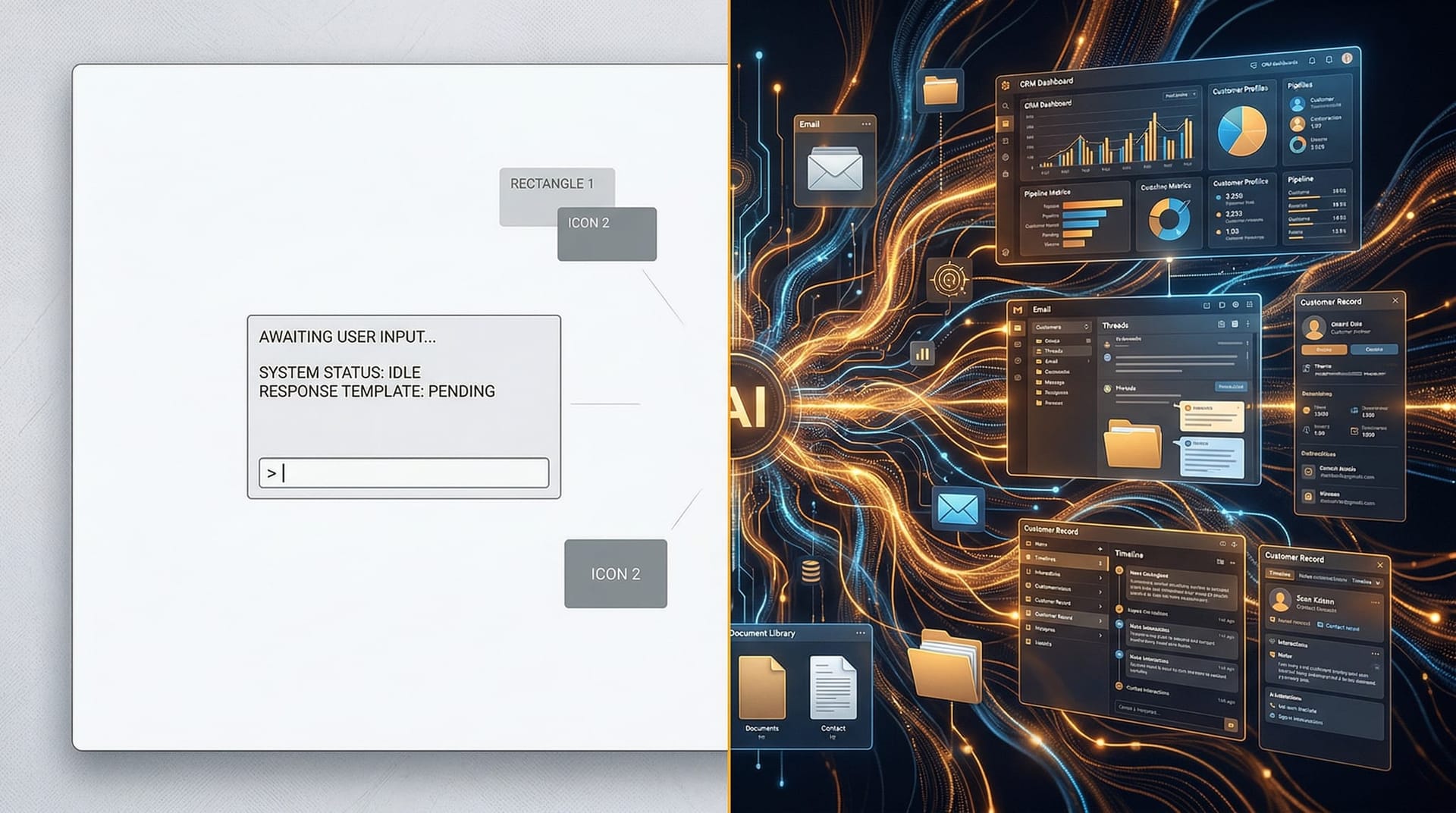
The largest AI company on earth just told the whole market what a real AI Employee looks like — and it isn't a chatbot bolted onto a help page.
On July 22, 2026, OpenAI launched Presence, a platform for building, deploying, governing, and continuously improving AI agents that handle customer support and internal service work across both voice and chat. Per OpenAI's own announcement, Presence already runs the company's English-language phone support line and resolves roughly 75% of inbound calls without a human. It targets high-value functions in customer support, sales development, procurement, IT, and HR.
Here's the part Northeast Indiana business owners should sit up for. Presence isn't a model you rent by the token. It's a governed system — policies, guardrails, approved actions, human escalation, simulations, evaluations, and a self-improvement loop. That's exactly the architecture we've been arguing an AI Employee needs for over a year. OpenAI just validated the category. Then it priced the delivery for the Fortune 500.
Key Takeaways
- OpenAI Presence is a governed AI Employee platform — not a raw model — with policies, guardrails, approved actions, and human-in-the-loop escalation built in.
- OpenAI reports Presence resolves about 75% of inbound calls on its own support line without a human, and cut handoffs 15% in ten days via automated improvements.
- Presence is not self-service. It ships through OpenAI's Forward Deployed Engineers and global systems integrators — a consulting-delivered, enterprise-only model.
- The governance architecture, not the model, is the real product. That's the same “control plane over commodity model” thesis mid-market buyers should be testing.
- A Northeast Indiana business can get the same governed capability by owning an AI Employee behind a Secure AI Gateway — no six-figure engagement, no vendor lock-in.
- The skeptics have a point: Gartner expects many companies to abandon plans to replace customer-service staff with AI by 2027. Governance and human oversight are what separate the deployments that last.
We're not here to dunk on OpenAI. Presence is genuinely good, and we'll say so plainly. The point of this post is different: the governed AI Employee is now the proven enterprise standard, and the path for a Fort Wayne clinic, an Auburn manufacturer, or a DeKalb County home-services company is to own that capability — not to rent a consulting deployment they'll never be big enough to buy.

What Is OpenAI Presence, and Why Does It Matter?
Presence is a deployment platform, not a standalone model. That distinction is the whole story. Anyone can now access frontier models; what enterprises have struggled with is safely putting those models to work against real systems, real customers, and real money.
According to Help Net Security's reporting, Presence brings together “policies and standard operating procedures, guardrails, approved actions, simulations, evaluation tools, and a Codex-powered improvement process.” In plain terms, it lets a company define exactly what knowledge an agent can access, which internal systems it may touch, what actions it's allowed to take, and when a conversation must be handed to a person. VentureBeat framed the launch as a platform to launch and manage realtime voice agents and chatbots — but the management layer is the meaningful half.
OpenAI has been dogfooding the product on its own support line. It reports resolving about 75% of inbound issues without human help, and — per CX Today's coverage — a 15% reduction in handoffs over ten days as the Codex-powered loop refined agent behavior. Those are the numbers that make a CFO lean forward.
Why does this matter for a business nowhere near the Fortune 500? Because it settles an argument. For eighteen months, the debate was whether a self-directed agent could be trusted with a customer relationship at all. OpenAI's answer is: yes — if you wrap it in a control layer. That's the same conclusion we reached building AI Employees for Northeast Indiana companies, and it's why we've always insisted the governance wrapper is not optional.

What Does a “Governed AI Employee” Actually Mean?
Strip away the branding and Presence describes a control architecture with five parts. It's worth walking through them, because these are the parts a generic chatbot doesn't have — and the parts you should demand from any AI Employee, whoever builds it.
| Control layer | What it does | Why it matters for you |
|---|---|---|
| Policies & SOPs | Encode how the agent should behave and what “good” looks like | The agent follows your rules, not a generic model's defaults |
| Guardrails | Intervene when an interaction moves outside defined boundaries | Stops the agent before it does something off-policy |
| Approved actions | Whitelist of what the agent may actually do in your systems | It can act — but only within a bounded, auditable set |
| Human escalation | Rules for when to hand a conversation to a person | The hard, sensitive, or high-risk cases reach a human |
| Evaluation & improvement | Simulate scenarios, monitor production, refine over time | Behavior gets measured and improved, not left to drift |
Notice what “approved actions” means in practice. Per The Register's write-up, Presence agents can verify a caller's identity, pull relevant account context, and take bounded actions — resolving billing issues, making account changes, and processing eligible refunds — while escalating anything outside their scope. That's an agent with hands, not just a mouth. And the reason that's safe is the whitelist around those hands.
This is precisely the point we made when we argued the agent control plane is the real buying decision: models are commoditizing, but the layer where policy lives, where the audit trail is generated, and where escalation is decided is not. The Register put it with characteristic bite — as models get commoditized, “maybe there's margin in the plumbing.” Presence is the plumbing, productized. It also confirms the warning we raised in your AI tools are already ahead of your AI policies: the governance layer is where most organizations are dangerously behind, and buying a tool without it just widens the gap.

Why Can't a Fort Wayne Business Just Buy Presence?
Here's where the celebration meets the fine print. Presence is not a self-service product. You cannot sign up, drop in a credit card, and deploy one this afternoon.
Per The Register, deployments are “led by OpenAI Forward Deployed Engineers and select global systems integrators.” Forward Deployed Engineers are exactly what they sound like — technical staff who parachute into a client organization and live inside its legacy systems, compliance constraints, and permissions tangle until the agent is running. It's a consulting model, delivered at consulting rates. OpenAI itself hasn't published pricing; a company representative told reporters that during this limited general-availability phase, “deployments are scoped individually based on each customer's use case and implementation needs,” with broader pricing “to come as availability expands.”
Translation for a mid-market operator: this is boots-on-the-ground enterprise consulting, sold through account teams, scoped per engagement. That's a fit for a bank, a national retailer, or a healthcare system with a seven-figure transformation budget. For a 40-person professional-services firm in Allen County or a family-owned manufacturer in DeKalb County, that door is effectively closed — not because the technology wouldn't help you, but because the delivery model isn't built for your scale.
This is a different animal from OpenAI's other 2026 agent products. When we broke down whether to rent an AI teammate or hire one you own, we were talking about an individual, internal task assistant. Presence is the opposite end of the spectrum: a customer-facing, consulting-deployed, governed platform. Same company, wildly different accessibility. The capability is now proven at both ends — and for the mid-market, the question isn't whether to get a governed AI Employee. It's how to get one without the enterprise price tag.

Own vs. Rent: How Mid-Market Gets Governance Parity
The good news buried in this launch is that OpenAI just wrote your requirements document for free. Every control layer Presence ships — policies, guardrails, approved actions, escalation, evaluation — is buildable today, on top of the same class of frontier models, without a Forward Deployed Engineer living in your server room.
The difference is ownership. A consulting-delivered deployment is something you rent access to and pay to have maintained. An owned AI Employee is an asset you control — one that runs your policies, touches only the systems you approve, and sits behind a governance gateway you can audit yourself. That's the model we've built around a Secure AI Gateway: the agent gets hands, but every action passes through a control layer that enforces approved-actions rules, isolates credentials, keeps an audit trail, and routes the hard cases to a human.
| Consulting-deployed (e.g. Presence) | Owned AI Employee behind a Secure AI Gateway | |
|---|---|---|
| Delivery | Enterprise account team + Forward Deployed Engineers | Built for you, then you own it |
| Access | Not self-service; enterprise-only | Available to mid-market and small business |
| Governance | Built in, controlled by the vendor's platform | Built in, controlled by you |
| Cost shape | Individually scoped consulting engagement | Fixed, mid-market-scaled |
| Lock-in | Tied to one vendor's platform and roadmap | Model-flexible; you keep the asset |
| Best fit | Fortune 500 with a transformation budget | Fort Wayne & Northeast Indiana businesses |
None of this means “roll your own with a weekend prompt.” The reason generic AI tools fail where custom AI Employees succeed is that the governance wrapper — the exact thing Presence just made table stakes — takes real engineering. The choice for a mid-market business isn't “cheap chatbot vs. expensive Presence.” It's “own a governed AI Employee sized for you” vs. “rent a deployment you're not big enough to buy.” OpenAI just proved the first option is the right target.

What the Skeptics Get Right
Confidence isn't the same as hype, so let's be honest about the trade-offs. A governed AI Employee is powerful, but it is not magic, and the failure modes are real.
Gartner has predicted that by 2027, half of the organizations that expected to significantly cut their customer-service workforce because of AI will abandon those plans — a sign the human touch remains irreplaceable in many interactions. Even OpenAI's own line resolves about three-quarters of contacts autonomously — which means roughly a quarter still need a person. The 75% number is impressive precisely because it's honest about the remaining 25%.
The lesson isn't “don't deploy.” It's “deploy with the guardrails on.” As Cyara CEO Sushil Kumar argues, human oversight “should function as a checkpoint rather than the entire CX assurance system,” and effective AI governance “has to move at machine-speed, with automated validation, guardrails, and real-time testing.” That's the whole argument for a control plane in one sentence. An AI Employee without policies, approved-actions limits, escalation rules, and continuous evaluation isn't an efficiency — it's a liability with a friendly voice.
Our recommendation, in our experience deploying these for local businesses: start with a bounded, high-volume, low-risk workflow; instrument it heavily; keep a human in the loop for anything sensitive; and expand only as the evaluations earn your trust. That's how you capture the 75% without getting burned by the 25%.
What This Means for Northeast Indiana
Fort Wayne, Auburn, and the surrounding DeKalb and Allen County business community don't compete on who has the biggest AI consulting budget — because on that field, nobody local wins. You compete on speed, service, and knowing your customers. A governed AI Employee is how a Northeast Indiana business punches above its weight: it answers the phone at 2 a.m., handles the routine billing and scheduling questions, qualifies leads, and escalates the calls that need a human — all under policies you set and can audit.
What OpenAI's launch confirms is that this model is no longer speculative. The biggest player in the industry just staked its own customer support on it. The real question for a local operator is delivery: a seven-figure enterprise engagement, or an owned AI Employee sized for a Midwest business. We built AI Employees for Fort Wayne businesses around that second answer — the same governed architecture, the same approved-actions discipline, the same Secure AI Gateway, without the Fortune 500 invoice.
Get a Governed AI Employee Sized for Your Business
OpenAI just spent its launch validating the exact category we build in. The governance layer, the approved actions, the human-in-the-loop escalation — that's not a preview of the future for us; it's what we've been deploying for Northeast Indiana businesses. The difference is that you own it, it's scaled for the mid-market, and you're not locked to a single vendor's roadmap.
If you've watched the enterprise AI headlines and assumed this level of capability was out of reach, it isn't. Explore our AI Employees service, or see how the Secure AI Gateway enforces the same guardrails OpenAI just made the enterprise standard. Then let's talk about which workflow to hand your first AI Employee.
Frequently Asked Questions
Q1.What is OpenAI Presence?
OpenAI Presence is a platform, launched July 22, 2026, for deploying and governing AI agents that handle customer support and internal service requests across voice and chat. It bundles policies, guardrails, approved actions, human escalation, simulations, evaluations, and a Codex-powered improvement loop. It is a deployment platform rather than a standalone model, and OpenAI already uses it to run its own English-language phone support line.
Q2.Can a small or mid-market business buy OpenAI Presence?
Not directly. Presence is not a self-service product — deployments are led by OpenAI's Forward Deployed Engineers and select global systems integrators through enterprise account teams, and pricing is scoped individually per engagement. That consulting-delivered model is built for large enterprises, which is why most mid-market businesses will find an owned AI Employee a better-fitting path to the same governed capability.
Q3.What does "governed AI Employee" mean?
It means an AI agent wrapped in a control layer: explicit policies for how it behaves, guardrails that intervene when it drifts off-boundary, a whitelist of approved actions it may take in your systems, rules for escalating to a human, and ongoing evaluation to measure and improve performance. The governance layer — not the underlying model — is what makes an AI Employee safe to give real responsibilities.
Q4.How much of the work can an AI Employee actually handle on its own?
OpenAI reports its Presence-powered support line resolves roughly 75% of inbound calls without human intervention, with the rest escalated to people. That ratio is a reasonable benchmark: a well-governed AI Employee can handle the bulk of routine, high-volume interactions autonomously while routing sensitive or complex cases to staff. The exact split depends on your workflows and how tightly you scope the agent's approved actions.
Q5.Isn't it risky to let an AI agent take real actions like refunds or account changes?
It's risky without governance, which is exactly why the control layer matters. Approved actions are a bounded whitelist — the agent can only take the specific, auditable actions you've authorized, and guardrails plus human escalation catch anything outside that scope. Analysts still expect many ungoverned customer-service AI rollouts to stall, so the safe approach is to start with low-risk workflows, keep humans in the loop, and expand as evaluations earn trust.
Q6.How is this different from a regular chatbot?
A regular chatbot answers questions from a script or a knowledge base. A governed AI Employee understands open-ended requests, acts inside your business systems under an approved-actions policy, escalates to humans by rule, and improves over time through evaluation. The gap between the two is the entire control architecture OpenAI just packaged into Presence — and the reason generic tools fall short where a purpose-built AI Employee succeeds.
Q7.How does a Northeast Indiana business get started with an AI Employee?
You start by owning one sized for your business rather than renting an enterprise deployment. Cloud Radix builds AI Employees for Fort Wayne and Northeast Indiana companies behind a Secure AI Gateway that enforces the same policies, approved actions, and human-in-the-loop escalation OpenAI uses — without the six-figure consulting engagement. A practical first step is picking a single high-volume, low-risk workflow and deploying a governed agent against it.
Sources & Further Reading
- OpenAI: openai.com/index/introducing-openai-presence — Introducing OpenAI Presence
- Help Net Security: helpnetsecurity.com/2026/07/22/openai-presence-ai-agent-platform — OpenAI Presence connects AI agents to enterprise data with built-in guardrails
- The Register: theregister.com/ai-and-ml/2026/07/22/openai-tries-the-consulting-path-with-presence — OpenAI tries the consulting path with ‘Presence’, charging enterprises boots-on-the-ground prices to deploy agents
- CX Today: cxtoday.com/security-privacy-compliance/openai-presence-enterprise-ai-agent-governance — OpenAI Launches Presence Amid AI Agent Safety Concerns
- VentureBeat: venturebeat.com/orchestration/openai-unveils-presence — OpenAI unveils Presence, a new platform that lets enterprises launch and manage realtime voice agents and chatbots
- No Jitter: nojitter.com/ai-automation/openai-makes-its-presence-felt-in-cx — OpenAI makes its Presence felt in CX
- Gartner: gartner.com/en/newsroom/press-releases/2025-06-10-gartner-predicts-50-percent — Gartner Predicts 50% of Organizations Will Abandon Plans to Reduce Customer Service Workforce Due to AI
- CX Today: cxtoday.com/ai-automation-in-cx/ai-hallucinations-customer-experience-risk — Human Oversight Can No Longer Protect Customers From AI Hallucinations
Own a Governed AI Employee, Sized for the Mid-Market
OpenAI just made the governed AI Employee the enterprise standard. Cloud Radix builds one you own — the same policies, approved actions, and human escalation, behind a Secure AI Gateway, without the six-figure engagement.