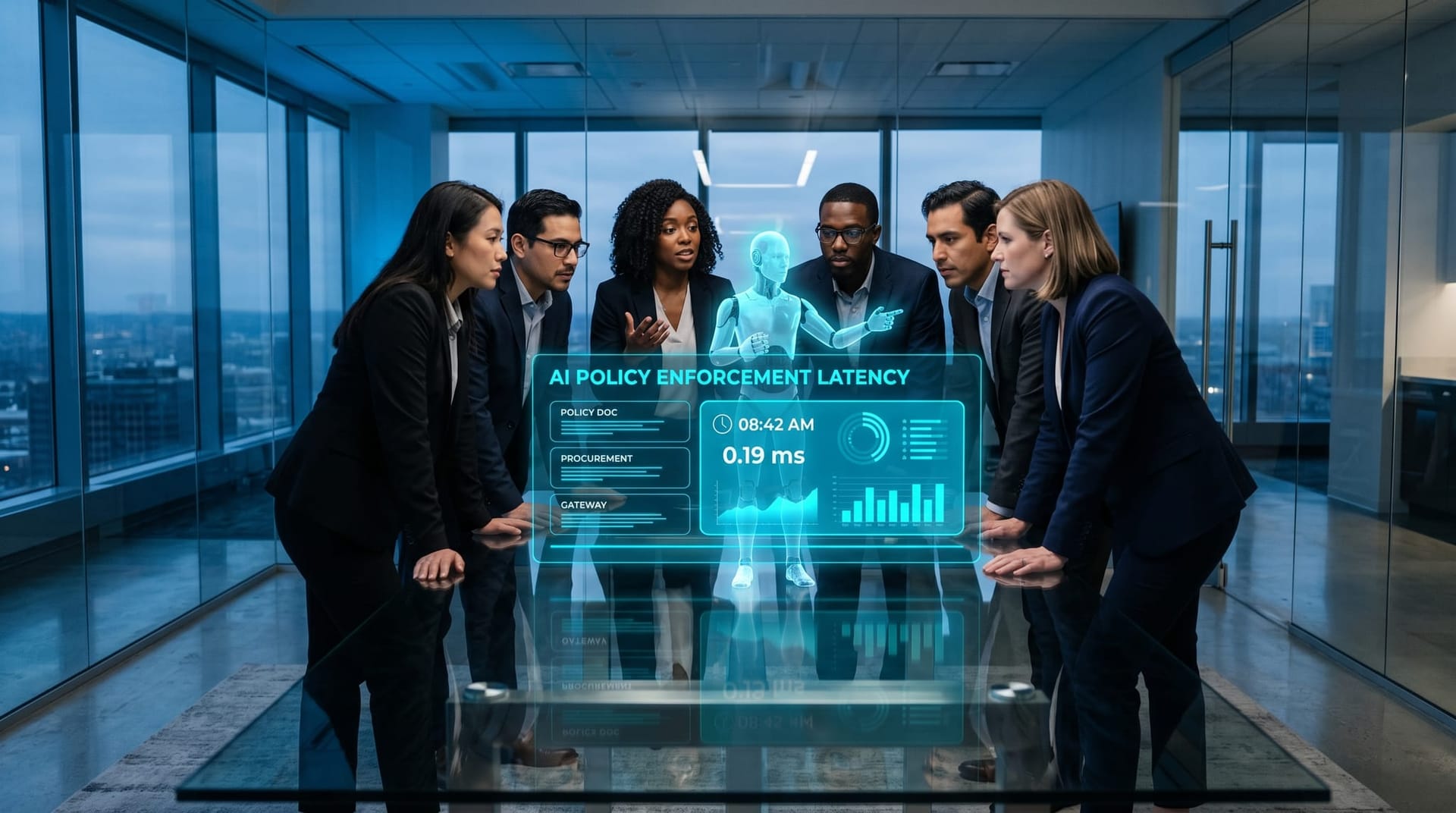
The governance documents most mid-market firms wrote in 2024 and 2025 are sitting in shared drives right now, and most of them are out of date. Not by a little. The AI tools the firm's employees were using when the policy was last reviewed — three or four foundation models, a handful of vendor copilots, a single sanctioned vector database — have since multiplied. New models ship every six weeks. New copilots embed themselves inside Word, Excel, Outlook, Slack, Teams, Notion, and the CRM. New browser extensions, new mobile apps, new agentic platforms appear on the firm's network every Monday morning. The policy review cycle, meanwhile, runs once a quarter on the optimistic end and once a year on the pessimistic one. The cadence mismatch is the new dominant governance failure mode in 2026.
A recent MarkTechPost analysis of enterprise AI governance in 2026 makes the structural argument: the velocity gap between employee AI tool adoption and the policies that cover them has overtaken technical security risk, AI-generated code oversight, and vendor framework adoption as the dominant governance failure mode. The two governance posts already in the Cloud Radix archive cover different gaps — the AI governance gap and software cost oversight prosecutes AI-generated code outrunning the firm's review processes, and the Mend.io AI security governance framework covers vendor framework adoption. The software-cost-oversight gap is one face of the same problem; framework adoption is necessary but not sufficient. Neither prosecutes the velocity gap directly. This piece does.
The frame that follows from the velocity argument is unfamiliar to most mid-market firms but operationally important: AI policy enforcement latency is the new measurable property of an AI governance program. Latency, not coverage. Latency, not coverage and not the version number on the policy document. The rest of this piece defines AI policy enforcement latency, builds a three-row maturity model around it, and ends on the buyer-side question we believe will separate real AI governance programs from paper ones for the next twenty-four months.
Key Takeaways
- The dominant AI governance failure mode in 2026 is the velocity gap between employee AI tool adoption (weekly) and policy review cycles (quarterly to annually) — not technical security, not code generation, not vendor framework adoption.
- AI policy enforcement latency is the elapsed time between a new policy decision and the moment that decision is actually enforced on every request flowing through the firm's AI surface. Days, hours, or minutes — not “next quarter.”
- The three-row maturity model maps where most mid-market firms sit today: a policy document with no enforcement, a procurement-checkpoint policy that employees route around, or a runtime-enforced gateway that makes the policy live as code.
- Governance-by-default at the gateway layer is the only structurally tractable answer because runtime enforcement decouples the policy update cadence from the policy review cadence — the policy ships when leadership decides it ships.
- The buyer-side question “What is your AI policy's enforcement latency?” is the question that separates a real AI governance program from a paper one. Read your existing program through it before your next board update.
- Aligning the gateway-enforced policy program with NIST AI RMF, ISO/IEC 42001, OWASP LLM Top 10, and the EU AI Act gives the firm a defensible posture against the regulatory frameworks that are converging through 2026.
Why is the velocity gap the dominant 2026 governance failure mode?
Three years of AI policy work in mid-market firms has produced a remarkably consistent pattern. The firm writes an AI use policy that covers the tools the firm sanctioned at the time. The policy lists approved vendors, approved data classes, approved use cases, approved logging requirements, and approved exception processes. The policy is signed by the CEO or General Counsel, distributed to staff, attached to the next compliance training, and filed in the policy repository next to the firm's information security policy and acceptable-use policy. Eighteen months later, an audit asks how the policy is being enforced. The answer, in practice, is that the policy is being enforced via trust: the firm trusts its employees to follow the policy as they remember it from the last training session.
The trust-based enforcement model worked for the previous generation of enterprise software because the previous generation of enterprise software did not multiply weekly. Microsoft 365, Salesforce, Workday, and the firm's ERP took years to roll out and changed slowly enough that the policy could keep up. AI does not behave like that. The MarkTechPost coverage of the 2026 enterprise AI governance survey frames the velocity problem precisely: employees adopt new AI tools as soon as the tools become available — usually within the same week of release — while the formal policy revision cycle takes weeks or months to incorporate the new tool, the new data flow, and the new risk profile. The gap widens every week the cycle does not converge.
Three structural properties of AI deployment in 2026 amplify the gap. First, the marginal cost to a single employee of adopting a new AI tool is essentially zero — the tool is free or low-cost, it installs in a browser tab, and it produces an immediate productivity gain. The economic gravity is in the direction of more tools, faster. Second, the surface area is fractal — a sanctioned tool like Microsoft Copilot ships new sub-capabilities monthly, and each sub-capability has its own data-class and policy implications that the original Copilot policy did not contemplate. Third, the policy review process is centralized — it requires the compliance, legal, IT, and security leadership to convene, deliberate, and decide — while the tool adoption is distributed across every employee with a browser. The structural property is that distributed weekly adoption will always outrun centralized periodic review.
The shadow AI piece of the problem is the visible tip. We covered the operational consequence in Fort Wayne vibe-coded shadow AI and S3 data leak — the production incident that surfaces when an unsanctioned AI tool touches a sensitive data class. The shadow AI incident is not the failure mode; it is the symptom of the velocity gap. The failure mode is the cadence mismatch between distributed tool adoption and centralized policy review, and shadow AI is what that mismatch produces operationally. Stopping the shadow AI incident requires closing the cadence mismatch — anything else is a patch on the symptom.
The traditional governance framework's posture against the velocity gap is to write a broader policy — a policy that prohibits “any AI tool not explicitly sanctioned” rather than enumerating specific approved tools. The broader policy is easier to keep in date but harder to enforce. Employees who use an unsanctioned AI tool to do their job are not deciding the policy is wrong; they are deciding the policy enforcement does not reach the tool. The policy is correct on paper and inert in practice. The audit answer six months later — “we have a policy that prohibits unsanctioned AI” — is true and unhelpful. The regulator and the carrier are increasingly asking the second question: how is the prohibition enforced?

What is AI policy enforcement latency?
AI policy enforcement latency is the elapsed time between a new policy decision and the moment that decision is actually enforced on every request flowing through the firm's AI surface. The latency is measured in time. The unit is hours or days in a mature program, weeks or months in an intermediate one, and “not enforced” in an immature one. The latency is the measurable property that separates a governance program that operates from a governance program that exists on paper.
Three properties make AI policy enforcement latency a defensible measurement target. First, it is a number. The firm can write it down, track it over time, report it to leadership, and benchmark it against peers. Numbers are what compliance programs run on; abstractions are what they drown in. Second, it is operationally falsifiable. The firm can test it — pick a hypothetical policy update (“redact social security numbers in all customer-service AI prompts starting today”), measure the elapsed time from the decision to the moment every AI request flowing through the firm enforces the new redaction, and report the actual latency. Third, it is vendor-portable. The latency measurement does not depend on which vendor's tools the firm uses; it depends on the firm's enforcement layer. Two firms with identical AI tool inventories can have radically different enforcement latencies based on how they have built their enforcement layer.
The phrase deserves to enter the buyer vocabulary because it makes the governance conversation operationally honest. The traditional vocabulary — “we have a policy,” “we have governance,” “we are compliant” — is binary and unfalsifiable. The latency vocabulary is continuous and falsifiable. A firm with a six-month latency is in a meaningfully different posture than a firm with a six-hour latency. The board update for the first firm reads “our governance program is improving”; the board update for the second firm reads “we are operationally compliant.” The phrase forces the program to be honest about which one is true.
The latency framing also pulls together the existing governance work. The NIST AI Risk Management Framework Govern, Map, Measure, and Manage functions all benefit from a latency measurement because each one has a “how fast does the change propagate?” sub-question that the latency captures. The ISO/IEC 42001 management-system standard explicitly contemplates policy lifecycle management as part of the AI management system, and latency is the operational metric the lifecycle management produces. The OWASP Top 10 for LLM Applications 2025 addresses runtime enforcement at LLM06 (Excessive Agency) — latency is the measurement of how quickly the firm's runtime-agency constraints can be updated when a new threat is identified. The EU AI Act high-risk-system obligations require timely incident response and policy correction; the latency measurement is the firm's evidence that the obligations are being met.
The structural value of the latency framing is that it shifts the buyer-side and regulator-side question from “do you have a policy?” to “can you change a policy in the time it takes the threat to evolve?” The first question is satisfiable by paper. The second question requires a runtime enforcement layer. That layer is the subject of the next section.

What does the 3-row AI governance maturity gap comparison look like?
The maturity model below maps where most mid-market AI governance programs sit in May 2026. Each row names a maturity level, the canonical evidence of that level, the AI policy enforcement latency the level produces, and the failure mode the level leaves open.
| Maturity level | Canonical evidence | Enforcement latency | Failure mode left open |
|---|---|---|---|
| Row 1: "We have an AI use policy" (immature) | A signed AI use policy document, a compliance-training module, an acceptable-use clause in the handbook, no runtime enforcement layer. | Not measurable. Effectively infinite. A new policy decision propagates only when the next training cycle, the next handbook revision, or the next compliance audit reaches every employee — and even then, enforcement depends on employee memory and discretion. | Shadow AI adoption is unbounded because the policy is enforced by trust. Every employee with a browser is the firm's enforcement perimeter. The audit answer is 'we have a policy'; the operational reality is the velocity gap in its fullest form. |
| Row 2: "Our AI use policy is enforced at procurement" (intermediate) | An approved-vendor list, a procurement gate that prevents official purchase of unsanctioned tools, vendor-specific data-class agreements, no runtime enforcement on personal-account or browser-extension AI use. | Weeks to months. A new policy decision propagates when the procurement team adds or removes a vendor from the approved list, communicates the change, and updates the procurement gate. Personal-account and browser-extension AI use route around the gate entirely. | Employees adopt unsanctioned AI tools through personal accounts, free tiers, browser extensions, and mobile apps that never touch procurement. The procurement gate enforces the policy on the firm's purchases; it does not enforce the policy on the firm's AI usage. |
| Row 3: "Our AI policy is enforced at the gateway" (mature) | Every employee AI request — sanctioned tool, browser extension, personal account, mobile app — routes through a Secure AI Gateway. Policy decisions are runtime-enforced as code. Audit logs are generated as a side-effect of every request. | Hours or minutes. A new policy decision propagates by deploying an updated rule to the gateway. The deployment cadence is the engineering deployment cadence — hours in most cases, minutes in some — not the policy-review cadence. | The failure mode left open is coverage — the gateway enforces the policy on every AI request the gateway sees, so the remaining work is making sure the gateway sees every AI request. That is a network-architecture problem, not a policy-cadence problem. |
Two observations about the table are operationally important. First, most mid-market firms in May 2026 are sitting at Row 1, with a smaller cohort at Row 2 and a much smaller cohort at Row 3. The shape of the distribution is not because Row 3 is technically out of reach — the runtime enforcement architecture is well understood, the gateway products are commercially available, and the integration cost is bounded. The distribution is because the maturity model was not the vocabulary most firms were using when they wrote their first AI policy. They wrote it in the Row 1 vocabulary. The transition to Row 2 or Row 3 is a re-architecture, not an incremental change.
Second, the transition from Row 2 to Row 3 is the structurally important one. Row 2 — procurement-gated AI policy — is the maturity level most firms aspire to and reach in 2025. Row 3 — gateway-enforced AI policy — is the maturity level the velocity gap requires. The reason is that procurement is a batch process and AI tool adoption is a streaming process. A batch process catching a streaming process is an architectural mismatch that does not resolve through better procurement; it resolves through changing the enforcement layer. The shape follows the same pattern we covered in the AI scaffolding layer is collapsing — the layer that does the work has to match the cadence of the work being done.
The Gartner AI TRiSM framework and maturity model prosecutes a similar maturity argument with slightly different vocabulary. The TRiSM framework's progression — from manual oversight to automated runtime controls — maps cleanly onto the three rows above. The convergence between the maturity vocabularies is the signal that the industry is settling on the same architectural answer, even if the names for the rows differ between analyst frameworks.

What does governance-by-default at the gateway layer look like?
Governance-by-default at the gateway layer is the operational shape of Row 3 maturity. The phrase is doing two pieces of work. “Governance-by-default” means the policy is the default behavior of the AI surface — an employee using any AI tool through the firm's network gets the firm's policy applied automatically, with no separate compliance workflow and no employee discretion required. “At the gateway layer” means the enforcement happens in front of the foundation-model platform, not inside the application code of each individual AI tool.
The mechanism is straightforward to describe and operationally tractable to deploy. Every employee AI request — whether it originates from Microsoft Copilot, Google Workspace Gemini, ChatGPT through a browser tab, a Claude desktop app, a Slack AI assistant, a mobile app, or an unrecognized new tool that appeared this Monday morning — routes through the firm's Secure AI Gateway on its way to the foundation-model platform. The gateway intercepts the request, applies the firm's policy decisions as runtime rules (egress allow-list, data-class redaction, identity binding, capability scoping, audit log emission), allows or blocks the request, and logs the outcome. The user-facing experience is essentially unchanged — the AI tool returns the response the user expected. The governance work happens invisibly in the gateway.
Three operational properties make the gateway pattern fit the velocity gap. First, the policy update cadence is decoupled from the policy review cadence. The compliance, legal, and IT leadership still meet on the firm's normal review schedule; when they decide to add a new redaction rule, change an egress allow-list, or block a new tool, the decision deploys to the gateway as code on the engineering deployment schedule. The latency from decision to enforcement is hours, not quarters. Second, the audit log is generated as a side-effect of the gateway routing every request, so the firm has documentary evidence of policy enforcement without a separate compliance workstream. Third, the gateway pattern is vendor-portable — the firm can swap foundation-model providers, swap AI tools, or absorb new tools without changing the enforcement architecture, because the architecture sits in front of the providers and the tools.
The structural strength of the pattern is the same structural strength that pulled the firewall into the network architecture in the 1990s, the SaaS proxy into the cloud architecture in the 2010s, and the API gateway into the microservices architecture more recently. The reasoning is the same in each case: the enforcement layer should sit at a chokepoint, not at the leaves. The cost of putting it at the leaves is the velocity gap. The cost of putting it at the chokepoint is the gateway's engineering investment, which is bounded.
The compliance-vocabulary alignment matters here too. The NIST AI RMF Govern function, the ISO/IEC 42001 control objectives, the OWASP LLM Top 10 LLM06 Excessive Agency control, and the EU AI Act high-risk-system obligations all have a runtime-enforcement sub-requirement. The gateway pattern is the architectural shape that satisfies all four simultaneously. A firm that adopts the gateway pattern is producing the evidence each framework asks for as a side-effect of the architecture, not as a separate compliance workstream. We covered the broader operational discipline of running AI Employees inside this kind of enforcement architecture in AI Employees and context-engineering discipline, and the credential-isolation side in zero-trust AI agents and credential isolation. The confused-deputy class of failure we covered in the confused-deputy AI agent audit matrix is a specific instance of the same governance shape applied to agentic AI rather than to direct employee AI use.
The honest trade-off worth naming is that the gateway is not free. It requires a one-time architectural deployment, a recurring engineering effort to keep the gateway's enforcement rules current, and a network architecture that routes every AI request through the chokepoint. Firms that have a strong network-architecture posture absorb the deployment quickly; firms that do not have to invest in the network architecture first. The investment is bounded and the cost compares favorably against the unbounded tail risk of the velocity gap.

What is the buyer-side question that exposes AI policy enforcement latency?
The buyer-side question is short, falsifiable, and structurally hard to bluff: “What is your AI policy's enforcement latency?”
The question is the operational version of “do you have AI governance?” — and it produces fundamentally different answers depending on whether the firm being asked sits at Row 1, Row 2, or Row 3 of the maturity model. The Row 1 firm answers “we have a policy” or “we are working on it.” The Row 2 firm answers “our procurement team controls vendor approval.” The Row 3 firm answers in time units — “minutes for high-priority rules, hours for the standard deployment cycle, days for cross-functional changes that require legal review.” Only the Row 3 answer is in the right units.
The question is useful in three buyer-side contexts. First, the firm asking itself the question — most leadership teams who run the test on their own program in 2026 find the answer is uncomfortable and informative. The discomfort is the productive signal. Second, the firm asking a vendor — particularly AI Employee vendors, AI tool vendors, and managed-service providers that touch the firm's AI surface — the question reveals whether the vendor's governance posture is operational or marketing. Third, the firm asking a peer in benchmarking conversations — the question produces an honest comparison that the more common “do you have AI governance?” question does not.
The question is also durable. The specific tools, the specific models, the specific risks of May 2026 will change by November 2026, and again by May 2027. The latency measurement is invariant to those changes. A firm that runs the question quarterly is producing a longitudinal measurement of its governance maturity that survives the underlying technology turnover. We argued elsewhere that durable measurement is the discipline that separates AI governance programs that compound from AI governance programs that thrash — the latency measurement is one of the few governance-side measurements that meets the durability test.
The question should be read out loud in the firm's next board update on AI risk. The answer the firm gives, in actual time units, is the answer the board will remember. If the answer is “we cannot measure it,” the board update writes itself: the program needs to advance to the next maturity row. If the answer is “minutes for high-priority rules, hours for the standard cycle,” the board update writes itself differently — the program is in a defensible operational posture for the next regulatory cycle.

What does this mean for NE Indiana mid-market AI governance programs?
For NE Indiana mid-market operators reading this — the 25-to-250-employee firms across Auburn, Fort Wayne, and the surrounding county footprint who are building or refining their AI governance program in 2026 — the velocity-gap framing reaches you on the same schedule it reaches the coastal firms. The MarkTechPost enterprise survey covers national patterns, but the velocity gap is not a coastal phenomenon; it is a property of the AI tool ecosystem itself, and the ecosystem ships to NE Indiana on the same release cadence it ships to Manhattan. The regional advantage NE Indiana mid-market firms have here is that the 25-to-250-employee scale is the scale at which the Row 1 → Row 3 transition is operationally feasible inside a single quarter. A 25,000-employee enterprise has organizational inertia that NE Indiana mid-market firms do not. The transition is closer to reach than the firm's leadership team usually assumes; the constraint is not capability, it is decision.
The right operational read for an NE Indiana mid-market AI governance program right now is to spend one leadership meeting running the buyer-side question on the firm itself, decide which maturity row the firm currently sits at, and decide whether the next maturity step is operationally important inside the next quarter. Most NE Indiana firms doing the exercise find that the answer is yes — the velocity gap is already producing shadow AI incidents the firm has not yet noticed, and the gateway-enforced posture is the only structural fix. The decision the leadership team makes after running the exercise is the meaningful decision; everything else is implementation.
Cloud Radix runs the AI policy enforcement latency assessment as a productized engagement for mid-market firms. The engagement maps the firm's current maturity row, measures the existing enforcement latency on representative policy decisions, identifies the gap between the current posture and Row 3 maturity, and proposes a runtime-enforcement architecture anchored on the Secure AI Gateway sitting in front of the firm's existing AI surface. The assessment ends with a written report the firm's compliance, legal, and IT leadership can take to the board, the carrier, and the regulator.
Frequently Asked Questions
Q1.What is AI policy enforcement latency?
AI policy enforcement latency is the elapsed time between a new policy decision and the moment that decision is actually enforced on every request flowing through the firm's AI surface. The measurement is in time units — hours or minutes in a mature program, weeks or months in an intermediate one, and not measurable in an immature one. The metric is operationally falsifiable and vendor-portable, which makes it a defensible governance measurement target for a leadership team or a regulator. It is the operational version of 'do you have AI governance?' — and it produces fundamentally different answers depending on whether the firm sits at Row 1, Row 2, or Row 3 of the governance maturity model.
Q2.Why is the velocity gap the dominant 2026 governance failure mode?
Employees adopt new AI tools as soon as the tools become available — usually within the same week of release — while formal policy revision cycles take weeks or months to incorporate the new tool, the new data flow, and the new risk profile. The marginal cost of a single employee adopting a new AI tool is essentially zero, the surface area is fractal (sanctioned tools ship new sub-capabilities monthly), and the policy review process is centralized while the tool adoption is distributed. The structural property is that distributed weekly adoption will always outrun centralized periodic review. The MarkTechPost 2026 enterprise AI governance survey identifies the velocity gap as the dominant failure mode in the current cycle.
Q3.What are the three rows of the AI governance maturity gap comparison?
Row 1 ('We have an AI use policy') is a signed policy document with no runtime enforcement; latency is effectively infinite. Row 2 ('Enforced at procurement') gates official tool purchase but leaves personal-account, browser-extension, and mobile-app AI use unaffected; latency is weeks to months. Row 3 ('Enforced at the gateway') routes every employee AI request through a Secure AI Gateway that applies policy decisions as runtime rules; latency is hours or minutes. The structurally important transition is from Row 2 to Row 3 because procurement is a batch process and AI tool adoption is a streaming process, and a batch process cannot catch a streaming process through better procurement.
Q4.What is governance-by-default at the gateway layer?
Governance-by-default at the gateway layer is the operational shape of Row 3 maturity. Every employee AI request routes through a Secure AI Gateway that applies the firm's policy decisions as runtime rules — egress allow-lists, data-class redaction, identity binding, capability scoping, audit log emission. The user-facing experience is essentially unchanged; the governance work happens invisibly. The pattern decouples the policy update cadence from the policy review cadence, generates audit logs as a side-effect of routing, and is vendor-portable across foundation-model providers. The architectural shape is the same chokepoint pattern that pulled firewalls into network architecture and API gateways into microservices architecture.
Q5.How does the gateway pattern align with NIST AI RMF, ISO/IEC 42001, OWASP LLM Top 10, and the EU AI Act?
Each framework includes a runtime-enforcement sub-requirement. The NIST AI Risk Management Framework Govern function asks for runtime policy enforcement; ISO/IEC 42001 contemplates policy lifecycle management as part of the AI management system; OWASP LLM Top 10 LLM06 (Excessive Agency) addresses runtime agency constraints; the EU AI Act high-risk-system obligations require timely incident response and policy correction. The gateway pattern is the architectural shape that satisfies all four simultaneously, producing the evidence each framework asks for as a side-effect of the architecture rather than as a separate compliance workstream.
Q6.What is the buyer-side question that exposes a firm's enforcement latency?
The question is: 'What is your AI policy's enforcement latency?' The answer separates governance programs that operate from governance programs that exist on paper. A Row 1 firm answers 'we have a policy'; a Row 2 firm answers 'our procurement team controls vendor approval'; a Row 3 firm answers in time units — minutes for high-priority rules, hours for the standard cycle, days for cross-functional changes. Only the Row 3 answer is in the right units. The question is useful internally, in vendor diligence, and in peer benchmarking conversations, and it is durable across changes in the underlying AI tool ecosystem.
Q7.Can a 25-to-250-employee mid-market firm reach Row 3 maturity in a single quarter?
In most cases, yes. The 25-to-250-employee scale is small enough that the leadership team can decide and execute inside a single quarter, the network architecture changes are bounded, and the gateway deployment is a one-time architectural investment with a recurring engineering maintenance cost. Larger enterprises carry organizational inertia that makes the transition slower; mid-market firms have a structural advantage on this specific transition. The constraint is rarely capability — it is leadership decision and prioritization. NE Indiana mid-market firms working with Cloud Radix typically run the latency assessment in week one, the architecture decision in week three, and the deployment over the remaining quarter.
Sources & Further Reading
- MarkTechPost: marktechpost.com/2026/05/13/enterprise-ai-governance-in-2026 — Enterprise AI Governance in 2026: Why the Tools Employees Use Are Ahead of the Policies That Cover Them.
- NIST: nist.gov/itl/ai-risk-management-framework — AI Risk Management Framework.
- International Organization for Standardization: iso.org/standard/81230.html — ISO/IEC 42001:2023 Information technology — Artificial intelligence — Management system.
- OWASP GenAI Security Project: genai.owasp.org/llm-top-10 — OWASP Top 10 for LLM Applications 2025.
- European Union: eur-lex.europa.eu/legal-content/EN/TXT/?uri=OJ%3AL_202401689 — EU AI Act (Regulation 2024/1689).
- Gartner: gartner.com/en/information-technology/glossary/ai-trism — Gartner AI TRiSM Framework and Maturity Model.
Measure Your AI Policy Enforcement Latency
Cloud Radix runs the AI policy enforcement latency assessment for mid-market firms — mapping your current maturity row, measuring real enforcement latency, and proposing the Row 3 gateway-enforced architecture.