On April 22, 2026, VentureBeat reported that OpenAI has unveiled Workspace Agents — an enterprise successor to Custom GPTs that plugs directly into Slack, Salesforce, and the other tools a business already runs. That sentence sounds like a product update. It is actually an end-of-era announcement for every business owner who built a Custom GPT between 2023 and 2025 and now has to decide whether to port, replatform, or walk away.
If you are a Fort Wayne CPA firm that built a “tax research GPT” for your team, or an Auburn home-services company that spun up a “first-response customer GPT” inside your own ChatGPT workspace, or a Northeast Indiana real-estate brokerage that stood up an “MLS-summary GPT” for agents in the field — you now have stranded intellectual property and a migration decision in front of you. And that decision is not the simple “click a migrate button” your Custom GPT's 2023 era trained you to expect.
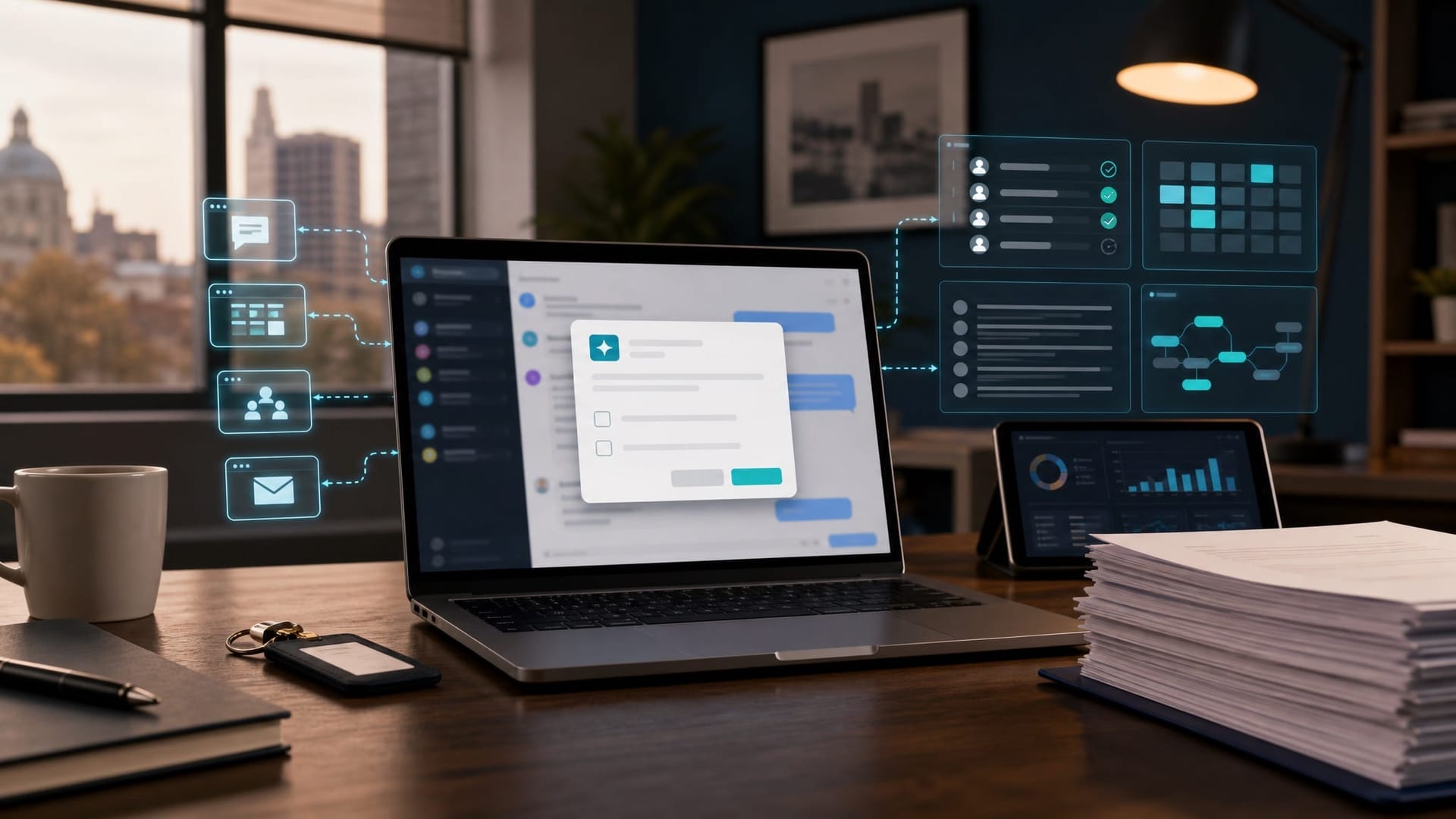
Workspace Agents are the first mainstream product that treats an AI agent as a coworker in your existing apps rather than a chatbot you visit in a browser tab. The shift from “visit ChatGPT to ask” to “agent lives inside Slack and Salesforce” is architecturally bigger than most SMB owners realize — and it reshapes the competitive map against Microsoft Copilot, Salesforce Agentforce Vibes 2.0, and the custom AI Employees that businesses like ours deploy behind a Secure AI Gateway. Stanford HAI's 2026 AI Index has tracked enterprise AI adoption crossing majority thresholds across mid-market segments over the past year, which is the demand signal behind every in-app agent launch on the market today.
Key Takeaways
- OpenAI's Workspace Agents is a successor to Custom GPTs, engineered to plug directly into Slack, Salesforce, and other enterprise tools — it is no longer a chat window you visit, it is an agent that lives inside the apps your team already uses.
- Every Custom GPT built between 2023 and 2025 is now stranded IP. Migrating is not automatic — it is an architectural port that requires a governance review before anyone clicks “connect.”
- The new product competes head-on with Microsoft Copilot, Salesforce Agentforce Vibes 2.0, and custom AI Employees — but none of the four solves the same problem the same way. The right answer depends on which stack you already live in.
- The governance trap: Workspace Agents inherit OAuth scopes across Slack and Salesforce, which maps directly to OWASP's LLM06 Excessive Agency risk. That blast-radius problem does not go away because the vendor is now OpenAI.
- For Fort Wayne SMBs, three migration patterns dominate: accounting firms, real-estate brokerages, and home-services companies. Each has a different “right answer” — and the right answer is rarely “port every Custom GPT to Workspace Agents.”
What exactly are OpenAI's Workspace Agents?
Per VentureBeat's reporting, Workspace Agents are persistent, stack-integrated AI agents that plug directly into the enterprise applications a business already runs — Slack, Salesforce, and a growing list of connectors — rather than requiring users to visit a chat window. They are positioned as the enterprise successor to Custom GPTs, the product OpenAI launched in late 2023 that let businesses spin up lightly customized chatbots inside their own ChatGPT workspace.
The operative word is “successor.” Custom GPTs were a clever packaging exercise: take a system prompt, attach some files, maybe point at a handful of actions, and share the result with your workspace members. They lived inside ChatGPT. You went to them. Workspace Agents reverse that polarity — they go to the user, inside the app the user already has open. That is the same directional move Microsoft made with Copilot inside Office, and the same move Salesforce made with Agentforce inside CRM. OpenAI's version arrives last but arrives with the broadest multi-app surface area.
The practical consequence for a 15-to-100-person business is that the cost of getting AI in front of a frontline employee just collapsed. You no longer have to train your team to open a separate tab, remember which Custom GPT to pick, paste in context, and interpret the answer. The agent is in the thread. The agent is in the CRM record. The friction goes away — but so does the default “firewall” that friction used to provide, because the agent now has default access to everything a legitimately-authenticated user can see.
That is the thesis of why AI interfaces matter more than AI models — the win is not that OpenAI's underlying model got better this week. The win is that the interface moved from visit-the-chat to live-in-the-app. For a small business, the interface change is what unlocks adoption.
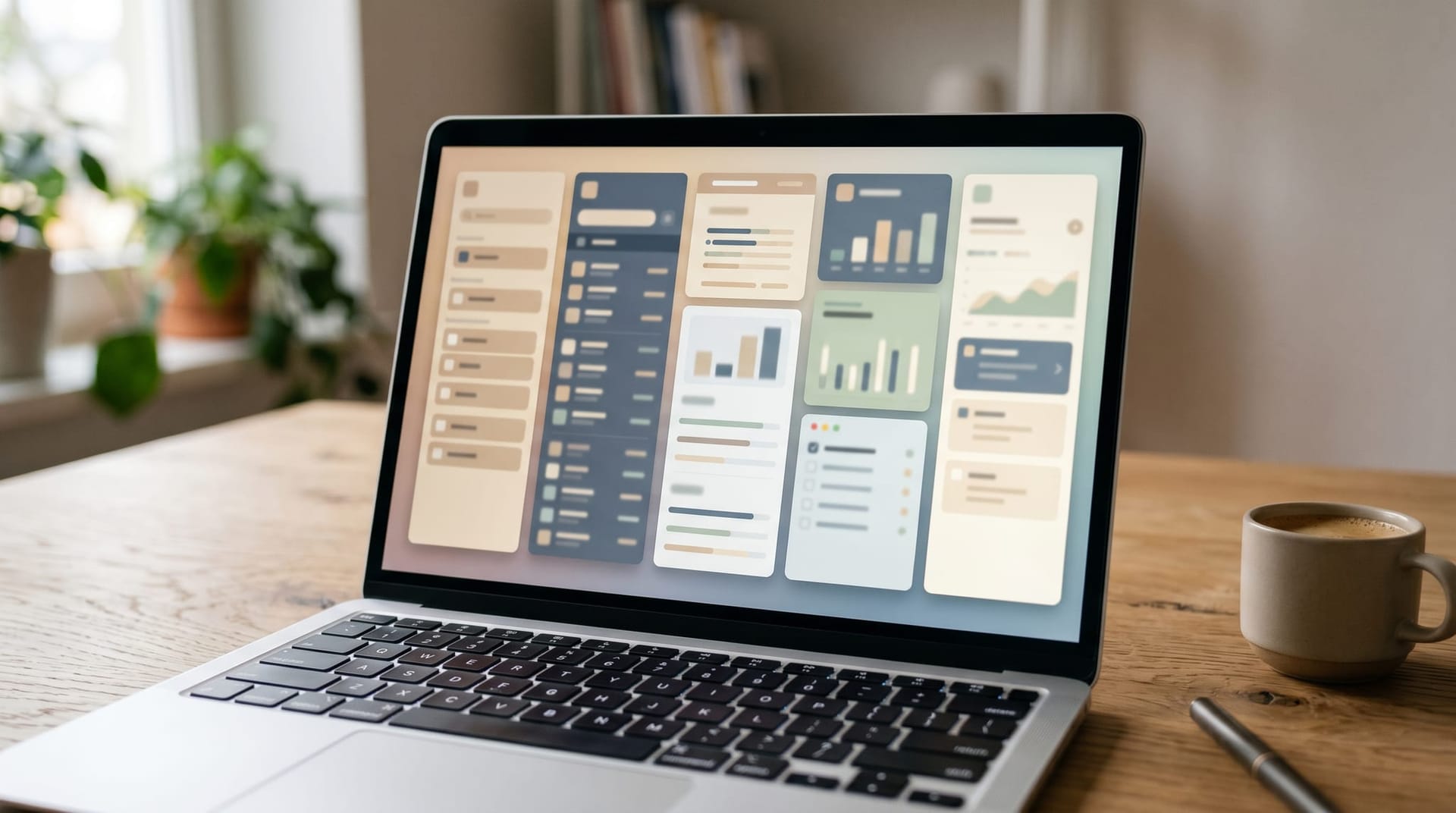
How are Workspace Agents different from the Custom GPTs they replace?
The honest summary: Custom GPTs were a shared-prompt feature that pretended to be an agent. Workspace Agents are an actual agent that runs across tools. Here is a plain-English comparison:
| Dimension | Custom GPT (2023-2025) | Workspace Agents (2026) |
|---|---|---|
| Primary surface | ChatGPT web/app workspace | Inside Slack, Salesforce, and connected apps |
| Authentication model | Shared prompt and files inside your workspace | Enterprise identity and OAuth into target apps |
| Actions | Limited — call webhooks via “actions” | Direct, native operations in connected tools |
| Memory | Thread-scoped inside ChatGPT | Persistent, workspace-level (as reported) |
| Governance | Opaque — admin has limited per-GPT policy | Admin-controlled scopes and connectors |
| Audit trail | Per-conversation export only | Integrated with enterprise logging |
| Migration from 2023-2025 | N/A (greenfield) | Port is manual — you rebuild, you do not copy |
If you built a Custom GPT in 2023, the important line in that table is the last one. There is not a “one-click migrate” story. Every operational assumption — where the data sits, who has access, what actions are permitted, how it shows up for the end user — changes in the move from Custom GPT to Workspace Agents. That is not a reason to walk away. It is a reason to review before you port, because any permission mistake you baked into the Custom GPT now becomes a permission mistake that can read and write across Slack and Salesforce.
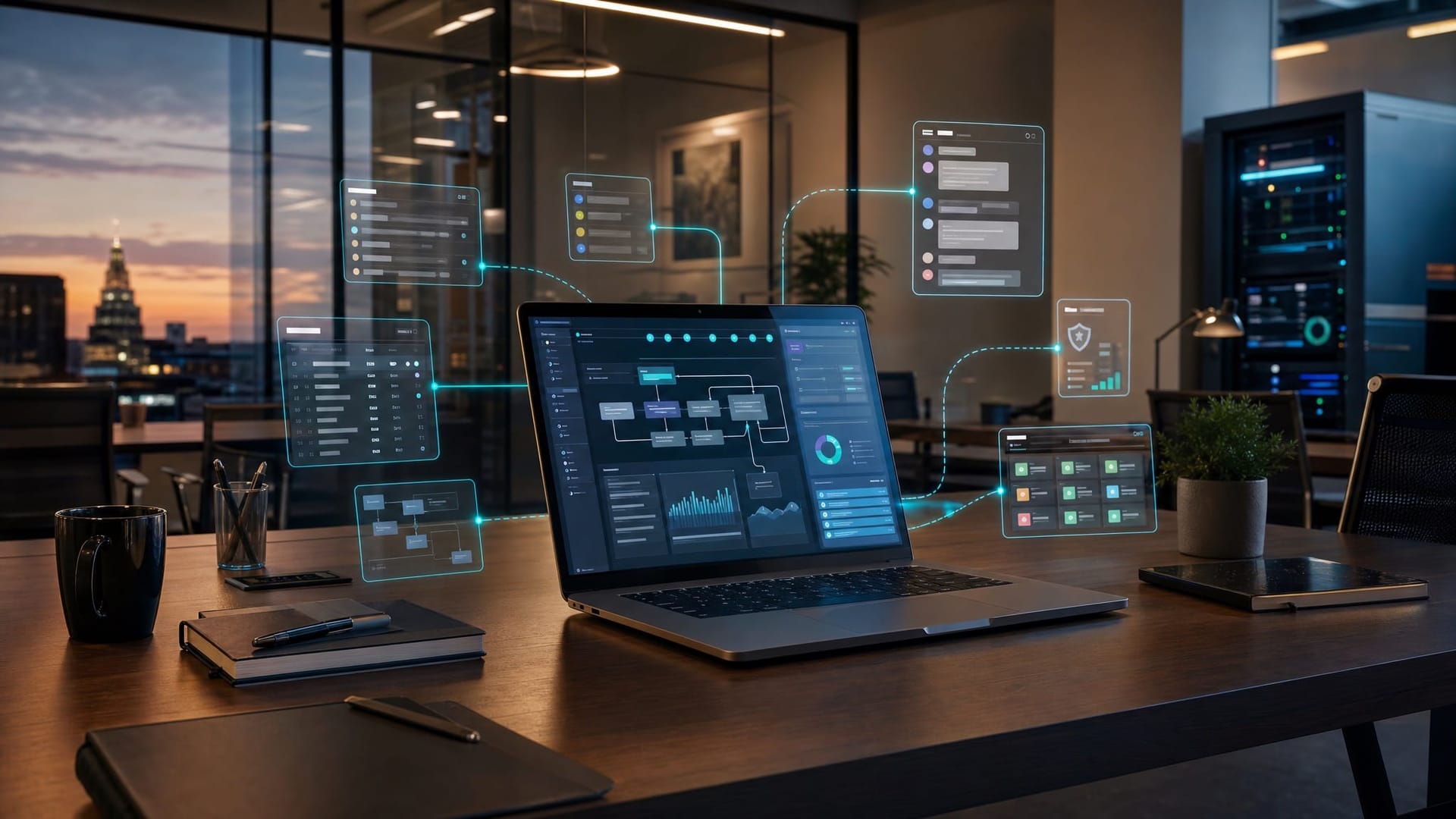
This is the same class of blast-radius problem we covered in cross-app AI agent approval dialogs. The fix is not cleverer prompts — the fix is a human-in-the-loop approval layer between the agent and anything it can irreversibly change, and an explicit scope-by-scope policy for which connectors each agent may touch.
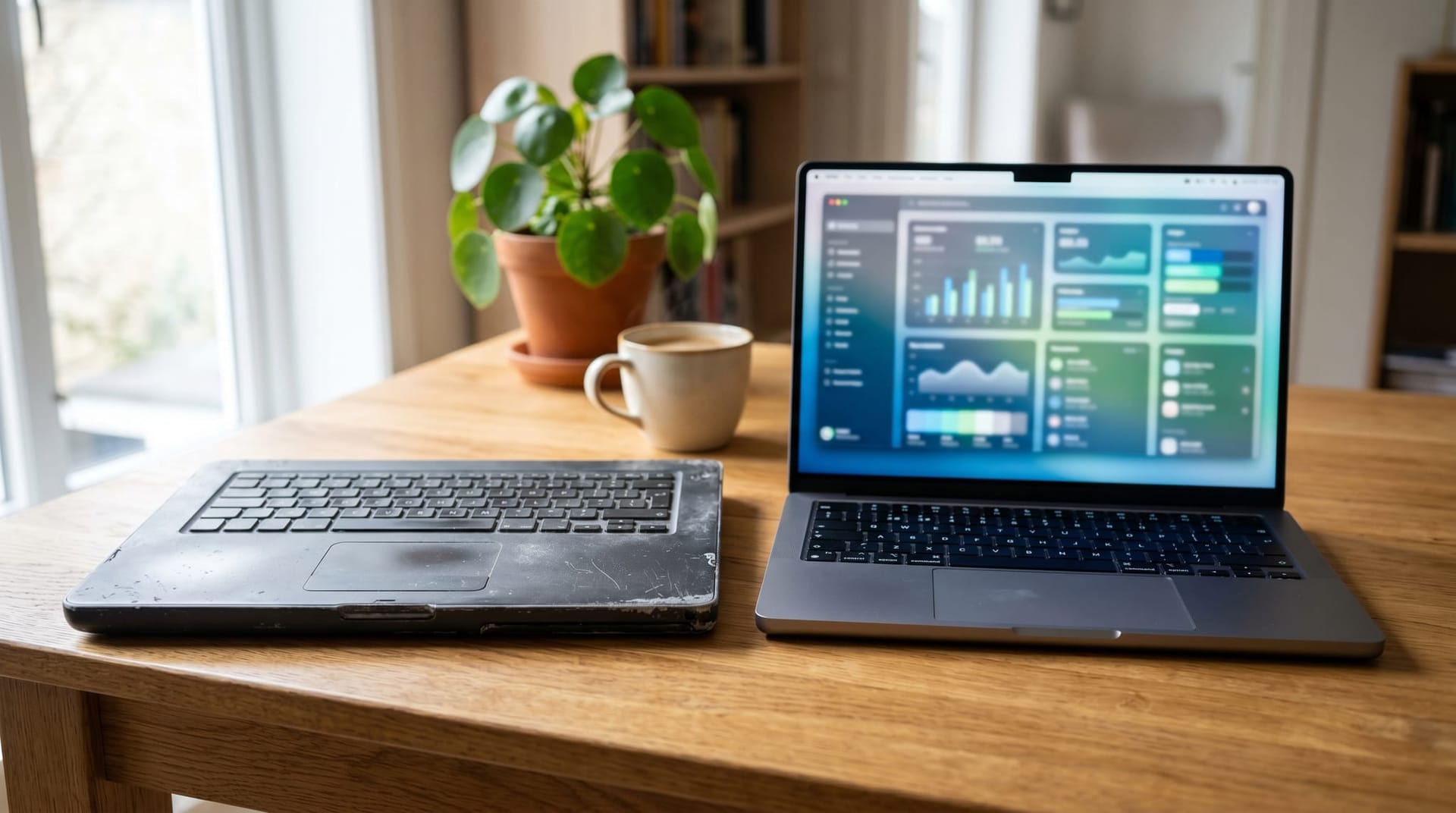
How do Workspace Agents compare to Copilot, Agentforce Vibes 2.0, and a custom AI Employee?
With Workspace Agents shipping the same week Salesforce released Agentforce Vibes 2.0 — a Salesforce-side update framed around context-overload failures in agents running across enterprise data — the agent-product matrix has effectively been redrawn in April. Microsoft Copilot already sat inside Office. Now every stack has a first-party in-app agent, and businesses have to pick between them.
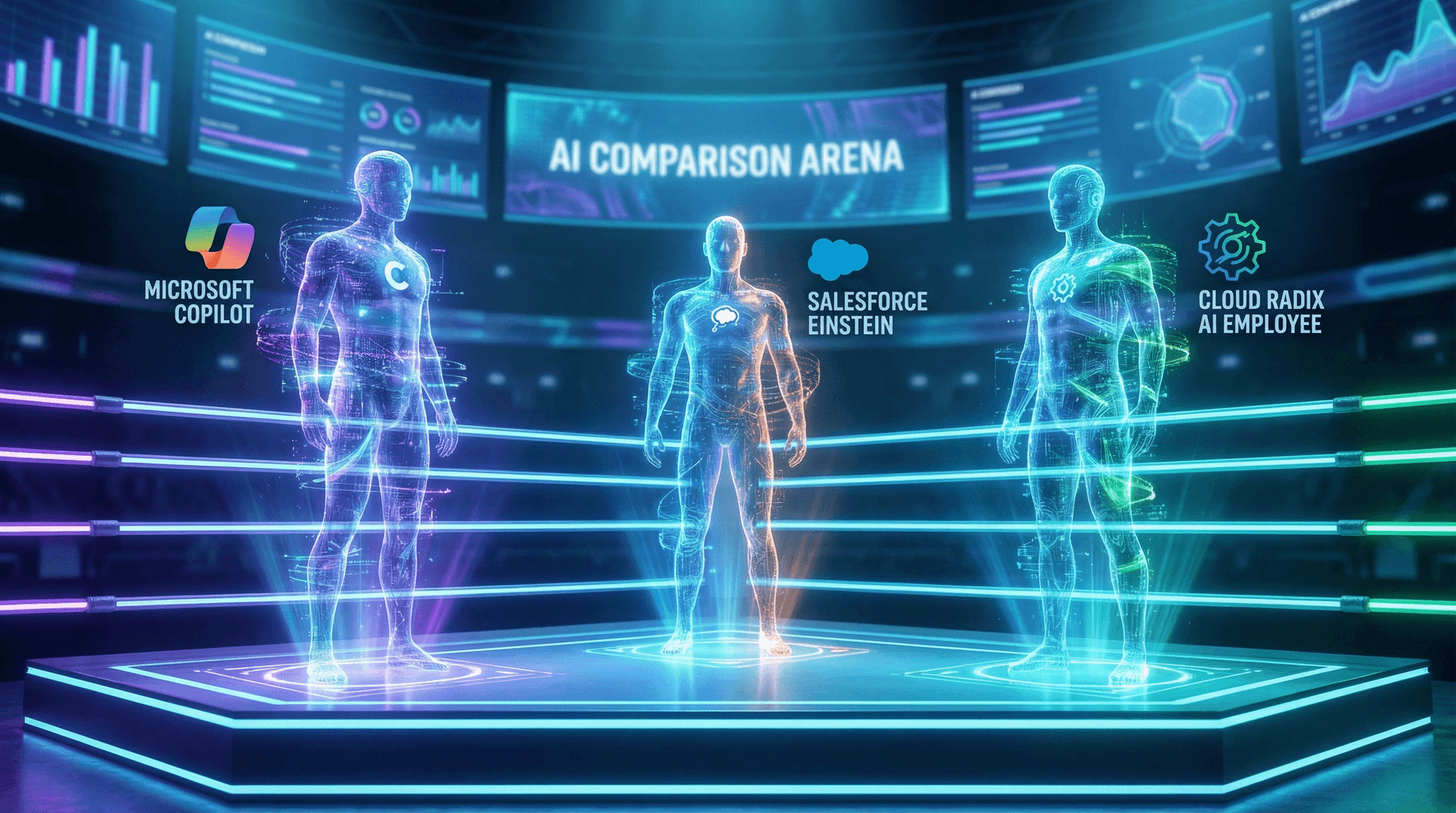
The decision is rarely “which model is smartest this week.” It is “which stack does your business already live in, and which governance model can you actually operate?” We walk through the broader framing in our AI Employee vs Copilot vs Einstein piece; Workspace Agents belong on that same decision tree, as a fourth option.
| Option | Best fit when | Primary trade-off |
|---|---|---|
| OpenAI Workspace Agents | You already use ChatGPT Business/Enterprise; you live across Slack and Salesforce | OpenAI holds the agent primitive; governance depends on how disciplined your admin is about connector scopes |
| Microsoft Copilot | Microsoft 365 shop; heavy Outlook, Teams, SharePoint use | Strongest inside Microsoft; weaker as a neutral hub across non-MS tools |
| Salesforce Agentforce Vibes 2.0 | Salesforce is your system of record for sales and service | Centered on CRM — less useful for operations and general productivity |
| Custom AI Employee (Cloud Radix, behind a Secure AI Gateway) | Regulated data, multi-vendor stack, or a workflow that crosses five or more systems | You pay for the architecture; you own the policy layer and keep it independent of any single vendor |
The fourth row is where Cloud Radix lives. We are not against Workspace Agents — for a Slack-heavy Fort Wayne SMB with a clean, Microsoft-lite stack, it is often the right starting point. But for the businesses whose data crosses HIPAA, TCPA, ITAR, or a specific industry regulator, a custom AI Employee behind a Secure AI Gateway is almost always the correct architecture, because the governance layer has to live outside any single vendor's console.
What is the governance trap in cross-app Workspace Agents?
The fastest way to turn a Workspace Agent into a liability is to rubber-stamp the OAuth connector prompt during setup. The reason sits in OWASP's LLM Top 10 for 2025, which names LLM06: Excessive Agency as a distinct category: an LLM-based system granted more permissions, autonomy, or plug-in access than the task actually requires. A Workspace Agent that connects to Slack with read/write access to every channel and to Salesforce with admin scope is textbook LLM06 — not because OpenAI did something wrong, but because the default scope set is wider than any single workflow needs.
The related risks stack on top. LLM02: Sensitive Information Disclosure comes into play the moment an agent can search private Slack channels where engineers or HR routinely paste customer data. LLM01: Prompt Injection becomes structural when an agent reads Salesforce notes that a third party wrote — those notes are now executable instructions as far as the model is concerned. None of these are theoretical in cross-app agent deployments. All of them are direct consequences of giving an agent broad OAuth at setup time.
We covered the approval-dialog pattern — pausing the agent for a human decision at each irreversible action — in our cross-app AI agent governance post. For Workspace Agents, the playbook translates cleanly: scope connectors to the minimum that makes the workflow work, turn on audit logging, and require a human approver for anything that writes to a shared record or sends an external message. The NIST AI Risk Management Framework GOVERN and MANAGE functions describe the same pattern in different vocabulary.
If you want a starting governance policy, the AI Employee governance playbook gives a concrete template — written for custom AI Employees, but equally applicable as the bones of a Workspace Agents rollout.
The Fort Wayne SMB migration playbook: three patterns we see locally
For Northeast Indiana businesses with a stranded Custom GPT and a Workspace Agents decision to make, three scenarios repeat often enough to treat as patterns. We do not recommend the same answer for all three — the correct move depends on the data, the stack, and the governance maturity of the business.
Accounting firms and CPAs (DeKalb, Allen County): The typical Custom GPT was a tax-research or engagement-letter drafter loaded with a firm's proprietary memos. The migration to Workspace Agents is usually not the right first move, because firm data lives in a mix of practice-management software (CCH, ProSystem, Canopy) that does not have a first-party Workspace Agents connector, and ePHI-adjacent client records that should be behind a gateway regardless. The recommended path is a custom AI Employee routed through our gateway, with Workspace Agents as a secondary surface for non-client-data tasks like scheduling and internal Slack summaries. Our Fort Wayne law firms and accountants AI compliance automation guide goes deeper.
Real-estate brokerages (Allen County, DeKalb County): The typical Custom GPT was an MLS-query helper or a listing-description drafter. Here, Workspace Agents is often a good first move, because most brokerage stacks are Slack-centric, CRM-light, and the data involved — listings, showing notes, non-private client preferences — is already semi-public by nature. The caveat: the brokerage needs a written policy on what the agent may post to client channels without a human gate, or it will eventually send a half-baked pricing opinion to a client under the broker's name.
Home-services companies (HVAC, plumbing, remodeling): The typical Custom GPT was a first-response customer-inquiry responder or a quote-drafting helper. Workspace Agents can be the right move, but the connectors most home-services businesses need — ServiceTitan, Housecall Pro, Jobber — are less mature in the Workspace Agents ecosystem than Slack and Salesforce are. In practice, a custom AI Employee with a direct ServiceTitan integration delivers more revenue lift in the first 90 days than a Workspace Agent pointed at a general Slack thread.
Across all three patterns, the single unifying recommendation is this: do not migrate your Custom GPT because the news cycle said to migrate. Migrate because you have a specific workflow whose ROI improves when the agent moves from the chat window to inside Slack or Salesforce, and where the governance story is written before the connector is approved.
Ready to evaluate where Workspace Agents fit in your stack?
Cloud Radix helps Fort Wayne, Auburn, and Northeast Indiana businesses answer two specific questions that Workspace Agents' launch forces: (1) which of your existing Custom GPTs should port, which should rebuild, and which should retire? and (2) for the workflows that do port, is Workspace Agents the right surface, or is a custom AI Employee behind a gateway a better fit? The deliverable is a written migration plan — not a sales quote — covering connector scopes, governance policy, and a 30-60-90 day rollout.
If you built Custom GPTs for your team over the past two years and want to know what to do with them before the April news cycle settles into a May-June migration scramble, send us the list (even a rough one) and the apps your team lives in. Book a 30-minute migration evaluation and we will come to the call with the framework, not a pitch. The AI Employees service page covers how we structure the engagement.
Frequently Asked Questions
Q1.Are OpenAI's Workspace Agents a drop-in replacement for Custom GPTs?
No. Per VentureBeat's April 22, 2026 reporting, Workspace Agents are the enterprise successor to Custom GPTs, but they are a new product with a different authentication model, different governance surface, and native connectors into Slack, Salesforce, and other enterprise apps rather than a chat-window workspace. Any Custom GPT you built between 2023 and 2025 needs to be rebuilt, not migrated, and the rebuild should include a governance review that the Custom GPT-era product never required.
Q2.Do Workspace Agents make Microsoft Copilot or Salesforce Agentforce obsolete?
No. Each product is strongest inside its own stack. Microsoft Copilot remains the right default for Microsoft 365-heavy shops, Salesforce Agentforce Vibes 2.0 remains the right default when Salesforce is the system of record, and Workspace Agents is the right default when your team lives primarily in Slack or uses ChatGPT Business or Enterprise as its AI platform. For a multi-vendor stack, a vendor-neutral custom AI Employee behind a Secure AI Gateway is often the better architecture because the governance policy does not depend on any single vendor's console.
Q3.What is the governance risk I should look at first before turning on Workspace Agents?
OAuth scope. The connector setup flow will ask you to grant access to Slack channels, Salesforce objects, and any other tools in the integration. The default scopes are almost always wider than the workflow needs. OWASP's 2025 LLM Top 10 names this pattern LLM06 Excessive Agency. Before approving any connector, map the specific workflow the agent will run, grant only the scopes that workflow requires, turn on audit logging, and set a human-approval gate for anything the agent writes back to a shared record or sends to a customer.
Q4.Can I use Workspace Agents for HIPAA or HITRUST-regulated data?
Only under a signed Business Associate Agreement with OpenAI covering the specific scope, and only after a data-flow review that confirms the agent's connectors cannot expose regulated data to uncovered surfaces. For most Fort Wayne healthcare and healthcare-adjacent businesses, the cleaner architecture is a custom AI Employee behind a compliance gateway, with Workspace Agents reserved for non-regulated workflows like internal Slack summaries and scheduling. The consumer-AI liability frame we have written up previously applies to Workspace Agents in any scope that touches ePHI: the vendor's consumer terms do not provide the contract surface a HIPAA-regulated entity needs.
Q5.How long does a Custom GPT to Workspace Agents migration typically take?
For a single Custom GPT with straightforward system-prompt logic and one or two connectors, a production-ready Workspace Agents build is usually a two-to-four-week engagement, the majority of which is governance work rather than prompt work. If the Custom GPT was doing serious retrieval against proprietary firm documents, the rebuild is longer because retrieval architecture, identity scoping, and audit logging all move to the new surface. The typical Fort Wayne SMB has five-to-twelve Custom GPTs in play and should plan for a phased migration across a quarter.
Q6.What happens to the Custom GPTs I already built if I do nothing?
As of today, OpenAI has not published a Custom GPT end-of-life date. The safe planning assumption is that Custom GPTs will continue to function for the near term but will not receive the feature investment that goes to Workspace Agents. Business-critical Custom GPTs should be on a migration plan even if the clock is not yet running, because the governance review should happen on your timeline rather than on a vendor deprecation deadline.
Q7.Where does a custom AI Employee fit if Workspace Agents exists?
In the workflows where your data, your compliance boundary, or your multi-vendor stack make a single-vendor agent the wrong choice. A custom AI Employee behind a Secure AI Gateway is the correct answer when the workflow crosses systems that Workspace Agents does not natively integrate with, when the data has a regulatory fence around it, or when governance policy needs to live outside any single vendor's admin console. For many Fort Wayne businesses the right architecture in 2026 is both — Workspace Agents for the in-app productivity surface, a custom AI Employee for the cross-system, regulated, or policy-heavy workflows.
One additional reference worth naming: for customers evaluating ChatGPT Business or Enterprise as the platform layer underneath Workspace Agents, the vendor's own OpenAI for Business page is the canonical place to confirm current plan details and the enterprise contract surface.
Sources & Further Reading
- VentureBeat: venturebeat.com/orchestration/openai-unveils-workspace-agents — OpenAI unveils Workspace Agents, a successor to Custom GPTs for enterprises that can plug directly into Slack, Salesforce and more (April 22, 2026).
- VentureBeat: venturebeat.com/orchestration/salesforces-agentforce-vibes-2-0 — Salesforce's Agentforce Vibes 2.0 targets a hidden failure: context overload in AI agents (April 22, 2026).
- OWASP: genai.owasp.org/llm-top-10 — OWASP Top 10 for LLM Applications 2025, including LLM01 Prompt Injection, LLM02 Sensitive Information Disclosure, and LLM06 Excessive Agency.
- NIST: nist.gov/itl/ai-risk-management-framework — AI Risk Management Framework and its GOVERN, MAP, MEASURE, and MANAGE functions.
- Stanford HAI: hai.stanford.edu/ai-index/2026-ai-index-report — 2026 AI Index Report covering enterprise adoption and agent capabilities.
- OpenAI: openai.com/business — OpenAI for Business plan details and enterprise contract surface for ChatGPT Business and Enterprise.
Book a Workspace Agents Migration Evaluation
Let Cloud Radix map your existing Custom GPTs, score each for port-rebuild-retire, and produce a 30-60-90 day migration plan covering connector scopes, governance policy, and the right agent surface for each workflow.