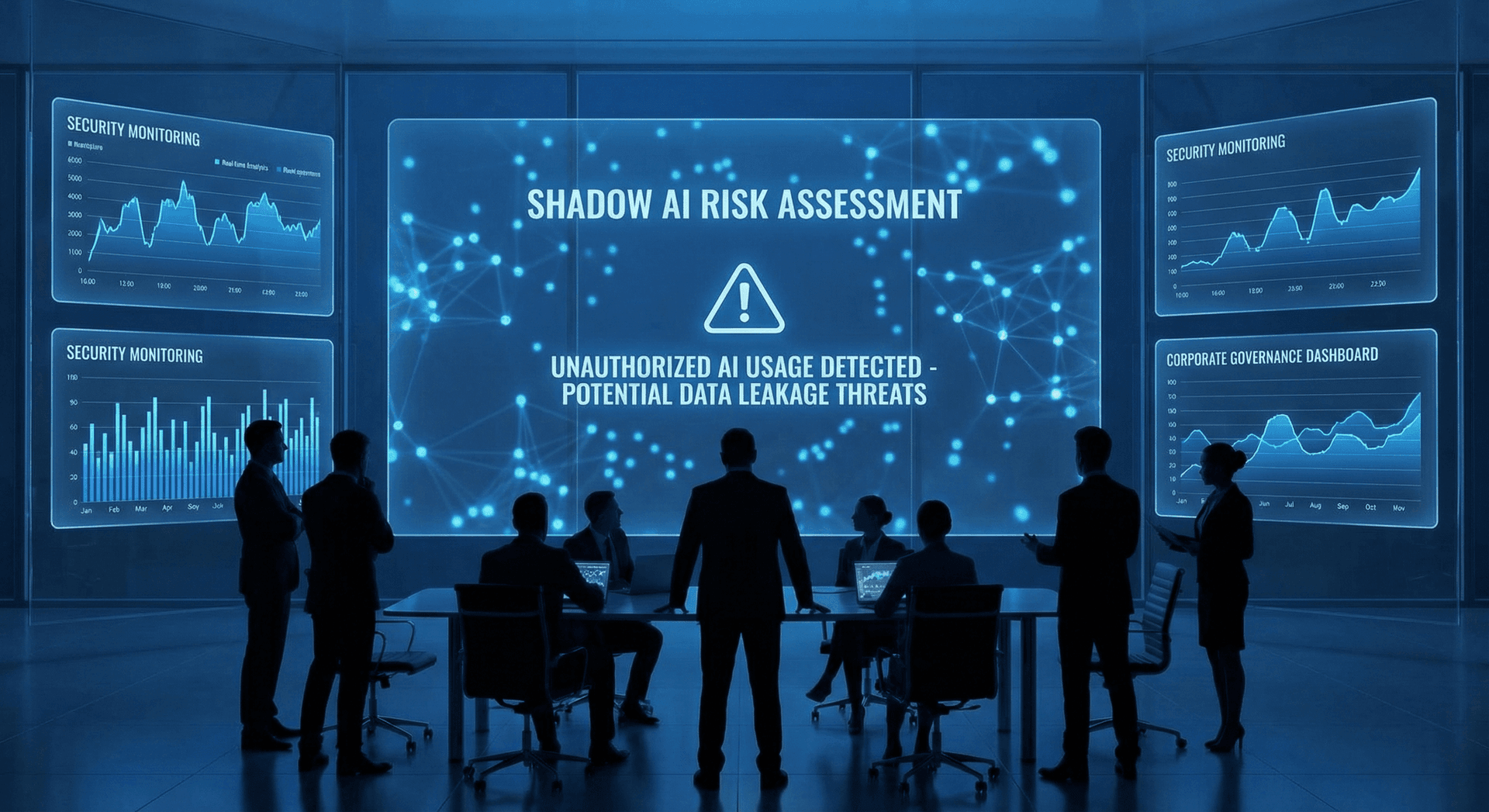
Somewhere in your organization, there is probably a server you forgot about. Someone on your team — maybe a developer, maybe an ambitious operations lead who watched a YouTube tutorial — spun up an open-source agent builder to prototype an “AI employee.” It worked. It got useful. It quietly started touching real data. And at some point, to make it easier to demo, someone exposed it to the internet. That server is now part of an attack surface you never decided to have.
That is not a hypothetical. According to VentureBeat's security reporting, roughly 7,000 internet-exposed Langflow servers are currently under active attack — and the two most popular frameworks underneath the agentic-AI boom, LangGraph and LangChain, carry the same class of holes. This is the predictable cost of a gold rush. The rush to “just spin up an open-source agent framework” has turned thousands of quiet automation experiments into internet-facing infrastructure, and most of the businesses running them have no idea they are exposed.
This is not a how-to for patching. It is an argument about architecture. Because the real lesson of the Langflow wave is not “patch faster” — it is that the way most businesses are deploying agentic AI keeps reproducing the same exposure, over and over, no matter which framework is in fashion.
Key Takeaways
- Roughly 7,000 internet-exposed Langflow servers are under active attack, and LangGraph and LangChain share the same vulnerability class.
- The pattern is structural, not a one-off bug: when raw agent frameworks are exposed to the internet, “it's just an internal tool” is exactly how they end up indexed and exploited.
- Agent frameworks are uniquely dangerous targets because they hold provider API keys, can execute code, and sit next to real business data.
- CISA has already added a Langflow flaw to its Known Exploited Vulnerabilities catalog, and exploitation has repeatedly followed disclosure within roughly a day.
- The defensible choice is not “self-host nothing” — it is deciding deliberately who owns the patching and exposure burden, and never letting a raw framework be directly internet-reachable.
- A managed, governed secure AI gateway turns this from a recurring fire drill into a one-time architectural decision.
What Actually Happened with Langflow, LangGraph, and LangChain?
Langflow is a popular visual builder for agent workflows — drag boxes, wire them together, ship an agent. That convenience is exactly what made the exposure so wide. The flaw now being exploited at scale, tracked as CVE-2026-5027, is a path-traversal bug in the POST /api/v2/files endpoint: the server takes a filename straight from form data and writes it to disk without sanitizing it. An attacker packs that filename with directory-traversal sequences and drops a file anywhere on the system — a cron job in /etc/cron.d/, for example — which is a short walk from full code execution. It carries a CVSS score of 8.8 and was patched in Langflow version 1.9.0.
The mass-exploitation wave isn't theoretical. As VentureBeat notes, the vulnerability scanner VulnCheck added the flaw to its exploited-vulnerabilities list on June 8, once its sensors caught the first real-world hits. The frameworks underneath share the pattern. LangGraph's SQLite checkpointer carried a SQL-injection flaw (CVE-2025-67644, CVSS 7.3) where user-controlled filter keys were dropped into a query with no parameterization; the same weakness reached the Redis checkpointer (CVE-2026-27022). LangChain-core disclosed a path traversal in its legacy prompt-loading API (CVE-2026-34070, CVSS 7.5). Different repos, same root cause: input that should never have been trusted flowing straight into a file path or a database query.
| Component | CVE | Class | CVSS | Status |
|---|---|---|---|---|
| Langflow | CVE-2026-5027 | Path traversal (file write) | 8.8 | Patched in 1.9.0; under active attack |
| LangGraph (SQLite checkpointer) | CVE-2025-67644 | SQL injection | 7.3 | Fixed in langgraph-checkpoint-sqlite 3.0.1 |
| LangGraph (Redis checkpointer) | CVE-2026-27022 | SQL injection | 6.5 | Fixed in langgraph-checkpoint-redis 1.0.2 |
| LangChain-core | CVE-2026-34070 | Path traversal (prompt loader) | 7.5 | Fixed in updated langchain-core |
This is not the first time Langflow has been on fire. Earlier in 2026, an unauthenticated remote-code-execution flaw in a public flow-build endpoint (CVE-2026-33017, CVSS 9.3) let attackers run arbitrary Python on exposed instances with a single HTTP request. Sysdig's analysis documented attackers compromising pipelines within roughly 20 hours of the advisory — without a public proof-of-concept, simply reverse-engineering the exploit from the advisory text. CSO Online reported that CISA sounded the alarm as exploitation began, and The Hacker News tracked the flaw being folded into CISA's Known Exploited Vulnerabilities catalog with a federal remediation deadline. Infosecurity Magazine underscored the same brutal timeline: hours, not weeks, between disclosure and exploitation.

Why Do Agent Frameworks Keep Becoming Attack Surfaces?
It would be comforting to write this off as a couple of sloppy projects. It is not. Three structural properties make agent frameworks unusually dangerous to expose, and they apply to whatever framework replaces today's leaders next year.
They hold the keys. An agent framework typically stores credentials for the model providers it calls — OpenAI, Anthropic, Azure, Bedrock — plus whatever databases, CRMs, and internal APIs the agent reaches. Compromise the framework and you don't just get one server; you get a wallet and a master key ring. As Security Boulevard argued, the foundation code of the AI stack has quietly become the attack surface precisely because it concentrates so much access in one place.
They are designed to execute. The entire point of an agent is to take an instruction and do something — run code, call a tool, write a file. Features that would be alarming in a normal web app are the headline features here. That makes the gap between “input bug” and “remote code execution” much shorter than in ordinary software. A path-traversal flaw in a static website leaks a file; the same flaw in a framework that can schedule jobs becomes a foothold.
They get exposed by accident. Almost nobody decides, in a meeting, “let's put our agent framework on the public internet.” It happens by drift. A developer opens a port to demo for a colleague. A cloud default leaves a service reachable. A prototype becomes load-bearing without ever being re-reviewed. This is the same dynamic behind why Shadow AI is your biggest data risk — the most dangerous systems are the ones nobody is formally responsible for. “It's just an internal tool” is the sentence that ends with your server indexed by a scanner.
Put those three together and you get a machine that reliably manufactures exposure. The framework changes; the failure mode does not. We made this argument before the Langflow wave in our piece on why AI security is a complexity problem, not a model problem: the danger almost never lives in the model. It lives in the plumbing around it.
Isn't This Just a Patching Problem?
Patch, yes — immediately. If you run Langflow, LangGraph, or LangChain, update to the fixed releases today and assume any internet-exposed instance running an old version is already compromised. But treating this as “we need to patch faster” misreads the situation.
The exploitation timelines tell you why. When the window between a public advisory and working in-the-wild attacks is measured in hours, your patching cadence is no longer the variable that decides whether you get hit — your exposure is. A server that the internet can't reach buys you time to patch on a sane schedule. A server the internet can reach has to be patched before attackers read the same advisory you did, and you will lose that race more often than you win it. We walked through this asymmetry in detail in the patching window exploits keep beating: the durable fix for “attacks arrive faster than patches” is to remove the thing from the line of fire.
There is also a maintenance reality nobody mentions during the prototype phase. The agent-framework ecosystem is moving fast and consolidating. Owning a self-hosted framework means owning its dependency tree, its checkpointers, its plugins, and a stream of CVEs across all of them — indefinitely. For a business whose actual job is law, or manufacturing, or healthcare, that is a security program you did not budget for and cannot easily staff.

What Does a Defensible Agentic-AI Architecture Look Like?
The strategic choice is cleaner than the noise suggests. You are deciding one thing: who owns the patching-and-exposure burden, and whether a raw framework is ever directly reachable from the internet. There are two honest answers.
Option A — Self-host, and own it like infrastructure. Run the framework, but treat it as production security infrastructure rather than a prototype. That means: no direct internet exposure (put it behind authentication and a reverse proxy, on a private network); least-privilege credentials scoped per agent rather than one master key; segmentation so a compromised agent can't reach everything; monitoring of agent actions; and a real patch-management process for the framework and its whole dependency tree. This is viable — but it is a staffed, ongoing commitment, not a weekend setup. Before choosing it, run an honest agentic-AI infrastructure-readiness audit and ask whether you have the people to sustain it.
Option B — Run agents behind a managed, governed secure AI gateway. Here the framework is never directly internet-reachable. Agents sit behind a control plane that brokers their access to models and data, holds credentials in one hardened place instead of scattering them across servers, enforces per-agent permissions, and logs every action. The exposure that turned 7,000 Langflow servers into targets simply doesn't exist, because there is no public endpoint to find. This is the control-plane buying decision we think most mid-market businesses should make deliberately rather than back into.
| Concern | Raw self-hosted framework | Behind a secure AI gateway |
|---|---|---|
| Internet exposure | Easy to create by accident | None by design — no public endpoint |
| Provider API keys | Scattered across instances | Held in one hardened broker |
| Patching the framework | Your team, indefinitely | Managed centrally |
| Agent permissions | Often one shared credential | Per-agent, least privilege |
| Auditability of actions | Build it yourself | Logged at the gateway |
| Who carries the CVE risk | You | The managed layer |
The point isn't that self-hosting is wrong. It's that the default — spin up a framework, expose it to make it convenient, move on — is the one path that is actually indefensible. Both real options require a decision. The drift doesn't.
How Can a Business Tell If It's Already Exposed?
You don't need a penetration test to start. You need an inventory and a few hard questions, because the dangerous systems are the ones that never went through review.
- Find the shadow deployments. Ask every team — not just engineering — whether anyone has stood up an agent builder, an LLM gateway, or a “workflow automation” tool. The honest answer is usually “yes, a couple.”
- Check what's internet-reachable. For each one, determine whether it has a public IP or open port. If you can reach a login page from outside your network, so can a scanner — and the credential exposure that follows starts exactly here.
- Trace the keys. Find out which API keys and data connections each tool holds, and what a full compromise of that tool would reach. That blast radius is your real risk.
- Check the version, and assume the worst. If an internet-exposed instance has been running an unpatched framework through this wave, treat it as potentially compromised, not merely vulnerable.
If those questions are uncomfortable to answer, that discomfort is the finding.

What This Means for Northeast Indiana Businesses
You don't have to be a tech company to be exposed here. Across Fort Wayne, Auburn, and the wider Northeast Indiana mid-market, the same story repeats with local specifics: a 60-person professional-services firm with a developer who built an internal agent over a few weekends; a manufacturer whose IT team of three is already stretched; a healthcare practice where a vendor quietly deployed an agent framework as part of a larger system. None of them set out to run internet-facing AI infrastructure, and none of them have a security team sitting idle waiting for the next CVE.
That is precisely why the architectural choice matters more here than it does at a company with a 24/7 security operations center. A large enterprise can absorb the staffing cost of self-hosting agent frameworks safely. A DeKalb County or Allen County business usually cannot — and shouldn't have to. For most local organizations, the honest answer is Option B: run AI employees behind a managed gateway so the exposure never gets created in the first place, and the patching treadmill belongs to someone whose full-time job it is. That is the trade we'd recommend for the firms we work with across the region.

The Bottom Line
The Langflow wave is not really a Langflow story. It's a preview of how every agentic-AI gold rush ends when convenience outruns architecture: thousands of well-meaning experiments turned into internet-facing attack surface, all sharing the same root cause, all exploited within hours of disclosure. The framework names will change. The failure mode won't — unless the architecture does.
So make the decision on purpose. Self-host and resource it like the production security infrastructure it is, or put your agents behind a governed gateway where there's nothing on the public internet to attack. What you can't afford is the third option you're probably running right now: the one nobody decided on.
If you're not sure which servers in your organization fall into that third category, that's the place to start. Cloud Radix builds AI employees that run behind a secure AI gateway by design — no raw framework on the public internet, credentials brokered in one place, every agent action logged. If you want a clear read on your current exposure before it becomes a headline, our team can walk you through an AI security review and tell you, plainly, what's reachable and what it would cost an attacker. Get in touch and we'll start with the inventory.
Frequently Asked Questions
Q1.Is it safe to self-host Langflow, LangGraph, or LangChain at all?
Yes — but only if you treat the deployment as production security infrastructure, not a prototype. That means keeping it off the public internet, scoping credentials per agent, segmenting the network, monitoring agent actions, and committing to ongoing patching of the framework and its full dependency tree. The danger isn't self-hosting itself; it's self-hosting by drift, where a convenient prototype ends up exposed with no owner.
Q2.What should we do immediately if we run one of these frameworks?
Patch to the fixed releases now — Langflow 1.9.0 or later and the updated LangGraph and LangChain packages — and assume that any internet-exposed instance running an old version may already be compromised. Then inventory every agent tool in your organization, check which ones are reachable from outside your network, and trace what data and API keys each one can access.
Q3.Why are AI agent frameworks more dangerous to expose than ordinary web apps?
Because they concentrate three risks in one place: they hold provider API keys and data connections, they are explicitly designed to execute code and call tools, and they tend to get exposed to the internet by accident. That combination turns a routine input bug into remote code execution and a single foothold into broad access to your systems and credentials.
Q4.How fast do attackers actually exploit these flaws?
Very fast. Security researchers documented attackers compromising Langflow pipelines within roughly 20 hours of an advisory — without any public proof-of-concept — and vulnerability scanners caught real-world exploitation of the latest flaw days after it surfaced. When the window between disclosure and attack is measured in hours, reducing your internet exposure matters more than promising to patch faster.
Q5.What is a secure AI gateway and how does it prevent this?
A secure AI gateway is a managed control plane that sits between your AI agents and the models and data they use. Agents never have a public internet endpoint of their own; the gateway brokers their access, holds credentials in one hardened location, enforces per-agent least-privilege permissions, and logs every action. Because there's no exposed framework for a scanner to find, the exact exposure that put 7,000 Langflow servers under attack never gets created.
Q6.Does this apply to a small Fort Wayne or Northeast Indiana business, not just tech companies?
Yes. You don't have to be a software company to be exposed — across Fort Wayne, Auburn, DeKalb County, and Allen County, the same pattern turns up in professional-services firms, manufacturers, and healthcare practices where one developer or an outside vendor quietly stood up an agent framework. If anything, smaller NE Indiana organizations are more exposed, because they rarely have a security team watching for the next CVE. Running AI employees behind a managed secure AI gateway keeps that exposure from being created in the first place.
Sources & Further Reading
- VentureBeat: venturebeat.com/security/7000-langflow-servers-under-attack-langgraph-langchain-same-holes — 7,000 Langflow servers are under attack. LangGraph and LangChain have the same holes.
- Sysdig: sysdig.com/blog/cve-2026-33017-how-attackers-compromised-langflow-ai-pipelines-in-20-hours — CVE-2026-33017: How attackers compromised Langflow AI pipelines in 20 hours.
- The Hacker News: thehackernews.com/2026/05/cisa-adds-exploited-langflow-and-trend.html — CISA Adds Exploited Langflow and Trend Micro Apex One Vulnerabilities to KEV.
- CSO Online: csoonline.com/article/4151203/attackers-exploit-critical-langflow-rce-within-hours-as-cisa-sounds-alarm — Attackers exploit critical Langflow RCE within hours as CISA sounds alarm.
- Infosecurity Magazine: infosecurity-magazine.com/news/hackers-exploit-critical-langflow — Hackers Exploit Critical Langflow Bug in Just 20 Hours.
- Security Boulevard: securityboulevard.com/2026/04/langchain-langflow-litellm-when-ais-foundation-code-becomes-the-attack-surface — LangChain, Langflow, LiteLLM: When AI's Foundation Code Becomes the Attack Surface.
Worried About What You're Running?
Cloud Radix builds AI employees that run behind a secure AI gateway by design — no raw framework on the public internet. We will give you a clear read on your current exposure before it becomes a headline.
Schedule a Free ConsultationNo contracts. No pressure. Just an honest read on your AI stack.