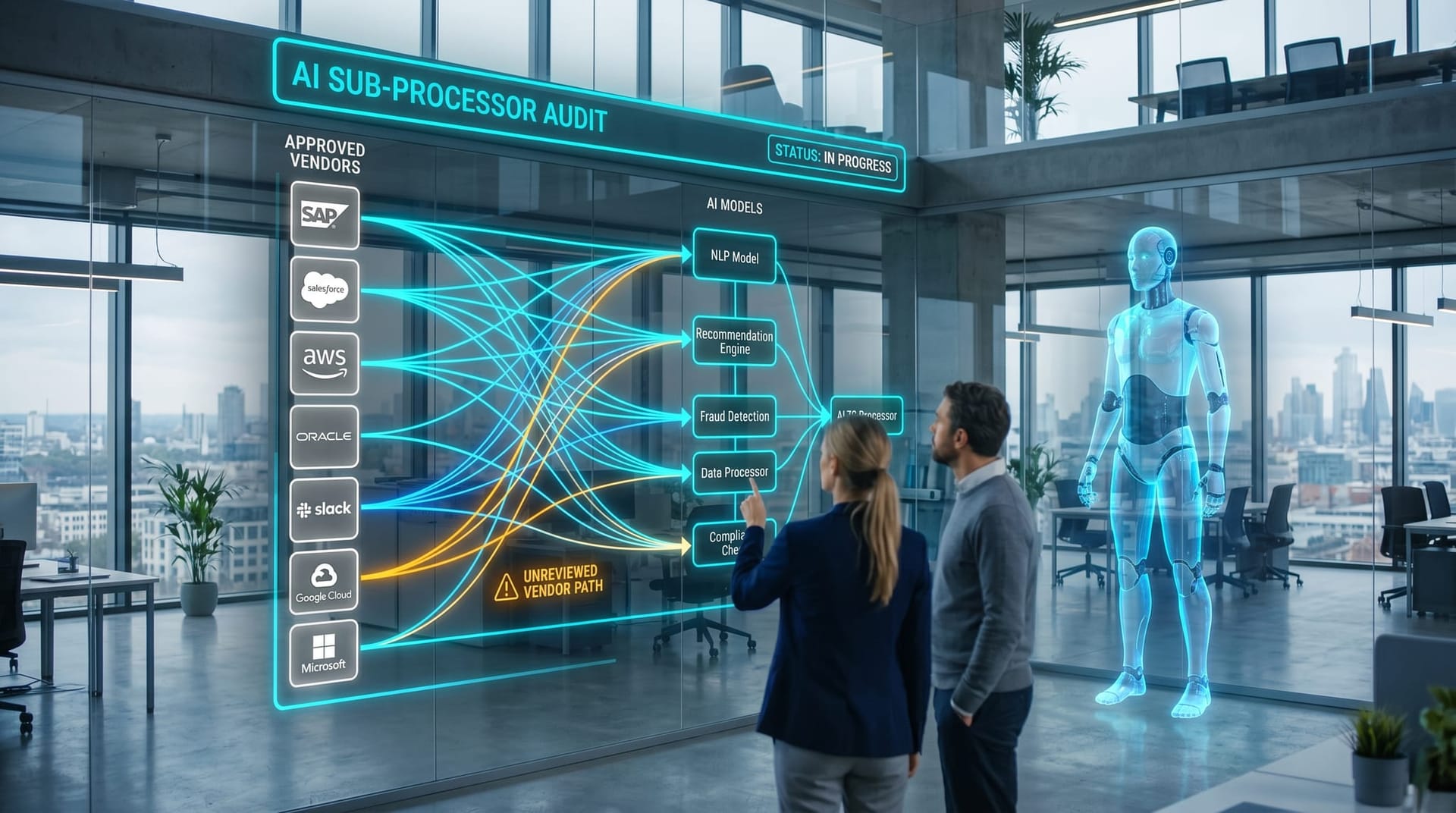
You spent weeks vetting your CRM vendor. Someone read the security questionnaire, someone signed the data processing agreement, and the contract named exactly which sub-processors were allowed to touch your customer records. That review was real, and it was correct — on the day you signed it. The problem is that the software you approved is not the software you are running today, because somewhere between then and now your vendor shipped an “✨ AI” toggle, switched it on, and started routing your customer and operational data through an AI model that was never on the list you reviewed.
This is not the shadow-AI story everyone already knows — the one where an employee pastes a contract into a consumer chatbot. That story is real, and we covered it in depth in shadow AI is your biggest data risk in 2026. This is a different blind spot, and almost nobody is auditing it: your approved vendor becomes an unapproved AI data egress path the moment they enable a new AI feature. VentureBeat reported on this directly this week, surfacing a DataGrail finding that your vendor may be sending data to AI models you never approved. I want to give that finding a name you can act on — AI sub-processor sprawl — and a concrete audit a single ops or IT lead can run in a week.
The short version of the thesis: your vendor's AI is your shadow AI. It hides behind a logo you already trust, inside a contract you already signed, under a feature you never asked for. Here is how it accrues, where to look for it, the contract language that closes the gap, and the minimum-viable inventory a mid-market team can actually maintain.
Key Takeaways
- AI sub-processor sprawl is distinct from classic shadow AI: it is your approved SaaS vendor quietly switching on AI features that route your data to third-party AI models you never reviewed.
- The exposure hides inside tools that already passed your last security review — CRM, helpdesk, marketing, HR, and accounting apps — so it rarely triggers a new approval workflow.
- The defensible control points are a vendor AI inventory, the right DPA and AI-addendum clauses, and an outbound data-egress gateway that sees what is leaving and where it goes.
- The contract language that matters: sub-processor disclosure that explicitly covers AI model providers, a training opt-out, tenant isolation, and a definition of which features count as “AI features.”
- A 20-to-60-person operator cannot run a Fortune-500 vendor-risk program, but it can run a minimum-viable AI sub-processor inventory in roughly a week.
- Treat every vendor's AI toggle as a sub-processor change, not a product update — because legally and practically, that is what it is.
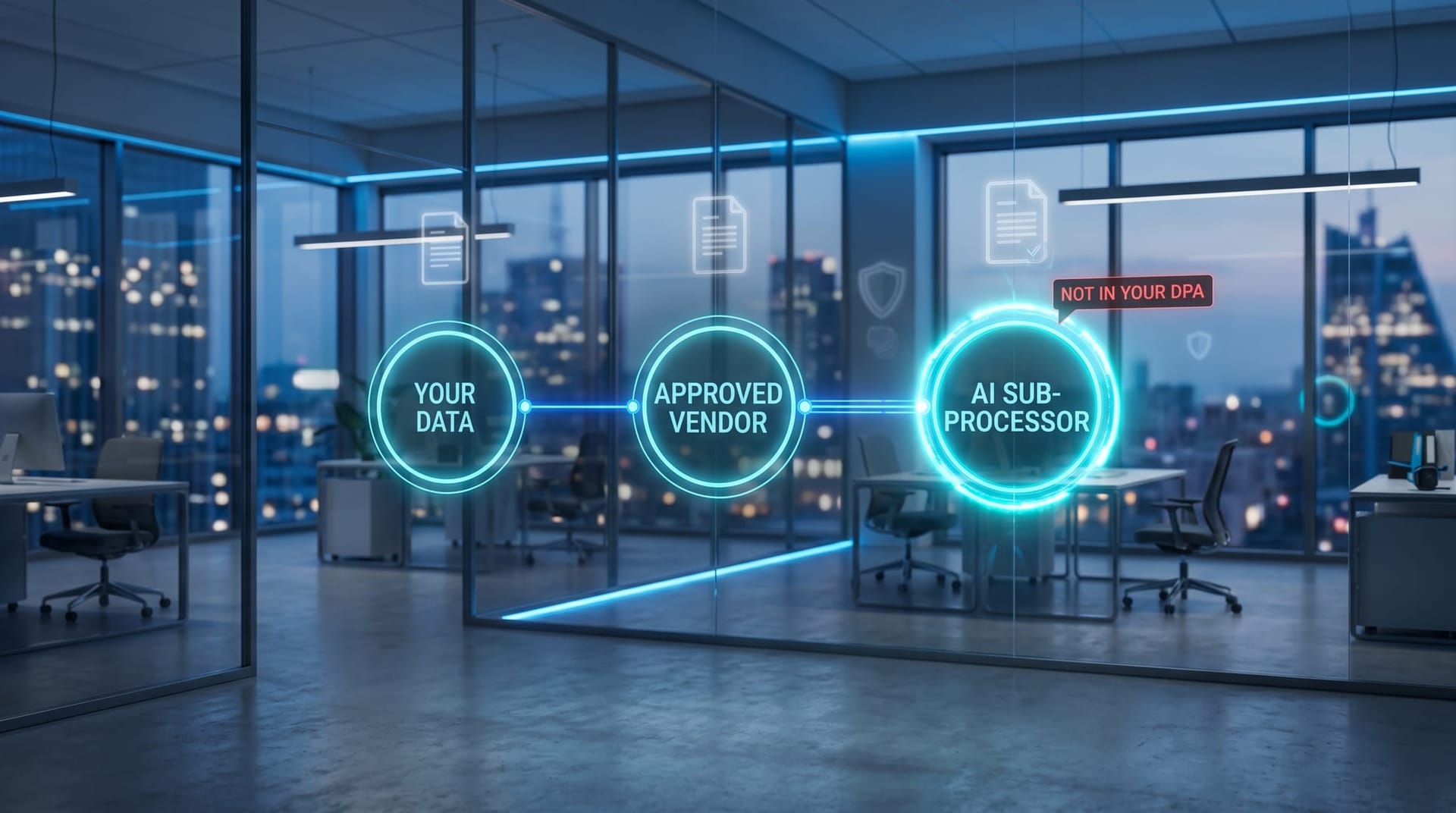
What Is AI Sub-Processor Sprawl, and Why Doesn't Your Shadow-AI Policy Catch It?
Start with the word that makes this a governance problem and not just an IT annoyance: sub-processor. Under data-protection frameworks like the GDPR, when you hand customer data to a vendor, that vendor is a processor acting on your behalf, and anyone they hand it to is a sub-processor. Your contract is supposed to list them. The legal weight of the distinction is real enough that privacy-tooling vendors now treat it as a first-class object — DataGrail, for instance, added a dedicated “Sub-Processor” role to its data map in May 2026, describing it as “a legally distinct role from ‘Processor’ under GDPR.” The point is simple: a sub-processor you never disclosed is a compliance gap, whether or not anything bad has happened yet.
AI sub-processor sprawl is what happens when your vendor adds a new AI model provider to that chain without telling you in a way that lands. The model behind the feature — an OpenAI, an Anthropic, a Google, or a smaller specialist — becomes a sub-processor of your data the instant the toggle flips. You did not approve it. It is not in your DPA. And your shadow-AI policy almost certainly does not catch it, because every shadow-AI control most companies have built is pointed at employees adopting tools, not at vendors adding capabilities to tools you already use.
That is the structural reason this slips through. As Obsidian Security put it in its analysis of how shadow AI hides in the SaaS you already trust, “AI features can often be enabled without triggering security reviews or approval workflows” because they arrive in applications that “already passed your last security review.” Your third-party risk management process is built around onboarding. It fires once, at the start of the relationship. When the vendor later introduces a new AI capability, the same scrutiny rarely happens — even though, as Obsidian notes, the potential risk can be just as significant. This is the same governance lag we wrote about in your AI tools are already ahead of your AI policies, pointed at a new target: the gap is no longer just between your employees and your policy, it is between your vendors' roadmap and your last review.
How Does an Approved Vendor Become an Unapproved AI Data Egress Path?
The mechanics are mundane, which is exactly why they are dangerous. A SaaS vendor — under competitive pressure to ship AI — adds a feature that summarizes, drafts, classifies, or “analyzes” the data already sitting in their product. To do that, the data has to reach a model. Sometimes that model is the vendor's own; very often it is a third party the vendor calls through an API. Either way, your data has now traveled somewhere new, and the trip happened during an ordinary product update you had no reason to scrutinize.
Obsidian's research makes the scale concrete. In a single 30-day window, it documented 69,749 interactions between users and corporate data through SaaS-embedded AI features — “most of which,” it notes, “would have gone unnoticed without in-browser detection.” It names the pattern across vendors most businesses run every day: Slack AI summarizing conversations with access to message history, Zendesk AI converting internal knowledge-base content, Airtable AI analyzing customer data to generate workflows. None of those are rogue tools an employee smuggled in. They are features inside sanctioned platforms, switched on by the vendor.
The reason a single employee enabling one feature is more than a one-person problem is contractual. As Obsidian observes, that employee “could inadvertently put your organization in breach of contract” — because your own agreements with your customers may promise that their data will not be processed by AI, or will not leave a defined set of sub-processors. When your vendor's AI feature quietly violates that promise, the liability is yours, not the vendor's, and not the employee's. This is adjacent to the customer-facing exposure we documented in is your AI chatbot handing out real customer data — except here the leak is not in a bot you deployed, it is in a back-office tool you forgot could even reach a model.
It is also distinct from two other vendor-AI risks worth separating cleanly. It is not the code supply chain — the question of whether your vendor's software pipeline is secure, which we covered in the vendor release-pipeline buyer test. And it is not model drift — the risk that a vendor silently swaps the model under your validated workflow, which we covered in when your AI vendor quietly changes the model. AI sub-processor sprawl is a third thing: a data egress problem. The wedge is not “is their code safe” or “did the model change,” it is “where is my data going now that it wasn't going last quarter.”

The 4-Row AI Sub-Processor Audit Matrix
You do not need to audit every vendor at once. You need to look hardest at the categories that hold the most sensitive data and ship the most AI features, and for each one know three things: where the AI data flow hides, what to demand in the contract, and the signal that tells you a vendor just turned AI on. The matrix below is the audit we recommend a lean team start with — four vendor categories, scoped to what one person can work through.
| Vendor category | Where the AI data flow hides | Contract / DPA clause to demand | Early-warning signal a vendor turned AI on |
|---|---|---|---|
| CRM & sales | “AI summary,” lead scoring, email drafting, and forecast features that read your full contact and pipeline records | Sub-processor disclosure that names AI model providers; a written training opt-out for your data | A new AI panel or “✨” icon in the record view; a release note mentioning “AI-powered” insights; a settings toggle defaulted on |
| Helpdesk & support | Ticket summarization, suggested replies, and knowledge-base “answer” features that ingest customer messages and internal docs | Tenant isolation so your data is not commingled or used to improve a shared model; data-residency commitment | A new “draft with AI” button in the agent console; auto-generated macros; an email announcing a support copilot |
| Marketing & email | Generative copy, audience analysis, and send-time tools that process your contact lists and engagement data | A clear definition of “Covered AI Services” and notice before any new AI feature processes your data | A beta invite to an AI content assistant; new AI fields in segmentation; list data appearing in “AI insights” |
| HR, recruiting & accounting | Resume screening, document analysis, and “ask your data” features touching employee PII and financial records | Sub-processor list updates pushed to you in advance; deletion and audit rights covering AI processing | A new AI assistant in the back-office app; AI-scored candidates; an “analyze with AI” option on financial reports |
Read the matrix as a set of questions to take to each vendor, not as a verdict. The “early-warning signal” column matters most, because it is the cheap, repeatable check: you are training yourself and your team to treat a new “✨” icon as a sub-processor change that requires review, not as a free upgrade. The cost of getting this wrong is well documented. IBM data compiled in Unseen Security's State of Shadow AI 2026 report attributes 65% of shadow-AI incidents to PII exposure and adds roughly $670,000 in additional cost per breach when shadow AI is involved — and the same report notes that fewer than 11% of AI applications in the workplace are even visible to IT teams. You cannot govern what you cannot see, and right now most of this is invisible.

What Contract and DPA Language Actually Closes the Gap?
Discovery tells you where your data is going. Contract language is what keeps it from going somewhere new without your say-so. The good news is that you do not have to draft this from scratch — the privacy field has converged on a short list of clauses that specifically address AI features, and DataGrail published a useful breakdown of what a procurement-ready AI addendum should contain. Four provisions do most of the work.
First, sub-processor disclosure that explicitly reaches AI providers. The addendum language is blunt about this: the vendor's obligations “apply to subcontractors, including third-party model/LLM providers,” and the vendor must hold those providers to terms “at least as strict as this addendum.” A generic sub-processor clause written in 2022 may not clearly cover an LLM API, so say so explicitly.
Second, a training opt-out. The cleanest version states that the vendor “will NOT use Customer Data, Inputs, or Outputs for training, retraining, fine-tuning, or improving any model or AI system” unless you authorize it in writing. This is the single most important line for protecting your customers' data from becoming someone else's model weights.
Third, tenant isolation. The addendum calls for customer data and outputs to be held in “logically or physically separate tenant infrastructure,” with controls to prevent commingling across customers. This is what stops your data from leaking into a model or a cache that other tenants can reach.
Fourth — and most specific to this problem — a definition of what counts as an AI feature, plus notice before new ones go live. DataGrail's guidance stresses defining “Covered AI Services” clearly, because an addendum that does not say which features it governs governs nothing. Pair the definition with a contractual requirement that the vendor notify you before any new AI capability begins processing your data. That single clause converts a silent toggle into a reviewable event — which is the whole goal. Recommendation, not legal advice: have counsel adapt these to your contracts, and prioritize the vendors from your audit matrix that hold regulated data.
How Does a Secure AI Gateway Become Your Vendor-Data Control Point?
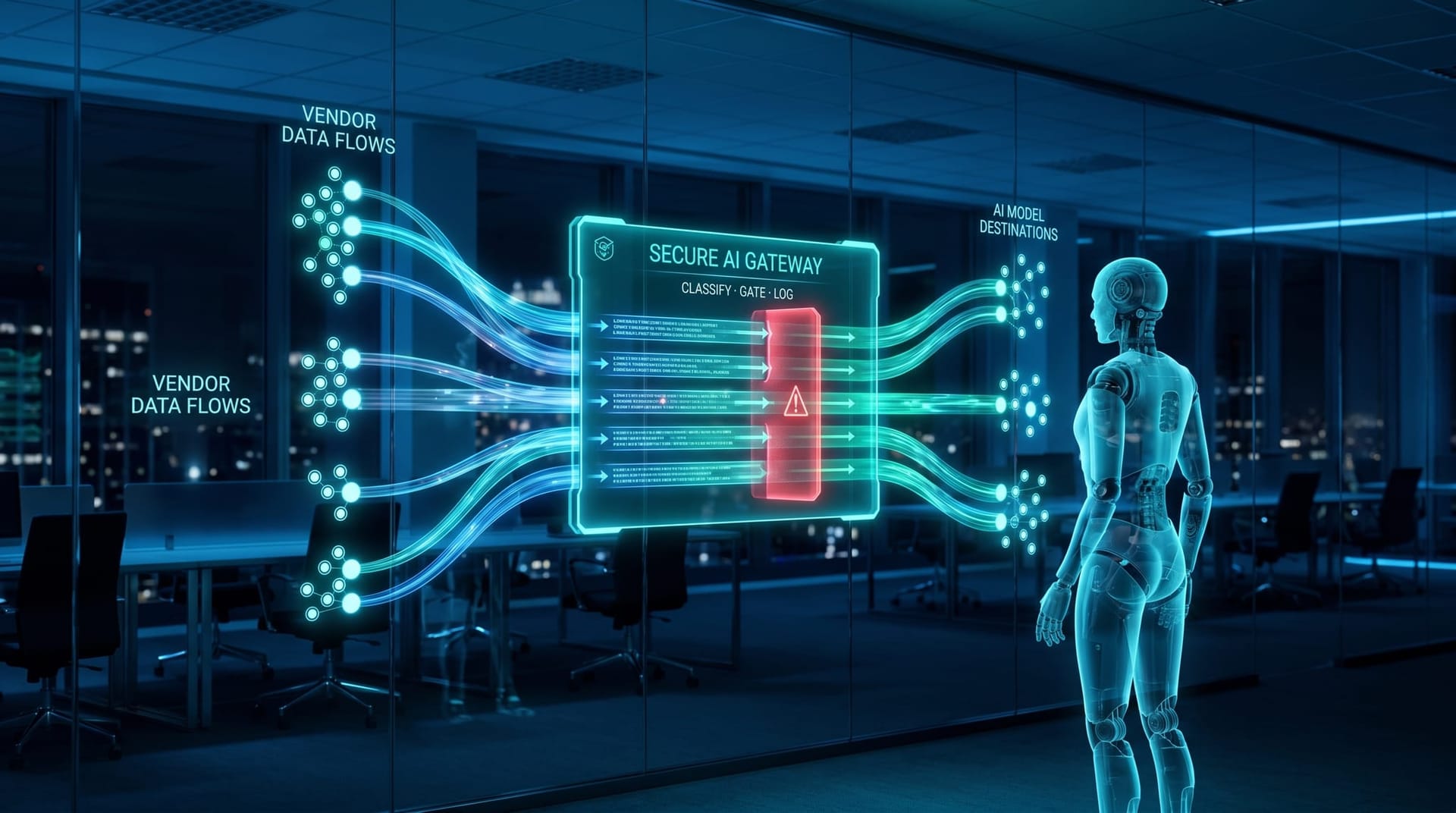
Contracts govern behavior you can see. The harder half of this problem is the behavior you cannot see — the API call your vendor makes to a model, the data field that gets included in a “summary,” the feature that shipped last Tuesday. Paper controls do not detect those. A technical control point does, and that is the role a Secure AI Gateway plays: it sits on the path your data takes out of your environment, so outbound flows toward AI services get inventoried, classified, and gated rather than assumed.
In practice that means three capabilities working together. The gateway maintains a live inventory of which destinations your data is actually reaching, so a model endpoint that was not there last month shows up as a change instead of staying invisible. It classifies what is in those flows, so you can distinguish a harmless metadata call from one carrying customer PII or regulated records. And it gates — it lets you set policy on what categories of data are allowed to leave toward which categories of destination, and to block or alert when something crosses a line. That is the difference between hoping your vendor's new AI feature respects your DPA and seeing whether it does.
This is also where the human and the vendor sides of shadow AI finally meet one control plane. The employee pasting data into a consumer tool and the sanctioned SaaS app quietly calling an LLM are, from a data-egress standpoint, the same event: sensitive data leaving toward an AI model. A gateway treats them the same way, which is the right way — by the destination and the data class, not by whether someone meant to do it. DataGrail frames the underlying business stakes plainly in its 2026 product vision, where it cites S&P Global Market Intelligence in calling privacy risk the leading reason generative-AI projects fail. The control point is how you keep your own AI program from joining that statistic on account of a vendor's roadmap.
What Does a Minimum-Viable AI Sub-Processor Inventory Look Like for a Northeast Indiana Operator?
A 20-to-60-person operator in Allen County or DeKalb County — a regional insurance brokerage, a specialty manufacturer, a multi-location home-services firm, a community clinic group — cannot run a Fortune-500 vendor-risk program. There is no dedicated third-party risk team, no procurement office, often no full-time security hire. That is precisely why AI sub-processor sprawl is a sharper risk here than at a large enterprise: nobody is watching the vendors' release notes, so the toggles flip unobserved.
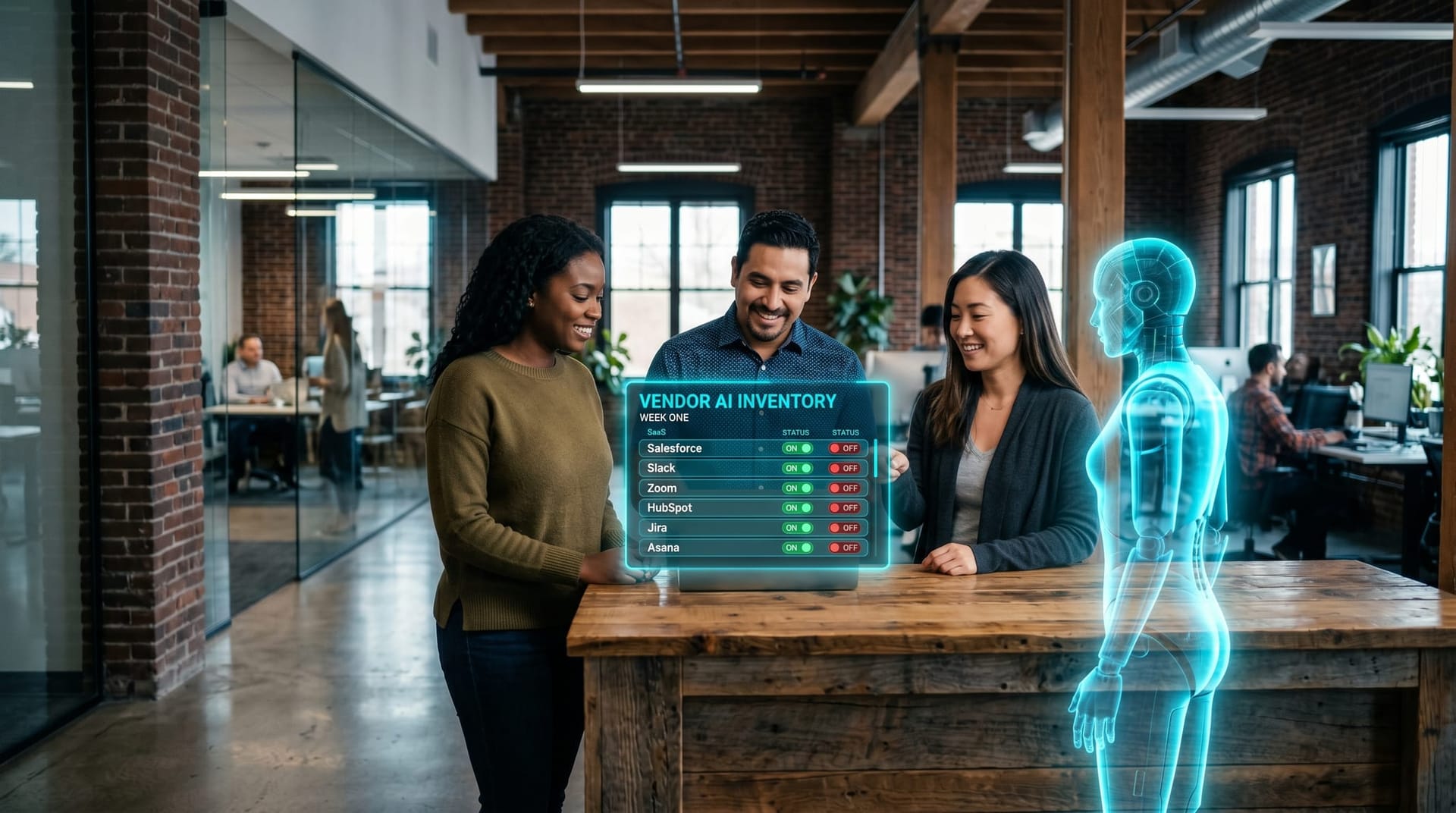
The realistic answer is a minimum-viable inventory one ops or IT lead can build in about a week, not a program. List the ten or so SaaS tools that hold your most sensitive data — customer records, employee PII, financial data, anything covered by a customer contract. For each, write down three things: what AI features it currently offers, whether those are on or off, and where its sub-processor or AI sub-processor list lives. Many privacy-forward vendors now publish AI sub-processors directly; that public page is your cheapest monitoring tool. Then set a recurring 30-minute calendar block to re-check that list and scan release notes for the “early-warning signals” from the matrix above. That is the whole program for a business this size: a spreadsheet, a recurring reminder, and the discipline to treat a new AI toggle as a sub-processor change. If you would rather not build it from a blank page, our AI consulting engagements start with exactly this inventory for Fort Wayne and Northeast Indiana operators.
Get Ahead of Your Vendors' AI Before It Becomes Your Breach
The pattern here is not malicious, and that is what makes it easy to miss. Your vendors are not trying to expose your data; they are racing to ship AI, and your DPA is collateral. But the liability for where your customers' data ends up is yours, regardless of whose toggle moved it. The businesses that handle this well are not the ones with the biggest legal team — they are the ones who decided to see their vendor AI flows instead of assuming them.
Cloud Radix helps Northeast Indiana businesses build that visibility: a vendor AI inventory, the DPA and AI-addendum language to demand, and a Secure AI Gateway that turns outbound data egress from a guess into a monitored, gated control point. If you are not sure which of your approved vendors have quietly become unapproved AI sub-processors, that is the audit to run first — and our AI consulting team runs it with you. Catch it now, while it is a spreadsheet exercise — book a vendor-AI audit and we will run the first inventory with you. The alternative is finding out from a customer, a regulator, or an incident report.
Frequently Asked Questions
Q1.What is an AI sub-processor?
An AI sub-processor is a third-party AI model or service that processes your data on behalf of a vendor you have already approved. When your CRM, helpdesk, or marketing tool sends your data to an AI model — its own or an external provider's — to power a feature, that model becomes a sub-processor in your data chain. Under frameworks like the GDPR, sub-processors are supposed to be disclosed and contractually governed, so an undisclosed AI sub-processor is both a security exposure and a compliance gap.
Q2.How is this different from regular shadow AI?
Classic shadow AI is an employee adopting an unapproved AI tool — for example, pasting company data into a consumer chatbot. AI sub-processor sprawl is a vendor adding an AI feature to a tool you already approved, routing your data to a model that was never in your contract. The data exposure is similar, but the cause is different: one is a person bypassing your controls, the other is a vendor outrunning your last review. Your existing shadow-AI policy, built around employee tool adoption, usually does not catch the vendor version.
Q3.How do I find out if my vendors are sending data to AI models?
Start with the ten SaaS tools holding your most sensitive data. For each, check the product for AI features and whether they are enabled, review release notes and settings for AI-powered additions, and look for a published sub-processor or AI sub-processor list — many privacy-forward vendors now post one. For flows you cannot see from the product UI, a secure AI gateway that monitors outbound data egress will surface which AI destinations your data is actually reaching, including ones that appeared recently.
Q4.What contract clauses protect my data from a vendor's AI features?
Four clauses do most of the work: sub-processor disclosure that explicitly covers third-party AI and LLM providers; a written opt-out barring the vendor from using your data to train or fine-tune any model; tenant isolation so your data is not commingled or used to improve a shared model; and a clear definition of AI features paired with advance notice before any new one processes your data. Have counsel adapt these to your existing agreements and prioritize vendors that hold regulated data.
Q5.Can a small business realistically audit this without a security team?
Yes. A 20-to-60-person business does not need a third-party risk program — it needs a minimum-viable inventory. List your most sensitive SaaS tools, record each one's AI features and on/off status and where its sub-processor list lives, and set a recurring 30-minute check to scan for new AI toggles. That is a spreadsheet and a calendar reminder, not a department. The discipline that matters is treating a new vendor AI feature as a sub-processor change that requires review rather than as a free upgrade.
Q6.Does this matter for a small Northeast Indiana business, or only large enterprises?
Arguably it matters more for a small business. A 20-to-60-person operator in Fort Wayne, Auburn, or across Allen County and DeKalb County rarely has a dedicated third-party risk team watching vendors' release notes, so AI toggles flip unobserved. The defense scales down to fit: a one-page inventory of your ten most sensitive SaaS tools, a note on which AI features each has enabled, and a recurring 30-minute review. Cloud Radix runs exactly that audit with Northeast Indiana operators as a starting consulting engagement.
Q7.Is my business liable if a vendor's AI feature exposes customer data?
Generally, yes — and that is the uncomfortable core of this issue. In most data-protection frameworks and customer contracts, you are the data controller responsible for where your customers' data goes, even when a sub-processor you did not explicitly approve is the one that moved it. If your own customer agreements promise limits on AI processing or on which sub-processors may touch the data, a vendor's silent AI feature can put you in breach. That is why disclosure clauses and a monitored egress control point matter: they keep the liability you already carry from being triggered by a decision you never made.
Sources & Further Reading
- VentureBeat: venturebeat.com/security/datagrail-report-finds-your-vendor-may-be-sending-data-to-ai-models-you-never-approved — DataGrail report finds your vendor may be sending data to AI models you never approved.
- Obsidian Security: obsidiansecurity.com/blog/shadow-ai-in-saas — Shadow AI isn't just new tools, it's hiding in the SaaS you already trust.
- DataGrail: datagrail.io/blog/company/engineering/datagrails-2026-product-vision — DataGrail's 2026 Product Vision: Wrangling Risk in an AI World.
- DataGrail: datagrail.io/blog/privacy-ai-prompts/create-a-procurement-ready-ai-addendum — Create a Procurement-Ready AI Addendum Using This 521-Word Prompt.
- DataGrail: docs.datagrail.io/changelog/2026-05 — May 2026 Product Updates (Sub-Processor legal role in Live Data Map).
- Unseen Security: unseensecurity.ai/shadow-ai-report — The State of Shadow AI 2026.
Find the AI Sub-Processors Hiding in Your Stack
We will run the first vendor AI inventory with you, flag the approved vendors that have quietly become unapproved AI sub-processors, and show you the DPA language and the Secure AI Gateway controls that close the gap.