
You check your Google ranking and you feel fine. You're on page one for “HVAC repair Fort Wayne,” maybe even in the map pack. By the old rules, you're winning.
Then a prospect in Aboite opens ChatGPT and types, “Who's the best HVAC company in Fort Wayne?” The model thinks for a second and names three businesses — confidently, in a tidy paragraph, with no blue links to scroll. You are not one of them. The buyer calls one of the three. You never knew the conversation happened.
That's the AI visibility gap, and it's the uncomfortable sequel to a decade of SEO wins. Ranking #1 in the links does not mean you exist in the answer. A business can dominate classic search and be functionally invisible the moment a buyer asks an assistant instead of a search box. You're winning a race fewer and fewer people are running.
This post is the diagnostic, not the victory lap. We'll cover why great Fort Wayne brands get left out of AI answers, how to tell in a few minutes whether ChatGPT, Perplexity, Gemini, or Google's AI Overviews ever mention your business, and what it actually takes to get cited again. It's grounded in public research on how these systems pick their sources — and in the work we do every day helping Northeast Indiana businesses show up where buyers now look.
Key Takeaways
- Ranking #1 in Google's blue links doesn't mean an AI assistant will name you — appearing in an answer (a “mention”) and being used as a source (a “citation”) are two different things, and you can miss both.
- A growing share of buyers now ask ChatGPT, Perplexity, Gemini, or Google's AI Overviews for recommendations instead of scrolling classic results — and they act on the names the model volunteers.
- Local brands vanish from AI answers for structural reasons: thin or ungrounded pages, no machine-readable facts, and little of the third-party corroboration the models lean on.
- You can self-audit in minutes — prompt the major assistants with your category plus “Fort Wayne” and see whether you're named, a competitor is, or no local business surfaces at all.
- Getting cited again is an AEO project — structured facts, deep answer-shaped pages, and earned third-party mentions — not a one-afternoon meta-tag fix.
Why does ranking #1 on Google no longer guarantee you show up in AI answers?
Because the answer and the link list are no longer the same surface. For twenty-five years, “being found” meant climbing a ranked list of ten blue links. An AI assistant doesn't hand the buyer a list — it hands them a decision, written as prose, with a short set of sources behind it. Your job changed from rank on the page to get named in the paragraph, and those are different competitions with different rules.
The first thing to understand is that there are two separate ways to show up, and most owners conflate them. Ahrefs' Brand Radar documentation draws the line clearly: a mention is “the total times each brand appears in AI responses,” while a citation is “the number of responses that cite the brand URL at least once.” You can be mentioned without being cited, cited without being prominent, or — most commonly for local businesses — neither. Ahrefs tracks “citation gaps” and “mention gaps” as distinct problems precisely because a brand can turn up in the text yet never be the source the model actually trusted.
The second thing is that the click itself is disappearing, which is why your ranking stopped translating into traffic. Pew Research Center analyzed 68,879 Google searches from 900 U.S. adults in March 2025 and found that roughly 18% already returned an AI summary. When one appeared, users clicked a traditional result link in only 8% of visits — versus 15% when there was no summary. And they almost never clicked the sources inside the summary: that happened in just 1% of visits. People were also more likely to end the session entirely, on 26% of pages with an AI summary compared with 16% without.
Read those two findings together and the problem snaps into focus. The answer increasingly is the destination, the sources under it rarely get clicked, and your hard-won #1 ranking is sitting below a summary that most people treat as the final word. If you're not in the summary — or not among the handful of sources it drew from — your ranking is a trophy for a game that's winding down. This is the same structural shift we unpacked in the Google search box redesign: the surface where answers appear has changed, and the old scoreboard no longer measures what matters.

How are Fort Wayne buyers actually finding businesses now?
They're asking, not searching. And this isn't a fringe behavior you can wait out. In its What Matters to Today's Consumer 2025 report, surveying 12,000 consumers across 12 countries, the Capgemini Research Institute found that 58% of consumers had replaced traditional search engines with generative AI tools for product and service recommendations — up sharply from 25% in 2023. The same report found 71% want generative AI built into their shopping experience and 68% want it to aggregate results from search engines, social platforms, and retailer sites into a single answer. The direction of travel is one-way.
The practical version in Fort Wayne looks like this. A homeowner near Southwest Allen County asks an assistant for “a reliable plumber in Fort Wayne.” A new office manager at a DeKalb County manufacturer asks, “Which IT companies in Northeast Indiana handle compliance?” A patient asks, “Best family dentist in Fort Wayne that takes new patients.” In each case the buyer gets a short, named shortlist and starts calling from the top — without ever seeing your map-pack listing.
The scale of the shift is now measurable at the brand level. In its 2026 AI Visibility Index, Semrush analyzed 126 million U.S. AI search prompts from January through April 2026 across more than 1,200 brands in 22 industries. Only 36 of those brands — a group Semrush nicknamed the “Universal 36” — held top-100 visibility across all four major platforms every month of the study. Everyone else was inconsistent: present on one assistant, absent on another, there in March and gone in April. Semrush also reported that AI-referred traffic to U.S. retail sites rose 1,324% between October 2024 and May 2026. Buyer attention isn't trickling toward answer engines; it's pouring.
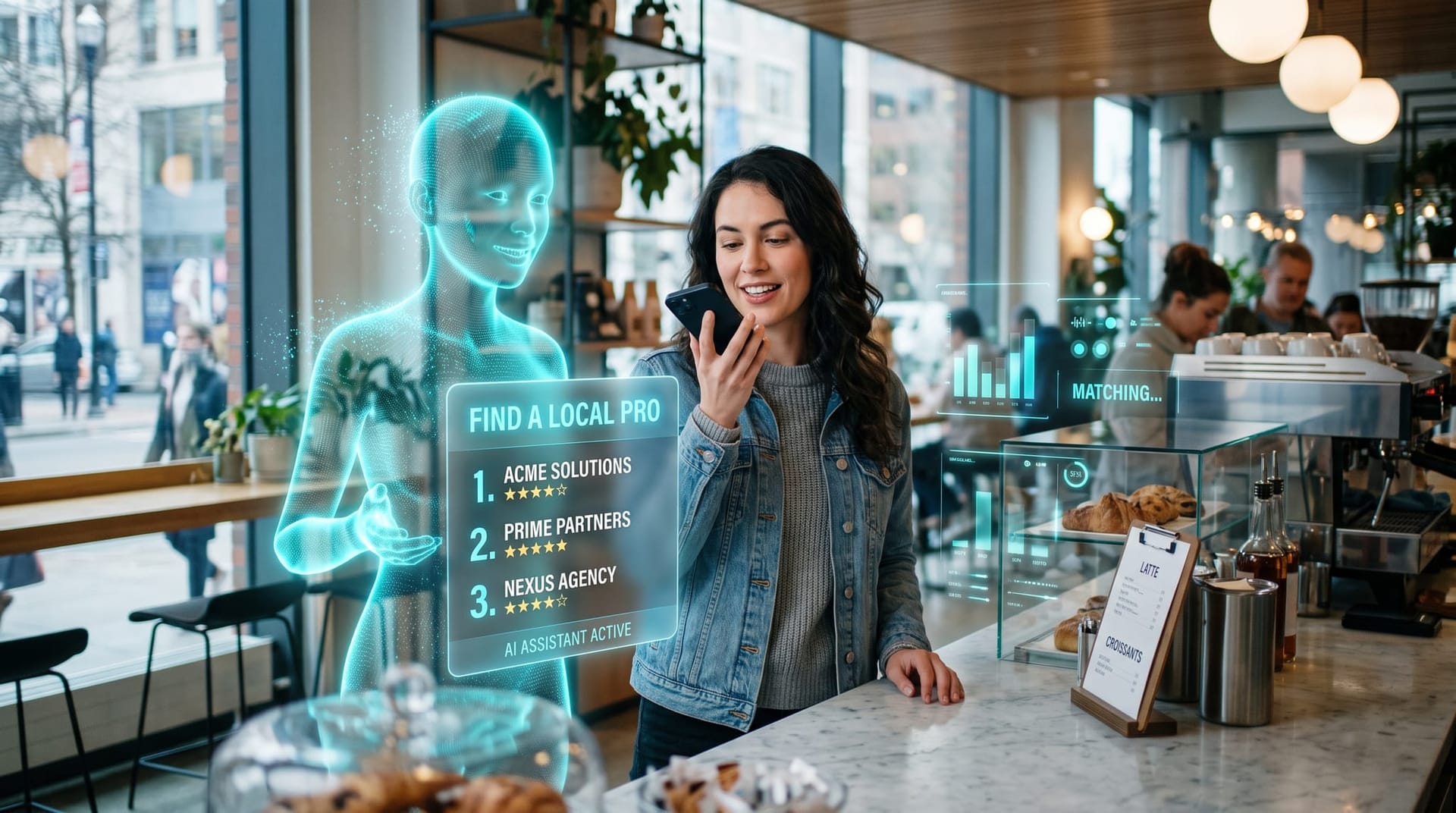
Investors see the same migration. Writing in Fortune, Lightspeed's Sachin Patel described “this massive migration happening, where consumer attention is moving from search engines into answer engines,” and added, “This isn't a theoretical shift, it's happening now.” The question for a Fort Wayne owner is no longer whether buyers ask AI — it's whether the AI knows you exist when they do.
Why do great local brands get left out of AI answers?
This is the part that stings, because the businesses that vanish are often the good ones — the shop with the loyal customers and the spotless reputation that simply never built a website an AI can read. The models aren't judging your service quality. They're judging the evidence trail, and most local brands haven't left one.
Here are the recurring reasons we see when a Fort Wayne business is missing from the answer:
| Why You Vanish | What the Model Sees | The Fix Lane |
|---|---|---|
| Thin, marketing-only pages | No concrete, extractable facts to quote | Deep, answer-shaped content |
| No machine-readable structure | Services, areas, and hours buried in prose or images | Structured data and clean facts |
| Little third-party corroboration | Nobody credible confirms what you claim | Earned mentions and citations |
| Inconsistent NAP and details | Conflicting facts across the web — low trust | Consistent, verifiable info |
| Homepage-funnel site design | Deep pages that could get cited don't exist | Rebuild around answerable questions |
The corroboration problem is the one owners underestimate most. Generative models heavily favor sources that are independently verifiable. Muck Rack's What Is AI Reading? report, which analyzed more than 25 million links cited across ChatGPT, Claude, and Gemini, found that earned media drives about 84% of AI citations, while paid and advertorial content accounts for just 0.3%. The report also found that Wikipedia is ChatGPT's single most-cited domain — a blunt signal that these systems reach for neutral, corroborated reference material over your own self-description. You cannot pay or self-declare your way into the answer; the model wants to see that someone else vouched for you.
Then there's volatility, which makes the gap feel random when it isn't. Profound's internal research, reported in the same Fortune piece, found that up to 90% of the sources cited in AI answers can change over time, and that different models lean on largely distinct sets of sources. So you might appear in Perplexity today, miss on ChatGPT tomorrow, and resurface next month. That churn is exactly why a one-time fix doesn't hold — and why the structural problem matters more than any single answer. Much of this traces back to a site that's built backward for AI search: all the authority lives on a homepage that answers nothing, while the deep service and FAQ pages an assistant would actually cite were never written.

How can you tell if AI assistants mention your Fort Wayne business?
You don't need a tool to start — you need ten minutes and a little honesty about what comes back. Run the same prompts your buyers would, on the assistants they actually use, and read the results like a customer, not an owner.
Here's a self-audit you can do today:
| Step | What to Do | What You're Looking For |
|---|---|---|
| 1. Ask the obvious question | In ChatGPT, Perplexity, Gemini, and Google AI Overviews, type “best [your category] in Fort Wayne” | Are you named at all? Who is? |
| 2. Ask the buyer's real question | “Which [category] in Fort Wayne handles [specific need]?” | Do you surface for the work you actually want? |
| 3. Check mention vs. citation | When you are named, is your site linked as a source — or just mentioned in passing? | A plain mention with no link is a citation gap |
| 4. Test variations | Swap in “Northeast Indiana,” “Allen County,” neighborhoods, and nearby towns | Consistency across phrasings and platforms |
| 5. Ask “who should I avoid / compare” | “Compare [your category] companies in Fort Wayne” | Whether you're in the consideration set at all |
Three outcomes are possible, and each means something different. If a competitor is named and you aren't, you have a corroboration and content gap they've closed and you haven't. If no local business surfaces and the model gives generic national advice, the whole Fort Wayne category is under-optimized — which is an opportunity, because the first business to get cited often stays cited. And if you're mentioned but never linked, you have the citation gap Ahrefs describes: the model knows your name but doesn't trust your pages enough to source them.
When you're ready to move past spot-checks, this is measurable continuously. Platforms like Ahrefs Brand Radar, Semrush's AI visibility tracking, and Profound exist specifically to monitor mentions, citations, and share of voice across assistants over time — which matters given how much the answers churn. Semrush's own index noted that 45% of marketing leaders can't yet accurately measure their brand's visibility inside AI answers, so if this feels like uncharted territory, you're in the majority. The companion move on the technical side is to run an agent-readiness audit on your site, which grades how well AI systems can actually read and use your pages in the first place.

What actually gets a Fort Wayne business cited again?
Getting back into the answer is less about tricks and more about leaving the evidence trail the models are looking for. Based on what the research shows these systems reward — and what we see work for Northeast Indiana clients — four things move the needle.
Publish concrete, extractable facts. Assistants quote specifics, not slogans. Replace “we're the area's trusted experts” with the things a buyer and a model both want: exactly which services you offer, which Fort Wayne and DeKalb County areas you serve, your hours, your certifications, your typical response times, honest pricing ranges. Facts are quotable; adjectives aren't.
Build deep, answer-shaped pages. One thin homepage can't compete with a library of pages that each answer a real question. Every service, every common FAQ, every local vertical deserves its own page structured so a model can lift a clean answer from it. This is the structural fix — the opposite of funneling every visitor to a homepage that answers nothing.
Earn third-party corroboration. Because earned media drives the overwhelming majority of citations and Wikipedia-grade reference sources sit at the top, your own site isn't enough. Local press, legitimate directories, reviews, partnerships, and mentions from other credible sites are what tell the model your claims are real. This is slow, unglamorous work, and it's the single biggest differentiator between the local brands that get cited and the ones that don't.
Keep your facts consistent everywhere. Conflicting addresses, phone numbers, and service descriptions across the web read as low-trust signals. One verifiable version of the truth, repeated consistently, helps the model feel safe naming you.
None of this is a weekend project, and we won't pretend otherwise — AI visibility compounds over months, not days, and the churn in the sources means it needs maintenance, not a single push. But the upside is real: once you're the business the assistant names, you capture buyers at the exact moment of decision. We've written before about what that AI search traffic is actually worth — it tends to convert far better than classic organic clicks, because the model has already pre-qualified you as the answer.

The Fort Wayne Reality: Winning a Race Nobody's Running
Here's the local gut-check. Fort Wayne and Northeast Indiana are full of excellent businesses — home-services crews, dental practices, law firms, manufacturers, financial advisors — that earned their reputations the hard way and assume that reputation carries online. For the Google era, it mostly did. For the answer era, reputation that lives in your customers' heads and your Google reviews doesn't automatically make it into the model's training and sources.
The businesses most exposed are exactly the ones that leaned hardest on word-of-mouth and local SEO and never invested in deep, factual web content. A buyer new to Fort Wayne — someone who just moved to Aboite, a transferred employee, a facilities manager sourcing a vendor — has no word-of-mouth network here. They ask the assistant. And the assistant names whoever left the clearest evidence trail, which may well be a newer or out-of-town competitor who simply publishes better.
The fix is within reach, and the local field is still wide open. Many Fort Wayne categories are under-optimized for AI answers right now, which means the window to become the cited local business in your trade is open in a way it won't stay. Winning the old race — ranking in the links — still matters, but it's no longer the whole game.
Ready to find out if AI mentions your Fort Wayne business?
Start with the ten-minute self-audit above. If the answers make you uncomfortable — a competitor named instead of you, or no local business at all — that's the signal to act, not panic. Our AEO services for Fort Wayne are built for exactly this: diagnosing where you're invisible across ChatGPT, Perplexity, Gemini, and AI Overviews, then rebuilding your web presence so the models can find, trust, and cite you. If you want the broader picture first, our answer engine optimization hub lays out the full approach. The buyers asking AI about your category are already deciding — get in touch and let's make sure your name is in the answer.
Frequently Asked Questions
Q1.What is the "AI visibility gap"?
The AI visibility gap is the difference between how well a business ranks in traditional search and whether it actually appears when buyers ask an AI assistant for a recommendation. A business can rank #1 on Google and still be absent from ChatGPT, Perplexity, Gemini, or Google's AI Overviews, because those systems write a short answer from a trusted set of sources rather than showing a ranked list of links.
Q2.Why would my business be missing from ChatGPT answers if I rank well on Google?
AI answers are built from sources the model trusts and can extract clear facts from — not from your Google ranking. If your pages are thin or marketing-heavy, lack machine-readable structure, or have little third-party corroboration, the model has no solid evidence to cite, so it names competitors who left a clearer trail. Ranking and being cited are two separate competitions.
Q3.How do I check whether AI assistants mention my Fort Wayne business?
Open ChatGPT, Perplexity, Gemini, and Google AI Overviews and ask the questions your buyers would — "best [your category] in Fort Wayne," then more specific versions with your real services and nearby areas. Note whether you're named, whether a competitor is named instead, and whether your site is actually linked as a source or just mentioned in passing. For ongoing tracking, tools like Ahrefs Brand Radar, Semrush, and Profound monitor AI mentions and citations over time.
Q4.What's the difference between a mention and a citation in AI search?
A mention is any time your brand name appears in an AI response; a citation is when the model actually uses your website as a source and links to it. According to Ahrefs, these are tracked as distinct metrics because a brand can be mentioned without being cited — the model knows your name but doesn't trust your pages enough to source them. Both matter, and local businesses often miss both.
Q5.How long does it take to start showing up in AI answers?
It's a compounding effort measured in months, not days. Because research from Profound found that up to 90% of the sources cited in AI answers can change over time, visibility also needs ongoing maintenance rather than a single fix. The work — publishing factual, answer-shaped pages and earning third-party corroboration — builds trust gradually, which is why starting sooner matters more than moving fast.
Q6.Is answer engine optimization different from SEO?
They overlap but aren't the same. SEO aims to rank your pages in a list of links; AEO (answer engine optimization) aims to get your business named and cited inside AI-generated answers. AEO leans harder on extractable facts, structured data, deep question-shaped pages, and earned third-party mentions — the signals Muck Rack's research shows drive the large majority of AI citations. Doing SEO well helps, but it doesn't automatically make you visible in AI answers.
Sources & Further Reading
- Capgemini Research Institute: capgemini.com/gb-en/news/press-releases — What Matters to Today's Consumer 2025, the survey of 12,000 consumers showing the shift from search engines to generative AI for recommendations.
- Pew Research Center: pewresearch.org/short-reads/2025/07/22 — Google users are less likely to click on links when an AI summary appears in the results.
- Semrush: semrush.com/news/463141 — Expanded 2026 AI Visibility Index, analyzing 126 million AI search prompts across 1,200+ brands.
- Muck Rack: media.muckrack.com/documents/What_Is_AI_Reading__May_2026.pdf — What Is AI Reading? (May 2026), an analysis of 25M+ links cited across ChatGPT, Claude, and Gemini.
- Ahrefs: ahrefs.com/aeo/track-ai-visibility — How to Track AI Visibility (Brand Radar), defining mentions versus citations.
- Fortune: fortune.com/2026/02/24 — As AI threatens search, Profound raises $96 million to help brands stay visible.
Find Out If AI Mentions Your Business
We will run the self-audit for you across ChatGPT, Perplexity, Gemini, and Google AI Overviews, show you exactly where your Fort Wayne business is invisible, and map the fastest path to getting cited again.
Get Your Free AI Visibility CheckNo contracts. No pressure. Just an honest look at whether the models name you.