The clearest signal that the AI industry is preparing for a structural shift is that the loudest research labs are no longer talking about the next-generation language model. They are talking about world models — systems that learn a simulation of physical or software environments and then reason and act inside that simulation, rather than generating the next likely token in a sequence. The MIT Technology Review feature framing the topic this week is short, and the editorial point of the piece is that world models are now part of the canonical “things that matter in AI right now” list.
That is a real architectural shift. It also does not change the buy-versus-train calculus for any business under roughly 5,000 employees. The point of this post is to define what a world model actually is in plain operational terms, walk through the systems that already exist in production research — Google DeepMind's Genie family, Meta's V-JEPA line, and NVIDIA's Cosmos world foundation models — and then prosecute the practical argument: world models will be embedded inside the AI agent layer over the next 12 to 24 months, not exposed as raw infrastructure to mid-market buyers. The business takeaway is that AI Employees become more capable as world models ship, not less needed.
This is a forward-looking piece, written for the operator who reads the same vendor pitches we read and wants to know which trend is structural and which is noise. World models are structural. The architectural conclusion is not that you need to build one. The architectural conclusion is that the layer that uses world models — the AI Employee abstraction — is where mid-market businesses should be investing this year.
Key Takeaways
- A world model is an AI system that learns a simulation of an environment (physical or software) and uses that simulation to reason about consequences, plan actions, and recover from failure — fundamentally different from a language model that predicts the next token in a sequence.
- The serious world-model systems in 2026 are Google DeepMind's Genie (action-controllable 3D environments), Meta's V-JEPA 2 line (video joint-embedding predictive architecture for robotics and physical reasoning), and NVIDIA's Cosmos platform (world foundation models targeted at robotics, autonomous vehicles, and industrial vision).
- For mid-market businesses, the architectural conclusion is not that you need to deploy a world model. It is that world models will be embedded inside the AI agent layer over the next 12 to 24 months, making AI Employees better at tool-use planning, physical-environment reasoning, and human-in-the-loop handoff.
- The buy-vs-train decision does not change for any business under roughly 5,000 employees. Training a world model requires research-scale GPU clusters, billions of frames of curated video, and a research team. Buying access via the AI Employee layer requires neither.
- The single most consequential business decision around world models is not which model to license. It is whether your AI deployment architecture treats models as substitutable processing layers, so that a world-model-enabled Claude or Gemini in 2027 plugs into the same agent runtime as today's text-only Claude or Gemini.
- For NE Indiana mid-market firms specifically, world models will arrive first as quiet capability upgrades inside AI Employee deployments — better workflow planning, fewer hallucinated tool sequences — rather than as new infrastructure line items.
What Is a World Model in Plain Operational Terms?
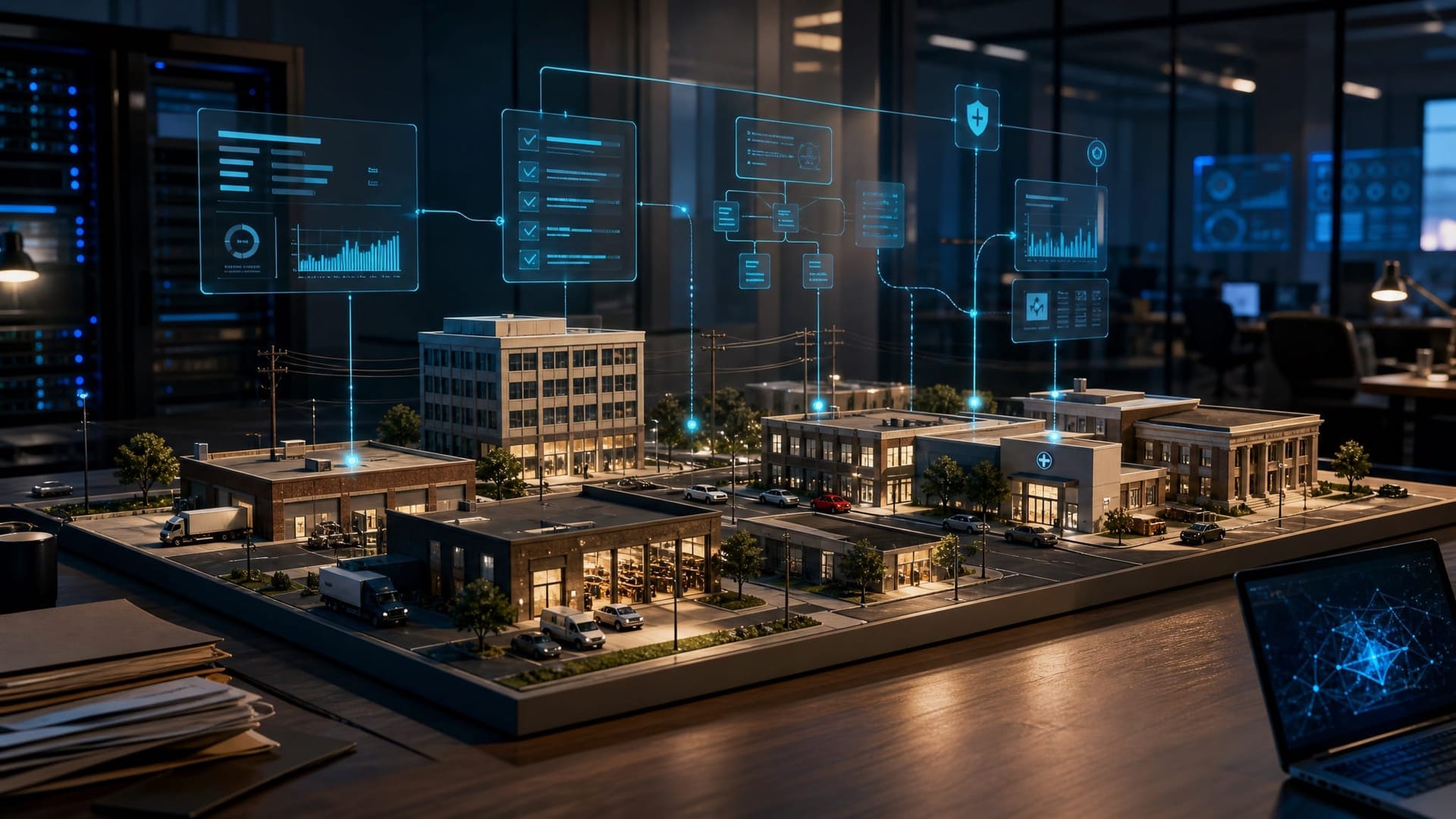
A world model is a learned simulation of an environment. The environment can be physical — the laws of a kitchen, a factory floor, a road, a warehouse — or it can be software — the structure of a web page, the state of a CRM, the response surface of an API. The defining property is that the model can predict what happens next in that environment as a function of an action taken by an agent. It is the difference between “predict the next likely sentence given this context” and “predict the next state of this environment given this action.”
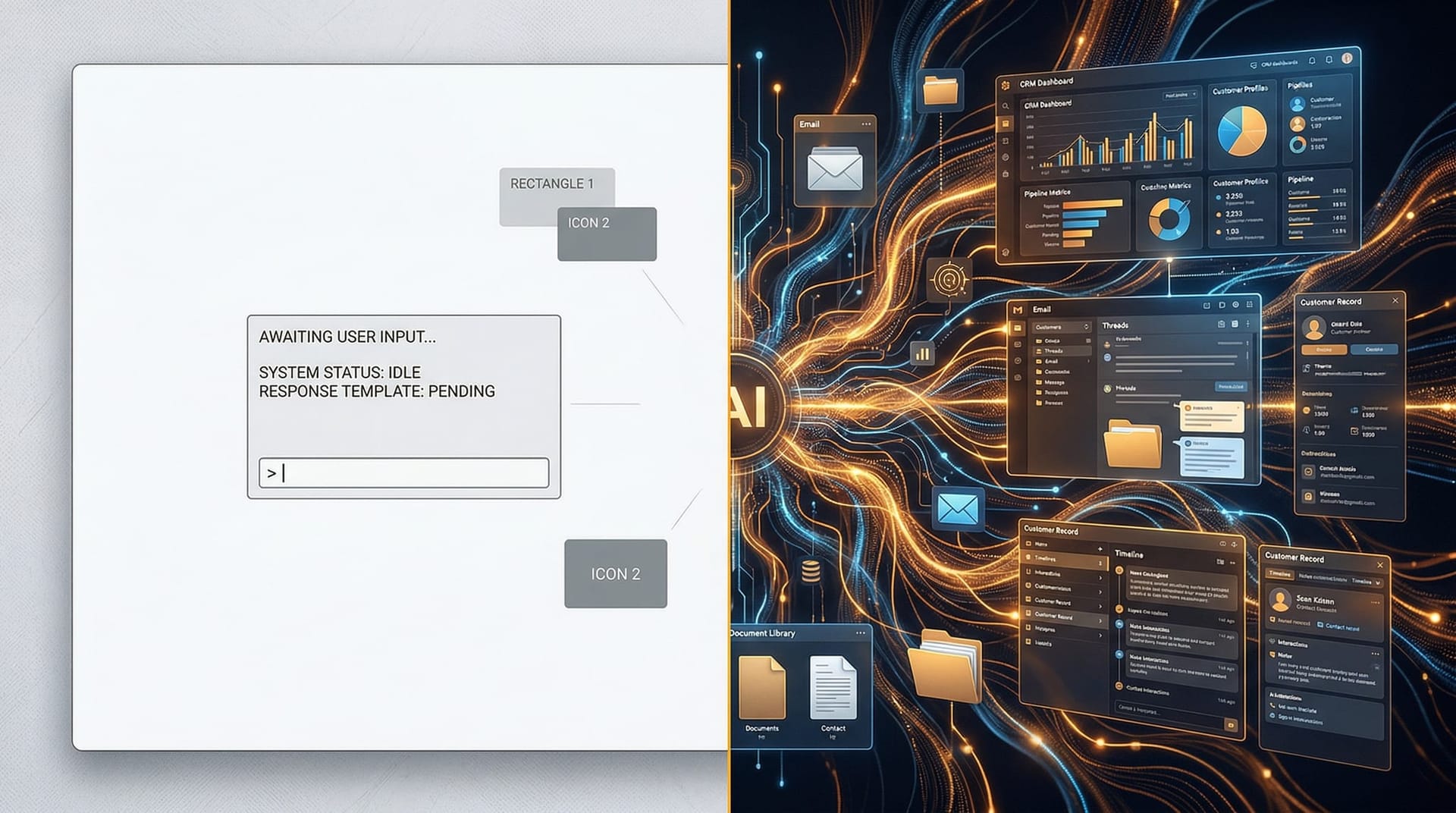
The architectural difference matters because the planning shape is different. A language-model-based agent picks actions by generating plausible-looking next steps in a token stream and hoping they correspond to a useful workflow. A world-model-based agent picks actions by simulating each candidate step inside its learned model of the environment, scoring the outcomes, and selecting the one whose simulated state matches the goal. The result is dramatically better planning under conditions where the environment is rich, the actions have side effects, and the cost of trial-and-error in the real environment is high.
Three current systems make the concept concrete. Google DeepMind's Genie 2, published in December 2024 and continuing to evolve, is described by the lab as a foundation world model that “can generate an endless variety of action-controllable, playable 3D environments for training and evaluating embodied agents.” It can simulate the consequence of an action — jump, swim, pick up an object — and maintain a consistent world for up to a minute of interaction. Meta's V-JEPA 2, released in June 2025 (with the research paper on arXiv), is a self-supervised video joint-embedding predictive architecture that achieves zero-shot robot planning — reaching, grasping, pick-and-place in unfamiliar environments after training on 62 hours of robot data. NVIDIA's Cosmos platform packages three world foundation models — Predict (30-second predictive video scenes), Transfer (sim-to-photoreal synthetic data), and Reason (a vision-language model that lets robots and AI agents “reason like humans” by combining knowledge, physics, and common sense) — and is explicitly targeted at robotics, autonomous vehicles, and industrial vision.
The pattern across all three systems is the same. A world model is a planning substrate, not a generation surface. It is built to inform an agent's actions inside an environment it has learned to predict, and the value of the architecture compounds with the richness of the environment and the cost of failure inside it.

What Problem Are World Models Actually Solving?
The clearest way to see why world models matter is to enumerate the failures of the current LLM-plus-agent stack that they directly address. The MIT Technology Review framing of “how AI may evolve to better reason about the real world” hints at this, but the operational answer is sharper.
First, today's agents hallucinate workflow steps. An agent told to schedule a meeting and email the participants will sometimes attempt to call an API that does not exist, miss a step in the sequence, or invent a plausible-looking but wrong tool signature. Those errors come from the agent's inability to actually simulate the consequence of a step before executing it. The model is generating a token stream that looks like a workflow, not running a workflow inside a simulated environment. A world-model-enabled agent can simulate the workflow first, catch the error before the side effects, and re-plan.
Second, today's agents struggle with physical-environment reasoning. A robot that needs to grasp an object whose weight, surface texture, and balance it has never seen before will, in the current generation, either fail or fall back on a hand-coded routine. V-JEPA 2's zero-shot robot planning result is the first credible signal that this changes — the system learned to plan from video alone and then transferred to novel objects without retraining. For industrial verticals — manufacturing, warehousing, logistics — this is the capability they have been waiting for.
Third, today's agents lose state across multi-step workflows. The compounding-memory architecture we covered in our Google ReasoningBank piece is one half of the answer — agents need to remember what they learned across runs. World models are the other half — the agent's reasoning surface should be a simulation, so that “what happened in the last run” is queryable as part of the same substrate as “what would happen if I tried this next step.” The knowledge-architecture discipline we covered in our LLM knowledge-base architecture beyond RAG writeup is what makes that substrate usable; world models make it more accurate.
Fourth, today's agents handle human-in-the-loop handoff badly. When an agent reaches an action it should not execute autonomously, the choice today is binary — execute or escalate. A world-model-enabled agent can simulate the consequence of the proposed action, present the simulation to a human reviewer, and resume only after the human's input has updated the simulated state. That is a qualitatively better handoff interface, and it is the one we expect to see ship inside agent runtimes over the next 24 months.
Why Will Most Businesses Not Train Their Own World Model?
The most important argument in this section is also the most boring. Training a competitive world model in 2026 requires research-scale GPU clusters, billions of frames of curated video or environment data, multi-month training runs, and a research team that can iterate on the architecture. The Genie 2, V-JEPA 2, and Cosmos efforts are at the scale of Google DeepMind, Meta FAIR, and NVIDIA respectively. The economics that drove the buy-versus-train decision for LLMs apply to world models with more force — the training is more expensive, the data is harder to assemble, and the eval surface is more specialized.
This is the same argument we have made for two years about base-model selection, framed in our generic AI tools versus custom AI Employees writeup and our AI interfaces matter more than AI models piece. The interface and the workflow are where mid-market value is captured. The underlying model is a substrate, and the substrate is increasingly substitutable.
What changes with world models is that the substitution becomes more useful. A vendor-neutral agent runtime — the kind of runtime we deploy as the AI Employee — can plug in a text-only Claude today, a world-model-enabled Claude in 2027, and a Cosmos-trained robotics agent in a hypothetical 2028, all without rewriting the workflow logic. That is the architectural bet behind the AI operating layer and workforce architecture piece we published earlier this year, and world models extend rather than invalidate it.
The exception that proves the rule is the small population of firms that have proprietary data so rich and so specific that fine-tuning or specialized training is worth the spend. For a 50,000-seat industrial automation firm with decades of factory-floor video, training a Cosmos-style world model on that data may be defensible. For a 100-seat NE Indiana manufacturer, the right move is to wait for the world-model capability to ship inside the AI Employees they already use, and capture the upgrade with no architectural change.
What Changes for AI Employees When World Models Ship?
Here is the table we walk clients through when the world-model conversation comes up. Each row is a capability axis where world-model-enabled agents qualitatively outperform today's LLM-plus-tools stack, and each row has a concrete mid-market translation. The numbers in the third column are directional — we are forecasting the next 12 to 24 months — but the direction is well-supported by the published research from DeepMind, Meta, and NVIDIA.
| Capability axis | Where today's agents fail | What world models change | Business translation for AI Employees |
|---|---|---|---|
| Tool-use planning | Agents call tools in sequences that look plausible but break at runtime; common failure mode in multi-step workflows | The agent simulates each candidate tool sequence before execution, scoring outcomes and rejecting plans that fail in simulation | Fewer "agent stuck retrying the same broken call" support escalations; higher reliability on cross-system workflows |
| Hallucinated workflow steps | Agent invents API endpoints or tool signatures that do not exist; introduces phantom steps in a sequence | Simulation surfaces the missing or invalid step before execution; planner re-plans rather than executes | Lower error rate on first-run deployments; faster time-to-stable on new workflows |
| Physical-environment reasoning | Robots and embodied agents fail on novel objects, layouts, or environments without re-training | V-JEPA 2-style zero-shot transfer from video; the agent plans inside the learned environment | Manufacturing, logistics, and warehouse AI Employees become deployable without a hand-coded routine per workflow |
| Human-in-the-loop handoff | Binary execute-or-escalate; the human cannot see the consequence of the proposed action before approving | Agent presents the simulated consequence of the action; reviewer updates the simulated state; agent resumes | Higher-quality handoff interface for tier-2 and tier-3 workflows in regulated verticals (healthcare, legal, financial) |
Two notes on reading this table. First, the changes are additive to the existing AI Employee architecture, not a replacement for it. The memory substrate, the eval harness, the orchestration runtime, and the secure tool gateway all remain. The model that lives inside the agent gets better at planning; the layers around the model stay the same. Second, the changes are not symmetric across verticals. Manufacturing, logistics, healthcare, and any vertical with physical-environment workflows will see the biggest qualitative shift. Professional-services verticals — legal, dental, financial — will see incremental gains on workflow reliability and human-in-the-loop interfaces, but no step-change.
A note on the security surface, which the MITRE ATLAS adversarial AI threat catalog is now starting to track for embodied and world-model-enabled agents: the simulation surface is itself a new attack surface. A poisoned world model — one trained on adversarial data, or one whose simulated state can be steered by an attacker — can cause an agent to plan toward harmful actions while appearing to be reasoning carefully. We do not think this changes the build-vs-buy argument; we think it strengthens it. Mid-market firms should not be standing up world-model security programs from scratch. They should be using AI Employee deployments where the security layer is operated by the vendor or by a partner.

How Should Mid-Market Firms Position for the World-Model Era?
The architectural recommendation is intentionally light. There is no urgent action a 25-to-250-seat firm should be taking today on world models specifically. The capability is in research and early-production at the largest labs; it is not yet available in the form factor mid-market firms consume AI. The right posture is awareness plus architectural readiness — make sure the AI Employee deployment you stand up this year is built on an architecture that can absorb world-model upgrades without a re-platform.
That comes down to three concrete checks. First, is the model layer substitutable in your deployment? If your AI Employee is built such that swapping Claude for Gemini for a future world-model-enabled successor requires rewriting workflow logic, you have a year-three migration problem already. The data stack rebuilt for AI agents piece covers the substrate side of that argument. Second, is the orchestration layer independent of the model? Workflows should live in the orchestrator, not in the model vendor's runtime. We covered the layered-architecture pattern in the AI operating layer piece. Third, does the eval harness measure outcomes, not model behavior? When the underlying model becomes world-model-enabled, an outcome-based eval suite will reward the upgrade automatically; a behavior-based suite will flag it as a regression.
If those three checks pass, the world-model upgrade is a quiet improvement that lands inside the existing deployment. If any of them fail, the year-three migration cost compounds — and the firms that absorb the world-model wave cleanly will be the ones that did the boring architecture work in 2026.

A Note for NE Indiana Mid-Market Readers
Cloud Radix is based in Auburn, Indiana, and the AI Employees we deploy across Northeast Indiana — manufacturing in DeKalb and Noble Counties, professional services in Allen County, healthcare and home services across the Fort Wayne metro — are all built on the substitutable-model architecture this post recommends. Our position on world models for mid-market clients in 2026 is “watch, do not buy.” When the capability ships inside the agent layer in 2027 or 2028, the firms running on a portable architecture will see it as a quiet capability upgrade. The firms running on a vendor-bundled stack will see it as a forced re-platform. The architectural conservatism is the protection. If you are evaluating an AI Employee deployment this year and want it built to absorb the upgrade rather than be displaced by it, the Cloud Radix AI Employees intake is the right place to start that conversation.

Frequently Asked Questions
Q1.What is a world model in one sentence?
A world model is an AI system that learns a simulation of an environment — physical or software — and uses that simulation to predict the consequences of actions before taking them, fundamentally different from a language model that predicts the next likely token. The most prominent 2026 examples are Google DeepMind's Genie 2, Meta's V-JEPA 2, and NVIDIA's Cosmos world foundation models.
Q2.Will my business need to train its own world model?
Almost certainly not. Training a competitive world model in 2026 requires research-scale GPU clusters, billions of frames of curated environment data, and a dedicated research team. The economics rule out internal training for any organization under roughly 5,000 employees. The right strategy for mid-market firms is to consume the capability via an AI Employee or agent layer that can substitute models — including future world-model-enabled successors — without re-platforming.
Q3.What is the difference between an LLM and a world model?
An LLM (large language model) predicts the next likely token in a sequence given context. A world model predicts the next state of an environment given an action. The architectural consequence is that LLM-based agents reason by generating plausible-looking next steps in text, while world-model-based agents reason by simulating candidate actions inside a learned model of the environment. World models are typically better at planning, multi-step workflows, and physical-environment tasks; LLMs remain the better fit for text generation, summarization, and language understanding. Production systems in 2027 and beyond will likely combine both.
Q4.Which NE Indiana verticals benefit most from world models?
Verticals with physical-environment workflows — manufacturing, logistics, warehousing, robotics, autonomous vehicles — will see the biggest qualitative gains, because world models close the long-standing zero-shot-transfer gap that hand-coded routines have been filling. In Northeast Indiana that maps directly onto the DeKalb, Noble, and Allen County manufacturing base, plus the Fort Wayne logistics corridor. Professional-services verticals — legal, dental, financial — will see incremental gains on workflow reliability and human-in-the-loop interfaces but no step-change. For a typical 75-seat NE Indiana manufacturer, the upgrade will land first as better workflow planning inside the AI Employee they already use.
Q5.How does this affect AI Employees today?
Not at all in the short term. Today's AI Employees run on LLM-plus-tools architectures and deliver value at that level. As world-model capabilities ship inside model providers' runtimes over the next 12 to 24 months, AI Employees built on substitutable-model architectures will absorb the upgrade without a re-platform. The single most consequential decision a firm can make this year is to ensure its AI Employee deployment treats the underlying model as a substitutable layer.
Q6.What is the security risk of world-model-enabled agents?
The simulation surface itself is a new attack surface. A poisoned world model — trained on adversarial data, or steered by an attacker who can influence the simulated state — can cause an agent to plan toward harmful actions while appearing to reason carefully. The MITRE ATLAS catalog is starting to track these threats. The defense pattern is the same as it is for today's agents — multi-layer security in the agent runtime, signed tool descriptors, runtime detection of anomalous plans — but the audit surface widens. Mid-market firms should not be standing up world-model security programs from scratch; they should consume the capability inside an AI Employee deployment where the security layer is operated by a partner.
Q7.Is there a single architectural decision a firm should make today to prepare for world models?
Yes — make sure the model layer in your AI deployment is substitutable. Workflows should live in your orchestrator, not in a single vendor's runtime. The eval harness should measure outcomes, not model-specific behaviors. If those two conditions hold, the world-model upgrade is a quiet improvement when it lands. If they do not, the upgrade becomes a forced re-platform. That architectural discipline is more important than any specific world-model vendor choice in 2026.
Sources & Further Reading
- MIT Technology Review: technologyreview.com/2026/05/12/world-models-10-things-that-matter-in-ai-right-now — World Models: 10 Things That Matter in AI Right Now (2026-05-12).
- Google DeepMind: deepmind.google/discover/blog/genie-2-a-large-scale-foundation-world-model — Genie 2: a large-scale foundation world model (2024-12-04).
- Meta AI: ai.meta.com/vjepa — V-JEPA 2: Self-Supervised Video Joint Embedding Predictive Architecture (2025-06-10).
- NVIDIA: nvidia.com/en-us/ai/cosmos — NVIDIA Cosmos, World Foundation Models for Physical AI (2026-02-09).
- arXiv (Meta FAIR): arxiv.org/abs/2506.09985 — V-JEPA 2 research paper (2025-06-12).
- MITRE: atlas.mitre.org — MITRE ATLAS, Adversarial Threat Landscape for AI Systems.
Build an AI Employee Architecture That Absorbs the World-Model Upgrade
We deploy substitutable-model AI Employees for NE Indiana mid-market firms so the world-model wave lands as a quiet capability upgrade in 2027 or 2028 — not as a forced re-platform.
Talk to Cloud Radix About AI EmployeesFor 25-to-250-seat firms in Auburn, Fort Wayne, DeKalb, Allen, Whitley, and Noble Counties.