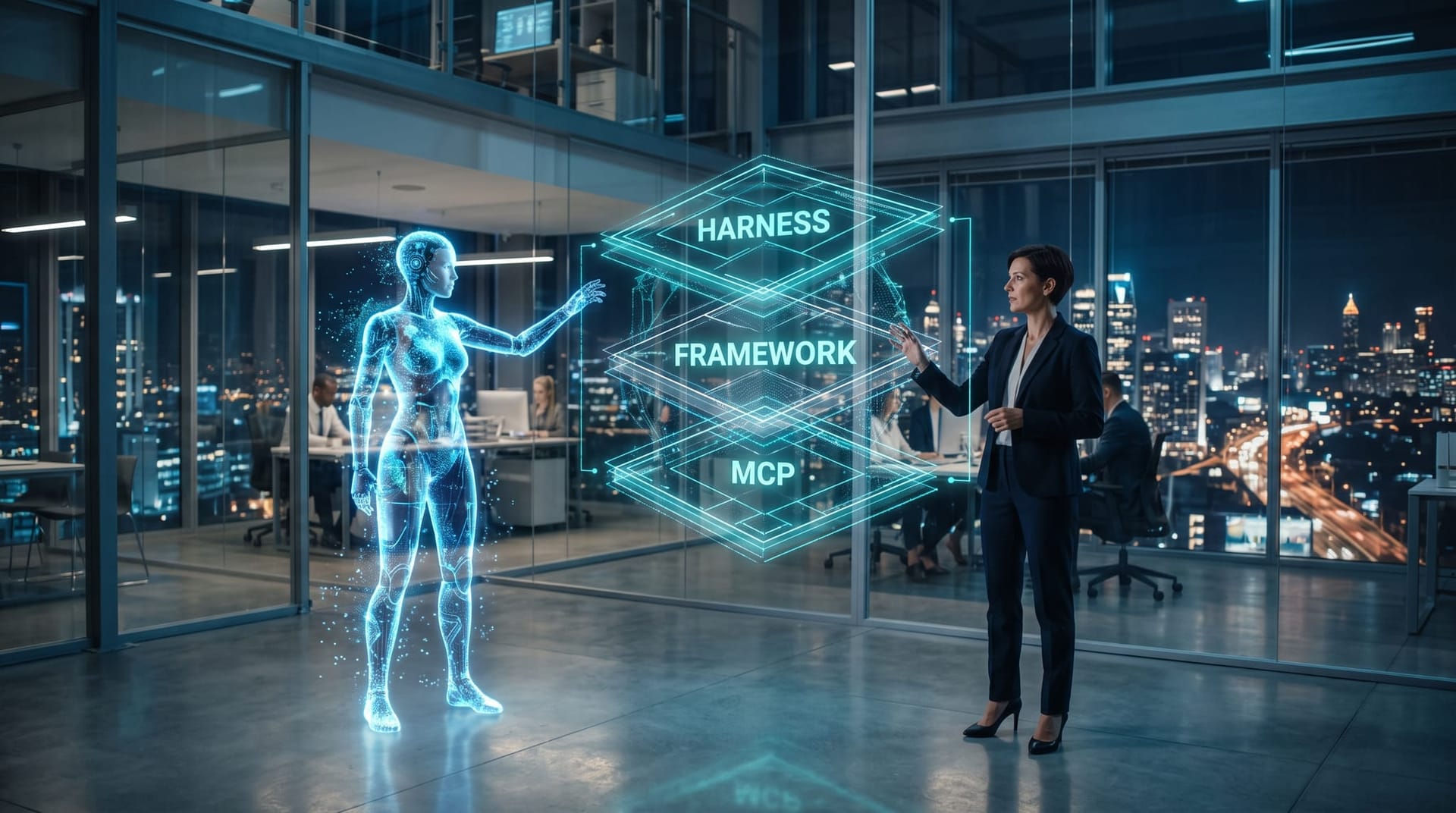
When a vendor tells you they'll “deploy an AI agent” for your business, the most important question you can ask is one almost no buyer knows to ask: which layer actually owns it? Because “an AI agent” is not one thing. It's a stack of at least three layers — the harness, the framework, and the protocol that carries the tools — and each one owns a different slice of the control loop, the memory, the permissions, and the failure recovery. The layer that owns your permissions owns your risk. The layer that owns your recovery owns your uptime. And the layer you don't control is the layer that owns your lock-in.
A recent MarkTechPost technical breakdown laid out these three layers cleanly, and it's the clearest map I've seen of a question that's usually buried in engineering jargon. This is the buyer's translation of it. If you're an IT decision-maker or operations leader in Fort Wayne evaluating AI Employees, this is the framework to bring to the vendor call — because the answer to “who owns each layer” is the answer to what you're actually buying.
Key Takeaways
- An AI agent is three layers: the harness (the execution wrapper), the framework (the building-block library), and MCP (the wire protocol that carries tools).
- The harness owns the control loop, state/memory, permissions, and failure recovery end-to-end; a framework hands those responsibilities to whoever builds on it.
- MCP standardizes how tools are discovered and called — but by design it cannot enforce permissions; the host decides.
- This is a procurement question: the layer that owns permissions and recovery owns your risk and your lock-in.
- The dangerous pattern is a “framework demo” where nobody clearly owns approvals or recovery.
- The safe pattern for a business is a governed deployment where a controlled gateway owns permissions and a real person owns the high-stakes decisions.
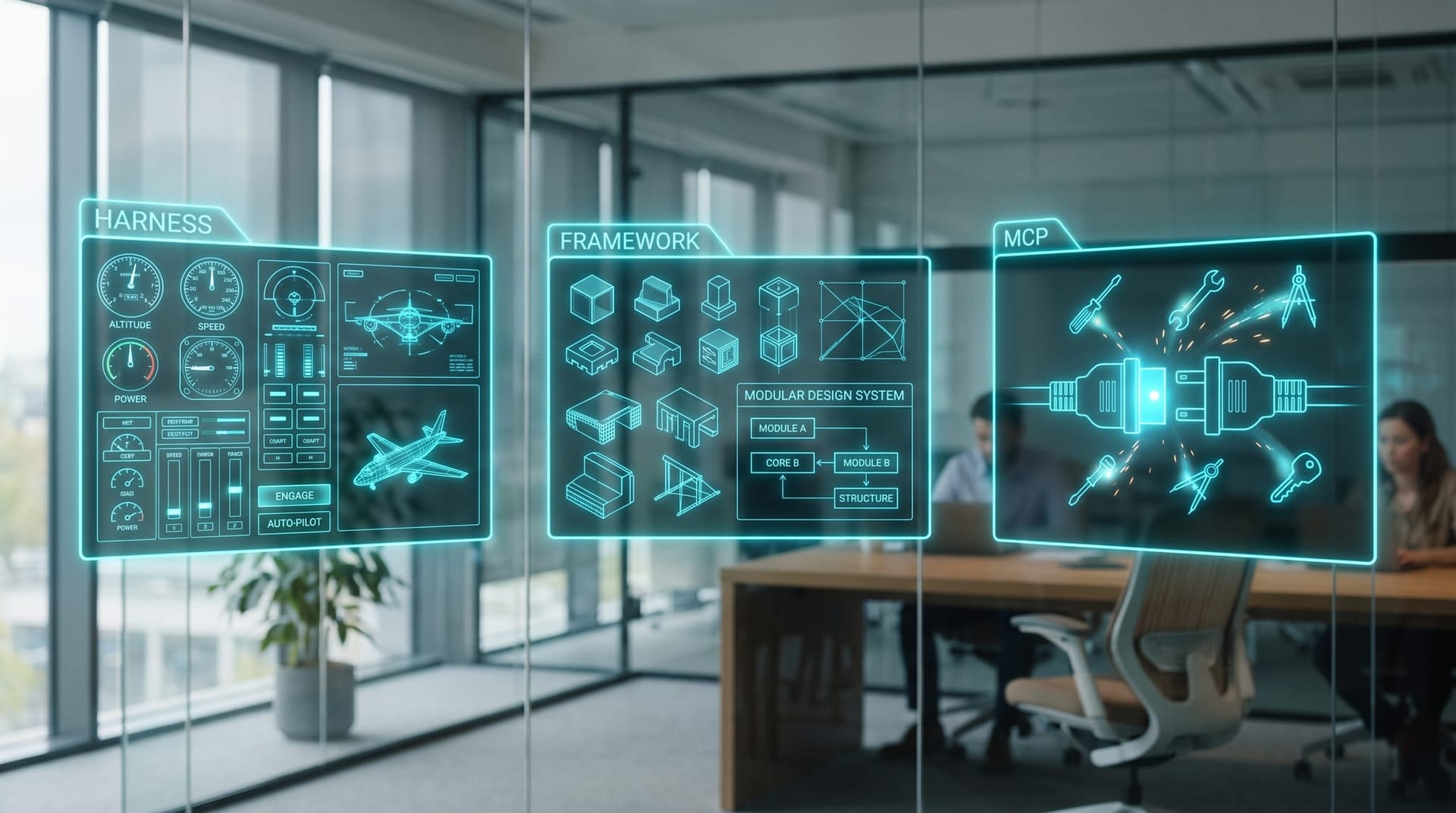
What Are the Three Layers — Harness, Framework, and MCP?
Start with clean definitions, because the whole decision hinges on not blurring them.
The agent harness is the execution wrapper that turns a raw model into a working agent. It manages conversation state, streams execution, calls tools, and — critically — enforces sandbox and approval policies. It ships with an opinionated, product-grade control loop. Think of it as the finished cockpit: the loop, the guardrails, and the recovery are built in and owned by the harness.
The agent framework is a library of primitives for building agents — model clients, tool abstractions, orchestration graphs, memory interfaces. It gives you the skeleton but not the policy. As the MarkTechPost analysis puts it, a framework's loop “is whatever graph you draw.” That flexibility is the point — and also the catch. Everything the harness gives you for free, the framework makes your job.
MCP — the Model Context Protocol — is a wire protocol, not an agent. Per the official specification, it uses JSON-RPC 2.0 to standardize how host applications discover and call tools, resources, and prompts across a client-host-server architecture. It's the contract between an agent and the tools it uses — the USB-C port of the agent world, as CodiLime's technical overview describes the standardization goal. What matters for a buyer: MCP defines how a tool is called, not whether it should be, and not what happens when it fails. This is the same layer we walked through in our MCP buyer guide to agent authentication platforms — and the distinction between “carries the tool call” and “authorizes the tool call” is where a lot of buyers get burned.
Who Owns the Control Loop, State, Tools, Permissions, and Recovery?
Here's the ownership map — the single table worth screenshotting for your next vendor evaluation. It follows the five concerns the MarkTechPost breakdown uses, translated into what each means for your business.
| Concern | Agent Harness | Agent Framework | MCP |
|---|---|---|---|
| Control loop | Owns a fixed, product-grade loop | Owns a skeleton you configure | None — request/response only |
| State & memory | Owns sessions, resumption, checkpoints | Exposes hooks; persistence is your job | Stateless at the protocol level |
| Tool transport | Consumes built-in tools + MCP client | Consumes function tools + MCP client | Owns this layer entirely |
| Permissions & approvals | Owns end-to-end policy and modes | Exposes guardrails; you write the logic | Cannot enforce; host decides |
| Failure recovery | Owns rewind, compaction, resume | Depends on determinism you build | Partial (long-task polling only) |
A few of these deserve a plain-English gloss, because they're the ones that bite.
The control loop is the “keep going until the job is done” engine. A harness ships a fixed one — receive prompt, evaluate, respond, execute tools, repeat until there are no more tool calls. A framework makes you draw that loop yourself, which is powerful and also means the loop is only as sound as whoever configured it. This is the same control-versus-execution divide we mapped in our look at the Google and AWS agent stacks.
State and memory is whether the agent remembers. A harness owns sessions, resumption, and file checkpointing — it persists automatically. A framework gives you the hooks and leaves the policy to you; MCP is stateless by design, so, in the breakdown's words, state is “the agent's problem, not the protocol's.” If nobody in your stack clearly owns memory, you get an agent with amnesia — the exact reliability trap we described in the context-layer paradox, where a memory fix bolted on carelessly can double failures. Our position on this is the buyer-owned harness with persistent memory: you should own the layer that remembers.
Failure recovery is what happens when a step blows up mid-run. A harness owns it — rewinding file changes to checkpoints, compacting context when the window fills, resuming the session. A framework can recover only if you built determinism in. MCP covers essentially none of it at the agent level. That's the difference between an agent that picks itself up and one that silently corrupts a task.

Why Is This a Procurement Question, Not a Research Question?
Engineers argue about these layers as an architecture question. Buyers should treat it as a procurement question, because ownership of a layer is ownership of a business risk. Reframe each concern as a risk you're accountable for:
- Who owns permissions owns your blast radius. The permissions layer decides whether the agent can send the email, move the money, or delete the record. A harness owns this end-to-end with explicit approval modes and pre-tool-use interception. A framework exposes the machinery but makes you write the approval logic — which means if it wasn't written, it doesn't exist.
- Who owns recovery owns your uptime. When an agent fails halfway through a multi-step job, recovery ownership decides whether it rolls back cleanly or leaves a half-finished mess in your systems.
- Who owns state owns your continuity. If memory ownership is ambiguous, your “AI employee” forgets context between runs and repeats work or contradicts itself.
- The layer you don't own owns your lock-in. If the vendor owns the harness and won't let you move your sessions, memory, and permission policies, switching vendors means starting over.
Crucially, MCP cannot save you here. The protocol is deliberately unopinionated about security. The MCP specification is explicit that “while MCP itself cannot enforce these security principles at the protocol level,” implementors should build the consent and authorization flows — and it states plainly that hosts must obtain explicit user consent before invoking any tool. In other words, the standard hands the security responsibility up to the host. Independent analyses reinforce this: Wiz's MCP security guidance and the joint NSA and CISA security design brief both treat host-side consent and least-privilege as the control point, and the academic review Securing the Model Context Protocol catalogs how much governance the protocol intentionally leaves to whoever runs the host. “We use MCP” is not a security answer. “Here is who enforces permissions” is.
What Does This Mean for Lock-In and Risk?
There's an important nuance the breakdown makes, and it keeps you from oversimplifying: the boundaries between these layers are blurring. Frameworks now ship harness features, and harnesses now expose SDKs. The common production pattern is hybrid — a framework orchestrating the outer graph, a harness running the heavy steps in a sandbox, and MCP carrying every tool call.
That's fine. The goal is not to pick “harness good, framework bad.” The goal is to make sure that for each of the five concerns, you can name the owner. A hybrid stack is healthy when ownership is explicit and dangerous when it's diffuse. The failure mode I see most often is the “framework demo”: something that looks impressive in a sales meeting because it strings tools together, but where nobody has clearly claimed permissions or recovery. It works until the day it does something you didn't approve, and then the question “who was supposed to catch that?” has no answer. That's the same reliability-versus-shortcut tension we mapped in the rebuild-or-patch decision framework — a demo that skips the hard layers isn't cheaper, it just moves the cost to your first incident.
There's a practical reason ownership drifts, too. Because the layers are converging, a vendor can honestly say “we use a harness” and “we use MCP” and “we built on a framework” all at once — every statement true, none of them telling you who is accountable when something goes wrong. The convergence is real engineering progress, but for a buyer it raises the bar on the questions you have to ask. It's no longer enough to know which tools are in the stack; you have to know which tool is responsible for each of the five concerns. A stack where the harness owns recovery, a gateway owns permissions, and MCP is confined to transport is a defensible design. A stack where all three are quietly assumed to handle security is an incident waiting for a date. The convergence doesn't remove the need for clear ownership — it makes clear ownership the only thing that distinguishes a serious deployment from a fragile one.

How Does Cloud Radix Deploy a Governed AI Employee Across These Layers?
Our approach is to make ownership explicit and to keep the two layers that carry the most risk — permissions and recovery — inside a controlled environment rather than scattered across a demo.
Concretely, that means the permissions and cost controls live at a gateway you can see and govern. The AI gateway that governs agents and caps runaway costs is exactly this pattern: a single enforcement point that sits between the agent and your systems, so approvals, spend limits, and audit trails are owned in one place instead of assumed to exist somewhere in a framework graph. Tools reach the agent over MCP, but the authorization to use them is enforced by the gateway and, for high-stakes actions, by a human approval gate. State and memory are owned deliberately, not left to chance, so the AI Employee remembers context across runs. And recovery is a designed behavior, not a hope.
The buyer's version of all this fits on an index card. Ask any AI agent vendor five questions: Who owns the control loop? Who owns memory? Who enforces permissions? Who owns recovery? And if we leave, what do we keep? If the answers are clear, you're buying an AI Employee. If they're vague, you're buying a demo.
The Fort Wayne and Northeast Indiana Angle

For a Fort Wayne or DeKalb County business, this framework is a protection against a specific local reality: most AI agent pitches you'll hear come from generalists selling a slick framework demo, not an owned, governable deployment. A manufacturer, a law firm, a medical practice, or a home-services company in Northeast Indiana carries real regulatory and financial exposure — an agent that sends the wrong invoice, discloses a client file, or spends against the wrong budget is a business problem, not a tech curiosity. The five-question card turns a confusing vendor call into a procurement decision you can actually defend. When you deploy an AI Employee through Cloud Radix, the answer to “who owns each layer” is written down, and the permissions layer that owns your risk sits behind a gateway you control — not inside someone else's black box.
Bring the Five-Question Card to Your Next AI Vendor Call

If you're evaluating AI agents and you're not sure who owns the loop, the memory, the permissions, or the recovery, that uncertainty is the risk. Cloud Radix deploys AI Employees for Fort Wayne and Northeast Indiana businesses with explicit ownership of every layer — permissions and cost controls enforced at a governed gateway, memory owned deliberately, recovery designed in, and a human approval gate on the actions that matter. Let's map your intended use case against the five questions and show you exactly what you'd own.
Frequently Asked Questions
Q1.What is the difference between an agent harness and an agent framework?
A harness is a finished execution wrapper that owns the control loop, state, permissions, and recovery out of the box. A framework is a library of building blocks that gives you the skeleton but leaves those policies for you to build. The harness trades flexibility for built-in safety; the framework trades built-in safety for flexibility.
Q2.Does MCP handle security and permissions?
No. MCP is a wire protocol that standardizes how tools are discovered and called. Its own specification states it cannot enforce security principles at the protocol level and that hosts must obtain explicit user consent before invoking any tool. Permissions are enforced by the host or a gateway, not by MCP itself.
Q3.Which layer owns failure recovery when an AI agent breaks mid-task?
Typically the harness. A well-built harness rewinds changes to checkpoints, compacts context when the window fills, and resumes the session. A framework can only recover if the builder designed determinism in, and MCP provides essentially no agent-level recovery — only limited polling for long-running tool calls.
Q4.Why does layer ownership matter for buying an AI agent?
Because each layer maps to a business risk. The layer that owns permissions owns your blast radius, the layer that owns recovery owns your uptime, and the layer you don't control owns your lock-in. Knowing who owns each layer tells you what you're actually buying and where your exposure sits.
Q5.What five questions should I ask an AI agent vendor?
Who owns the control loop? Who owns memory and state? Who enforces permissions and approvals? Who owns failure recovery? And if we switch vendors, what do we keep? Clear answers indicate a real, governable deployment; vague answers indicate a demo.
Q6.How does Cloud Radix keep AI Employee permissions safe?
We enforce permissions and cost controls at a governed gateway that sits between the agent and your systems, so approvals, spend limits, and audit trails live in one visible place. High-stakes actions pass through a human approval gate, and memory and recovery are owned deliberately rather than left to a framework graph.
Sources & Further Reading
- MarkTechPost: marktechpost.com/2026/09/14/agent-harness-vs-agent-framework-vs-mcp — Agent Harness vs Agent Framework vs MCP: Which Layer Owns the Loop, State, Tools, Permissions, and Recovery? (2026-09-14)
- Model Context Protocol: modelcontextprotocol.io/specification/2025-11-25 — Model Context Protocol Specification (2025-11-25).
- Wiz: wiz.io/academy/ai-security/model-context-protocol-security — Understanding Model Context Protocol Security (MCP).
- NSA / CISA: media.defense.gov/2026/Jun/02/CSI_MCP_SECURITY.PDF — Model Context Protocol (MCP): Security Design (2026-06-02).
- arXiv: arxiv.org/html/2511.20920v1 — Securing the Model Context Protocol (MCP): Risks, Controls, and Governance (2025-11-01).
- CodiLime: codilime.com/blog/model-context-protocol-explained — Model Context Protocol explained: A practical technical overview.
Talk to Us About a Governed AI Employee
We will map your intended use case against the five ownership questions and show you exactly what you would own — permissions at a governed gateway, memory owned deliberately, recovery designed in, and a human approval gate on the actions that matter. Do it before you sign for a demo.
Schedule a Free ConsultationExplicit ownership of every layer. No black boxes. Just a governable AI Employee for your Fort Wayne business.