
When VentureBeat reported that agentic AI had “solved coding and exposed every other problem in software engineering,” the headline read like a software story. It isn't. It's the clearest illustration yet of a law that governs every workflow you hand to an AI Employee: automating the easy step doesn't shrink the work — it relocates it.
Here's the mechanism. Every process has a slowest step, the constraint that sets the pace for everything else. For two decades, in software, that step was writing the code. Agentic tools collapsed it. But the moment the cheapest, most-automated step stops being the bottleneck, every adjacent step it used to hide — requirements clarity, review, testing, integration, deployment, coordination, ownership — becomes the new rate-limiter. The work didn't disappear. It moved to wherever you weren't looking.
That is the single idea worth taking from the software world into your operating model. This is not another post about whether AI writes good code, about AI-generated code quietly breaking production, or about what happens when 80% of your code is AI-authored. It's about the bottleneck shift itself — how to find where your constraint went after you automated production, and how to rebuild the workflow around the new pinch point instead of celebrating the old one.
Key Takeaways
- The constraint moves, it doesn't vanish. Automating your fastest-to-automate step relocates the bottleneck to the slowest un-automated step next to it — usually judgment, handoffs, or verification.
- Production was rarely the real work. When intake, drafting, or quoting gets automated, the new pinch point is almost always review-and-approval, not output.
- A faster front-end can overload a slower back-end. More throughput upstream means more items queued at the human checkpoint that hasn't scaled.
- The new bottleneck needs an owner. Shifted constraints fail silently because no one was assigned to the step that suddenly matters most.
- A supervisor layer absorbs the shift. A Manager Agent that routes, checks, and escalates is how you scale verification without hiring a verification team.

Why Does Automating One Step Make the Next Step Harder?
The instinct after a successful automation is to assume the whole workflow got faster. It usually didn't. It got unbalanced.
The software data makes this concrete. In a randomized controlled trial, METR found that experienced open-source developers using early-2025 AI tools took 19% longer to complete tasks — even though those same developers predicted AI would make them 24% faster, and estimated afterward that it had made them 20% faster. The perception gap is the whole story: the generation step felt faster, so everyone assumed the workflow was faster, while the review-and-integration step quietly absorbed the time the model “saved.”
That pattern repeats downstream. A VentureBeat-reported survey found that 43% of AI-generated code changes needed debugging in production — meaning the cost didn't leave the system, it migrated from the keyboard to the incident channel. And as VentureBeat's analysis of underperforming AI coding pilots argues, the reason most pilots stall is “not the model” — it's the process around the model that never got rebuilt.
Translate that out of software. Replace “writing code” with “writing the first draft of a proposal,” “entering the intake form,” or “generating the quote.” Same physics. The AI Employee makes the production step nearly free, output volume climbs, and the step that used to keep pace — a human reading, judging, and approving — becomes the new constraint. The work relocated. It did not shrink.
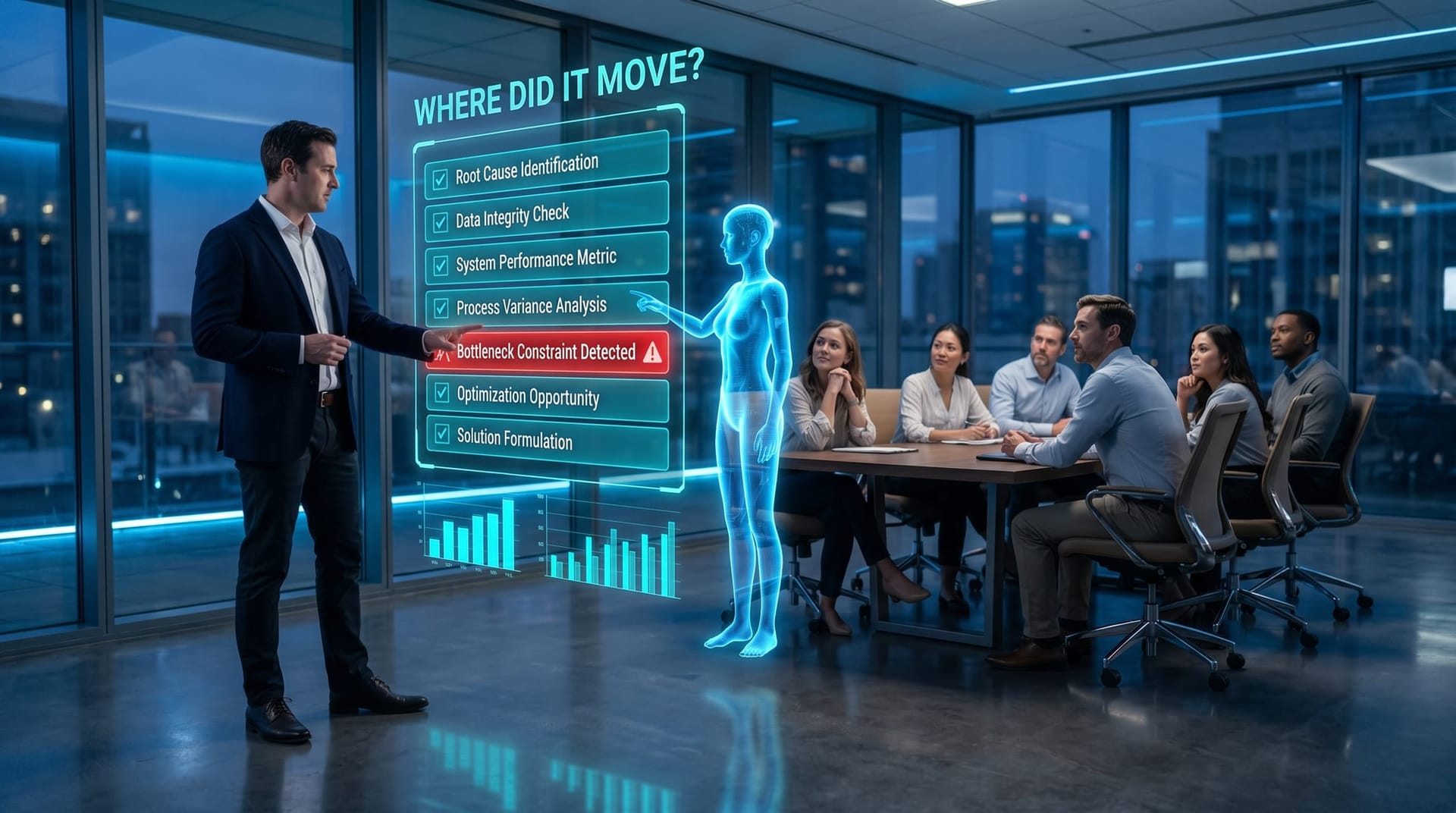
Where Did Your Bottleneck Move? A 5-Question Diagnostic
You can't rebuild around a constraint you haven't located. Run these five questions against any workflow you've recently handed to an AI Employee. Each answer points at the step that quietly became your new rate-limiter.
1. What used to be the slowest step — and is it still slow?
Name the pre-automation bottleneck honestly. If the AI Employee dissolved it, the constraint has already moved and you're now measuring the wrong step. The first sign of a shifted bottleneck is a metric that looks great (output volume) sitting next to one that quietly degraded (cycle time to “done”).
2. Where is work now piling up in a queue?
Constraints announce themselves as backlogs. If drafts, quotes, or tickets are generated in seconds but sit for days awaiting a human “yes,” the bottleneck moved to approval. Look for the inbox that's filling faster than it empties.
3. Which step did we never staff for high volume?
Automation raises upstream throughput without touching downstream capacity. The review desk that comfortably handled 20 items a day does not magically handle 200. Find the step whose capacity assumptions were silently invalidated.
4. Who is responsible for the new bottleneck — by name?
If you can't name the owner of the step that now sets your pace, that's the finding. Shifted constraints fail silently precisely because they used to be trivial and nobody was ever assigned to them.
5. What are we now verifying by hand that we never had to before?
More AI output means more output that needs checking. If verification was implicit when a human produced the work, it becomes explicit — and unbudgeted — when an AI Employee produces ten times as much of it.
The Constraint-Shift Matrix: Mapping the New Pinch Point
Once you've located the shift, map it. The matrix below is the working artifact — five common mid-market workflow steps, whether each was the bottleneck before automation, whether it's the bottleneck now, who owns the new constraint, and the control that addresses it. Fill in your own rows; these are the patterns we see most often.
| Workflow step | Was the bottleneck before? | Is it the bottleneck now? | Who owns the new bottleneck? | Control that addresses it |
|---|---|---|---|---|
| Production (drafting, quoting, intake) | Yes — slowest step | No — now near-instant | AI Employee | Throughput monitoring; volume caps |
| Review & approval | No — kept pace easily | Yes — work queues here | Operations lead / partner | Manager Agent triage + human checkpoint |
| Requirements clarity | Hidden inside production | Yes — vague inputs surface late | Process owner | Structured intake; spec-first templates |
| Integration & handoff | Occasional friction | Yes — more items, more handoffs | Workflow owner | Routing rules; ownership at each edge |
| Verification & QA | Implicit, unbudgeted | Yes — now explicit at scale | Quality owner | Automated checks + sampled human audit |
Read the matrix and the lesson is unavoidable: four of the five steps that were not the bottleneck before became the bottleneck after. That's not a failure of the automation. That's the automation working exactly as designed — and revealing that the rest of the workflow was never built to run at the new speed. This is the same trap behind bolting AI onto broken processes: if you automate production without redesigning review, integration, and ownership, you've simply moved the jam closer to your customer.
How Do You Rebuild Around the New Constraint?
Locating the shifted bottleneck is half the job. The other half is re-architecting so the new constraint can actually scale — and that almost always means adding a supervisory layer, not another production tool.
The most durable pattern we deploy is the Manager Agent supervisor layer: a coordinating agent that sits above your production AI Employees, triages their output, applies deterministic checks, routes the genuinely ambiguous cases to a human, and lets the clear-cut ones through. It doesn't try to remove the human checkpoint — it tries to make sure the human checkpoint only sees the items that actually need a human. That's how you scale verification without standing up a verification department.
This reframes the ROI conversation. The return on an AI Employee was never just the production step it automated; that's the part VentureBeat describes as the “runtime problem, not a model problem.” The return shows up only when the whole workflow runs at the new speed — when review, integration, and ownership are rebuilt to match the throughput. One team VentureBeat profiled reportedly reached 170% throughput at 80% headcount — but gains like that come from redesigning the operating model around the shift, not from the generation speed alone.
There's an organizational dimension too. The step that became your bottleneck needs an owner who didn't have to exist before, which is exactly why rethinking org design for agentic AI belongs in this conversation. And the teams that pull this off are the ones turning AI pilots into AI Employees by treating execution — the unglamorous rebuild of the back half of the workflow — as the real differentiator.
A practical warning before you start rebuilding: resist the urge to “fix” the new bottleneck by automating it too, reflexively, without thinking. If review became the constraint, the answer is not always to throw another AI Employee at review and hope the problem dissolves. Sometimes it does — triage genuinely scales with a Manager Agent. But sometimes the reason review is slow is that it carries irreducible human judgment or legal liability, and automating it just relocates the constraint again, this time to a place where a mistake is far more expensive. The discipline is to ask, at each shift, whether the new bottleneck is a capacity problem (more throughput needed — automate it) or a judgment problem (human accountability required — protect it). Conflating the two is how mid-market teams automate themselves into a corner. Map the shift first, classify the new constraint honestly, and only then decide whether the fix is more automation or a better-supported human.

What This Looks Like in Northeast Indiana
This isn't abstract for operators in Fort Wayne, Auburn, and across Allen and DeKalb counties. Consider a professional-services firm — a regional accounting practice or a mid-sized law office — that gives an AI Employee the job of drafting client intake summaries and first-pass engagement documents. The production bottleneck vanishes overnight. What used to take a paralegal or junior associate two hours now takes ninety seconds.

Then the partners notice the new problem. The drafting desk produces ten times the volume, and every one of those drafts still has to be read, judged against the firm's standards, and approved by someone whose signature carries professional liability. The constraint didn't leave the building. It walked down the hall from the drafting desk to the partner's review queue — and that queue was never staffed to absorb ten times the volume.
The Northeast Indiana firms getting real ROI are the ones that saw this coming and rebuilt the review step: a Manager Agent pre-checks every draft for completeness, flags the three that contain a judgment call, and routes only those to a partner while clearing the rest. A regional manufacturer in the same boat — automating quote generation — discovers the new pinch point is engineering sign-off, not quoting. Same physics, different hallway. The lesson holds across every vertical we serve: the bottleneck shift is local, it's specific, and it lands on whichever human step you forgot to rebuild.
What separates the Fort Wayne operators who capture the gain from the ones who stall is rarely the model they chose — it's whether they treated the rebuild as a project at all. The firms that win schedule the work: they assign an owner to the new constraint, they instrument cycle-time-to-done so the shifted bottleneck can't hide behind a healthy output number, and they accept that the back half of the workflow now deserves more attention than the front half they just automated. The ones that stall keep optimizing the production step that's already solved — buying a faster drafting tool when the jam is three steps downstream at approval. In a regional market where most competitors are still running their first pilot, simply being the firm that mapped the shift and staffed the new pinch point is a durable operating advantage. It compounds: every additional workflow you automate surfaces its own relocated constraint, and the team that already has the muscle for finding and rebuilding around it absorbs each new shift faster than the last.
The 30-Day Bottleneck-Shift Audit
If you've deployed an AI Employee in the last year and you're not sure the ROI has fully landed, the constraint probably moved and nobody mapped it. Here's a 30-day audit you can run:
- Week 1 — Locate. Run the five diagnostic questions against every automated workflow. Find the queues that are filling.
- Week 2 — Map. Build your Constraint-Shift Matrix. For each shifted bottleneck, name the owner.
- Week 3 — Design. Decide where a Manager Agent triages and where a human checkpoint stays. Rebuild the back half of the workflow.
- Week 4 — Measure. Track cycle-time-to-done, not just output volume. Confirm the constraint actually moved off the human.
Cloud Radix builds and runs AI Employees for mid-market operators across Fort Wayne and Northeast Indiana — including the supervisory layer that keeps the bottleneck from landing on your team. If your automation sped up production but not results, let's run the Bottleneck-Shift Audit together.
Frequently Asked Questions
Q1.What does it mean that an AI bottleneck "shifts" instead of disappearing?
Every workflow has a slowest step that sets its overall pace. When you automate that step, the work it was holding back flows to the next-slowest step, which becomes the new constraint. The total work doesn't shrink — it relocates to whatever step you didn't automate, usually review, verification, or coordination.
Q2.Why did our output go up but our results didn't?
Because you automated production but not the steps after it. More drafts, quotes, or tickets generated upstream means more items queued at the human review step downstream — and if that step's capacity didn't change, your cycle time to a finished result can stay flat or even get worse despite higher output volume.
Q3.Where does the bottleneck usually move in a mid-market workflow?
Most often to review-and-approval. The METR research and production-debugging surveys both point the same direction: when generation gets cheap, the cost migrates to verification. In practice that's the partner sign-off, the engineering approval, or the QA step that was never staffed for high volume.
Q4.Do we need to remove the human checkpoint to get ROI?
No — you need to make it scale. The goal isn't to delete human judgment; it's to ensure the human only reviews the items that genuinely require judgment. A Manager Agent that triages AI output and routes only ambiguous cases to a person is how you keep the checkpoint without making it the new jam.
Q5.How is this different from worrying about AI code quality?
Code quality is about whether the output is good. The bottleneck shift is about where the work goes once production is automated, regardless of output quality. Even with perfect AI output, you still relocate the constraint to review, integration, and ownership — so the operating-model rebuild matters even when the model is excellent.
Q6.How do we find where our bottleneck moved?
Run the five-question diagnostic in this post: name the old bottleneck, find where work now queues, identify the step you never staffed for volume, name the owner of the new constraint, and list what you're now verifying by hand. Map the answers into a Constraint-Shift Matrix and the new pinch point becomes obvious.
Q7.Why does the AI bottleneck shift matter for Fort Wayne and Northeast Indiana operators?
Because in a regional market where most competitors are still running their first pilot, the advantage doesn't come from owning the fastest AI tool — it comes from being the operator who mapped where the constraint moved and staffed the new pinch point. A Fort Wayne professional-services firm or Allen County manufacturer that rebuilds the review-and-approval step after automating production captures ROI that a competitor still optimizing the already-solved production step never sees.
Sources & Further Reading
- VentureBeat: venturebeat.com/technology/agentic-ai-solved-coding-and-exposed-every-other-problem-in-software-engineering — Agentic AI solved coding and exposed every other problem in software engineering.
- METR: metr.org/blog/2025-07-10-early-2025-ai-experienced-os-dev-study — Measuring the impact of early-2025 AI on experienced open-source developer productivity.
- VentureBeat: venturebeat.com/technology/43-of-ai-generated-code-changes-need-debugging-in-production-survey-finds — 43% of AI-generated code changes need debugging in production, survey finds.
- VentureBeat: venturebeat.com/ai/why-most-enterprise-ai-coding-pilots-underperform-hint-its-not-the-model — Why most enterprise AI coding pilots underperform (hint: it's not the model).
- VentureBeat: venturebeat.com/orchestration/when-ai-turns-software-development-inside-out-170-throughput-at-80-headcount — When AI turns software development inside-out: 170% throughput at 80% headcount.
- VentureBeat: venturebeat.com/resources/the-agentic-reckoning-enterprise-ai-organizations-have-a-runtime-problem-not-a-model-problem — The agentic reckoning: enterprise AI organizations have a runtime problem, not a model problem.
Find Where Your Bottleneck Moved
We will run the Bottleneck-Shift Audit on your automated workflows, map the relocated constraint, and rebuild the back half — including the Manager Agent supervisory layer — so the ROI actually lands.
Schedule a Free ConsultationServing mid-market operators across Fort Wayne and Northeast Indiana. No contracts. No pressure.