Key Takeaways
- Agentic AI changes the shape of the org chart, not just the contents of job descriptions — spans of control widen and the junior-does / senior-reviews pyramid starts to invert.
- The new model is agent-does / human-supervises: AI Employees do the volume work and humans move up into oversight, judgment, and exception handling.
- Four net-new human roles appear — Agent Supervisor, Eval Owner, Exception Handler, and Human-in-the-Loop Reviewer — and every deployed agent needs a named owner.
- Most organizations are bolting agents onto a human operating model instead of redesigning reporting lines, which caps the value they get.
- A 30-100 person operator can restructure without a reorg consultant by answering one question per agent: who owns it, who reviews it, and who catches the edge cases.
For thirty years the mid-market org chart has worked the same way. Junior people do the work. Senior people review it. Promotion meant moving up the pyramid from doing toward checking, and the whole structure rested on a quiet assumption: that the bottleneck was always human hands, so you hired more hands and stacked reviewers on top of them. Agentic AI breaks that assumption, and when the assumption breaks, the chart breaks with it. Organizational design for agentic AI starts here — not with new tools, but with the reporting lines themselves.
It is the part of the AI conversation almost nobody is having out loud. We talk endlessly about which tasks agents can do, and rarely about what happens to the boxes and reporting lines once those agents work all day. But that is exactly the argument MIT Technology Review's May 2026 analysis makes: agentic AI doesn't just change tasks, it changes the shape of the organization. Spans of control widen. New supervisory roles appear because someone has to own the agents. And the traditional pyramid — junior-does, senior-reviews — starts to invert.
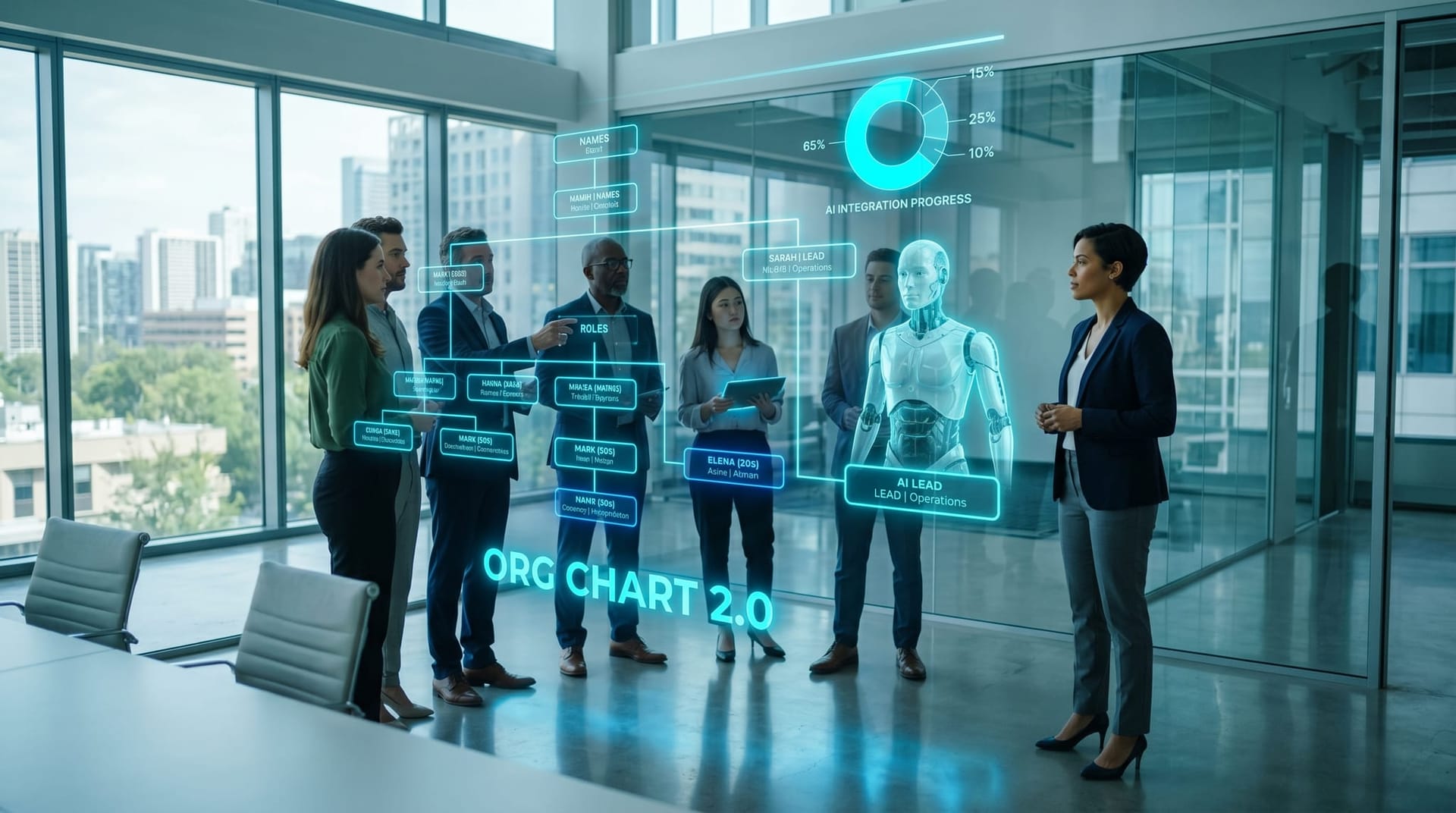
Here is the inversion in one sentence. The old chart was junior does the work, senior reviews it. The new chart is the agent does the work, the human supervises it. That sounds like a small reordering of words. It is not. It moves the entry point of every workflow from a person to a software agent, it pushes humans up into oversight rather than down into production, and it quietly deletes the bottom rung of the ladder that mid-market firms have used to train their next generation of talent. This post is about the human org chart that has to exist around AI Employees — where they sit, who owns them, and what new human jobs appear. It is deliberately not about redesigning the underlying processes; that is a separate and equally important layer we cover in our piece on agent-first process redesign. Here we stay on reporting lines.
Why does agentic AI break the org chart instead of just changing jobs?
The instinct of most leadership teams is to treat agents as faster employees. You drop an AI Employee into the existing structure, point it at a queue, and assume the org chart stays put while productivity goes up. The research says that instinct is exactly the trap.
Deloitte frames it bluntly in its analysis of operating models for humans with agents: “bolting autonomous agents onto operating models designed for human workers is like fitting a jet engine to a bicycle.” Their data backs the warning — Deloitte reports that 84% of companies have not redesigned jobs to fit AI even though automation expectations are high. The MIT Tech Review piece uses a similar image, calling it the “sticky tape problem,” where organizations embed AI employees into what is still fundamentally a human operating model and then wonder why the value never fully arrives.
The reason this matters at the structural level is mechanical, not philosophical. A traditional org chart is a coordination machine. Its layers exist because a single human can only direct, review, and stay accountable for so many other humans — Gallup's workplace research notes that large companies run roughly one manager for every ten employees. That ratio is a physical constraint on attention and trust, and the entire pyramid is built to respect it. When an agent absorbs the production work, two things change at once: the volume of work flowing through a single human shifts from “what my hands can produce” to “what my judgment can supervise,” and the unit you are managing stops being a person and becomes a fleet of software workers that never sleep, never escalate on their own, and never tell you when they are quietly wrong.
That is why this is an org-design problem and not a staffing problem. You are not adding faster workers to the bottom of the chart. You are changing what each layer is for. We treat the agents themselves as infrastructure in our discussion of AI as an operating layer; the chart we are drawing here is the human structure that has to sit on top of that layer.
What does the inverted pyramid actually look like?

Picture the classic pyramid. Wide base of junior doers, a narrower band of supervisors, a thin layer of senior leaders at the top. Work flows up to be checked; authority flows down. The base is wide because that is where the labor lives.
Now invert the logic. In an agent-does / human-supervises model, the base of human labor narrows because the production work moves to AI Employees. The humans who remain do not disappear — they move up into roles defined by oversight, judgment, and exception handling rather than throughput. The pyramid does not get shorter; it changes what each level contributes. The bottom is no longer “people doing the work.” It is “people watching the work get done and stepping in when it goes sideways.”
This has an uncomfortable consequence worth naming: the inversion erodes the entry-level rung that mid-market firms have always used to grow talent. If juniors no longer do the first-pass work, where do they learn the craft well enough to supervise it later? That is a real trade-off, and we treat it as its own subject in our look at the entry-level squeeze and the inverted pyramid. For org-design purposes, the point is this: you cannot invert the pyramid and pretend the apprenticeship pipeline still works the way it did. You have to design the supervisory roles deliberately, because they are now where most of your humans live.
The widening of spans of control is the other half of the picture. MIT Technology Review describes hierarchies becoming “blurred” when agents execute and coordinate without managerial oversight, with managers increasingly handling “trust, explainability, psychological safety, and status dynamics” in hybrid human-agent teams. Harvard Business Review's analysis of how AI is redefining managerial roles makes a related point: much of what used to define a manager's day — status updates, coordination, tracking who did what — is increasingly absorbed by AI, pushing the role toward judgment and oversight. In plain terms: one human can now be accountable for a much larger volume of output, but only if the structure clearly defines what they are watching and what they are allowed to ignore.
Where do AI Employees actually sit on the org chart?
This is the question that stalls most mid-market deployments, so let's answer it directly. An AI Employee is not a tool that belongs to whoever bought the license, and it is not a free-floating capability that everyone shares and no one owns. On a well-designed chart, every deployed agent sits in a reporting line with a named human owner above it — exactly the way a human direct report would.
Deloitte captures why this is non-negotiable: “Agents are neither capital nor labor. They act like workers but are funded like technology, creating governance gaps.” When something acts like a worker but is bought like software, ownership defaults to nobody. Deloitte warns that “ownership can become muddled, especially with respect to decision rights, risk and liability, quality assurance, and performance accountability.” The fix is structural. You assign each agent an owner the same way you assign a new hire a manager on day one.
Here is the model we recommend for a 30-100 person operator. Think in three tiers:
| Org-chart tier | Who or what lives here | Primary job |
|---|---|---|
| Production tier | AI Employees (agents) + a thin layer of humans | Execute the volume work; produce first-pass output |
| Supervision tier | Agent Supervisors, Exception Handlers, HITL Reviewers | Own agents, catch edge cases, review high-stakes output |
| Accountability tier | Function leaders / owners | Hold decision rights, risk, and outcome accountability |
The key move is that agents report into the supervision tier, not into a vague “IT owns the AI” box off to the side. The function that consumes the agent's output — billing, intake, scheduling, quoting — owns the agent, because that function is accountable for the outcome. IT and your AI partner build and maintain the agent; the business function owns its performance. This distinction is what separates an org chart that works from one that produces the accountability gap Deloitte describes.
What new human roles does agentic AI create?

When the agent does the work, four net-new human roles emerge to keep the structure honest. These are not necessarily four new full-time hires for a mid-market firm — in a 30-100 person company one person often wears two or three of these hats. But the responsibilities are distinct, and the org-design discipline is naming each one and putting it in a reporting line.
| New role | Responsibility | Reports To | What They Own |
|---|---|---|---|
| Agent Supervisor | Day-to-day oversight of a fleet of agents — monitoring output, performance, and drift | Function leader (billing, intake, ops) | The agents' operational performance and uptime |
| Eval Owner | Defines and maintains what "good output" means; builds and runs the evaluation tests | Function leader or quality lead | The quality bar and the eval/test suite |
| Exception Handler | Resolves the edge cases agents flag or fail; owns the escalation path | Agent Supervisor | The exception queue and resolution playbook |
| Human-in-the-Loop Reviewer | Approves or rejects high-stakes agent output before it ships (legal, clinical, financial) | Function leader / compliance | The approval gate on regulated or high-risk decisions |
The Agent Supervisor is the role with the most external validation. Harvard Business Review argues directly that companies need “agent managers” — a new supervisory position focused on AI agent oversight and performance. HBR profiles a “support agent manager” at Salesforce whose day is, in his own words, “Data, Data, Data. I start and end my day in dashboards, scorecards, and agent observability monitoring.” That is a real job that did not exist three years ago, and it is the closest thing we have to a template for the supervisory layer. We go deeper on building that specific function in our companion piece on the manager-of-agents supervisory layer.
The Eval Owner deserves special emphasis because it is the role mid-market firms most often skip. Deloitte cites one organization that tripled its measured ROI simply by switching from output metrics (“cost per query”) to outcome metrics (“contracts reviewed without escalation”). Someone has to own that distinction — what counts as a good outcome, how you test for it, and when the bar moves. Without an Eval Owner you have a fleet of agents and no agreed definition of whether they are doing well.
The Exception Handler and HITL Reviewer roles exist because trust in agents is, sensibly, still limited. A Harvard Business Review survey reported by Fortune found that only 6% of companies fully trust AI agents to autonomously run core business processes, with 43% trusting them only for limited or routine tasks and 39% restricting them to supervised use cases. That distribution is not a reason to avoid agents — 72% of those same respondents said the benefits outweigh the risks. It is a reason to build the human gates into the chart deliberately rather than discovering you need them after an agent ships something wrong.
Who owns the agent — and why is that the central org-design decision?
If you take one structural rule from this entire post, take this one: every agent needs a single named owner, and that owner sits in the business function that consumes the agent's output.

The temptation in a mid-market firm is to let ownership live with whoever is most comfortable with the technology — usually IT, sometimes an enthusiastic individual contributor, occasionally an outside vendor. All three are wrong as the owner of record. IT and your AI partner are the builders and maintainers. The owner is the person accountable for the agent's outcomes, and that has to be someone with decision rights over the function the agent serves. Deloitte's framing is again the cleanest: the unresolved questions are “decision rights, risk and liability, quality assurance, and performance accountability.” Each of those resolves to a person, not a department.
This is also where today's reliability conversation hands off directly to org design. When an agent is failing, our rebuild-or-patch decision framework helps you decide whether to fix it or rebuild it from scratch. But a rebuilt agent is not a finished deliverable — it is a new hire. It needs an owner, an Eval Owner to define its success bar, and an Exception Handler for the cases it will inevitably get wrong. The output of a rebuild decision is therefore an org-design output: a fresh reporting line. If you rebuild an agent and don't reassign ownership, you have rebuilt the technology and recreated the accountability gap.
MIT Technology Review surfaces the same governance questions through PwC's global consulting CTO, who asks: “Who is accountable when an AI employee makes a mistake? What happens when AI and humans disagree?” Those are org-chart questions, not philosophical ones. “Who is accountable” is answered by the owner box; “what happens when they disagree” is answered by the Exception Handler's escalation path and the HITL Reviewer's approval gate. Design those boxes and the questions answer themselves; skip them and you are running agents on hope.
It's worth being candid about the limits. The owner model adds a real management burden, and Gallup's research is a useful caution: only about 18% of managers demonstrate high managerial talent, and managers account for at least 70% of the variance in team engagement. Asking your best people to supervise fleets of agents on top of their existing work is not free, and a thin bench of capable supervisors is a genuine constraint on deployment speed — an argument for designing the structure deliberately, not pretending it manages itself.
How does a 30-100 person operator restructure without a reorg consultant?
You do not need a six-figure transformation engagement to do this. You need to answer three questions for every agent you deploy, and to do it before the agent goes live rather than after it causes a problem.
Question one: who owns it? Name one human in the consuming function. Not IT, not the vendor — the person accountable for the outcome. Write their name next to the agent.
Question two: who defines and checks “good”? Assign the Eval Owner role. Decide what outcome metric matters (not “cost per query” but “resolved without escalation”) and who maintains the test for it.
Question three: who catches the edge cases? Name the Exception Handler and, for any high-stakes output, the HITL Reviewer. Define the escalation path in one sentence: “When the agent flags X or fails Y, it goes to Z.”
That's the whole framework. Run it agent by agent and the new org chart assembles itself organically — no big-bang reorg required. Here is a starter decision matrix for assigning the roles:
| If the agent... | You need a... | Owned by |
|---|---|---|
| Handles routine, low-stakes volume | Agent Supervisor (monitoring only) | Function leader |
| Produces output someone else relies on | Eval Owner + Agent Supervisor | Function leader / quality lead |
| Touches regulated or high-risk decisions | HITL Reviewer (approval gate) | Compliance / function leader |
| Frequently hits edge cases or ambiguity | Exception Handler (escalation path) | Agent Supervisor |
One sequencing note from experience: do the ownership assignment before you scale the agent, not after. The firms that struggle are the ones that deployed first and asked “who owns this?” only when something broke. And remember that the people you move into these supervisory roles carry institutional knowledge the agents don't have — which is why we recommend pairing any restructure with deliberate tribal knowledge capture so that the judgment now concentrated in a few supervisors doesn't walk out the door undocumented. The structure you draw and the workforce changes that follow are two sides of the same plan, which is why we treat them alongside our broader workforce transition planning.
What does this mean for Northeast Indiana operators?

Mid-market firms across Fort Wayne, Auburn, DeKalb County, and Allen County tend to run lean, owner-led structures where one person already wears several hats. That is actually an advantage for this kind of redesign. You do not have to dismantle a sprawling bureaucracy or win a political fight across five layers of management — you have a small leadership team that can decide, in a single afternoon, who owns which agent.
Consider a hypothetical Auburn manufacturer running a quoting agent that drafts customer quotes from incoming RFQs. Under the old chart, a junior estimator drafted quotes and a senior estimator reviewed them. Under the agent-does / human-supervises model, the agent drafts the quotes, the senior estimator becomes the Agent Supervisor and HITL Reviewer for anything above a dollar threshold, and the Eval Owner role — held by the same senior estimator at first — defines that a “good” quote is one that ships without a margin correction. No reorg consultant set foot in the building. The leadership team just answered the three ownership questions and redrew two boxes. That is the realistic path for a regional operator: small enough to move fast, structured enough to stay accountable.
Ready to design your AI org chart?

You can deploy agents without redesigning your org chart, but you will pay for it later in muddled ownership, missed edge cases, and accountability gaps that surface at the worst moment. The better path is to draw the structure deliberately — owner, eval, exceptions, review — before you scale.
That is exactly the work we do in an AI consulting engagement. We help Northeast Indiana operators map where their AI Employees sit on the chart, name the owners, stand up the four supervisory roles in a way that fits a 30-100 person company, and connect that structure to the agents themselves. No big-bang reorg, no jargon — just a working org chart for a hybrid human-and-agent workforce. If you are deploying agents this year, design the org around them before they design it for you.
Frequently Asked Questions
Q1.Does organizational design for agentic AI mean we need a bigger management layer?
Not necessarily bigger, but differently shaped. Spans of control tend to widen because one human can supervise far more agent output than human output, so you may need fewer pure managers. What organizational design for agentic AI actually requires is clearly defined supervisory roles — Agent Supervisor, Eval Owner, Exception Handler, and Human-in-the-Loop Reviewer — even if a single person holds several of them in a small firm.
Q2.Who should own an AI Employee on the org chart?
The owner should be a named human in the business function that consumes the agent's output — billing, intake, quoting — not IT and not your vendor. IT and your AI partner build and maintain the agent, but the owner is accountable for its outcomes and holds decision rights over the function it serves. Deloitte's research warns that ownership becomes "muddled" precisely when no single person holds it.
Q3.What is the inverted pyramid in organizational design for agentic AI?
It describes the shift from "junior does the work, senior reviews it" to "the agent does the work, the human supervises it." Production work moves to AI Employees, and the humans who remain move up into oversight, judgment, and exception handling rather than throughput. The trade-off is that it erodes the entry-level rung firms have used to train new talent.
Q4.Do we need to hire four new people for the new roles?
Usually not, in a 30-100 person company. The four roles describe distinct responsibilities, but one capable person often holds two or three of them at first. The org-design discipline is naming each responsibility and placing it in a reporting line, not necessarily adding four headcount.
Q5.How is this different from process redesign?
Process redesign changes how the work flows — the steps an agent and humans take to get something done. Org design changes the reporting lines and ownership around that work — who supervises the agent and who is accountable. They are complementary layers; this post covers the human org chart, and our agent-first process redesign piece covers the workflow layer.
Q6.Can a Fort Wayne or Northeast Indiana mid-market firm do this without a reorg consultant?
Yes, and the lean, owner-led structures common across Fort Wayne, Auburn, DeKalb County, and Allen County actually make it easier. Answer three questions for each agent before it goes live: who owns it, who defines and checks "good," and who catches the edge cases. A small leadership team can settle those in a single afternoon and let the new structure assemble itself agent by agent — no big-bang reorganization or outside transformation team required, though an advisor can accelerate the first few.
Q7.What happens to an agent after we rebuild it?
A rebuilt agent is effectively a new hire and needs the full org treatment: an owner, an Eval Owner to define its success bar, and an Exception Handler for the cases it will get wrong. The output of a rebuild-or-patch decision is therefore an org-design output — a fresh reporting line — not just a fixed piece of technology.
Sources & Further Reading
- MIT Technology Review: technologyreview.com/2026/05/26/1137584/rethinking-organizational-design-in-the-age-of-agentic-ai — Rethinking organizational design in the age of agentic AI
- Deloitte Insights: deloitte.com/us/en/insights/topics/talent/operating-models-for-humans-ai-agents.html — Rethinking operating models for humans with agents
- Harvard Business Review: hbr.org/2026/02/to-thrive-in-the-ai-era-companies-need-agent-managers — To Thrive in the AI Era, Companies Need Agent Managers
- Harvard Business Review: hbr.org/2025/07/how-ai-is-redefining-managerial-roles — How AI Is Redefining Managerial Roles
- Gallup: gallup.com/workplace/231593/why-managers-key-engagement.aspx — Why Great Managers Are So Rare
- Fortune: fortune.com/2025/12/09/harvard-business-review-survey-only-6-percent-companies-trust-ai-agents — HBR survey: only 6% of companies fully trust AI agents to handle core business processes
Design the Org Around Your AI Employees
Map where your AI Employees sit on the chart, name the owners, and stand up the four supervisory roles — in a way that fits a 30-100 person company. No big-bang reorg required.
Book an AI Consulting Engagement